Showing posts with label reusing. Show all posts

Flour sack dresses from the Flour Mills

by Michael Smith (Veshengro)

Flour sack dresses from the Flour MillsIn times gone by, amidst widespread poverty, the Flour Mills realized that some women were using sacks to make clothes for their children. In response, the Flour Mills started using flowered and patterned fabric.

With the introduction of this new cloth into the home, thrifty women everywhere began to reuse the cloth for a variety of home uses – dish towels, diapers, and more. The bags began to become very popular for clothing items.

This is almost 100 years ago and instead of improving the reuse things have gotten worse. But, what the Flour Mills did then every manufacturer could do for packaging. Firstly using things that can be reused and secondly to already create the idea of a secondary use of the materials. But, let's for the moment get back to the lour sacks and textiles made from them.

As the recycling trend looked like it was going to stay, the manufacturers began to print their cloth bags – or feedsacks – in an ever wider variety of patterns and colors, including those more suitable for boys and their shirts and nightshirts.

Over time, the popularity of the feedsack as clothing fabric increased beyond anyone's wildest expectations, fueled by both ingenuity and scarcity.

By the time WWII dominated the lives of Americans, and cloth for fabric was in short supply due to its use in the construction of uniforms, it was estimated that over three and a half million women and children were wearing garments created from feedsacks.

Images of the times help to remind us that large swaths of the country were once so poor that making clothes for children, out of flour sacks, was simply a part of life in those times. The manufacturers even gave instructions for how to remove the ink of their logos and such.

The family in the photo show their children wearing the Feed Sack dresses and shirts. People back then certainly knew how to try to use and reuse everything they had and not be wasteful.

Feed sacks continued to grab the attention of women during the Depression and World War II. In the 1950s, though, cheaper paper sacks became available, and thus the gradual decline for these bright, beautiful and functional fabrics began.

The start of the 1960's saw sack manufacturers trying to tempt customers back with cartoon- printed fabrics, from Buck Rogers to Cinderella. There was even a television advertising campaign intended to prick the conscience of the American housewife, but it failed to generate a significant upsurge in sales. Today it is only the Amish who still use cotton sacks for their dry goods.

The world has changed in so many ways since back then, yet having a mindset for making the best use of what you have available to you is a trait that, rightly, does and should carry on.

As I said earlier in this essay we need designers and manufacturers, of packaging especially, to design a second life into their packaging. It can be done as the flour sacks and feed sacks and other examples show.

Some of the makers of mustard, in both Germany and France, still do this in that the glasses in which the mustard comes, without even having to give it a second thought, are meant to be retained as drinking glasses. In Germany they are often small beer tankards which those of French mustard are the kind of glasses that would be used in homes for the vin de pays. It is hardly rocket science as it was done before and thus could easily be done again and, with giving people templates and ideas to go with it, encouraging them to reuse, it more than likely would work and work well.

In those days when people used the flour and feed sacks – made from cotton then – times were hard and money in short supply and they did not just use and reuse that kind of material but everything that they could reuse, including glass jars for drinking vessels – aside of other uses too. Though the poor working class did that well before the Great Depression and from that, we more than likely have the term of “having a jar” as to having a drink.

If we really want to be serious about reducing waste it requires industry and design as well as us as consumers to think and rethink our ways and we, as consumers, if there is not other way finding ways to make use of as much as the stuff that comes our way as possible. Consider also that (1) you have paid for the packaging in your purchase price thus you might as well reuse it and make something out of it if and where you can and (2) you have to pay for the disposal of it and the less you have to dispose ideally the less you have to pay.

© 2018

Reusing and upcycling tin cans

by Michael Smith (Veshengro)

Tin Can Cutlery Bins2_webMany food products and produce still come in tin cans of various sizes and while they, the tins, are – mostly – completely recyclables, as they are – predominately – steel, they also lend themselves extremely well for reuse and for upcycling.

As with glass jars the attitude of my grandparents and their parents, and, generally the majority of the people of that time, was that they had paid for the tin cans – and those were the days before there was recycling – and because of that as many as possible of them were put to reuse and were upcycled, although that word also did not exist then, the practice, however, did, before throwing them into the trash.

Reuse and upcycling of them came in many ways from the simple reuse of a can as s coop for chicken feed, for example, to more elaborate conversions. The Australian bushmen (nothing to do with Aborigines or the Bushmen of Southern Africa) were also real masters in the reuse and upcycling of all manner of tin cans.

Personally I always have to smile and almost laugh out loud when some people are so proud buying recycled steel pencil bins and such for quite a lot of money while they toss clean tin cans into the recycling bin, apparently incapable of thinking that such a can, in itself, can serve immediately as such a receptacle.

I have personally encountered such “green” contemporaries who were so proud of having purchased recycled steel pencil bins while, at the very moment of telling me, deposited a number of tin cans, which they had even washed out and the labels removed, into the recycling bin. When I commented on it they just could not get the message. What has gone wrong with the mindset of people?

Below a couple of ideas (of mine... there are more) and I am sure there are others who have more ideas still.

Storage Wall: Wooden board with various different sized tin cans attached to it by means of screws (and affixed to wall). Such a storage wall can be used for all manner of storage, even in the kitchen for utensils.

Billycans: Carefully drill two holes on opposite sides just below the rim, make fence wire handle, put the wire in through the holes and voila! One billycan. That's the way the Australian Bushmen used to make the first before billycans were made by manufacturers. OK. Your homemade one won't have a lid but so what. It is, after all, the way they originally were. The bigger the can, obviously, the better, in a way.

Drinking cups: Tin cans such as from condensed milk with either handle made from wire, such as softer fence wire or aluminum wire, or a tin handle affixed by means of wire, or solder.

Beakers: Use narrower and taller tins than those used for the little cups (above), such as those larger ones, and they often are olive drab color on the metal, in which tuna comes.

Desk Tidy: That is to say “pencil bins” made from tin cans. You can paint those, give a sleeve of denim or whatever else. Or you could, obviously, use them as they are, or use those that have pictures on them. Some still are that way instead of having paper labels. But even plain tin ones are fine, in my opinion. They also make an instant statement of a reuse mindset.

Storage for kitchen utensils: Same idea as for the desk tidy/pencil bins only that they hold cutlery and such instead (see photo above).

The above is but a small list, even of what I, on my own, could come up with, but there is so much more what can be done with tin cans of (almost) all sizes. While they are recyclable steel I still rather like to use them for something that will keep them even out of the recycling steam for longer than just tossing them into the recycling bin.

© 2017

Make Do and Mend

by Michael Smith (Veshengro)

18557251_1397913886914578_1270310445997979841_nMake do and mend is a basically philosophy and mindset that I grew up with as a child, as much as I grew up in hand-me-downs whether this were clothes, bicycles, or what-have-you, and it is something that has stayed with me to this day. I still practice this philosophy – which nowadays is often known as practical recycling, reusing and upcycling – in various forms to this very day.

Already as a small boy I developed the habit, which was actively nurtured by our parents and other elders, and it has – unfortunately, some of my friends would say – stayed with me too, of picking up anything from the streets, the woodland paths, the hedgerows, and so on that might just come in handy. Old nails and screws; nuts and bolts; tools that have been lost or thrown away; even “old” knives; and much more are in that category.

Among the knives that I have found there have been knives for the re-working into sheath knives, as well as pocketknives with nothing wrong with them; there have been spanners and wrenches, screwdrivers, and many other tools, including a Leatherman Wave, in its holster, that was almost new and only required deburring the two knife blades. It had been deliberately thrown into the trash in a Park and had not just been lost accidentally. Some people simply seem to have too much money to know what to do with it, it appears, and more money than sense, that's for sure.

The habit of making do and making things also stretches with me to making use of everything that can be, in one way or another, re-worked into something else, whether this be old and worn Jeans into Ditty/Possibles bags or other things; old kitchen and butcher’s knives into “new” sheath knives. The leather of old boots, shoes and bags will be made into the sheath for such knives and/or into other items such as belt pouches for folding-knives, compass, pocket-watch, and so on.

There is only one severe drawback to such a habit and that is the need for a fairly large storage area in your home for all the things ”that might come in handy some day”.

During WWII in England booklets galore were published by the Ministry (and there was a shortage of things but they seemed to have enough paper to produce those official booklets) on the very subject of “Make Do & Mend” telling people, for instance, of how to change adult clothes into underclothes for children; to convert Dad’s old cotton shirts into nightshirts for the boys, and so on.

The philosophy and attitude of making do also applied in those days to digging up one’s flowerbeds and “digging for victory” by growing vegetables there instead of flowers in one’s garden. That could also still be a very valuable philosophy today too – instead of filling the garden up with grass and flowers, which may be esthetically pleasing to the eye and all that don’t feed no-one. Growing at least some of one’s own vegetables and such could give one some more cash in one’s pocket. Vegetables can – in actual fact – grown behind say a flowery border in a garden and look quite nice as well. The trees in one’s garden should not be ornamental this or that but fruit trees such as apples, pears, cherries, walnut and hazelnut, and anything else in that league and the ground beneath such trees should be utilized by vegetables and soft fruit such as strawberries. Also grow your own culinary and medicinal herbs in your garden, including such beneficial plants as Aloe Vera. If the climate isn’t suited for growing the latter out-of-doors than grown those in pots in the house. The same can also be done with many other herbs and spices.

And if you have no garden to speak of to grow your own vegetables and such then you can use various forms of containers such tubs made of various things such including old bathtubs even. Almost everything can be grown in containers, fruit trees even. Hanging baskets of all kinds also can be employed for growing fruit and vegetables. Strawberries do well there, and even beans and peas can be grown in such containers.

But back to the make do and mend philosophy per se.

While make do and mend seems to be coming back into fashion to some degree many people still have the disposable attitude and seem to have to have the latest in fashion, be this with regards to clothes or anything else.

Among children and young people peer pressure may have something to do with it in that clothes from a charity shop don't, in their minds, have much street cred and all that. Years ago it had to be Adidas, then Fila, then Nike, and the wheel keeps turning in that department. But what makes them better then non-brands? The name only, not necessarily the quality, and the price is often astronomical. The same goes for other things. And ordinary cell phone doesn't cut it; it has to be an iPhone, and ideally always the latest.

All need to learn, and the children and young people have to be taught, that it does not have to be the latest and that the latest and most expensive is not always the best, especially not for the Planet and the wallet.

Staying with what we have, making things ourselves even from things considered “waste” in the common perception, and generally making do and mending, buy secondhand, and so on, must be the way to go. The latter also and especially keeps money in the local economy, though only if we are using local secondhand shops, thrift stores and charity shops. And, if things can be repaired and you cannot do it yourself then use local repair shops to do it. Keeps the money local and also work.

© 2017

Reusing silica gel packets

by Michael Smith (Veshengro)

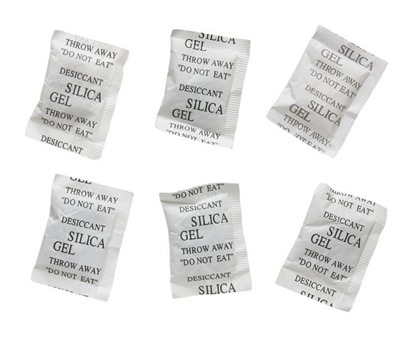
silica gel packetsDo not throw those packets away which come in different sizes. While they are not edible – please don't try – they can be reused in several ways.

We find those little – and sometimes not so very little – packets everywhere. They pop our of all sorts of packaging and lurk like an ugly bug or something in vitamin bottles, new shoes and many other products. The majority just toss those packets out but there are many ways in which we can actually reuse them. So, hold on to them. They can come in handy.

Silica gel is a desiccant, a substance that absorbs moisture. It is not a gel, despite its name, but actually a very porous mineral with a natural attraction to water molecules, that is to say, in simple terms, moisture.

Manufacturers utilize the “gel” to keep goods from spoiling, molding or degrading due to humidity. The “gel” itself is nontoxic, but can have a moisture indicator added (cobalt chloride) which is a known toxin that turns pink when hydrated and is otherwise blue in its dry form. Most silica found in our food and household purchases, however, looks like tapioca beads and is benign unless combined with certain chemicals. Even in that benign form, though, you should not eat it.

Although silica gel has massive potential for reuse, there do not seem to be an recyclers, commercial ones I mean, that are prepared to, well, recycle it.

I tend to keep them, whatever the size, for future reuse. The only problem I have is that I keep forgetting where I put them. Which reminds me that I must look for all of them and – finally – put them somewhere all together into a box or such and then label the box. – Update: Box with packets found. Now must put label on box and remember where it is.

There are a number of reuse possibilities for those little, and not so little, sachets, that can keep the stuff out of the landfill for a little longer.

  • Put some packs in your ammo cans and gun cases/safes to keep the ammo and guns dry. The same goes as to where you keep your knives.

  • Protect personal papers and important documents by putting some gel in a bag wherever these are stored, such as filing cabinets (oh, I know, I am old-fashioned and yes, I still use them – the filing cabinets that is).

  • Keep with photos to protect them from humidity.

  • Put and keep a little sachet of gel in your camera bag. After snapping photos in cold or wet conditions, silica gel will absorb moisture to keep your lens from fogging or streaking.

  • Leave a couple packs in your tool box to prevent rusting of tools.

  • You could also use the gel to to dry flowers or place with seeds in storage to prevent them going moldy.

  • Put some packets on your window sills to banish condensation.

  • Use in luggage while traveling.

  • Put some bags with your leather goods, such as coats and shoes, bags, belts, etc., wherever you keep them to to prevent them going moldy in storage.

While these packets may be annoying and seem like a waste of resources, they can extend the life of many items. Another reason someone needs to be collecting them to recycle: they can be reactivated repeatedly. To recharge, you just need to bake the saturated beads on a cookie sheet in the oven, though that takes a while, or gently in the microwave. They can also be air dried near a radiator or other safe heat source.

P.S. If you don't have silica gel packs handy then rice in small cotton bags will also do the trick of absorbing moisture. Our parents and grandparents used to do that to keep salt from getting lumpy.

© 2017

Plastic frozen food bags as hanging basket liner

by Michael Smith (Veshengro)

Wall_hanging_basket_lined_with_frozen_food_bag1I am one of those people who take reuse and all what is related to that to another dimension at times, as regular readers will know, and I do, yes, tend to keep those bags from frozen food.

Being a vegetarian, single, and not being able to shop for fresh vegetables daily or such, I tend to buy them frozen. Alas, they then come in those bags. But waste not want not they are, after being rinsed out, used for all manner of things, such as sandwich bags and, well, in this case to line hanging baskets.

While coir liners are compostable and all that they cost money and they don't always come in the shape of the particular hanging basket – or container that one is repurposing as a hanging basket – and I also often like to keep the plants in those baskets for longer than the lifespan of a coir liner.

Previously I have used cut up potting compost bags and such but none to hand when I wanted to do a hanging basket – this one, as you can see from the picture, however, is actually a wall mounted one – and remembered that I did have those frozen food bags.

Well, cut a long story short – and cutting was involved in the work as well – two bags later with the help of my trusty garden scissors the basket was lined and then filled with leaf mold. The latter no longer involved any plastic bags or cutting. The cost of the entire exercise? Aside from a little battery power for the drill to make the whole for the screw to hold the basket – zero. The basket was found, the screw and rawlplug, aka wall plug or screw anchor, too. Waste not want not obviously.

© 2017

Reusing plastic utensils in the garden

Reusing plastic utensils (flatware) in the garden (and elsewhere)

by Michael Smith (Veshengro)

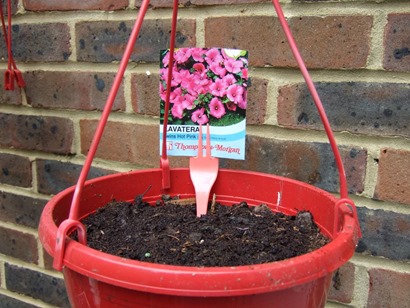
Plastic fork plant label holder1-webDon't toss those plastic knives, forks and spoons. There are number of reasons why you should plant them in your garden beds instead. No, they do not sprout roots if you do and reproduce, but for other reasons.

These days people are looking to be more environmentally conscious, which means using reusable utensils instead of plastic ones. However, if you have to use plastic utensils there are ways that you can reuse them instead of just tossing them out after eating one meal.

Also, although to some this may sound gross, why not pick up and take home those plastic cutlery pieces you may find laying about when on a walk or such. Plastic utensils can work wonders for your garden. Well, if not directly wonders then they still can be useful.

Deterring garden “pests”

Place plastic utensils in your garden to keep pests that might sabotage growth, like dogs and cats, at bay. They will not want to maneuver around the pointed objects where your fruits, vegetables, and flowers are in the process of growing.

If you have animals who like to trounce or do their business in your garden, certainly may want to use this option. You can remove the cutlery when your plants grow.

You, obviously, won't keep slugs and snails at bay with this method but it could help to keep squirrels, cats, and others off your plants when they are growing.

Plant labels

Don't waste your money on fancy garden labels. You can write the names of your plants on handles of the utensils and stake them in the ground next to your plant.

This goes especially for the white of light colored ones, not so much the black ones, unless you have a white permanent marker.

Alternatively, use plastic forks, and here the color does not matter, stuck into the soil by their handles, and tuck the pack into the tines.

White plastic spoons, for instance, you could paint and then write the name of the plant, or draw/paint a picture of it, on the spoon. The back of the bowl probably would work best for this.

Make a little fence

Place forks into the soil with the prongs facing upward and in a row to create a spiked fence. This will keep squirrels out – well, hopefully – and can also make a cute fence for a fairy garden, if you are thus inclined.

Strong plastic forks – more of the reusable plastic cutlery kind that people nevertheless tend to treat like disposable – can also serve as small garden forks in pots, hanging baskets, and window boxes, etc. for loosening soil should this be deemed necessary.

Oh yes, I did not get around to ideas about the “elsewhere”, but that might happen in another article.

© 2017

Be creative and reduce waste

by Michael Smith (Veshengro)

Make things for yourself and for others and reduce the need to go an buy everything that you want (and need).

Upcycling_examples1There are many things that are considered waste and waste products by the majority and the powers-that-be that, in fact, can become the resources for making things we want and need ourselves, or as gifts for family and friends. And, with the right mindset, ideas and a little skill those can also and even become salable products.

Even, unfortunately, people who consider themselves “green” and “ecologically minded” do not seem to have the mindset that our ancestors have and cannot see items of waste as a resource, aside from being recyclables to be used by the recycling industry.

They will go out and buy a recycled steel pencil bin while, at the same time, throwing away a clean tin can into the recycling which can – for nothing – serve the same purpose and can make for a great conversation piece when placed on the desk.

Or they will go and throw some large glass jars into the recycling bin and then go out and spend lots of money of recycled glass storage jars where the produce jars would have been able to to the same job for zero costs and removing some glass jars from the waste stream.

Those are but two examples and I have seen this happening myself and the people were so programed to recycling that they could not see that they could have been using those “recyclables” instead of buying new products, even though made from recycled materials.

When I was a child drinking glasses in daily use where not proper, if you like, glasses but glass jars of different sizes and I strongly believe that the reason for the predominately working class term of “having a jar” of something means just that, namely that a jar was used as a drinking vessel. And why not?

I have not bought a notebook for ages. I make my own from single-sided printed press releases and other printed matter. The same goes for the index cards that I use which I make from card material from packaging and I also make my own business card from such materials.

When we look back at the way our ancestors made use of waste for their everyday needs (and wants), from backs of envelopes, over cigar boxes, glass jars and so much more we can, and in deed must, take a leaf out of their books to make our money go further and, at the same time, reduce the amount that we put into the waste stream.

Starve your recycling bins and not just the trash can, I say, and make use of as much of the waste materials that you can. There is so much that you can make from waste for your own use, as gifts and, even, for sale. Just use your mind and some of the ideas that can be found in books and all over the Internet. Especially, however, take a look at what our ancestors did and how the reused and recycled well before it was a fashionable thing. And I mean they did reuse, repurpose and upcycle out of necessity often and for us it may just be a way to save money and to reduce our impact on the Planet.

© 2014

Finding the Use in ReUse

by Michael Smith (Veshengro)

Our ancestors were very adept in finding the use in reuse, so to speak, and it came rather natural to them, and this includes especially items of waste. Most of modern man today, however, seem to have entirely lost this ability and can think no further, it seems, than going and buying everything, creating yet more waste.

I look for a possible reuse in everything that I come across and not just waste that I encounter in the home.

Only recently, through work, I came a cross a discarded almost new metal TV stand (I don't have a TV though) that I most successfully upcycled into a stand for my printer on top of the filing cabinet, with a shelf above for paperwork.

Use_in_ReUse_webNot more than a couple of months prior to this find and reuse I came across an almost new IKEA coffee table in the same dumpster which now serves me as a table for my laminator in the “office”.

Reuse with me is always top on the list as I simply hate waste and especially hate waste of resources of any kind.

I grew up with reuse and recycling (making things from waste) before the word recycling as such was ever coined and sold recycled goods on the markets. It was just something that we did.

Glass jars were reused for storage or as drinking glasses when I was a kid, and it is still the case in my home, and many other things were and are given a new life through reuse and via upcycling.

The word “reuse” is made up of “re” and “use” with the “re” standing for “again”, as in “repeat”, and the “use” for, well, “use”. So “reuse” is “use again” and this can mean reuse for the same purpose or for another.

All too often, even among “greenies”, reuse fall by the wayside and the mantra appears to be “we must recycle more” as if the recycling bin would die of starvation if it is not fed. The fact that the recycling mantra is “reduce, reuse, recycle” is being totally forgotten. Clean glass jars are tossed into the glass recycling bin and then they go to the store and buy recycled glass storage jars, being very proud of themselves to have bought recycled, while the jars that they tossed into the recycling bin could have been used for the same purposes, that is to say, as storage jars.

Reuse was common, I mean really common, well into the 1970s and I find it rather alarming that, despite the mantra of the three Rs waste reduction (reduce), and especially reuse, most of the time today does not even enter people's minds. Have we been so brainwashed into consumerism and even into “greensumption”? Methinks it is so.

Today people need to be taught, it would seem, as to reusing items of waste for new purposes in the same way as to making do with what they already have. No one seems to be satisfied with what they have and reusing items of waste or using preowned and preused is an anathema to all too many, and that even in the green movement, I am afraid to say.

If you need (or want) a pencil bin for your desk why go out and buy one, even if it is made from recycled steel, costing you seven to ten dollars, when a clean tin can will do the job equally well for free while at the same time making an even greater statement on your desk as to your concern for the Planet than any recycled would even make.

Reuse was once so in everyone's blood almost, especially among country folks and the working class and also the lower middle class, that it would have been strange to see people not do it. And even behind the scenes in the Big Houses it was common enough. Today it is more common amongst the lords and ladies of the manor that the working classes though true country folk, in the main, never abandoned it. However, people who do it as a rule, in today's society, are seen as eccentric by the majority and even as, and I kid you not, terrorist by the government as, as the powers-that-be say, we do not back the economy.

Nowadays people do have to be taught, literally, and various food manufacturers are doing it on their packaging, how to, maybe, reuse the box of what-have-you so that they have some guidance as to what they could reuse it for. It is rather sad that it had to come to this and proves that we have not advanced at all but rather have gone backwards in so many ways.

Reuse does require a certain mindset. One that can see the potential in this or that, be that an item of packaging that would otherwise go to waste, a glass jar or a tin can, etc., or something that no longer fulfills its original purpose or something that another has tossed into the trash.

I don't know about you but as for me reuse is always high on the agenda and I consider a possible reuse for everything that I come across. It saves me money and it good for the Planet. A total win-win situation therefore.

© 2013

Waste has to stop

by Michael Smith (Veshengro)

All waste has to stop and we are the only ones that can do this. We can stop waste and starve the trashcan.

While it is true that we will never be able to eliminate all waste, and that aside from human waste; not even our ancestors of old managed to do that, much of it can be eliminated, especially food waste and packaging waste.

The former we can tackle by learning to cook from scratch and to make use of any leftovers and the second by reusing, repurposing and upcycling as much of it as possible, in the way that our forebears did, whether on the farm or not.

In addition to that we, as consumers, have the power to demand that the manufacturers reduce packaging and also that packaging be designed in such a way that it can have a second or even third life. The Japanese can teach us a thing or two about that.

They package goods more often than not – or at least they did – in boxes, and whatever else, that are purposely intended for reuse.

But even in the West similar things were happening not so long ago, but seem to have gone with the wind no. Nutella used to have its spread in glass jars that were designed to be used after as drinking glasses as did the makers of a number of brands of French mustard and also Kuehne, a German mustard producer, did the same. So why does it seem to be so difficult now, not more than two or three decades after?

Wen it comes to glass jars for packaging our forefathers and -mothers reused each and every one, until they no longer had a use for them. A glass jar is what? A glass and they can be used for drinking out amongst other things. So, let's not waste them. After all you pay for them when you buy the product contained therein.

It seems, however, so alien to many of our contemporaries today to do that. They rather go out and buy a pencil bin for $7 (made from recycled steel) than to use a tin can, destined for the recycling bin, for the same purpose.

And the same goes for glass storage jars. People spend $15 or more on recycled glass storage jars, thinking they do the green thing, while tossing some large glass jars, from products they bought, into the recycling bin.

Aside from the fact that this is waste of resources it is also a waste of money. As I said, you paid for that glass jar or the tin can or the cookie tin; so reuse it.

But we have come so far from the source, so to speak, that now some cookie tins, whether metal or plastic, have printed on them the fact that they can be reused and also for what purpose. Maybe, in fact, we need such instructions printed on the labels and such like in order for people to understand that the trip to the trashcan or the recycling bin is not necessary and should only be the last resort.

Packaging waste is our biggest problem, aside from food waste, and both can be overcome.

As far as packaging waste is concerned we have to reuse, repurpose and upcycle as much as possible of it, as said already, by using our mind. And, in addition, we must demand redesign of it and a reduction of it and also return to lose products, as once was the case. We, as consumers, have the power to make this happen by demanding it and the same goes for products that can be repaired. Let's do it. Let's reduce waste by all means possible.

© 2013

Repurposing glass containers

by Michael Smith (Veshengro)

Reusing and repurposing class containers is probably as old as such containers themselves and in times past most of those were used, reused and repurposed until such a time that they could no longer be used because they were broken.

Many of us have a steady stream of glass containers coming into our homes, but we often don't know what to do with all of them. Reason for that, more often than not, is that we have been condition to immediately go into the recycling mode.

Now most people cannot think further than tossing such valuable items, as glass jars and other glass containers, are into the recycling bin. That bin should be the absolute last resort and not the first thought. We have, however, been conditioned, or should I say brainwashed, to think only recycle and buy new what we could easily reuse and repurpose such containers for. And this does not just for glass containers. It does so equally for paper and card, for plastic containers, tin cans, and much, much more.

Used glass jars and other such items can be repurposed for so many different things.

When I was a child most people reused glass jars of all kinds for all kinds of things. Grandfathers and fathers kept screws, nails, and what-have-you in them and grandmothers and mothers used them in the kitchen as storage containers for dried things such as sugar, coffee, tea, beans, rice, salt, and also for to store leftovers. They also used them for buttons and other small things. We seem to have lost that and buy all manner of storage containers when an glass jar we have finished with would do the job just as well with no impact on out finances and the Planet's resources.

Oh, and before anyone suggests that the glass jars that go into the recycling bin are made into new bottles and jars let me enlighten you. They are not. In 99% of all cases they are made into products other than what they were, often simply road sand, bricks, and counter tops. A waste of resources and energy.

There are many ways of reusing and repurposing glass jars and here are just a few suggestions.

You can, for instance, turn old glass containers into beautiful vases for your kitchen window or even for the table.

One of my favorites for that, I have to say, are tall square glass jar in which I buy my coffee from Lidl.

You can also use larger glass containers as mini 'cloches' to get an early start on planting tomatoes and such outdoors. Many dill pickles tend to come in large jars that are well suited for this. Just remember to take them off the plants when the sun beats down on them as there will be no opening to regulate the heat. But then the old glass cloches had not any either.

The same jars also are good for the making of a small terrarium or especially a bottle garden.

Like many of our ancestors your could also use them for leftovers, small and large ones, depending how much you have on leftovers. Glass jars are also great for keeping small items organized, such as crafts, hardware, jewelry, toiletries, you name it.

I remember cottage gardens as a child where the part borders were all lined with old glass bottles, stuck into the ground by their necks and many people also created borders for slightly raised beds with them.

Empty wine bottles and such can also be used as candlesticks, obviously, for use during power outages or for a (romantic) dinner or dinner party.

In the good old Hippie days of the 1960s and 1970s many repurposed glass jars for drinking vessel, as I still do today. Small squat ones from, for instance, mustard, become whisky tumblers, larger ones, from small Frankfurters glass for beer, water and juice and those from herbs and spices shot glasses.

As you can see only you imagination sets the limits as to how glass containers can be reused and repurposed, and the same is true for other so-called waste items, whether tin cans, plastic containers, and much else.

Always reuse and repurpose before heading for the recycling bin...

© 2013

Why buy what you can make yourself?

by Michael Smith (Veshengro)

Often it is just a case of putting your mind to it and reusing, repurposing or upcyling some bits of waste into just the thing that you want and need. At other times it is using ingenuity and some tools to make things from natural materials.

However, more often that not, people cannot think in that fashion anymore and that even applies to those in the “green movement”. All seem to have been brainwashed, and it is a case of brainwashing for sure, to buy, buy and then to buy some more.

While, at the same time they have also been brainwashed to throw everything that could be reused, repurposed and upcycled into the recycling bin for, well, recycling.

Despite the fact that the mantra that everyone was taught, almost, is “reduce, reuse, recycle” it has become a brainwashing into “recycle, recycle, recycle” and people have swallowed that hook, line and sinker.

Reusing and repurposing was the way of our forefather and foremothers – no one ever seems to mention those, the foremothers (and I know I have just invented that word) – and everything that could be used in that way was.

No tin can that could be reused, no glass jar, no piece of paper, no rubber band, or whatever else, was ever thrown into the trash if there was just the remotest of use for it.

But that was and is only half the story for, aside from using items of trash they also used, as can we, the things that Mother Nature provides. They did.

Reuse and repurposing can give us lots of the things that we would otherwise go out and buy and many, even many in the green movement, do not manage to see and understand that.

An empty tin can becomes a pencil bin, or a bin for cutlery. A glass jar that once contained food or spices a storage jar, a drinking glass for different purposes depending on type and size.

Coffee jars can become vases for flowers, and many other items of “waste” can be upcycled into things we want and need. Paper printed on just one side can be made, with little effort, into notebooks. Card stock from packaging, cut to size by using a guillotine, and then printed by means of a rubber stamp, can become business- and visiting cards or, cut to different size, e.g. index card size, and then without any print, become, well, index cards.

And this is just a very small selection of ideas what can be made from and with things that others would consider “waste”.

In addition to that there are so many other things that we can make ourselves such as from natural materials with a little ingenuity and some tools.

Tree offcuts are, with some skill and a couple of tools, easily made into wooden spoons, spatulas (easier even than spoon) and other kitchen utensils. Offcuts from tree pruning can also be fashioned into other things such as, when they lend themselves to it, coat hooks, walking sticks, and much more.

Our grandparents and great-grandparents still had this mindset of making things they wanted and needed for themselves in this fashion, at least those that did not have money to burn, but today most cannot think further than going to the stores and buying what they want and need.

Nowadays a great majority, it would appear, have more money than sense and that can also be seen by what they throw away and things that they lose and never come looking for it again.

How one can lose a hat, whether wooly or other, that costs ten, fifteen or even twenty Pounds to buy and not try to find it again is a question to which few, if any, who grew up with little money will ever understand. Our grandparent and great-grand parents certainly would not.

© 2013

Recycling is dead!

Reuse is king and we must change our ways to rethink how we act and interact

by Michael Smith (Veshengro)

The mantras and mindsets of the past have become obsolete. We must now throw them out and create space to develop new ones which will guide us into the future as well as in the future.

It is no longer enough to simply REDUCE, REUSE, RECYCLE the damage we do to the world we live in.

Instead we must RETHINK the very systems in which we function (do we really function in it) today which allow such damage to occur in the first place.

We must create new systems which allow us to REIMAGINE a world in which we are not separate from our environment but a vital, meaningful and integral part of it.

In this new world we will not only renew ourselves but also REGENERATE Mother Nature so that she may provide for not simply a few but indeed for all.

This means that first and foremost we must get away from consumerism and that includes greensumption.

Going Green is not about buying a bunch of new organic and recycled stuff and then feeling good and smug in the belief that you've done your bit. It is about reducing the amount that we buy and choosing to reuse. We must reuse because the Planet cannot be recycled but all too many think that if they but buy new recycled stuff they are really, really green. Well, they are not.

It is amazing how many people in the Green Movement even do not seem to be able to think past recycling, especially when considering that they are repeating the Three R mantra all the time.

There is, however, no need to reinvent the wheel. Reuse is almost as old as the hills and we need but look at the way our grandparents and their parents did things in the reuse department and then apply our mind to the new materials that they did not know.

We must also bring back the systems of reusing glass bottles and glass jars) as was in the past by using the incentives of then too; namely refundable deposits on the containers. It is hardly rocket science now, is it?

However, we are being conditioned and have been conditioned – brainwashed almost – into believing that recycling can save most of our problems.

As long as a product can be recycled at the end of its life we have been fed, for lack of a better word, it is OK to toss it and buy new when we desire a new version of the product. After all, we have to stimulate the economy; an economy that is based on ever more growth, which means the need for ever more consumption. This does not compute considering that the Planet is finite; it cannot grow.

Our economic system, as it stands today, is broken and we need to change it. That means replacing it and not repairing it or tinkering with it.

While I am always for repairing as far as things are concerned this system cannot be repaired and that also goes for our political systems; but that is a different story.

We cannot continue to consume at the rate that we do at present and it is not a case of “it's the economy, stupid” but “it's the stupid economy”.

Non-renewable resources of this Planet and even renewable resources are being depleted at a rate of knots and we have come to a point now where the global annual consumption of oil is 40% greater than the rate of production. One does not have to be an economist or mathematical genius to realize that that does not add up. Even the least brightest person will recognize that if you use more than you produce it is not sustainable, not even in the short run, let alone the long one.

This operation is only possible by using so-called strategic reserves and those reserves are going to run out in the not so distant future.

It can safely be assumed that the powers that be feed the reserves into the market in order to massage and manipulate the fuel prices at the pumps at a level so that people are not going to revolt and all that in the hope that more cheap oil can be found. That, however, is highly unlikely and that means that the shortage is only being delayed. But, oops, I digressed again.

Resource, especially non-renewable ones, be this oil, gas, minerals, etc., are getting short in supply and wars are already being fought about then and conflicts. Only a reduction in consumption is going to being sanity back and products that are made to last.

© 2012

Reuse: The stepchild of waste management (in our homes)

by Michael Smith (Veshengro)

For some peculiar reason, despite the fact that the 3Rs of waste management are “reduce, reuse, recycle” most people and even governments only seem to understand them as being “recycle, recycle, recycle” and reuse is, literally, being ignored like a poor stepchild or orphan.

It would appear that many people do not understand the difference between reuse and recycle either and will refer to, say, my glass jars that I reuse, or repurpose, if you will, as drinking glasses as to the jars having been recycled into such glasses. This is, obviously, incorrect. They are reused or, if one wants, repurposed; not recycled.

When we reuse something, albeit for a purpose slightly different to the product's original intended one, we do not change it or its structure, and thus we use no energy.

Recycling, on the other hand, uses lots of energy. Energy to collect the “recyclables”, many of which should be reused; energy to sort and get them to the recycling plant; energy to break the materials up; and then still yet more energy to make new products. In other words, recycling is a very energy intensive process.

Reuse, as we have already seen, on the other hand, requires no energy use (or very, very little) but your own and your imagination.

In addition to reuse by us as individuals a more commercial reuse should be brought back in that glass bottles and jars should be taken back by the stores for reuse for their original purpose. This used to be done with all lemonade, soda and beer bottles some decades past and is, indeed, still being done or again in some countries. Glass jars were also taken back during World War Two in Britain and in all cases there is and was a deposit on the things. It is, thus, not rocket science.

Next to reducing our, especially packaging, waste REUSE must be our priority in managing our waste; at home, at school, and at work.

Recycling is very far down on the list for, when you have to resort to and choose the last option, namely recycling, you have already lost the game.

Reuse must be, if reduce has not worked, and industry is still over packaging things, the way to go and our primary choice. We must relearn, and the great majority of people today indeed seem to need to, the thinking of our parents and grandparents and their parents and grandparents, of considering packaging waste in the form of glass jars, tin cans, and nowadays a variety of other things, as a resource. A resource for reuse and upcycling.

So, instead of throwing out a glass jar we reuse them as much and as long as possible, until such a day when we have a system in place where stores take them back. And the same, though only as far as reusing, goes for tin cans, bicuit tins, single-side printed papers, cardboard boxes, packaging card, plastic containers, etc.

They all must be candidates for reuse and upcycling and the limit as to what they can be reused for and upcycled into is only set by our imagination.

So, let's get reuse out of the orphanage and give it a loving home.

© 2012

From disposable lighter rack to soap dish in 60 seconds

by Michael Smith (Veshengro)

Disposable cigarette lighters come to the retailer in little plastic racks/stands holding 50 lighters. Once sold out they are tossed out by the store and market stall holder and end up in the landfill or, if we are very lucky, in the plastic recycling stream.

Soap dish1 However, those make great soap dishes to keep soap going soggy. The rack can either be reused as is, if the space is there by the basin, or cut down, thus upcycled, as shown in the pictures.

Soap dish2 In about a minute, using only a sharp knife and a safe cutting base, such as a chopping board, from something tossed into waste stream, a useful item can be created (if you don't just simply reuse it).

Soap dish3 Soap racks made of wood, bamboo or plastic, that do more than this though may look a little prettier, can be bought but why when you can reuse and upcycle something to fulfill the same purpose for nothing and, at the same time, take some weight of the Planet.

The great advantage, aside from keeping something out of the waste stream and not having to buy it, is the fact that one of these can be tossed into the water when it has soap residue on it and cleaned in a few seconds and does not require drying or such.

© 2012

Uses for Found Orphaned Socks

Often, on my walks, I do find the odd orphaned sock of a small and not so small child and I have often wondered as to what to do with them, as I always thought it a shame to waste them, as a resource and then, one day it just dawned on me... USB stick and cell phone/MP3-player socks, obviously.
Now I have a use for them and you have an idea as to what to do with them too, if you find some.

The smallest ones, those that tend to be lost by babies in their pushchairs are turned into covers – not much to do about it – for USB Flash Drives, aka USB Sticks, and the bigger ones, from older babies and toddlers, make great ones for cell phones and also for iPods and other MP3 players. Why buy a so-called USB or cell phone sock when you can have them for free and do something for the environment at the same time.
So, happy sock hunting...

© Michael Smith (Veshengro), March 2008