Showing posts with label making do. Show all posts

Don't try to impress people with what you can buy

by Michael Smith (Veshengro)

20604260_2114171278607919_4510769526560386680_nDon't try to impress people with what you can buy. Instead impress them – or at least try to impress them – with what you can do and make. Make from natural materials, from trash, and whatever, and thus don't have to buy.

Also with what you can do without, I would add to that. People are always totally amazed that I do not have a television, for instance. How can you not have a television and stay informed, they ask at times. Others wonder in a question as to whether I don't get bored not being able to watch TV and what I do with and in my spare time. First question here is: “what is spare time?”, for of that I do not have much. I am far too active with all manner of things. And, also, have they never heard of hobbies and books?

But, let's get back to the things that you can do (and make) for yourself instead of buying them. I am more impressed what someone can make and do then what they can buy. There money won't get them anywhere should the time come when the proverbial hits the air moving device, if you get my meaning.

Being able to make (do) and do – and do without – is what counts, as far as I am concerned, and that more and more so today where we have already over-consumed our quota of the Earth's resources and with recycling and the circular economy being but, in the main, a serious case of greenwash.

Instead of buying to impress, and buying more and more, we should and must, in fact, reduce our consumption – maybe even reduce to impress, but then again why impress or try to impress in the first place – and make do, repair, reuse, make our own, ideally from waste in the form of reuse or upcycling, and make our own from scratch from natural materials and/or from waste.

In my house absolutely nothing matches, as far as furniture and such is concerned, and many things, such as coat racks, and others, are made by myself from waste materials, natural materials or a combination of both. Found objects become decorations in one way or the other and on goes the list. And why not? Shabby chic is now seriously the in thing and such decorations are very much part of it.

Making furniture from pallets – and similar wood – was once the domain of the poor student and the hippies but today it is more or less big business and pieces of furniture made from such wood fetch high prices. But, with a little knowledge and skill, and some tools, you can make those yourself rather. The same goes for so many other things too.

That is rather the way how I like to impress people – although I do not set out to impress them – and not by buying expensive things.

© 2018

Learn a new skill every week

by Michael Smith (Veshengro)

OK, a little late as a New Year's resolution but...

self-reliance-skillsFor anyone wanting to become more self-reliant – notice that I rarely use the word self-sufficient, as true self-sufficiency just is not possible – skills are what count and not a huge amount of supplies, even not in the event of an Apocalypse and such. It is skills that will see you through when everything else fails and has failed. And, for goodness sake, don't believe the idiots trying to sell you silver and gold coins as something that will get you buy in such events. Then again it is not – just – for those events you should learn skills and perfect your skills.

If you would try to learn one new skill per week then that would make fifty-two per year and even if it is not one every week but one every fortnight or even if only one a month, but then thoroughly. Skills – and knowledge – are what is going to get you and yours through a crisis or simply making your life better where you are by being able to do things that otherwise you may have to pay for.

It is true that you can and will unlike become a master every skill that you may need but at least you can become a master in a couple and proficient in a fair number more.

One of the most important skills, and so many no longer seem to be capable of it, is cooking from scratch. I know to many reader that would be obvious but for some people simply boiling an egg seems rocket science nowadays let alone cooking anything else that isn't just ready to go into the microwave. Some cookery programs not so long ago actually stated with teaching people how to – no, not a joke – boil water, followed then by how to boil an egg. When people need to be taught how to boil a saucepan with water then the world definitely has lost the plot and relearning of skill definitely is called for.

Another important skill, if I may call it that way, is, in my opinion, making do and mending, and just simply making do with what one has, and making things one may need from scratch and scrap. Into that category should also fall reusing, repurposing and upcycling of waste materials, such as glass jars, tin cans, plastic bottles, etc. While some of it should come natural, with some imagination, it would appear that many today, however, need instructions for anything in that department, though.

Obviously, there are many skills that you may want to have and learn but starting easy is the best option and the skills themselves are legion so listing all of them would fill a book, without even going into detail.

Woodworking on a number of levels, from making simple items, over carving spoons and other treen, to making furniture if a valuable skill set to have but it is not learned over night.

Textile crafts: Now this encompasses anything really from mending clothes up to and including of making your own clothes and even your own cloth. It also includes crochet and knitting.

Metal working: This could be anything from sheet metal working – a great way of converting tin cans into something new – to full blacksmithing and anything and everything in between.

Leather working: This is another one of those skills that you may, more or less, definitely want to learn as the making of leather items are not only useful for you as useful things but those items can also become an income. In the main it is akin to sewing only with a difference but if you can sew running stitch then you can also work in leather. Theoretically the stitch is a different one but, personally, I just use the running stitch, then reversed, and the process repeated.

This list could go on ad infinitum (almost) as there are so many skills that would and could be worth learning and learning to do them is one thing, mastering them an entirely different story, though. So, let's go and try to learn as many skills as possible and then go onto trying to master them as far as possible.

© 2018

From consumer society to maker society

by Michael Smith (Veshengro)

20139988_1539078376130193_5453055660688507791_nThere was a time when people made and grew almost all of the things they needed; the majority of them at least. They did not – and could not – simply go to the stores or order on-line for home delivery. The latter option did not exist until even a few years ago and the other was not an option because there were no stores (in the very old days) or they could not afford to buy what they wanted.

Money was tight for many, especially the working class, farm laborers and such. So the only option they had was to make what they needed and wanted from materials that were available for free or cheap.

The raw materials for many of the things people needed and wanted was wood, but also other natural and man-made materials, such as scrap and trash. Children used their imagination to fashion all manner of toys from natural materials and from trash, and this is, on all counts, still true today in many a Third World country but also in what some would call backwards areas in the Western world.

The majority today, however, cannot even think how to get something that they need or want aside from checking their wallets or bank accounts and the nearest store or website. The very thought of making something seems alien to many today.

We have been brainwashed into the consumer mentality believing that whatever we need and want has to be coming from some shop of sorts, whether in bricks and mortar or in the virtual realm, and that making things that we need and want to ourselves from natural materials or, God forbid, waste materials, is something only for the very poor in other countries.

And also to use things that are more that a year or so old is also something that is only for the very poor. We must have new manufactured goods all the time, preferably cheap from some offshore manufacturing site.

Sometimes I wonder how this kind of brainwashing was ever possible to happen to the majority but happen it did and it is scary.

We have to find back to reality and that pronto. The time is going to come, and it is not all that far away, for sure, that those products that the majority run after today will no longer be dirt cheap and therefore we must change our ways and do things differently again. I say purposely again as it once was the way things were done and they must be done that way again.

We must return from a consumer and consumption orientated society return to, or transition and develop, however one may wish to put it, into a maker society where, once again, people are prepared to make things and enjoy making things rather than just consuming things. But it is a learning curve and I will not deny that, especially for those that never did such things before. Many young people today, as children, never made their own toys and entertainment the way some of the somewhat older generation did. They often were not allowed to do that as they could get hurt using a knife for whittling of such and as a knife, in the hands of a child or young person (and not just in the hands of a young person), in places such as the UK, is immediately considered an offensive weapon.

Not only is it just a question of being prepared to make our own things – and to repair the things that we have – but a society where everyone makes things or grows things, and is involved in making and growing things or maintaining those things.

In the main, however, all people are doing today is to consumer, bar the few that produce and grow things, and after the things are used they get thrown away. That is the mentality that is prevalent today and it is that mentality that also is causing other ills in society for a consumer, a user, society also uses people and animals in the same way as things and discards them when they are no longer productive.

The entire world needs to change to a new society but it will only do so if we, the people, actually change. The consumer is but a passive user of products and living things and often has no idea as to the true cost of his or her mentality to the Planet.

While it is true that the consumer him- or herself does not do the actual exploitation of environment, of people and of animals, and that is being done by the capitalists, the corporations and such, it is he or she who, by the act of consuming in the way he or she does, being not prepared to turn to being a maker, participates, passively in this exploitation, whether they want this to be true or not.

Edward Abbey is quoted to have said, with reference to the United States of America: “If America could be, once again, a nation of self-reliant farmers, craftsmen, hunters, ranchers and artists, then the rich would have little power to dominate others. Neither to serve nor rule. That was the American dream.” And this also applies to all other nations as well.

The move from a consumer society to a maker society – even if the making part is but a small one with each and every one, to start with – already would go a long way towards this, such as removing the power from the corporations, and thus the rich and “powerful” to dominate others, as in us as the people.

However, a maker society does not just mean making just things for oneself from scratch and even scrap but a society of people who make things rather than having things made for them in some factory in some far way third world country.

On the other hand making things ourselves, for ourselves and for others, and even for sale, liberates. It sets us free from the constant consumption and consumerism and allows us to think what we really need and want (out of life). And it not just liberates the individual, but the entire society.

As far as society goes, we cannot just be consumers, as the majority seems to be today, permanently buying something and tossing out the things – often the very same things we have just bought new, but which are newer than the old ones – that we only bought a couple of months ago. We all must become makers again, on a small and on a larger scale, but always on a human scale.

© 2017

Needs and wants and being frugal

by Michael Smith (Veshengro)

21034533_1455313397883264_6962462607872370993_nVery often wants are mistaken for needs and on other levels a want culture is being and has already been created where even the smallest child screams that he wants that because he needs it.

Parents must start here by putting a stop to such demands but instead of doing that they just give in to each and every demand of the child believing that the child would be disadvantaged if he does not get what he wants. By allowing this to happen they are responsible, and this has been going on for some decades already, of creating, and having created, the entitlement culture that we have today.

Also to blame are, obviously, but to some extent only for the power lies elsewhere, the advertisers whose commercials create in the viewer, child and adult alike, depending who it is target towards, the belief that they need this things shown to be happy or more fulfilled, or whatever. That it costs them dearly more than likely on more than one level the person in whom this desire is aroused rarely recognizes.

The true difference between needs and wants are that needs are, to an extent, but a few, wants, on the other hand, can be and are legion.

The child wants this or that, be it a toy, or whatever, the parent gives in and gets it for him and then, how long does the interest in whatever it was last? If it is a bicycle then, maybe, almost for ever, but when it comes to toys and such, often no more than a couple of days after which he gets “bored” with it and demands yet another one.

Oh, I was a child myself (obviously) and, although the “I want” better was not something that was said in a demanding voice or reinforced with a tantrum, and “I want” actually was better not said at all; more a “I'd like that?” or “Can I have one of those?” and it might happen. Though most of the time it didn't and I would be told to go and do some jobs and earn the money to get it. We didn't have much in the way of money coming in when I was a kid and I learned to appreciate the value of things.

I did just that in the case of roller-skates. Every kid on the block, almost, had a pair and I just needed to have a pair too. Oh yes, I needed a pair though a need it definitely was not but. Found some jobs to do for people against payment and I managed to get the money together and bought a pair. That was a bad move. Why? Because I just could not get on with them at all and after a few tries gave up, put them away, and they were never even looked at again. That also taught me a great lesson.

Over time I learned that what I really needed was different to that what I wanted and soon learned that the fancy stuff that everyone wanted to have I actually did not need – and also could not afford to have and want. That does not mean that over time I have not bought some (more) white elephants. Some of my kitchen gadgets speak for it, such as the deep fat fryer (used probably four or five times), the juicer (oh what a rigmarole cleaning it), and one or two others.

But there were those toys that I made for myself like my catapult, or that wooden tractor that an “uncle” had made for me and that got repaired so many times. How I loved that tractor and to this day I wish I had kept, just for the sake of it. Those really got used. Same as tin can stilt, wooden stilts, and so on. Well, and not to speak of the bicycle that I was given. It may have been a secondhand one but to me it might as well have been the most expensive one in the world. Those things I used day in and day out.

The catapult (slingshot) for instance was with me every day and I practiced with it every spare minute and hunted with it for the pot. We also made our own toys out of bits of wood, things from the forest and things found in the trash and we played more with those things than we ever did with store-bought toys. And I think we also looked after the things we made for ourselves or which someone had made for us much better than after those gotten from a store – with the few exception of expensive things that we bought ourselves from hard-earned money.

The same goes for fashion, aka clothing, whether the Nike (or whatever brand may be in fashion at the very moment) baseball cap. The gimme-hat from the country show, that often are given out for free, are just as good only that you are advertising a brand of tractor or something of that nature. OK, it might not have the right “street cred” but so what. It meets your need for a hat and that's what counts.

Saving money is the main part of being frugal and if you can’t make something yourself then look at getting it second-hand/used and this is the same with clothes as with other things such as a bicycle or whatever.

When I was a kid we all wore hand-me-downs that came from other peoples’ children and also many of our toys came that way too if we did not make them ourselves or got them made for us. There is absolutely nothing wrong with good second-hand clothes or other goods.

While clothes from the charity shop may not be the latest fashion they more often than not are good quality and that at a small fraction of the cost. With the exception of certain clothes, such as socks and undergarments, all my stuff comes from charity shops and my wardrobe is well stocked; overstocked in fact.

I take the greatest pleasure on the frugality front though in making things I need and want from things that otherwise might be thrown away or which have been thrown away and I do take that, probably, to the extreme. But so be it, as far as I am concerned.

Anything and everything that can be reused, reworked and upcycled is on that list. Reuse here applies to reusing an item of waste that can be used for this or that purpose, which would be more repurposing than reuse, as much as something that someone has thrown away and which still works well, such as in the case of a multi-tool that came into my possession in that way.

Reworking and upcycling is a somewhat different kettle of fish to reuse and it all depends of what comes my way here, be that items of waste at home or stuff found, but I look at everything with an eye for doing just that and see what I can make from it and out of it for my own use or even, hopefully, for sale.

So much of what the general population sees as “waste” is transformable into something useful or into art. Personally I prefer the useful side rather than that of artworks but, if all else fails, then artworks are still better than landfill, especially if it is something decorative that one might actually want to have in the home or office.

© 2017

#GreenLiving #greenlivingtips #needs #wants #frugality #makingdo #children #lifelessons

Make Do and Mend

by Michael Smith (Veshengro)

18557251_1397913886914578_1270310445997979841_nMake do and mend is a basically philosophy and mindset that I grew up with as a child, as much as I grew up in hand-me-downs whether this were clothes, bicycles, or what-have-you, and it is something that has stayed with me to this day. I still practice this philosophy – which nowadays is often known as practical recycling, reusing and upcycling – in various forms to this very day.

Already as a small boy I developed the habit, which was actively nurtured by our parents and other elders, and it has – unfortunately, some of my friends would say – stayed with me too, of picking up anything from the streets, the woodland paths, the hedgerows, and so on that might just come in handy. Old nails and screws; nuts and bolts; tools that have been lost or thrown away; even “old” knives; and much more are in that category.

Among the knives that I have found there have been knives for the re-working into sheath knives, as well as pocketknives with nothing wrong with them; there have been spanners and wrenches, screwdrivers, and many other tools, including a Leatherman Wave, in its holster, that was almost new and only required deburring the two knife blades. It had been deliberately thrown into the trash in a Park and had not just been lost accidentally. Some people simply seem to have too much money to know what to do with it, it appears, and more money than sense, that's for sure.

The habit of making do and making things also stretches with me to making use of everything that can be, in one way or another, re-worked into something else, whether this be old and worn Jeans into Ditty/Possibles bags or other things; old kitchen and butcher’s knives into “new” sheath knives. The leather of old boots, shoes and bags will be made into the sheath for such knives and/or into other items such as belt pouches for folding-knives, compass, pocket-watch, and so on.

There is only one severe drawback to such a habit and that is the need for a fairly large storage area in your home for all the things ”that might come in handy some day”.

During WWII in England booklets galore were published by the Ministry (and there was a shortage of things but they seemed to have enough paper to produce those official booklets) on the very subject of “Make Do & Mend” telling people, for instance, of how to change adult clothes into underclothes for children; to convert Dad’s old cotton shirts into nightshirts for the boys, and so on.

The philosophy and attitude of making do also applied in those days to digging up one’s flowerbeds and “digging for victory” by growing vegetables there instead of flowers in one’s garden. That could also still be a very valuable philosophy today too – instead of filling the garden up with grass and flowers, which may be esthetically pleasing to the eye and all that don’t feed no-one. Growing at least some of one’s own vegetables and such could give one some more cash in one’s pocket. Vegetables can – in actual fact – grown behind say a flowery border in a garden and look quite nice as well. The trees in one’s garden should not be ornamental this or that but fruit trees such as apples, pears, cherries, walnut and hazelnut, and anything else in that league and the ground beneath such trees should be utilized by vegetables and soft fruit such as strawberries. Also grow your own culinary and medicinal herbs in your garden, including such beneficial plants as Aloe Vera. If the climate isn’t suited for growing the latter out-of-doors than grown those in pots in the house. The same can also be done with many other herbs and spices.

And if you have no garden to speak of to grow your own vegetables and such then you can use various forms of containers such tubs made of various things such including old bathtubs even. Almost everything can be grown in containers, fruit trees even. Hanging baskets of all kinds also can be employed for growing fruit and vegetables. Strawberries do well there, and even beans and peas can be grown in such containers.

But back to the make do and mend philosophy per se.

While make do and mend seems to be coming back into fashion to some degree many people still have the disposable attitude and seem to have to have the latest in fashion, be this with regards to clothes or anything else.

Among children and young people peer pressure may have something to do with it in that clothes from a charity shop don't, in their minds, have much street cred and all that. Years ago it had to be Adidas, then Fila, then Nike, and the wheel keeps turning in that department. But what makes them better then non-brands? The name only, not necessarily the quality, and the price is often astronomical. The same goes for other things. And ordinary cell phone doesn't cut it; it has to be an iPhone, and ideally always the latest.

All need to learn, and the children and young people have to be taught, that it does not have to be the latest and that the latest and most expensive is not always the best, especially not for the Planet and the wallet.

Staying with what we have, making things ourselves even from things considered “waste” in the common perception, and generally making do and mending, buy secondhand, and so on, must be the way to go. The latter also and especially keeps money in the local economy, though only if we are using local secondhand shops, thrift stores and charity shops. And, if things can be repaired and you cannot do it yourself then use local repair shops to do it. Keeps the money local and also work.

© 2017

The latest model is not the greenest

by Michael Smith (Veshengro)

14570597_1317930151553422_1404047324989227567_oPlease note that I have not even inserted the word “always” in the headline as it is a fact that the latest model is not the greenest, period.

The latest model is not the greenest even if it is being promoted and touted as having greener credentials than the one you already have got. Stick with what you have got (as long as it still works, obviously) for that is the greenest, and you know what, that even applies to your car.

I know that we have visited this issue before but let us, nevertheless, do so again.

Every new product that you buy to replace another one that is still fully functional, even though the new one may have, according to claims, “greener” credentials than the “old” one, comes at a much higher environmental cost than the one that you are already using.

Sticking with what you have got, for as long as at all possible, is far better for the Planet and much “greener” than any new product however “green” its credentials are made out to be.

First of all credentials are all but claims made by the makers which we, the ordinary consumers, can absolutely not verify in any way, as can be seen from the supposed cheating on emission standards by various car manufacturers.

How can we verify the claims that are being made without testing equipment and the technical know-how to carry out such tests? We cannot, and that is a fact. And it is also a fact that most of the accreditation industry awards itself by way of a voluntary code of practice and such jazz.

There is so much on greenwash about that all such claims must be taken with an extreme large dose of salt; the proverbial pinch does not suffice. Therefore sticking with the things that you have already got rather than believing and being taken in by the claims is by far a better and “greener” choice. It is also kinder on the wallet.

© 2017

Reusing silica gel packets

by Michael Smith (Veshengro)

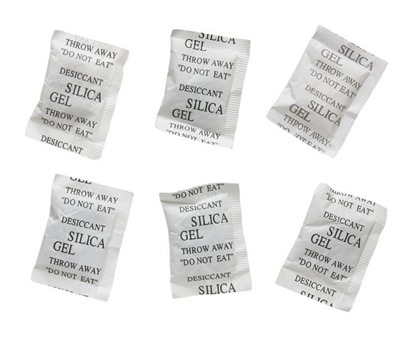
silica gel packetsDo not throw those packets away which come in different sizes. While they are not edible – please don't try – they can be reused in several ways.

We find those little – and sometimes not so very little – packets everywhere. They pop our of all sorts of packaging and lurk like an ugly bug or something in vitamin bottles, new shoes and many other products. The majority just toss those packets out but there are many ways in which we can actually reuse them. So, hold on to them. They can come in handy.

Silica gel is a desiccant, a substance that absorbs moisture. It is not a gel, despite its name, but actually a very porous mineral with a natural attraction to water molecules, that is to say, in simple terms, moisture.

Manufacturers utilize the “gel” to keep goods from spoiling, molding or degrading due to humidity. The “gel” itself is nontoxic, but can have a moisture indicator added (cobalt chloride) which is a known toxin that turns pink when hydrated and is otherwise blue in its dry form. Most silica found in our food and household purchases, however, looks like tapioca beads and is benign unless combined with certain chemicals. Even in that benign form, though, you should not eat it.

Although silica gel has massive potential for reuse, there do not seem to be an recyclers, commercial ones I mean, that are prepared to, well, recycle it.

I tend to keep them, whatever the size, for future reuse. The only problem I have is that I keep forgetting where I put them. Which reminds me that I must look for all of them and – finally – put them somewhere all together into a box or such and then label the box. – Update: Box with packets found. Now must put label on box and remember where it is.

There are a number of reuse possibilities for those little, and not so little, sachets, that can keep the stuff out of the landfill for a little longer.

  • Put some packs in your ammo cans and gun cases/safes to keep the ammo and guns dry. The same goes as to where you keep your knives.

  • Protect personal papers and important documents by putting some gel in a bag wherever these are stored, such as filing cabinets (oh, I know, I am old-fashioned and yes, I still use them – the filing cabinets that is).

  • Keep with photos to protect them from humidity.

  • Put and keep a little sachet of gel in your camera bag. After snapping photos in cold or wet conditions, silica gel will absorb moisture to keep your lens from fogging or streaking.

  • Leave a couple packs in your tool box to prevent rusting of tools.

  • You could also use the gel to to dry flowers or place with seeds in storage to prevent them going moldy.

  • Put some packets on your window sills to banish condensation.

  • Use in luggage while traveling.

  • Put some bags with your leather goods, such as coats and shoes, bags, belts, etc., wherever you keep them to to prevent them going moldy in storage.

While these packets may be annoying and seem like a waste of resources, they can extend the life of many items. Another reason someone needs to be collecting them to recycle: they can be reactivated repeatedly. To recharge, you just need to bake the saturated beads on a cookie sheet in the oven, though that takes a while, or gently in the microwave. They can also be air dried near a radiator or other safe heat source.

P.S. If you don't have silica gel packs handy then rice in small cotton bags will also do the trick of absorbing moisture. Our parents and grandparents used to do that to keep salt from getting lumpy.

© 2017

What to do with an old toothbrush

by Michael Smith (Veshengro)

toothbrush-311373_960_720Over the course of your life, you will buy things that are meant to last, like a home (if you are lucky enough to have the funds to do so), and others that are frequently replaced, like the humble toothbrush.

Speaking of the toothbrush, dentists recommend replacing your toothbrush every three months. If you adopt that schedule, four of your toothbrushes will hit landfills every year. If you are feeling resourceful, however, you can prolong your former toothbrush's landfill trip by putting it to further use after you are done using it on your teeth.

This may be seen, even by ardent reusers, as somewhat of a yuck subject but it is not and does not have to be.

You may want to give old brushes a good cleaning before taking on these projects. To do that I simply stick them in a small container with some hot water and chlorine bleach. After that, you are good to go.

I know that some people have a problem with bleach as not being environmentally friendly but as a disinfectant it is hard to beat and replace.

Get the dirt off veggies

Mushrooms often come with a bit of dirt, but they hate being cleaned with water. A soft-bristle brush will let you remove dirt easily and effectively. Don't stop at mushrooms, either. Other fruits and veggies can be cleaned just as thoroughly with a soft-bristle brush.

Cleaning pesky dishes and tile grout

The lids of sippy cups, stubborn Tupperware containers, and other hard-to-clean kitchen hardware are a perfect use for an old toothbrush. You can get right into the spots that a typical kitchen sponge or even dishwash brush cannot reach.

A toothbrush is wonderful for cleaning pesky kitchen grout and for certain cleaning jobs, including the tile grouts, in the bathroom.

In the bathroom

As already indicated an old toothbrush can serve very well as a cleaning brush for tile grout in the bathroom and is equally at home cleaning off gunk, limescale, and other stuff from around the taps at the sink and the bathtub.

Bicycle chains

A toothbrush is great for getting dirt and such out of bicycle chains and also the freewheel and crank wheel, as well as the gear cluster, if your bike has one, before it causes problems or builds up excessively.

Working with crafts

A toothbrush can be used to apply paint, glue, polish, and all manner of arts-and-crafts materials. It is a brush, after all.

Applicator brush for boot polish

As we have just established that the toothbrush is a brush, after all, it is quite natural to also consider using a retired toothbrush as an applicator brush for boot and shoe polish.

When your toothbrush is done cleaning your teeth, its life has only just begun, and with the above list we have only just about scratched the surface of all the tasks that an old toothbrush could be put to before finally putting it into the trash.

© 2017

Crisis Preparedness

by Michael Smith (Veshengro)

krisenvorsorgeWhen we look at the world today we can see that preparedness, being prepared and equipped to deal with any kind of crisis, is very important. The world in which we live today, being overly dependent on technology, especially the electronic kind, can easily be brought out of its equilibrium.

The next financial crash is only around the corner especially considering the way that many banks are back playing the same ponzy schemes that they played last time round and there are many economists and others who predict that the next crash is already on its way – probably just a year or a couple away – and that it will be worse than the last and probably worse than the Great Depression even.

But, unlike when the Great Depression hit, the majority of the people today live a life that is so far removed from reality that they do not have the skills and also not the mental frame to do things for themselves. They have to learn this from scratch and while today we have all the knowledge we – the majority at least – do not have the practical skills. Some cannot even cook from scratch let alone be capable of growing their own food, know where to get wild food, or now to make this or that they need or want for themselves.

Many people who are more or less self-appointed and self-acclaimed experts in the field of preparedness always suggest that people should have gold and silver coins as means of cash/currency. That is utter baloney as nowadays gold and silver, unlike in the days of the Great Depression and even still after WW2 are not recognized (as currency) and thus are absolutely useless. They offer no means of and for barter whatsoever. Gold and silver in whatever kind of coins are just a way for you to waste your money. In addition to that if those coins are not old currency coins how can you be sure, if they come from some “wild” mints, that they actually have the gold or silver content that is being claimed?

Your best bet is not gold and silver coins but skills and tools to perform jobs or produce goods that other want and need. Knowledge and skills are the key here. And knowledge must be more than just theory.

In times gone by people always prepared for the unexpected and for lean times and that not just by having some cash under the mattress or such place. They canned, the preserved food in other ways, and they knew how to make things from almost nothing. Today most do neither and do not have the skills either.

Cash under the mattress is not going to be an option anymore today where the coins and notes are changed in design every five minutes – well, almost – and the old version being no longer legal tender within a short space of time. All done in order to make us dependent on the state and its agencies. Therefore it will have to be other supplies – and especially skills – that you have to make it possible for your to live well enough after such an event and which also provide a means of barter with other, perhaps.

Theoretically, properly prepared there is no reason to fear a crisis nor is there any need to get into a panic and tiswas, when it happens. I did say theoretically, for the world today is not the world of the 1920s and 30s when people still had proper community and also knew how to do things.

Books on the various subjects of preparedness, homesteading, gardening, survival, and the many crafts and whatever, are good to have as a reference library but they are not something that you would want to go to when the proverbial already has hit the air moving device but you want to learn from them, and ideally also from live teachers, and acquire the knowledge and especially the practical skills well before well before any such event.

In the event of a crisis, which, more than likely will be a global one, you cannot rely of the state or other body for help. You have to know how to help yourself and you can only rely on yourself.

You may have the skills, the knowledge, and the provisions. Others that don't, however, are the danger; a danger to you, your loved ones and your survival. In a crisis you also cannot rely on the state and its agencies to protect you from any marauders; in fact the state and its agencies themselves will become a threat to you and your freedom.

So, thus, when it comes to protection from marauders it would appear that you will be, in the event, more or less on your own. The agencies of the state, as I have just said, will not (be able to) protect you and therefore you will have to do that yourself and you may also need to protect yourself and your loved ones from the very agencies of the state.

© 2017

Making do with less

by Michael Smith (Veshengro)

It is not so much of making do with less than using what you have and having fewer possessions, especially gadgets and also simpler things.

I am not talking about minimalism here but just reducing the unnecessary things, and there have been times that I have myself been guilty such as buying kitchen gadgets which are then used but a few times and that is. Afterwards they then just sit about somewhere doing nothing. But such and other gadgets are only one part. But I also do not mean throwing out what you have in order to unclutter unless uncluttering is absolutely necessary. Making do with less also means, obviously, making do with what you already have without adding any more to it.

Doing with less also means using the car less and using your feet more instead and the bicycle. You have one, haven't you?

When it comes to a bicycle it does not have to be the most “state of the art” (where is this state, this country, anyway?) one but an old one – done up – will do just as well, maybe even better. And a simple bike, especially a single-speed one, is much easier to maintain.

Such a simple bicycle can easily from an old derailleur gear change one by simply removing the gear changers, shortening the change so that the drive train runs true from either the middle or the outer crankshaft cogwheel to one of the smaller ones on the back wheel cluster. There is no need to buy a simple speed back wheel nor, in all honesty, a conversion kit.

There is no need to buy a new bicycle. An older or even old one can often be found for little money at a variety of places and mostly they but require a little TLC to get them back on the road and save you money and get you and keep you fit at the same time.

Reuse, because we can't recycle the Planet!

All too often people are obsessed with having to have the latest “toys” like as if they had never grown up. Then, maybe, they haven't. At least that is definitely how it does appear. They also seem to have been fiddling with those “toys” all the time, even when they are talking with another person.

I never did, as a child, have many toys. The toys that we did have when I was a child were either hand-made, found ones, or those handed down to us from others, and may be that has given me an edge here as not always to be looking for the latest “toy” but to make do with what I have got and also with what I find and what I can make from trash, for instance.

This is something that, for the sake of the Planet, and also as a preparation for changes in our world that are coming, we all must consider doing, that is to say making use of what we have and that includes reusing and upcycling some of the “waster” that we generate.

There is so much that we can change without having to shell out a single cent only no one seems to realize that and many people seem to think that living a simpler life actually costs them money, in the same way that they believe leading and living a greener life does. And by making do with less this can be achieved easier than with any green gadgets.

Reuse and upcycling is the name of the game as well as repair and not buying unnecessary stuff. Many things that you may need or want you can easily make your self by repurposing, reusing and upcycling and thus living a simpler life and making do with less by way of purchased possessions.

All too many people seem to be permanently buying something new, be this clothes, shoes, gadgets, or whatever, even though they already have enough of everything. I am not talking here about those that don't have enough to live comfortably but about those that have more that enough.

However, even those that do not – almost – have two pennies to rub together also fall for this and are prepared even to go into debt in order to afford all those things that everyone else has, as they think. If I have to go into debt to buy something then I cannot afford it and I will not try regardless if the neighbor has this or that that I may not have.

How many clothes or shoes, for instance, does one need or how many cellphone, TVs or whatever? You can only wear one pair of shoes at any one time and one set of clothes. But, apparently, they have to have at least one pair of shoes for every day of the week and at least two to three sets of clothes per day of the week. And, ideally, all of those clothes and shoes have to be respectable designer brands.

Then there has to be a pair of pajamas for every day of the week it seems and on and on it goes. That also means that there is a great deal of laundry that must be tackled at the end of the week or several times during the week even because of the sheer amount of it and that means energy and water usage by the ton.

We are being told, at least by those who buy all of that, that they need a suit for work, then a set of clothes for after work, and then something to lounge about in in the evening. And you have to have some good special clothes for going out to restaurants and such (and that also seems to have to happen several times a week), and on and on the excuses go as to why they have to buy all of that stuff and why they have to have it all.

We have become possessed by our possessions and while this may not be true for everyone, thank god, it seems true for a great majority, unfortunately. This all comes to the detriment of resources, of the Planet, and everything else.

Apparently there also has to be a TV set in every room of the house, and everyone has to have their own PC, their own this device and that, and on and on the list goes.

There is another way but it is almost as hard a sell as voluntary poverty, and in a way it is part of it, and that is to make do and to live well with less, especially with buying less unnecessary stuff, as said already.

With simple reuse, repurposing and upcycling you can make many of the things that you may need (and want) yourself without spending another single cent often. But most have become so accustomed to and, dare I say, brainwashed into having to buy everything that they need and want. And whatever they may need and want has to be able to be purchased now, there and then. It is, apparently, not possible to wait until one can actually afford it or look for a substitute to repurpose or a way to make this or that oneself.

Among some it has not become fashionable to drink from jars, glass jars, but they have to be designer recycled jars, it seems. To do what was common when I was a child, a definitely with my folk, to reuse a glass jar that had products packaged in them when you bought those products and which cost nothing bar what you paid for them (hidden cost) when you bought the products packaged in them, appears to be impossible. But at the same time they will toss such jars into the recycling bin doing their bit for the environment.

For those that are minded to do it there are so many ways to make things for themselves (and even for others) that it baffles me that there are so very few of us actually doing it. What was once, and that is not even that long ago, so common has now become something a rare a common sense and think of the rarest mineral. Not so long ago most people didn't even consider buy what they could make for themselves in one way or the other. Today, however, they do not think about the simple ways, only about buying, even if they cannot afford it. And, if they cannot buy it because they have not got the funds they bemoan that fact.

Sometimes, I must say, I despair of humanity. We believe to be so advanced but there are times that I am beginning to think that all that technology and the consumerism that we have brainwashed into has stifled everything else. We have lost, it would seem, any sense of resourcefulness and of the make do and mend attitude that existed not so long ago.

© 2015
Burlap sacks are to fabric as what pallets are to wood

by Michael Smith (Veshengro)

Burlap sacks, also called Hessian sacks, are to fabric as what pallets are to wood. Projects abound to the creative mind. Homesteaders are filled with creative ways to recycle things and our ancestors, whether on the homestead or even town know how to make use of all of those kind of resources, including tin cans, wire, glass jars, etc.

Hessian rucksack_web

Small rucksack made from burlap sack and some waste rope

The Internet abounds with ideas of how to reuse, recycle and upcycle pallet wood and there are also instructions to be found on the use and reuse and the recycling and upcycling of burlap (Hessian) sacks. In addition to that books with the old skills of the homesteaders and the Australian Bushmen also have ideas and instructions for reworking such material in them.

The first mountaineer rucksacks of the Alps were nothing but sacks, more often than not potato sacks, that were “fitted” with some rope for straps. Both ends are tied to the bottom corner of the sack and the too pf the sack is closed by forming a “cow hitch” with the rope, which is them put over the top of the sack gathered together and pulled tight and – voila – one old-timer rucksack. Even during World War Two many Soviet soldiers used rucksacks like this, simply made from a sack and rope. (see picture)

Floor covering and throw rugs were made from burlap sacks on the homestead, as were even bed coverings and burlap and other sacking in those old days was even used to make clothes.

Flour came in nice material which, in fact was canvas rather than burlap, and many a child had bib overalls or dresses that Mom made from flour sacks.

Of course now flour comes in a paper sack, and that even from the mill to the baker, and farm feed comes in plastic lined paper sacks, if it does not come in plastic sacks altogether. That's progress for you.

Where, in those days of old, which are not all that long past since, most packaging, bar glass containers, was made from natural materials, and much came in sacks, from flour, over potatoes, to nuts, pulses and rice, and much else besides, today this is all being packaged, in the main, in man-made materials, predominately plastic bags, the latter which may not actually be all that good for us either.

As said, I do not think that we have progressed much at all. In fact it would appear that we have gone mad.

© 2014

We need less of more and more of less

by Michael Smith (Veshengro)

I need less of more and more of less if I am to be free…at last. ~ K.B. Brown

lessThe prevailing attitude is, however, and that even in the green movement, it would appear, that more is still king and it is being suggested to us that we need more of this and more of that, but it has to be green and ethically produced.

We need, we are told, this green gadget and that in order to live a green life on this Earth. The truth is that we don't. This is just exchanging one kind of consumption for another, the latter which I have termed “greensumption”.

We do not need more. We need less and we need to learn to make do with what we have and with what we can make for ourselves, and here as much as possible out of the waste that is produced by us and by others.

There is a saying that says and which some have attributed to the old Romani philosophy and that goes: “Possessions possess the possessor” and this can be very true indeed. And envy and greed is another contributing factor. Because the neighbors have a new car or a new TV we must get an even better car or better TV. We have forgotten how to make do with what we have and how to make things for ourselves as and where possible. All the majority can think of, and that includes all too many greenies is going to the store and buying. We are swapping one form of consumption for another and the latter just is as unsustainable as the former, regardless of whether the products are made from recycled materials or ethically produced. Consumption remains consumption and leads to problems.

When I buy pickles in g lass jars, or jam or what-have-you, I get a ready storage jar with it. All it takes it to wash this jar out and retain it for future use. No need to go to the stores and buy recycled glass storage jars. I already got them, thanks.

The same goes for tin cans that become, as and when needed, a pencil bin or other container. And other glass jars can be used as drinking vessels for water, whiskey, or whatever, and the same goes for bottles of the Snapple kind that are ready-made reusable water bottles. But, all to many, even among those in the green movement, cannot think that way anymore, if ever they could.

Our parents and grand-parents and their parents reused almost everything and glass jars and such like where always reused, including for drinking glasses for every day use. If there were real glasses in the house they were for special occasions, especially if there were visitors. Otherwise the drinking glasses were jars; period.

Every scrap of paper and envelope was reused and newspapers were used as wrapping paper, and so forth. I remember many a home where the walls were papered with the pages old newspapers that were then painted over. The walls of the old farmhouses and cottages needed, generally an underlay paper of sorts in order for the interior walls to be painted and instead of buying the special stuff many people simply used old news sheets.

While this may be seen as serious scrimping it is and was a way of saving resources and money. However, our governments nowadays equate thriftiness and such ways as – wait for it – “acts of terrorism” as one is not helping the economy to grow by not going out spending like it is gling out of fashion.

You cannot spend yourself out of a recession and the constant growth economy is not sustainable. The very attempt of continuing with the economy as it is and trying to grow it more and more is an act of terrorism, on all of humanity, on the Planet and all on all living things.

We need less of more and more of less and we need a new system, economic as well as political.

© 2013

Salvaged food

What, you ask, do I mean by salvaged food? Let me tell you, it ain't for the ultra fastidious or the weak of stomach.

Many stores and greengrocers (produce stores) will through out bags and boxes of fruits and veggies that my have one or two bad apples, potatoes, tomatoes, whatever, rather than sort through it and re-bag. A lot, and I mean a lot, goes into the dumpster.

Read the entire article here