Showing posts with label green living tips. Show all posts

Poverty Mindset vs Voluntary Poverty

by Michael Smith (Veshengro)
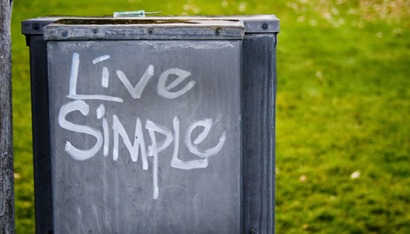
voluntary-simplicityWhat was once called voluntary poverty is now referred to as voluntary simplicity because some people seem to have had problem with the word poverty.

When you decide to go that route on your own accord, to live a simpler, more or less, poverty lifestyle, it is a different kettle of fish to having it forced upon you by circumstances, some beyond your control.

We have looked at Voluntary Poverty before so now let us consider the Poverty Mindset with which we have, more or less, been programmed through various societal pressures and via the power elite.

The reality of this here and now of our existence in this world is that money, in one form or another, is an inherent part of the global interactive construct.

While many of us, if not indeed most, would love to live in a different kind of economic collective where money would not, necessarily, be the means of exchange fact is that currently most of us live in one where we have to use money for most of our transactions regardless of our beliefs and ideology surrounding this “energy”.

This “Poverty Mindset” is a mind control program that has cleverly created and disseminated by the wealthy elite who want us to believe in and operate from. The poverty mindset formula is simple: if we don’t have access to financial abundance, then we don’t have access to the resources we require to become more effective in this world. It is a program of suppression and oppression. Interestingly, it is also a program that requires resentment to fuel it.

In addition to that the mind control has gone so far that we see everyone who does not have the financial abundance as a failure and someone who is alone to blame for his misfortune.

Those elites and “our” politicians keep referring to money as “resources”? But money is not a resource. It is, at the very best, a piece of printed paper (or minted metal), at worst it is a bunch of numbers on a screen. The only thing that gives it any value whatsoever is our shared belief in its value. This means that money is actually a faith-based religion and the politicians and bankers its clerics. But are you and I ready to become non-believers?

Money only has the value that we give it. After all it is only a piece of metal, or worse still a piece of paper, with a number, a “value”, printed upon it. If we would so decide we could use anything as “money”, such as the bits of paper for the Monopoly board game, shells, copper discs of different sizes (in the latter case at least the metal does have a value in that it is something that is needed for the making of things), or bits of wood or simply figures written in a book.

What is “Poverty Mindset”?

It is the mindset that we are being programmed with, through societal pressure, into believing that only if we have a certain amount of money, a fancy car, a big house, and so on, that we are valuable to and in society. That those that have a lot of money and possessions are our betters and thus we should look up to them and, maybe, even obey them.

There is nothing wrong with having a lot of money and there is also nothing wrong with having not so much. However, people should not be pushed into poverty through high prices and low incomes, despite the fact that they work all the given hours, while others who work little or not at all “make” lots of money. That we should not accept. The worker is worthy of his hire, and in all honesty the people that many look down upon because they do the so-called menial and manual jobs are probably worthy of it more than the bankers and the chief executives of industry. Without the worker all the wheels would stand still.

But we are conditioned to believe in this exploitative capitalist system that those “at the top” are worthy of greater pay and remuneration than those “at the bottom” and that those who are in more or less poverty have only themselves to blame for not doing well at school so that they too could be in those “higher” positions. But what would happen if we all would be academics? Who would then maintain the parks, the forests? Who would collect the trash, keep our streets clean, care for the elderly and the sick?

Everyone's hours of work should have the same value and be rewarded in the same way, for the hour of the academic, of the chief executive, of the prime minister, is worth no more than the hour of the road sweeper, the dustman, the gardener, the forester, the nurse or the carer. An hour is an hour is an hour.

It is the system that pushes people into poverty and it is also the system that keeps them there and the majority blames the poor for their condition and looks upon them as something of no value. Mind you, those of the middle class and the upper class also look down upon those of the working class as if they have little or no value. And in the poor the same mindset takes hold, of believing that they are not worthy, but also resentment of those that have more.

And all, including those that are poor not by their own choice, look down upon those that chose Voluntary Poverty; who chose a simple life and lifestyle, trying to do with little money only and few(er) possessions. Doing without a car, a television, foreign holidays, and so on. Few, even those that are poor, believe that people could be (so stupid, as many see it) to voluntarily life a life of poverty (aside from, maybe, some monks).

There should be no poverty, aside from the voluntary kind, in society, if our society is as it is meant to be, with equality. Everyone should be equally remunerated for the hours that they work regardless of what the work is that they do. But for that we would have to change the system, including and especially the “monetary system”.

When everyone's work is regarded the same and everyone is being remunerated in the same way for the hours worked in hours and not coin and when there is work for all then, and only then, the poverty mindset will no longer exist either.

© 2018

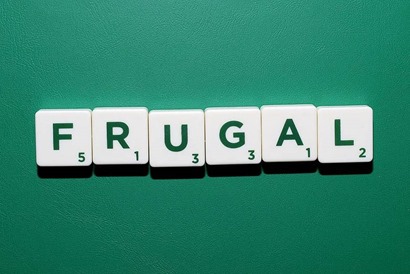
What does it mean to be frugal?

There is more to frugality than penny-pinching.

By Michael Smith (Veshengro)

What does it mean to be frugalThe dictionary defines frugality as "the quality of being economical with money or food," but there is far more to it than that. It is a word worth examining closely because it embodies values and principles through which we can improve our overall quality of life.

Most basically, frugality is about getting maximum bang for your money. It reflects a conscious effort to allocate your resources (that is to say money) in ways that offer the most value. A major part of getting value out of an investment is how well something does its job, and the cheapest item does not necessarily offer value if it generates more work, nor if it last only for a short while and then breaks.

Let us use, say, garbage bags as an example. If you purchase the cheapest bags, at 5 cents apiece ($5 for 100 bags), and they can only be filled halfway and occasionally split open, creating a huge mess on the kitchen floor there may greater value in the 20-cent bags ($20 for 100), which can be filled much further and are stronger, thus not having the mess on the kitchen floor.

There are more costs to the things you buy than just the initial dollars and cents. Using things costs time and energy, too. If you are saving money on something that is going to end up requiring additional time and energy to use, you need to make sure that the saved money is worth the extra time and energy.

Frugality means allocating resources toward things that matter to you; this can also be called “voting with your wallet.” The money you spend reflects values of many different kinds. In the example above, it it time and effort spent cleaning and taking out the trash that matter than saving 15 cents on each garbage bag and not just that, because if you need two or three bags to do the job of one it is also the resources and energy that goes into making those that you save. Other values could also be choosing plastic-free packaging, supporting a local food co-op, buying organic food, etc. Though, in general, frugality means making the pennies count and getting the best value for money and not just the cheapest product.

But frugality and being frugal is not just all about looking after our money when we buy things. It is also about making do, reusing and repurposing all the way up to upcycling, making things for your use from packaging waste, for instance, including glass jars, which are often the obvious choice for reuse. Alas, some people need reminding of that and the way our parents and especially their parents and theirs reused every jar they could and so many other things. Those jars were often the receptacles into which the other saves items for reuse where stored; buttons from worn out garments, reclaimed nails, screws, nuts and bolts, and so much more.

While with some of us frugality was put into the cradle many today have to learn it and cannot even see, for themselves, the reuse potential, say, of glass jars. As far as they are concerned those jars belong into the recycling bin and storage jars, for they have to match don't they, have to be purchased but then they have to be of recycled glass. The brainwashing has worked well. The brainwashing about recycling and buying recycled, that is.

© 2018

How to keep cool in the summer heat without cranking up the AC

by Michael Smith (Veshengro)

Chorley_Park-awnings.jpg.860x0_q70_crop-smartMany, when the temperatures soar in countries in the “West”, with the USA in the lead, rather crank up the air conditioning which is no good for them, their wallet, nor the Planet. The simple act of opening a couple of windows in the house to create a draft, the way our ancestors cooled the house, does not even occur to them. So up goes the air conditioning but the clothes remain, often, all firmly in place and even the windows firmly closed.

In many countries of the world they have a different attitude to that and that is, aside from using window shutters and awnings to reduce the sun reaching the interior of the house they rather strip off and in many cases, during the warm season, their children go bare all the time, as do some of the adults, the latter at least indoors.

siesta_boy1Tip #1 in my department, therefore, is when the temperatures sore and it gets uncomfortably (humid) shed your clothes, all of them, and all of you. It is good for all of us but especially the children as their bodies, apparently, do not control the temperatures too well. That is why we so often see red-faced kids during hot weather and them being cranky. When unclothed their bodies, and adult bodies actually too, can perform better as to temperature control. I grew up that way and can vouch for it. The standard attire for Gypsy boys in days of old was, and not only in the heat of summer, nothing, and that was not even that long ago (and in some places it still is).

Adding family nudism to the inventory, so to speak, to beat the summer heat might be a good idea on more than one level. You may even find that neither the kids, nor you, really want to be be going back to wearing clothes again for much of the time.

Tip #2 Open windows to create a through draft. Don't, however, create an invitation for burglars by keeping windows, especially on the ground floor, open during the night or when you are out.

If you want to avoid bugs and other flying critters entering through an open window or door think fly-screen. Screen doors and window screens used to be very common not so long ago and, in fact, they are still in use in many homes.

Tip #3 If possible install shutters or other blinds and use them to keep the sun at bay indoors thereby keeping the temperatures lower. Even heavy drapes will keep some of the heat of the sun at bay. Also, awnings are very useful over the windows, as was common once.

We seem to, strangely enough, have forgotten all those old ways simply because of the advent of the air-conditioning and rather run that expensive thing which costs us dearly in many ways, by way of money and also the destruction of the Planet.

© 2018

Don't try to impress people with what you can buy

by Michael Smith (Veshengro)

20604260_2114171278607919_4510769526560386680_nDon't try to impress people with what you can buy. Instead impress them – or at least try to impress them – with what you can do and make. Make from natural materials, from trash, and whatever, and thus don't have to buy.

Also with what you can do without, I would add to that. People are always totally amazed that I do not have a television, for instance. How can you not have a television and stay informed, they ask at times. Others wonder in a question as to whether I don't get bored not being able to watch TV and what I do with and in my spare time. First question here is: “what is spare time?”, for of that I do not have much. I am far too active with all manner of things. And, also, have they never heard of hobbies and books?

But, let's get back to the things that you can do (and make) for yourself instead of buying them. I am more impressed what someone can make and do then what they can buy. There money won't get them anywhere should the time come when the proverbial hits the air moving device, if you get my meaning.

Being able to make (do) and do – and do without – is what counts, as far as I am concerned, and that more and more so today where we have already over-consumed our quota of the Earth's resources and with recycling and the circular economy being but, in the main, a serious case of greenwash.

Instead of buying to impress, and buying more and more, we should and must, in fact, reduce our consumption – maybe even reduce to impress, but then again why impress or try to impress in the first place – and make do, repair, reuse, make our own, ideally from waste in the form of reuse or upcycling, and make our own from scratch from natural materials and/or from waste.

In my house absolutely nothing matches, as far as furniture and such is concerned, and many things, such as coat racks, and others, are made by myself from waste materials, natural materials or a combination of both. Found objects become decorations in one way or the other and on goes the list. And why not? Shabby chic is now seriously the in thing and such decorations are very much part of it.

Making furniture from pallets – and similar wood – was once the domain of the poor student and the hippies but today it is more or less big business and pieces of furniture made from such wood fetch high prices. But, with a little knowledge and skill, and some tools, you can make those yourself rather. The same goes for so many other things too.

That is rather the way how I like to impress people – although I do not set out to impress them – and not by buying expensive things.

© 2018

All you need is one

by Michael Smith (Veshengro)

29513116_287094908492162_7131041815685215326_n“A man with one watch knows what time it is. The man with two is not quite sure.” Unknown

So many homes are clogged with duplicate items, which are supposed to make things easier, but end up contributing to clutter and cost. But can downscaling to just one of each really be done? Maybe, maybe not entirely. It all depends on the individual's and the individual family's situation.

If you do have children who attend school then you can't just have one pair of school trousers, and one shirt, and pair of underpants, for the child unless you can wash and dry this each and every time that they need washing so they can be ready again the next day.

The same goes for someone who has to have clean clothes for work every day. Here too just having one set would not work. It is a little different if you are working somewhere where you are being issued with a uniform, and that in a couple of sets.

In most cases you will need two sets, whether this is as regards to bedding or clothes, especially underwear and socks. It would also not be very environmentally healthy, so to speak, to do your washing every day and use a tumble dryer, for instance, so as to have the clothes clean again next day.

Just having one, good, pair might work with shoes but not necessarily with anything else. You can reduce some of the clothing pile, even to a very minimalist level, if you add family nudism to the equation.

If your children are homeschooled and thus need no clothes for going to school, as they don't go to school, and can do their lessons at home in the altogether then you win even more in that department.

The one section in the clothing department you can do away with altogether, at least for the males, and that is underwear in the form of underpants. Science has shown that they are actually bad for boys and men alike.

In addition to that the idea that you only need one and only owning one item or pair of something goes against our cultural, and possibly even human, tendency to stockpile multiples for future times of need, even though most of the time those extras add more clutter, cost, and work to our lives than benefits.

Personally, I have to say that I am guilty of this, but many of the things stockpiles are consumables and it saves having to dash out to the stores when you run, say, out of toilet paper to have another couple sitting there in the cupboard.

In some departments it is possible to pare down to single items or just two of them, in others this simply does not work. With clothing this would mean that daily, more or less, you have to do the washing and then, probably, use a dryer, such as a tumble dryer, to dry the clothes so that they are ready for the next day. It does not make for savings and neither is that good for the Planet; the opposite rather.

As far as some items are concerned the question also is why own them at all. The television, as far as I am concerned, is one of those. If it has only entertaining and childminding duties then it is best not ever given houseroom in the first place or gotten rid off now. It is also not called program for no reason. It is a means of programing us and especially the kids who do not have as much discernment as adults should have.

In addition the toy department can be reduced – though ideally in cooperation with the children – as too many toys do not make for better play either. In fact the fewer toys kids own the better and more imaginary the play is.

While, as said, it can be possible to have just one items of something, as far as clothing is concerned this is not, and also not very environmentally friendly even if some may think it. Constant washing is not good for the clothes, requires water and energy, not speaking of detergent, and if the drying has to happen on the quick, via a dryer, then that costs additional energy and extra wear on the clothes.

Owning less in a way is a good idea as there is less stuff and clutter in the house, making it easier to find that single item as it is easier to designate a specific location in which to keep it. But in many cases the single items just is not going to be possible.

There are many minimalists and aspiring minimalists who believe that they are doing the Planet a service by cutting down almost to the bone but this is not always the case and what do you do if your single set of clothes that you have washed that evening is not dry for the next morning? Just one of the possible dilemmas.

You also wouldn't, necessarily, want to pare down too much on practical items like dinner plates, cutlery, etc., since that could create more work, and this is the same with regards to owning just one set of everything in regards to clothes. However, having ten shirts, ten pairs of pants, etc., as some seem to have, really is not necessary. Nor are hundreds (OK, I may be exaggerating) toys for the kids.

As far as clothes go good reduction and reduction in use is possible if you, whether you are an individual, a couple, or a family, embrace nudism, at least at home (and on the property) as a lifestyle. Also your health and that of the kids will benefit from such a change.

© 2018

Drinking the hipster way

by Michael Smith (Veshengro)

The HipsterWay1There definitely was a time when you used a jam jar or other glass jar as a drinking vessel you were looked down upon and was surely regarded as being seriously poor or a strange eccentric.

Jam jars and other glass jars were the common drinking vessels of the poorer classes for many, many decades and more and the very term of “having a jar”, referring to having a drink, even in the pub, probably originates from that. More than likely they even brought their own appropriate jars to the pub.

Robert Tressell in his book “The Ragged Trousered Philanthropists” mentions on more than one occasion, I believe, of the workers drinking their tea during their break from jam (glass) jars.

When I was a child drinking glasses in our home were reserved for guest and all the family, though especially the children, drank from glass jars of various sizes for various purposes. Cheaper also to give children a jam jar, for instance, and have him drop that and break it – at least in those days – that a real drinking glass which would cost money to replace.

Personally I have kept this habit and my (personal) drinking glasses are all reused glass jar of different types and kinds and even the water bottle that I use by my desk is a glass jar, in that case a reused Bockwurst glass from Aldi.

Nowadays it has become the hipster thing to do to drink from glass jars (again) and many fashionable bars and coffee shops serve cold beverages and smoothies in glass jars to their customers.

But, hold it! No ordinary reused jar will do. No way, Jose! It has to be Mason jars. And they do the same at home but also there, in their own four walls, it has to be bought Mason jars. Reusing jam jars they could not possibly do. What would others think. Empty jars are for the recycling bin. One has to do one's part as to recycling. It would not do to reuse those jars. (Sorry, my sarcasm has got the better of me again.)

As drinking from glass jars – canning jars – has become so very trendy why not go the reuse route and make use of those that come with the products you buy.. After all you have paid for them through the purchase price. Much better for your wallet and for the Planet than buying – rather expensive – canning jars for the same purpose.

© 2018

Zero waste myths: should we really be avoiding plastic?

by Michael Smith (Veshengro)

Zero waste myths_ should we really be avoidingnbspplasticFirst of all it also must be said that “zero waste” is a myth itself. There is no such thing as “zero waste”. It will never be possible. Having said that, however, does not mean that we should not reduce waste, especially in way of packaging, and waste that occurs also through planned obsolescence.

Images of ocean plastic pollution are causing so much revulsion that many people are switching to some supposedly more “environmentally friendly” materials to try to reduce their impact. But does this actually work? How much greener are the alternatives?

Also, there is plastic and then there is plastic. Single-use plastic, in my opinion, is a bad idea. We should, with the exception of may be a few things, avoid any kind of single use altogether. Other plastics, for plastic products intended to last for a long time, are a different story and here the material, quite often, is the appropriate one, unless we return to (more) natural materials.

Plastic vs Paper: It is easy to see how paper bags are seen as and appear to be more environmentally-friendly than plastic ones. They are made from trees, which grow in nature, and can biodegrade, in fact compost, when they are finished with.

Research, however, consistently finds that paper bags have a far higher carbon footprint than plastic ones, because the process of making them uses so much energy, and not just energy but also lots of water. Trees may be in harmony with nature, but the process for mashing them up into paper is not.

True, paper bags can decompose, but it is not exactly zero waste to use so much energy producing something that is not designed to last. And if you are careful to reuse and recycle a plastic bag, it should be possible to prevent it ending up as litter or in the ocean, whereas every single paper bag will have made a hefty contribution to global warming, regardless of where it ends up. The best option, of course, is to avoid the problem of single-use waste altogether by using reusable bags.

If you are a business and you want to offer something to customers who have forgotten their own bags, consider doing as Arjuna Wholefoods in Cambridge does, which is to invite people to drop off their old plastic bags to be reused. Alternatively, bags made from recycled materials is the next best thing. Just please don't hand out new single-use bags for free, as this does not reflect how much it costs the Earth to produce them.

As for the idea that paper is “more recyclable” than plastic, this has now been repeated so many times, that it has become almost fact. While it is true that paper can be recycled, the quality of it degrades in the process. Plastic can also be recycled, although some types of plastic are easier to recycle than others, and packaging that mixes plastic with other materials can be more tricky to recycle (single-use coffee cups are the most well-known example of this), but also here, in the main, the quality deteriorates and to make good new plastic from recyclables a great deal of virgin polymer needs to be added to the mix. So, there is no such thing – generally – as 100% recycled plastic, with a few exceptions, maybe. .

So, when it comes to recyclability, there is not that much to be gained from choosing paper-based products over plastic ones, and anyway, it is actually a big mistake to be overly focused on how recyclable something is, when most of the impacts of the stuff we consume is in the process of producing it, rather than what happens to it at the end of its life. This is true regardless of the material, but in terms of paper, we need to factor in how much carbon it takes to produce it.

The best way to lower impacts from packaging waste is to reduce the amount of packaging that we buy, and where possible, buy products packaged in recycled materials. Though it has also be said that often we, as consumers, do have little choice as to the amount of packaging of any kind, be this paper, cardboard (often laminated with foil), or plastic except by voting with our wallet and not buying over-packaged products. This can be a difficult undertaking, however,

Plastic vs Metal: Stainless steel tins and bottles are something of a zero waste style statement. There is no doubt that they look good, but the process of producing metals like stainless steel and aluminium releases scary amounts of carbon into the atmosphere. This means that reusables made from metal will need to avoid a lot of waste before they save more resources than it took to produce them.

The choice is really up to each of us: Option one would be stainless steel (or other) products, which are very high impact to produce, but highly durable, or option two would be plastic bottles and containers, which are more environmentally-friendly to produce, but tend to wear out somewhat more quickly, so that you may end up using more of them in the end. This is essentially a judgment call, based on your personal routines and how much waste you expect to avoid by using your reusable bottle and containers.

Single-use cups vs reusable cups: Several studies have looked into how many times a reusable cup needs to be used before it saves more resources than it took to produce. As they are carried out by academics, there is no simple answer – it depends on which type of reusable cup you are using, which type of single-use cup you are trying avoid, and which environmental impact you are considering – but it seems to range from 5-16 times. So, if you would otherwise expect to use at least 17 single-use cups, consider investing in a reusable one. For top marks, see if you can pick one up in a charity shop or other kind of secondhand store.

Glass jars vs plastic packaging: The jury certainly appears to be out on this one still. Glass tends to lose points compared to plastic because of the high carbon emissions involved in manufacturing and transporting it (think of how much more glass weighs) but can redeem itself by being more efficient to recycle than certain types of plastic. Glass jars, for instance, if we want to be thrifty in the way our grandparents and their parents were, also have a great reuse potential for us, whether as storage jars for all kinds of things or as drinking vessels, etc. And the reuse thought should always come well before any thought of recyclability.

If you can and will reuse or refill jars, the that is your best option. Otherwise, there is, apparently, no clear justification for always choosing glass jars over plastic.

Plastic bags vs cotton or other textile bags: Its a bit of a mystery why cotton has gained a reputation for being an environmentally friendly material. It takes 20,000 liters of water to make 1kg of cotton, and much of it is sourced from countries where water is extremely scarce. Worldwide, cotton production causes pollution and biodiversity loss. But there are alternatives to cotton and cotton bags, such as hessian, aka burlap, canvas, and others, including, though it is oil-based to some extent, woven and non-woven polyester bags.

When it comes to plastic there are – if I may put it this way – good plastics and bad plastics and I am not putting so-called bio-degradable into the category of good necessarily either. Also, as far as plastic water bottles, the reusable kind I mean here, are concerned not all leach chemicals. It all depends on the plastic. The Dutch designed (and produced?) “de Dopper”, as an example, does not, and is also of a rather ingenious design.

The biggest problem is plastic packaging and the over-packaging of products, often products that do not need to be packaged in such a way at all. That is where the changes have to happen and we must force industry to make the change.

© 2018

Don't weed them – Eat them

by Michael Smith (Veshengro)

How to use and benefit from Dandelions

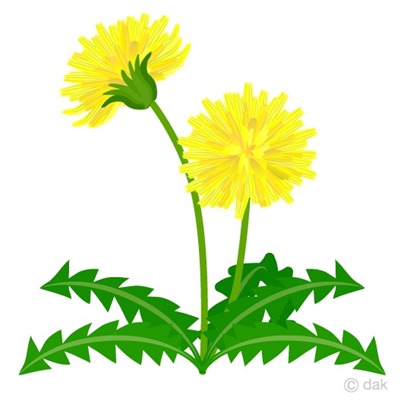
Dandelion-clipart1We are now entering the season where people will start to do battle again with the weeds in the garden beginning, no doubt, with the humble Dandelion. But if these maligned yellow-blossomed plants pop up in a yard or garden, there is a much better way to “control” the problem and that is by eating them. But, even though they are edible, do leave the flowers as they are some of the first nigh-nectar flowers the bees will need after winter.

Every part of the Dandelion is edible – leaves, roots, stems, and flowers. And the plants are nutritional powerhouses. The greens are rich in beta-carotene, fiber, potassium, iron, calcium, magnesium, phosphorus, B vitamins, and protein. Their nutrition profile compares favorably to kale and spinach and trounces iceberg lettuce, the most widely eaten salad green in the United States.

It may sound strange to forage in the backyard for dinner, but wild greens were once a dietary staple around the world. Many cultures still eat them regularly. Apparently many people in France deliberately grow Dandelion in their gardens as a greens while we in the UK, the USA, and some other places, try our very best to eradicate this beneficial weed.

Some North Americans have caught on to Dandelion's “superfood” status. High-end farmers' markets and boutique grocery stores often sell them in small, expensive bundles. But thrifty consumers can gather Dandelions from lawns and urban meadows for free. However, not all Dandelion greens are equal. It pays to know when and how to safely pick them.

On the other hand why not harvest those in your own garden and why not, like many French gardeners do, grow them deliberately. I have been doing that for years now. I tend to remove them, as far as possible will all of the roots from where I may not want them to planters where I want them to grow.

I get great pleasure out of people – I work in a public park and garden – asking when I am weeding: “As a professional gardener...” and I already know that nine times our of ten the continuation of question will be “...what do you suggest I'd do with the Dandelions in my garden?” To which I, invariably, reply “eat them!” The looks on the faces, generally, are priceless.

Once I said that and got the usual “but aren't the poisonous, seeing they have milky sap”, etc. when a French lady stood nearby who then, when the questioner had gone, commented that she did no understand the Brits as regards to their obsession as to getting rid off Dandelions as the French grew them on purpose and used them.

The entire plant is, by the way, edible, from leaves, over stems to flowers and roots. The French use the leaves in place of rocket salad leaves or the older ones sauteed with garlic as a side dish. The Greek dish “Hortes”, meaning simply “greens” is made of Dandelion and some other wild leaves, including stinging nettle.

How to harvest Dandelion greens: First, be sure to identify Dandelion correctly, because it has a few doppelgangers. Look for smooth leaves shaped like jagged teeth. The plant's name comes from the French dent-de-lion or “tooth of lion”, that's why the German name is “Loewenzahn”. Dandelions' thick stems are hollow and filled with milky sap. Catsears – Dandelions' most ubiquitous look-alike – are often called False Dandelions. They are distinguished by hairy leaves with round lobes and wiry, branched stems. Catsears are edible, but the leaves are not as palatable as those of the Dandelion. Also it must be remembered that not every Dandelion looks alike in the shape of their leaves. Some are wider and bigger, some thinner and smaller.

When harvesting Dandelion leaves pick them from lawns, or other areas, free of pesticides or herbicides only. Avoid areas near building foundations, streets, and driveways, where the soil's lead levels tend to be highest. And always wash the greens well. Alternatively, or in addition, you could, like many French gardeners do, plant Dandelions on purpose.

For the most tender and least bitter greens, herbalists advise foragers to harvest before the plant flowers. However, it can be tricky to find the leaves before the blossom appears. Raw Dandelion greens will probably taste bitter to most people, regardless of when they are harvested. The key is to look for tender leaves and learn how to prepare them based on taste preferences.

The bitterness, however, is no reason to lose out on the benefits of this nutritious plant. There are plenty of tactics to tame the bitterness of Dandelion greens. Moreover, food preferences are malleable and based on exposure. In addition, many health experts believe bitterness is an important, often- neglected key to optimum wellness.

Bitter foods for better health: Bitter compounds are plants' way of protecting themselves from being eaten by mammals. Bitter plants are more likely to be dangerous to humans, so we are acutely sensitized to the taste. However, bitter plants are also more likely to be highly nutritious, because hytonutrients have a bitter, sour, or astringent taste. It is no coincidence that kale, broccoli, Brussels sprouts, and other phytonutrient-rich foods are bitter.

Unfortunately because of consumer preference the food industry has largely bred bitterness out of our food. As a result, we lose out on more than just nutrition. Bitterness is important for liver health. It stimulates the liver to produce bile, which aids digestion and nutrient availability. Bitter foods also modulate hunger.

Eating Dandelion is an excellent way to benefit from bitterness, and Dandelion's curative powers go beyond its bitter taste. It has been used as a medicine for thousands of years for numerous conditions. In fact, its Latin name Taraxacum officinale means the “official remedy for disorders.” What kind of “disorders” is not specified.

Dandelion cures: Native Americans boiled Dandelion and drank the water to treat kidney disease, swelling, skin problems, heartburn, and stomach troubles. The Chinese use the plant to treat breast and stomach issues and appendicitis. In Europe, it has been used for fever, boils, eye problems, diabetes, and diarrhea.

Modern scientific studies are scant, but research has confirmed Dandelions as a folk-remedy diuretic. It is prescribed for edema in Germany and may be safer than other remedies because it replenishes potassium. Preliminary animal studies suggest that Dandelion may help normalize blood sugar and fight inflammation.

Recipes for the use of Dandelions can be found in large numbers in certain books and, nowadays, all over the Internet. My personal favorite is the way we used to eat Dandelion leaves as children, in a sandwich just with butter, salt and pepper. Or, if really decadent, then a good mayonnaise is substituted for the butter. Another is sauteed as greens, with garlic in oil and spices.

Here a link to a more sophisticated recipe using Dandelion greens: https://www.motherearthnews.com/real-food/fresh-dandelion-spring-salad-recipe-zerz1802zmos

© 2018

Take back the tap

by Michael Smith (Veshengro)

Take back the tap: Let's put and end to the big business fraud of bottled water

Take back the tapCorporations like Nestlé are wasting your money, and not just Nestlé. All bottled water is a scam and to a great extent the water actually comes from the same source that you have in the kitchen, the faucet, the tap. At times it may have been filtered to remove chlorine and the taste of it but it is still nothing but tap water and you pay hundreds of times as much for a bottle than you would if you fill up your own at home.

Industry marketing from corporations like Nestlé, and others, means that more people are buying bottled water than ever – even though about 64 percent of the bottled water comes from municipal water systems. That means that people buying bottled water are paying much, much more than they would for that same water from the tap. Bottled water is literally more expensive than gasoline – and about 2,000 times more expensive than tap water.

Bottled water companies profit from misleading advertising. People and the environment lose and this advertisement targets people of color, women, mothers, children and lower-income groups.

Industry marketing strategies designed to promote the safety of bottled water to people who historically lack access to safe tap water (especially recent immigrants) prey upon those who may mistrust tap water and communities concerned about obesity and sugary beverages.

The truth, however, is that tap water, generally, is more rigorously tested for safety than is any kind of bottled water and many of the bottled water that is marketed as “spring water” actually sprung forth from the same source as the water in your kitchen, namely the tap.

While it has to be said that in some areas in the USA, one of the richest countries in the world, the municipal water is not very good (and also not very safe when one considers some areas) but in general tap water is safe and a great deal cheaper – and safer – than bottled water.

The abstraction of water for bottling, often from municipal sources, prior to going into the general consumer stream, put a great strain on often already overstretched water resources and in some places, where the abstraction happens from aquifers, it puts water for people, animals and crops at risk but still Nestlé even is permitted to abstract water in times of drought in places such as California. They would otherwise sue the state for damages. Industry comes always first in capitalism.

Companies such as Nestlé also greatly benefit from public disinvestment in water infrastructure, as the chairman of Nestlé Waters stated in 2009: “We believe tap infrastructure in the US will continue to decline. People will turn to filtration and bottled water for pure water needs.” Well, that is definitely what they hope, aided and abetted by the senators and other politicians that they have paid off.

According to the CEO of Nestlé in a statement some years ago water is not and should not be a human right but should be for the corporations to make profits from. That is how callous those capitalists are. Every bit of Nature and human need is there only for their exploitation and profit.

On the water from we can fight them by refusing to fall for their tricks and filling up our own reusable water bottles at home – and at refilling stations, where they exist, and more and more are coming “on stream” – and thus not giving them our hard-earned money and making them rich.

Then we must demand from the powers-that-be in our countries, powers that often better would not be – that water infrastructure, including waste water, as much as other utilities, are taken (back) into public ownership and if that means outright expropriation. Vital utilities and services such as water, energy, health, transportation, and many more, should never be in the hands of private business, but in the hands of the people as a whole, either as co-operatives or in the hands of the state.

© 2018

Uses for empty plastic containers in your garden

by Michael Smith (Veshengro)

HarvestingTubs1Plastic bottles to garden cloches: It all, obviously, depends on the size of the bottles but I, personally, use everything from 1 liter (over 3inch pots) to bigger ones – for seed raising. The large one gallon water bottles that, after events in parks and such, are so often tossed out, I use as cloches for bigger plants in the garden itself.

The standard PET bottles of one and even two liter, with their bottoms cut off, fit nicely into the rim of or just over the standard 3inch pots and leaving the top intact and thus removable gives a chance to, when needed, give to air to the mini-greenhouses thus created.

Milk jugs can also be used in the garden as cloches, and they even, as they are opaque, are better for the plants to some extent, as they prevent scorching.

Plastic buckets: The buckets that I am talking about here are those in which various products come for the catering trade, whether it be mayonnaise, oil, or marinated herrings. Most are about a gallon in size, some are bigger, some also smaller, and they make for great bucket garden planters but, obviously, as well can be used as buckets for any number of tasks in and around the garden, as many do have handles, some steel wire, some plastic.

Uses for empty plastic containers in your garden1I have seen several market gardens where all the produce is grown in such buckets and so why should we not make use of those rather than have them go for, if they do, recycling or, as is mostly the case, to landfill. A couple of good sized holes drilled into bottom and the sides around the bottom for drainage and ready you are.

While it is true that many of those containers can be recycled they are not in some areas, or not all, even if they are put into the recycling bins. Thus us finding ways of reusing them is the better option. It also saves us gardeners money.

Harvesting containers: Plastic milk jugs of the 4pt and 6pt size, with a section cut out but the handle left in place and intact, make for great little daily harvesting “buckets”. They also can be carriers for small hand tools for the gardener. If you would want to you could slide one or even two of those onto a belt and then be able to work hands-free.

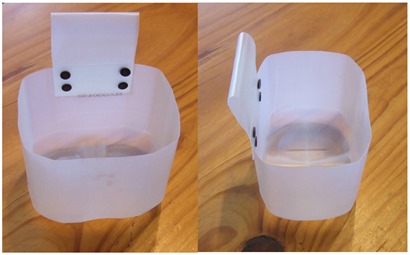
Harvesting or deadheading tub: This is made from the bottom section of a 4pt plastic milk jug (British) and for a belt loop a length of plastic from another jug was riveted to it. Costs were just a little time and a couple of rivets. (see main photo).

Harder plastic bottles such as those from cleaning products can be made into soil scoops, funnels, and many other things useful in the garden (and also around the home).

Those, together with lotion bottles, also can be upcycled and converted into holsters, whether belt-worn or just as pocket protectors, for carrying the likes of secateurs (pruning shears), trowels, as well as sharpening stone(s) for scythe. But the uses are only limited by your imagination.

Personally I am always looking for new ways to repurpose and upcycle such container for use in the garden, around the home, etc., as in fact with much of the waste products that I come across. One just has to think laterally a great deal and sometimes get inspiration from homeware and gardening equipment catalogs. That is how the idea for the harvesting tub from plastic milk jugs came about.

The same I did with various upcycled milk jugs that are on my kitchen windowsill and hold all manner of things such as the dish brushes, etc. The idea came from plastic homeware items from a catalog. I don't buy if I can make it myself, is my motto, and thus such things can be rescued. Problem is only that there is only that many that you can actually reuse yourself, even if you make cloches for the plants in your garden. OK, I guess it depends on the size of your garden.

Waterers: PET and other plastic bottles can also be made into garden waterers, stuck into (spout down), or embedded in, the soil (bottom cut off for the former) and filled (and refilled) with water (as needed). Obviously the bottle needs some holes in it so the water can trickle out.

Whether in the home, the workshop, the garden, or even the home/office, there are reuse and upcycling possibilities for plastic bottles and other plastic containers galore and the possible uses would be enough to fill a book at least.

So, let's reduce the plastic waste that there is by making use of those items that come our way rather than even sending them for recycling. A bit like with glass jars that can be used for storage and such it means what you can reuse and upcycle you do not have to buy. A win-win situation for you and the Planet.

© 2018

Uses for plastic containers

by Michael Smith (Veshengro)

New uses for plastic containersPlastic packaging and plastic containers are everywhere, they are ubiquitous, and most end up in the landfill for recycling does not always happen in the way that we are being told. In fact, quite often it does not happen. Now that China has closed its doors to plastic (and other) recyclables from the Europe and America the problem is going to get bigger still.

We can also not expect that the uses of plastics, for packaging especially, is going to go away soon and even so-called bio-plastics, biodegradable and even – supposedly – compostable plastics are still plastics and most will only compost, when it comes to the latter, in commercial hot composting facilities and not in Nature per se, and not even on your domestic compost heap or in a composter in your garden.

So, what do we do? Aside from reducing where we can we must look at reusing and upcycling wherever possible. As far as plastic containers are concerned they come in many shapes and sizes and thus to many reuse and upcycling possibilities.

There are the humble milk jugs in a variety of sizes. In the UK they are pint, two pint, four pint and six pint sizes while in the US they happen do be different and also come in gallon size. They all, as far as I am concerned, have reuse potential and I have made a variety of things from them, including a belt-wearable berry picking/dead heading container for gardening (see photo).

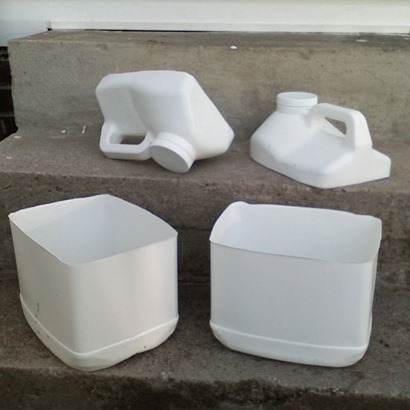
Milk jugs, of all sizes, can also be used as planters, for seed starting as well as for growing plants. Larger plastic jugs, like those used in commercial catering and also for other purposes, often small to large jerrycan size and style, can be reused, repurposed and upcycled also into planters.

The same goes for plastic buckets in which many products come when purchased in bulk, or for commercial catering, for instance, such as mayonnaise, oil, etc. Those buckets, often gallon and greater in size, make great planters in the garden. Drill holes into the bottoms, and, maybe the sides, of the emptied and cleaned containers, and then use them for growing vegetables or invasive plants, such as mint. You can also use the plastic buckets to organize and haul garden materials and compost, sort laundry, or store household items.

But they can also be made into other useful items, such as storage drawers, and smaller ones can be used for dividers in desk drawers and such. The only limitation, probably, is set by your imagination or lack thereof.

From plastic lotion containers (bottles) holsters and pocket protectors can easily be made for safely carrying tools, such as, say secateurs. They can either be fitted with “straps” so they can be worn on the belt, or shoulder straps, or they can just simply be put into the pocket. The tool is safely encased in the holster and thus will not damage the clothes or the wearer.

Other bottles from strong plastic, such as those from cleaning fluids, for instance, can become holsters for scythe sharpening stones, the name for which I rather not mention here as nowadays it is considered a cuss word, as it has four letters, begins with a “c” and ends in a “t”. But, honestly, that is the real word for such a holster.

Many other items of plastic packaging also, no doubt, have reuse, repurposing and upcyling potential and I am sure we can all create a whole list of ideas in this department. Often all that is required is the correct mindset, imagination and inspiration.

I strongly believe that there is even potential, as far as plastic containers (and such) are concerned, for upcyling business ventures if people can be brought to understand to buy into the concept – literally as well.

© 2018

Make toys with and for your kids instead of buying toys

by Michael Smith (Veshengro)

cup&ball_game1-1In order to present your child with a toy they will be excited about, you do not necessarily need to rush to a toy store and spend hours wandering between the shelves and a great deal of money. It is quite easy to make wonderful toys at home from available materials. Even better still if you and your child make those toys together.

Make toys with and for your kids instead of buying toys for them. There are toys, simple and not so simple ones, that you can make together and there are also the ones that you may have to or wish to make – on your own – for them.

Slingshot (catapult): While in some people's mind this might be rather controversial I will still mention it. I have yet to come across a child, especially a boy, who would not relish having one of those beanflippers and, as long as he is taught not to do the wrong things with it, a catapult (slingshot) is a fine toy and gift. It is also one of those that you and the child can make together.

Wooden blocks: Offcuts from carpenter workshops and such can be made, with little work, into a set of wooden (building) blocks for children to play with. No need to spend money buying those things at often great cost. It is also possible from such offcuts to make “Lincoln Logs”, for instance. Such toys will give years of happiness in play and construction as they are ageless – in more than one way – and the play is only limited by imagination.

Wooden cars, etc.: Can also be – with some skills – quite easily made from such wood offcuts and can be very simple or quite elaborate. The skill level here has to be somewhat higher than for wooden blocks and it may also require a little more in the way of tools.

Tip cat: Very simple to make and will give hours and hours of fun (and exercise). Mostly intended for use outdoors. Pakistan this toy and game is called Gulli-Danda (elsewhere it goes under different names but is the same) and there it is played a little like cricket with teams. Very easy to make and lots of fun. Tipcat can also be played alone and is still great fun.

When we were children a carved tipcat was always in the pocket to play the game as, generally, a suitable stick was always to be be found and, as we always carried a pocketknife, cut to size. However, a special one could be made and used instead.

Stick gun: “Oh, what is he on about now?”, I can now hear some readers ask. Which child has not, wandering in a park of wood, picked up a stick that resembled a gun in some way and played with it? Most will, I am sure. This, though, is a deliberately chosen piece of wood (stick) and fashioned to create a stick gun he will keep to play with and may even cherish. They can now be found on sale – yes, you wouldn't believe it – at stores such as Habitat at around $15 each for a “pistol”. Yes, the world has apparently gone stupid.

Bullroarer: The bullroarer, rhombus, or turndun, is an ancient ritual musical instrument and a device historically used for communicating over great distances. It dates to the Paleolithic period, being found in Ukraine dating from 18,000 BC.

In ancient Greece it was a sacred instrument used in the Dionysian Mysteries and is still used in rituals worldwide.

Along with the didgeridoo, it was a prominent musical technology among the Australian Aborigines, used in ceremonies across the continent.

A bullroarer consists of a (weighted) airfoil (a rectangular thin slat of wood about 15 cm (6 in) to 60 cm (24 in) long and about 1.25 cm (0.5 in) to 5 cm (2 in) wide) attached to a long cord. Typically, the wood slat is trimmed down to a sharp edge around the edges, and serrations along the length of the wooden slat may or may not be used, depending on the cultural traditions of the region in question.

The cord is given a slight initial twist, and the roarer is then swung in a large circle in a horizontal plane, or in a smaller circle in a vertical plane. The aerodynamics of the roarer will keep it spinning about its axis even after the initial twist has unwound. The cord winds fully first in one direction and then the other, alternating.

Having said all that it is easy to make, does not have to be that large, and can be a fun toy for a child of (almost) any age. Scrap wood from woodworking projects or from a wood yard, often free at some places, would do nicely.

Tic Tac Toe: This game that, when played on paper often referred to as Naughts and Crosses, can, with a mat or board, made from waste materials, such as bottle caps of two different colors and, once again, cost nothing.

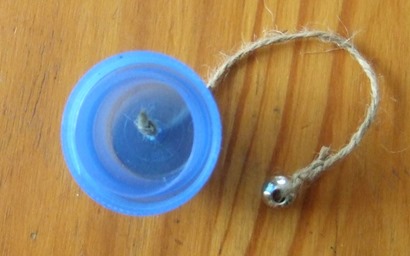
Whirligig: This is a very old and simple children's toy that have been around for the gods only know how long. Probably made with a wooden disc in the very distant past it was later made with a (large) button.

You can make it in ten minutes, but your children will be playing with it for hours. Used to be made from a large button, as said, and could very well be done from, say, a plastic milk jug lid.

Cup & ball toy: Here is one of those where you can make use of those ubiquitous single use cups, or it can also be made from other stuff, such as the plastic cup lids of liquid detergent bottles (as in the the case of the “model” in the picture).

There are a great many different toys and kinds of toys that you can make for and with your child, often even and especially from waste materials. The only limit is the imagination. You have to still have a child-like imagination often to see the potential of this or that in order to turn it into a toy, or several different things into the one toy. Toy cars and other toys from empty plastic bottles, those from the stronger plastic and not the PET, come to mind, for instance.

The children in many places in Africa, Asia and South America make amazing toys from waste materials and this could also be something done by us and our children.

We all know that all too often an expensive toy is being played with for a short time and then ends up in the toy box never, or rarely, to see again the light of day.

Another thing, and I am sure that someone can come up with a reuse solution, is using the bottle caps of various sizes and colors, with which to make things, as in toys (and also other things). Clip It (http://clip-it.fr/en/) is fine and good but the clips, in my opinion, are rather expensive and I am sure that parents and children, together, might come up with their own solutions.

© 2018

Let them get dirty

by Michael Smith (Veshengro)

Let them get dirtyWarning! I am going to be controversial again...

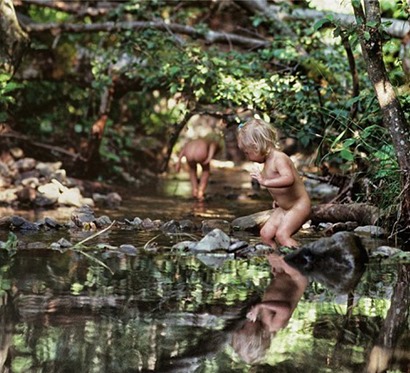
Mud and dirt is good for your children but if you don't like washing their dirty clothes – even their play clothes – all the time then let them get dirty naked. It is good for them and boosts their immune system no end, especially both together. Nudity for children, especially boys, also ads additional metal health benefits due to the stimulation of the skin (so say some experts).

It turns out that both getting dirty and being naked as much as possible is the best way to boost the immune system of children no end. Being naked stimulates, in addition to all the other benefits, nerves and also being in that state releases various hormones that are beneficial during development but also equally good for the adult.

Let them dirty get nakedWhen I was a child we could get dirty as much as possible – and by the gods did we ever – without having to worry about our parents and elders chiding us about our dirty clothes. We, at least the boys, wore none. It was easier, so our parents' and elders' reckoning to wash us than to continuously having to wash our clothes. It was also a great deal cheaper as we needed fewer clothes.

While this was at a time when we did not have much in the way of clothes anyway, and not much of anything really, and washing them was not always as easy as it is for most folks today, the fact that both dirt and nudity were good for us made up for it all. Not that we minded being naked (and dirty) one bit; in fact we hated the very idea of wearing clothes.

I have yet to encounter a young child, especially a boy, who would not prefer being naked over being dressed, especially when that permits him to get as dirty as he likes without getting told off for it by his parents or carers. Naked he can splash in the muddy waters and roll in dirt and mud as much as he likes, and wipe his hands not on his clothes but on himself. All that is needed at the end is to hose him down (literally).

Dirty kids equal healthy kids

Emerging research points out that the backyard garden just may be the cure for what ails us. But then that is, basically, already something that our grandparents and great-grandparents knew. Many a grandmother will have said: “A little dirt does not hurt”. And right she was. In fact, it turns out it is actually good for kids (and us all).

While in today's Western culture, children with soiled feet and grass-stained knees are hurriedly rushed to the bathtub and slathered with antibacterial soap, the loss of our connection to the garden and its dirt means a loss of connection to all the good microbes that live inside it. Too much bathing, showering and such is not good for the children and their immune system either.

Our industrialized world has become squeaky clean – and chronically ill. Many children today are prevented from going outside to play, whether to keep them clean or due to an inflammatory condition, such as allergies, asthma or eczema. Many of these ailments can be traced to a lack of good dirt in our own bodies. The problem, as it seems, may actually turn out to be the solution.

Worldwide studies based on children's lifestyles are proving that early exposure to a healthy microbiome – the community of bacteria living in your body – is a key factor to a strong immune system later in life.

The so-called anti-bacterial soaps, etc., are also seen, now, finally, as a problem rather than a benefit as they destroy all bacteria, including those that we actually need, and especially the young body in order to build a strong immune system.

Grandmothers all around the world used to say: “A little dirt does not hurt” and it turns out that not only does a little dirt not hurt but actually is good for us all and exposing – literally – the whole body to it, and those bacteria that it contains, is better still. This is probably one of the reasons why nudist children are less prone to all those ailments than children who do not come from families who live a natural life in the nude, the way that we all were made.

© 2018

Plogging... or picking litter while you jog

by Michael Smith (Veshengro)

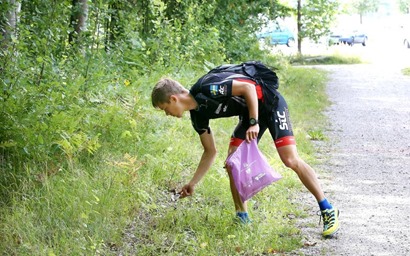
Plogging SwedenPlogging is a new concept in and from Sweden that hopefully is going to make its way to other places as well. Plogging is the Swedish word, or better the English translation for it, for just picking up trash while you are out jogging.

It is also super easy. Just bring a plastic bag with you on your next run, walk, hike or trailrun and just pick any trash you might find a long you way, so it it not just for joggers.

If everyone going out for a walk, walking the dog (yes, and please pick up your dog's mess as well), would do this there would be a great deal less litter in our parks, countryside, towns and villages. Fair enough, if people would actually not throw their littler away outside but dispose of it properly there would be less still.

In the Summer of 2017 the 1st official plog run in Örebro and about 15 persons turned up at Naturens Hus. They split up into 3 groups and headed out in different directions. An hour later they all met up again to put all the trash they found in larger plastic bags.

All in all they collected around 10-12 kg of trash during that plog and found everything from cigarettes, napkins, plastic containers to broken bottles. And that while that is a area of Örebro that is considered one of the cleanest places in town.

In the large local park with which I am concerned a number of responsible dog walkers not only pick up their dog's waste but also pick litter on their rounds, while there are other people who simply walk in the park who do this too.

As I said earlier, if everyone would do just a little of that when walking or hiking, etc., things would begin to look a great deal better and a lot less little would find its way into water courses and the sea. Better still, as mentioned, if people would actually start to learn to be responsible and take better care of their litter things would be much better still.

It is not the fault of the plastic bottle that it ends up in the river nor the fault of the plastic bag that it ends up in a tree. The fault lies with inconsiderate and lazy people who cannot be bothered to dispose off their trash in the proper manner.

© 2018

Wayward socks and gloves

by Michael Smith (Veshengro)

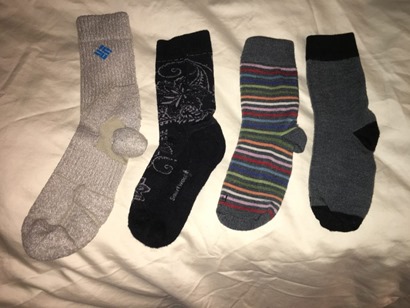
wayward socksFor some unknown reason washing machines seem to eat individual socks and, at times, it seems, also individual gloves, but they do seem to have a penchant for socks, and then a poor orphaned, wayward, sock or glove is left to fend all for itself. So, what do we do? We mix and don't match, that's what we do. Or that's what we should be doing.

I come across lost and never looked for again gloves, mostly single ones, as well as other clothing such as children's socks, again mostly single ones, but also others, in the municipal park here on a regular basis. Generally I do take them home, wash them and, in the case of gloves and socks, I try to, somehow, match them and make new unmatched pairs.

In fact, a number of years ago I wrote about turning odd gloves into unmatched pairs and that idea of mine was – shall we call it what it was – stolen by an enterprise online that then commercialized it by asking people to send odd gloves that they found to them for them, the “enterprise”, to “match” them up with others for sale.

When it comes to wayward socks at home – or when one sock is damaged beyond repair while the other one is still OK – why sort of not matching two of those up and wearing them should not be the way to go. Mismatched has, to some extent, it would seem, become fashionable even, at least among some. This can also be a way of rescuing found socks, especially for toddlers and children, and create unmatched pairs for them. Waste not want not.

When it comes to holy (not as in sacred but as in having holes) socks, nowadays, darning them is (almost) impossible due to the materials being used in the manufacture, with the exception of high quality expensive ones, maybe, and hand-knitted ones. So, let's pair up the unmatched and use those that are gone (beyond repair although often repair is not even possible) for other purposes before tossing them out. Worn out socks that are not repairable can be used as application cloths for shoe polish and even for polishing shoes, as dusters, and many other uses.

© 2018

Be happy with the little that you have

by Michael Smith (Veshengro)

Be happy with the little that you haveBe happy with the little that you have. There are people who have nothing and still manage to smile.

Many of us want more, more and still more while, in fact, we have all that we really need, at least in comparison to others who have nothing but who, more often that not, are happier than those who perpetually seek for more.

I have, and so have many others, found that it is also those very same poor who will share with you the little they have – without a second thought – while those who have much will not share even a little. “It's all mine and you can go and (enter your own expletive here, if you so wish)”.

It is, and I am not happy to admit that, not always easy to be prepared to share, especially not if you have grown up poor and are afraid to lose again what you have now. But being happy with the little that I have now I, basically, am and I, but then that is me, do not desire to have more than I need. What for?

Though, alas, I do have to admit that I have, at times, I bought far too much in the way of clothing, from charity shops though, I hasten to add, and now have more than I will, probably, ever be able to make use of. But those purchases were all very cheap but good quality and some, though theoretically secondhand, had never been worn and thus I do not, really, regret purchasing them. Whether I'll ever get to wear all of the stuff I do not know. On the positive side though I will not have to buy any clothes, bar the essentials, for a long time to come (if I don't put on weight, that is).

In order to be able to make many things myself I must say that I do own quite a few tools, some new, some old, and I do like to upcycle a lot of stuff (hence the tools) including pallets. If I can make something I need (and want), or repurpose or upcycle for that purpose, then I will do just that. My philosophy always has been that and that is what I grew up with, having little as a child.

Our toys where those that were handmade for us by others, that we made ourselves from natural materials or trash, or those that we found. Our clothes, if we wore any at all, were hand-me-downs, often from other people's children, and some where even homemade. Still, we were happy for we were being loved and cared for. We had fun with those toys we had and even greater fun making them, and fun not having to wear any clothes for much of the time. I believe that it does not take much to be happy, even with little in materials things, as long as the emotional needs are met. And I guess that why so many who have little to nothing but have community are happier than those who have so much in material things.

© 2018

Simple, frugal and eco living with children

by Michael Smith (Veshengro)

Simple, frugal and eco living with childrenMany people think that simple, frugal and especially eco-friendly living with children is an impossibility, as kids cost so much money in what they need.

But what do they really need? The greatest, the most important, need a child has is love and care and that should come free. Other things are, sort of, optional extras. And once again, without apology though, I have to warn people that some of my suggestions may be seen as controversial.

Clothes: As few as necessary, and those should, ideally, be secondhand, otherwise let them go naked, at home, and such, where this is possible, especially the boys that haven't reached puberty as yet (or bare bottom, if it is a little too cold). This is a common practice in many countries and cultures, especially in China and Asia, for the boys particularly, and it seems to benefit them no end physically and mentally.

But I don't want skid marks on the furniture, such as armchairs and sofa, you say. Well then either have them use the dog shelf or wash their behinds after they have done their ablutions, as it is done in China and India. Also better for their behinds than toilet paper.

Why not go the whole hog, so to speak, and start the practice of family nudism, at least at home. It also saves on adult clothes. Family nudism equals true minimalism as far as clothes – especially for the kids – are concerned and is good for Planet and wallet.

I have yet to encounter any boy, at least of prepubescent age, who does not take to more or less permanent nudity like a duck to water. You might be hard pressed to get and keep clothes on him even when required.

Underpants: None for the boys. Underpants are now – finally – even by and especially the medical profession considered as extremely bad for the male.

Swimming trunks (costume): If and where possible let them play in the water and swim bare.

Shoes: some, otherwise barefoot and that – even – outdoors as much as possible.

As I said, I can be very controversial.

Sodas: No. not at all, not even as a “treat”. Have them drink tap water instead, as well as milk and fruit juices (unsweetened). And maybe, also, tea and other infusions (herbal teas).

Toys: Some good quality ones – maybe wooden ones – building blocks and others, toys that do not use batteries, and also and especially teach them how to make their own toys and entertainment. It is amazing what entertainment kids can get from some sticks and stones and other things that cost nothing.

Create games (and toys) with them that use and are made from waste materials. There are some Chinese games that could use, for instance, plastic bottle tops as game pieces (counters). I shall be featuring them in the near future after I have created some example by way of reuse and upcycling. So, maybe, look out for that article for some ideas.

Then there are the outdoor games such as Tipcat, which in Pakistan is called Gulli-Danda (elsewhere it goes under different names but is the same) and where it is played a little like cricket with teams. Very easy to make and lots of fun. Tipcat can also be played alone and is still great fun.

When we were children a carved tipcat was always in the pocket to play the game as, generally, a suitable stick was always to be be found and, as we always carried a pocketknife, cut to size. However, a special one could be made and used instead.

Get wood offcuts from a lumberyard, or such, and make your own version of Lincoln Logs, for instance, or just simply wooden building blocks. The kids will have more fun with them than with commercially made ones, that's for sure, and you save money, and save stuff from going to the landfill.

Pizzas & other takeouts: Don't. Cook good wholesome food at home and involve the kids in the cooking activities, at the same time teaching them to cook. There are enough recipes to be found online that copy takeouts and which, as you have done them yourself, are by far healthier as you know what has gone into them and where and how they were prepared and cooked.

Fakeouts are so much better and are easily made at home and can be better than the real thing without going to the expense even of getting all the right ingredients. Chinese takeout foods such as Chow Mein, for instance, which, by the way, is not a dish actually found in China but which was invented and created in the Chinese diaspora and is very popular also among the diaspora Chinese. Same as the pizza is not Italian at all. You do not need soba noodles, for instance, for Chow Mein, and pizza can be made much better at home with homemade dough and your own choice of toppings.

Those are but a few ideas here as to simple, frugal and “green” living with children and they can add to some real savings in the financial as well as the environmental footprint department.

© 2018

Unlock the untapped potential of your faucet

by Michael Smith (Veshengro)

plastic-in-ocean-670x388Drinking tap water might be the simplest solution to ocean plastic pollution (oh dear, and this even rhymes).

The solution to plastic water bottle pollution could be as simple as educating the general masses that (their) tap water is safe to drink. While it is not the case everywhere – the safety of the tap water, that is – and unfortunately also in many places in the US, in most places in the more civilized countries it is the case. Also, tap water undergoes far more rigorous testing for purity and safety than does any bottled water.

Bottled water, for anyone who does not know it as yet, is also one of the greatest scams ever created by industry. In the great majority of cases the water is nothing more than tap water filled into plastic bottles – the latter which then end up polluting the environment – and while it is true that in some cases that water went through some additional “filtration” treatment to remove chlorine, for instance, it still is tap water.

And for a bottle of that, which as tap water would cost you just a fraction of a cent, you end up paying hundred times as much and more. That sure does not make sense. Not only are we hurting the environment with the plastic (bottle) waste, we are also hurting ourselves in our own pockets.

The pollution of those bottles, which more often than not are not recycled in any way, shape or form, pollutes the environment even if they are properly disposed off into the waste stream.

In 2017 about 480 billion bottles of plastic will be produced and less than 10% of them will be recycled. The remaining 90% will end up somewhere – whether discarded in nature or in landfills – where the plastic then breaks down into microplastic and ends up in our groundwater, rivers and eventually lakes and oceans. In addition to plastic pollution, bottled water also has an enormous carbon footprint from production and transportation.

And the problem is getting worse as bottled water consumption is growing, all while households may already have access to a clear and present solution, namely their kitchen tap.

Unfortunately, some people are afraid to drink from the tap. A survey of 1500 households in the US and Europe found a growing mistrust in tap water. The concerns are based on a myriad of factors including multiple water crises like the one in Flint, Michigan, the water database by EWG and microplastics reported in tap water by Orbs, preference in taste, health expert opinions, bottled water advertising, and urban myths.

There is also a misconception around recycling, mineral water, and everything else related to bottled water. And so more people are turning to bottled water.

While there are some issues here and there the fact is that, generally, tap water has gotten better in both Europe and the US over the last ten years. More importantly, there is no scientific evidence that bottled water is healthier than tap water.

So here are a couple of recommendations:

1. Drink tap water. It is almost free and in most places in Europe and North America it is as healthy and clean, if not even more so, as bottled water.

2. Anyone worried about the quality of the tap water or who does not like the taste can use a water filter, such as a filter jug even, costing very little to buy and “run”.

3. Always bring a refillable water bottle to stay hydrated.

4. Ask for tap water in restaurants and bars. This, alas, may not always be successful.

It is time to stop polluting the environment with plastic and to clean up the oceans. This way our children and grandchildren can enjoy clean oceans full of life and plastic free sand beneath their feet on the beach. We also must not forget that, if we eat fish, those tiny particles of plastic find their way into the food chain – they already have done so – and end up in the fish that we eat and thus in us.

© 2017

The wasteful toilet flush

by Michael Smith (Veshengro)

toilet-cisternNo, I am not taking the proverbial though about it we have to talk, in a way.

The primary use of water in many Western homes is flushing the toilet and it is reckoned that in the US 18.5 gallons (US gallons not Imperial gallons) are used per person per day, which equates, for the US, in US terms again, 5.7 billion US-gallons of clean drinking water going down the drain, literally wasted.

There is an old saying that goes: “If it's yellow, let it mellow. If it's brown, flush it down” and that could be a start to save water in this department. If your water usage is metered and you pay according to how much water you and your family use then thinking along those lines not only saves clean drinking water from being wasted but also stops you flushing money down the drain, literally.

Aside from that there is another option or one could even say two. If you have a garden then you do not want to waste this fantastic source of nitrogen, phosphorus, etc. that you tend to flush away. You want to use it beneficially for your plants. Saves too in the garden fertilizer department.

This is, if you have a garden, have the males of your family pee on the compost heap or, alternatively, have them pee into a plastic bottle, such as one of those that you buy your milk in, and then, every evening or such, empty this onto the compost heap. It acts as a compost agitator – you see, something else you don't have to buy then – and (one) helps to speed up the composting process and (two) makes a very nutrient rich compost.

If you don't have a garden then still do the bottle thing and only once a day flush the contents of the bottles (all of them together). That way you only flush once. But, if possible, urine should be utilized in the garden, ideally as a compost agitator. While it is a “plant food” it should never be applied to plants directly nor the soil around them even, as it will burn plants and roots when still “fresh”.

© 2017

Sustainable and money-conscious living with children

by Michael Smith (Veshengro)

photo-1446072030474-a32143843657I say right at the start here that, more than likely, some suggestions may be a little controversial, at least to some readers.

Anyone who has children wants the best for them, that is obvious. But financial restraints do not always allow for doing all the things that one may want for them and giving them everything. Then again giving them everything is neither good for the children not is it good for the Planet and sustainable.

It is often said that the rich are rich because they live like poor and the poor are poor because they live like rich and that definitely often is the case as to poorer families with children who want to buy and do everything for their children so that they are not seen as poor. Totally defeats the object.

Wanting to to consider the Planet and to live as far as possible green and sustainable often meets with financial limits. But that should not, actually, be the case. On the contrary: A consumer behavior aimed to resource-conserving should actually benefit the household finances as it should help you save money rather than spend more. But, having said that, greenwash advertising tell us that we have to buy this and that.

Then there are the restrictions as to income and budget anyway and if one is on a restricted budget then what is one to do in this case. On the other hand those suggestions that I shall be making here can also be applied to any financial situation especially if one wants to be kinder to the Planet.

So let's consider a couple of ideas...

Clothes: Children grow very quickly, as those who do have them will know, that they very fast outgrow their clothes and that often well before those clothes are worn out. Unless, that is, you buy the very cheapest, but that is not really a sustainable option. So, what is one to do?

The answer here would be – OK, I know that that is not always what the kids would want – secondhand from charity shops and such like, or hand-me-downs from older siblings or even other families.

If they go to school where school uniforms are worn then, generally, they will have to be purchased new unless the school has a system of “recycling” those from older children to the younger ones. If school without uniform then anything goes.

Clothes for play should always be secondhand or even handmade by the parent. If they are at home, indoors or in the yard where it is possible, and now comes a controversial bit, let them be in their one-button suit they were born with. This saves washing clothes and this saves money on water, detergent, energy and is also is better for the clothes as too much washing also wears them out. It is easier and cheaper to wash the kids than their clothes. It is also better for the children and the Planet.

If you homeschool your children – and while that is not an option in many countries but where it is I would suggest to take it if possible – then no school clothes are needed at all (another saving) and if you (and the children) so desire the natural attire of wearing nothing is also an option.

Bedclothes such as nightshirts or pajamas: Here you should ask yourself as to whether they are really necessary at all. Sleeping in the nude is better for them as far as their health is concerned, and the same goes also for you, as their parents. And if it is a little too cold, say, then an old T-shirt will do with below the waist remaining bare. Never should children (or adults) sleep in underpants.

Shoes: Children's shoes are another one of those things that they grow out of at an alarming rate. So, the ideal thing is to have just a couple of pairs of shoes and boots for them and at other times let them go barefoot whenever and wherever possible. Better for their feet anyway.

Ditch the underpants: For the male of the species this, apparently, is especially important for health, and best start with the boys as soon as they are safely out of diapers and “accident free”. Apparently the restriction in those garments causes problems later as well, but it could also be the reason that many males later in life have health problems down there in the front.

Nudity for the children – and even the entire family – at home reduces the impact in the clothing department on the Planet and the wallet. Far fewer clothes are then needed and there are none that get dirty during play, craft activities, helping in the garden, and such. Paint, glue or dirt on the skin only need a bit of soap and water and not a whole wash cycle in a washing machine. It is a lifestyle that not only benefits your children and you but greatly reduces your family's impact on the Planet.

Holiday camp” for and with children instead of long-distance travel

You want to give your children something special when they are on holiday from school (if you don't homeschool)? Sure travels are great – but not really always for the children many who rather would stay at home – but holiday “camps” and other activities organized by the local council or other organizations which will give the little ones many great experiences. At the same time the environmental footprint is reduced as there are no long distances to travel.

If such “holiday camps” are not available locally, though in many places they are, then create your own adventure with and for the kids in the local countryside. There is much that you can do yourself for and with the kids: a night hike, a scavenger hunt or the campfire by the river or lake (make sure you can legally make a fire there) with bread on the stick or such – such highlight cost next to nothing, don't use up much energy and are much more interesting and exciting for the children and much greener than any travel to foreign destinations. Children also do not necessarily take too well to such trips.

Let children make their own ways

This is very controversial nowadays as in some places this can be constituted as child neglect by the powers-that-be but really should not be.

A quick drive to music lessons, to ballet classes into the next big town: especially when hobbies are concerned much money and gasoline can be saved because also the local municipal centers of have many possibilities and much to offer.

Many regional and local spots or music courses are offers which the child can often get to on his own steam without the need of the Mom or Dad Taxi. Walking and cycling should also be the main way to and from school.

Oh, but dare you suggest that in some countries nowadays, or even do it, that is to say to let the kids go alone to school, walking or cycling, or to the part or the woods, then you risk a visit from child protective services and a charge of child neglect, child endangerment or such. The world has gone mad, I know.

Toys

Regardless of age children really do not need many toys and definitely not expensive ones. All too often the new toy is being played with for five minutes – well, it may be a little longer but – and then put away often never to be played with again. So what's the point?

Pester power, obviously, can be very strong with all the ads on the television aimed at the kids during kids' viewing times and especially during the programs aimed directly at children. The only way to avoid this is to either limit the television viewing of your kids or, my recommendation, getting rid off the television altogether.

Many toys can also, safely, be bought secondhand, at, what we call in Britain, charity Shops, and such like, including stuffed cuddly toys. The best toys, often, however, are those that the kids learn to make for themselves, and the games.

Also and especially when we are talking here about sustainable and money-conscious living with children we want the children to learn and take up that habit of sustainable and money-conscious living themselves and how we raise them in that spirit will go a long way towards how they will become in that department.

© 2017