Showing posts with label consumerism. Show all posts

The problem with consumerism

by Michael Smith (Veshengro)
consumerism1We do this not because it is the only way to meet our needs but because we live in an economy which requires us to consume more every year or it implodes and can't meet anyone's needs.

At the moment the entire global economy seems to be built on the model of digging things up from one hole in the ground on one side of the Earth, transporting them around the world, using them for a few days, and then sticking them into a hole in the ground on the other side of the world.

We have, by now, more or less, been programed to perform in exactly that model, and all so that the economy can keep growing without manufacturers having to come up with new products really. And that is aside from all of the, mostly unnecessary, packaging.

Consumerism has so much become part of the (new) capitalist model that it is destroying the Planet right before our eyes but we either, because of having been programed in that way already, are not prepared to go another way, cannot see another way, or, and that is more often than not the case, feel powerless to do anything about it.

It has been said that capitalism carries the seed of war in itself like clouds carry rain, but to that we should add that it also carries the seed of planetary destruction in itself in the same way.

So, what is the answer? Simply put it is that we need a new system. The capitalist economic model of perpetual growth via predestined and pre-programed obsolescence can no longer – in fact it never could – function on a finite Planet.

Is socialism the answer? Maybe, then maybe not, as it would very much depend on the model that is being applied. The socialism and communism that we have, mostly, seen in the past – with a few exceptions – have not been proper socialism or communism but state capitalism and whether it is private capitalism or state capitalism, it still is capitalism.

Though, having said that, due to lack of resources mostly, many of the socialist countries, such as the German Democratic Republic, however, produced consumer goods that were made to last, in the main, such as, per example, the RG28 kitchen machine, made in the GDR, that still, after 40 years, is doing its duty in many a kitchen. The reason? It is made well and repairable, even by a user with some tinkering ability.

It has to be said, also, that until about the 1980s most products, also in the West, were made more or less in a similar way in that they could be easily repaired and the repair economy also existed. Today, if repair is possible, it is made so expensive that the real option for most people is to toss the old and buy new. The system is designed in that way nowadays and that deliberately. It is called built-in obsolescence. In other words the system is designed in such a way – and the products – that after a given time they either break down and cannot be repaired, or repair being too expensive or, in the case of computers, are no longer hardware compatible with software, and thus have to be replaced. This is how the current economic model functions and that means that we, the consumer, have to buy the same product, with some modifications, over and over again.

In fact it is not a problem with consumerism that we have, although there is an element of that in it as well, but a problem with the economic system which is designed to grow through us, the consumer, having to, as said above, the same product, with some modifications, over and over again, because of (1) that the products are made to break down and (2) that they have also been designed not to be repairable or repair being too costly.

By means of this model the economy grows, but to the detriment of the Planet as well as our finances. And does the economy actually really grow when this is the case? While, on the outside, it may appear to do so in all honesty, as we have to buy the same thing over and over again, it does not really make for real and honest growth. Just for well massaged figures, so to speak.

Unfortunately, as long as the system is skewed like this we have very little choice, unless we can afford it, to buy in the way we are being forced to do. The alternative, though much more expensive, is to buy well-made, ideally made in our own respective countries, products. Products that are made to last and that can be repaired and hand-made goods. But who has that kind of money as that does not come cheap?

Well-made, and especially hand-made, is not cheap because a great deal of work time goes into making each and every product, and this even more so with hand-made than with just well-made. That is the difference between mass-produced goods produced outsources in countries such as China and others. Already mass-produced goods in our own countries are more expensive and that is due to labor costs, and years ago that would have also been due to quality, though that is no longer necessarily the case.

Most consumer goods, nowadays, are produced as consumables, to be used once or a couple of times and then discarded, because they are either outdated, worn out, broken and too expensive to repair, etc., and we have to buy new. That is, however, the way the system is skewed against, us, the consumer and the Planet. It is all about quick profit for the corporations at any and all expense in human and environmental costs. That is why the system needs replacing, not just changing or “repairing”. It can't be repaired because it is not broken; it was designed this way.

© 2018

The repair, reuse and upcycling economy

by Michael Smith (Veshengro)

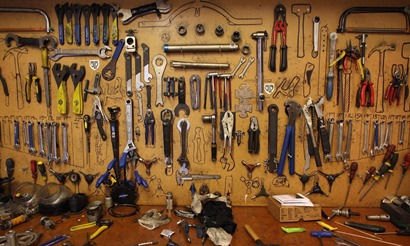
Bike repair tools1_webTaking possessions to be repaired, be it bicycles, clothes, shoes, or anything else, instead of throwing them out and replacing them is green gold. But reuse and upcycling should and must also be and become part of this economy. For it is not “just” repair that we must be looking at.

In the reuse sector we would have the secondhand stores, charity shops and even flea markets and car boot sales. While in the upcycling sector all those that rework – upcycle – items of waste of all kinds.

The little unassuming repair shop on the high street may not look like a major disruptive force. However, being able to extend the lifespan of your possessions by getting them fixed is one of the most effective green direct actions that are available. The problem is though that often neither the shops nor the repairability of the products are available.

Repair shops are often few and far between and those that there are, such as some of the so-called “shoe & boot menders” are not very capable in that department when it comes to things that cannot be done by the machines that they have, such as sewing back a midsole to leather uppers, for instance.

In addition to that there is the problem that many goods cannot be repaired as they have actually be designed in such a way and furthermore that for those that may, possibly, be repaired the costs of repair is several times that of buying the same product new. Here we are faced and confronted with a dilemma that needs to be overcome.

Making all the stuff that we buy requires raw materials and energy. Across the European Union now, recycling and recovering energy from waste when it is burned, only captures around 5% of the value of the original raw material used to make all the products in the first place. But consumption in 2030 is predicted to be twice that of 2010. A very troubling prospect given that it is already responsible for between 50% and 80% of total land, material, and water use.

The cycling community is at the forefront of the repair economy. An increase in people using their bikes and an abundance of independent bike retailers offering repair services (there are 2,500 retailers across the UK) means repair is booming. The reason for that is, though, that bicycles can be repaired and that, theoretically, quite easily.

When it comes to the bicycle much of the repairs and more can be done by the user with a little knowledge, including rebuilding “new” from old. But again here often the cost of spares is astronomical. And properly adjusting, say, Shimano gears, can, even at a repair shop, take several hours and thus the labor charges here can make getting a new (cheap) bike almost cheaper than the repair. I have been quoted more than once – I was just checking really – around £75 for that job. That is one of the reasons that I have converted all my bikes (yes, plural, but most are rebuilds from abandoned bicycles that have been found in parks and open spaces) to single speed by simply removing the gears and setting the chain onto one of the cogs in the back cluster.

What is missing sadly, is proper repair services for clothing and also for shoes and other goods. The few small attempts by certain sectors do not make up for the lack of the repairers we once used to have, in both clothing, shoes, boots, and leather goods.

Neuroscience research claims to have shown that our consumption of low-cost consumables, including fashion, activates dopamine receptors in the pleasure region of the brain and it is difficult to compete with our hard-wiring. Repair needs to not only make environmental and moral sense, it needs to make us feel good, too. But that is just what it should do, anyway.

Personally, unless I am hard-wired in a different way, and that is why I do not buy into the neuroscience research, find it much more pleasurable to be able to extend the life of something that I have rather than buying new. But then, I am strange.

In addition to repair, as said, we need to also accommodate the other parts, that is to say reuse and upcycling, into the economy and also, maybe, the teaching of repair, reuse and upcycling as part of that economy.

Repair, in some way, is also reuse as you continue to use the item repaired, while reuse can be secondhand, and that's where the particular stores and shops come in, but also reusing things found and items of what generally might be considered waste directly by us as individuals and households.

Upcycling is going a step above simple reuse, as far as items of “waste” are concerned, as it may come in a couple of forms. The first one is the simple reuse of something for a higher purpose, such as, say as glass jar becoming a drinking vessel. The next level is the transforming an item into something new, without, necessarily, destroying the shape and such while the third, which still is not recycling (though that word is always, erroneously, used there) but is close to it, is taking the material and reworking it into something new, combining elements from more than one items, and such.

The simple reuse, as mentioned earlier, like reusing a glass jar that had some produce in in as a storage jar, and that of the upcycling such as glass jar into drinking vessel (and those are just examples) is something to that most can do at home in the way that our parents, grandparents and their parents did. While it is not part of the economy – so to speak – it is a way for us to save money that we can circulate into the economy in another way.

The other upcycling, reworking, etc., again is part and must be part of the economy. This is what is done my craftspeople, artisans and such who make things from waste and material that others have declared to be waste.

But, as far as repair is concerned, the first thing that needs to happen is that industry actually starts producing again goods that can be repaired and for which spare parts (and repair) do not cost more than a new product.

Just by way of an example allow me to tell you this true story: Some years ago I was using an Epsom PC printer that cost then £35 to buy. It lasted about six months (well within the warranty period of a year). When I contacted Epsom I was told: “The waste ink reservoir is full. You are printing too much with it, Sir.” They were not going to honor any warranty because of that claim from them and as to repair I was told: “Yes, can be done. Part will be £70 and labor, not counting sending it back and forth, £75”. When I told the person from Epsom that I could buy more than four new printers of that make for that money I was told: “Well, I would suggest anyway that you buy a new one.”

That kind of attitude from manufacturers has to change first of all and products, all products, must become repairable, at a reasonable cost, again, though ideally they should also be repairable by a user who likes tinkering around. It once was that way with most things, today though it is exactly the opposite. Often goods cannot be opened even without specialist tools, if even then.

Only when that happens again and when repair is actually economically will we also see the return of the repair shops of all kinds to the High Street, and the not so high one, and the true repair economy, that we once had, will return.

In addition to that a change of mindset amongst the people is required and it has nothing to do, in my view, with any hard-wiring the neuroscience research claims, but with the fact that people have been brainwashed into a perpetual consumption mode, to buy everything new. Then again, as long as repair is not possible or simply not economical what else is one to do when something breaks?

But the mindset is a problem. We can see that every time a new iPhone, or whatever, hits the market. People will queue for hours and hours to be the first to get this new model even though they still have the previous one – in some cases less than a year old and still working perfectly – simple because they have to have it.

Well, that shall be all in the food for thought department on this subject for this time. I have talked enough, I think.

© 2017

The pathological consumption of the majority

by Michael Smith (Veshengro)

13876526_1045327358850366_8227695636228548239_nThe pathological consumption of the majority, for I do know that not all participate in it, has become so normalized that we scarcely notice it.

The way the majority buys things that is, aside from the essentials, with which we are not concerned really when it comes to consumption for we all have to eat, have at least some clothes to wear, need toilet paper and other things.

What I do mean here with pathological consumption is buying the things that really they don't need and only buy because the latest version is on the market or whatever. It is killing our Planet, other people and ourselves in the end.

There is nothing really that they need, nothing that they don't own already, and still they keep on buying. The new smartphone that has more bells and whistles than the one they only got six months ago and which they still have not used to its full potential, and so on and so forth. And then there are all those things that really are of little use, such those unitaskers for kitchen and elsewhere that will never, actually, be used but be just white elephants. And yes, alas, I have also managed to buy one or two proverbial white elephants for the kitchen at times. Some people work just so they can afford the next new gadget, etc..

Researching her film The Story of Stuff, Annie Leonard discovered that of the materials flowing through the consumer economy, only 1% remain in use six months after sale. Even the goods we might have expected to hold onto are soon condemned to destruction through either planned obsolescence, meaning that they are designed to break or fail quickly and cannot be fixed or perceived obsolescence, that is to say by becoming “unfashionable”. When the new iPhone comes out it is obvious that an old one is unfashionable; or at least so we seem to have been programed.

Grown men and women devote their lives to manufacturing and marketing often a load of rubbish, and dissing the idea of living without it. “I always knit my gifts”, says a woman in a television ad for an electronics outlet. “Well you shouldn’t,” replies the narrator. An advertisement for Google’s latest tablet shows a father and son camping in the woods. Their enjoyment depends on the Nexus 7’s special features. The best things in life are free, but we’ve found a way of selling them to you, and we, the majority at least, have been brainwashed enough to believe that we need those things for our enjoyment of life. Things have gone so far that people go for hikes in the woods, along trails, etc., either glued to the screens of their smartphones and/or having earphones on or in and listening to some music, or podcast, or whatever. Pray, what's the point?

The growth of inequality that has accompanied the consumer boom ensures that the rising economic tide no longer lifts all boats, not that it ever really did. In the US in 2010 a remarkable 93% of the growth in incomes accrued to the top 1% of the population. The old excuse, that we must trash the planet to help the poor, simply does not wash and the trickle down economy does not work and it is a load of hogwash.

So effectively have governments, the media and advertisers associated consumption with prosperity and happiness that to say these things is to expose yourself to opprobrium and ridicule. When the world goes mad, those who resist are denounced as lunatics. Well, let's be lunatics then and swim, like living fish, against the current of this madness.

The problem is that the system is not broken but that it was designed in this way. So, what are we to do? May I suggest we break the system and make a new one, one that benefits all of the Planet; people, animals, and the biosphere as a whole.

To some extent some of us are already doing it by moving away from the consumer culture and -society, by reusing, upcycling and by making do and mending. By growing some of our own food and by making things that we want and need ourselves, even, as I love to do, from items that others regard as waste.

However, those that are doing this not only encounter ridicule at times, as said above, but are even seen and proclaimed – by governments even – as a threat to the economy and the nation. Thriftiness was declared by some politicians (in the UK) not so long ago as akin to domestic terrorism.

© 2017

Recycling is taking our mind off the real issue

by Michael Smith (Veshengro)

Recycling and recyclability is taking our minds off the real issue and that is the overconsumption and consumerism but then that is also the aim.

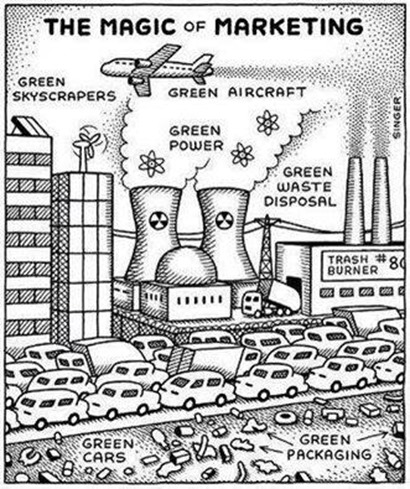
The act of recycling and the recyclability of products and/or their components is meant to make us feel good and forget about the real culprit; our wasteful consumption and the built-n obsolescence in most of the products on the market today.

Not so long ago goods were made to last and so they could be repaired if and when they eventually did break down, but they did cost more, by comparison. We did, therefore, not simply throw them out when they were a little older or when a new model came out. We used them for as long as it was possible. Often the money would not have been available to afford to change them. Instead things got repaired, whether this were clothes or shoes and boots or other goods, and that even in the homes and offices of the very rich.

Today the model has changed to cheap(er) goods that fail soon and we have to buy the same product over and over again as they cannot, more often than not, be repaired, or it is much more expensive to repair than to buy new. This is the way our economy today actually functions. Company profits depend on products breaking just at the right time so that we have to rush out and buy new and the cycle begins all over again and this built-in obsolescence is equally found in expensive brands as in discounter products, and about the same time span goes for them all.

But this built-in obsolescence is only half of the problem though, to a degree, a large one. The biggest problem by far is consumerism and our belief that we must have this or that, or that we must this or that item new because the old one, well, is old and old in this context is often six months to a year old only, and that all the while the old one still dos work and still does the job perfectly well. But throwing it out is not a problem, industry now tells us, as everything in it is recyclable. And so what if it is? Is that a good enough reason? No!

Recycling and recyclability is not the answer to the problem. It only clouds the real issues and problems, namely consumerism and the perpetual growth economy.

We all know what we must do if we want to rectify this and that is to stop buying all those products we do not need and to upgrade our things every five minutes even though our “old” ones still work perfectly well.

We must learn to also repair the things we have and to maintain them, even, though it is often claimed today that this cannot be done, although with some products this is, unfortunately, the case, and that is a rather sad state of affairs. But even when repair is easy and can be carried out by almost anyone there are still people who rather buy new than to spend half and hour or an hour fixing it again. The case of a bicycle someone brought to the refuse tip because it had a flat tire which they could not bother to repair is but one of those “shining” examples. Oh yes, they had already bought a new bike, by the way.

But, seems to be the attitude, those products can all be recycled and thus I can just go and buy new and toss the “old” one into the recycling bin or whatever. Scary, I know!

Despite the fact that almost everything nowadays can be recycled chances are that most things are not and are just dumped into landfill. Or they are sent, a great cost to the Planet, to Third World countries to be broken up into their component parts, causing misery to the workers and pollution the environment. Much of the so-called recyclables, however, and that includes glass, textiles, and what have you, that are being collected by the kerbside collections, end up in the very place we don't want them to end up, namely the landfill.

That, and because I have learned from a very young age to value things and money is the reason I try to make everything last for as long as possible. In some instances I probably take things to the extreme as far as this and repurposing and reuse is concerned. But so be it.

© 2015

Consumption can cause all manner of ills

by Michael Smith (Veshengro)

Consumption can cause child labor, environmental pollution and social inequality and many more ills to boot.

The way consumption is running rampant and we are being encouraged to consume more and more is a recipe for disaster on many levels, not at least on the environmental one.

The governments keep telling us all, however, that we must consumer more in order to grow the economy and to raise living standard. I do not know on which planet they are living but, apparently, it cannot be this one or they just simply do not live in the real world at all.

Consumption and the perpetual growth economy are something that just does not for a healthy Planet and a healthy population make. There is exploitation of the Planet and exploitation to workers that all make those goods cheap and those goods, alas, are mainly also made in such a way as to break down – about a day or so after the warranty has expired – forcing us to buy new, as they, in the main, also are designed and made in such a way that repair is not an option. Perpetual growth on a finite Planet such as the Earth is is not possible but it is the only way the powers-that-be seem to be able to think and the only way capital can make more and more profit.

The only way we can change things, and we can do it, it to refuse to be part of it, or, at least, reduce the part we have in it by reducing our consumption understanding that so much that we do buy believing that we need this or that are but wants and not needs. No one needs a new cellphone or a new computer or whatever simply because there is a new model out. And the same goes for fashion and everything else. You may need clothes but you do not need fashion.

But that route is not one that people wish to travel as such a refusal to partake in consumerism is seen by many of our peers as a sign of not being able to afford things rather than of a voluntary step of trying to tread a little lighter on the Planet and help conserve its resources. Neither is it a popular step with the governments who are only interested in GDP and thus in growing the economy and, as did the UK government a while back, liken those that refuse to partake in this madness to “domestic terrorists”.

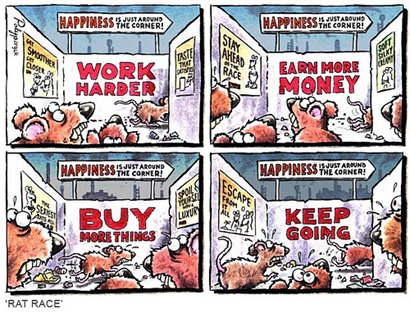
But fact is that we have to get out of this hamster wheel and back to normality of only buying what we really need and maybe so luxuries only every now and then and that means that as long as something works it does not get replaced. And if it can be repaired and that is cost-effective then it is repaired rather than a new one purchased.

We all have to change our attitude and approach to things and get off the bandwagon of consumption for the sake of it if we want to continue to live on this Planet and have it support us.

If we continue to use up the resources of the Earth, both non-renewable ones, such as oil, gas, coal, and minerals, as well as the renewable ones, and get a handle on the pollution of all kinds then there is, really, no future for the human race.

It is time to get out of the rut and do things differently and that may mean not buying new and also reusing what we have, including items of waste that we generate and that have a reuse and upcycling potential, and to make things ourselves (again).

© 2015

Study shows that experiences, not things, will make you happier

little boys on a beach in Brazil

Many people know that experiences will make them happier, and yet they continue to spend money on material objects because of their perceived greater value.

There is an ongoing debate between my husband and me about how we’d like to spend any extra money that comes in. He likes to acquire, slowly but surely, high quality items that will last for many years, such as cookware, chef’s knives, and winter coats.

While I can’t argue with his ongoing quest for quality, I would prefer to spend money on travel, to skip buying that gorgeous pot by Le Creuset and put that money toward a destination, an experience, and a lasting memory. We do a good job of striking a balance between our two preferences, but now I’ve come across some interesting research that I’ll have to show him as a way of boosting my side of the argument!

It has been shown by a recent study from San Francisco State University that greater happiness comes from seeking experiences, rather than material objects. Although this may seem like common sense to many readers, reality paints another picture – one in which people most often spend their money on material items because they mistakenly believe that they have greater value.

Read more here.

Consumerism: The scourge of our world

by Michael Smith (Veshengro)

Ever since the end of the Second World War the developed world – and also some other countries have followed suit now – has headed for the consumer society and industry created built-in obsolescence.

Companies had made huge profits from the war as the military was using stuff at the rate of knots and then some. Now, with the cessation of hostilities, they saw their profits diminish like the proverbial furs escaping down the river.

In order to counteract this they realized that if they could but produce goods in such a way that they could not be repaired (no user serviceable parts inside, used to be on many products), and then even to such an extent that even repairmen could not longer do it, or if they could be repaired make it in such a way that parts and labor would be more expensive than buying new and design products in such a way that they had but a limited lifespan and would break down, irreparably, in a short number of years, they could keep selling the same product to people over and over again they would be on to an absolute winner. And so they did just that. This also meant that they did not have to invest too much in designing new and better products and thus also saved in that department and made bigger profits still.

There was a time when products were well made and made to last and could be repaired, often even by the users themselves. New sales were mostly achieved only by designing and making new and better products and such.

Repair constituted an entire sector of the economy with small repair shops for everything in even the smallest towns. Today the so-called show repair shops can't do more than glue a rubber sole (leather, if you are lucky) on a shoe or boot. Don't ask them, though, to resew upper to midsole, for instance; the majority can't do it as they “haven't got a machine to do that”, as I was told. This is how far we have fallen!

Not so long ago everything was made in such a way that it would be repaired and spare parts were available for those products almost ad infinitum today, even it something can be repaired, spares cannot be had after five or ten years, even if the product would continue for a long time were they available.

This is just another way of manufacturers making sure that we have to buy new all the time, as with the built-in obsolescence where a PC, a printer, or what-have-you will, literally, stop working after a given time and it is designed so that it cannot be repaired, thus requiring new products, of the same kind, all the time to be produced, putting a great strain on the resources and the environment.

Ever after World War Two, as already mentioned, the course has been set for this stupid way of making us into consumers and forcing us to buy more and more and as we would not do so if products would last and be repairable as they used to be they just simply moved the goal post and made things so that they could not be repaired or limit the availability of spared to but a few years and bingo; a new this or that will have to be bought, and that goes for (almost) everything.

But it is also people who have become shall we say lazy and are not even – but things are changing with some – prepared to learn simple DIY repair skills such as sewing on a button on a shirt, for instance. They rather throw is and buy a new one and the fact that sweatshop produced garments are sold so cheaply nowadays also makes for that. Rather than putting on a new button, even if a spare may be sewn into the shirt somewhere, they throw it away and buy a new one and the same goes, alas, for so many other things.

We have been conditioned to consume and to consume ever more to make ever more profits for the corporations, to the detriment of our wallets and especially the Planet and all its inhabitants. But, the good thing is that we can change it through how we buy and by demanding to have things changed back to a proper way of doing things and that means also that products are, once again, repairable, for instance. This is not going to happen by itself. It is us who have to bring this change about.

© 2015

Study links certain parenting tactics to increased materialism later in life

Christmas morningIf you want to raise appreciative and grateful children, here's what NOT to do.

The temptation to use holiday gifts as bribery to ensure kids’ good behaviour is hard to resist. It’s a time of year when emotions run high. Stressed parents are busy shopping and wrapping gifts, and many kids come up with absurdly detailed lists of items they’d like (or even expect) to receive. Decent behaviour would seem a logical trade for all the effort parents put in to make the holidays good for their kids.

A new study, however, urges parents to avoid this temptation. The manipulation of material objects as a parenting tactic can lead to kids having certain issues later on in life. The researchers, who surveyed more than 700 adults about their childhood circumstances, relationships with parents, and types of punishments, concluded that three parenting strategies in particular lead to increased materialism:

1) Using gifts as a reward when children have accomplished something, such as good grades or making a team
2) Giving gifts as a way of showing affection
3) Taking away gifts or favourite toys as a way to punish children

Marsha Richins, one of the researchers who is a professor of marketing at the University of Missouri, explains why this is damaging:

Read more: http://www.treehugger.com/culture/study-links-certain-parenting-tactics-increased-materialism-later-life.html

How To Bore The Children

Here is how to make a child bored: first and foremost, keep him indoors so that the infinitude of nature, its endless variation and chaotic messiness is replaced by a finite, orderly, predictable realm. Second, through television and video games, habituate him to intense stimuli so that everything else seems boring by comparison. Third, eliminate as much as possible any unstructured time with other children, so that he loses his capacity for creative play and needs entertainment instead. Fourth, shorten his attention span with fast-paced programming, dumbed-down books, and frequent interruptions of his play. Fifth, hover over him whenever possible to stunt his self-trust and make him dependent on outside stimulation. Sixth, hurry him from activity to activity to create anxiety about time and eliminate the easy sense of timelessness native to the young.

No one, of course, sets out on purpose to strip away their children’s most primal self-sufficiency — the self-sufficiency of play — but that is the net effect of a culture fixated on safety, bound to schedules, and addicted to entertainment. In a former time, children, despite a dearth of complicated toys, were rarely bored. Ask your grandparents whether they were bored as children, with their bikes, bats and balls, simple dolls that didn’t speak or move by themselves, in the days before television. Boredom, in fact, is a very recent word, apparently not having appeared in print until the mid-19th century. It is not a natural state, and did not exist in state of nature, or in a state anywhere near nature. It is a symptom of our alienation.

Read more: http://www.filmsforaction.org/articles/how-to-bore-the-children/

10 Reasons to Quit Excessive Consumerism

10 Reasons to Quit Excessive ConsumerismWith advertising bombarding our senses everywhere we go, it’s very hard to not be tempted to buy the newest gadget or gear on the market. While buying things is a part of life, a balance must be implemented or things can get out of control. Here are 10 reasons to put the plastic back in your pocket.

1) Less Stress

Chasing the lure of the next great purchase, that one thing that will finally make you happy, can get addictive. Unfortunately, no matter how happy you are when you buy something, that feeling fades. The bills, however, don’t. Most families are burdened with too much credit card debt because they decided that having that next greatest thing was more important than saving or staying out of debt. The stress caused by excessive consumerism and financial turbulence is showcased in statistics for divorce, suicide, and healthcare costs.

2) Less Stuff

About two years ago, I left a very lucrative job, sold our house, car, and all of our stuff, and moved to another country to join my husband who had been living overseas due to a career advancement opportunity. It was very difficult selling everything that I had used to create my comfortable cushy life. I was emotionally attached to all of my stuff, however, once I let it go, an unexplainable calm came over me. It was like all my things had been weighing me down, and suddenly I was free to breathe again. When you have a lot of possessions, you have to take care of them, organize them, maintain them, and manage them. I have moved many times, and lugging all of my junk around was exhausting. Now, I can go anywhere, do anything, and not have any extra weight holding me down. I have never been a minimalist before, but after being forced to experience it due to life circumstances, I will continue to embrace it in my life.

Read more: http://www.lifehack.org/articles/lifestyle/10-reasons-quit-excessive-consumerism.html

Voluntary poverty

Voluntary poverty could very well save your life, but it is a hard sell

by Michael Smith (Veshengro)

Simple living can be comfortable, but are we ready to voluntarily seek out poverty just to survive after peak oil and other calamities that climate change and whatever else may bring?

DepressionChildrenPoverty is finding middle class families these days these days through unemployment, bankruptcy and home foreclosure, whether they like it or not. And mostly, they don't like it. However, those who haven't found poverty yet might want to seek it out for their own good as, when things are ging to get scarce, as they will, it will be the only way to go.

Poor and lovin' it

Preparing we must for the eventuality of the end of the world as we know it and in order to do that I would recommend preparing our households for a future of doing with fewer products and services from the marketplace once peak oil puts an end to our current age of abundance.

In order to do that I would suggest “Survival Games” to be played at home, aside from generally cutting down on things and making things ourselves more than we have been doing in the last decades.

As we look forward to an economy of "scarcity industrialism", if looking forward to can be the right word, and whether industrialism actually still will be part of the equation is another story as even the UN is stating that the industrial age if coming to its end and we are entering a port-industrial era, we must develop the kinds of DIY skills that could be found in issues of Mother Earth News from the 1970s and which would be referred to as “Green Wizardry”.

Also in the list of study materials should be How-To books such as used to be published by Odhams in the UK in the first third of the twentieth century, as well as books such as those by John Seymour and the Australian Bushman crafts ones by Ron Edwards and also the Foxfire Books. I am lucky enough to have a number of Odhams How-To books in my collection as well as a couple of Foxfire ones, some of John Seymour's books and the two Australian Bushman ones by Ron Edwards.

Knowing how to grow and preserve our own food is only the start. There is learning how to cook with the haybox, how to insulate and weatherize and to provide the small amount of energy one may need from homescale sources. Those who know the latter will be able to ignore the decline of the electrical grid.

Those who learn how to get the things they need from salvage, instead of relying on global supply chains fed from rapidly depleting resource stocks, will be able to stand aside as what's left of the global economy circles the drain and goes down it.

The idea of voluntary poverty – or better the term – was coined by Henry David Thoreau. The founders of the modern movement of "voluntary simplicity", however, backed away uncomfortably from the noun in Thoreau's phrase, and thereby did themselves and their movement a huge disservice as it is all too easy to turn "voluntary simplicity" into a sales pitch for yet another round of allegedly simple products at fashionably high prices. The concept of voluntary poverty does not lend itself anything like so well to such evasions. The idea, Thoreau's idea, is to deliberately embrace being poor, in every material sense, in order to avoid the common fate of being possessed by your possessions. And this commercialization has happened, as we must all be well aware, to the term “green”, “eco” and “environmentally friendly” and thus “greenwash” came about.

Without many modern comforts you can still live a comfortable life when your food comes from a backyard garden, your heat comes from a wood stove, and your job comes from refurbishing salvage. But it requires the proper mindset to be able to do so.

Free your mind

A thrifty, self-reliant life – I refuse to use the term self-sufficient, as it is simply not possible, complete self-sufficiency that it – may be comfortable physically, but it is certainly not a middle-class lifestyle. And it is also a lifestyle that is not liked by the powers-that-be who, not so long ago in Britain, declared that people who did not buy enough products would undermine the economy and were, in fact, terrorists.

True household self-reliance – homesteading or its urban variety – is more like monasticism, the lifestyle of a Benedictine or Zen monk who has taken a vow of poverty and committed himself to simple living for a higher cause. And what especially is not comfortable about living in poverty is the loss of status.

I know that plenty of people like to claim that they don't care what other people think about them but it is clear from the way most Americans act, and not just Americans, that they care very much about status, reflected in conspicuous consumption from Versace to Nike to Apple. Big brands are not just on our bodies; they are inside our heads, defining the good life.

Even for people interested in prepping for peak oil (and peak everything) and open to a message of simple living, I don't think, if we are honest with ourselves, this message is a hard one, and many of us are not quite ready yet to leave behind all the ideas of the “good life” that they have known since childhood and embrace what society would define as personal failure. But, the problem, so to speak, is that we must.

Indeed, corporate marketers have done so well at getting inside our heads that most of us judge the good, the true and especially the beautiful by what brand advertising has taught us.

I like the idea of transitioning out of the money economy for philosophical reasons, and many others around the world do too. Some have even done it and gone into the “money strike”. I would like to free my mind from money, status-seeking and corporate brainwashing, and personally I have been able to do that to a large extent due to the way I was raised (we will come to that later). Many in our Western world who are in financial distress right now also might find it appealing to find some relief from the stress of juggling bills that get harder to pay each month as the economy continues to stagnate, despite of what we are being told by governments and media (who have become but a mouthpiece for government).

But to get to a life beyond money, and to do it with joy rather than resentment, will take a huge mind-shift. And here looking to the past might help.

There is a long tradition of simple living or even voluntary poverty in the West going back before today's Amish and Old Order Mennonites through Tolstoy and St. Francis of Assisi all the way to down to the ancient Greek philosophers Epicurus and Diogenes. The latter was such a showboat that he lived in a barrel in the agora of Athens, the agora being a central spot in ancient Greek city-states, the literal meaning of the word is "gathering place" or "assembly", just to make sure everybody knew how much he was doing without.

But none of the great ascetics of the past embraced poverty merely as a way to survive in a difficult economy. Instead, there was always that higher motivation: to get closer to God, to reach enlightenment, to discover absolute truth.

Survival is a surprisingly very bad motivator

For modern Americans were to do something so opposed to the country's national character as to go beyond the fashionable slow food, slow work and slow sex of the simple living movement to brand themselves with the straight-up shame of poverty, there would need to have a better reason to do it than mere survival.

A people that have been brought up on the Horatio Alger dream of hard work, equal opportunity and upward mobility won't soon walk around in sackcloth and ashes even if it means their very survival is at stake and that of the Planet. Sad to say, but it would appear that many Americans would choose to die first than to give up on their middle-class identity.

Indeed, it has been shown that they are perfectly ready to give their lives in the cause of maintaining our social status. It is not only the Japanese salaryman who is drawn to harakiri when he loses his job. Plenty of Americans have also sought refuge in an early grave to avoid the ignominy of bankruptcy or otherwise appearing to fall out of the middle class, and also many bankers in recent times, though with the latter one may wonder as to whether they were suicided because they knew too much about the economic collapse that was engineered by the banks, on behest of our governments.

But whether we like it or not the path to voluntary poverty will have to be taken by us all in order to be able to cope with the inevitable coming of the peak oil and peak everything.

Most of the luxuries, and many of the so called comforts of life, are not only not indispensable, but positive hindrances to the elevation of mankind.

© 2014

The best things in life come in Cellophane

by Michael Smith (Veshengro)

“Our enormously productive economy demands that we make consumption our way of life, that we convert the buying and use of goods into rituals, that we seek our spiritual satisfaction and our ego satisfaction in consumption.

We need things consumed, burned up, worn out, replaced and discarded at an ever-increasing rate.”

  • Victor Lebow, Journal of Retailing (1955)

And here is where we can see the very philosophy of consumerism and when it was created.

no-to-consumerismWe have been brainwashed since the 1950s – in the USA at least, as the rest of the developed world took a little longer to cotton on – into this very idea of consumerism only because they began to base the economy on obsolescence and the modern version of that is products that can no longer be fixed and that have a factored in lifespan after which they will have to be replaced.

Before that time when Victor Lebow advocated this new approach to making the manufacturers ever richer the economy worked on a different level and you had to bring out really something new and revolutionary to get people to buy it or the things they had really had worn out and could no longer be fixed.

Before this time of brainwashing people to buy into this new idea of an economy everything bar consumables, as one could refer to them, such as foods, soap and the like, were made in such a way that they would last for as long as possible and almost everything could be repaired either by people doing it themselves or by taking it to a repair shop.

And entire economy existed, and in the former East Germany an industry existed, basically, geared to repair, from electrical appliances, over clothes and shoes, to almost everything else. Repair shops for almost anything could be found on every high street, from cobblers being versed in all manner of shoe and boot repair, tailors geared to repair and alteration, electrical repair shops that could fix any appliance, from the wireless and the TV to washing machine and what have you. And then cam the new economy of consumerism and built-in obsolescence and that part of the economy died a death and that predominately because products were being made and still are being made in such a way that they can neither be opened nor repaired.

Basically this entire new economy can be traced back to 1955 and the approach taken by Lebow, et al, in order to turn everything we have had before around and get people to have to buy new every couple of years at least. They had run out of ideas to keep going without this and thus they had to invent a new way of making more and yet more money.

It was also, not long after this, that vacuum cleaner manufacturers made the suction claims as if that would make for better cleaning power. However, that is just what the people began to believe having been indoctrinated to believe just that and that way they could sell one new one after the other. The fact is that most vacuum cleaners today do not even have the cleaning power of the little Hoover of the 1950s. They may be able to lift a bowling ball and thus eat your curtains and lift up your carpet but cleaning power that does not equate to.

Nowadays the sales of products go on bells and whistles even though those new bells and whistles often do not work at all properly and “food” manufacturers make all sorts of health claims appertaining to their products which bear no resemblance to reality. And the same goes for all the claims associated with genetically engineered “foods” being needed to feed the world. It is a sales gimmick at best and something far more sinister at worse, if the book “A Quirk of Destiny” by Catherine Greenall is taken as a warning.

We need a return to sanity on all levels and get back to the way things were before those people decided that consumerism was to be the new religion and brainwashed the people into believing that they can buy themselves happiness.

Consumerism is much like the arms race. It needs things to break in order for the makers to make more profit in the same way as the arms industry needs the arms race and wars to continue to make their huge profits and ever bigger ones. And, as the governments are but protection agencies of the corporations they, the governments, are not about to make any changes as to consumerism nor the arms race.

It is up to us, each one of us, who have to buy this and that to send the corporations a message via the way we spend our cash as to what we want and that we no longer buy into the consumerism message. We have an enormous power in our wallets and if we but make use of it by demanding, via where we spend our money, the kind of products that we want, products that are made ideally in our own countries, made to last and are repairable, and are made ethically. It can be done and will be good for us and the Planet.

It will also create jobs at home in the factories and workshops, if products are, once again made at home, and will rekindle the repair-economy also with the small repair shops we once had.

We can bring about the changes that we want to see if we but make the right points to the corporations, the producers, and spend our money more locally especially, on locally-made products and for local services.

Time to get off the consumerism train and onto the local bus.

© 2013

Black Friday promotions are starting even earlier this year

by Michael Smith (Veshengro)

Black Friday promotions are starting even earlier this year, earlier even than they did last year and the years before. Thus, in timely fashion, I have decided to issue my “thought for the day” also early.

No_to_Black_FridayBlack Friday is the Friday following Thanksgiving Day in the United States, often regarded as the beginning of the Christmas shopping season. In recent years, most major retailers have opened extremely early and offered promotional sales to kick off the holiday shopping season. This year this day falls on November 29, with November 28 being Thanksgiving.

So, therefore, before you line up, however, on Thursday night, as so many do in order to be first in line when the stores open, for those great sales - I am being sarcastic, yes - ask yourself this:

"How is buying things that are made in China at discounted prices going to help the economy of the country that I am concerned about, or should be concerned about?"

It does not and cannot. It only fills the pockets of the corporations that are having their stuff made in China, in Vietnam, in India, in Thailand, in the Philippines, and other low wage countries, with many instances in China prison (slave) labor being used even to make the goods that we all are forced to buy, as far too many things are no longer available as "Made in US" or "Made in England".

Instead go and buy local, on Saturday. Boycott Black Friday by not buying anything on that day and encourage others to do so too. Buy from local makers, craftspeople, and others and chose “Made in USA” or “Made in England” (or chose your country) over anything from the Far East. I know it is not easy but we can try and if we do then we can create a positive change in our country, especially by how we spend our money.

Another question you should ask yourself also is: “Do I need those things that are on sale anyway?” and more often than not the answer will be a firm “No!” if you are but honest with yourself.

Often, I am sure, if you will really think about it in the right way you will find that those goods are not a need and not even, maybe, a want and if you really look at things there are many of them that, with a little thought and skill you could even make yourself – from waste – rather than buying. It is better for your finances and good for the Planet.

As consumers our money is our weapon for change and if we put it into the hands of local makers and craftspeople and producers we can keep them in business and can send a message to the rest of the country and indeed the world that we will not put up with this system anymore and that we demand a change.

Every Dollar, Pound or Euro that does not flow into the pockets of the corporations but goes to a local business it a plus for the (local) economy and even more so if the goods are produced locally.

Let's put local back into economy and demand local products and produce.

© 2013

European Commission to tackle eco impact of consumerism

The European Union executive is to tackle eco impact of consumerism

by Michael Smith (Veshengro)

The European Commission, the European Union's executive body, is going to launch a raft of proposals to reduce and curb the environmental impact of consumerism in the Union by supporting eco-friendly products and technology.

It would appear that they have nothing else to do. Then again, why should they worry about human rights violations in one of the EU founder nations, namely Italy, as that violation is ONLY against the rights of dirty Gypsies who no one wants anyway.

The plan comes as the European Union moves to cut energy consumption amid soaring fuel and power prices and as part of its ambitious mid-term goal of cutting carbon dioxide emissions by one fifth by 2020, compared to 1990 levels.

"This will mainly be targeted at products that use a lot of energy, such as computers, televisions, water heaters and industrial fans," a source at the Commission, the bloc's executive arm, said.

Faced with oil at record highs, and with years of investment needed to reach renewable energy goals, the European Union's main near-term response is to cut energy consumption.

French Ecology Minister Jean-Louis Borloo, whose country is EU president, said last week at a meeting of energy ministers in Paris that the bloc had reached a turning point with energy efficiency becoming the "keystone" in EU energy strategy.

The Commission's "action plan on sustainable industrial policy and on sustainable consumption and production" is part of that push.

"There will be proposals on green public procurement, as well as widening the scope of the existing directive on eco-design to help improve the energy efficiency of buildings, and the scope of rules on eco-labeling will be widened," the Commission source said.

Various policies in Europe already promote eco-friendly design, but these are limited to devices that use energy such as dishwashers and air-conditioning units, and do not yet fully cover such things as windows and home insulation.

Many EU local authorities already take account of energy consumption when placing bulk orders for products such as vehicles and office computers, but new common standards are seen as vital to cutting the bloc's energy consumption.

Eco-labeling schemes, which help consumers choose the most efficient products, will be extended to cover goods beyond the existing narrow range, which is mainly focused on electrical appliances.

It is a shame that the Commission cannot have an action plan to tackle Italy's violation of all that is decent as far as the Romani People are concerned.

© M Smith (Veshengro), July 2008