Showing posts with label crafts. Show all posts

Making art and craft every day keeps the doctor away!

by Michael Smith (Veshengro)

Making art every day keeps the doctor away!Art and craft comes in many forms and shapes, so to speak, from (creative & expressive) writing – including so-called journaling – to knitting, crochet, woodcarving and woodworking, and everything else in between.

Your health and personal well-being, according to studies, can benefit when you make time to be creative? And, apparently, it is true! Whether you write, draw, scrapbook, or create quilts, do woodcarving, or whatever in the arts and crafts department; when you engage in something creative, your mind and body benefits.

Expressive Writing fort instance, whether it is just journaling – that is what once was called keeping a diary and done by a so-called diarist – will eanble you in other areas to better be able to put your thoughts on paper, even if the paper is but virtual.

Writing has been found to grant practicioners a host of long term benefits including, but not limited to:

  • Fewer stress-related visits to the doctor Improved immune system functioning Reduced blood pressure

  • Reduced absenteeism from work

  • Quicker re-employment after job loss

  • Improved working memory

The Science of Google's 20% Rule

Some may have heard of Google's 20% rule, some maybe not (and I must say I didn't until I came across it), which allows employees to spend 20% of their time on side projects they are passionate about. What seems on the surface to be a huge sink in productivity actually saw huge boosts for both the company and their employees.

Side projects, it turns out, boosts work performance and productivity.

A study conducted by San Francisco State psychology professor Dr. Kevin Eschleman and his colleagues measured the effect of creative hobbies on over 400 employees. They found those who had a creative hobby were more likely to be helpful and creative on the job as well as more relaxed and in control.

The finding from the research indicate that organizations may benefit from encouraging employees to consider creative activities in their efforts to recover from work.

Creative activities are likely to provide valuable experiences of mastery and control, but may also provide employees experiences of discovery that uniquely influence performance-related outcomes.

Creative Therapies

There is now a whole emerging field of people who employ the arts to help people heal. It is called Creative Arts Therapies, and according to the National Coalition of Creative Arts Therapies Associations (NCCATA), it encompasses a wide range of modes of expression including art, dance/movement, drama, music, poetry, and psychodrama. One could, obviously, also be sarcastic here and say that there is always someone – or quite a number of people – who find a way of making money from “strange professions”.

Creative Arts Therapists are human service professionals who use arts modalities and creative processes for the purpose of ameliorating disability and illness and optimizing health and wellness. Treatment outcomes include, for example, improving communication and expression, and increasing physical, emotional, cognitive and/or social functioning.

When you undertake these activities, whether for yourself or with the guidance of a Creative Art Therapist, you stand to benefit by making art.

In a world full of distractions and stress, it can be difficult to find time to be creative but considering the outcomes time should be made available and not just for us adults but also and especially for children (and young people). Their lives have become far too structured and stressful and, aside from unstructured play, letting them get into creative activities, more or less on their own, could be of great benefit.

© 2018

A move back to our roots: more wood and clay and less plastic

by Michael Smith (Veshengro)

23213129_1845303528843664_4872651655123413633_oBefore plastic became ubiquitous, many kitchen items were made from wood or pottery, that is to say clay, and also from metal. Predominately the material was wood and pottery; metal in the form of copper, lead, bronze and then finally iron, from whence came steel, including stainless steel, came into the equation much later.

The anti-plastic movement is gaining strength as more people realize the folly of using a material that not only leaches chemicals into our bodies, food, and environment, but also does not biodegrade. The movement has taken many shapes and forms, from no-straw campaigns to the zero waste lifestyle to more natural-fiber clothing.

But there is plastic and there is plastic in this context and while, yes, predominately, though not entirely anymore, plastic is made from oil and thus not very sustainable and all that, some plastic is better than other. The main concern, in the general context of getting away from plastic, is the disposable kind, the stuff that really no one needs and that ends up in our countryside, rivers and the seas.

Children are the key to the future so it is the children, therefore, first and foremost that we must educate about the “back to our roots” way of using natural materials. Once kids’ habits change (through education), they will influence their parents to change, while holding them accountable.

To this end teaching children the making of things from natural materials, such as making a wooden spatula or even a spoon, and in that case an eating spoon just right for them, and making a piece of pottery, would be the order of the day.

There was, once, a time when all schools were teaching handcrafts, especially woodwork and pottery but today that is all but gone.

When a child makes something him- or herself, for personal use especially, this product will have a special value for them – and thus we should teach them to aim for the best they can do.

But it should not stop at wood and clay (pottery) but include also the making of products from other, ideally natural materials, by hand and schools – and other places – must be at the forefront again for children – and not just children – to learn again the skills and the joys of making. Textiles, leather, and also metals, should be included.

While in regards to wood, pottery, and even textiles, the entire process can become part of the learning process with leather and metals it is somewhat of as different story. Working with wood and clay for pottery the process goes from natural to made product easy. With textiles it is a little more complicated. Wool needs to be shorn off the sheep, then made into yarn and then worked either by knitting, weaving or otherwise. Even more work is involved in the making of cotton, canvas and linen. And metals are getting even more complicated.

Having said that, however, does not mean that the skills of working those materials should not be taught; they should, as they once were. They should also be taught to both genders, as far as schools are concerned. Boys and men should know how to sew as well, not just girls and women, and the same goes for mending. We must remember that traditionally in the past the tailor was male. Also the cooks – chefs – in inns and hotels were (and often still are) predominately male, so both cooking and sewing is not (just) something that girls and women do. But I digressed somewhat.

We must become makers again instead of being (just) consumers (and learning again to appreciate the handmade efforts of ourselves and our children – proficiency comes with time) and this making can take many forms.

And making “by hand” may not always mean absolutely without any machines. As long as your hands are still involved in the work, and your skills, and it is not an automated process you are still making whatever you are making “by hand”. The potter who uses a powered wheel rather than a kick wheel still shapes the clay by hand into the object that he or she is making. The wood-turner who is using a powered lathe rather than a foot-operated pole lathe or such, still, like the potter, shapes the object, using his hands. I am just saying.

© 2017

The most important school subjects

by Michael Smith (Veshengro)

Handwerk1The most important school subjects are not reading, writing, arithmetic, etc. even though they are important, especially for self-directed learning, as I can ascertain. However, “viewed scientifically the most import school subjects would be music, sports, dramatics, art and handicrafts, the latter is what the Scandinavians would call sloyd”. This is what the brain researcher Manfred Spitzer says and, as far as child development, especially in elementary school children, is concerned that is exactly what is needed.

Children who spend much of their childhood playing (for play is an important aspect of learning), drawing, painting, doing sports, dramatics, and such, are in a much better position later to be taught, to study and to be trained in order to be able to follow a useful profession and calling. Much more useful than learning in Kindergarten already Chinese or having to be worried in elementary school about tests and passing them in order to progress up the ladder, so to speak.

Some may say that this does not do the economy any good and that it is only that which counts, in other words productivity and growth, and training obedient wage slaves.

But today's economy no longer needs untrained docile workers at production lines but highly flexible, stress resistant multi-taskers who are prepared to learn new things to the end of their life. No one needs what the schools of today churn out in the way of unripe non-adults. Nor will the children, as children and later as adults, ever need most of what they have been “taught” in school – generally only in order to pass the tests and exams – in later life.

Yes, reading, writing and some other things are important, as I have already said in the beginning, but you do not have to go to the brainwashing institution called “school” to learn those.

As far as handicrafts, aka sloyd in Scandinavia, and such like are concerned getting hands dirty and learning about traditional trades is what it is all about – kids will be having a ball as long as they are not just be shown how to but are actually allowed and helped to make things.

Also teach them gardening and the growing of food and involve them in this, to the extent of letting them have their own plots where to experiment with growing this or that.

Maybe the best thing would be for children to be taught at home (or other similar setting) rather than in the formal setting of the brainwashing facilities that we call schools where children are but trained to pass tests and regurgitate information in order to pass them.

Many kids are measured on their intelligence base solely on regurgitation of information. Many grow up thinking they are worthless and stupid because they do poorly. This is one of the many factors that contribute to social burden and decay. No matter what anyone says you are not stupid, just a different kind of smart. Also and especially children develop and mature in different stages regardless of age so any standardized tests actually prove nothing and all they do is make some believe that they are failures and will never amount to anything.

That is why self-directed learning, as often is the case with homeschooling, where the kids decide what they want to learn, research, etc., rather than following a set of guidelines, is so much better than any other way.

© 2017

Everybody is not a lawyer or a doctor

...and not everybody can be a lawyer or a doctor

by Michael Smith (Veshengro)

Handwerk1In the school system in far too many countries children are being pushed towards academic careers and towards college and university degrees. Manual trades are being discouraged, often even with derogatory statements from teaching staff that they at those schools are “better” that those who do those trades, and other manual work.

We need to, once again, teach children that it is not just OK to work with your hands but that you can learn to build some real cool stuff and make a good career out of just that.

I have come across a number of young people who had to fight with the schools to allow them to follow a chosen path, in the cases I am referring to, one of horticulture and forestry, via vocational college rather than university. The schools were refusing to allow the youngsters to make their own choice and from what I learned it was a real battle.

The kids were bright and, yes, university material, but had no intention to go to such institutions, rather wishing to pursue a career where they were working with their hands and outdoors even. It was – and is – all about the schools wanting to be looking good in the league tables and not having all those that have the “right grades” go to university apparently sets the school back the league table.

In other cases when schools have been visited and someone commented on the great pieces of woodwork, for instance, such as scale models of period furniture head teachers have been known to say that those pieces were the work of one or the other of their less able students.

It would appear that learning a useful skill and trade, in the eyes of teaching staff and whatever else of those schools just not as important as getting a liberal arts degree or media studies one; degrees that often quite will not bring about any useful employment in the first place. Already far too many young graduates a flipping burgers because there are no openings for them elsewhere.

Many years ago the West German state, more than just the universities, operated a numerus clausus (limited number) system which restricted the numbers of students for at least particular subjects such as law, medicine, and even forestry (forest officer career path), to make sure that, basically, for everyone passing out with the degree a job was available in the profession. Certain sections of the liberal (neoliberal, more like) spectrum ranted and raved against it claiming it those measures to be unfair, and a change was in the air.

We need to get vocational training back into our schools – homeschoolers are better off in that department as they can do that – where youngsters, and not just the boys, learn wood and metal work, etc. In addition to that all schools should – and it should be feasible – have a school garden where horticulture can be taught hand-on.

We really need more people working with their hands again making cool things and growing stuff, working the woods, and so on. There are too many people around today with degrees that are worth very little to nothing and not enough people with the skills that really make a difference.

In many countries of mainland Europe, where the proper system of apprenticeships still exist, the certificates of journeyman and of master craftsman (also applies to women before anyone screams and shouts) are as well regarded as university diplomas and in many places you cannot, for instance, operate a business as an electrician, carpenter, etc., without having attended trade school and done the master certificate. That, by the way, takes at least six years. No wonder the Eastern-European plumbers, carpenters, and other craftsmen are so in demand in Britain. Time we grew our own again, but properly. And this may not just apply to Britain alone.

© 2017

Our society has lost sight of what is truly important in life

by Michael Smith (Veshengro)

Our society has indeed lost sight of what is truly important in life and it is high time to find it again.

What if – Instead of worrying about whether we should give kids gold stars for participating or gold stars for being the best, we would involve them in real world activities where the end result of the activity itself is the reward?

Teach them gardening, woodworking, repair skills, fiber arts, sewing, cooking. Get them out hiking somewhere with a gorgeous view. Raise animals – have them learn to care about something other than themselves. Have them help out a grandparent or elderly neighbor.

Schools, unfortunately, do not teach things that are important to children but teach them how to pass tests instead. Woodworking classes, or even “Design & Technology”, as they were called later, cooking (Home Economics), and such have gone out of the window and instead they are just taught to – basically – memorize what they require to pass those tests so that the schools look good in the so-called “league tables”.

While lessons in “mindfulness”, in meditation, as being introduced in some primary schools in Britain now, are a good idea there are other practical aspects that are important and that from a very early age. Practical skills such as using tools to make things, to grow things, to cook, and so on.

Memorizing dates and events and information that they will, more than likely, never need in their lives after school is not just a waste of time. It prevents proper learning. It would be much better to teach kids to read and write properly, and to enjoy reading for the sake of reading, as well as where to find the information that they may want to know. It is not what you know but knowing where to find the information and to use this information that counts.

Most important of all are life skills, practical skills, and the skill of critical thinking. Schools, teachers, and others also fail kids and society in that they do not teach them how to think but what to think. This is not new at all. School and the compulsory school “education” was, after all, invented for the very reason to indoctrinate children into what to think rather than to teach them critical thinking.

In addition to that everything is geared to academic “success” which in the end means that we have people with PhDs flipping burgers are burger joints. There are only that many places available for all those that have attended university and gotten a degree in this or that, and more often that not, as is now very often the case, in useless subjects. However, schools will insist to push pupils, even if they, the pupils that is, are not interested, towards academic subjects and university and it can be one heck of a fight for the student and his or her parents to get the school to accept the young person's decision to pursue a non-academic career.

Working with one's hands is nowadays seems to be considered by educators and people in general as something dirty and a career in “manual” trades, whether agriculture, horticulture, forestry, carpentry, plumbing, and whatever else, as something that no one really should aspire to. And then we wonder that we have no carpenters or plumbers, and whatever else, and complain that they are all Poles.

Everything is being geared to making lots of money and then still more, often at the detriment of others in society. We have lost what really matters in the pursuit of what really does not and we must rediscover those things that really matter.

© 2015

Arts and crafts activities are good for you

Arts and crafts activities may be able to ward off dementia

by Michael Smith (Veshengro)

If you have ever wanted to try your hand at pottery, woodcarving, basketry or knitting, a new study suggests that doing so might be good for your health, especially your mental health.

man-woodworking-150408Middle-age and older adults who do arts and crafts activities and socialize may reduce their risk of the thinking and memory problems that can lead to dementia, the study found.

Researchers have followed 256 people whose average age was 87 at the beginning of the study. Over four years, 121 participants developed mild cognitive impairment, a condition that means having thinking and memory problems, but problems that are not severe enough to affect daily life.

The people who engaged in artistic activities such as painting or drawing, in both middle age and when they were 85 and older, were 73 percent less likely to develop mild cognitive impairment than those who did not engage in artistic activities.

The people who engaged in craft activities such as woodworking or pottery were 45 percent less likely to develop mild cognitive impairment than those who did not participate in such activities, the researchers found.

The study also found that the risk of developing mild cognitive impairment was also 55 percent lower among those who socialized in middle age and when they were older, compared with those who did not socialize and people who used a computer when they were 85 and older were 53 percent less likely to be diagnosed with mild cognitive impairment than those who did not use a computer.

It is not completely clear why engaging in these activities appears to help lower a person's risk of mild cognitive impairment but is it is likely that these activities maintain the function of neurons.

The new findings are very much consistent with the results of previous studies that have also demonstrated the benefits of cognitively stimulating and social activities and such activities have been shown to lower the rate of cognitive decline, or slow the development of Alzheimer's disease.

While medical science thus far cannot cure mild cognitive impairment or Alzheimer's disease, there is increasing evidence that disease risk may be modifiable and it would appear that certain activities, such as arts and crafts, among others, can help do so.

The study was published April 8, 2015 in the journal Neurology.

© 2015

Traditional crafts deserve a revival

by Michael Smith (Veshengro)

In today's increasingly virtual world, there is something appealing about making things by hand, using centuries-old techniques and many traditional crafts definitely deserve a revival. In fact, many will have to be revived for the coming post-carbon and post-industrial age and, yes, it is coming.

There are in fact many traditional crafts and trades that deserve a revival and also traditional skills in general. Aside from the danger of them becoming lost they will be, as I have already said, needed again in the not so distant future when oil is becoming more and more expensive and even may be gone for good, at least cheap and abundant oil, and this includes skills of maintaining old-fashioned tools such as sharpening and setting crosscut felling saws, sharpening and peening scythes and sickles, and many more. And do not get lulled into a false sense of security by the fact that in early 2015 the price of a barrel of oil is at more or less rock bottom. This price drop is not due to more oil having come on stream but due to the OPEC nations wishing to put a stop to fracking.

So, here are a few traditional crafts to, maybe, try your hands on and learn or vice versa.

Blacksmithing

Blacksmiths use fire, hammers and an anvil to hot-forge iron and steel, shaping and joining the metal to make every thing from gates and staircases to chairs, fire irons, curtain poles, doorknobs, jewelery and sculptures. You need a small forge to heat the metal up to 1,000C (1,832F), an anvil complete with the various cutting and bending tools that slot neatly into it, a pair of pliers, a vice, and a selection of hammers and punches. The skills need learning, and can take years to perfect, but it's well worth it.

Smithing produces metalwork of unique character, very different from cut-and-weld manufacturing. And this is true for all handmade goods really.

Aside from the above mentioned goods a blacksmith also produces, or used to, knives, axes, sickles, scythes, billhooks and much, much more, and when the post-carbon world arrives handmade will be the way to go once again.

And, in fact, making cutting tools, especially knives, from scrap is a good way of learning the craft of the blacksmith and you do not need much in the way of tools. I have made many a small knife that way by using the head of an old sledgehammer for an anvil, and only a small ball-peen hammer, aside from a pair of pliers and a fire, and I mean a fire and not even a forge.

There are also ways of cold-forging steel for the making of knives and tools and using the heat later for tempering the steel.

Pole-lathe turning

Apart from a brief conversion to pottery thanks to the Romans, people largely ate and drank from wooden plates and bowls in Britain until the early 18th century and in many countries that went on even much further. In Russia wooden spoons for eating, for instance, and also wooden bowls, were still in use in the military even and in some cases until – especially the wooden spoons – the early part of World War Two.

Every village had its wood turner with his pole-lathe, a simple homemade assembly of timber beams and posts using as its driving power a springy sapling, anchored at the base. From the sapling's free end hangs a length of cord wrapped once around a spiked chuck, called a mandrel, hammered into the block of wood you are turning. If chair legs and other such rounds are being turned, including dibbers, truncheons, and such, the string is, in fact, wrapped around part of the peace being worked.

When you push down on a foot treadle attached to the other end of the cord, the chuck revolves. Release the treadle and the block spins back again. On each downward stroke, a chisel or hook tool shapes the wood. It's highly skilled work, and hugely rewarding. The Association of Polelathe Turners and Greenwood Workers has a list of courses: www.bodgers.org.uk

Spoon carving and general wood carving

In times past spoons – especially of the lower classes and those used for work in the kitchen – were all carved from wood by means of gauges and the crooked knife. And even bowls were made like that and not just turned on the pole-lathe.

Most of what we had, bar the iron tools, textiles, etc., in the days of old were made of and from wood and using wood is also a green, pardon the pun, way to go as products made from wood keep the carbon locked up in this product for the rest of its life.

Working with wood, in which ever way, is extremely rewarding as an occupation and also very relaxing. The skills will also be very important in the days when our technology is going to let us down and when we finally have to rethink how we make things for our daily needs, wants and use.
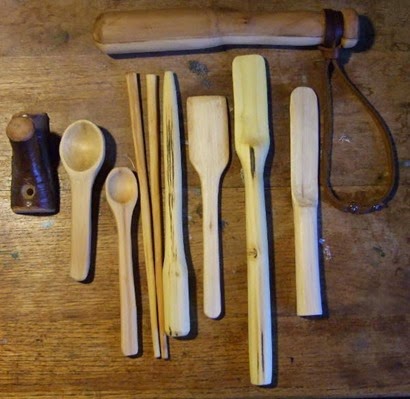
WoodRecycledProductSamples_webWhile pole-lathe turning and wood turning in general is a good skill it is not always necessary to make treen goods, as I have discovered making rolling pins (for the making of tortillas) just simply by carving it from a piece of relative straight piece of coppice wood by using just knife, glass shave, and surform rasps and working entirely by eye. Also a more or less copy of an old style British Detective truncheon was done in the same way (see top piece in photo).

For spoon carving and so-called green woodworking and especially for inspiration see some of the Facebook pages and groups: https://www.facebook.com/groups/GreenWoodWork/, https://www.facebook.com/groups/greenwoodworking/

Basket making

Willow baskets, and baskets from other woods, for carrying vegetables, laundry, logs and coal, fruit, bicycles, shopping, letters and such were fixtures of British life until plastic arrived in the 1950s.

The craft of basket making hasn't changed in thousands of years. You require very few tools: knives for pointing the ends of the willow or hazel, for this is another common wood used, rods and trimming the finished basket; a bodkin to make openings in the weave; a cleave and shave to split rods into three or four finer skeins; a beating iron to hammer the weave down. The base is made first: a round or rectangular frame of sturdier stakes interwoven with finer willow rods. Then you insert the upright stakes to form the side frame, and lay the first weave. Then you start weaving, in one of a range of styles: randing, slewing, fitching, waling. Finish with a border around the top. You need strong hands, a good eye for straight lines, and lots of patience. The Basketmakers' Association lists courses: www.basketassoc.org

In years gone by the itinerant traders, the hawkers, more often than not carried their goods in woven baskets on their backs and those kinds of baskets can be found all over Europe and also in the Americas. They are the forerunner the the rucksack and the backpack but are much better for the carrying of goods, such as carved wooden spoons and other such things, that ever would be a rucksack or backpack.

There are, obviously, many other crafts and trades that deserve a revival and revitalization and that also for the fact that we may, rather sooner than later, also require them again in order to live comfortably in the post-fossil fuel age, and the coming Wood Age.

© 2015

For more on coppicing and why, etc. see “Managing our Woods”, a small book that explains the whys and wherefores of managing our woods in this way and calls for us to return to that way.

Don’t stop knitting! It keeps you healthy.

woman knittingLast month I wrote an article called “Why bother knitting a scarf?” Much to my surprise, I received thousands of positive reactions from readers who share my love of homemade, local, and beautiful “slow fashion” items. Clearly, knitting is being embraced by people from all walks of life who benefit from its peaceful, relaxing repetition. It got me wondering – what’s really going on when people knit? Why is it so tremendously popular?

It turns out that knitting has incredible health benefits. It makes people feel good in just about every way. A bit of research has revealed a wide range of ways in which knitting helps humans cope, physically and mentally.

1. Knitting is used for therapy. It’s a powerful distractant, helping people manage long-term physical pain. For those who are depressed, knitting can motivate them to connect with the world. It is a conversation starter, allowing people to interact politely without making eye contact. It builds confidence and self-esteem.

2. Knitting is supremely relaxing, which is extremely important for reducing stress and anxiety. Dr. Herbert Benson, founder of Harvard’s Mind/Body Medical Institute, wrote The Relaxation Response, in which he recommends the repetition of a word, sound, phrase, prayer, or muscular activity to elicit “the relaxation response” – decreased heart rate, muscle tension, and blood pressure. Knitting is likened to meditation, sometimes described by knitters as “spiritual” and “Zen-like.”

Read more: http://www.treehugger.com/culture/dont-stop-knitting-its-keeping-you-healthy.html

Crafting

by Michael Smith (Veshengro)

In a world that has become increasingly dependent on technology, too much one might say, artisans and everyday crafters are finding a renewed satisfaction in making something with their own hands.

Leagues of people are also finding physical and mental health benefits in handwork, and are beginning to frame it as a spiritual practice.

Some people believe, and I think that this can be true also, that you can literally "craft the crazy away" through beading and crocheting, candle-making, and other crafts.

I find working with wood, especially spoon carving, extremely relaxing and there are times where I definitely need the fix of carving yet another spoon. I also make walking sticks from coppided wood and other things.

Another craft that I like to engage in, and it always brings out good ideas, is repurposing and upcycling items of waste into something useful.

While writing, of which I do a great deal, as a writer, obviously, is also seen by many as a craft and as a way of relaxing, I need to get away from that at times and, being a forester by original trade, working with wood, especially does that for me, but also making anything else, including, as said, upcycling.

And, while I may be a crafts-person on more than one level I would not call myself and artist and that what art. In fact, I prefer to make useful things, whether in working with wood or in upcycling, rather than something that one put on a shelf or hangs on a wall to collect dust. That does not mean, however, that I do not like objects to also be beautiful, especially when it comes to the wooden articles. The upcycled ones I do like to leave “plain” so that it can be see what they are made from, though I have, at times, “dress up” some tin cans that I have made into pencil bins, but that is a rare occasion.

We all can be creative and make things with our own hands and with the right mindset this will also be beneficial for the Planet and our wallet. And it is also most beneficial for our mind as it will detach us, if even for a while, from the hustle and bustle of life in general.

Go and get crafting...

© 2013

Old skills, crafts and trades for the new age

by Michael Smith (Veshengro)

The new post-fossil fuel age will require the skills, crafts and trades of the old ones, in many aspects, especially those of working with one's hands and with hand tools.

Despite the fact that shale oil and shale gas are now being extracted by means of the most controversial method of “fracking” we are coming to the end of cheap and abundant oil and gas.

In 2011 the world used 40% more oil than it produced and the forecast, though dampened by the Great Recession, was that in 2012 over 60% more than produced would be consumed.

For a while now already various countries have put oil from strategic reserves on the market in order as not to frighten the populous with rocketing prices at the pumps. Sooner rather than later, however, those reserves are going to run out and the pigeons are then coming home to roost for sure.

And when that happened and the reality of the fuel going beyond what can be borne by the people and industry, much of how we work now is going to change; change back to the way the old people did things way back when.

This will mean a return to working with hands and hand tools and human-powered machines, be this a treadle or hand operated sewing machine, a treadle lathe, or the billhook, axe and crosscut saw in forestry.

It is, however, not only the use of those tools and the ways of using them that we will have to learn (again). We also must learn how to maintain them and keep them in good order, and also how to bring old, neglected ones back to life and into use again.

Many of the tools for those old skills, crafts and trades that we will need for the new age are often no longer made and thus we must, aside from making them again, refurbish the old ones that we can still obtain. Those old tools will be more valuable after the even than any gold or silver.

The skills, crafts and trades required for the new post-carbon age are, in fact, legion and they are those that many of our ancestors mastered, more or less, themselves. Many knew a large number of them as to be as little dependent on others as possible.

It is true that no person can master all those skills and can be entirely self-sufficient but we all will have to become as self-reliant as it is at all feasible.

You may not be able to produce your own leather from scratch but you should be able to make your own leather goods and growing at least some of your own food must become second nature as it was to our grandparents and their parents.

Getting hold of some old how-to books from publishers such as Odhams is a good idea and another good source is the Foxfire series of books, and then practicing many of those sills until you master them. The Odhams books were published in the 1930s and 1940s or thereabouts in Britain and can today, almost exclusively, only be found on flea markets, yard sales, trunk sales, and such like, and maybe, but then probably expensive, in secondhand antiquarian bookshops.

Nothing, however, beats learning from the old masters, and I am not referring to painters such as Rubens and such, but there are today few and far between. Many of those old masters, alas, have gone by now and those few that are lest are difficult to track down. If you can learn from a practitioner of the arts count yourself very lucky indeed, learn all you can and then go and teach others.

For the great majority of the needed old skills, etc.,, you will have to, I should guess, resort to (old) books and then learn them – the skills not the books – by trial and error and of both there will be many until the stage of more or less perfection.

Aside from old books there are also new ones, even videos, to be had that show the how-to of many of those old skills, trades and crafts, etc. In most cases, though, the old books are a great deal better.

The most important skills is, however, your mindset and no one can teach you that one. The mindset of which I speak is the one of seeing a way of making things from almost nothing; reusing, repurposing and upcycling.

When we have to make do with less, and that is also that we will have to learn again, and can't buy everything (immediately) at the stores – because of costs – being able to reuse what we have is a great skill though it may not, necessarily, bring in any income as some of the others may.

Learn all that you can while you can...

© 2013