Showing posts with label trades. Show all posts

Everybody is not a lawyer or a doctor

...and not everybody can be a lawyer or a doctor

by Michael Smith (Veshengro)

Handwerk1In the school system in far too many countries children are being pushed towards academic careers and towards college and university degrees. Manual trades are being discouraged, often even with derogatory statements from teaching staff that they at those schools are “better” that those who do those trades, and other manual work.

We need to, once again, teach children that it is not just OK to work with your hands but that you can learn to build some real cool stuff and make a good career out of just that.

I have come across a number of young people who had to fight with the schools to allow them to follow a chosen path, in the cases I am referring to, one of horticulture and forestry, via vocational college rather than university. The schools were refusing to allow the youngsters to make their own choice and from what I learned it was a real battle.

The kids were bright and, yes, university material, but had no intention to go to such institutions, rather wishing to pursue a career where they were working with their hands and outdoors even. It was – and is – all about the schools wanting to be looking good in the league tables and not having all those that have the “right grades” go to university apparently sets the school back the league table.

In other cases when schools have been visited and someone commented on the great pieces of woodwork, for instance, such as scale models of period furniture head teachers have been known to say that those pieces were the work of one or the other of their less able students.

It would appear that learning a useful skill and trade, in the eyes of teaching staff and whatever else of those schools just not as important as getting a liberal arts degree or media studies one; degrees that often quite will not bring about any useful employment in the first place. Already far too many young graduates a flipping burgers because there are no openings for them elsewhere.

Many years ago the West German state, more than just the universities, operated a numerus clausus (limited number) system which restricted the numbers of students for at least particular subjects such as law, medicine, and even forestry (forest officer career path), to make sure that, basically, for everyone passing out with the degree a job was available in the profession. Certain sections of the liberal (neoliberal, more like) spectrum ranted and raved against it claiming it those measures to be unfair, and a change was in the air.

We need to get vocational training back into our schools – homeschoolers are better off in that department as they can do that – where youngsters, and not just the boys, learn wood and metal work, etc. In addition to that all schools should – and it should be feasible – have a school garden where horticulture can be taught hand-on.

We really need more people working with their hands again making cool things and growing stuff, working the woods, and so on. There are too many people around today with degrees that are worth very little to nothing and not enough people with the skills that really make a difference.

In many countries of mainland Europe, where the proper system of apprenticeships still exist, the certificates of journeyman and of master craftsman (also applies to women before anyone screams and shouts) are as well regarded as university diplomas and in many places you cannot, for instance, operate a business as an electrician, carpenter, etc., without having attended trade school and done the master certificate. That, by the way, takes at least six years. No wonder the Eastern-European plumbers, carpenters, and other craftsmen are so in demand in Britain. Time we grew our own again, but properly. And this may not just apply to Britain alone.

© 2017

Traditional crafts deserve a revival

by Michael Smith (Veshengro)

In today's increasingly virtual world, there is something appealing about making things by hand, using centuries-old techniques and many traditional crafts definitely deserve a revival. In fact, many will have to be revived for the coming post-carbon and post-industrial age and, yes, it is coming.

There are in fact many traditional crafts and trades that deserve a revival and also traditional skills in general. Aside from the danger of them becoming lost they will be, as I have already said, needed again in the not so distant future when oil is becoming more and more expensive and even may be gone for good, at least cheap and abundant oil, and this includes skills of maintaining old-fashioned tools such as sharpening and setting crosscut felling saws, sharpening and peening scythes and sickles, and many more. And do not get lulled into a false sense of security by the fact that in early 2015 the price of a barrel of oil is at more or less rock bottom. This price drop is not due to more oil having come on stream but due to the OPEC nations wishing to put a stop to fracking.

So, here are a few traditional crafts to, maybe, try your hands on and learn or vice versa.

Blacksmithing

Blacksmiths use fire, hammers and an anvil to hot-forge iron and steel, shaping and joining the metal to make every thing from gates and staircases to chairs, fire irons, curtain poles, doorknobs, jewelery and sculptures. You need a small forge to heat the metal up to 1,000C (1,832F), an anvil complete with the various cutting and bending tools that slot neatly into it, a pair of pliers, a vice, and a selection of hammers and punches. The skills need learning, and can take years to perfect, but it's well worth it.

Smithing produces metalwork of unique character, very different from cut-and-weld manufacturing. And this is true for all handmade goods really.

Aside from the above mentioned goods a blacksmith also produces, or used to, knives, axes, sickles, scythes, billhooks and much, much more, and when the post-carbon world arrives handmade will be the way to go once again.

And, in fact, making cutting tools, especially knives, from scrap is a good way of learning the craft of the blacksmith and you do not need much in the way of tools. I have made many a small knife that way by using the head of an old sledgehammer for an anvil, and only a small ball-peen hammer, aside from a pair of pliers and a fire, and I mean a fire and not even a forge.

There are also ways of cold-forging steel for the making of knives and tools and using the heat later for tempering the steel.

Pole-lathe turning

Apart from a brief conversion to pottery thanks to the Romans, people largely ate and drank from wooden plates and bowls in Britain until the early 18th century and in many countries that went on even much further. In Russia wooden spoons for eating, for instance, and also wooden bowls, were still in use in the military even and in some cases until – especially the wooden spoons – the early part of World War Two.

Every village had its wood turner with his pole-lathe, a simple homemade assembly of timber beams and posts using as its driving power a springy sapling, anchored at the base. From the sapling's free end hangs a length of cord wrapped once around a spiked chuck, called a mandrel, hammered into the block of wood you are turning. If chair legs and other such rounds are being turned, including dibbers, truncheons, and such, the string is, in fact, wrapped around part of the peace being worked.

When you push down on a foot treadle attached to the other end of the cord, the chuck revolves. Release the treadle and the block spins back again. On each downward stroke, a chisel or hook tool shapes the wood. It's highly skilled work, and hugely rewarding. The Association of Polelathe Turners and Greenwood Workers has a list of courses: www.bodgers.org.uk

Spoon carving and general wood carving

In times past spoons – especially of the lower classes and those used for work in the kitchen – were all carved from wood by means of gauges and the crooked knife. And even bowls were made like that and not just turned on the pole-lathe.

Most of what we had, bar the iron tools, textiles, etc., in the days of old were made of and from wood and using wood is also a green, pardon the pun, way to go as products made from wood keep the carbon locked up in this product for the rest of its life.

Working with wood, in which ever way, is extremely rewarding as an occupation and also very relaxing. The skills will also be very important in the days when our technology is going to let us down and when we finally have to rethink how we make things for our daily needs, wants and use.
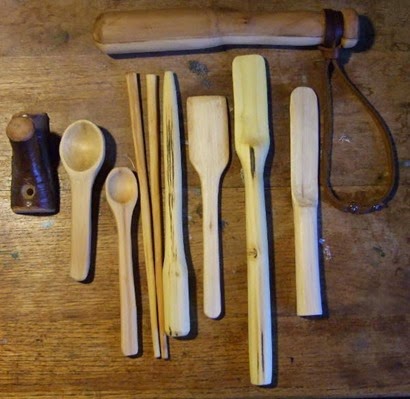
WoodRecycledProductSamples_webWhile pole-lathe turning and wood turning in general is a good skill it is not always necessary to make treen goods, as I have discovered making rolling pins (for the making of tortillas) just simply by carving it from a piece of relative straight piece of coppice wood by using just knife, glass shave, and surform rasps and working entirely by eye. Also a more or less copy of an old style British Detective truncheon was done in the same way (see top piece in photo).

For spoon carving and so-called green woodworking and especially for inspiration see some of the Facebook pages and groups: https://www.facebook.com/groups/GreenWoodWork/, https://www.facebook.com/groups/greenwoodworking/

Basket making

Willow baskets, and baskets from other woods, for carrying vegetables, laundry, logs and coal, fruit, bicycles, shopping, letters and such were fixtures of British life until plastic arrived in the 1950s.

The craft of basket making hasn't changed in thousands of years. You require very few tools: knives for pointing the ends of the willow or hazel, for this is another common wood used, rods and trimming the finished basket; a bodkin to make openings in the weave; a cleave and shave to split rods into three or four finer skeins; a beating iron to hammer the weave down. The base is made first: a round or rectangular frame of sturdier stakes interwoven with finer willow rods. Then you insert the upright stakes to form the side frame, and lay the first weave. Then you start weaving, in one of a range of styles: randing, slewing, fitching, waling. Finish with a border around the top. You need strong hands, a good eye for straight lines, and lots of patience. The Basketmakers' Association lists courses: www.basketassoc.org

In years gone by the itinerant traders, the hawkers, more often than not carried their goods in woven baskets on their backs and those kinds of baskets can be found all over Europe and also in the Americas. They are the forerunner the the rucksack and the backpack but are much better for the carrying of goods, such as carved wooden spoons and other such things, that ever would be a rucksack or backpack.

There are, obviously, many other crafts and trades that deserve a revival and revitalization and that also for the fact that we may, rather sooner than later, also require them again in order to live comfortably in the post-fossil fuel age, and the coming Wood Age.

© 2015

For more on coppicing and why, etc. see “Managing our Woods”, a small book that explains the whys and wherefores of managing our woods in this way and calls for us to return to that way.
Old skills, crafts and trades for the new age

by Michael Smith (Veshengro)

The new post-fossil fuel age will require the skills, crafts and trades of the old ones, in many aspects, especially those of working with one's hands and with hand tools.

Despite the fact that shale oil and shale gas are now being extracted by means of the most controversial method of “fracking” we are coming to the end of cheap and abundant oil and gas.

In 2011 the world used 40% more oil than it produced and the forecast, though dampened by the Great Recession, was that in 2012 over 60% more than produced would be consumed.

For a while now already various countries have put oil from strategic reserves on the market in order as not to frighten the populous with rocketing prices at the pumps. Sooner rather than later, however, those reserves are going to run out and the pigeons are then coming home to roost for sure.

And when that happened and the reality of the fuel going beyond what can be borne by the people and industry, much of how we work now is going to change; change back to the way the old people did things way back when.

This will mean a return to working with hands and hand tools and human-powered machines, be this a treadle or hand operated sewing machine, a treadle lathe, or the billhook, axe and crosscut saw in forestry.

It is, however, not only the use of those tools and the ways of using them that we will have to learn (again). We also must learn how to maintain them and keep them in good order, and also how to bring old, neglected ones back to life and into use again.

Many of the tools for those old skills, crafts and trades that we will need for the new age are often no longer made and thus we must, aside from making them again, refurbish the old ones that we can still obtain. Those old tools will be more valuable after the even than any gold or silver.

The skills, crafts and trades required for the new post-carbon age are, in fact, legion and they are those that many of our ancestors mastered, more or less, themselves. Many knew a large number of them as to be as little dependent on others as possible.

It is true that no person can master all those skills and can be entirely self-sufficient but we all will have to become as self-reliant as it is at all feasible.

You may not be able to produce your own leather from scratch but you should be able to make your own leather goods and growing at least some of your own food must become second nature as it was to our grandparents and their parents.

Getting hold of some old how-to books from publishers such as Odhams is a good idea and another good source is the Foxfire series of books, and then practicing many of those sills until you master them. The Odhams books were published in the 1930s and 1940s or thereabouts in Britain and can today, almost exclusively, only be found on flea markets, yard sales, trunk sales, and such like, and maybe, but then probably expensive, in secondhand antiquarian bookshops.

Nothing, however, beats learning from the old masters, and I am not referring to painters such as Rubens and such, but there are today few and far between. Many of those old masters, alas, have gone by now and those few that are lest are difficult to track down. If you can learn from a practitioner of the arts count yourself very lucky indeed, learn all you can and then go and teach others.

For the great majority of the needed old skills, etc.,, you will have to, I should guess, resort to (old) books and then learn them – the skills not the books – by trial and error and of both there will be many until the stage of more or less perfection.

Aside from old books there are also new ones, even videos, to be had that show the how-to of many of those old skills, trades and crafts, etc. In most cases, though, the old books are a great deal better.

The most important skills is, however, your mindset and no one can teach you that one. The mindset of which I speak is the one of seeing a way of making things from almost nothing; reusing, repurposing and upcycling.

When we have to make do with less, and that is also that we will have to learn again, and can't buy everything (immediately) at the stores – because of costs – being able to reuse what we have is a great skill though it may not, necessarily, bring in any income as some of the others may.

Learn all that you can while you can...

© 2013