Showing posts with label bicycles. Show all posts

200 years on the bicycle is more needed than ever

by Michael Smith (Veshengro)

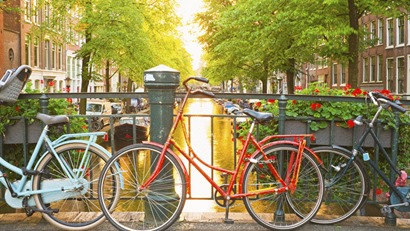
bicycles_Amsterdam1Does it have to be a brand-spanking-new bicycle? No... The old one that you may still have standing around in your shed given a little TLC or some other secondhand one would be much better and ideally without the fancy gearing of today.

On June 12, 1817 the bicycle saw the light of the world, in the form of the Laufmaschine (Draisine), by making its maiden voyage under the captainship of its inventor, Karl Drais. It has come a long way since and today is more needed than ever.

It was born out of the need for a replacement – albeit temporary – of the horse as very few horses were left in Germany at that time due to a climate event which brought about “the year without a summer”.

Today not just a climate event but climate change makes the bicycle even more important, and in this case as a replacement for the modern horse, the motorcar.

While the climate event of 1817, “the year without summer”, went away, the climate and weather returned to normal. Horses came back into use as they could be fed again and there was food for people again too. The bicycle, therefore, descended into obscurity for some time. With climate change this is, more than likely, not going ever be a return to normal and we will have to look to the bicycle as a low-carbon alternative for travel.

Today's bicycles are about as far removed from the original concept of the running machine, the Draisine, as is the ox cart from the modern car, with the exception of the balancing bikes for children nowadays which are almost a Draisine, having no pedals.

Bicycles do not, that is true, do not achieve the speed of a car and neither can they travel the same distance in a day as can a motor vehicle. On the other hand though most cars are not used daily for long distances but mostly for short trips (with the exception of those that may use them indeed for long commutes) for which a bicycle would not only be more efficient and cheaper but also faster.

By the time you have the car ready to go on the road, especially if it is kept in a garage, have buckled up and all that, you would already be half way there with a bicycle. Then at your destination, say the high street, you have to find a place to park the car, and more than likely that will take some time and may even cost you money to boot. The bike, on the other hand, you can just “chain” to the nearest lamppost or such and you can do what you want and need to do.

The bicycle is also one of the most energy efficient vehicles for public transportation. Instead of burning fuel and money and making you fat it burns fat and keeps you fit. Though as a cyclist I do realize that in many countries the infrastructure is not there for cycling, at least for safe cycling, and drivers of motor vehicles, from cars to trucks, see the cyclists as someone, more often than not, who should not be on the road with them. That needs to change.

While we are seeing a year by year increase in bicycle use in Britain, including for commuting, no real serious change will come about until the political will is there to change the status of cycling infrastructure by creating safe paths for cyclists (and pedestrians) alongside every, or at least almost every, road, that are separate from the road itself. What can be done in other European countries can be done in the UK and no one can tell me different.

© 2017

Happy Birthday to the bicycle; 200 yeas old

by Michael Smith (Veshengro)

Laufmaschine.jpgThe old girl has reached the ripe old age of 200 and is looking as good as ever. Actually, let's face it, over the years the old girl has changed and improved, and thus looking even better. Though, when we see today's so-called balancing bikes for young children, the Draisine is back, even in wood, with some improvements.

June 12, 2017 marked the 200th anniversary of the date on which Karl Drais (although he had an aristocratic title he renounced the “von” and the title Freiherr, that is to say, Baron later) took his new invention out for a ride and the modern bicycle was born.

On that day Drais rode his two-wheeled invention, the first Velocipede, five miles from the centre of Mannheim and back in less than an hour, at an average speed of 9.3 mph. It was basically a bicycle without pedals that one pushed along the ground but it was still much faster than walking. He called it a Laufmaschine (running machine in German) but the press named it a Draisine after the inventor.

The reason for the invention was not just for the fun of it. It was in response to an environmental crisis. Two years earlier in April 1815, Mount Tambora exploded and changed the world. This put so much ash and sulphur dioxide into the atmosphere that it turned 1816 into "the year without summer", causing world-wide famine. Most of the horses were slaughtered because there was nothing to feed them or their owners, so they became dinner.

But Drais needed a means of inspecting his tree stands that did not rely on horses. Drais discovered that, by placing wheels in a line on a frame, one could balance through dynamic steering. Thus a narrow vehicle capable of maneuvering on his land and the Laufmaschine became the immediate precursor of the bicycle.

As the bicycle became more popular, people found riding in the streets was uncomfortable due to the deep ruts left behind in surfaces of the roads by coach and cart wheels. This lead to cyclists sharing the sidewalks with pedestrians, which, in turn, led to the first conflicts. The penny-farthing, a bicycle with a huge direct-drive front wheel and tiny rear wheel accelerated fears for the safety of riders and passers-by alike and bicycles bans became common.

The invention of the "rover safety cycle" put the rider's feet back within reach of the ground, and helped this mode of transportation to return to the streets of cities around the world, introducing the rear chain drive in the process. Further important breakthroughs included the invention of ball bearings, the pneumatic tire, and the freewheel. Though some have, today, gone back to the fixed back wheel and please do not ask me why.

Today the bicycle is the most energy efficient and pollution free means of transportation on the planet, aside from walking. It is seen by many as a major player in the solution to climate change given that they are emission free. They could also be the answer to urban congestion as they take up so much less space than a car, and especially to urban pollution.

As in Drais' day, bikes are controversial. Motorists hate them when they are sharing the road and hate them even more when bike lanes are built and take away space for driving and storing cars. As in the days of Drais road conditions are often so awful and dangerous that cyclists sometimes take to riding on the sidewalk, alienating and endangering pedestrians. Though, it has to be said, neither of that is necessary if the cyclist remembers that he or she, theoretically, and often legally, is not meant to be there and that it is the domain of the pedestrians.

The way some cyclists ride and their attitude – and I am a cyclist myself – it is no wonder that people are often not very fond of them, and it seems to be getting worse.

I cannot understand why one has to race along the sidewalk – where one is not supposed to be in the first place though, I admit, I ride there myself but at slow speed (I am in no hurry ever) – or park paths, and such, where pedestrians have priority, weave in and out of motor traffic, undertake cars and trucks, etc. What's the hurry, what's the rush?

But two hundred years ago the skies cleared and a normal climate returned, and soon people were back to being pulled around by horses and the bicycle almost was forgotten. But in our the environment and climate, more than likely, is not going to return to normal, and our cities cannot hold any more cars.

As we enter an era when new pressures encourage everyone to swap their car for alternative transportation, it makes sense to celebrate the birthday the bicycle. So, once again, Happy Birthday old Girl! Let's ride!

© 2017

Surprise: The Wall Street Journal doesn't understand that bikes are transportation

Public

Rachel Berman of the Wall Street Journal appears to be surprised that people actually ride bikes for other than mad racing in spandex. She speaks to one Austin rider who says:

“I ride my bike purely to get from one place to another—not, ‘I’m going to take this out for exercise for like 20 miles,’ ” says Cassie Rae DuBay, a 28-year-old law librarian in Dallas. She says she aims to “add a little exercise to my day by riding 2 miles, as opposed to driving.”

She goes on to compare the growth of running as a sport to that of cycling, and finds that cycling is lagging running, showing a graph that compares "people in the US ages 6 and up who bicycled on pavement or went running at least once during the calendar year." She then compares running events to cycling, and speaks to a bike dealer:

“When you look at a marathon or half-marathon, you will see people walking, and they’re not ashamed,” says Fred Clements, executive director of the National Bicycle Dealers Association. “They’re not made to feel embarrassed. And that’s something that you won’t really see at a bicycling event. I don’t think we’re as far along as running is in making events that appeal to everyone.”

I wonder what planet these people are on. There's been an explosion in the use of bikes as transportation in cities across North America, with a 61.6 percent increase in bicycle commuting since 2000. It's growing at about 10 percent per year.

Read more here.

The number of bike commuters in London, UK, has doubled in the past 10 years

Cyclist in London UK

n urban areas, commuting in a car doesn't make much sense. When a majority of the population tries to move back and forth between the residential areas and the work areas, all at the same time, every day, there's got to be a better way to do that than 1 person per vehicle... That's why we're always happy to see the numbers go up for public transportation and cycling.

A new census in the U.K. is revealing that London is doing really well in that regard. Statistics compiled and analyzed by the Office for National Statistics (ONS) for the decade between 2001 and 2011 puts the capital well ahead of the rest of the country when it comes to bike commuting progress.

Read more here.

Personal transportation of the future: The Bicycle

by Michael Smith (Veshengro)

bicycle12.1_webWell, this is a little a case of back to the future, I know but despite all the hype the electric vehicle of whatever kind is not going to cut it for personal transportation for the masses. Keeping a horse and using horse and cart also is not an option for everyone, especially not those that live in towns and cities, that's for sure.

We are being told that battery technology is advancing on an almost daily basis but what no one who advocates the car in the form of electric vehicles (EVs) is the fact, and they don't even seem to consider it, that the manufacture of those and of those batteries requires energy and lots of it. It just will not work, period!

But still we are being sold the story that the electric vehicles, the battery car, is the future for personal transportation. It is not; the bicycle is, as it once was. I am sorry to shatter many illusions but the truth must be told.

And, the truth is that battery technology is not anywhere near what would be required to have all electric personal transportation and even less so freight transport.

The biggest problem remains the cost of the batteries and their components, both in monetary terms and in environmental terms and above that the fact that any of those batteries have a limited lifespan. They only have so many recharge cycles before they have to be replaced.

The future of all transportation, personal and freight, is going to be, once again, human and animal powered and not internal combustion engine or electric. As I said, I am sorry to shatter many illusions but we have to face reality and when the post-industrial area arrives, which it will, then those vehicles and their batteries will either no longer be produced due to lack of facilities or become so expensive as to be out of the reach of most mere mortals.

We have to leave the dream world that has been conjured up for us and wake up and face reality and reality is that things will, in the more likely not so distant future very different to the way we have known things to be. So, we better get used to the idea and start to prepare ourselves for this mentally.

The biggest problem is not that people in general are not prepared to face this reality but that industry and the powers-that-be are trying to blind everyone still with science and with smoke and mirrors. Everyone is in denial and believes government, industry and science will come up with a solution so we can continue to drive our cars, even if they are electric, that way we have done for the last half a century or so. Reality check: It is not going to work!

The reality is that, in the not so distant future, not only will oil be history, we will also simply not be able to continue to use it unless we no longer want a livable Planet and thus other ways must be found and employed and those other ways that those that were there before the world went mad, such as the bicycle, our feet, and also animal power.

The means of personal transportation for ordinary mortals with no way of keeping a horse will only be one option, aside from walking, and that is the iron steed, the humble bicycle.

Oh, and one little additional thought: It is not going to be the carbon-fiber road bike that we are talking about here but more the old-style single speed steel bicycle, produced in small workshops rather than in large factories in China.

But, for starters, there is no need to buy a new bicycle for transitioning to the “new” form of personal transportation. An old one, given some TLC will do just as well, if not even better, for you, your wallet and the Planet.

© 2015

Cargo bikes continue to spread, now in UK department stores

Johnny Loco cargo bike photoIn yet another sign that cargo bikes really are everywhere, UK department store John Lewis is now carrying cargo bikes from Dutch brand Johnny Loco.

For those outside the UK, this story probably doesn't hold that much significance. But as someone who grew up in the UK, I can attest that John Lewis was the first port of call for my mum when we went shopping for kids clothes, gifts, and just about everything else. When mainstream retail locations like John Lewis get on the bandwagon, it's exposing a whole new audience to these powerful transportation tools.

Currently included in their line up is The Johnny Loco Earl Grey Cargo Bike (RRP £1,999, or about US$3,100), and the Dutch Delight E-Cargo bike (RRP £3,499/US$5,429). The company is also offering the Johnny Loco Womens' Husky—which features a pretty darned hefty looking frame.

Read more: http://www.treehugger.com/bikes/cargo-bikes-continue-spread-now-uk-department-stores.html

Old-fashioned ways for the modern age

by Michael Smith (Veshengro)

When speaking here of and referring to old-fashioned ways I do not – necessarily – mean in a Luddite way or in a way similar to the Amish who refuse – basically – to have anything to do with modern ways.

old-fashioned-waysIt is not those – per se – that I will be speaking of but of the ways of old that especially today would be good for us and the Planet if they be brought back.

The old-fashioned ways I shall be considering and speaking of here are those that society today more often than not thinks quaint and antiquated, like walking and cycling instead of using the car, using pen and paper instead of electronic means for writing, for instance. As well as speaking with people face-to-face or on the telephone instead of sending text messages. And also making do and mending and making things rather than buying them.

The motorcar, it has to be said is beginning to fall out of favor in the second decade of the twenty-first century and that especially with young people and that to such an extent that many are not even bothering, while making the driving license, to actually acquire a car themselves. Instead they take to cycling, including for the daily commute.

This is a good turn of events as it cuts down on pollution from motor vehicle traffic – the less of them on the roads the better – and is good not only for the Planet and the doers' wallets. It also keeps the doers fit and healthy, if they do not get knocked off their bikes by inconsiderate motorists who seem to believe that they own the roads. But safety can be found in numbers here (as in so many cases) and the more people who will take to the bicycle the better.

The cost of fuel and everything else associated with owning and sunning a car is one of the reasons that the old-fashioned way is becoming rather popular again, that is to say the walking and the cycling.

A bicycle is not just cheaper to buy and cheaper to run. It also can be (almost) entirely maintained at top condition by the owner and also repaired. The bicycle is, however, but one of those old-fashioned ways that is making rather a comeback. The humble typewriter is another.

TYPEWRITER

In late Spring 2013 the Russian secret service community announced that, in light of the electronic spying by the NSA and GCHQ disclosed by Edward Snowden, the services are returning to using typewriter, albeit electric ones, for sensitive documents and communications. Thus the announcement of the death of the typewriter has been very premature indeed.

The typewriter is far from being an old hat and dead even though it could have been thought so with the large use of computers and such nowadays.

To all intents and purposes, however, the typewriter is very much alive and is having rather a renaissance these days and that includes also and especially manual ones.

Manual typewriters, and here especially old working ones, are sought after once again and not (just) to put on display. They are intended and bought for use. Reports even suggest that young people especially, in places such as the USA and other hyper-modern countries, are looking at using and learning how to use typewriters again.

PEN & PAPER

Pen and paper is another old-fashioned way whose death has been announced very prematurely indeed. In fact pen and paper is having rather a revival if the amount of Moleskine and other notebooks that can be seen carried and used and here very much again by the younger generation, especially young professionals, is anything to go by.

head-medium_0For many years we have been told – brainwashed in fact – that computers would make pen and paper obsolete and also that we should reduce and even eliminate the use of paper and go “paperless” in order to save the (rain) forests.

The latter, as to the rainforests and paper, is a total fallacy at best and an outright lie at worst as paper pulp cannot be produced from (tropical) hardwoods.

Why we are thus being lied to in such a way I cannot say but what I can say if that pen and paper are still very much in use and, it would appear, are coming back in vogue.

Even the use of the fountain pen is coming back and many of those that have taken to using Moleskine, Leuchtturm1917 and similar quality notebooks also invest in good quality fountain pens to use with those notebooks. Here it is also mostly “real” fountain pens – filled from an ink bottle – rather than cartridge pens.

Slowly, it would seem, many people are coming back to the realization that not everything modern is what it is made out to be and that not everything that glitters is gold. There is a great amount of fools' gold around which has been mistaken for the real stuff.

Too many of the good old-fashioned ways are not, as yet, coming back into their own but in order to bring back sanity into all of our lives and for the sake of the Planet they must be revived.

MAKING DO & MENDING is one of those and while the mending with products today that are made to break down easily and designed so they cannot be repaired in most cases it is a bit hard – but we can change that too – the making do is what we all can do already now. Especially here as to making do with what we already have as long as it works (well) and does the job.

Making do is something that we can and must do (again) for the sake of sanity, our wallets, and especially for the Planet. We only have this one Planet, we only have one Mother Earth.

Our ancestors, and especially here those of the working class and the peasantry, were masters in the making do department and from their ways, some of which are recorded in books and other publications, we can surely learn a great deal and we also must.

© 2013

Rethinking personal transportation

by Michael Smith (Veshengro)

draisineBio-fuel nor electric vehicles can help us continue the way things are today. The car, whether gasoline, diesel, or even electric, does not have a future.

Britain would be, in theory, well and ideally placed as regards to the production and use of bio-diesel with public transport, that is to say buses, and delivery and public service vehicles considering the number of Fish and Chips Shops throughout the country that have masses of waste cooking oil to dispose off on a daily basis which could be easily converted.

One can but wonder how many gallons or even tons per day are actually discarded around the country.

However, bio-fuel, be this kind of diesel or ethanol cannot sustain the amount of personal motoring in Britain and in the rest of the world and neither can electric vehicles.

It will, therefore, be necessary that we reconsidered our ways and that we ALL woke up to this fact including and especially those greenies that keep advocating bio-fuels and electric vehicles instead of a real change; a change from the car, of whatever kind, to a real sustainable alternative.

Personal motoring is very much yesterday and has had its day. Like one of the people said in the movie documentary “The Power of Community”, the car was but a blip in the history of mankind and we need to go back to the ways and methods we used to use before motoring became cheap and was regarded as a right for all, a human right almost.

We still have one of the best means of personal transportation that does not rely on either an engine or animal power – aside from walking but it is equally human-powered – and that is the humble bicycle, it burns calories instead of fossil fuel and keeps you fit.

The electric car has be touted, even by many greenies, as the answer to the internal combustion engine motorcar but it is doubtful as to whether, as far as purchase cost, it will ever be truly affordable by the masses. The production of such high-tech vehicles and their batteries also use up valuable resources, much better employed elsewhere, and that entirely aside from the pollution the mining for those rare earths and metals causes.

The mining for and production of gold in many places is almost as destructive as the Canadian tar sands and the same is true as regards to the extraction of rare earths and other components required to make electric cars. This make electric vehicles as unsustainable as ordinary motorcars, maybe even more so.

The humble bicycle is a proven technology, uses steel or aluminium for frames and wheel rims, etc., the metal for which can come from recycled sources and can be recycled again at the end of life almost ad infinitum.

A cared for bicycle, however, has a fairly long lifespan and some bikes of 60 or more years ago are still with us today and still perform as well as they day they were made.

We must stop and think and reconsider our options for personal transportation which, admittedly, are not great without the personal motorcar and leave but a few, most of them powered by self.

Looking at the electric car, aside from not being carbon neutral at all, it will also be costly. Costly to buy in the first place and costly to run as we all know that the batteries have a limited recharge cycle and thus lifespan and will need replacing every couple of years and that to the tune of about two-thirds of the price of a new car.

When industry, governments and environmentalists sing the praises of electric vehicles in how they will reduce CO2 emissions the CO2 and other pollutants emitted in the production of the cars and their batteries almost never enter the equation.

Industry is interested in the continuation of motoring and if people can be made to believe that electric vehicles will make for a clean Planet they are prepared to perpetuate this myth.

Governments are not prepared to tell the people the truth for fear of a backlash as people have come to believe that owning and driving a car or even three is their G-d-given and even human right.

And many environmentalists themselves – the very same that keep jetting off to all those many UN and other conferences in far flung countries – also want to keep the status quo of personal motoring and thus are on the bandwagon unquestioning.

However, the fact of the matter is that electric cars are as bad for the environment as are their ICE counterparts only that the emissions and environmental destruction happens elsewhere.

To say that the motorcar has served us well one definitely can not. The horse and the bicycle on the other hand have and will do so again.

Regardless of what the powers-that-be, the oil- and the car industry are trying to tell us and our governments cheap oil is coming to an end – in fact, it has done so already – and motoring for everyone is about to rung into a very solid rock face.

And this crash is going to be very much a shock to the system of people who believe that the current way of life of motoring will go on for ever.

The ever escalating – and doesn't it just – cost of fuel in Britain has already led to an increase in cycling including and especially for commuting but it is still nowhere close to where it is in other European countries and still miles away from the Netherlands and Denmark.

In the movie documentary “The Power of Community”, which is about Cuba's enforced peak oil after the “collapse” of the Soviet Union and how this Caribbean island dealt with the aftermath, one scientist expressed the truth plainly when he said that the motorcar has just been a blip in the history of mankind and that we have to return to other ways of doing things. And that indeed we must, and not only because we are running out of (cheap) oil, but also and especially for the sake of the Planet (and not just in regards to climate change).

We have to find an alternative to motoring as far as personal transportation (for the masses) is concerned and neither the electric car not ICE cars on bio-fuel will cut it here. But there is no need to reinvent the wheel. That alternative already exists. It is cheap and reliable, can be maintained with a little skill and tools by the user, and it is none other than the humble bicycle and the simpler the better.

Believing that we can carry on motoring ad infinitum is but an illusion and the sooner we woke up from this dream the better.

The future of personal transportation (for the masses) is human-powered and the very same that our grandparents and their parents used and not electric or bio-fuel and has been a reliable technology ever since Forestry Superintendent Karl Dreis invented it and Pierre Michaux improved upon it by adding pedals (and then the chain drive) and the rest, as they say, is history.

While the horse (and carriage) is also an alternative, and the Hanson Cab may make a comeback in the cities, it is not a practical alternative for everyone and, in addition, the bicycle is much cheaper to buy and does not require feeding, watering, vets bills, etc.

© 2013
Calcutta bans bicycles

Calcutta bans bicycles in an apparent attempt to check bombing terror

by Michael Smith (Veshengro)

Just when you think you have heard and seen it all and then along comes something like that from a city where bicycles vastly outnumber cars.

Bicycles IndiaAn Indian city, Calcutta (aka Kolkata) to be precise, has banned cyclists from major roads on the grounds that bicycles prove handy for anti-social elements intending to plant bombs. The decision is getting unwelcome reactions from many levels.

“Cycling is banned on major thoroughfares of the city for two reasons,” said K Hari Rajan, the assistant commissioner (traffic) of Calcutta police.

“To ensure that traffic flow is not disturbed by the mix of fast-moving vehicles and cycles, as Calcutta has no provision for dedicated cycling lanes. There are also security concerns as bicycles are often used to plant bombs,” he explained.

Many cities around the world have made policies which promote the switch to the more eco-friendly mode of transport provided by bicycles, hoping to help check increasing environmental pollution. Calcutta’s move in the opposite direction is not getting a positive response from commuters or environmentalists.

“Polluting auto-rickshaws and buses have a free run in the city but bicycles are banned,” said transport environment activist Debashish Bhattacharya. “If terrorists plant an explosive in a four-wheeler, will the government ban cars on arterial roads?”

Another environmentalist, S M Ghosh, said that the bicycle is eco-friendly. “Bicycles are universally encouraged to counter environmental pollution. Instead of banning cycles, the administration should make arrangements for dedicated cycling paths,” Ghosh said.

From another perspective, the vast majority of India’ population depends on bicycles for daily transport. In a nation of 1.2 million where 800,000 live in poverty, cheap, simple, reliable transportation can mean the difference between earning a living and begging for one.

“The bicycle is a poor man’s vehicle. Throughout the day I have to be on the move on a bicycle for my job and I cannot afford anything else,” Sushanta Chakrabarty said. Chakrabarty collects blood samples to earn his livelihood.

Environmentalists have urged the government to look at Bangkok and European cities, which are reaping the benefits of encouraging bicycles as a means of transport.

How any local authority or police department can actually be that stupid beats the hell out of me considering that, as it has already been said, bicycles are probably, aside from walking, the most environmentally friendly mode of transportation and that in a city where bicycles vastly outnumber cars and other modes of transport and where many people cannot afford anything else but a bicycle.

Terrorism seem to be the excuse for everything when the powers-that-be want to ban anything and in this case it is absolutely laughable.

© 2013

Cycling Britain's fastest growing mode of transport

by Michael Smith (Veshengro)

Cycling is one of the fastest growing modes of transport in Britain. It is clean, healthy and good for the environment. But the government is still lagging behind those of other EU countries in providing a proper safe cycling infrastructure for British cyclists.

The Mayor of London, Boris Johnson, has created a “vision for cycling”, but then he is a cyclist and understands, for an unbroken network of cycle routes in London. And while there are many things that one could disagree with with Mr. Johnson this is not one of them.

However, we need more than just an unbroken network of lanes, as they are today, even though very fragmented, as they are not safe for cyclists. The lanes must be, as they are in most countries of Europe, physically separated from the motor traffic.

Mayor Johnson has also stated that he wants to “de-Lycrafy” cycling and bring it to the masses and this is indeed something that must be done if we want to have a sustainable low- to zero-carbon transportation future.

This vision in which many of us who use bicycles to get around, some as primary mode of transport even, share with the Mayor of London can only come true if we keep knocking at the right doors by demanding that proper, separated, bicycle lanes get created in the same way of those that can be found on the European mainland, whether in the Netherlands, in Germany or in Denmark.

Cycling is becoming, and it is evident in the new faces one can see on a daily basis using the bike for commuting, to go to the shops or to visit friends, more popular than it has been for many decades and many young people shun the car, in fact, in favor of the bike.

One of the main fact, aside from environmental consciousness and wishing to become fit or fitter, for cycling being the fastest growing mode of transportation in Britain today is the ever increasing cost of fuel and motoring per se, for insurance and road tax also pay part in this.

Motorists are always fuming about the fact that cyclists need not to pay the road fund license and neither have to have insurance but no one forces those people that moan to use their cars. They too could use a bike. In addition to that they seem to forget that the bicycle was here before the car, as were pedestrians.

Britain has been, and still is, sadly lacking behind other countries in Europe as to provisions for cyclists and if one sees the cycle lanes in places such as the Netherlands – yes, OK, more people use bikes than cars there – and in Germany, which go from about everywhere to everywhere one can but dream and hope to get something like that in the UK too (one day).

Unfortunately, presently, Britain has the worst provisions for cycling and cyclist of all the EU countries and this is, despite the increase in cycling as mode of transportation presently, still preventing many people from getting on their bike instead of into their car, especially for shorter journeys. This must change for our health and for that, especially, of the Planet.

© 2013

WHAT’S NOT TO LIKE ABOUT THE BIKE? CIWEM URGES GOVERNMENT TO BACK BORIS’S VISION FOR CYCLING

Cycling is one of the fastest growing modes of transport in Britain. It is clean, healthy and good for the environment. CIWEM has joined cycling groups in calling on the government to back the London Mayor’s vision for cycling, invest in his proposals for an unbroken network of cycle routes in London, and roll it out across Britain.

The Chartered Institution of Water and Environmental Management (CIWEM) is pleased to support the London Mayor’s proposals to “de-Lycrafy” cycling and bring it to the masses. A new London cycling super-highway to encourage commuters on to bikes will bring huge benefits. It will improve London’s environment, improve people’s health and wellbeing and bring new investment and jobs.

The forthcoming publication of a report by the All Party Parliamentary Cycling Group is likely to bring pressure on the government to support the London Mayor’s plans, and to find the nearly one billion pounds needed to fund the scheme. CIWEM urges the government to follow the Mayor’s lead and roll out similar proposals to other cities and towns across Britain. The health, environmental and economic benefits would be significant, and lead to a transformation of our transport systems. CIWEM believes this one infrastructure plan that makes sense and is genuinely sustainable.

CIWEM Executive Director, Nick Reeves OBE, said: “It’s time to change our transport habits and learn to love our bikes. Boris Johnson’s vision for an unbroken network of cycling superhighways across London is the perfect infrastructure project that is also genuinely green. It will democratise cycling, improve our health and our environment, create jobs and launch a transport renaissance that could be introduced to all our cities and towns. In a time of austerity, this is just the sort of investment the country needs to get Britain working, clean up our urban centres, and get us fit.”

CIWEM’s vision for sustainable, local transport and infrastructure will soon be outlined in forthcoming policy position statements.

The Chartered Institution of Water and Environmental Management (CIWEM) is an independent professional body and a registered charity, advancing the science and practice of water and environmental management for a clean, green and sustainable world. www.ciwem.org

The All Party Parliamentary Cycling Group is a cross-party group of MPs, is co-chaired by Ian Austin, the MP for Dudley (Lab) and Julian Huppert, the MP for Cambridge (LD). It has conducted an Inquiry and taken evidence on cycling and will publish its report with recommendations in April 2013. http://allpartycycling.org/

Full Disclosure Statement: The GREEN (LIVING) REVIEW received no compensation for any component of this article.

This article is for your information only and the GREEN (LIVING) REVIEW does not (necessarily) approve, endorse or recommend the product, service or company mentioned.

Learn bicycle maintenance

by Michael Smith (Veshengro)

bicycle_maintenance This is not an attempt to but cycle mechanics and bike shops out of business but cycle maintenance, even more advance cycle maintenance, is something everyone using a bicycle should know.

Being able to repair your bike, from simple puncture repair to much more advanced maintenance and repair, is a great skill to know and one that could be more than vital in time to come.

The fact is that we will all have to look to the humble bicycle more as a means of personal transportation as, sooner or later, though it would appear that it might be sooner rather than later, cheap and abundant oil will come to an end.

Gasoline and diesel prices are already at an all time high and while they do fluctuate a little and, in some cases, in the early part of 2012, have gone down a little even, in some places and cases, the latter is due only to the fact that the US and UK governments have release strategic reserves onto the market to prevent riots in the streets.

In 2011, according to statistics, the world used 40% more oil than was being produced. One does not have to be a mathematical genius to work out that that does not compute; definitely not in the long run. Forecasts for 2012 were about 50% to even 60% more needed than being brought to the surface.

So, therefore, the bicycle is going to make and already making a comeback as far as personal transportation is concerned, even for commuting, and thus it is important that anyone using a bike also knows how to maintain it.

Fact is that many, especially “new” cyclists, have got no idea of what maintenance is required and cannot even, in many cases, repair a puncture. While that makes a nice little income for the cycle mechanics, and I do not begrudge them the trade, it is rather ludicrous, but it is the truth.

It has even been known for people to go and throw a bike away at the dump (or leave it in the countryside) simply because of a flat tire. OK, if they have more money than sense and rather want to buy a new bike rather than repair it then they should go and give the bike to someone who appreciated it and can fix it.

Bicycle maintenance is not rocket science and while the tools for the more advance jobs are quite expensive – unless you can find that Lidl are selling a kit of tools for little money (that's how I got mine) when they have them in stock - it is worth in the long run.

However, even if one would not want to tackle rebuilding a bicycle from abandoned ones, as I do, there are aspects of cycle maintenance that every cyclist should know regardless.

Fixing a puncture, one of the simplest jobs, is one of them for sure. One of the most important aspects of routing maintenance, however, is keeping the parts all nicely lubricated. A bike is not meant to make squealing or clonking noises, especially no clonking noises emanating from the crank. As soon as you hear anything like that apply oil. It normally is all that is needed.

My advice to anyone considering serious use of a bicycle for personal transportation is to use a single speed bike, or one with hug gears. Bicycles with Shimano dérailleur gears are a pain in the proverbial neck and if it ever comes to adjusting those, and that needs arises from time to time, it can take hours, literally, to readjust them again.

A simply drop of the bike on the dérailleur can seriously affect the gear change and thus my advice – for I have been there and done it and spent over three hours trying to get it realigned – is to use either, if you can afford it, a bike with three hub gears (Sturney Archer, if you can get it), and you can even get them up to eight gears now, or simple single speed.

When it comes to single speed the older kinds of bicycles can be converted quickly and easily and there is no need to buy a new back wheel, and a conversion, as long as the bike has a “horizontal” dropout compared to the more modern “vertical” dropout at the back, is just a simple case of removing the dérailleur and associated cabling, etc., and then setting the chain to the smallest but one cog on the cassette, shorten chain to appropriate length by use of chain tool and, voila, one single speed bicycle.

Routine bicycle maintenance that anyone should know, however, is much simpler and contains, in the main, of proper cleaning, lubricating, chain tensioning, fitting new brake pads, new cables for brakes (and gears, if you have them), and fixing a puncture.

Unlike cars of today bicycles are still user-maintainable and thus everyone using a bike should, in my opinion, know at least the basics. With a good handbook or two the rest can also be learned bar one or two aspects, maybe.

And because bicycles can be maintained, repaired and even rebuild with only hand tools and the right amount of knowledge they are one of the most sustainable forms of personal transportation.

While it is true that we need some amount of spare parts every now and then such as new tires when the tread is worn down or they fail other wise or new inner tubes for there is only that much patching of them that you can do, and, obviously patches, vulcanizing fluid and such like, they are a lot easier to deal with than anything else, bar one's own feet.

Most aspects of bicycle maintenance is but the application of common sense and a little knowledge to the problem and the problem thus gets solved. You also do not take a bicycle to the bike shop for an annual service or such. You can do those things yourself. Learn from a good book or two or someone who tinkers with bikes and you are up and running to keeping your bicycle(s) running almost for ever.

The bicycle is the personal transportation of the future, together with walking, for the masses. The age of motoring is history, regardless of what those with a vested interest or those that cannot and do not want to see the writing on the wall. Thus knowing how to maintain, repair, service and rebuild a bicycle is a skill worth learning.

© 2012

CYCLE logistics: Moving goods by bicycle

Achieving concrete reduction in energy used for urban freight transport

By Michael Smith (Veshengro)

cargo-bicycle_web As societies face urban congestion, rising fuel costs and increased air and noise pollution, using bicyles to move goods is now being seen a viable transport solution. This is clearly the idea behind CYCLE Logistics, the EU funded project being launched in May 2011.

“All modern sustainable companies and cities will incorporate delivery of goods by bikes in their logistic systems” proclaims Dr. Bernhard Ensink, Secretary General of the European Cyclists’ Federation (ECF), and one of the key partners involved in the project. The CYCLE logistics project will build upon this new trend of moving goods out of trucks and vans and onto bicycles.

Running from May 2011 to 2014 and spanning across 12 countries, this project will draw upon the expertise of local authorities, the private sector, cyclists’ groups, communications experts and energy agencies. With ECF as a main partner of this project, CYCLE logistics will strive to remove unnecessary motorized vehicles from roads by using more bikes to transport goods in city center across Europe.

A clear example of bikes being used as part of every-day business

“Currently, half of all trips in the city are related to the transportation of goods with light goods representing over a third of these trips”, explains ECF Project manager Dr. Randy Rzewnicki, noting that “there’s a huge potential for CYCLE logistics to shift these trips away from motorized vehicles and towards cycling-related solutions”.

Despite the mammoth task ahead of him, Rzewnicki is upbeat: “In Berlin, London, Paris, and many other cities elsewhere it’s happening already for business. Even for those who have the most efficient delivery networks, cycling solutions lead to increased efficiency”.

But, let's face it: this is not a new concept now. Baker's, butcher's, etc., used to do their deliveries around towns, villages and even part of the countryside by “cargo” cycles and the postal service, even in rural areas of the UK, for instance, has been using bicycles until they enlarged the delivery areas too much.

Germany has seen a return of the courier, as in DHL kind of, and also other delivery services, including grocery home deliveries, so I understand, on “cargo” cycles and also in Britain some small ventures have taken up that option once again.

On a larger scale, I should think, as far as Britain is concerned, the talk would be about needing “pilot” projects before, say, local authorities and such would take up this option of bicycle deliveries.

In other countries of Europe, for instance, this is happening and also other alternatives to car and truck are being used and not just “explored” such as horse-drawn dustcarts in a number of areas in France, including, so I understand, some districts of the capital.

According to reports from France the savings are huge in switching from the huge diesel-turbine trucks to horse and cart and even collection speeds do not seem to have suffered.

As far as deliveries in towns and cities are concerned if one considers that, due to the congestion, the traveling speed of a truck may be less than that of a bicycles, especially if cycle paths are available, deliveries by bike might just be rather a viable option, and maybe not just in towns and cities.

© 2011

Increase in rail and bicycle usage in Britain

By Michael Smith (Veshengro)

According to recent figures rail journeys in the UK have increased tremendously pointing to the fact that people leave the car at home more because of the cost of fuel going up, and up, and up.

Bicycle usage also has risen rather greatly from what I can observe on a daily basis and more and more people seem to join the throng of those riding through our parks on their way to work or from work, or to take the children to school, or to go to the stores.

With the equivalent of US$8 and more for a US gallon of ordinary gasoline this change in choice of mode of transport really is not surprising. What is surprising that not more bikes are about on the commuting trail and the school run or the trip to the stores for the pint of milk or the loaf of bread.

The way people are and have been using the car is not really sustainable and nor has it ever been. We clog up the village and town centers, the roads to and fro, and we pollute the air. Short journeys cause much greater emissions than the loner runs and vehicles idling are the biggest cause of automobile air pollution.

While most readers of this journal will know the facts as to pollution caused by idling cars and such like very well indeed already it is, nevertheless, interesting and, dare I say, encouraging, to see that rail journeys are going up and, as far as I can see, the use of bicycles too is very much on the increase, for commuting as well as for taking the kids to school or for the run to the shops.

Let us just hope – and, those who do, pray – that this increase will not just dissipate again if and when oil and gasoline become cheap again. Not that I, personally, think that this is going to be the case again, ever.

And if it is indeed the case that the era of cheap and abundant oil has come to an end everyone best prepare for a return to mass transport, such as, especially, rail, for the longer journeys and to the use of the bicycle and walking for the shorter journey. Unless, that is, you can afford to keep and maintain (no, not a musket, silly) a horse and cart.

The problem though is that this fact is not, as yet, really sinking in with the majority of the people who still think that they are entitled to a car and to be able to be running it.

I don't know about such entitlements. Even the Constitution of the United States of America does not make mention of any of that. There is no right to have access to cheap gasoline enshrined in that document, not even in any of the many Amendments to said Constitution.

© 2011

Cycle Show 2009 – A Visit Report

by Michael Smith (Veshengro)

Cycle Show 2009 at Earls Court, London from October 8-11, 2009

While there was not all that much new with the big makers and suppliers some new innovations and arrivals, as least as far as the Cycle Show in London is concerned, were to be seen.

Dutch ID (cargo) bikes was definitely one new one on the show; at least I am sure that I have not seen them before here, and those bicycles really got me interested.

Bicgfish Folding Bike was represented again and, so I understand, is going from strength to strength and also Pashley Bicycles report good sales.

It would appear that bicycles are beginning to make a comeback in Britain, and elsewhere, and also especially for commuting to work, going to the shops and more.

German bicycle makers Tout Terrain also showcased some great and well designed and -constructed urban and country touring bikes.

What makes those bikes rather special is the fact that the luggage rack on the back is an integral part of the frame and not, as with other bikes, a bolted on thing. This not only makes for a more rigid carrier but also is adding to the strength of the frame itself.

Nowadays it needs the Germans, the Dutch and the Danes, it would seem, to show us in Britain (and elsewhere) how to make good and proper bicycles for the everyday tasks.

Paper Bike from the UK though is also very interesting and was on the show last year already. The bikes are extremely sturdy steel constructions, simple in design, and, so I believe, made in Britain.

On the other hand, however, the rest of the stuff was not all that relevant, as far as I am concerned, such as a “gold” bike and a sparkling low rider. Gimmicks those are and expensive ones at that. People who want real bikes and for whom cycling is a means of transportation, by choice, and not a plaything certainly did not even give those a second look.

While the golden bike was a folding one and one might not have to worry too much as to someone vandalizing it or steeling it if chained up outside, for that would not come into the equation here, with some of the other bicycles in the several thousand pound bracket that would be a serious concern though to me and I am sure also to others.

At the same time that there were many vendors of cycle accessories (lights, clothing, bags, etc.) present at the Cycle Show 2009 the makers of such products, in the main, were rather conspicuous by their absence.

This is rather always rather a shame for writers on the lookout for new products to report on. Vendors rarely have interest in having anyone review the products.

What was good to learn from the visit to the show though is that cycle sales, according to the makers that I spoke to, are up and that despite the recession – or maybe because of the recession - and also bike repair shops and cycle re-builders are doing good business.

From where I am standing in this I can say that I but hope that this is a sign that people are beginning to think about alternative transport to the car and are seeing the bicycle as a viable alternative, especially for shorter journeys.

I tend to find it rather silly – and I use that word for lack of a better one – when I see people going a mile or two (even less at times) to get a newspaper or a pint of milk getting the car out and driving there.

© 2009

<>

The bicycle and cycling has an image problem

by Michael Smith

The bicycle has been my sole means of transportation, aside from public transport and the one or other friend ferrying me about in a motor vehicle as and when, and I happen to feel pretty good about that.

This also, and for that I am grateful, means that my environmental footprint – I still refuse to call it “carbon footprint” – is a great deal smaller than that of other people and and I save money on gas and insurance. I addition to that cycling keeps me somewhat in shape and it is fun to boot. I also happen to love the beauty and technology of bicycles, as well as, their, to some degree, simplicity. Instead of aspiring to an expensive car I look forward to the day that I can afford – or the day they give me one to keep for review – a Pashley bicycle or a Velorbis or Dutch bike.

For most people, unfortunately, the bicycle is something that you use for transportation until you are old enough (and successful enough) to purchase a car. The fact that the bicycle is not seen as a sexy, technologically advanced machine worth aspiring to shows us that cycling has an image problem, but one that will be overcome, of that I am sure. In the UK bicycles are coming, slowly, back into fashion in all walks of life, though, for a strange reason more so by those of the middle and upper classes than the working class. The latter aspire to a car, more often than not, even if they can barely afford to buy and to run it.

The message that is constantly conveyed, on TV and in the movies, is that not only is cycling for transportation inconvenient and dangerous, it's also a sign of failure. It isn't surprising, then, that people aspire to purchase a better, faster, sexier car: that's what signifies that one is moving up in the world.

In addition to that any '10 things you can do for the environment' list will, without fail, include cycling, which turns a simple cycle ride into some sort of heroic act instead of what it is: fun and good for you. People do not want to be heroes, they want to work for a better world by having fun and using their creativity and talent to solve problems.

While there may be nothing wrong, even to people in the environmental movement, with nice cars, such as, for example, the Tesla Roadster with its electric motor and advanced lithium ion battery pack.

The bicycle is worth aspiring to, more so than people think, and that especially in the world where gas prices are on the rise and with the possibility that we are reaching or may have even reached already peak oil this is not going to improve.

While hybrids have dramatically altered the image of the car, the bicycle is still seen as a backward, slow toy that is better suited to children, starving college students and racers than to adults with errands to run. But bicycles today are more comfortable, light and advanced than ever before. The use of carbon fiber, titanium, hydraulic disc brakes, LED headlights and GPS units are things that one expects to find on fighter jets, race cars and the family saloon, but, nevertheless, they are becoming standard on £1,000+ bicycles. You can pay well over £7,000 for as bike, if you wanted to, even bikes made by Ferrari and Porsche – yes, those car makers. But you don't have to buy a bike for that price but we come to that in a minute.

There are also tons of bike racks, trailers and panniers, that is to say, saddle bags, that can enable one to do anything with a bicycles, from shopping for groceries, commuting to work, to hauling a fridge.

One can easily get into bicycling with a £100 investment in a bicycle from Halfords, Argos or some of the supermarket chains, and one could, if one wanted to, move on up to a top-of-the-line, racing cycle of £6,000 or such. This means that cycling is accessible and meaningful to anyone.

With the prices of gasoline being on the rise and, as I said before, the possibility that we have reached peak oil and that, hence, the prices will not fall ever again, in addition to the problems with the “credit crunch”, the use of the motorcar may be a more and more difficult thing.

The automakers seem to look at the hybrid to save the environment and try to get people to buy those motorcars, and the same is true for electric cars and while the electric ones do not have such a large environmental footprint as does the gasoline or diesel powered car with the ICE, and a smaller one still than the hybrid, it is still not going to be cheap to run one and still their production puts a much greater strain on the environment than does the production of cycles.

While this still may not make cycling immediately chique the use of the bicycle will, in due course, I am sure, become once again much more the norm and this not just because people have to turn over the pennies a lot more. When the infrastructure is being cerated, as it is being done in some countries already, to make riding a bike better and safer cycling is going to be in vogue once again. The problem is that the humble bicycle is still far too humble and the hybrid and the electric car and motorbike are given far too much coverage. There are much better low-tech alternatives available often to all those high-tech gadgets that are meant to save the planet.

© M Smith (Veshengro), November 2008
<>

Green Oil – Product Review


I was given a sample of this bicycle oil (and you can also use it for other things that need oiling) at the Camden Green Fair – which, I know, is a while ago – but only have had time to try it out over the last couple of weeks on my bikes (yes, I have more than none) and can only say that it does what is says on the bottle.

Aside from being environmentally friendly it lubricates as it should and I certainly think that my oil for the bikes in future will be nothing but Green Oil.

As far as I can see so far the chains lubricated with Green Oil do not seem to get clogged up with debris and dust and all as fast as they do when other cycle oils or such are being employed.

Green Oil contains advanced long-chain molecules to reduce friction and these polymers also repel water molecules, which inhibits rust and corrosion, prolonging the chain's mechanical life.

The bottle for Green Oil is made of a thermoplastic. This means that it can be repeatedly softened by heating and hardened again on cooling making it possible to recycle it over and over.

Green Oil bottles are made out of HDPE, or 'High Density Polyethylene' and this is the same plastic as that used in milk bottles so, therefore, ff your council recycles plastic milk bottles, it will recycle Green Oil bottles.

The cap, alas, is made of polypropylene, which is plastic type 5 and is not usual recyclable through council schemes though there may be commercial schemes that use those caps.

Each Green Oil bottle has a recycled paper label. This can be removed, and recycled again, possibly into a new Green Oil label, The label is printed with non-harmful inks.

Green Oil is manufactured from naturally occurring plant extracts, a blend of which produces a high performance lubricant. Green Oil contains no animal derivatives.

Green Oil protects from rust and gives a smooth, low friction ride. It contains no irritants or hazardous materials.

Other lubricants more often than not contain chemicals that are harmful to human and animal skin. Green Oil, on the other hand, is different, without compromising performance, however. Green Oil is not based on petrochemicals. It also contains no palm oil. Also, Green Oil contains no animal products or by-products, and is suitable, therefore, for vegetarians and vegans.

Green Oil is made in Kent, in the United Kingdom, and has a very low environmental footprint in that regard, not being imported from either the USA or even China.

As far as I am concerned as reviewer and a cyclist – please note I do not own a car and the bicycle to me is therefore vital as a working means of transport – Green Oil is a great lubricant and having those nice environmental credentials definitely gets a 5-star rating, that is to say, the maximum.

All we now need is to have Green Oil available in all bike shops.

Review by Michael Smith (Veshengro), August 2008
<>

It’s all about the Bike

Cycle 2008: The future of cycling all under one roof

Worried about the credit crunch? Concerned about the environment? Fed up of sitting in traffic? On your bike!


Cycling is enjoying a renaissance in the UK for many different reasons, it’s cheap, clean, makes you healthy and most importantly, it’s fun! So whether you’re already riding or just thinking about throwing your leg over the saddle, this is a great time to book your ticket to this autumn’s Cycle08 at Earls Court, the biggest and best consumer cycle show in the UK with all the very latest bikes, clothing and accessories for cyclists of all shapes, sizes and abilities.

Names like Specialized, Ridgeback, Scott and Raleigh are all amongst those exhibiting at the show, along with Shimano, Campagnolo, Mavic and SRAM all exhibiting their 2009 ranges for the very first time in the UK.

Cycle 08 is one of the biggest and certainly the most diverse exhibition of bikes and accessories in the UK showcasing everything from the latest road and mountainbikes right through to childrens bikes, classic commuter bikes and even electrically assisted bikes for those who need that extra push!

As well as offering the chance to see, Cycle 08 also offers visitors a unique opportunity to try out the latest equipment. The return for 2008 of the Mountainbike test track, sponsored by Volvo and Tyrol as well as the Commuter ‘Try it’ track means that visitors will have every opportunity to try before they buy.

For those who can’t wait to get back to their local bike shop to make a purchase, Cycle 08 will once again feature the retail zone with clothing from all the leading manufacturers at the show in the latest styles and colours as well as glasses, helmets and other accessories to help the fashion conscious cyclist stay one step ahead of the pack!

Finally, after a summer that has provided so much entertainment for fans of the sport of cycling, Cycle 08 will have its own arena space for the first time this year, bringing together some of the stars of the sport for interviews, demonstrations, Q&A and more in a packed programme of events that will keep Earls Court buzzing throughout the three consumer days of the show.

Summing up this years event, show director Andrew Brabazon said:

“We’ve crammed in more than ever before at this years show, with even more exhibition space alongside the interactive features and a programme of entertainment that justifies the ticket price alone! Cycle continues to offer great value for money particularly if you pre-book your ticket, so make a date in your diary now and head to the website!”

Whatever your reason for getting on a bike, Cycle 08 has something to offer and to entertain you this year, book your ticket now and receive a £3 discount against the on-the-door price of £14.
Head to www.cycleshow.co.uk now to find out more.

Cycle 2008 takes place at Earls Court 1, London

The show dates are: 9th Oct Trade only and 10th-12th Oct open to the Public

Opening Times:
Thursday (trade only day) 10.00am to 6.00pm
Friday 10.00am to 6.00pm
Saturday 10.00am to 6.00pm
Sunday 10.00am to 5.00pm

Adult ticket prices are £11 in advance and £14 on the door.

Source: Upper Street Events
<>

Mayor launches London's 'Summer of Cycling'

London, July 21, 2008: The Mayor of London, Boris Johnson, today joined Sky Sports News presenter Georgie Thompson and cyclists from across London to launch the capital’s Summer of Cycling, which aims to encourage more Londoners to take to their bikes.

The Mayor and Transport for London (TfL) will be promoting cycling throughout the coming months, through innovative events and the ongoing “You’re better off by bike” campaign. The aims of this campaign are to encourage existing cyclists to use their bikes more regularly, and promote cycling to the estimated 1.1 million Londoners who have access to bikes but don’t use them.

On September 7th, the Tour of Britain, supported by TfL, will bring the spectacle of professional cycling back to the capital following the success of last year’s Tour de France Grand Depart.

Two weeks later, Londoners of all ages and cycling abilities will get their chance to experience the joys of cycling themselves when the Summer of Cycling culminates in the hugely popular Sky Sports London Freewheel event on 21st September. At this year’s event, participants will enjoy a carnival atmosphere and views of some the capital’s most spectacular landmarks as they bike along a car-free central route past the Tower of London, the Houses of Parliament, the London Eye, Trafalgar Square, and Buckingham Palace.

The Summer of Cycling launch comes as TfL releases new figures showing that while one in three people in the capital have access to bicycles, only half of these have actually used a bike in the past 12 months. That means that over a million Londoners have left their bikes to gather dust over the past year.

Launching the summer cycling campaign, Mayor of London, Boris Johnson, said:
“While there’s already been a healthy increase in the number of people on bikes, half of Londoners who own a bike aren’t using them regularly, and over a million Londoners are still missing out on the benefits of cycling. I’m challenging all Londoners who have bicycles languishing in the shed or garage, to dig them out, dust off the cobwebs, and re-acquaint themselves with one of the most glorious ways of getting about.

“There are so many reasons to dust off your bike this summer – it’s a great way to get fit, it saves you money, and it’s good for the environment. For those who are still not convinced, we are laying on the Sky Sports London Freewheel on September 21st – closing the roads of central London to allow Londoners of all ages, backgrounds and cycling abilities the chance to enjoy our fantastic city by bike. What could be nicer than feeling the wind on your face as you zip past some of London's most famous landmarks, completely undisturbed by traffic.”

Vic Wakeling, Managing Director Sky Sports, said "Sky Sports is pleased to support the London Freewheel. It’s a tremendous event that gets people of all ages and abilities involved in sport and that’s to be applauded. I hope that our association will help to encourage people across the capital to get involved.”

Sky Sports News Presenter, Georgie Thompson who is helping launch the Sky Sports London Freewheel today, said: "I'm passionate about all sports and I take a keen interest in health and fitness. We all live such busy lives that it can be difficult to fit everything in, but it's very important to maintain a healthy balance. The great thing about cycling is that it's fun and so simple to fit into hectic schedules and everyone can do it - I am a big fan.”

Janis Tjarve, a bike maintenance expert from The Bike Doctor, has advice for Londoners dusting off a ‘dormant bike’. He said:
“If you’re going to use a bike that’s been out of action for some time, there are a few quick and easy checks you should make. Ensure that your tyres are pumped up to the right pressure – this is the BAR or PSI measure on the side of the tire. Check that your brakes are lined up and working properly. Make sure that the stem and saddle are tightly bolted and at the right height. Your leg should be almost fully extended at the bottom of a pedal stroke. Finally, test that the gears are working and that the chain is well oiled.”

To further develop cycling in the capital, the Mayor and TfL are investing a further £55 million in cycling this year - up from £36m last year. The money is being invested in cycle routes, cycle parking facilities, a bike hire scheme to make cycling accessible to all, education, adult and child cycle training, and cycling events.

For further information about cycling, including cycle training, bike maintenance advice and cycle maps, visit www.tfl.gov.uk.

To find out more about the Sky Sports London Freewheel, and to register for the event, visit: www.londonfreewheel.com. The event is free and open to everyone, but participants must register in order to take part.

This year's Freewheel will include 20 local led rides, supported by the London Cycling Campaign, which will offer less confident cyclists the chance to be escorted by experienced riders as they make their way from the outer boroughs to four main hubs at parks across London, and then on to the central London route.

The four hubs will act as meeting points for local cyclists to congregate and join led rides into the central route, and will be located at Highbury Fields in north London, Clapham Common in South London, Victoria Park in east London, and Ravenscourt Park in west London.

Signposted routes will guide cyclists to the car-free central London zone and support marshals will be present at key junctions from the hub to the central route.

There will be roving entertainment along the route, including mobile music, cycling angels, jugglers and others.

Rest areas on the route, which will include toilet facilities and information points, will allow riders the chance to take a breather.

A shorter route for those less able to complete the whole route will be made available.

To complete the London Freewheel, cyclists will be directed home from the central London route on the same route used to some in. Event hubs will remain open until 6:30pm to allow participants to stop off on their way home.

The 2007 event saw more than 38,000 bikes descending on the city's streets for the day. Cyclists enjoyed an afternoon of entertainment, picnics, stalls and cycling. We hope that this year's event will be even better.

Source: Mayor of London