Showing posts with label sustainable transport. Show all posts

200 years on the bicycle is more needed than ever

by Michael Smith (Veshengro)
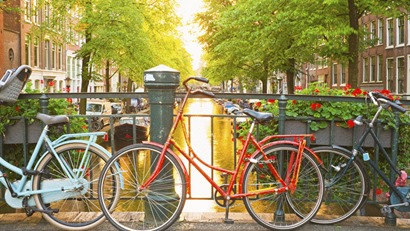
bicycles_Amsterdam1Does it have to be a brand-spanking-new bicycle? No... The old one that you may still have standing around in your shed given a little TLC or some other secondhand one would be much better and ideally without the fancy gearing of today.

On June 12, 1817 the bicycle saw the light of the world, in the form of the Laufmaschine (Draisine), by making its maiden voyage under the captainship of its inventor, Karl Drais. It has come a long way since and today is more needed than ever.

It was born out of the need for a replacement – albeit temporary – of the horse as very few horses were left in Germany at that time due to a climate event which brought about “the year without a summer”.

Today not just a climate event but climate change makes the bicycle even more important, and in this case as a replacement for the modern horse, the motorcar.

While the climate event of 1817, “the year without summer”, went away, the climate and weather returned to normal. Horses came back into use as they could be fed again and there was food for people again too. The bicycle, therefore, descended into obscurity for some time. With climate change this is, more than likely, not going ever be a return to normal and we will have to look to the bicycle as a low-carbon alternative for travel.

Today's bicycles are about as far removed from the original concept of the running machine, the Draisine, as is the ox cart from the modern car, with the exception of the balancing bikes for children nowadays which are almost a Draisine, having no pedals.

Bicycles do not, that is true, do not achieve the speed of a car and neither can they travel the same distance in a day as can a motor vehicle. On the other hand though most cars are not used daily for long distances but mostly for short trips (with the exception of those that may use them indeed for long commutes) for which a bicycle would not only be more efficient and cheaper but also faster.

By the time you have the car ready to go on the road, especially if it is kept in a garage, have buckled up and all that, you would already be half way there with a bicycle. Then at your destination, say the high street, you have to find a place to park the car, and more than likely that will take some time and may even cost you money to boot. The bike, on the other hand, you can just “chain” to the nearest lamppost or such and you can do what you want and need to do.

The bicycle is also one of the most energy efficient vehicles for public transportation. Instead of burning fuel and money and making you fat it burns fat and keeps you fit. Though as a cyclist I do realize that in many countries the infrastructure is not there for cycling, at least for safe cycling, and drivers of motor vehicles, from cars to trucks, see the cyclists as someone, more often than not, who should not be on the road with them. That needs to change.

While we are seeing a year by year increase in bicycle use in Britain, including for commuting, no real serious change will come about until the political will is there to change the status of cycling infrastructure by creating safe paths for cyclists (and pedestrians) alongside every, or at least almost every, road, that are separate from the road itself. What can be done in other European countries can be done in the UK and no one can tell me different.

© 2017

Creating 100% Renewable Transport Systems

Guy Dauncey explores how to make transport systems 100% renewable - getting rid of fossil fuels and creating sustainable cities.

Cycling-in-Copenhagen.jpg

Last week I started to explore the possibility that British Columbia could become a 100% renewable energy region, as 140 regions in Germany are planning to become.

This week, we look at transportation. Is it possible that we could get where we want to be and ship our goods where they need to go without any use of fossil fuels?

Helsinki, capital of Finland, is taking a big step in this direction, with its goal that by 2025, nobody will need to own a car in the city at all, thanks to an advanced integrated 'mobility on demand' network of shared bikes, transit, LRT, and computer-automated Kutsuplus minibuses that adapt their routes to take you wherever you want to go.

The cars, trucks, ferries and planes that we use to go about our daily lives are 38% of the cause of global warming in BC, so this is clearly a big deal. So let's start at the easy end, and work our way into the difficult, uncharted territory.

Have You Ever Tried Cycling in North Vancouver?

Cycling is easy: the bustling city of Copenhagen has already demonstrated that 35% of its commuters can get to work by bike, and many cities in Holland can boast equally good numbers.

"Ah, but it's flat," you might respond. "Have you ever tried cycling in North Vancouver?"

"Ah," I respond, "have you ever tried an electric bike?" Electric bikes defy gravity, making hills vanish with a twist of the hand. In so doing they open up new realms of possibility for older cyclists, and anyone who doubts their ability to cycle a 10km round trip. Add safe protected bike-lanes, off-road bike trails, clearly marked intersections, good bike-sharing schemes with bike-attached tablets that give GPS based-directions, as they are doing in Copenhagen, and you've got a set-up in which cycling becomes irresistible.

Read more: http://www.permaculture.co.uk/articles/creating-100-renewable-transport-systems

Sustrans calls on local authorities to spend £17 million on safe routes to school

Sustainable transport charity, Sustrans, is calling on local authorities to apply for funding to develop safer and healthier routes to schools in their area. The £17 million for the 'Links to Schools' programme is part of £140 million announced earlier this year by the Department for Transport to promote cycling.

The 'Links to Schools' programme will extend the National Cycle Network, bringing it closer to schools and, by joining up residential areas to schools, make it easier for young people to walk or cycle. It is expected that more than 700 schools will directly benefit via funding to 300 schemes.

Sustrans' Chief Executive Malcolm Shepherd said: "Sustrans believes that every child in the country has the right to a safe walking and cycling route to school. This record breaking funding will mean that we can continue to work with local authorities to ensure this vision moves a step closer to becoming a reality.

"It is vital that we do whatever we can to support children and young people to cycle and walk to school. Cycling and walking has so many benefits for pupils such as improved health, confidence and concentration as well as the obvious benefits for the environment in which they will grow up in. We know that concern for children's safety is a major barrier to cycling and walking. The Links to School programme aims to address these concerns by putting in place safe walking and cycling paths to and from schools."

Transport Minister Paul Clark said: "We have dedicated £17 million through the 'Link to Schools' programme to encourage as many children as possible to walk or cycle and to feel safe doing so. Not only does this have a positive effect on health and fitness, it also helps cut congestion and improve air quality.

"Earlier this month I visited a successful walking bus in Whitstable, and saw for myself how these schemes can get children active and improve their understanding of road safety. If we work with Local Authorities to develop local schemes I am confident that we will continue to make great progress."

Staff, parents and teachers who are interested in promoting cycling and walking in their school are encouraged to call the Sustrans School Travel Team on 0117 915 0100 for free information and advice.

Further information about Sustrans including other news releases, is available via the website: www.sustrans.org.uk

Source: Sustrans
<>

Ken looks at radical new plans for cycling in London

Mayor of London, Ken Livingstone, announced today that he has asked Transport for London to examine the feasibility of bicycle hire scheme to promoting cycling in London. The Mayor recently saw at first hand the successful 'Velib' - Freedom bike - hire scheme introduced by the Mayor of Paris, which has enjoyed great success since its launch a few weeks ago.

The Mayor and Peter Hendy, the Commissioner of Transport for London, witnessed the Paris Velib scheme at first hand during the recent Tour de France.

Transport for London have been asked to look at international best practice in promoting cycling, including hire schemes like that of Paris, with a view to introducing a scheme which meets the specific needs of London. Cycling groups and other stakeholders will be consulted on the options.

A London scheme would require the support of London Boroughs, as well as the Mayor, as most London roads are controlled by the boroughs.

The Paris scheme offers 10,000 bicycles sited at 750 dedicated hire-points every 300 metres around Paris, with plans for 20,000 bikes at 1,400 hire points by the end of the year. The bikes are available at any time of the day or night and cost just about 70 pence to hire for half an hour. Theft is minimal because of the unique design of the bicycles, their highly secure parking facilities and because payment is via credit or debit card. If a bicycle is not returned the hirer is charged around £100.

The Paris scheme has been an instant success, with the distinctive Freedom Bikes now seen all around the centre of Paris.

Transport for London officials have been working with the Clearzones Partnership and central London boroughs to examine the potential for a similar scheme for some months and will be meet their opposite numbers in Paris, and other European cities, to discuss the practicalities of such schemes. Other cities with a strong record on cycling or with public cycle hire scheme include Barcelona, Lyon, Brussels, Vienna, Berlin, Munich, Oslo and Copenhagen.

Ken Livingstone, the Mayor of London, said:

‘Cycling is a clean, fast and cheap way to get around London and we have seen an 83 per cent increase in cycling since I became Mayor. I have seen the Paris Freedom Bike scheme, and discussed it with the Mayor of Paris. It clearly works and is highly popular. I have asked transport officials in London to study the Parisian and similar schemes in order to draw up proposals for a scheme which would meet the needs of London. I am sure that we can learn from the success of the Parisian and similar schemes to expand access to cycling in London.'