Showing posts with label human-powerd transport. Show all posts

200 years on the bicycle is more needed than ever

by Michael Smith (Veshengro)
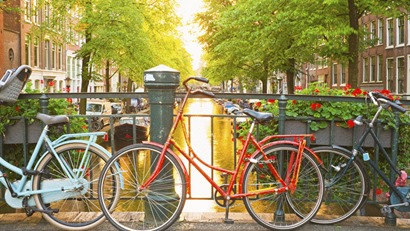
bicycles_Amsterdam1Does it have to be a brand-spanking-new bicycle? No... The old one that you may still have standing around in your shed given a little TLC or some other secondhand one would be much better and ideally without the fancy gearing of today.

On June 12, 1817 the bicycle saw the light of the world, in the form of the Laufmaschine (Draisine), by making its maiden voyage under the captainship of its inventor, Karl Drais. It has come a long way since and today is more needed than ever.

It was born out of the need for a replacement – albeit temporary – of the horse as very few horses were left in Germany at that time due to a climate event which brought about “the year without a summer”.

Today not just a climate event but climate change makes the bicycle even more important, and in this case as a replacement for the modern horse, the motorcar.

While the climate event of 1817, “the year without summer”, went away, the climate and weather returned to normal. Horses came back into use as they could be fed again and there was food for people again too. The bicycle, therefore, descended into obscurity for some time. With climate change this is, more than likely, not going ever be a return to normal and we will have to look to the bicycle as a low-carbon alternative for travel.

Today's bicycles are about as far removed from the original concept of the running machine, the Draisine, as is the ox cart from the modern car, with the exception of the balancing bikes for children nowadays which are almost a Draisine, having no pedals.

Bicycles do not, that is true, do not achieve the speed of a car and neither can they travel the same distance in a day as can a motor vehicle. On the other hand though most cars are not used daily for long distances but mostly for short trips (with the exception of those that may use them indeed for long commutes) for which a bicycle would not only be more efficient and cheaper but also faster.

By the time you have the car ready to go on the road, especially if it is kept in a garage, have buckled up and all that, you would already be half way there with a bicycle. Then at your destination, say the high street, you have to find a place to park the car, and more than likely that will take some time and may even cost you money to boot. The bike, on the other hand, you can just “chain” to the nearest lamppost or such and you can do what you want and need to do.

The bicycle is also one of the most energy efficient vehicles for public transportation. Instead of burning fuel and money and making you fat it burns fat and keeps you fit. Though as a cyclist I do realize that in many countries the infrastructure is not there for cycling, at least for safe cycling, and drivers of motor vehicles, from cars to trucks, see the cyclists as someone, more often than not, who should not be on the road with them. That needs to change.

While we are seeing a year by year increase in bicycle use in Britain, including for commuting, no real serious change will come about until the political will is there to change the status of cycling infrastructure by creating safe paths for cyclists (and pedestrians) alongside every, or at least almost every, road, that are separate from the road itself. What can be done in other European countries can be done in the UK and no one can tell me different.

© 2017

Cycling Britain's fastest growing mode of transport

by Michael Smith (Veshengro)

Cycling is one of the fastest growing modes of transport in Britain. It is clean, healthy and good for the environment. But the government is still lagging behind those of other EU countries in providing a proper safe cycling infrastructure for British cyclists.

The Mayor of London, Boris Johnson, has created a “vision for cycling”, but then he is a cyclist and understands, for an unbroken network of cycle routes in London. And while there are many things that one could disagree with with Mr. Johnson this is not one of them.

However, we need more than just an unbroken network of lanes, as they are today, even though very fragmented, as they are not safe for cyclists. The lanes must be, as they are in most countries of Europe, physically separated from the motor traffic.

Mayor Johnson has also stated that he wants to “de-Lycrafy” cycling and bring it to the masses and this is indeed something that must be done if we want to have a sustainable low- to zero-carbon transportation future.

This vision in which many of us who use bicycles to get around, some as primary mode of transport even, share with the Mayor of London can only come true if we keep knocking at the right doors by demanding that proper, separated, bicycle lanes get created in the same way of those that can be found on the European mainland, whether in the Netherlands, in Germany or in Denmark.

Cycling is becoming, and it is evident in the new faces one can see on a daily basis using the bike for commuting, to go to the shops or to visit friends, more popular than it has been for many decades and many young people shun the car, in fact, in favor of the bike.

One of the main fact, aside from environmental consciousness and wishing to become fit or fitter, for cycling being the fastest growing mode of transportation in Britain today is the ever increasing cost of fuel and motoring per se, for insurance and road tax also pay part in this.

Motorists are always fuming about the fact that cyclists need not to pay the road fund license and neither have to have insurance but no one forces those people that moan to use their cars. They too could use a bike. In addition to that they seem to forget that the bicycle was here before the car, as were pedestrians.

Britain has been, and still is, sadly lacking behind other countries in Europe as to provisions for cyclists and if one sees the cycle lanes in places such as the Netherlands – yes, OK, more people use bikes than cars there – and in Germany, which go from about everywhere to everywhere one can but dream and hope to get something like that in the UK too (one day).

Unfortunately, presently, Britain has the worst provisions for cycling and cyclist of all the EU countries and this is, despite the increase in cycling as mode of transportation presently, still preventing many people from getting on their bike instead of into their car, especially for shorter journeys. This must change for our health and for that, especially, of the Planet.

© 2013

The bicycle: A simple machine with a profound impact

by Michael Smith (Veshengro)

Bicycle The bicycle is such a simple machine that can have such a profound impact on our daily lives, every day. It gives you freedom and not just a "sense of freedom" but real freedom. When you are on your bike there is no email, there are no text messages, no phone calls - unless you insist in answering your cell phone or BlackberryTM all the time.

Given only half a chance the bicycle could also, once again, have a profound influence on society as a whole, by being the instrument to wean us all off our dependence on oil.

Cycling is a great way to get around. Quicker than walking, less sweaty than running and saves plenty of CO2 versus driving. And as a bonus bikes can zip through traffic, go to nice places where cars don't stand a chance, like the beach, and help you shed loads of weight whilst saving you truck loads of money on parking.

Some areas have proper cycle path, not the pathetic cycle lanes that are part of the road in some towns and cities, especially in London. We need, in Britain and elsewhere, the kind of cycling provisions that are there in places such as the Netherlands, Germany, Belgium, France and Denmark.

If we had such proper cycling facilities, such as properly physically segregated bike lanes – even if shared with pedestrians, as in some places – the uptake of cycling to work, to school, to the shops and for general getting about would be much higher than it is.

Around 600,000 Britons already cycle to work. As well as living longer, together they save the same amount of CO2 every quarter of an hour as one car would produce driving around the world, and they get to work faster too. On average cyclists travel at 12-15mph, double the speed of a city car in cross town traffic.

But is speed really such an issue? I don't think so.

The one drawback, and I know that as I am a cyclist and do not drive nor own a car, is when it comes to going to the supermarket for a weekly shop. Carrying all the groceries on a bike can be a little bit of a thing. Panniers do help, as does the use of a large backpack. A trailer could be very useful indeed but then you lose part of the mobility and ease of “parking”.

Having stores closer to where one lives would certainly make it possible to go more than once a week and thus avoid having to carry all that stuff in one go.

Don't own a bike anymore but did have one when you were a kid and would like to get back to it. No need to buy new; there are places were you can buy secondhand and reconditioned, often abandoned, bikes.

As readers know, I rebuild abandoned bicycles myself and turn them into single speed bikes, most of the time, by a simple conversion. The multi-speed bikes are really, in my opinion, overrated and way too difficult, nowadays, to fix for the ordinary punter. Give me a single speed any day. No need to adjust and readjust gears all the time. Bad enough that brakes need having that done rather frequently.

Cycling, to me, is about about freedom, excitement, adventure, nostalgia and most of all deep, true passion for a wonderful two wheeled object. Come and discover it too.

© 2011