Showing posts with label cycling. Show all posts

Pavements and cycle paths are critical infrastructure, not frills

by Michael Smith (Veshengro)

cycle path londonIn the USA this does not seem to be understood by local, state, and federal government and the only thing that seem to count in their eyes are provisions for the motor car. But things are not much better in Britain, for instance.

Unfortunately, many pavements (sidewalks, as our American cousins would say) in Britain are in a bad state of repair as well, even though the maintenance of those is down to the local authorities, the councils. Lack of funding from central government and more cuts in the name of austerity certainly do take their toll, but some of them seem to have been lacking maintenance for a couple of decades at least and in some instance it would appear more than just a couple of decades.

As to cycle paths, their provision, in comparison to what is being done and has been done almost for ever in countries of mainland Europe, is absolutely derisory and the talk of government that it would like to encourage more people to cycle is laughable when one sees the provisions (not) made.

There is hardly, in Britain, a single cycle path that is continuous and virtually none that is actually physically separated from the motor traffic on the road, unlike a great many, if not the majority, of such paths in countries such as The Netherlands, Denmark and Germany. According to the British government, an not just the current, it is not possible to do such things in this country. It can be done, the only thing lacking is the political will to do so.

If government is truly interested in getting people out of their cars and wanting them to walk and cycle to the shops, to school, and even to work, then provisions must me made so that people can feel safe and be safe to do so. What it boils down to is that the motoring lobby hands out fat donations and facilitation payments to the governments while, obviously, the lobby of cyclists and pedestrians does not and cannot do that. Hence more and more roads are being built instead of making provisions for alternative modes of transport, by creating the necessary infrastructure. But time and again there are plans for new roads, there is money found for new roads, and so on. Cycle paths and pavements, on the other hand, when it comes to them then there is no money to be found.

As I said, the majority of cycle paths would make our continental cousins, especially in Holland, Denmark and Germany, suffer a serious laughing attack. Not only are they not physically separated from the roads; nay, often they are just short strips on the road and then that is it. At other times, where there are long stretches of cycle paths that are part of the road cyclists will have to dodge the traffic anyway as the paths are full of parked cars, or cars are actually using those parts of the road that are dedicated to cycling, thus again the cyclist either has to avoid those stretches or is actually in danger of being hit. That is no way to encourage people to take to the bike instead of the car. In fact, it has rather the opposite effect. Thus it is hardly surprising that people, illegally, cycle on the pavements as no safe provisions are being made for them.

© 2017

200 years on the bicycle is more needed than ever

by Michael Smith (Veshengro)

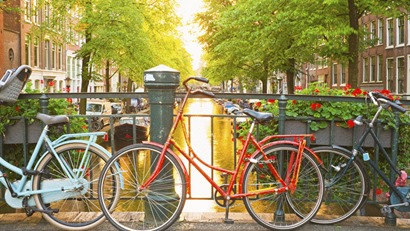
bicycles_Amsterdam1Does it have to be a brand-spanking-new bicycle? No... The old one that you may still have standing around in your shed given a little TLC or some other secondhand one would be much better and ideally without the fancy gearing of today.

On June 12, 1817 the bicycle saw the light of the world, in the form of the Laufmaschine (Draisine), by making its maiden voyage under the captainship of its inventor, Karl Drais. It has come a long way since and today is more needed than ever.

It was born out of the need for a replacement – albeit temporary – of the horse as very few horses were left in Germany at that time due to a climate event which brought about “the year without a summer”.

Today not just a climate event but climate change makes the bicycle even more important, and in this case as a replacement for the modern horse, the motorcar.

While the climate event of 1817, “the year without summer”, went away, the climate and weather returned to normal. Horses came back into use as they could be fed again and there was food for people again too. The bicycle, therefore, descended into obscurity for some time. With climate change this is, more than likely, not going ever be a return to normal and we will have to look to the bicycle as a low-carbon alternative for travel.

Today's bicycles are about as far removed from the original concept of the running machine, the Draisine, as is the ox cart from the modern car, with the exception of the balancing bikes for children nowadays which are almost a Draisine, having no pedals.

Bicycles do not, that is true, do not achieve the speed of a car and neither can they travel the same distance in a day as can a motor vehicle. On the other hand though most cars are not used daily for long distances but mostly for short trips (with the exception of those that may use them indeed for long commutes) for which a bicycle would not only be more efficient and cheaper but also faster.

By the time you have the car ready to go on the road, especially if it is kept in a garage, have buckled up and all that, you would already be half way there with a bicycle. Then at your destination, say the high street, you have to find a place to park the car, and more than likely that will take some time and may even cost you money to boot. The bike, on the other hand, you can just “chain” to the nearest lamppost or such and you can do what you want and need to do.

The bicycle is also one of the most energy efficient vehicles for public transportation. Instead of burning fuel and money and making you fat it burns fat and keeps you fit. Though as a cyclist I do realize that in many countries the infrastructure is not there for cycling, at least for safe cycling, and drivers of motor vehicles, from cars to trucks, see the cyclists as someone, more often than not, who should not be on the road with them. That needs to change.

While we are seeing a year by year increase in bicycle use in Britain, including for commuting, no real serious change will come about until the political will is there to change the status of cycling infrastructure by creating safe paths for cyclists (and pedestrians) alongside every, or at least almost every, road, that are separate from the road itself. What can be done in other European countries can be done in the UK and no one can tell me different.

© 2017

Happy Birthday to the bicycle; 200 yeas old

by Michael Smith (Veshengro)

Laufmaschine.jpgThe old girl has reached the ripe old age of 200 and is looking as good as ever. Actually, let's face it, over the years the old girl has changed and improved, and thus looking even better. Though, when we see today's so-called balancing bikes for young children, the Draisine is back, even in wood, with some improvements.

June 12, 2017 marked the 200th anniversary of the date on which Karl Drais (although he had an aristocratic title he renounced the “von” and the title Freiherr, that is to say, Baron later) took his new invention out for a ride and the modern bicycle was born.

On that day Drais rode his two-wheeled invention, the first Velocipede, five miles from the centre of Mannheim and back in less than an hour, at an average speed of 9.3 mph. It was basically a bicycle without pedals that one pushed along the ground but it was still much faster than walking. He called it a Laufmaschine (running machine in German) but the press named it a Draisine after the inventor.

The reason for the invention was not just for the fun of it. It was in response to an environmental crisis. Two years earlier in April 1815, Mount Tambora exploded and changed the world. This put so much ash and sulphur dioxide into the atmosphere that it turned 1816 into "the year without summer", causing world-wide famine. Most of the horses were slaughtered because there was nothing to feed them or their owners, so they became dinner.

But Drais needed a means of inspecting his tree stands that did not rely on horses. Drais discovered that, by placing wheels in a line on a frame, one could balance through dynamic steering. Thus a narrow vehicle capable of maneuvering on his land and the Laufmaschine became the immediate precursor of the bicycle.

As the bicycle became more popular, people found riding in the streets was uncomfortable due to the deep ruts left behind in surfaces of the roads by coach and cart wheels. This lead to cyclists sharing the sidewalks with pedestrians, which, in turn, led to the first conflicts. The penny-farthing, a bicycle with a huge direct-drive front wheel and tiny rear wheel accelerated fears for the safety of riders and passers-by alike and bicycles bans became common.

The invention of the "rover safety cycle" put the rider's feet back within reach of the ground, and helped this mode of transportation to return to the streets of cities around the world, introducing the rear chain drive in the process. Further important breakthroughs included the invention of ball bearings, the pneumatic tire, and the freewheel. Though some have, today, gone back to the fixed back wheel and please do not ask me why.

Today the bicycle is the most energy efficient and pollution free means of transportation on the planet, aside from walking. It is seen by many as a major player in the solution to climate change given that they are emission free. They could also be the answer to urban congestion as they take up so much less space than a car, and especially to urban pollution.

As in Drais' day, bikes are controversial. Motorists hate them when they are sharing the road and hate them even more when bike lanes are built and take away space for driving and storing cars. As in the days of Drais road conditions are often so awful and dangerous that cyclists sometimes take to riding on the sidewalk, alienating and endangering pedestrians. Though, it has to be said, neither of that is necessary if the cyclist remembers that he or she, theoretically, and often legally, is not meant to be there and that it is the domain of the pedestrians.

The way some cyclists ride and their attitude – and I am a cyclist myself – it is no wonder that people are often not very fond of them, and it seems to be getting worse.

I cannot understand why one has to race along the sidewalk – where one is not supposed to be in the first place though, I admit, I ride there myself but at slow speed (I am in no hurry ever) – or park paths, and such, where pedestrians have priority, weave in and out of motor traffic, undertake cars and trucks, etc. What's the hurry, what's the rush?

But two hundred years ago the skies cleared and a normal climate returned, and soon people were back to being pulled around by horses and the bicycle almost was forgotten. But in our the environment and climate, more than likely, is not going to return to normal, and our cities cannot hold any more cars.

As we enter an era when new pressures encourage everyone to swap their car for alternative transportation, it makes sense to celebrate the birthday the bicycle. So, once again, Happy Birthday old Girl! Let's ride!

© 2017

You are not stuck in traffic; you are traffic

by Michael Smith (Veshengro)

TrafficJamFrustrationIf you are driving and getting nowhere you are not stuck in traffic. You are traffic. Get out of the car. Cycle, walk or use public transport and you no longer are traffic and maybe things might work a little – may be even more than a little – better.

How often do we hear someone excuse themselves for being late for a meeting or whatever with: “Sorry I am late. I am/I was stuck in traffic”. Sorry, no, if you are with a car “stuck in traffic” you are not stuck in it, you are it. The traffic that is in which you say you are stuck.

The governments' answer to the “traffic problem” is ever more roads and bigger roads and wider road “to accommodate” all the traffic but no one ever stops to think that that will not actually make any difference to the “traffic problem” but will exasperate even further. The London Orbital Car Park, otherwise known as the M25 motorway, is a shining example for this. Well, not very shining, in fact.

When it was realized that more cars and trucks were on that road than it could cope with the answer by government was to make it bigger, that is to say, wider, adding another lane and guess what happened? Yes, even more gridlocks as more vehicles began using that motorway.

The problem is that Western society, in the main, is heavily motoring orientated and no serious effort is made to change this by creating, for instance, proper public transit infrastructure and especially infrastructure for cycling and walking.

While it is true that London has, for instance, created some “bike lanes” they are a joke as they are (1) not physically separated from the roads and thus the cars and trucks and (2) often have parked vehicles on them meaning that cyclists have to get into the road and endanger themselves. On top of that many of those routes end rather abruptly and the cyclist finds himself or herself again slap bang in amongst the cars. Taking a lead from what is being done for cyclist, and has been for decades, by our European neighbors is not something that is being considered or it is written off as something that is, supposedly, not possible in Britain. And that excuse we also tend to hear with regards to many other issues, be that as to waste management, or other things. Always the response is that it is not feasible in Britain. Where there is no (political) will there never is a way.

© 2015

Surprise: The Wall Street Journal doesn't understand that bikes are transportation

Public

Rachel Berman of the Wall Street Journal appears to be surprised that people actually ride bikes for other than mad racing in spandex. She speaks to one Austin rider who says:

“I ride my bike purely to get from one place to another—not, ‘I’m going to take this out for exercise for like 20 miles,’ ” says Cassie Rae DuBay, a 28-year-old law librarian in Dallas. She says she aims to “add a little exercise to my day by riding 2 miles, as opposed to driving.”

She goes on to compare the growth of running as a sport to that of cycling, and finds that cycling is lagging running, showing a graph that compares "people in the US ages 6 and up who bicycled on pavement or went running at least once during the calendar year." She then compares running events to cycling, and speaks to a bike dealer:

“When you look at a marathon or half-marathon, you will see people walking, and they’re not ashamed,” says Fred Clements, executive director of the National Bicycle Dealers Association. “They’re not made to feel embarrassed. And that’s something that you won’t really see at a bicycling event. I don’t think we’re as far along as running is in making events that appeal to everyone.”

I wonder what planet these people are on. There's been an explosion in the use of bikes as transportation in cities across North America, with a 61.6 percent increase in bicycle commuting since 2000. It's growing at about 10 percent per year.

Read more here.

The number of bike commuters in London, UK, has doubled in the past 10 years

Cyclist in London UK

n urban areas, commuting in a car doesn't make much sense. When a majority of the population tries to move back and forth between the residential areas and the work areas, all at the same time, every day, there's got to be a better way to do that than 1 person per vehicle... That's why we're always happy to see the numbers go up for public transportation and cycling.

A new census in the U.K. is revealing that London is doing really well in that regard. Statistics compiled and analyzed by the Office for National Statistics (ONS) for the decade between 2001 and 2011 puts the capital well ahead of the rest of the country when it comes to bike commuting progress.

Read more here.

Personal transportation of the future: The Bicycle

by Michael Smith (Veshengro)

bicycle12.1_webWell, this is a little a case of back to the future, I know but despite all the hype the electric vehicle of whatever kind is not going to cut it for personal transportation for the masses. Keeping a horse and using horse and cart also is not an option for everyone, especially not those that live in towns and cities, that's for sure.

We are being told that battery technology is advancing on an almost daily basis but what no one who advocates the car in the form of electric vehicles (EVs) is the fact, and they don't even seem to consider it, that the manufacture of those and of those batteries requires energy and lots of it. It just will not work, period!

But still we are being sold the story that the electric vehicles, the battery car, is the future for personal transportation. It is not; the bicycle is, as it once was. I am sorry to shatter many illusions but the truth must be told.

And, the truth is that battery technology is not anywhere near what would be required to have all electric personal transportation and even less so freight transport.

The biggest problem remains the cost of the batteries and their components, both in monetary terms and in environmental terms and above that the fact that any of those batteries have a limited lifespan. They only have so many recharge cycles before they have to be replaced.

The future of all transportation, personal and freight, is going to be, once again, human and animal powered and not internal combustion engine or electric. As I said, I am sorry to shatter many illusions but we have to face reality and when the post-industrial area arrives, which it will, then those vehicles and their batteries will either no longer be produced due to lack of facilities or become so expensive as to be out of the reach of most mere mortals.

We have to leave the dream world that has been conjured up for us and wake up and face reality and reality is that things will, in the more likely not so distant future very different to the way we have known things to be. So, we better get used to the idea and start to prepare ourselves for this mentally.

The biggest problem is not that people in general are not prepared to face this reality but that industry and the powers-that-be are trying to blind everyone still with science and with smoke and mirrors. Everyone is in denial and believes government, industry and science will come up with a solution so we can continue to drive our cars, even if they are electric, that way we have done for the last half a century or so. Reality check: It is not going to work!

The reality is that, in the not so distant future, not only will oil be history, we will also simply not be able to continue to use it unless we no longer want a livable Planet and thus other ways must be found and employed and those other ways that those that were there before the world went mad, such as the bicycle, our feet, and also animal power.

The means of personal transportation for ordinary mortals with no way of keeping a horse will only be one option, aside from walking, and that is the iron steed, the humble bicycle.

Oh, and one little additional thought: It is not going to be the carbon-fiber road bike that we are talking about here but more the old-style single speed steel bicycle, produced in small workshops rather than in large factories in China.

But, for starters, there is no need to buy a new bicycle for transitioning to the “new” form of personal transportation. An old one, given some TLC will do just as well, if not even better, for you, your wallet and the Planet.

© 2015

Study: Cycling keeps you young

cycling in copenhagenThere's a reason all those Copenhagen cycle chic people look so good, and it's not just those nordic genes and tight jeans. It's the exercising they are getting doing all that cycling. Now a new study confirms that not only will cycling keep you looking good, it will keep you young. Published in the Journal of Physiology, researchers from King’s College London and the University of Birmingham found that cyclists over the age of 55 "had levels of physiological function that would place them at a much younger age compared to the general population."

It should be noted that the study looked at serious cyclists, not those doing their local shopping. Men were capable of doing 100 kilometers in under 6.5 hours; That's a pretty small subset of cyclists. The researchers put the cyclists through all all kinds of tests and in fact couldn't determine their age from their measurements, everything varied from person to person and nothing correlated to age. But Professor Norman Lazarus is quoted in Road.CC:

Inevitably, our bodies will experience some decline with age, but staying physically active can buy you extra years of function compared to sedentary people. Cycling not only keeps you mentally alert, but requires the vigorous use of many of the body’s key systems, such as your muscles, heart and lungs which you need for maintaining health and for reducing the risks associated with numerous diseases.

The study concluded again what we all know apocryphally: people age at different rates, but if you keep active it will keep you younger. Professor Stephen Harridge concludes:

Read more: http://www.treehugger.com/health/study-cycling-keeps-you-young.html

Cargo bikes continue to spread, now in UK department stores

Johnny Loco cargo bike photoIn yet another sign that cargo bikes really are everywhere, UK department store John Lewis is now carrying cargo bikes from Dutch brand Johnny Loco.

For those outside the UK, this story probably doesn't hold that much significance. But as someone who grew up in the UK, I can attest that John Lewis was the first port of call for my mum when we went shopping for kids clothes, gifts, and just about everything else. When mainstream retail locations like John Lewis get on the bandwagon, it's exposing a whole new audience to these powerful transportation tools.

Currently included in their line up is The Johnny Loco Earl Grey Cargo Bike (RRP £1,999, or about US$3,100), and the Dutch Delight E-Cargo bike (RRP £3,499/US$5,429). The company is also offering the Johnny Loco Womens' Husky—which features a pretty darned hefty looking frame.

Read more: http://www.treehugger.com/bikes/cargo-bikes-continue-spread-now-uk-department-stores.html

A cyclists emits more CO2 than a Porsche Cayenne

by Michael Smith (Veshengro)

CayennevsBicycleI do not think so so for one moment but time and again we find statements and comments such as this all over the place, apparently backed up by supposedly independent scientific research.

OK, so as I cycle I breathe out CO2. Yes, agreed, but I also do so while walking or just by the simple act of breathing; all humans, and every other living being, bar fish, breathe in oxygen, as in air, and breathe out carbon dioxide. This is why this entire carbon measuring stuff is – pardon my language – crap.

While the cyclist exhales CO2, as inn simple carbon dioxide, the Porsche Cayenne referred to “exhales” not just CO2 but all manner of pollutants and we really must get back to calling our problem air pollution (and general pollution) and not just carbon emissions.

What those people who like to claim that thus cycling has greater CO2 emissions also forget to factor in into this equation is the pollution – and I deliberately use that term here – cause in the manufacture of said Porsche and already in the production of the raw materials said car is made from.

The cyclist may be exhaling an amount of carbon dioxide and some pollution will have occurred during the manufacture of the bicycle and it components but once it is dealt with the bicycle and cycling is non-polluting, bar the somewhat increased exhalation of carbon dioxide by the cyclist while cycling, compared to walking and sitting. We all breathe in and exhale all the time and during any physical activity the rate is just somewhat greater and thus somewhat more CO2 is being exhaled.

Here we can see how figures can be used too almost prove anything and on top of it all we also may have to ask who commissioned and paid for that kind of “scientific” research. I am afraid to say that there is no one who can tell me that using a human-powered vehicle of the simplest kind, well almost, if we discount the Draisine and the Kick-Scooter, is more polluting, even if only by way of CO2 emissions than a 4x4 Porsche powered by an internal combustion engine, and I hope no one else falls for that one either.

It is time that we came back to reality and stopped talking about carbon emissions as if that were the only thing. When we called it pollution that was more like it and brown carbon, the stuff that is causing the Himalayan glaciers to melt, is nothing more than soot, regardless of how they want to paint it, and thus air pollution from factory chimneys and those of power stations.

© 2015

Trying to travel in a city? Biking is the best (or at least most energy-efficient) mode

trying-to-travel-in-a-city-then-bikes-most-efficientWe've covered a number of the crazy contests in which a bike, a car, a public transit rider see who can race between two urban points fastest.

Usually, the bicycle wins.

Bike are an extremely energy-efficient form of transportation. As the graph above shows, riding a bicycle is more than twice as efficient than walking. This is in terms of megajoules of energy expended per kilometer traveled.

The bike comes ahead of every other common transportation choice, including public transport and personal cars.

Some people object to the comparison of biking (and walking) to things like a taxi or a private car because human-powered transport does require calories to make it go. And those calories - i.e. food - may be less efficient to create than say, diesel fuel. Which means that the caloric cost of bicycle commuting for your daily transport may actually cost you more than the gas for your car.

In addition, to get these figures, the different modes that can carry more passengers were weighted with occupancy estimates - for example, in the case of the light rail occupancy was estimated at 33%, as was bus rider occupancy.

And furthermore, who would use a 727 to get to work? Very few of us.

In the paper from which the graph was produced, written by David Banister of London's University College, it's argued that transport in general needs to reduce its dependency on non-renewable fuel choices for the environment, economic competitiveness and energy security.

But actually the arguments for using the bicycle, at least in short-distance traveling in urban environments, are much more personal.

Read more: http://www.treehugger.com/bikes/trying-travel-city-bikes-are-most-efficient-way-move.html

Going Dutch and Danish

Imagine a major city where 35 percent of all traffic is people on bikes. Or think even bigger--an entire nation where 27 percent of all trips are pedal-powered.

This is not some Utopian vision of the commons dreamed up by a 24-year-old after too many handcrafted beers. These are real places located in modern societies with high levels of car ownership. Places not so different from the US named Copenhagen and the Netherlands.

Don’t believe it? Go there, and you can see for yourself. You’ll be surprised to find these are great places for everyone, no matter how they get around, because cities that work for bicyclists are more vital, prosperous, convenient and attractive places to live and work.

In fact, it’s never been easier for local leaders across the US to experience life in these world-class communities. Next summer PeopleForBikes, a Colorado-based non-profit, is organizing tours of Denmark and the Netherlands to offer public officials, planners, civic activists and business leaders practical lessons about how to help their own cities thrive. (Minimum of four participants from each community.)

“These tours are 20 percent about bikes and 80 percent about how to make great places full of economic, social and cultural wealth,” said PeopleForBikes’ Zach Vanderkooy in a phone conversation from Amsterdam, where he was leading a group of officials from Atlanta, Seattle and Boston.

“Nothing is better than getting on a bike to see how it feels,” said Rick Dimino, CEO of the Boston business coalition A Better City, who was part of the recent Netherlands tour.  “We saw some very creative and robust ways that a strong bicycling system can improve mobility, quality of life and our economy in the US.”

“I took hundreds of pictures on those trips and I gave many slideshows for our planners and transportation people to show what could be done,” remembers Gabe Klein, former Director of the Chicago Department of Transportation, who visited Danish and Dutch cities on PeopleForBikes study tours.

Chicago, never noted previously as a great place to bicycle, is now ranked as America’s #2 Bike City byBicycling magazine. That’s because the city is now second only to New York (Bicycling’s #1 city) in the number of protected bike lanes--bike routes on busy streets that are physically separated from fast-moving vehicles. According to Vanderkooy, “protected lanes together with slow-speed local streets and off-street paths create a seamless transportation system that strengthens public transit and helps keep all  traffic well-organized and free-flowing.”   

Read more: http://www.onthecommons.org/magazine/going-dutch-and-danish

You know it’s good when your biggest transportation problem is too many cyclists

It must be nice to be Dutch: While the rest of us are dealing with ensuring reasonable access to reproductive healthcare and violent seasonal pumpkin festivals, in the Netherlands, people are taking to the streets to protest poor bike traffic planning.

While we’ve fretted about the possibility that there are TOO MANY bikers in the Low Country before, the truth is more complicated than that.

Citylab’s Sarah Goodyear points out that despite our utopian mental images of happy Dutchmen gleefully coasting along their superior bike infrastructure, even the most advanced of biking societies still have logistical speed bumps to work out when it comes to bike traffic. Case in point: In Utrecht, where an estimated third of trips are taken on two wheels, certain intersections have cyclists waiting so long for a green that some of them have just started running the light. And then the police started doing what they do best: writing tickets. The resulting backup last week was more than 100 bikers deep and rattled the city to its polite and measured core.

So last week, volunteers from the local chapter of Cyclists’ Union broke out the radical tools of social change — sweet rolls and pamphlets — to soothe their impatient compatriots and gently called attention to another of the poorly designed intersections last week. And it’s working! A day after the first incident, city planners conceded that the traffic signal’s timing was off, and readjusted it to cycle more cyclists through faster.

Read more: http://grist.org/news/you-know-its-good-when-your-biggest-transportation-problem-is-too-many-cyclists/

Why U.S. women don't bike: blame it on the childcare and the chores

why-us-women-dont-bike-blame-in-on-the-choresOver the years at TreeHugger we've written about possible reasons that the cycling gap between genders exists, and why it is so difficult to close. Already some years ago we wrote about author Elly Blue's theory that women's lower earning power and larger chunk of household duties made it harder for them to bike.

Turns out, Blue's theory - at least the part about women having more household duties - is bolstered with some data.

A study from UCLA's Kelcie Ralph and Michael Smart shows that U.S. women's lives – at least, straight women's lives – are more filled with domestic chores and duties. Huff and Ralph studied non-commute travel in households - they used data between 2003 and 2012 from the American Time Use Survey (ATUS) for their findings. ATUS respondents kept detailed diaries of their travel over a single day, allowing the researchers to see what tradeoffs household members make to go places and do things.

Smart and Ralph's report documented that even when U.S. straight women earn more, are better educated, and work more hours than their male counterparts, they still make more 'child-serving' trips and more slogs to the grocery!

They found that: "straight women do the the most household-serving labor and related travel, and straight men the least."

Read more: http://www.treehugger.com/bikes/why-women-dont-bike-blame-it-housework.html

Biking or walking may be the secret to a happier life

happy bikeThere are many anecdotes about the joys of trading in a car for a bike, and now researchers in England are backing this idea with data. A study from the University of East Anglia and the Centre for Diet and Activity Research finds that people who switch from commuting by car to biking or walking improved their overall well-being.

Researchers examined data from 18,000 commuters in Britain, collected by the British Household Panel Survey. They looked at mental health indicators such as feelings of worthlessness, sleepless nights, the ability to face problems and unhappiness. People who walk or cycle to work reported better concentration and lower levels of stress, compared to people who drive a car.

The study controlled for a number of factors that also impact well-being, like income, relationship changes and switching jobs.

Read more: http://www.treehugger.com/health/biking-or-walking-may-be-secret-happier-life.html

Cycle tours have to be registered with the authorities

by Michael Smith (Veshengro)

Symbolbild-FahrradfahrenWhen you thought you have seen it all along comes some information that will make you go “duh!” and “double face palm” and this is one of those stories.

Bicycle tours in the German state of Schleswig-Holstein will from now on have to be registered with and licensed by the authorities if they happen to travel on routes that do not have a cycle path and that includes even families, regardless of number of participants.

Oh and this registration is by no means free. Each and every “license” will cost 50 Euro (about £30) and that means that if a family wants to go by bicycle to the shops in rural and semi-rural areas or take the children to school then each and every time they have to fork out this sum and registration, obviously, has to happen during working hours and several days ahead.

Should anyone attempt to undertake a cycle tour, even a family of three or four (or even two), without a permit then they will face a penalty charge of several hundred Euro. It will also be considered an offense to deviate from the route given in the application.

Germany, once upon a time, could always, together with Denmark and The Netherlands, as cycle friendly and as an example for good practice. This has come to an end now, for sure.

© 2014

Why we REALLY need protected bike lanes in the countryside

separated bike lanes photoI have often lamented the lack of physically separated bike lanes in Durham, North Carolina—but a transportation-geek friend of mine reminds me that they're hard to implement in many newer American cities where every house has a driveway.

But what about the countryside?

Having recently raved about how awesomely hellish it was to drive in Helsinki, I am also struck by how easy it is to bike in the Finnish countryside, not least because many quiet country roads have well-maintained, physically separated bike lanes/footpaths which get used regularly for both transportation and recreation—often over reasonably long distances. True, many Finns are at least as dependent on their cars as their American counterparts, but they at least have options. And the amount of bikes I see on Finnish roads—bikes being ridden by Finns of all shapes, sizes and ages—suggests many people exercise that freedom of choice.

Having previously lived in the North Carolina countryside for several years, and watched (mostly poor) people traverse dangerous grass verges on the side of a busy road, it seems to me that many rural American communities could benefit from similar bike infrastructure.

Here are just a few of the reasons why bike lanes/footpaths are at least as important in the countryside as they are in the city:

Ease of implementation: Try putting a physically separated bike lane in a dense urban environment and you'll need a whole lot of resources, some serious planning and a tolerance for long committee meetings. In the American countryside, however, where land is plentiful and the roads are wide, it really shouldn't be that difficult to evoke eminent domain, purchase some extra land and add a little asphalt for human-powered transport—so long as the political will were there. (You might have to contend with the anti-Agenda 21 crowd though...)

Read more: http://www.treehugger.com/bikes/why-we-really-need-protected-bike-lanes-countryside.html

Cycling Britain's fastest growing mode of transport

by Michael Smith (Veshengro)

Cycling is one of the fastest growing modes of transport in Britain. It is clean, healthy and good for the environment. But the government is still lagging behind those of other EU countries in providing a proper safe cycling infrastructure for British cyclists.

The Mayor of London, Boris Johnson, has created a “vision for cycling”, but then he is a cyclist and understands, for an unbroken network of cycle routes in London. And while there are many things that one could disagree with with Mr. Johnson this is not one of them.

However, we need more than just an unbroken network of lanes, as they are today, even though very fragmented, as they are not safe for cyclists. The lanes must be, as they are in most countries of Europe, physically separated from the motor traffic.

Mayor Johnson has also stated that he wants to “de-Lycrafy” cycling and bring it to the masses and this is indeed something that must be done if we want to have a sustainable low- to zero-carbon transportation future.

This vision in which many of us who use bicycles to get around, some as primary mode of transport even, share with the Mayor of London can only come true if we keep knocking at the right doors by demanding that proper, separated, bicycle lanes get created in the same way of those that can be found on the European mainland, whether in the Netherlands, in Germany or in Denmark.

Cycling is becoming, and it is evident in the new faces one can see on a daily basis using the bike for commuting, to go to the shops or to visit friends, more popular than it has been for many decades and many young people shun the car, in fact, in favor of the bike.

One of the main fact, aside from environmental consciousness and wishing to become fit or fitter, for cycling being the fastest growing mode of transportation in Britain today is the ever increasing cost of fuel and motoring per se, for insurance and road tax also pay part in this.

Motorists are always fuming about the fact that cyclists need not to pay the road fund license and neither have to have insurance but no one forces those people that moan to use their cars. They too could use a bike. In addition to that they seem to forget that the bicycle was here before the car, as were pedestrians.

Britain has been, and still is, sadly lacking behind other countries in Europe as to provisions for cyclists and if one sees the cycle lanes in places such as the Netherlands – yes, OK, more people use bikes than cars there – and in Germany, which go from about everywhere to everywhere one can but dream and hope to get something like that in the UK too (one day).

Unfortunately, presently, Britain has the worst provisions for cycling and cyclist of all the EU countries and this is, despite the increase in cycling as mode of transportation presently, still preventing many people from getting on their bike instead of into their car, especially for shorter journeys. This must change for our health and for that, especially, of the Planet.

© 2013

ACTIVE TRANSPORT: THE FAST TRACK TO BETTER LIVING

Good for the environment, the economy and our wellbeing, cycling and walking also provide a range of social and health benefits for individuals. In its latest policy statement, ‘Active Transport,’ CIWEM calls on Government to make Britain’s streets and roads safe for walking and cycling.

Cycling and walking are everyday activities that enhance and complement the built and rural landscape and living environment, yet current infrastructure, facilities, motoring laws and protocols do not support routine cycling and walking. In its new policy position statement published today, the Chartered Institution of Water and Environmental Management (CIWEM), calls on government to: create a high profile Centre for Active Transport - dedicated to integrating safe cycling and walking into the nation’s everyday lives; promote a safe roads initiative; and allocate greater funding for active transport with cross-departmental cooperation to maximise the benefits from this investment.

Currently, planning policy does not explicitly encourage walking and cycling. Given the expected increase in levels of urban living (60% of the world’s population by 2030), investment and commitment are urgently required to secure cities and towns where walking and cycling are primary transport options.

The statement highlights the need for immediate safety concerns to be addressed; proposing that each local authority should have a road safety plan and a director-level manager or chief officer with responsibility for embedding safe cycling and walking in their communities. CIWEM also calls for full inclusion of all the benefits of active transport when comparing them with other transport investments.

CIWEM痴 Executive Director, Nick Reeves OBE, says: 展e all know that motorised transport is the main contributor to urban pollution; walking and cycling are not. Government must work harder to make active transport options truly accessible and democratic. Strong policy and more investment in cycling and walking are essential to sustainable and resilient local economies. The health and environmental benefits would also be significant, and transform peoples�lives. By foot and bike, what痴 not to like?

The Chartered Institution of Water and Environmental Management (CIWEM) is an independent professional body and a registered charity, advancing the science and practice of water and environmental management for a clean, green and sustainable world. www.ciwem.org

CIWEMç—´ policy position statement, Active Transport, can be found online at http://www.ciwem.org/policy-and-international/policy-position-statements/active-transport.aspx.

The All Party Parliamentary Cycling Group is a cross-party group of MPs, is co-chaired by Ian Austin, the MP for Dudley (Lab) and Julian Huppert, the MP for Cambridge (LD). It has conducted an Inquiry and taken evidence on cycling and will publish its report with recommendations in April 2013. http://allpartycycling.org/inquiry/

Peter Treadgold, CIWEM Honorary Vice President, has initiated CIWEM's work in active transport; drawing on his experience in the promotion and delivery of cycling and walking programmes in London, and nationally for the Olympic Games.

Full Disclosure Statement: The GREEN (LIVING) REVIEW received no compensation for any component of this article.

WHAT’S NOT TO LIKE ABOUT THE BIKE? CIWEM URGES GOVERNMENT TO BACK BORIS’S VISION FOR CYCLING

Cycling is one of the fastest growing modes of transport in Britain. It is clean, healthy and good for the environment. CIWEM has joined cycling groups in calling on the government to back the London Mayor’s vision for cycling, invest in his proposals for an unbroken network of cycle routes in London, and roll it out across Britain.

The Chartered Institution of Water and Environmental Management (CIWEM) is pleased to support the London Mayor’s proposals to “de-Lycrafy” cycling and bring it to the masses. A new London cycling super-highway to encourage commuters on to bikes will bring huge benefits. It will improve London’s environment, improve people’s health and wellbeing and bring new investment and jobs.

The forthcoming publication of a report by the All Party Parliamentary Cycling Group is likely to bring pressure on the government to support the London Mayor’s plans, and to find the nearly one billion pounds needed to fund the scheme. CIWEM urges the government to follow the Mayor’s lead and roll out similar proposals to other cities and towns across Britain. The health, environmental and economic benefits would be significant, and lead to a transformation of our transport systems. CIWEM believes this one infrastructure plan that makes sense and is genuinely sustainable.

CIWEM Executive Director, Nick Reeves OBE, said: “It’s time to change our transport habits and learn to love our bikes. Boris Johnson’s vision for an unbroken network of cycling superhighways across London is the perfect infrastructure project that is also genuinely green. It will democratise cycling, improve our health and our environment, create jobs and launch a transport renaissance that could be introduced to all our cities and towns. In a time of austerity, this is just the sort of investment the country needs to get Britain working, clean up our urban centres, and get us fit.”

CIWEM’s vision for sustainable, local transport and infrastructure will soon be outlined in forthcoming policy position statements.

The Chartered Institution of Water and Environmental Management (CIWEM) is an independent professional body and a registered charity, advancing the science and practice of water and environmental management for a clean, green and sustainable world. www.ciwem.org

The All Party Parliamentary Cycling Group is a cross-party group of MPs, is co-chaired by Ian Austin, the MP for Dudley (Lab) and Julian Huppert, the MP for Cambridge (LD). It has conducted an Inquiry and taken evidence on cycling and will publish its report with recommendations in April 2013. http://allpartycycling.org/

Full Disclosure Statement: The GREEN (LIVING) REVIEW received no compensation for any component of this article.

This article is for your information only and the GREEN (LIVING) REVIEW does not (necessarily) approve, endorse or recommend the product, service or company mentioned.