Make this New Year the year of the green resolutions

Make the 2014 the year of the green resolutions at home and elsewhere

by Michael Smith (Veshengro)

new-year-green-resolutionsMany people tend to make New Year resolutions that they end up breaking, unfortunately, already, in the majority, about two days in, because those resolutions are, all too often, about self-improvement. Let's forget about those and make yours resolutions that have a lasting impact on you and the environment. Resolve to make this year greater, more productive, more peaceful, beautiful and green than the last.

Go green at home and elsewhere. Going green should not cost you money, it should save you money.

Often people believe that in order to do something for the environment, to go green, they have to buy all those green gadgets and things but that is not the case at all.

Don't buy a recycled steel pencil pot; instead make your own from an empty tin can. Don't buy a set of recycled glass storage jars; use empty glass produce jars instead. And this is just a very small example.

Reduce waste: By doing the above you already begin with the waste reduction program and at the same time save money. Buying new, regardless whether made from recycled materials of not, though buying stuff made from recycled materials is better than stuff made from virgin raw materials, creates waste and required the use of many kilojoules of energy.

Waste reduction takes many forms and one of them is reducing food waste. Every year people throw out about half of all the food that they buy because they buy too much,, cook too much and have no idea as to how to use leftovers, and also do not understand the use by, and best before, etc., dates and the latter can be confusing.

So, resolve to buy less, cook from scratch and learn how to use leftovers and the meaning of the dates.

Reuse (including “waste” materials): Glass jars = storage jars; tin cans = pencil bins and many other things; and the list could go on and on.

Make you own: Instead of buying everything that you want and need try to making things for yourself, from items of “waste”, natural materials or other.

Want and need a walking stick? Don't get one of those telescopic aluminum or fiberglass things. They break or bend when pressure is applied such as trying to prevent a slip from a mountain. Make yourself a good sturdy wooden one.

Grow a garden: Even if you do not have all that much space you can grow some of your own food.

Rethink your eating habits: Instead of always having meat consider that meat was once upon a time reserved in the time of our grandparents and their parents for special days and Sundays, in most cases, and they were a great deal healthier than us today. Also their food, including the meat, was produced in a much healthier way than it is today.

Use a reusable water bottle and fill up with tap water instead of buying water in plastic bottles. Better for your wallet and the Planet. And no, bottled water is not healthier than tap.

Take homemade lunch to work or to the park. Don't buy at fast food places, and use real cutlery when having a picnic in the park or for your lunch at work rather than plastic flatware.

Change the way you travel: Walk or cycle instead of using the car and for longer distances, wherever possible, use public transport. The former two are good for Planet and your wallet, the latter, in the case of Britain, I am afraid much better for the Planet than your wallet.

Those are but a few ideas for some green New Year's resolutions which are easy to do, are good for the Planet, and which also, at the same time, give your wallet a relief from the stress and strain.

© 2013

The Best of the Year 2013

by Michael Smith (Veshengro)

This is a new one for this publication but I thought it would be a good idea. Here I shall be listing the best books and products that I have encountered and reviewed this year.

Best books

books2013_webI think #1 must be “Turn Here Sweet Corn” as it is such a good book that gives such a deep insight into organic gardening and -farming without being preachy.

On the same level we have then “A Quirk of Destiny” – another must read book – though different, as it is about GMO and more a thriller and a novel rather than a memoir.

A Handbook of Scotland's Wild Harvest”, “The Rurbanite”, “Lost the Plot” and “The New Horse-Powered Farm” all shall share the second spot here are they are, in their own fields, equally important.

Best products

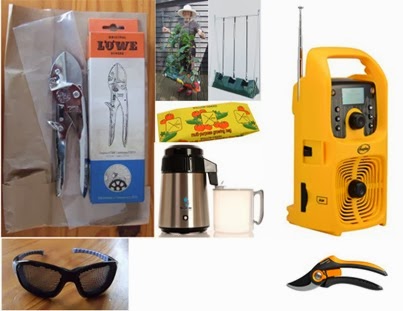
products2013_webLoewe garden pruners must here be mentioned as the best tools that I have reviewed in 2012 and 2013 as far as pruning shears are concerned. 2013 saw the 90th anniversary of the first ever anvil pruning shears made and patented by Loewe and for this anniversary the company went retro and produced a version of the first one in almost identical packaging too.

The Grow Bag Frame is then the next best product for the garden and it stands out in its simplicity making the use of the British grow bag for growing the likes of tomatoes or beans so much better and so much more efficient.

Megahome Water Distiller

Rock Croft Safe Eyes wrap around safety goggles

Fiskars SmartFit™P68

Freeplay Encore Player

And here you have it. My take on the best books and product that I was able to review in 2013.

© 2013

Government council cuts are punishing the most vulnerable

by Michael Smith (Veshengro)

Unite_logo_for_webMass scale cuts to council budgets will lead to the death of local government and heap punishment on the most vulnerable, as ministers announce a further 2.9 per cent cut in funding for 2014/15, warns Unite, Britain and Ireland’s largest trade union.

Many of the country’s most deprived councils will bear the brunt, with Liverpool city council facing a 62 per cent cut in funding between 2010 and 2017. Local government workers, who have already suffered a £3,544 cut in pay since 2010, will be pushed deeper into poverty as they are forced into a jobs versus wages tussle.

Unite, Britain’s biggest union, fears that by 2015 there will be little local government left after a 43 per cent real terms cut in funding in the five years since 2010. Cuts of this scale will lead to the complete demolition of services including care for the frail and elderly, children services, support for vulnerable families and youth services.

Despite the huge pressures faced by councils, Unite appeals to councils not to slash before thinking, but to work with unions to find savings and to protect service quality.

Responding to the government’s provisional local government financial settlement, published on December 18, 2013, Fiona Farmer, Unite national officer, said: “This government is presiding over the complete meltdown of local services. Ordinary hardworking people are, again, the ones being battered by the loss of the services they rely on to educate and care for their families.

“This is a shamelessly political settlement which rewards wealthy Tory councils and punishes the less well off.

“In some of the country’s most deprived areas, including the prime minister’s Oxfordshire constituency, services such as care for the frail and elderly, support for vulnerable families, children’s centres, sexual health services around teenage pregnancy and Connexions services, have already been shut or are threatened with closure. The wealthy Tory shires continue to escape relatively unscathed.

“The government will be gambling on the public blaming local councils for service cuts, but it is wrong; the public understand where the real blame lies - at the door of the communities and local government secretary, Eric Pickles.”

Unite is Britain and Ireland’s largest trade union with 1.4 million members working across all sectors of the economy. The general secretary is Len McCluskey.

In spite of warnings such as this by the leaders, so to speak, in the labor movement the British Labour Party has stated that it will continue, should it win the 2015 elections, which cannot come too soon, with the austerity measures and cuts.

While it is true that the finances of the United Kingdom are rather in disarray and the country is heavily indebted to the bankers of the world there are savings and cuts that can be made elsewhere and which would be real cuts in expenditure and not to vital services.

Alone abandoning the stupid idea of a nuclear deterrent which is laughable in the extreme would save billions upon billions which could be better used elsewhere and that is just for starters. Abandoning ideas of wars in countries where we have no business of being would be another great saving that could be made, not that the generals and warmongers would like this idea and neither the industries whose “vital interests” might be abandoned if we did.

The brief of our armed forces is the “defense of the realm” and the realm, last time I checked, does not include Iraq, Afghanistan, Syria, or any other country. It also does not include Bosnia and such like. It ends with the territorial waters of the United Kingdom and may, if we so want, include Gibraltar and the Islas Malvinas and other so-called dependents.

Let's look at savings there and to creating a peaceful country that regards the sovereignty of other countries and to a green economy which could create masses of jobs and give us energy and food security and much more.

© 2013

Old-fashioned ways for the modern age

by Michael Smith (Veshengro)

When speaking here of and referring to old-fashioned ways I do not – necessarily – mean in a Luddite way or in a way similar to the Amish who refuse – basically – to have anything to do with modern ways.

old-fashioned-waysIt is not those – per se – that I will be speaking of but of the ways of old that especially today would be good for us and the Planet if they be brought back.

The old-fashioned ways I shall be considering and speaking of here are those that society today more often than not thinks quaint and antiquated, like walking and cycling instead of using the car, using pen and paper instead of electronic means for writing, for instance. As well as speaking with people face-to-face or on the telephone instead of sending text messages. And also making do and mending and making things rather than buying them.

The motorcar, it has to be said is beginning to fall out of favor in the second decade of the twenty-first century and that especially with young people and that to such an extent that many are not even bothering, while making the driving license, to actually acquire a car themselves. Instead they take to cycling, including for the daily commute.

This is a good turn of events as it cuts down on pollution from motor vehicle traffic – the less of them on the roads the better – and is good not only for the Planet and the doers' wallets. It also keeps the doers fit and healthy, if they do not get knocked off their bikes by inconsiderate motorists who seem to believe that they own the roads. But safety can be found in numbers here (as in so many cases) and the more people who will take to the bicycle the better.

The cost of fuel and everything else associated with owning and sunning a car is one of the reasons that the old-fashioned way is becoming rather popular again, that is to say the walking and the cycling.

A bicycle is not just cheaper to buy and cheaper to run. It also can be (almost) entirely maintained at top condition by the owner and also repaired. The bicycle is, however, but one of those old-fashioned ways that is making rather a comeback. The humble typewriter is another.

TYPEWRITER

In late Spring 2013 the Russian secret service community announced that, in light of the electronic spying by the NSA and GCHQ disclosed by Edward Snowden, the services are returning to using typewriter, albeit electric ones, for sensitive documents and communications. Thus the announcement of the death of the typewriter has been very premature indeed.

The typewriter is far from being an old hat and dead even though it could have been thought so with the large use of computers and such nowadays.

To all intents and purposes, however, the typewriter is very much alive and is having rather a renaissance these days and that includes also and especially manual ones.

Manual typewriters, and here especially old working ones, are sought after once again and not (just) to put on display. They are intended and bought for use. Reports even suggest that young people especially, in places such as the USA and other hyper-modern countries, are looking at using and learning how to use typewriters again.

PEN & PAPER

Pen and paper is another old-fashioned way whose death has been announced very prematurely indeed. In fact pen and paper is having rather a revival if the amount of Moleskine and other notebooks that can be seen carried and used and here very much again by the younger generation, especially young professionals, is anything to go by.

head-medium_0For many years we have been told – brainwashed in fact – that computers would make pen and paper obsolete and also that we should reduce and even eliminate the use of paper and go “paperless” in order to save the (rain) forests.

The latter, as to the rainforests and paper, is a total fallacy at best and an outright lie at worst as paper pulp cannot be produced from (tropical) hardwoods.

Why we are thus being lied to in such a way I cannot say but what I can say if that pen and paper are still very much in use and, it would appear, are coming back in vogue.

Even the use of the fountain pen is coming back and many of those that have taken to using Moleskine, Leuchtturm1917 and similar quality notebooks also invest in good quality fountain pens to use with those notebooks. Here it is also mostly “real” fountain pens – filled from an ink bottle – rather than cartridge pens.

Slowly, it would seem, many people are coming back to the realization that not everything modern is what it is made out to be and that not everything that glitters is gold. There is a great amount of fools' gold around which has been mistaken for the real stuff.

Too many of the good old-fashioned ways are not, as yet, coming back into their own but in order to bring back sanity into all of our lives and for the sake of the Planet they must be revived.

MAKING DO & MENDING is one of those and while the mending with products today that are made to break down easily and designed so they cannot be repaired in most cases it is a bit hard – but we can change that too – the making do is what we all can do already now. Especially here as to making do with what we already have as long as it works (well) and does the job.

Making do is something that we can and must do (again) for the sake of sanity, our wallets, and especially for the Planet. We only have this one Planet, we only have one Mother Earth.

Our ancestors, and especially here those of the working class and the peasantry, were masters in the making do department and from their ways, some of which are recorded in books and other publications, we can surely learn a great deal and we also must.

© 2013

Walking the breadline - the scandal of food poverty

by Michael Smith (Veshengro)

britain-isnt-eating-posterIn 2012 half a million people in the UK depended on emergency food aid. The single most common reason for people to need food aid is that their benefits have been changed, delayed or stopped.

The explosion in food poverty and the use of food banks is a national disgrace. It undermines the UK's commitment to ensuring all its citizens have access to food – one of the most basic human rights – along with access to water, not that the Con-Dem coalition regime under David Cameron would know anything about human rights.

We urgently need action to stop our benefits system making people destitute. We need a national investigation into how this is happening but first of all we need to give people enough money so they can feed themselves and their families and on top of that we must ensure that basic foods are at an affordable price. In other words, basic healthy food stuffs need to be at a price that everyone, even those with a low income. From everyone according to his or her ability and to everyone according to his or her need, but then again that is not something that the British government would understand, and not even a Labour one.

The poster that is going with this campaign is already, it would appear, upsetting Number 10 and Ian Duncan Smith and this is a good sign that it is hitting the points it should.

It is an absolute scandal that in Britain, the country that is number eleven of the richest places in the world with a GDP of over $ 2 trillion food poverty, and poverty in general, is allowed to be so prevalent.

PLEASE read, share & download the report produced by Church Action on Poverty http://t.co/AmiUsO5NFb

Watch the VIDEO: http://t.co/lxMx6CLR8K

© 2013

Urban gardens are key in times of crisis

by Michael Smith (Veshengro)

Allotment gardens have often been sources of local resilience during periods of crisis. During World War I the number of allotment gardens surged from 600,000 to 1,500,000 in Britain, supplying city people with food and other ecosystem services.

Urban_gardens1The gardens were planted in parks and sports fields, and even Buckingham Palace turned up the earth to grow vegetables. After declining abruptly in the 1920s and 1930s, World War II saw a new explosion in the numbers of allotment gardens in cities of Britain and other parts of Europe.

In Germany, and several other European countries, allotment gardens have always played a great role for the people and in giving them a small measure of self-sufficiency in food though some do manage to grow more than enough for themselves and their families as far as vegetables are concerned.

In Britain the law, theoretically, states that councils have a duty to provide land for allotment gardens if a certain number of people demand them. This appears to be (1) a little known fact and (2) something councils often do not follow either, even if the demand is there.

In other European countries the allotment garden movement is far more active than it is in Britain and also much better organized and there are allotment colonies all over the place. Cities, towns and even villages have them and they are well used, it would seem.

However, we need more urban and suburban community gardens where people can grow their own food and there is enough derelict land around in most places so that this can be possible, also in the UK, and in the middle of the cities. Where the soil may be contaminated it is quite feasible, though it means bringing in healthy soil, to do the growing beds in large containers such as reused builder bags which nowadays, to 90%, are not reused by the companies and cannot even be returned. This is, basically, killing two birds with one stone namely having a place in which to grow food and also keeping such bags, made predominately from woven polypropylene, out of landfill.

Using this approach could turn many empty urban lots in any town or city into productive community gardens without needing to dig the ground, which might be covered in concrete or tarmacadam and thus cannot be easily dug or ground that is possibly contaminated. Yes, it would require bringing it good soil to fill the bags with and then grow the food therein but that still is better than not having such gardens at all.

Allotments must be made available also to all that want to work such plots and not just in urban areas but in them and suburban areas especially as there less land at home is available for the growing of food and people must be encouraged to grow at least some of their own food at home or at allotments and similar gardens.

Our food security depends on this for our individual regions as much as for the country as a whole and there was a time when all cities had market gardens and small farms surrounding them and even almost in their hearts, as did Paris before World War One and we must bring this back to make local foods available to all.

Allotment garden, known as Schrebergaerten or Kleingaerten in German, have in that country been in use for about a century or so and they are, as previously stated, well received and they are much like that Dachas in Russia, and in some cases, just like on their Dachas in Russia, people spend their entire summers, growing plants, both flowers and vegetables, living in little cabins.

During the Second World War the roads and streets of Germany, including those in towns and cities, were lined with fruit trees to provide fresh fruit, especially apples, pears and plums, for the population during the war time and many of those trees were still about in the 1980s though rarely anyone made use of the fruit provided by the trees.

There were also, once upon a time, so-called common trees of various fruits that lined the country lanes of Britain but most of those trees have been grubbed out by now as they were deemed a danger to motorists. The car has to come first, obviously. But, actions of guerrilla gardeners grafting fruit tree branches to that of city trees and the reception of this by the people proves that it would be popular to have fruit trees lining the streets and being found in our parks and open spaces. Many, the majority, in fact, of our common woods in the countryside were a mix of timber trees with fruit trees (the latter in the end also will provide valuable timber) to a ratio of 2:1. Proof that it is all possible and that food security can be created for every area, including our urban and suburban areas. Time we got going.

© 2013

The Stick

by Michael Smith (Veshengro)

Entered into the Toy Hall of Fame in 2008 it is now available everywhere. In fact it has been available in your local woodlands for ever and has been used by children as a toy for centuries if not millennia.

stick-gunsI know that the above is a little tongue in cheek but it is true that the stick was inaugurated into the Toy Hall of Fame in 2008 as a favorite child's toy. One can but wonder though why it took them that long to realize that.

One of the first toys that children, especially the boys, seem to pick up when they get out of doors is a stick and it becomes all manner of imaginary things, a gun, though rather frequently, being just one them.

As children we made ample use of sticks for toys, as they came, or we turned those sticks, with a little help of a (pocket)knife into just what we wanted them to be, including catapults (slingshots) for hunting, digging sticks, and much more.

It must be something deep in our psyche but when going into the woods one of the first things most kids do is to pick up and good sizable stick and to use it as a walking stick, as a staff.

Not much has changed as to that even in our modern age of computers and games consoles and it is good to see that, for sure, and thus the stick definitely deserves a high place in the list of toys.

© 2013

CHOOSING ETHICALLY SOURCED CHRISTMAS PUD & MINCE PIES CAN HELP REDUCE THREATS TO RAINFORESTS, SAYS NEW SURVEY

4113373_2450673_final_01A new survey reveals that a growing number of seasonal foods including Christmas puddings and mince pies now only use palm oil which is produced in way that reduces harm to the world’s rainforests.

Many of the biggest names in Christmas party food including the Co-operative Group, M&S, Premiere Food and Waitrose makers of some of the UK's most popular Christmas puddings and mince pies, have all made a commitment to reduce or only use sustainably sourced palm oil in their products.

In the survey carried out by the Rainforest Foundation UK (RFUK) and Ethical Consumer magazine some of the UK's biggest Christmas party food companies were surveyed on their use of palm oil or its derivatives.

The survey was carried out in response to the increasing threat that unsustainable palm oil is posing to the world’s rainforests, and consequently, to the people that rely almost entirely on these forests for their livelihoods.
Having destroyed vast areas of forest in countries including Indonesia which is home to orangutans, palm oil companies are now planning to expand into the rainforests of the Congo Basin in Africa, home to lowland gorillas and chimpanzees.

Simon Counsell, Executive Director of The Rainforest Foundation UK said: "We commend the producers of Christmas party treats that have committed to reducing or using only sustainably sourced palm oil because by doing so, they are helping to ensure the long-term survival of Africa’s rainforest, its people and unique wildlife.”

The top scoring companies in the survey include the Co-op, M&S, Premier Foods and Waitrose.

The bottom scoring companies include ASDA/Wal-mart, Iceland and Mondelez International. Leonie Nimmo, researcher at Ethical Consumer said: “Our latest research shows that some companies have put their commitments to sustainable palm oil into practice and made significant changes in their supply chains.”

“However, others, including Tesco, ASDA and Cadbury still have a serious amount of work to do to address the issue across their global operations.”

The Christmas party food survey is the latest initiative of a campaign to encourage consumers to buy products that have the top rated palm oil policies, forcing those companies that are not taking their environmental responsibilities seriously to use more sustainably sourced palm oil.

Details of the ethical palm oil score for many other products can also be found in the Rainforest Foundation’s online guide, here: www.rainforestfoundationuk.org/Christmas_Party_Food

Full Disclosure Statement: The GREEN (LIVING) REVIEW received no compensation for any component of this article.

This article is for your information only and the GREEN (LIVING) REVIEW does not (necessarily) approve, endorse or recommend the product, service, company or organization mentioned.

Soaring hospital admissions for malnutrition in Leeds, UK

Soaring hospital admissions for malnutrition branded ‘disgrace’ by politician

by Michael Smith (Veshengro)

malnutritionSpiraling numbers of admissions to hospitals in Leeds of patients with malnutrition have been branded “an absolute disgrace”. And one can only agree with that. However, is this not directly part of what the Con-Dem Coalition is all about; getting the country back to Victorian values.

The figures, however, which have trebled in five years, could just be the tip of the iceberg, a politician has warned, as people with malnutrition needed hospital care on 93 occasions in 2012, compared with 30 in 2008. The fact that those figures could just be the tip of the iceberg is also because those are just the figures from one UK city, namely Leeds. We have, so far, no figures from other places, and especially not the capital, London.

Coun Lisa Mulherin, executive board member for health and wellbeing on Leeds City Council, said that he numbers being admitted to hospital are shocking and potentially the tip of the iceberg.

“It’s an absolute disgrace”, she continued, “that in a wealthy, modern nation we are seeing anybody turning up in hospital in that condition, but the fact we are seeing three times as many now tells us something about the changes to the welfare system, wage stagnation and the way fuel prices have gone up out of all proportion with people’s pay”.

Pressures on ordinary working are enormous and the reasons for the increase include poverty, which can prevent people buying nutritious food, the growing number of older people, many of whom are living in ill-health, as well as greater recognition of the issue by health workers.

A year ago it was revealed that more than 27,000 people in Leeds were suffering from malnutrition, which occurs when the body does not get the nutrients it needs. Lack of cash means that people are forced to choose between eating or heating their homes. Victorian times are indeed returning just as the coalition of the blues and yellows want them to be.

If the working class can be kept on a subsistence level they will, once again, like in the times of Queen Victoria (and before) become a pool for cheap labor and the zero-hour contracts that have been and are being introduced all over the place are also part of this.

There seem to be, however, even more sinister moves afoot in the entire European Union as to the dismantling of the welfare state and the safety net for which people have fought so long and hard.

On December 13, 2013 (a black Friday one can only say) the Dutch King Willem-Alexander has announced the end of the welfare state and this trend seems to be moving across the entire area of the European Union. Ireland has, apparently, told the unemployed of the country to sling their hooks and leave the Emerald Isle.

In Britain people affected by changes in the welfare system who have absolutely no prospect of getting any work and thus see no way how to carry on with life have taken to ending theirs and have committed suicide and quite a number of them by now already.

Still the Con-Dems are continuing with their assault on the poor and the working people of this country unabated with claims that they are creating a fairer society. One can but wonder in which parallel universe those people actually reside. In ours it cannot possibly be.

We need a new system, political and economical, not a new government. In fact, we need no government at all.

© 2013

The best things in life come in Cellophane

by Michael Smith (Veshengro)

“Our enormously productive economy demands that we make consumption our way of life, that we convert the buying and use of goods into rituals, that we seek our spiritual satisfaction and our ego satisfaction in consumption.

We need things consumed, burned up, worn out, replaced and discarded at an ever-increasing rate.”

  • Victor Lebow, Journal of Retailing (1955)

And here is where we can see the very philosophy of consumerism and when it was created.

no-to-consumerismWe have been brainwashed since the 1950s – in the USA at least, as the rest of the developed world took a little longer to cotton on – into this very idea of consumerism only because they began to base the economy on obsolescence and the modern version of that is products that can no longer be fixed and that have a factored in lifespan after which they will have to be replaced.

Before that time when Victor Lebow advocated this new approach to making the manufacturers ever richer the economy worked on a different level and you had to bring out really something new and revolutionary to get people to buy it or the things they had really had worn out and could no longer be fixed.

Before this time of brainwashing people to buy into this new idea of an economy everything bar consumables, as one could refer to them, such as foods, soap and the like, were made in such a way that they would last for as long as possible and almost everything could be repaired either by people doing it themselves or by taking it to a repair shop.

And entire economy existed, and in the former East Germany an industry existed, basically, geared to repair, from electrical appliances, over clothes and shoes, to almost everything else. Repair shops for almost anything could be found on every high street, from cobblers being versed in all manner of shoe and boot repair, tailors geared to repair and alteration, electrical repair shops that could fix any appliance, from the wireless and the TV to washing machine and what have you. And then cam the new economy of consumerism and built-in obsolescence and that part of the economy died a death and that predominately because products were being made and still are being made in such a way that they can neither be opened nor repaired.

Basically this entire new economy can be traced back to 1955 and the approach taken by Lebow, et al, in order to turn everything we have had before around and get people to have to buy new every couple of years at least. They had run out of ideas to keep going without this and thus they had to invent a new way of making more and yet more money.

It was also, not long after this, that vacuum cleaner manufacturers made the suction claims as if that would make for better cleaning power. However, that is just what the people began to believe having been indoctrinated to believe just that and that way they could sell one new one after the other. The fact is that most vacuum cleaners today do not even have the cleaning power of the little Hoover of the 1950s. They may be able to lift a bowling ball and thus eat your curtains and lift up your carpet but cleaning power that does not equate to.

Nowadays the sales of products go on bells and whistles even though those new bells and whistles often do not work at all properly and “food” manufacturers make all sorts of health claims appertaining to their products which bear no resemblance to reality. And the same goes for all the claims associated with genetically engineered “foods” being needed to feed the world. It is a sales gimmick at best and something far more sinister at worse, if the book “A Quirk of Destiny” by Catherine Greenall is taken as a warning.

We need a return to sanity on all levels and get back to the way things were before those people decided that consumerism was to be the new religion and brainwashed the people into believing that they can buy themselves happiness.

Consumerism is much like the arms race. It needs things to break in order for the makers to make more profit in the same way as the arms industry needs the arms race and wars to continue to make their huge profits and ever bigger ones. And, as the governments are but protection agencies of the corporations they, the governments, are not about to make any changes as to consumerism nor the arms race.

It is up to us, each one of us, who have to buy this and that to send the corporations a message via the way we spend our cash as to what we want and that we no longer buy into the consumerism message. We have an enormous power in our wallets and if we but make use of it by demanding, via where we spend our money, the kind of products that we want, products that are made ideally in our own countries, made to last and are repairable, and are made ethically. It can be done and will be good for us and the Planet.

It will also create jobs at home in the factories and workshops, if products are, once again made at home, and will rekindle the repair-economy also with the small repair shops we once had.

We can bring about the changes that we want to see if we but make the right points to the corporations, the producers, and spend our money more locally especially, on locally-made products and for local services.

Time to get off the consumerism train and onto the local bus.

© 2013