Showing posts with label poverty. Show all posts

Poverty Mindset vs Voluntary Poverty

by Michael Smith (Veshengro)

voluntary-simplicityWhat was once called voluntary poverty is now referred to as voluntary simplicity because some people seem to have had problem with the word poverty.

When you decide to go that route on your own accord, to live a simpler, more or less, poverty lifestyle, it is a different kettle of fish to having it forced upon you by circumstances, some beyond your control.

We have looked at Voluntary Poverty before so now let us consider the Poverty Mindset with which we have, more or less, been programmed through various societal pressures and via the power elite.

The reality of this here and now of our existence in this world is that money, in one form or another, is an inherent part of the global interactive construct.

While many of us, if not indeed most, would love to live in a different kind of economic collective where money would not, necessarily, be the means of exchange fact is that currently most of us live in one where we have to use money for most of our transactions regardless of our beliefs and ideology surrounding this “energy”.

This “Poverty Mindset” is a mind control program that has cleverly created and disseminated by the wealthy elite who want us to believe in and operate from. The poverty mindset formula is simple: if we don’t have access to financial abundance, then we don’t have access to the resources we require to become more effective in this world. It is a program of suppression and oppression. Interestingly, it is also a program that requires resentment to fuel it.

In addition to that the mind control has gone so far that we see everyone who does not have the financial abundance as a failure and someone who is alone to blame for his misfortune.

Those elites and “our” politicians keep referring to money as “resources”? But money is not a resource. It is, at the very best, a piece of printed paper (or minted metal), at worst it is a bunch of numbers on a screen. The only thing that gives it any value whatsoever is our shared belief in its value. This means that money is actually a faith-based religion and the politicians and bankers its clerics. But are you and I ready to become non-believers?

Money only has the value that we give it. After all it is only a piece of metal, or worse still a piece of paper, with a number, a “value”, printed upon it. If we would so decide we could use anything as “money”, such as the bits of paper for the Monopoly board game, shells, copper discs of different sizes (in the latter case at least the metal does have a value in that it is something that is needed for the making of things), or bits of wood or simply figures written in a book.

What is “Poverty Mindset”?

It is the mindset that we are being programmed with, through societal pressure, into believing that only if we have a certain amount of money, a fancy car, a big house, and so on, that we are valuable to and in society. That those that have a lot of money and possessions are our betters and thus we should look up to them and, maybe, even obey them.

There is nothing wrong with having a lot of money and there is also nothing wrong with having not so much. However, people should not be pushed into poverty through high prices and low incomes, despite the fact that they work all the given hours, while others who work little or not at all “make” lots of money. That we should not accept. The worker is worthy of his hire, and in all honesty the people that many look down upon because they do the so-called menial and manual jobs are probably worthy of it more than the bankers and the chief executives of industry. Without the worker all the wheels would stand still.

But we are conditioned to believe in this exploitative capitalist system that those “at the top” are worthy of greater pay and remuneration than those “at the bottom” and that those who are in more or less poverty have only themselves to blame for not doing well at school so that they too could be in those “higher” positions. But what would happen if we all would be academics? Who would then maintain the parks, the forests? Who would collect the trash, keep our streets clean, care for the elderly and the sick?

Everyone's hours of work should have the same value and be rewarded in the same way, for the hour of the academic, of the chief executive, of the prime minister, is worth no more than the hour of the road sweeper, the dustman, the gardener, the forester, the nurse or the carer. An hour is an hour is an hour.

It is the system that pushes people into poverty and it is also the system that keeps them there and the majority blames the poor for their condition and looks upon them as something of no value. Mind you, those of the middle class and the upper class also look down upon those of the working class as if they have little or no value. And in the poor the same mindset takes hold, of believing that they are not worthy, but also resentment of those that have more.

And all, including those that are poor not by their own choice, look down upon those that chose Voluntary Poverty; who chose a simple life and lifestyle, trying to do with little money only and few(er) possessions. Doing without a car, a television, foreign holidays, and so on. Few, even those that are poor, believe that people could be (so stupid, as many see it) to voluntarily life a life of poverty (aside from, maybe, some monks).

There should be no poverty, aside from the voluntary kind, in society, if our society is as it is meant to be, with equality. Everyone should be equally remunerated for the hours that they work regardless of what the work is that they do. But for that we would have to change the system, including and especially the “monetary system”.

When everyone's work is regarded the same and everyone is being remunerated in the same way for the hours worked in hours and not coin and when there is work for all then, and only then, the poverty mindset will no longer exist either.

© 2018

The real reason behind austerity

by Michael Smith (Veshengro)

austerity-isnt-working-2The real reason behind austerity is to erode hope, to increase inequality and to make people's lives so hard that they do not have a chance to demand better. Nay, not just that, but that they even do not dare to demand better for fear of falling every deeper into poverty.

It has nothing whatsoever to do with reducing the country's dept and all that jazz. Portugal did not follow that idea put forward by the EU and others and, erm, no, the country did not fall off a cliff; the economy grew.

Austerity is about putting people into poverty because poverty is the ultimate form of control. Because people who are poor are, more often than not, dependent on government or other agencies for help and thus are controllable.

The aim of the neo-liberals, on whose dung heap those ideas have grown, is to make the poor ever poorer and also put the middle class into the poor bracket, wherever possible, while the elite gets richer by the minute.

Also, people who are poor but are working will not risk taking industrial action, that is to say strike or such, for fear of losing their job, which in turn could lead to losing their home and even losing their children.

In this context we also have to and must see the attempt by the neo-liberal establishment to outlaw, basically, cash and the use of it. Without money in the form of cash people also have no chance to do any extra, unofficial work, or make a little money from hobby crafts, selling surplus garden produce and such. Neither can they be trading on craft and other markets as card terminals would not be within their scope.

The end of cash will also, to a great extent, mean the end of markets in villages, towns and cities, selling produce and other things, as the majority of the market traders would also not be able to afford the use of card terminals.

The entire reason for the neo-liberal idea of austerity is to make the poor poorer still, to make the middle class poor, and to make the rich ever richer and by privatizing every public service making increasing the values of the shares of the corporations and the dividends for their shareholders, mostly the already very rich. It has nothing to do with the economy not with the reduction of the public debt.

Austerity is the tool by means of which the neo-liberal elite is turning most of the people into obedient slaves, who dare not revolt for fear of becoming poorer still.

© 2018

Tories Victorian values bring the return of Rickets & Co

by Michael Smith (Veshengro)

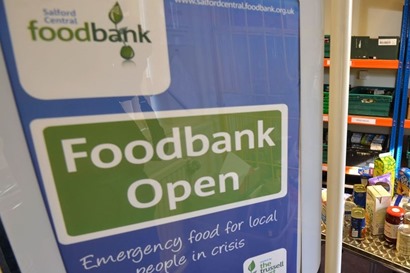
foodbank1Children are suffering malnutrition and Victorian diseases as poverty tightens its grip

In Salford, Greater Manchester, UK, the number of malnutrition cases has doubled – with many of the victims children.

Victorian illnesses such as rickets and beriberi – thought to be long eradicated – are on the rise due to food poverty according to a shocking new report with the number of people being admitted to hospital with the condition doubled over a four year period.

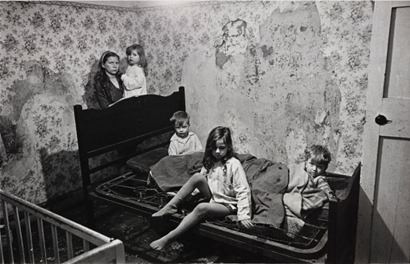
These shocking pictures show what poverty was like in Manchester in the 60s and 70s and although health conditions are often a primary cause, Salford council leaders believes that poverty is also to blame.

The number of people being admitted to hospital with malnutrition increased from 43 in 2010 to 85 in 2014. Although an exact breakdown of those admitted was not available, many of them are believed to be children. 50,000 emergency food supplies given to struggling families across Greater Manchester in past year. This was significantly higher when compared to Greater Manchester overall.

In addition, just alone in Salford, there were other signs that household poverty was increasing. The number of homeless people rose from 40 in 2010/11 to 356 in 2014/15.

In 2013 the number of children deemed to be living in poverty was 12,175, as measured by households in receipt of work benefits and tax credits, which equated to 26 per cent of children in the city. The figure for the North West was 21 per cent and for England 18 per cent.

Anecdotal evidence has suggested that some children in the city are being fed when they arrive at school as they have gone without breakfast and nearly 12,000 unwanted tinned meals given to foodbanks across Greater

Manchester.

But, if the Tories are to be believed, we have never had it as good as we are having it now in Britain. In Germany the government is using the self-came mantra, a country that has also seen a serious increase in poverty and homelessness levels.

We are seeing a drastic rise in in-work poverty, foodbank usage and homelessness. In 2014 the Faculty of Public Health said conditions like rickets were again becoming more apparent because people could not afford quality food in their diet. Forgotten forms of poverty and diseases associated with it are becoming standard again.

It would appear that this was the standard that the Tory regime in Britain has been aiming at by promoting a “return to Victorian values” forgetting to tell people that what they really meant and mean with it is a return to Victorian conditions.

But neoliberal “conservative” regimes in other countries of Europe (and elsewhere) are, it would appear, working towards the same aim. There seems to be an agenda there somewhere.

© 2017

Thank You for voting Tory

by Michael Smith (Veshengro)

500534084Thanks for voting Tory. Everyone who did has really done well.

Due to the actions of the Conservative government of the “United Kingdom” it has been estimated that 120,000 children will wake up homeless this Christmas and many, many more in dire poverty. Hope you are proud of yourself. But, I guess, as long as it is not you and your children why should you care.

The Tories have been talking about getting Britain back to Victorian values but what they really aim to do is turning back the clock and bringing us all back into the Victorian era and if we are not careful back further still.

10446715_10205374118698472_1392947066675936283_nVictorian values were not, necessarily, the greatest thing either but the era definitely was no good for the common man, woman or child. Homelessness was rampant and dire poverty and we are on the best way to that kind of situation again.

It won't be long, if we allow the Tories to remain in power, that we will have workhouses and child labor again, but, no doubt, that is also something that the Tories would not mind, as long as it is not their children but only those of the working class.

The most worrying part is that such a great number of working class people actually vote Tory (or even further right-wing) and thus are causing misery for their class and the children of their class. But it seems to be the attitude of “I am alright, Jack” in the same way as Gypsies in the West are not prepared to do anything to help those of the same race persecuted in Eastern Europe, for instance. But, when the shoe is on the other foot they are the first to complain.

I do not even want to start to talk about the other things that are being destroyed, dismantled and sold off to the highest bidder for private gain, by the Tories, such as the NHS and other aspects of the welfare state. You really have done well keeping those parasites in power.

© 2017

Poverty is now a way of life for many again

The scourge of modern day poverty in Britain

by Michael Smith (Veshengro)

The Tories have for a long time, under various administrations, intended to bring the country back to Victorian values; to the Victorian era more like. And to all intents and purposes they are succeeding.

We have today an epidemic in the Britain, a scourge in our communities, and this epidemic and scourge is called poverty. Taboo, however, does make it difficult for sufferers to admit that this epidemic affects them. Millions are being condemned by a food poverty that has reached the level of a ‘health emergency’ while Government policy merely fans the flames of this national scandal. At least 1.3 million people, adults and children, in Britain live in poverty and this is a national disgrace for a nation that is rated as the 11th richest country in the world. A country with a GDP of $2,375 trillion.

The poverty that we see today differs somewhat from poverty from the past. We may not see the squalor and hardship as yet that was seen prior to the creation of the welfare state but the effects of poverty still hit extremely hard. One definition of poverty is: “People are said to be living in poverty if their income and resources are inadequate as to preclude them from having a standard of living acceptable in the society in which they live.”

Poverty has a horrendous effect in the UK but this is exasperated by a Government that has no interest in combating poverty, in fact, it is near fatal to appear poor as it makes the Government want to kick you.

Today’s Government has a mantra of ‘making work pay’. They tell a story of shirkers vs. skivers, a narrative that informs us that people living in poverty do so due to them being feckless, workshy individuals languishing in the bed all day watching repeats of the Jeremy Kyle show. But the rhetoric doesn’t match the stats.

In 2011/12 there was 1.3 million people living in poverty in the UK and over half of these people were in employment. How in the name of the Big Man above did we end up in a situation where so many people in our fantastically rich country are living in poverty while in employment?

One of the reasons is Income Inequalities. The UK’s Gina coefficient, a method to measure income inequalities between nations, is now higher than at any time in thirty years.

This is reinforced by data showing that, in the last decade, the poorest 10% of our nation have seen a fall in their ‘real income’ after deducting housing costs which is in sharp contrast to all other sections of our population.

In layman’s terms, it means that after adjusting for inflation, the poorest 10% of the UK have had less income that they did 10 years ago while everyone else has seen a rise in their income.

What makes matters worse is the Government’s attack of the welfare state which is removing the protection that people had from the blight of poverty. Their attacks, under the auspices of reforms, has linked to the rise in the use of foodbanks and homelessness. Their system of unwarranted and senseless sanctions has literally take food from the tables of our children which an extra 600,000 children being thrown into absolute poverty by Governmental policy.

So what do the Conservatives do when they are confronted by the facts? Kent Council commissioned an official report which concluded that the rise in foodbanks and a rise of homelessness being linked to the Government’s welfare reforms. After looking at all the evidence the report concludes that these rises were due to ‘welfare reform as no other alternative explanatory factor is yet apparent’.

Did the ruling Conservatives at Kent council at Kent Council act on this report? No, they attempted to suppress this report as they did not like the report’s conclusion.

So we live in an unequal country where the poorest become poorer and the wealthy become richer. But there is an alternative. There is a better way so that we can have a democratic nation based on equality and fairness which I will write about in future post.

It has to be said, however, that there is poverty and then there is poverty. And while this may sound a little too cryptic I will try to explain.

What is perceived by many today as “poverty” is a reduction of what they have been used to and the problem is that many, I am afraid to say, are not prepared to forgo some things that are not necessities and needs but only wants. Many also are unable to manage the money that they have and spend it unwisely.

Do you really have to have cable TV (pay for) or TV at all? Do you have to have take out meals almost every day of the week? And the list of questions could go on and on. Fact is that that is exactly, I am afraid to say, the way some of the poor behave.

I am not trying to lessen the fact that, according to the way the index is used, people are poor and some are even poorer than that, but there are times when people also must blame some of their own actions for the fact that they are short of money and not try to shift the blame onto others, onto circumstances and especially the government, even though the latter has a great deal to answer for.

© 2015

A Rich Man Took His Son To See What It Was Like To Be Poor, And This Is What Happened

ImageProxy (14)

One day a very wealthy father took his son on a trip to the country for the sole purpose of showing his son how it was to be poor.  They spent a few days and nights on the farm of what would be considered a very poor family.

After their return from the trip, the father asked his son how he liked the trip. “It was great, Dad,” the son replied. “Did you see how poor people can be?” the father asked. “Oh Yeah,” said the son.

“So what did you learn from the trip?” asked the father. The son answered, “I saw that we have one dog and they had four. We have a pool that reaches to the middle of our garden and they have a creek that has no end. We have imported lanterns in our garden and they have the stars at night. Our patio reaches to the front yard and they have the whole horizon.

We have a small piece of land to live on and they have fields that go beyond our sight. We have servants who serve us, but they serve others.

Read more here.

Justin Welby's 'shock' at scale of hunger in UK

Hunger 'stalks large parts' of the country, Archbishop of Canterbury warns ahead of Parliamentary report on issue

Justin Welby has accepted an invitation to present Thought For The Day on the Today programme being edited by Antony JenkinsThe Archbishop of Canterbury has said he was left more shocked by the plight of Britain's hunger-stricken poor than suffering in African refugee camps.

Food is being wasted at "astonishing" levels across the UK yet hunger "stalks large parts" of the country, the Most Rev Justin Welby said.

Families are being forced to turn to food banks to make ends despite holding down jobs, he wrote in the The Mail on Sunday.

The Archbishop's comments come ahead of the publication on Monday of a parliamentary report he has backed that sets out a blueprint to eliminate hunger in Britain by 2020 and urges ministers and the food industry to act.

In the The Mail on Sunday article, he said, although less "serious", the plight of a family who turned to a food bank in Britain had shocked him more than terrible suffering in Africa because it was so unexpected.

Read more: http://www.telegraph.co.uk/news/religion/11278085/Justin-Welbys-shock-at-scale-of-hunger-in-UK.html

Reversing Global Warming, Hunger and Poverty: Supercharging the Global Grassroots

"It is easy to forget that once upon a time all agriculture was organic, grassfed and regenerative. Seed saving, composting, fertilizing with manure, polycultures, no-till and raising livestock entirely on grass—all of which we associate today with sustainable food production—was the norm in the ‘old days’ of merely a century ago, not the exception as it is now. Somehow, back then we managed to feed ourselves and do so in a manner that followed nature’s model of regeneration.

“We all know what happened next: the plow, the tractor, fossil fuels, monocrops, nitrogen fertilizer, pesticides, herbicides, fungicides, feedlots, animal byproducts, e. coli, CAFOs, GMOs, erosion, despair—practices and conditions that most Americans today think of as ‘normal,’ when they think about agriculture at all.

“Fortunately, a movement to rediscover and implement ‘old’ practices of bygone days has risen rapidly, abetted by innovations in technology, breakthroughs in scientific knowledge, and tons of old-fashioned, on-the-ground problem-solving.”
—Courtney White, The Carbon Pilgrim, Nov. 16, 2014

A critical mass of climate scientists have warned us repeatedly that we must reduce the concentration of CO2 in the Earth's atmosphere to 350 parts-per-million (ppm) in order to preserve life on Earth.

Unfortunately the business-as-usual behavior of out-of-control corporations, indentured politicians and hordes of mindless consumers, continues to lead to billions of tons of CO2 and greenhouse gases (GHGs) being pumped into our already (398 ppm) supersaturated atmosphere and ocean. By the time major reductions in fossil fuel use take effect—in 20 years, if we’re lucky—it could be too late. By then, we will likely have reached 450 ppm or more, approaching the point of no return, where serious climate instability morphs into climate catastrophe.

While climate scientists sound their alarms on the global warming front, agronomists and hunger experts warn of equally catastrophic events. They tell us that unless we embark on a global campaign to reduce the damages of industrial agriculture, restore soil fertility (especially on the 22 percent of potential arable lands now eroded or desertified), improve crop quality and food nutrition, and conserve water, we face increasing rural poverty, starvation, and permanent food and water wars, especially in Asia, Africa and Latin America, where the majority of the world’s population live.

These looming disasters—climate catastrophe, and rural poverty, starvation, and food and water wars—are not entirely unrelated. And neither are their solutions.

We can reverse (not just mitigate) global warming. And while we’re at it, we can also restore soil fertility, eliminate rural poverty and hunger. We can do this by sequestering several hundred billion tons of excess CO2 from the atmosphere, using the traditional, time-tested tools we already have at hand: regenerative organic farming, ranching and land use.

What will it take to make this world-changing transition to a livable Earth?

Read more: http://www.commondreams.org/views/2014/12/05/reversing-global-warming-hunger-and-poverty-supercharging-global-grassroots

Welfare reform reinforces growing class prejudice reminiscent of Victorian era

Welfare reform reinforces growing class prejudice reminiscent of Victorian era• Study finds people believe work is plentiful and unemployment is a lifestyle choice
• Evidence of an alarming intolerance towards disabled people, with questions over legitimacy of benefits
• Government rhetoric on ‘scroungers’ likely to reinforce these attitudes

British society is becoming increasingly intolerant of unemployed people and other disadvantaged groups, according to academics at the Sheffield Political Economy Research Institute (SPERI).

A study by the University of Sheffield has found there is a growing sense that unemployment is caused by individuals’ personal failings, rather than by structural problems in the economy.

People tend to believe that work is plentiful, and that unemployment was therefore a lifestyle choice, rather than an imposition, and that poverty therefore results from moral deficiencies.

The research also highlighted an alarming intolerance towards disabled people, with participants questioning the legitimacy of benefits for disabled people deemed incapable of working.

It is clear that the derogatory term ‘chav’ remains in popular usage. Middle class research participants tended to identify and condemn ‘chav’ culture so as to validate and re-affirm their own superior social position. Working class respondents were more likely to identify and condemn ‘chav’ culture in order to distinguish themselves from it.

We appear to be witnessing the re-emergence of traditional distinctions between the ‘deserving’ and ‘undeserving’ poor, associated with the Victorian era.

This research identifies contemporary attitudes to the unemployed by drawing on a series of case studies conducted in Leeds, in Northern England. The evidence presented here is based on 90 interviews which were conducted with participants from a variety of different social classes and ethnic backgrounds.

The Coalition government’s welfare policies are in part a response to the kind of popular prejudices identified in the research. However, government rhetoric on welfare ‘scroungers’ is likely to reinforce these attitudes – focussing blame for poverty on individuals rather than on wider structural problems in Britain’s increasingly low-pay, low-skill economy.

There is in fact a danger that misplaced fears and prejudices relating to welfare claimants will present a threat to social cohesion, potentially legitimising policies which might exacerbate, rather than alleviate, social inequality.

Professor Gill Valentine, Pro-Vice-Chancellor for the Faculty of Social Sciences at the University of Sheffield and author of the report, said: “The evidence is mounting that the coalition government’s austerity agenda has been targeted at the poorest groups in society rather than the most affluent.

“This research shows that this is reinforcing prejudicial and intolerant attitudes towards the most disadvantaged members of society, as the government has been successful in individualising the causes of poverty and unemployment, and marginalising the socio-economic determinants of hardship.”

The full report can be viewed at http://speri.dept.shef.ac.uk/publications/speri-briefs/ .

Today’s publication is the eight in a new series of SPERI British Political Economy Briefs. Through this series SPERI hopes to draw upon the expertise of its academic researchers to influence the debate in the UK on sustainable economic recovery.

Sheffield Political Economy Research Institute

The Sheffield Political Economy Research Institute (SPERI) is an academic institute based at the University of Sheffield. The institute aims to bring together leading international researchers, policy-makers, journalists and opinion formers to develop new ways of thinking about the economic and political challenges posed for the whole world by the current combination of financial crisis, shifting economic power and environmental threat.

The University of Sheffield

With almost 26,000 of the brightest students from around 120 countries, learning alongside over 1,200 of the best academics from across the globe, the University of Sheffield is one of the world’s leading universities.

A member of the UK’s prestigious Russell Group of leading research-led institutions, Sheffield offers world-class teaching and research excellence across a wide range of disciplines.

Unified by the power of discovery and understanding, staff and students at the university are committed to finding new ways to transform the world we live in.

In 2014 it was voted number one university in the UK for Student Satisfaction by Times Higher Education and in the last decade has won four Queen’s Anniversary Prizes in recognition of the outstanding contribution to the United Kingdom’s intellectual, economic, cultural and social life.

Sheffield has five Nobel Prize winners among former staff and students and its alumni go on to hold positions of great responsibility and influence all over the world, making significant contributions in their chosen fields.

Global research partners and clients include Boeing, Rolls-Royce, Unilever, AstraZeneca, Glaxo SmithKline, Siemens and Airbus, as well as many UK and overseas government agencies and charitable foundations.

Source: University of Sheffield

Even It Up: Time to End Extreme Economic Inequality

Around the world, the gap between the rich and poor is spiralling out of control. Extreme inequality is not accidental or inevitable - it's the result of deliberate policy choices by people in power. Together we must even it up and stop inequality from undermining our fight against poverty.

Source: Films for Action & Oxfam

Poverty Is Not Inevitable: What We Can Do Now to Turn Things Around

Having poor people in the richest country in the world is a choice. We have the money to solve this. But do we have the will?

Pearl Street photo by Eric MagnusonInequality and poverty are suddenly hot topics, not only in the United States but also across the globe. Since the early 1980s, there has been a growing underclass in America. At the same time a much smaller class, now called the superrich, built its wealth to levels of opulence not seen since France’s Louis XVI. Despite this, the resulting inequality went mostly unnoticed. When the Great Recession of 2008 hit, and the division between the very wealthy and the rest of us came starkly into focus, various people and groups, including the Occupy movement, began insisting more publicly that we tax wealth. But still, helping the poor has been mostly a discussion on the fringes. At last, the terms of public debate have changed, because inequality and poverty now are debated regularly in the mainstream media and across the political spectrum, not solely by labor, by the left, and by others imagining a new economy.

Inserting such a controversial topic into mainstream discourse is French economist Thomas Piketty. His 700-page tome, Capital in the Twenty-First Century, shocked everyone this year when it made The New York Timesbestseller list and bookstores found themselves backordering an economicsbook for legions of eager readers. Piketty did exhaustive searches of tax records from Great Britain, France, and the United States, going as far back as the late 18th century in France. Using sophisticated computer modeling and analyses, the professor from the Paris School of Economics debunks a long-held assumption—that income from wages will tend to grow at roughly the same rate as wealth—and instead makes a compelling case that, over time, the apparatus of capitalism grows wealth faster than wages. Result: Inequality between the wealthy and everyone else will widen faster and faster; and, without progressive taxation, his data show we’ll return to levels of inequality not seen since America’s Gilded Age.

Piketty, no Marxist, says a solution lies in a “confiscatory” tax on wealth: Tax salaries over $500,000 at 80 percent worldwide, and tax wealth at 15 percent worldwide. Every year.

Read more: http://www.yesmagazine.org/issues/the-end-of-poverty/why-poverty-is-not-inevitable

Walking the breadline - the scandal of food poverty

by Michael Smith (Veshengro)

britain-isnt-eating-posterIn 2012 half a million people in the UK depended on emergency food aid. The single most common reason for people to need food aid is that their benefits have been changed, delayed or stopped.

The explosion in food poverty and the use of food banks is a national disgrace. It undermines the UK's commitment to ensuring all its citizens have access to food – one of the most basic human rights – along with access to water, not that the Con-Dem coalition regime under David Cameron would know anything about human rights.

We urgently need action to stop our benefits system making people destitute. We need a national investigation into how this is happening but first of all we need to give people enough money so they can feed themselves and their families and on top of that we must ensure that basic foods are at an affordable price. In other words, basic healthy food stuffs need to be at a price that everyone, even those with a low income. From everyone according to his or her ability and to everyone according to his or her need, but then again that is not something that the British government would understand, and not even a Labour one.

The poster that is going with this campaign is already, it would appear, upsetting Number 10 and Ian Duncan Smith and this is a good sign that it is hitting the points it should.

It is an absolute scandal that in Britain, the country that is number eleven of the richest places in the world with a GDP of over $ 2 trillion food poverty, and poverty in general, is allowed to be so prevalent.

PLEASE read, share & download the report produced by Church Action on Poverty http://t.co/AmiUsO5NFb

Watch the VIDEO: http://t.co/lxMx6CLR8K

© 2013

Throwing away food is like stealing from the poor – Pope Francis

by Michael Smith (Veshengro)

POPE-FRANCIS-WORLD-ENVIRONMENT-DAYPope Francis denounced on the occasion of World Environment Day 2013 the what he called a “culture of waste” in an increasingly consumerist world. He said that throwing away good food was like stealing from poor people.

“Our grandparents”, he said in his speech, “used to make a point of not throwing away leftover food. Consumerism has made us accustomed to wasting food daily and we are unable to see its real value”. This, alas, is so very true indeed.

“Throwing away food is like stealing from the table of those who are poor and hungry,” he continued.

Around 1.3 billion tonnes of food, or one third of what is produced for human consumption, gets lost or wasted every year, according to the United Nations' food agency, and some estimates are even as high as 50 percent.

In the industrialised world the majority of waste is by consumers, often because they buy too much and have to throw away what they do not manage to eat.

A U.N.-backed study released on the same day said simple measures such as better storage and reducing over-sized portions would sharply reduce the vast amount of food going to waste.

The Holy Father said that the “culture of waste” was especially deplorable given the prevalence of hunger in the world. According to the United Nations hunger affects some 870 million people, while 2 billion suffer from at least one nutritional deficiency, and that not only in the Third World. We have serious hunger at our very own doorsteps
The Argentinian-born pontiff warned that too much focus on money and materialism meant financial market dips were viewed as tragedies while human suffering had become normal and ignored. And that in this way people are discarded as if they were garbage.

Since taking office Pope Francis has made great efforts to get the Roman Catholic Church to defend the poor and to practice greater austerity itself. He, himself, has decided on a much more austere lifestyle than all of his predecessors and has also made several calls for global financial reform.

We are in a culture today that could well be described, as the Pope did, as a culture of waste and it is an absolute throwaway society in almost all regards despite all the recycling claims and supposed efforts.

We don't need to recycle more; we need to consume less, make do with what we have and reuse things on all levels.

As far as food waste is concerned it is true that much is wasted by household in the developed world where people buy too much stuff and then throw food that is going rotten away. At the same time they do not know what to do with leftovers either, as many people today, in the modern developed world appear to be unable to cook properly.

On the other hand much of the food waste occurs between field and store and in the stores too. In the first instance it is food that is being rejected by the buyers because of shape, size, etc., and in the second instance stores throw out perfectly good food because of blemishes and such like.

In the days of old a greengrocers would be allowed to give such fruit and vegetables that he could not sell at the end of the day away to needy folks but the litigation culture put an end to that too, as did other laws.

Through our culture of waste we steal not just food from the poor, so to speak, but we steal from the Planet also, and that too is a tragedy.

© 2013

The living standards squeeze tightens as minimum cost of living soars by 25% since downturn

The minimum cost of living has soared by a quarter since the start of the economic downturn, according to a report for the Joseph Rowntree Foundation, which details the true inflationary pressures facing low income households.

The research finds families are facing an "unprecedented erosion of household living standards" thanks to rapid inflation and flat-lining wages.

The findings are part of JRF’s annual Minimum Income Standard (MIS), which is based on the goods and services members of the public think people need in order to have a minimum acceptable standard of living.

Since the research was first published in 2008, the cost of the MIS basket has increased by 25 per cent, compared with 17 per cent for the Consumer Prices Index (CPI), the standard measure of inflation. The inflationary pressures facing low income households are far greater than official measures suggest.

Rising costs have implications for the earnings people now need to get by. In 2008, a single person earning £13,000 would have reached the minimum. If their wage had risen in line with average wage increases, they would now earn £14,000 - well short of the £17,000 salary needed to cover higher living costs in 2013, according to today’s report.

In 2013, to reach an adequate standard of living:

  • A single person needs to earn £16,850.

  • A working couple with two children need to earn £19,400 each.

  • A lone parent requires earnings of £25,600.

The cost of essentials has driven up the earnings required by families. Over the past five years:

  • Childcare costs have risen over twice as fast as inflation at 37%

  • Rent in social housing has gone up by 26%

  • Food costs have increased by 24%

  • Energy costs are 39% more and;

  • Public transport is up by 30%.

Cuts to benefits and tax credits have exacerbated the problem over the past 12 months. The Coalition’s flagship policy of raising the personal tax allowance to £9,440 in April has helped - but is cancelled out by the cuts and the rising cost of essentials.

The freeze in child benefit, the decision to uprate tax credits by just 1% and the increase in the cost of essentials faster than inflation mean that a working couple with two children will be £230 worse off a year; a working lone parent has £223 less disposable income and a single person is worse off by £49 per year.

Katie Schmuecker, Policy and Research Manager at JRF, said: “Our research shows that the spiralling cost of essentials is hurting low income families and damaging living standards. The public have told us their everyday costs have soared above wage levels, driving up the amount they need to make ends meet.

“Inflation has impacts for us all, but is most keenly felt by the poorest. Balancing weekly budgets has become an unenviable task for those who are worse off. Help for families in paying for essentials at more affordable prices can be just as important as improving household income - a precarious combination of rising costs and falling incomes leaves families in a risky position.

“Cuts to benefits and tax credits – especially cuts to support for childcare – combined with stagnant wages and the rising cost of essentials is resulting in an unprecedented erosion of living standards. The government has introduced measures like raising the personal tax allowance to try and help, but any positive effect is more than cancelled out. If the government wants to help these struggling families, they have to make sure that different policies join up rather than contradict each other.”

Donald Hirsch, author of the report, said: “From this April, for the first time since the 1930s, benefits are being cut in real terms by not being linked to inflation. This combined with falling real wages means that the next election is likely to be the first since 1931 when living standards are lower than at the last one.

“This year’s MIS tells us working parents with children need to earn £19,400 each at a time when wages are flat. There is a growing gulf between public expectations of the living standard everyone should be able to afford and their ability to earn enough to achieve it. About a quarter of households in the UK fall short of the income required to reach an adequate standard of living - for them a 25% increase in costs intensifies the everyday struggle to make ends meet.

“This year’s report demonstrates how the price of a basket of goods needed for an acceptable living standard has risen far faster than average inflation. This has combined with low pay increases to create a widening gap between income and needs.”

Source: Joseph Rowntree Foundation

Full Disclosure Statement: The GREEN (LIVING) REVIEW received no compensation for any component of this article.

Many parents ‘can't afford to fed their children’

by Michael Smith (Veshengro)

Poverty has been known in Britain before in decades and centuries past but we seem to be seeing a return to some of the conditions of those years nowadays.

Save The Children has launched the first-ever appeal for British children over child poverty to help British children escape poverty. The accompanying report says that poor children in the UK are missing out on warm coats, new shoes and hot meals at home.

The charity says that there are 350,000 children living in real poverty in the UK, with 50 per cent of low-income families short of money every week according to its report “It Shouldn't Happen Here”.

It said poverty was 'tearing families apart' with 12% of the poorest children not having at least one hot meal a day, excluding school dinners and 25% of parents have deliberately skipped a meal so their children can eat instead.

Some 20% of mothers and fathers from households with incomes of less than £17,000 a year say their children go without new shoes, while 17% cannot afford new clothes. About 20% of children in poverty are not able to go on school trips and 14% have to do without a warm coat in winter.

One low-income parent admitted that they literally had to reply on any money we raised at car boot sales to pay for food for the week.

As I said above, poverty is not new to Britain and neither to the USA, and other developed nations, including Germany. However, this level of poverty should have been dealt with a long time a go. Our very welfare system was established to eliminate such kinds of poverty.

It is true that there are families that just cannot manage their finances and where the root cause is a different one than just low income.

One of the biggest problems, in my opinion, is that too many people still think that they have to keep up with the Joneses next door or down the street. Only problem is that the Joneses are a two-earner household with each of them brining in over £30,000 say.

There are essentials and there are things that too many think to be needs and essentials when they are not. And no, I am not trying to shift the blame but...

What is to blame for this situation is our economic and political system and the culture of more, more, more, and new all the time, and it is obvious that the poor families also would like to have some of those new shiny things.

In addition to that most things that we do have cannot, because the economic system has it decreed thus, no longer be repaired, as was the case with goods in years gone by, and therefore, when something breaks, it needs replacing.

Household payments, such as rents, utilities and such, keep going up and when then, in addition to that, food gets more expensive on a daily basis, as it would seem, what chance do those in the lower income bracket stand? Very little to none.

We do not need a new government; we need a new system. A new political as well a new economic system. A system where people and Planet come before profit and greed.

© 2012