Showing posts with label toys. Show all posts

Fewer toys definitely beneficial for children

by Michael Smith (Veshengro)
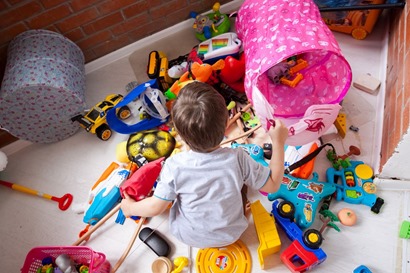
fewer-toysThe other day I observed a small boy – about five to six years old – in the Park, while I was cutting the grass on the estate, playing for hours happily on his own with a toy truck while his adults were sitting on a bench.

With one single toy he was occupied, and seriously engrossed in play, on his own, without getting distracted or fidgety. I assume that, had his adults not wanted to leave, he would have happily been there for another few hours still playing with the self-same toy.

While parents seem to believe, all too often, that the more toys the child has the happier he – or she – will be and the more play and better play, and play experience, they will have. The opposite, however, seems to be the case rather, as also some research appears to strongly suggest as well.

The more toys a child has the less he (and the he stands for both genders here in the continuation of this piece) will be using his imagination during play but using imagination in play is what makes play the work of the child, as Maria Montessori said about play, especially unstructured play.

When we were children we, more often than not, made our own toys, often from scrap, wood or other, some of it waste materials, and from natural wood. We made slingshots – yes, working ones with rubber bands and leather pouch – stick guns, you name it. Sticks and stones often also were the materials for play constructions and we had fun for hours on end making our own entertainment.

On the other hand, even then, children that had (too) many toys – even though we did envy them at times – got bored with one thing very quickly and moved on to the next, never being able to link their play in the way that we did, looking back at it now, with hindsight. What we lacked in store-bought manufactured toys we made up for in imagination in play and in creating our own toys and stuff.

Too many toys in a child's toy box seem to distract play and learning and actually seems to lead to boredom rather than the opposite. In other words, masses of toys are not boredom killers but rather boredom creators because the child gets soon disinterested in the toys. There are just too many which is overwhelming. Fewer toys also make for less clutter in the playroom, bedroom, or any other room where the kids may play.

© 2018

Why children benefit from fewer toys

by Michael Smith (Veshengro)

Children play better when they have fewer toysRenown child educator, Maria Montessori said “Play is the child's work.” With that she meant that children are not just playing when they play, but they are working. Play is an important part of child development, and the types of toys that a child interacts with shapes their understanding of the world around them. Toys are the tools children use to accomplish their work, but it is best for the amount of toys that a child has to be limited.

Through play, children practice cooking, cleaning, going to work, fighting, taking care of the baby. I other words every adult activity they see around them. This kind of playful practice, performed over and over, makes them more confident. Play also helps children cope with problems ranging from big traumas to little upsets and helps them process the new information they receive every day.

Toys help children play. They also help children self-entertain and become independent. Therefore it may seem logical to assume that more toys provide more entertainment and help the child work, but that is, apparently, not the case.

Here are reasons why it is best to keep toys minimal and simple:

Children with less use their imagination more. Without many toys, children use their craft of pretending to imagine the scenario in which they are working. Studies show that Einstein was right when he stated that “the true sign of intelligence is not knowledge but imagination.” They also, might, make their own toys. We certainly did as children.

Children maintain focus. Fewer toys mean fewer distractions teaching the child to focus on the task at hand. Toys that provide excess stimulation have been linked to various attention deficiency related problems.

Children interact more with others. Communications skills are not innate; they are learned. Having less stuff allows for less to get in the way of social interactions. When children pretend together, they communicate together and pretend play is the most beneficial play.

Children learn to respect what they have. A child is more likely to value their work when they know they do not have replacements.

Children are more educated. When you choose toys like books, blocks, art supplies and puzzles, children work on skills like reading, building, drawing, and writing. Such toys can incorporate lessons about the world that the child is immersed in rather than distract them from it.

Children become resourceful. Kids learns to use what they have to get the job done and to make things and toys up as they go along.

Children learn to share and share. As parents, we want our children to put people over possessions and to not be greedy. Interacting with others without objects coming between them allows children to value people over things.

Children learn mastery. As a child focuses on a certain toy, they learn to master it and to be proud of their accomplishments.

Children realize they cannot have everything they want. As it goes, “you can't always get what you want, but you get what you need.” Parents may worry that not giving their child what their peers have may make them unpopular or feel under privileged, but it teaches them that a persons identity is built by character, not possessions.

Children appreciate nature. Children have tons of fun outdoors once they are out there, but it may be hard to get them outside if they have endless entertainment inside the home. Outdoors also the building material for homemade toys can be found.

With less, as in fewer toys and games, children learn to be happy with what they have. What a child needs most is love, and they will learn that love and happiness cannot be bought.

Fewer toys also means less clutter in the child's room or the playroom, or wherever they play with their toys and it is all easier for them (and you) to clear up after.

If there are a few toys too many then put them away and only let your children have a certain number. If and when they get bored with them you can circulate them around and refresh with the others.

When I was a child toys, much like clothes, were very much in short supply growing up relatively poor by most standards, even back then, but it did not matter to us. As far as toys and play was concerned we made many of our own toys or had them made for us, from wood, mostly, and much of that wood “natural”, that is to say it cam from the woods and hedgerows. Other “real” toys were those that we found lost or thrown away by others, whether toy cars, stuffed cuddly toys, or whatever. But most fun, I seem to remember, we had with those toys that we made ourselves and such and with the imaginary play using sticks, for instance.

© 2018

Make toys with and for your kids instead of buying toys

by Michael Smith (Veshengro)

cup&ball_game1-1In order to present your child with a toy they will be excited about, you do not necessarily need to rush to a toy store and spend hours wandering between the shelves and a great deal of money. It is quite easy to make wonderful toys at home from available materials. Even better still if you and your child make those toys together.

Make toys with and for your kids instead of buying toys for them. There are toys, simple and not so simple ones, that you can make together and there are also the ones that you may have to or wish to make – on your own – for them.

Slingshot (catapult): While in some people's mind this might be rather controversial I will still mention it. I have yet to come across a child, especially a boy, who would not relish having one of those beanflippers and, as long as he is taught not to do the wrong things with it, a catapult (slingshot) is a fine toy and gift. It is also one of those that you and the child can make together.

Wooden blocks: Offcuts from carpenter workshops and such can be made, with little work, into a set of wooden (building) blocks for children to play with. No need to spend money buying those things at often great cost. It is also possible from such offcuts to make “Lincoln Logs”, for instance. Such toys will give years of happiness in play and construction as they are ageless – in more than one way – and the play is only limited by imagination.

Wooden cars, etc.: Can also be – with some skills – quite easily made from such wood offcuts and can be very simple or quite elaborate. The skill level here has to be somewhat higher than for wooden blocks and it may also require a little more in the way of tools.

Tip cat: Very simple to make and will give hours and hours of fun (and exercise). Mostly intended for use outdoors. Pakistan this toy and game is called Gulli-Danda (elsewhere it goes under different names but is the same) and there it is played a little like cricket with teams. Very easy to make and lots of fun. Tipcat can also be played alone and is still great fun.

When we were children a carved tipcat was always in the pocket to play the game as, generally, a suitable stick was always to be be found and, as we always carried a pocketknife, cut to size. However, a special one could be made and used instead.

Stick gun: “Oh, what is he on about now?”, I can now hear some readers ask. Which child has not, wandering in a park of wood, picked up a stick that resembled a gun in some way and played with it? Most will, I am sure. This, though, is a deliberately chosen piece of wood (stick) and fashioned to create a stick gun he will keep to play with and may even cherish. They can now be found on sale – yes, you wouldn't believe it – at stores such as Habitat at around $15 each for a “pistol”. Yes, the world has apparently gone stupid.

Bullroarer: The bullroarer, rhombus, or turndun, is an ancient ritual musical instrument and a device historically used for communicating over great distances. It dates to the Paleolithic period, being found in Ukraine dating from 18,000 BC.

In ancient Greece it was a sacred instrument used in the Dionysian Mysteries and is still used in rituals worldwide.

Along with the didgeridoo, it was a prominent musical technology among the Australian Aborigines, used in ceremonies across the continent.

A bullroarer consists of a (weighted) airfoil (a rectangular thin slat of wood about 15 cm (6 in) to 60 cm (24 in) long and about 1.25 cm (0.5 in) to 5 cm (2 in) wide) attached to a long cord. Typically, the wood slat is trimmed down to a sharp edge around the edges, and serrations along the length of the wooden slat may or may not be used, depending on the cultural traditions of the region in question.

The cord is given a slight initial twist, and the roarer is then swung in a large circle in a horizontal plane, or in a smaller circle in a vertical plane. The aerodynamics of the roarer will keep it spinning about its axis even after the initial twist has unwound. The cord winds fully first in one direction and then the other, alternating.

Having said all that it is easy to make, does not have to be that large, and can be a fun toy for a child of (almost) any age. Scrap wood from woodworking projects or from a wood yard, often free at some places, would do nicely.

Tic Tac Toe: This game that, when played on paper often referred to as Naughts and Crosses, can, with a mat or board, made from waste materials, such as bottle caps of two different colors and, once again, cost nothing.

Whirligig: This is a very old and simple children's toy that have been around for the gods only know how long. Probably made with a wooden disc in the very distant past it was later made with a (large) button.

You can make it in ten minutes, but your children will be playing with it for hours. Used to be made from a large button, as said, and could very well be done from, say, a plastic milk jug lid.

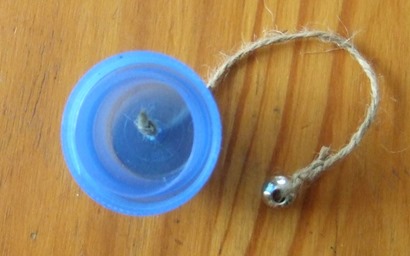
Cup & ball toy: Here is one of those where you can make use of those ubiquitous single use cups, or it can also be made from other stuff, such as the plastic cup lids of liquid detergent bottles (as in the the case of the “model” in the picture).

There are a great many different toys and kinds of toys that you can make for and with your child, often even and especially from waste materials. The only limit is the imagination. You have to still have a child-like imagination often to see the potential of this or that in order to turn it into a toy, or several different things into the one toy. Toy cars and other toys from empty plastic bottles, those from the stronger plastic and not the PET, come to mind, for instance.

The children in many places in Africa, Asia and South America make amazing toys from waste materials and this could also be something done by us and our children.

We all know that all too often an expensive toy is being played with for a short time and then ends up in the toy box never, or rarely, to see again the light of day.

Another thing, and I am sure that someone can come up with a reuse solution, is using the bottle caps of various sizes and colors, with which to make things, as in toys (and also other things). Clip It (http://clip-it.fr/en/) is fine and good but the clips, in my opinion, are rather expensive and I am sure that parents and children, together, might come up with their own solutions.

© 2018

Mokuru – Product Review

Review by Michael Smith (Veshengro)

This new toy is expected to overtake fidget spinners to become the next big craze – a fidget stick.

x-defaultMokuru is a (weighted) wooden stick, about the same size as a cricket bail, and is being touted as the biggest toy to hit Britain since loom bands - because it's easy to play with but fiendishly difficult to master.

Millions of children and adults in Japan and China are already addicted to playing with the Mokuru, but it has only now gone on sale in the UK.

The £9.99 toy allows users to flip and spin on any flat surface - just like the bottle-flipping craze.

This simple hand-held wooden toy was originally designed to test an individual's balance and focus – but now it is testing the dexterity of fast fingered flippers everywhere.

Designer Masakazu Node spent years creating the satisfying beech wood toy, which has rubber stoppers on the end to help it stand up.

The Japanese inventor said: "Beginners can simply tip over the toy, let it flip and catch it with their fingers or flip it to draw a triangle or square.

"Mokuru masters can use five of them at once with one hand.

"Claimed to help focus and concentration, imagination and alleviate stress, Mokuru fits into your pocket."

The UK Distributor for Mokuru is Leicester based company Peterkin, and it will be in sale in Smyths toy stores.

The only thing that worries me is that the rubber pads may come adrift and get lost. It would, therefore, be good to know whether someone has considered spares though, I guess, certain stick-on pads of that size that can be bought elsewhere could be used as replacements should the original ones ever do come off.

This “fidget toy” requires a health warning though not like the so-called fidget spinner because it could cause injury, at least the very cheap ones apparently have to be known to do this, or because it could become stuck on some part of the male anatomy – as apparently has happened to one boy – but because it is seriously addictive.

There are some great plus points to this “toy”, as far as I am concerned, and they are that there are no moving parts, and, aside from the “rubber pads” on either end, no plastic. The Mokuru is entirely, bar for the aforementioned rubber pads, made of beech wood. Being “Made in China” ascertaining as to certification, e.g. FSC, or sustainability of wood is another story. But, then again, the FSC certification is not – generally – worth the paper it is printed on. The Mokuru requires no batteries, but then neither does the fidget spinner thus the no plastic (bar the rubber pads) is the great point.

I started playing with it after receiving the sample and even though I am almost 60 but growing up I did not do – I was told was optional and I don't do optional – and got hooked within minutes. That is why I said it needs a health warning about being addictive, in a positive sense though. Also, having it next to me on the desk I am using it with my left hand which, to all intents and purposes, never had much of a coordination in the hope to change that and I think it is beginning to work.

Website: www.mokuru.com

Buy from Amazon and Smyths Toys

See it in action here : https://www.youtube.com/watch?v=NMPl4XyDBQw

So, what do I think of the Mokuru toy? Short and simple answer: I love it, especially for its simplicity though mastering it will be another story altogether.

© 2017

Gander Kids debut at the 2012 London Toy Fair

by Michael Smith (Veshengro)

London, UK, January 24, 2012 : Precocious new distributor Gander Kids make their debut at the 2012 London Toy Fair with an award winning range of products from the USA.

We have gone from zero to 100mph in the space of one year.

pkgroup_sml As exclusive distributors for the American company P’kolino, the UK-based toy and play furniture distributor have had an amazing first year, attracting stockists including John Lewis, Amazon and Firebox along the way. Product ranges have also featured on BBC1 and the Disney Junior Channel as well as a number of national parenting and interiors magazines.

Riding the wave of the ‘slow toy’ movement, the new kids on the block will be exhibiting the P’kolino range of award winning wooden puzzles and eco-friendly Arts and Crafts on stand G136 at the London Olympia Toy Fair. The range features;

Crayons and pencils which are coloured with food dye and angular shaped so
they won’t roll away;

A stylish wall mounted Safari elephant easel, which releases the valuable floor
space taken up by traditional easels; and

Silly Soft modular toddler seating that’s part furniture, part toy.

Also available will be the award-winning Multi Solution Puzzles, which were quickly snapped up by the London Design Museum and have proved popular with independent stores.

Gander Kids founder Maxine Lewis said: "We have gone from zero to 100mph in the space of one year." 2012 will see us launching a number of new products and the LondonToy Fair will be a great opportunity for us as a small business to reach a wider audience."

Those toys here fall under the Slow Toy category and slow toys have been defined as;
* ethically sourced
* fun to play with
* without batteries
* sold in independent toy shops
* durable
* without thousands of different functions

Products in the range have won two Practical Pre-School Awards, and a Practical Parenting & Pregnancy Magazine Award. The toy range also includes Art supplies, Easels, puzzles, rattles, tops, stackers and nesting birds.

The London Toy Fair takes place at the Grand Hall, Olympia from 24-26 January 2012 and is the UK's only trade event dedicated to toys, games and hobbies.

Gander Kids is a London based importer and wholesale distributor of quality toys and play furniture to the UK market and was listed in the 2011 O2 SMARTA 100 Business Awards. Maxine Lewis founded Gander in 2010 following a successful career in financial services and is the winner of the 2011 Best Start Up at the Mumpreneur UK Awards sponsored by Yell. www.ganderkids.co.uk

P’kolino (pee-ko-lee-no) was founded to improve play at home by two dads with a passion for creating great products. With the help of friends, family and a global network of designers, P’kolino has created play products that are beloved worldwide for their playful style and smart functionality. Their innovative line of toys, play furnishings, art supplies, décor and more offer children of all ages playfully smart solutions to improve play at home. P'kolino was founded in 2004 and is located in Florida, USA. www.pkolino.com

© 2012

In hard economic times, toys of yesteryear strike a chord

by Michael Smith

In these days of recession and economic hard times may people have to count their dollars and even pennies this Christmas season and hence some clued-up parents are trying to avoid buying high-priced techno gadgets for their children.

Instead many are looking back to their own childhood and are buying for their children those ageless classics such as “Lincoln Logs” or other such toys, including the good old Daisy airguns.

Airguns are always a good bet for boys and girls alike and the use of a Daisy under supervision – at least for starters – will teach them to be responsible shooters and anyone, so I have found, who was taught how to shoot from an early age is very unlikely to ever commit a crime with a gun. The same is true for anyone who has used a knife from earliest childhood, especially if he or she comes from a true knife culture.

Having said this, a good pocketknife also is a time-honored gift and I sure remember how proud I was of the first folding knife that I was ever given, even though this was a used one. That made no difference to the appreciation of the present and I still have that knife to this very day.

Without an apparent definite “must-have” toy fad this season and with parents facing a deteriorating economy, tried-and-true toys are being embraced by parents and toy makers alike - what one analyst calls a "back to the toy box" approach.

I think that this is a step that has not come before time. It was about time we all woke up to the fact that the gadget toys that the advertising media tell us and especially our children that they MUST have are nothing that will last. It is just a fad and that's it. Period.

I remember the few toys – real toys – that I had but one thing there was that I loves, aside from the old wooden tractor and caravan it pulled (both of which were held together by more glue than anything else, I think) and that was the small Mecano set that I had and with which I build so many things.

Without a defnite, as I have said, "must-have" toy fad this holiday season, and with parents facing a deteriorating economy, tried-and-true toys are being embraced by parents and toy makers alike - what one analyst calls a "back to the toy box" approach.

"'Retro' or 'nostalgia' toys can be viewed as the 'comfort food' of the toy industry, and I do think folks naturally gravitate to what made them happy when they were young or what is familiar to them," said Anita Frazier, a toy analyst at NPD Group, a market research firm.

Ken Moe, general manager of Backtobasicstoys.com, a Web site owned by Scholastic Corp. that offers classic toys like "Rock 'Em, Sock 'Em Robots," Slinky and Colorforms, said sales so far this season indicate a rising interest in old favorites.

Though most sales will occur over the next few weeks, Moe said Junior TinkerToys, Lincoln Logs and toy instruments have been among the big sellers in the past few months.

Parents are not the only ones looking again at classic toys. Toy makers also are turning to the old standbys as they face not only weakening toy sales but also steep prices for commodities like resin used to make many toys and tough competition from electronic gadgets.

Classic toys could fill the gap left by a lack of a "must have" toy, as toy makers stick to past hits and avoid taking risks, what Needham & Co. analyst Sean McGowan calls going "back to the toy box."

"Partly, its because they know 'this thing works,' " he says.

On the other hand it is toys that parents played with as children and they know that they will have appeal once presented to the child in the right manner.

Wooden building blocks, and their plastic counterparts such as Lego, have a timeless appeal and so have Meccano metal construction sets. Mind you, Meccano has grown up a lot since I was a child and now it has construction sets from age 2+ upwards.

Hasbro Inc. has found success this season by revitalizing names such as the 40-year-old Nerf brand and Transformers, which first hit the U.S. in the early '80s and are selling well again after last year's "Transformers" movie.

The company also debuted revamped versions of classic board games like Clue, Operation and Monopoly this year.

"One of our core tenets is to reinvent and reimagine a lot of our core brands," says John Frascotti, Hasbro's global chief of marketing, who is 47. "There's an emotional resonance that comes from the quality of the experience people in my or our generation had with the toys, and recognition that the same experience can now shared with entire family and children."

Hasbro plans to continue to update old brands and has a G.I. Joe revival - including toys related to a new live-action movie - set for 2009.

Jakks Pacific Inc. has brought back several classic brands this year, including a 25th anniversary Cabbage Patch Kid doll that is the replica of the original version and a new Smurfs plush toy and DVD.

© M Smith (Veshengro), December 2008
<>