by Michael Smith (Veshengro)
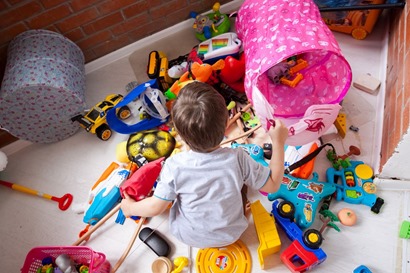 Renown child educator, Maria Montessori said “Play is the child's work.” With that she meant that children are not just playing when they play, but they are working. Play is an important part of child development, and the types of toys that a child interacts with shapes their understanding of the world around them. Toys are the tools children use to accomplish their work, but it is best for the amount of toys that a child has to be limited.
Through play, children practice cooking, cleaning, going to work, fighting, taking care of the baby. I other words every adult activity they see around them. This kind of playful practice, performed over and over, makes them more confident. Play also helps children cope with problems ranging from big traumas to little upsets and helps them process the new information they receive every day.
Toys help children play. They also help children self-entertain and become independent. Therefore it may seem logical to assume that more toys provide more entertainment and help the child work, but that is, apparently, not the case.
Here are reasons why it is best to keep toys minimal and simple:
Children with less use their imagination more. Without many toys, children use their craft of pretending to imagine the scenario in which they are working. Studies show that Einstein was right when he stated that “the true sign of intelligence is not knowledge but imagination.” They also, might, make their own toys. We certainly did as children.
Children maintain focus. Fewer toys mean fewer distractions teaching the child to focus on the task at hand. Toys that provide excess stimulation have been linked to various attention deficiency related problems.
Children interact more with others. Communications skills are not innate; they are learned. Having less stuff allows for less to get in the way of social interactions. When children pretend together, they communicate together and pretend play is the most beneficial play.
Children learn to respect what they have. A child is more likely to value their work when they know they do not have replacements.
Children are more educated. When you choose toys like books, blocks, art supplies and puzzles, children work on skills like reading, building, drawing, and writing. Such toys can incorporate lessons about the world that the child is immersed in rather than distract them from it.
Children become resourceful. Kids learns to use what they have to get the job done and to make things and toys up as they go along.
Children learn to share and share. As parents, we want our children to put people over possessions and to not be greedy. Interacting with others without objects coming between them allows children to value people over things.
Children learn mastery. As a child focuses on a certain toy, they learn to master it and to be proud of their accomplishments.
Children realize they cannot have everything they want. As it goes, “you can't always get what you want, but you get what you need.” Parents may worry that not giving their child what their peers have may make them unpopular or feel under privileged, but it teaches them that a persons identity is built by character, not possessions.
Children appreciate nature. Children have tons of fun outdoors once they are out there, but it may be hard to get them outside if they have endless entertainment inside the home. Outdoors also the building material for homemade toys can be found.
With less, as in fewer toys and games, children learn to be happy with what they have. What a child needs most is love, and they will learn that love and happiness cannot be bought.
Fewer toys also means less clutter in the child's room or the playroom, or wherever they play with their toys and it is all easier for them (and you) to clear up after.
If there are a few toys too many then put them away and only let your children have a certain number. If and when they get bored with them you can circulate them around and refresh with the others.
When I was a child toys, much like clothes, were very much in short supply growing up relatively poor by most standards, even back then, but it did not matter to us. As far as toys and play was concerned we made many of our own toys or had them made for us, from wood, mostly, and much of that wood “natural”, that is to say it cam from the woods and hedgerows. Other “real” toys were those that we found lost or thrown away by others, whether toy cars, stuffed cuddly toys, or whatever. But most fun, I seem to remember, we had with those toys that we made ourselves and such and with the imaginary play using sticks, for instance.
© 2018