Showing posts with label transportation. Show all posts

200 years on the bicycle is more needed than ever

by Michael Smith (Veshengro)

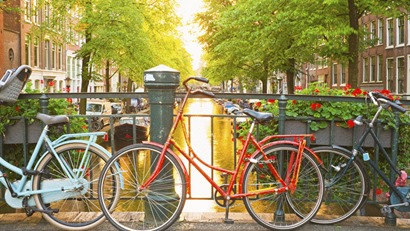
bicycles_Amsterdam1Does it have to be a brand-spanking-new bicycle? No... The old one that you may still have standing around in your shed given a little TLC or some other secondhand one would be much better and ideally without the fancy gearing of today.

On June 12, 1817 the bicycle saw the light of the world, in the form of the Laufmaschine (Draisine), by making its maiden voyage under the captainship of its inventor, Karl Drais. It has come a long way since and today is more needed than ever.

It was born out of the need for a replacement – albeit temporary – of the horse as very few horses were left in Germany at that time due to a climate event which brought about “the year without a summer”.

Today not just a climate event but climate change makes the bicycle even more important, and in this case as a replacement for the modern horse, the motorcar.

While the climate event of 1817, “the year without summer”, went away, the climate and weather returned to normal. Horses came back into use as they could be fed again and there was food for people again too. The bicycle, therefore, descended into obscurity for some time. With climate change this is, more than likely, not going ever be a return to normal and we will have to look to the bicycle as a low-carbon alternative for travel.

Today's bicycles are about as far removed from the original concept of the running machine, the Draisine, as is the ox cart from the modern car, with the exception of the balancing bikes for children nowadays which are almost a Draisine, having no pedals.

Bicycles do not, that is true, do not achieve the speed of a car and neither can they travel the same distance in a day as can a motor vehicle. On the other hand though most cars are not used daily for long distances but mostly for short trips (with the exception of those that may use them indeed for long commutes) for which a bicycle would not only be more efficient and cheaper but also faster.

By the time you have the car ready to go on the road, especially if it is kept in a garage, have buckled up and all that, you would already be half way there with a bicycle. Then at your destination, say the high street, you have to find a place to park the car, and more than likely that will take some time and may even cost you money to boot. The bike, on the other hand, you can just “chain” to the nearest lamppost or such and you can do what you want and need to do.

The bicycle is also one of the most energy efficient vehicles for public transportation. Instead of burning fuel and money and making you fat it burns fat and keeps you fit. Though as a cyclist I do realize that in many countries the infrastructure is not there for cycling, at least for safe cycling, and drivers of motor vehicles, from cars to trucks, see the cyclists as someone, more often than not, who should not be on the road with them. That needs to change.

While we are seeing a year by year increase in bicycle use in Britain, including for commuting, no real serious change will come about until the political will is there to change the status of cycling infrastructure by creating safe paths for cyclists (and pedestrians) alongside every, or at least almost every, road, that are separate from the road itself. What can be done in other European countries can be done in the UK and no one can tell me different.

© 2017

Happy Birthday to the bicycle; 200 yeas old

by Michael Smith (Veshengro)

Laufmaschine.jpgThe old girl has reached the ripe old age of 200 and is looking as good as ever. Actually, let's face it, over the years the old girl has changed and improved, and thus looking even better. Though, when we see today's so-called balancing bikes for young children, the Draisine is back, even in wood, with some improvements.

June 12, 2017 marked the 200th anniversary of the date on which Karl Drais (although he had an aristocratic title he renounced the “von” and the title Freiherr, that is to say, Baron later) took his new invention out for a ride and the modern bicycle was born.

On that day Drais rode his two-wheeled invention, the first Velocipede, five miles from the centre of Mannheim and back in less than an hour, at an average speed of 9.3 mph. It was basically a bicycle without pedals that one pushed along the ground but it was still much faster than walking. He called it a Laufmaschine (running machine in German) but the press named it a Draisine after the inventor.

The reason for the invention was not just for the fun of it. It was in response to an environmental crisis. Two years earlier in April 1815, Mount Tambora exploded and changed the world. This put so much ash and sulphur dioxide into the atmosphere that it turned 1816 into "the year without summer", causing world-wide famine. Most of the horses were slaughtered because there was nothing to feed them or their owners, so they became dinner.

But Drais needed a means of inspecting his tree stands that did not rely on horses. Drais discovered that, by placing wheels in a line on a frame, one could balance through dynamic steering. Thus a narrow vehicle capable of maneuvering on his land and the Laufmaschine became the immediate precursor of the bicycle.

As the bicycle became more popular, people found riding in the streets was uncomfortable due to the deep ruts left behind in surfaces of the roads by coach and cart wheels. This lead to cyclists sharing the sidewalks with pedestrians, which, in turn, led to the first conflicts. The penny-farthing, a bicycle with a huge direct-drive front wheel and tiny rear wheel accelerated fears for the safety of riders and passers-by alike and bicycles bans became common.

The invention of the "rover safety cycle" put the rider's feet back within reach of the ground, and helped this mode of transportation to return to the streets of cities around the world, introducing the rear chain drive in the process. Further important breakthroughs included the invention of ball bearings, the pneumatic tire, and the freewheel. Though some have, today, gone back to the fixed back wheel and please do not ask me why.

Today the bicycle is the most energy efficient and pollution free means of transportation on the planet, aside from walking. It is seen by many as a major player in the solution to climate change given that they are emission free. They could also be the answer to urban congestion as they take up so much less space than a car, and especially to urban pollution.

As in Drais' day, bikes are controversial. Motorists hate them when they are sharing the road and hate them even more when bike lanes are built and take away space for driving and storing cars. As in the days of Drais road conditions are often so awful and dangerous that cyclists sometimes take to riding on the sidewalk, alienating and endangering pedestrians. Though, it has to be said, neither of that is necessary if the cyclist remembers that he or she, theoretically, and often legally, is not meant to be there and that it is the domain of the pedestrians.

The way some cyclists ride and their attitude – and I am a cyclist myself – it is no wonder that people are often not very fond of them, and it seems to be getting worse.

I cannot understand why one has to race along the sidewalk – where one is not supposed to be in the first place though, I admit, I ride there myself but at slow speed (I am in no hurry ever) – or park paths, and such, where pedestrians have priority, weave in and out of motor traffic, undertake cars and trucks, etc. What's the hurry, what's the rush?

But two hundred years ago the skies cleared and a normal climate returned, and soon people were back to being pulled around by horses and the bicycle almost was forgotten. But in our the environment and climate, more than likely, is not going to return to normal, and our cities cannot hold any more cars.

As we enter an era when new pressures encourage everyone to swap their car for alternative transportation, it makes sense to celebrate the birthday the bicycle. So, once again, Happy Birthday old Girl! Let's ride!

© 2017

Surprise: The Wall Street Journal doesn't understand that bikes are transportation

Public

Rachel Berman of the Wall Street Journal appears to be surprised that people actually ride bikes for other than mad racing in spandex. She speaks to one Austin rider who says:

“I ride my bike purely to get from one place to another—not, ‘I’m going to take this out for exercise for like 20 miles,’ ” says Cassie Rae DuBay, a 28-year-old law librarian in Dallas. She says she aims to “add a little exercise to my day by riding 2 miles, as opposed to driving.”

She goes on to compare the growth of running as a sport to that of cycling, and finds that cycling is lagging running, showing a graph that compares "people in the US ages 6 and up who bicycled on pavement or went running at least once during the calendar year." She then compares running events to cycling, and speaks to a bike dealer:

“When you look at a marathon or half-marathon, you will see people walking, and they’re not ashamed,” says Fred Clements, executive director of the National Bicycle Dealers Association. “They’re not made to feel embarrassed. And that’s something that you won’t really see at a bicycling event. I don’t think we’re as far along as running is in making events that appeal to everyone.”

I wonder what planet these people are on. There's been an explosion in the use of bikes as transportation in cities across North America, with a 61.6 percent increase in bicycle commuting since 2000. It's growing at about 10 percent per year.

Read more here.

Personal transportation of the future: The Bicycle

by Michael Smith (Veshengro)

bicycle12.1_webWell, this is a little a case of back to the future, I know but despite all the hype the electric vehicle of whatever kind is not going to cut it for personal transportation for the masses. Keeping a horse and using horse and cart also is not an option for everyone, especially not those that live in towns and cities, that's for sure.

We are being told that battery technology is advancing on an almost daily basis but what no one who advocates the car in the form of electric vehicles (EVs) is the fact, and they don't even seem to consider it, that the manufacture of those and of those batteries requires energy and lots of it. It just will not work, period!

But still we are being sold the story that the electric vehicles, the battery car, is the future for personal transportation. It is not; the bicycle is, as it once was. I am sorry to shatter many illusions but the truth must be told.

And, the truth is that battery technology is not anywhere near what would be required to have all electric personal transportation and even less so freight transport.

The biggest problem remains the cost of the batteries and their components, both in monetary terms and in environmental terms and above that the fact that any of those batteries have a limited lifespan. They only have so many recharge cycles before they have to be replaced.

The future of all transportation, personal and freight, is going to be, once again, human and animal powered and not internal combustion engine or electric. As I said, I am sorry to shatter many illusions but we have to face reality and when the post-industrial area arrives, which it will, then those vehicles and their batteries will either no longer be produced due to lack of facilities or become so expensive as to be out of the reach of most mere mortals.

We have to leave the dream world that has been conjured up for us and wake up and face reality and reality is that things will, in the more likely not so distant future very different to the way we have known things to be. So, we better get used to the idea and start to prepare ourselves for this mentally.

The biggest problem is not that people in general are not prepared to face this reality but that industry and the powers-that-be are trying to blind everyone still with science and with smoke and mirrors. Everyone is in denial and believes government, industry and science will come up with a solution so we can continue to drive our cars, even if they are electric, that way we have done for the last half a century or so. Reality check: It is not going to work!

The reality is that, in the not so distant future, not only will oil be history, we will also simply not be able to continue to use it unless we no longer want a livable Planet and thus other ways must be found and employed and those other ways that those that were there before the world went mad, such as the bicycle, our feet, and also animal power.

The means of personal transportation for ordinary mortals with no way of keeping a horse will only be one option, aside from walking, and that is the iron steed, the humble bicycle.

Oh, and one little additional thought: It is not going to be the carbon-fiber road bike that we are talking about here but more the old-style single speed steel bicycle, produced in small workshops rather than in large factories in China.

But, for starters, there is no need to buy a new bicycle for transitioning to the “new” form of personal transportation. An old one, given some TLC will do just as well, if not even better, for you, your wallet and the Planet.

© 2015

Trying to travel in a city? Biking is the best (or at least most energy-efficient) mode

trying-to-travel-in-a-city-then-bikes-most-efficientWe've covered a number of the crazy contests in which a bike, a car, a public transit rider see who can race between two urban points fastest.

Usually, the bicycle wins.

Bike are an extremely energy-efficient form of transportation. As the graph above shows, riding a bicycle is more than twice as efficient than walking. This is in terms of megajoules of energy expended per kilometer traveled.

The bike comes ahead of every other common transportation choice, including public transport and personal cars.

Some people object to the comparison of biking (and walking) to things like a taxi or a private car because human-powered transport does require calories to make it go. And those calories - i.e. food - may be less efficient to create than say, diesel fuel. Which means that the caloric cost of bicycle commuting for your daily transport may actually cost you more than the gas for your car.

In addition, to get these figures, the different modes that can carry more passengers were weighted with occupancy estimates - for example, in the case of the light rail occupancy was estimated at 33%, as was bus rider occupancy.

And furthermore, who would use a 727 to get to work? Very few of us.

In the paper from which the graph was produced, written by David Banister of London's University College, it's argued that transport in general needs to reduce its dependency on non-renewable fuel choices for the environment, economic competitiveness and energy security.

But actually the arguments for using the bicycle, at least in short-distance traveling in urban environments, are much more personal.

Read more: http://www.treehugger.com/bikes/trying-travel-city-bikes-are-most-efficient-way-move.html

Rethinking personal transportation

by Michael Smith (Veshengro)

draisineBio-fuel nor electric vehicles can help us continue the way things are today. The car, whether gasoline, diesel, or even electric, does not have a future.

Britain would be, in theory, well and ideally placed as regards to the production and use of bio-diesel with public transport, that is to say buses, and delivery and public service vehicles considering the number of Fish and Chips Shops throughout the country that have masses of waste cooking oil to dispose off on a daily basis which could be easily converted.

One can but wonder how many gallons or even tons per day are actually discarded around the country.

However, bio-fuel, be this kind of diesel or ethanol cannot sustain the amount of personal motoring in Britain and in the rest of the world and neither can electric vehicles.

It will, therefore, be necessary that we reconsidered our ways and that we ALL woke up to this fact including and especially those greenies that keep advocating bio-fuels and electric vehicles instead of a real change; a change from the car, of whatever kind, to a real sustainable alternative.

Personal motoring is very much yesterday and has had its day. Like one of the people said in the movie documentary “The Power of Community”, the car was but a blip in the history of mankind and we need to go back to the ways and methods we used to use before motoring became cheap and was regarded as a right for all, a human right almost.

We still have one of the best means of personal transportation that does not rely on either an engine or animal power – aside from walking but it is equally human-powered – and that is the humble bicycle, it burns calories instead of fossil fuel and keeps you fit.

The electric car has be touted, even by many greenies, as the answer to the internal combustion engine motorcar but it is doubtful as to whether, as far as purchase cost, it will ever be truly affordable by the masses. The production of such high-tech vehicles and their batteries also use up valuable resources, much better employed elsewhere, and that entirely aside from the pollution the mining for those rare earths and metals causes.

The mining for and production of gold in many places is almost as destructive as the Canadian tar sands and the same is true as regards to the extraction of rare earths and other components required to make electric cars. This make electric vehicles as unsustainable as ordinary motorcars, maybe even more so.

The humble bicycle is a proven technology, uses steel or aluminium for frames and wheel rims, etc., the metal for which can come from recycled sources and can be recycled again at the end of life almost ad infinitum.

A cared for bicycle, however, has a fairly long lifespan and some bikes of 60 or more years ago are still with us today and still perform as well as they day they were made.

We must stop and think and reconsider our options for personal transportation which, admittedly, are not great without the personal motorcar and leave but a few, most of them powered by self.

Looking at the electric car, aside from not being carbon neutral at all, it will also be costly. Costly to buy in the first place and costly to run as we all know that the batteries have a limited recharge cycle and thus lifespan and will need replacing every couple of years and that to the tune of about two-thirds of the price of a new car.

When industry, governments and environmentalists sing the praises of electric vehicles in how they will reduce CO2 emissions the CO2 and other pollutants emitted in the production of the cars and their batteries almost never enter the equation.

Industry is interested in the continuation of motoring and if people can be made to believe that electric vehicles will make for a clean Planet they are prepared to perpetuate this myth.

Governments are not prepared to tell the people the truth for fear of a backlash as people have come to believe that owning and driving a car or even three is their G-d-given and even human right.

And many environmentalists themselves – the very same that keep jetting off to all those many UN and other conferences in far flung countries – also want to keep the status quo of personal motoring and thus are on the bandwagon unquestioning.

However, the fact of the matter is that electric cars are as bad for the environment as are their ICE counterparts only that the emissions and environmental destruction happens elsewhere.

To say that the motorcar has served us well one definitely can not. The horse and the bicycle on the other hand have and will do so again.

Regardless of what the powers-that-be, the oil- and the car industry are trying to tell us and our governments cheap oil is coming to an end – in fact, it has done so already – and motoring for everyone is about to rung into a very solid rock face.

And this crash is going to be very much a shock to the system of people who believe that the current way of life of motoring will go on for ever.

The ever escalating – and doesn't it just – cost of fuel in Britain has already led to an increase in cycling including and especially for commuting but it is still nowhere close to where it is in other European countries and still miles away from the Netherlands and Denmark.

In the movie documentary “The Power of Community”, which is about Cuba's enforced peak oil after the “collapse” of the Soviet Union and how this Caribbean island dealt with the aftermath, one scientist expressed the truth plainly when he said that the motorcar has just been a blip in the history of mankind and that we have to return to other ways of doing things. And that indeed we must, and not only because we are running out of (cheap) oil, but also and especially for the sake of the Planet (and not just in regards to climate change).

We have to find an alternative to motoring as far as personal transportation (for the masses) is concerned and neither the electric car not ICE cars on bio-fuel will cut it here. But there is no need to reinvent the wheel. That alternative already exists. It is cheap and reliable, can be maintained with a little skill and tools by the user, and it is none other than the humble bicycle and the simpler the better.

Believing that we can carry on motoring ad infinitum is but an illusion and the sooner we woke up from this dream the better.

The future of personal transportation (for the masses) is human-powered and the very same that our grandparents and their parents used and not electric or bio-fuel and has been a reliable technology ever since Forestry Superintendent Karl Dreis invented it and Pierre Michaux improved upon it by adding pedals (and then the chain drive) and the rest, as they say, is history.

While the horse (and carriage) is also an alternative, and the Hanson Cab may make a comeback in the cities, it is not a practical alternative for everyone and, in addition, the bicycle is much cheaper to buy and does not require feeding, watering, vets bills, etc.

© 2013