Showing posts with label pollution. Show all posts

Zero waste myths: should we really be avoiding plastic?

by Michael Smith (Veshengro)

Zero waste myths_ should we really be avoidingnbspplasticFirst of all it also must be said that “zero waste” is a myth itself. There is no such thing as “zero waste”. It will never be possible. Having said that, however, does not mean that we should not reduce waste, especially in way of packaging, and waste that occurs also through planned obsolescence.

Images of ocean plastic pollution are causing so much revulsion that many people are switching to some supposedly more “environmentally friendly” materials to try to reduce their impact. But does this actually work? How much greener are the alternatives?

Also, there is plastic and then there is plastic. Single-use plastic, in my opinion, is a bad idea. We should, with the exception of may be a few things, avoid any kind of single use altogether. Other plastics, for plastic products intended to last for a long time, are a different story and here the material, quite often, is the appropriate one, unless we return to (more) natural materials.

Plastic vs Paper: It is easy to see how paper bags are seen as and appear to be more environmentally-friendly than plastic ones. They are made from trees, which grow in nature, and can biodegrade, in fact compost, when they are finished with.

Research, however, consistently finds that paper bags have a far higher carbon footprint than plastic ones, because the process of making them uses so much energy, and not just energy but also lots of water. Trees may be in harmony with nature, but the process for mashing them up into paper is not.

True, paper bags can decompose, but it is not exactly zero waste to use so much energy producing something that is not designed to last. And if you are careful to reuse and recycle a plastic bag, it should be possible to prevent it ending up as litter or in the ocean, whereas every single paper bag will have made a hefty contribution to global warming, regardless of where it ends up. The best option, of course, is to avoid the problem of single-use waste altogether by using reusable bags.

If you are a business and you want to offer something to customers who have forgotten their own bags, consider doing as Arjuna Wholefoods in Cambridge does, which is to invite people to drop off their old plastic bags to be reused. Alternatively, bags made from recycled materials is the next best thing. Just please don't hand out new single-use bags for free, as this does not reflect how much it costs the Earth to produce them.

As for the idea that paper is “more recyclable” than plastic, this has now been repeated so many times, that it has become almost fact. While it is true that paper can be recycled, the quality of it degrades in the process. Plastic can also be recycled, although some types of plastic are easier to recycle than others, and packaging that mixes plastic with other materials can be more tricky to recycle (single-use coffee cups are the most well-known example of this), but also here, in the main, the quality deteriorates and to make good new plastic from recyclables a great deal of virgin polymer needs to be added to the mix. So, there is no such thing – generally – as 100% recycled plastic, with a few exceptions, maybe. .

So, when it comes to recyclability, there is not that much to be gained from choosing paper-based products over plastic ones, and anyway, it is actually a big mistake to be overly focused on how recyclable something is, when most of the impacts of the stuff we consume is in the process of producing it, rather than what happens to it at the end of its life. This is true regardless of the material, but in terms of paper, we need to factor in how much carbon it takes to produce it.

The best way to lower impacts from packaging waste is to reduce the amount of packaging that we buy, and where possible, buy products packaged in recycled materials. Though it has also be said that often we, as consumers, do have little choice as to the amount of packaging of any kind, be this paper, cardboard (often laminated with foil), or plastic except by voting with our wallet and not buying over-packaged products. This can be a difficult undertaking, however,

Plastic vs Metal: Stainless steel tins and bottles are something of a zero waste style statement. There is no doubt that they look good, but the process of producing metals like stainless steel and aluminium releases scary amounts of carbon into the atmosphere. This means that reusables made from metal will need to avoid a lot of waste before they save more resources than it took to produce them.

The choice is really up to each of us: Option one would be stainless steel (or other) products, which are very high impact to produce, but highly durable, or option two would be plastic bottles and containers, which are more environmentally-friendly to produce, but tend to wear out somewhat more quickly, so that you may end up using more of them in the end. This is essentially a judgment call, based on your personal routines and how much waste you expect to avoid by using your reusable bottle and containers.

Single-use cups vs reusable cups: Several studies have looked into how many times a reusable cup needs to be used before it saves more resources than it took to produce. As they are carried out by academics, there is no simple answer – it depends on which type of reusable cup you are using, which type of single-use cup you are trying avoid, and which environmental impact you are considering – but it seems to range from 5-16 times. So, if you would otherwise expect to use at least 17 single-use cups, consider investing in a reusable one. For top marks, see if you can pick one up in a charity shop or other kind of secondhand store.

Glass jars vs plastic packaging: The jury certainly appears to be out on this one still. Glass tends to lose points compared to plastic because of the high carbon emissions involved in manufacturing and transporting it (think of how much more glass weighs) but can redeem itself by being more efficient to recycle than certain types of plastic. Glass jars, for instance, if we want to be thrifty in the way our grandparents and their parents were, also have a great reuse potential for us, whether as storage jars for all kinds of things or as drinking vessels, etc. And the reuse thought should always come well before any thought of recyclability.

If you can and will reuse or refill jars, the that is your best option. Otherwise, there is, apparently, no clear justification for always choosing glass jars over plastic.

Plastic bags vs cotton or other textile bags: Its a bit of a mystery why cotton has gained a reputation for being an environmentally friendly material. It takes 20,000 liters of water to make 1kg of cotton, and much of it is sourced from countries where water is extremely scarce. Worldwide, cotton production causes pollution and biodiversity loss. But there are alternatives to cotton and cotton bags, such as hessian, aka burlap, canvas, and others, including, though it is oil-based to some extent, woven and non-woven polyester bags.

When it comes to plastic there are – if I may put it this way – good plastics and bad plastics and I am not putting so-called bio-degradable into the category of good necessarily either. Also, as far as plastic water bottles, the reusable kind I mean here, are concerned not all leach chemicals. It all depends on the plastic. The Dutch designed (and produced?) “de Dopper”, as an example, does not, and is also of a rather ingenious design.

The biggest problem is plastic packaging and the over-packaging of products, often products that do not need to be packaged in such a way at all. That is where the changes have to happen and we must force industry to make the change.

© 2018

Plastic, plastic use, and plastic pollution

by Michael Smith (Veshengro)

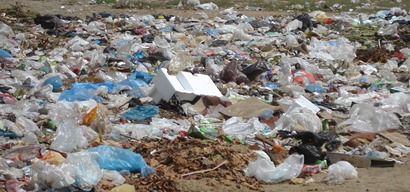
plastic_waste1Plastic is pervasive nowadays and there is almost no place where you can look and plastic will not be staring you in the face in some for or the other. The computer keyboard, the case of the laptop, of the cellphone; all plastic, and that just for starters.

Since the real commercial production of plastic begun in the 1950s the world has produced more than eight billion tons of plastic which is about as much in weight as a billion elephants. Now let that sink in for a moment. That's an awful lot of the stuff. And that which has not been recycled or burned is in landfills and much of it, in fact, is floating around in the sea, causing problems to marine life, and in the end to us, who eat some of that marine life.

In 1950 the world produced around two million tons of plastic per year, while 65 years later, in 2015, it was 380 million tons in that year alone. Half of the so far produced plastic has been has been made in the last 13 years. Until 2015 only nine percent of this plastic has been recycled while twelve percent has been burned. The rest, alas, is still with us, predominately in landfills.

In some cases, let's face it, there, probably, is no real substitute for plastic and there is plastic and then there is plastic, as I keep saying. Instead of making it from petroleum there are other ways plastic materials could and can be made but even if the plastic is from a plant-based source it remains plastic and compostability is in most cases nothing more than greenwash.

On the other hand plastic can be extremely durable – aside from being light – and I say the can be because some of it is not made to be durable and that is due again to industry's design of needing things to break in order to sell more of the things to us.

It is the single use plastic that really is the greatest of problems, whether it comes in the form of the all present and all pervasive PET-bottle or the other plastic packaging such as fruit punnets, salad bowls, etc. ad infinitum.

What bugs me is that many of those things can be given an extended life if we but put our thinking cap on when we encounter them. Only recently I rescued the bases of some Sainsbury's sandwich trays (the kind you but ready-made sandwiches in for parties) which will become the trays for plant pots when raising seedlings.

I have found that the plastic that is used for those salad bowls with ready-made made salads from supermarkets, for instance, is a fairly flexible and also strong kind in that there is nothing preventing us from reusing those small and not so small bowls for a variety of uses in the kitchen, at table and otherwise in the home (and garden).

Those single-use plastic beer beakers (1pt), often made of a strong and flexible plastic, that are used at festivals and such like, instead of glasses, and then, obviously, being tossed thoughtless into the countryside, make for great propagators put upside down over a small plant pot for raising seedlings.

While, obviously, it would be good if we could get rid off all single-use plastic I, personally, doubt that that is going to happen soon and thus we ensure that we dispose of the stuff responsibly (for recycling ideally though we can but wonder how much recycling actually truly happens) or, maybe better still, must find a way of making use of those things by reusing, repurposing and upcycling them in other ways, stretching their lifespans for as far as possible.

In the case of plastic drinks bottles, be it water or other, I would advocate the introduction of a deposit, as it is done in some countries already, and the use of reverse vending machines where such bottles can be returned to and the deposit given to whoever returns them.

Bottled water is a scam anyway as most of the water is not “spring water” or “mineral water” but simply ordinary, often tap, water filled into bottles and sold at a huge profit. In most places in Europe, bar a couple of countries, the local tap water is better than any bottled water. The US still has a problem despite considering itself to be such a great advanced nation. In some places the municipal water supply there is as bad, sometimes even worse, than that in many a city in the Third World.

The problem nowadays though is also that other drinks and products that used to be packaged in glass come now in plastic bottles and jars, such as wine, spirits, peanut butter, etc. The claim is that this is being done to reduce the impact on the environment as glass is heavier than plastic and thus transportation requires more fuel. Come on, let's be honest dearest people. It is cheaper and the environmental claim is but hogwash or should we better call it greenwash. Fact is that plastic bottles and jars are cheaper than glass and that they are cheaper to transport than glass. Hence the move to more and more plastic.

As consumer we are facing a dilemma when it comes to the above, that is to say drinks and produce in plastic jars, let's not even talk about fruit and vegetables packages in unnecessary plastic (wasn't sure whether to laugh or cry the other day when I saw at ALDI apples packaged in the kind of tube in which tennis balls are sold) as in the great majority of cases we do not have an alternative. It was Sainsbury's a couple of years ago that started the trend of peanut butter in plastic jars and now almost every producer of peanut butter has followed suit.

Wines and spirits, at least those at the lower end of the price scale, now also come in plastic, rather than glass, in our supermarkets and the letters WTF very much come to mind with regards to that.

So, instead of working to reduce the problem industry and supermarkets actually perpetuate the problem by introducing more and more plastic packaging. Get rid off the plastic carrier bag, to some degree, and they just get some more plastic in that you can't avoid, more or less. Sometimes I do wonder whether they actually want to help or not, and it looks more like that they do not want to help at all. Plastic is cheaper to use than glass and much cheaper to ship as it is lighter and there are no breakages. It's all down to money yet again. But where does that leave us, as consumer, who are left without an alternative and choice often?

© 2017

Consumption can cause all manner of ills

by Michael Smith (Veshengro)

Consumption can cause child labor, environmental pollution and social inequality and many more ills to boot.

The way consumption is running rampant and we are being encouraged to consume more and more is a recipe for disaster on many levels, not at least on the environmental one.

The governments keep telling us all, however, that we must consumer more in order to grow the economy and to raise living standard. I do not know on which planet they are living but, apparently, it cannot be this one or they just simply do not live in the real world at all.

Consumption and the perpetual growth economy are something that just does not for a healthy Planet and a healthy population make. There is exploitation of the Planet and exploitation to workers that all make those goods cheap and those goods, alas, are mainly also made in such a way as to break down – about a day or so after the warranty has expired – forcing us to buy new, as they, in the main, also are designed and made in such a way that repair is not an option. Perpetual growth on a finite Planet such as the Earth is is not possible but it is the only way the powers-that-be seem to be able to think and the only way capital can make more and more profit.

The only way we can change things, and we can do it, it to refuse to be part of it, or, at least, reduce the part we have in it by reducing our consumption understanding that so much that we do buy believing that we need this or that are but wants and not needs. No one needs a new cellphone or a new computer or whatever simply because there is a new model out. And the same goes for fashion and everything else. You may need clothes but you do not need fashion.

But that route is not one that people wish to travel as such a refusal to partake in consumerism is seen by many of our peers as a sign of not being able to afford things rather than of a voluntary step of trying to tread a little lighter on the Planet and help conserve its resources. Neither is it a popular step with the governments who are only interested in GDP and thus in growing the economy and, as did the UK government a while back, liken those that refuse to partake in this madness to “domestic terrorists”.

But fact is that we have to get out of this hamster wheel and back to normality of only buying what we really need and maybe so luxuries only every now and then and that means that as long as something works it does not get replaced. And if it can be repaired and that is cost-effective then it is repaired rather than a new one purchased.

We all have to change our attitude and approach to things and get off the bandwagon of consumption for the sake of it if we want to continue to live on this Planet and have it support us.

If we continue to use up the resources of the Earth, both non-renewable ones, such as oil, gas, coal, and minerals, as well as the renewable ones, and get a handle on the pollution of all kinds then there is, really, no future for the human race.

It is time to get out of the rut and do things differently and that may mean not buying new and also reusing what we have, including items of waste that we generate and that have a reuse and upcycling potential, and to make things ourselves (again).

© 2015

Report: Plastic pollution in the ocean is reaching crisis levels

Plastic has infiltrated the ocean’s ecosystem, from plankton to whales.

There are 5.25 trillion pieces of plastic trash in the world’s oceans, and each year, 8 million tons of plastic are added to the count. That’s equivalent to one municipal garbage truck pulling up to the beach and dumping its contents every minute. Though the oceans seem vast enough to stomach a lot of plastic, the level of waste is starting to reach a crisis point: According to a new report by the Ocean Conservancy, in partnership with the McKinsey Center for Business and Environment, by 2025, the ocean could contain one ton of plastic for every three tons of finfish.

All these floating bits of plastic–from micron-sized plastic pieces to those six-pack can rings–not only disrupt marine ecosystems, but they also poison the global supply of seafood. “It’s reaching crisis proportions,” says Andreas Merkl, CEO of the Ocean Conservancy. “Plastic breaks down into small pieces that look like plankton and is eaten by everyone from plankton to whales.” Plastic acts as a pollution sponge in the ocean, so when wildlife ingest pieces, the plastic might as well be a poison pill.

Read more here.

Pollution, not carbon emissions

by Michael Smith (Veshengro)

Already in the 1970s the Hippies (of the day), who had developed a link with Mother Earth, warned us about environmental pollution, about the fumes from cars, factory and power station chimneys, and also about the waste created which we were, and still are, dumping wholesale into holes in the ground. “Acid Rain” was then a topic and all the “rage” but that was and is not the only problem. Now the only talk is about carbon emissions, which obscures all the rest.

Brown carbon has become the new term for soot, which is affecting the glacier in the Himalayas and other mountain regions and causing their melt. But why not call it soot, that is to say by its real name? Why not? Simple...

Because you can trade carbon certificates nowadays, the new indulgences, thus everything has to be carbon and if it is not carbon or can be made into carbon we do not talk about it, in the hope that it might go away. If it cannot be made into carbon we also do not – at least the powers-that-be and industry – do anything about it.

Carbon certificates and carbon trading is all, it would appear, what the powers-that-be and industry are interested in. Waste reduction and the real cutting of air pollution is something to be swept under the carpet. Mind you, under that rug it is getting almost as overfull as in our landfill sites.

Britain has jut gotten a rap over the knuckles from the EU as to the missed target for air pollution clean up in London with the Mayor, Boris the Buffoon, just making light of the matter despite the fact that that very pollution being the cause of the increase in asthma, especially among children (and the elderly).

When the Con-Dem coalition regime got in they claimed that they were going to be the greenest government ever. Green with envy, maybe, or with rage – enter the Incredible Hulk – but green as far as the environment is concerned certainly not. More the opposite.

The term emissions has replaced the word pollution in the political speak vocabulary and with that they can play around. However, pollution is the problem and not just carbon emissions and even particle emissions; it is pollution of air, water and soil that we have to fight.

© 2015

Air pollution kills 200,000 people a year, vehicle emissions largely to blame

Automobile emissions are linked to some 53,000 premature deaths every year, according to a new study by MIT

by Michael Smith (Veshengro)

air-pollution1A new study released by the Massachusetts Institute of Technology (MIT) shows that air pollution is prematurely killing off some 200,000 Americans every year, and the leading source of that pollution is vehicle emissions. In fact, some 53,000 deaths annually are linked to exposure to automotive exhaust. Following a close second is electric power generation, which accounted for 52,000 deaths.

“It was surprising to me just how significant road transportation was [as a contributing factor],” said Steven Barrett, an assistant professor of aeronautics and astronautics at MIT, in a statement, “especially when you imagine [that] coal-fired power stations are burning relatively dirty fuel.”

The study results, which were published in the scientific journal Atmospheric Environment, used information collected in 2005, but Barrett and his team say the data is reflective of current usage and trends. Other areas of emissions studied were industry, commercial and residential sources, marine transportation and rail transportation.

When researchers broke down the data and analyzed the health impact of air pollution by state, California topped the list for suffering the worst health effects from air pollution. About 21,000 premature deaths — or slightly more than 10 percent of all pollution-related deaths annually — occur in the Golden State, with emissions from road transportation and commercial/residential heating and cooking cited as the main culprits.

Most of the premature deaths related to electricity generation were in the Midwest and east-central parts of the U.S., where power plants tend to rely on coal with higher sulfur content.

The city with the highest emissions-related deaths was Baltimore, where 130 out of every 100,000 residents die each year from long-term exposure to air pollution.

Premature deaths were categorized as deaths occurring a decade earlier than expected. The research was based on data collected by the Environmental Protection Agency’s National Emissions Inventory.

The question is as to whether it really required an expensive study yet again to “discover” and confirm something that we have known already for decades and of which the Hippies in the 1960s and 1970s already warned us all. But then again they were just eccentrics and not scientists.

However, they and many others of us, were right and renaming the pollution as “brown carbon”, as has been done as to the soot that is causing glacial melt in the Himalayan mountains does not change this either.

The climate scientists have become obsessed with the word “carbon” and that, I would say, simply because of the invention of carbon trading and carbon certificates, the modern version of indulgences, nothing more.

We must get away from this carbon this and carbon that and address all pollution and also not just those from exhausts, whether vehicular, factory, power stations or others. A chimney is also but an exhaust, only bigger that that of a car or truck.

And it is not just airborne pollution that is an issue and a danger to us all and the Planet which is the only one that we have to live on. The is no Planet B, there is only Mother Earth.

© 2014

Dissent not allowed

by Michael Smith (Veshengro)

The Church of Global Warming does not permit dissent in any way, shape or form, and from whatever quarter. Anyone who disagrees is hounded and pilloried as a heretic.

University and other kinds of scientific research that point to global warming having plateaued and/or being on the vane is being rejected out of hand as being “not representative”, etc. Why? Because it disagrees and does not fit into the agenda. Simple!

Climate change is real and human activity, such as general pollution from burning coal, oil, and even natural gas, is to blame, as is the deforestation of our Planet, which has been rampant ever since the very beginning of the Industrial Revolution.

However, the CO2 people lead the charge and every bit of ice melting, glacier receding, etc., is being blamed on CO2 and global warming and this mantra is held to firmly even in the face of evidence to the contrary such as, in the case of Himalayan glacial melt (and others), that is caused by soot, referred to nowadays by some as “brown” or “black” carbon. It's soot, period! And this points, once again, to the problem of general pollution that the Hippies of the 1960s and 1970s already warned about.

But, as general pollution and soot cannot be traded and they have designed this nice system of carbon credits, carbon certificates and carbon trading exchanges, no one is permitted to upset the applecart of this nice source of income for carbon traders and those that get a cut from this trade in modern-day indulgences.

It seems that the truth does not count in this case, as in the far number of others, simply because there is lots of profit to be made and the truth would interfere in this endeavor.

Our Planet's climate is indeed changing and the Earth is throwing a serious wobbly but it appears that there are many other man-made, and also natural, factors at play that are the cause of this and not just CO2 emissions. Many other emissions and pollution is much more of a problem, especially also to human and animal health and the health of the Planet.

We all will have to make some serious changes to our lives and not just in the way of reducing fossil fuel use. A total rethink is required of how we use and abuse our Planet and Her resources.

However, trading in indulgences is not one of those changes and is going to do nothing for the Planet nor to stop any kind of climate change. Carbon trading certificates are just a get out that has no benefits bar for the traders and issuers.

A real change in the way we live and work is what is needed and that everywhere. That includes working closer to where we live or living closer to where we work, conserving energy and water, driving less and walking and cycling more, reducing waste including and especially food waste, consuming less, etc. and not carbon trading.

© 2013

Mercury pollution on the rise

by Michael Smith

The fifty filthiest coal-fired plants are producing more mercury pollution than in 2006, according to a report by the Environmental Integrity Project. Twenty tons of mercury, a neurotoxin that affects brain development in fetuses, have been released into our air by the these top fifty offenders. Although some of these plants have made strides towards producing cleaner-burning energy, most have increased their rates of mercury pollution.

The places that are most at risk in the United States are, for starters, Texas which has the dubious honor of having seven plants amongst the fifty dirtiest with five of those being in the top ten. Alabama has two plants in the top ten and four in the top fifty. It also has the greatest offender within its borders. Pennsylvania, Georgia, Ohio, Indiana, North Dakota, Missouri, Kansas, Wisconsin and Arkansas round out the other mercury-plagued states. Minnesota gets an honorable mention for having only one plant on the list but that plant being of the dirtiest ten.

Coal-fired power plants account for 40% of all mercury emissions, and hence for the largest single source of mercury in our air. Low-level mercury poisoning is so prevalent, it is estimated that six percent of woman have enough mercury in their bodies to cause neurological damage to their unborn fetuses.

There is not a single expert who denies that mercury emissions are causing some damage to developing brains and causing drops in IQ – and there is no debate that there is a monetary cost associated with this loss. There is, however, debate within the scientific community about the actual dollar amount associated with the IQ detriments. Furthermore, recent research has specifically documented the type of damage that low levels of mercury exposure cause to developing neurons. This damage occurs even at levels of mercury exposure that would be unlikely to cause harm in an adult; but at levels that a significant portion of the child-bearing population have circulating in their bodies.

Mercury removal at coal-fired plants is possible with current technologies, but, obviously, this costs a little money and that is where, always it would seem, the problem lies.

Activated carbon injection, a sort of mercury-hungry sponge placed in the smokestack, can reduce mercury pollution by ninety percent in some instances. Combined with other technologies – sulfur dioxide scrubbers, selective catalytic reduction, fabric filters – the mercury output can be even further reduced and coal-fired power stations can be made virtually emission free – to a great degree at least.

But are coal-fired power stations really the only culprit or in fact the biggest culprit? This is a question that maybe needs answering especially as the use of mercury has risen tremendously since the introduction of the compact fluorescent light bulbs, the CFLs.

CFLs and the standard fluorescent lights contain mercury and not just traces of it and the more of those things that we need the more mercury we are going to use and the greater danger of pollution from mercury.

It is time to rethink the idea of CFLs and the banning of the incandescent light bulb. As far as I am concerned any savings that may be made by using CFLs are canceled out by the costs of those bulbs and especially the fact that the things contain mercury.

It took the industry and the authorities until after the time they declared that incandescent light bulb would be outlawed and only CFLs would be allowed to be sold and used.

Is it not worrying that we are told about the dangers of those things only after the event, so to speak. After the governments have decided – without consultations, for instance – to force us all to replace the old kind of light bulb, the one invented by Thomas Alva Edison, with those CFLs that, supposedly, are so much better for the environment.

The Edison light bulb does not contain mercury and is by far cheaper and easier and safer to manufacture than those CFLs but still the CFLs are being touted as the greatest thing since sliced bread – in fact I do not believe that sliced bread was such a good invention either – and as the savior of the environment. Why are we fixing something that is not broken?

All that is needed as regards the incandescent light bulb, the good ol' Edison one, is some common sense of the people and turning lights that are not needed off.

I do not think that CFLs will do us any good in the end run and it would be better to wait and continue with the old incandescent bulbs until LEDs are of such size and quality that they can – cheaply – replace the old light bulbs.

Just some food for thought...

© M Smith (Veshengro), December 2008
<>

Even low levels of pollution impairs lungs according to study

by Michael Smith

Already relatively low levels of particle pollution can have a significant impact on function of a lung, a study of city cyclists has revealed.

The study followed eight cycle couriers working in London for six weeks, regularly testing how effectively their lungs were delivering oxygen to the body.

The levels of particulate pollution (PM) were, at the time, below the World Health Organisation's recommended safe maximum of 50mg per cubic metre but were, nevertheless, shown to significantly impair lung function. This, hence, means that the safe maximum is, in fact, not safe at all.

The calculated 'pollution load' delivered to the couriers' lungs varied over the six-week testing period, but the study found that when the load was low, lung function improved by almost five percent.

When the load was high, lung performance dropped by a similar per cent, suggesting acute inflammation of the lungs.

"Previously, these sort of changes in lung function have only been observed in people with asthma, or at much higher levels of particulate air pollution", said Prof Alison McConnell from the Centre for Sports Medicine & Human Performance at Brunel University.

"Unfortunately the lungs are a very good conduit, a very good route for getting all sorts of materials into the body, It takes less than 10 seconds for the 'hit' from a cigarette to reach the brain, which provides a very good illustration of how rapidly material can pass from the lungs and into the body."

Professor McConnell added that cyclists are especially vulnerable to the effects of particulate matter in pollution, not only because they are much closer to the source of the pollution, but also that their higher rate of breathing increases the amount of pollution they inhale.

"The problem for the urban cyclist is that exercise magnifies the amount of pollution that they inhale," she said.

"The deposition of some particles can be as much as 16 times higher during exercise. This means a 30-minute cycle ride can equate to eight hours of sitting by the roadside." Cheers pal!

This does, however, also have, as other studies have revealed as well, that even such low level of pollution, and modern pollution in general, is bad for the lungs. Many respiratory ailments that are common all of a sudden all around the UK (and more than likely also elsewhere) can, it would appear, be laid at the door of the pollution, and even low level pollution. It could even, though I am not aware of any studies on that level as yet, that the recurrence of the incidents of tuberculosis (TB) may be due to pollutants, especially of the particulate kind. While, as I said, there does not seem to have been a study conducted as regards TB and pollution as yet, as far as I am aware, the fact that TB has reared its ugly head again after such a long time of remission, especially in the West, must make us think, and this also in the light of another article on this matter published here recently.

Time that we did some serious cleaning up and, while smoking of cigarettes and other tobacco products certainly is harmful to the user and those in the immediate environment of him or her on can but wonder as to whether the impact of pollution is not a far greater contributing factor to the ailments suffered by smokers and non-smokers alike that all are assumed to have come from smoking. Just food for thought, this latter thought, though.

© M Smith (Veshengro), October 2008
<>

Laryngitis joins list of ailments that are blamed on pollution

Industrial pollution may be a cause of laryngitis

by Michael Smith

Pollution, allergens and passive smoking could be to blame for long-lasting and recurrent cases of laryngitis, say American doctors.

Airborne toxic gases and fine soot - particulate matter - can be the root cause of all manner of ailments from heart disease to asthma.

Now research from the American Academy of Otolaryngology, or head and neck surgery, have published research suggesting that many cases of laryngitis can be put down to poor environmental conditions rather than the usual list of suspects for the ailment.

Laryngitis symptoms include hoarseness of the voice, cough, and chronic clearing of the throat which researchers and doctors generally attribute to a viral infection and overuse of the voice.

Other factors, including consistent exposure to second-hand smoke, have also been cited as a trigger.

Researchers have now found through animal experiments that exposure to different environmental pollutants, including dust mites and everyday air pollution, can cause what they term "environmental laryngitis."

According to the American Academy of Otolaryngology, the findings are significant, given recent reports on diminishing air quality and increased unhealthy levels of ozone and particle pollution, especially in emerging economies like China, which could lead to more cases of laryngitis and chronic laryngitis in particular.

But not just laryngitis appears to be caused in this way too but also ailments that appear to be a kind of chest infection and also some kinds of asthma. As stated in earlier in this article already airborne toxic gases and fine soot, so-called particulate matter, can be the root to all manner of ailments that often appear to doctors to have a different source or one that cannot be explained.

Therefore, whether or not “Climate Change” may be the result of CO2 and/or other such emission, we must curb any such emissions possible, as well as reduce the impact that we have on the environment and Nature in general in order for us, as the human race, so to speak, to survive at all.

Whether climate change is something that we have control over or not is not the issue in this case. We must get to grips with the emissions of all kinds or else we will be history before even the seas may rise and flood some areas.

© M Smith (Veshengro), September 2008
<>

Firm fined over milk and food waste polluting watercourse

by Michael Smith (Veshengro)

Milk was among the food waste polluting the Towns Croft Drain, in Grimsby

A factory has been fined £30,000 after allowing milk and other food waste to pollute a nearby watercourse.

The pollution from the company's premises killed a large number of creatures in Towns Croft Drain, in Grimsby, and fish were also adversely affected by the discharge from the premises owned by Bakkavor Foods, magistrates heard.

Bakkavor Foods, which pleaded guilty to two charges, was also ordered to pay £1,710 in costs after failing to dispose properly of its waste.

The pollution was first spotted by a member of public in August 28, 2007 when it was noticed that a tributary of the Towns Croft Drain was milky white and smelt of rotten eggs.

An Environment Agency investigation traced the contamination back to the site of Bakkavor Foods.

The court heard the officer found that waste management at the premises was poor, and that yard surfaces had become contaminated with food waste including milk, which is the most highly polluting of all foods. Other foodstuffs such as pasta, rice, carrots and beans, too, were found in the Towns Croft Drain.

Following the hearing, Environment Agency officer Christian Martin said: "Despite being warned following the first incident in August, the company again allowed highly organic polluting matter to enter the watercourse.

"This should send out a clear message to companies that the Environment Agency will take action against those who disregard environmental law."

© M Smith (Veshengro)