Showing posts with label child labor. Show all posts

Child slaves working for the cobalt in your batteries

by Michael Smith (Veshengro)
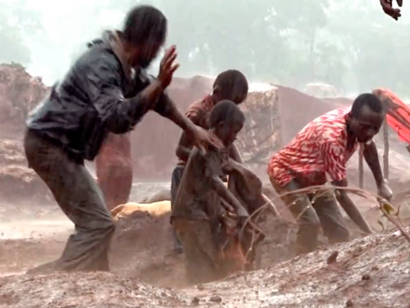
cobaltSome just might like to refer to them as child laborers but when four, eight and eleven year old children being beaten and whipped if they don't produce enough, spill some of the ore, and such like, then they are not laborers but slaves.

In the photo eight-year-old Dorsen is pictured cowering beneath the raised hand of an overseer who warns him not to spill a rock.

And what are they slaving for? So that you can drive an electric car, have a new smartphone every six months, and so forth. They are working for the western world's green energy crusade.

I have said more than once but will say it again and that is that the electric car, and especially its batteries, is not sustainable and it certainly is not ethical, and that includes the Tesla storage batteries for solar and wind home use.

Also with the demand and the cost of cobalt rising astronomically the price of the batteries is not going to come down making for electric cars as cheap as ICE-powered cars; the opposite rather and at what cost other than just the price.

But it is not only cobalt that child slaves are extracting from the earth. Other elements too, and in addition to that child slaves are also involved in large numbers in the “recycling” of E-waste to extract materials for use in smartphones and other electronic devices. The latter is also a very dirty and unhealthy business. But, hey, it's cheaper to use child slaves in foreign countries than to have the recycling, for instance, done at home under stricter conditions.

An army of children, some just four years old, working in the vast polluted mines of the Democratic Republic of Congo, where toxic red dust burns their eyes, and they run the risk of skin disease and a deadly lung condition. Here, for a wage of just 8p a day, the children are made to check the rocks for the tell-tale chocolate- brown streaks of cobalt – the prized ingredient essential for the batteries that power electric cars.

It is feared that thousands more children could be about to be dragged into this hellish daily existence after the historic pledge made by Britain – and other countries – to ban the sale of petrol and diesel cars from 2040 (or even before, as in the case of some other nations) and switch to electric vehicles.

Almost every big motor manufacturer striving to produce millions of electric vehicles buys its cobalt from the impoverished central African state. It is the world's biggest producer, with 60 per cent of the Planet's reserves.

The cobalt is mined by unregulated labor and transported to Asia where battery manufacturers use it to make their products lighter, longer-lasting and rechargeable.

The planned switch to clean energy vehicles has led to an extraordinary surge in demand. While a smartphone battery uses no more than 10 grams of refined cobalt, an electric car needs 15kg (33lb).

While the race to change from ICE-powered vehicles to electric ones may herald a future of clean energy, free from pollution but such ideals mean nothing for the children condemned to a life of hellish misery in the race to achieve his target.

We need to rethink how we drive and so on and also how we use energy and in which form.

© 2018

Consumption can cause all manner of ills

by Michael Smith (Veshengro)

Consumption can cause child labor, environmental pollution and social inequality and many more ills to boot.

The way consumption is running rampant and we are being encouraged to consume more and more is a recipe for disaster on many levels, not at least on the environmental one.

The governments keep telling us all, however, that we must consumer more in order to grow the economy and to raise living standard. I do not know on which planet they are living but, apparently, it cannot be this one or they just simply do not live in the real world at all.

Consumption and the perpetual growth economy are something that just does not for a healthy Planet and a healthy population make. There is exploitation of the Planet and exploitation to workers that all make those goods cheap and those goods, alas, are mainly also made in such a way as to break down – about a day or so after the warranty has expired – forcing us to buy new, as they, in the main, also are designed and made in such a way that repair is not an option. Perpetual growth on a finite Planet such as the Earth is is not possible but it is the only way the powers-that-be seem to be able to think and the only way capital can make more and more profit.

The only way we can change things, and we can do it, it to refuse to be part of it, or, at least, reduce the part we have in it by reducing our consumption understanding that so much that we do buy believing that we need this or that are but wants and not needs. No one needs a new cellphone or a new computer or whatever simply because there is a new model out. And the same goes for fashion and everything else. You may need clothes but you do not need fashion.

But that route is not one that people wish to travel as such a refusal to partake in consumerism is seen by many of our peers as a sign of not being able to afford things rather than of a voluntary step of trying to tread a little lighter on the Planet and help conserve its resources. Neither is it a popular step with the governments who are only interested in GDP and thus in growing the economy and, as did the UK government a while back, liken those that refuse to partake in this madness to “domestic terrorists”.

But fact is that we have to get out of this hamster wheel and back to normality of only buying what we really need and maybe so luxuries only every now and then and that means that as long as something works it does not get replaced. And if it can be repaired and that is cost-effective then it is repaired rather than a new one purchased.

We all have to change our attitude and approach to things and get off the bandwagon of consumption for the sake of it if we want to continue to live on this Planet and have it support us.

If we continue to use up the resources of the Earth, both non-renewable ones, such as oil, gas, coal, and minerals, as well as the renewable ones, and get a handle on the pollution of all kinds then there is, really, no future for the human race.

It is time to get out of the rut and do things differently and that may mean not buying new and also reusing what we have, including items of waste that we generate and that have a reuse and upcycling potential, and to make things ourselves (again).

© 2015

The downside of cashew nuts

by Michael Smith (Veshengro)

Many who are vegetarians and especially vegans look at nuts, including and especially cashew nuts as a source for their protein. Few, however, consider the downsides of the nut production, especially the human impacts.

Caju_RN_Foto_Daniel-Santini_RBRChild labor in the production of cashew nuts: Boys and girls have their hands burned by acid and lose digits in breaking the cashew nut and even after complaints, problem persists in Rio Grande do Norte.

If you look at the tips of your finger you will note the set of tiny lines forming its identity, so to speak, your fingerprints. This combination is unique, its only a pattern that does not repeat. Children working in the breaking up of cashew nuts in João Câmara, in Rio Grande do Norte, have no fingerprints. While any criminal would love this, I am sure, for the children that means that they have no verifiable identity, to all intents and purposes, as in countries such as Brazil fingerprints are used on identity documents.

The oil present in the shell of the cashew nut is acidic. It is best known as anacardic acid is the main component of cashew nutshell liquid (CNSL). This liquid sticks to the skin like and is difficult to take off. In it is this anacardic acid, which corrodes the skin, causing irritation and chemical burns.

Anacardic acids are phenolic lipids, chemical compounds found in the shell of the cashew nut (Anacardium occidentale). As they are closely related to urushiol, they also cause an allergic skin rash on contact known as urushiol-induced contact dermatitis.

Child labor is common as entire families work in the processing of the cashew nuts and most people are unaware that the oil from the nuts is acidic and is causing the problem. Many believe it is caused by the bleach – yes, you read that right, bleach – that is also used in the process of extracting the nuts from their shells.

The employment of children in the breaking the cashew is included in the list of worst forms of child labor in Brazil, alongside activities such as processing of tobacco, sisal and sugar cane.

While the fingerprints, actually, may come back if someone stops this activity while still young chances are that they will not as that is for many their only way of making an income.

When we look at this closely it is a little like the use of European and American vegetarian of Quinoa from Peru where the people growing it can no longer afford to use it.

Our demand from products and produce from abroad pits the lives of the workers at risk and also the environment in those countries and for reasons of ethics and the Planet we must rethink our ways.

© 2013