Showing posts with label waste. Show all posts

Recycling is a fraud, a sham, a scam

by Michael Smith (Veshengro)
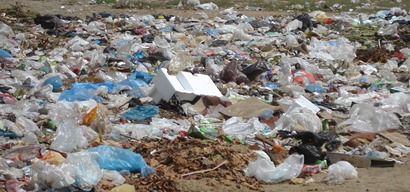
Recycling is a fraud, a sham, a scamRecycling is a fraud, a sham, a scam, perpetrated by big business on the citizens and municipalities to make us all feel good about single use packaging. It won't save the planet.

We blame ourselves, or consumers are getting blamed, that's you and me, by government, for not recycling more plastics, and yet our efforts are like “hammering a nail to halt a falling skyscraper.” It is time we got to the root of the problem.

“People need to get better at recycling” is a comment we often hear as soon as the topic of (plastic) waste comes up. It is a misleading assumption, however, to think that tossing more items in the recycling bin and fewer in the trash can make that much of a difference in dealing with the catastrophic level of plastic contamination that our planet currently faces. In fact, it is actually pretty much pointless. And the same goes for other single-use, or perceived single-use, items of packaging, even for glass jars. Aside from the fact that the latter can be reused in so many ways and do not have to end up as recyclables.

We need to rethink the way that we deal with trash because individual consumer cannot solve this problem as individual consumers are not the problem. We have taken it on as our problem because of some very astute, corporate-driven psychological misdirection in the form of campaigns like Keep America Beautiful and other such “initiatives”, created by industry.

Keep America Beautiful, Keep Our Country Tidy, Don't Be A Litterbug, and others were all, in one way or another created, brought to life or sponsored, by industry in an attempt to place the problem of litter, waste and trash on the shoulders of the consumer rather than keeping it on their own and dealing with it.

Keep America Beautiful was founded by major beverage companies and tobacco giant Philip Morris in the 1950s as a way to encourage environmental stewardship in the public. Later it joined forces with the Ad Council, at which point, "one of their first and most lasting impacts was bringing 'litterbug' into the American lexicon." This was followed by the 'Crying Indian' public service announcement and the more recent 'I Want To Be Recycled' campaign.

We can safely assume that campaigns of a similar nature in other countries were and are sponsored by the same entities, be it the programs like “Keep Our Country Beautiful” (UK), ot others of a similar nature.

While these PSAs appear admirable, they are little more than corporate greenwashing. For decades Keep America Beautiful has actively campaigned against beverage laws that would mandate refillable containers and bottle deposits. Why? Because these would hurt the profits of the companies that founded and support Keep America Beautiful. Meanwhile, the organization has been tremendously successful at transferring the blame for plastic pollution onto consumers, rather than forcing the industry to shoulder responsibility.

The greatest success of Keep America Beautiful has been to shift the onus of environmental responsibility onto the public while simultaneously becoming a trusted name in the environmental movement. This psychological misdirect has built public support for a legal framework that punishes individual litterers with hefty fines or jail time, while imposing almost no responsibility on plastic manufacturers for the numerous environmental, economic and health hazards imposed by their products.

The burden, whether as regards to plastics or other waste, was placed on the should of the consumer, and the same, today, happens also as regards to food waste. The majority of food that is wasted has never even made it to the consumer.

If we are serious about tackling plastic pollution, then corporations' actions are where we should start. They are the real litterbugs in this situation. The focus should be on the source of the plastic, not its near-impossible disposal.

This also goes for any packaging and also for food waste. It needs to start at the source and not at the consumer. When it comes to food waste, as mentioned already, the majority of waste occurs before it ever gets to the shop let alone on the consumer side. When the market buyers refuse vegetables and fruit because it does not fit certain criteria and the farmer is ordered to destroy the crop. That is where the waste starts.

With plastic and packaging it starts at the manufacturers of products who use too much packaging.

But, it would appear that we, the consumers, allowed ourselves to accept individual responsibility for a problem we have little control over. In fact, a problem over which we have almost not control.

I know we all want to feel that we can do something to make a difference and, indeed, we can, but it starts well before we think “recycling”, or at least it should. We can refuse, where possible, to buy things in plastic bottles – though in certain cases it gets more and more difficult. We can refuse to buy bottled water altogether for in most places the tap water is at least as good as to water in those bottles – which often is, by the way, from municipal sources, in other words, it is tap water, just bottled tap water.

I am not saying don't separate your recyclables and put them out for the municipalities to collect, only that that, in itself, is not going to make much of a difference, especially not considering that much of what you are going to put out ends up in landfill again because either the price that can be achieved for the recyclables is too low to make dealing with them viable or, as with China refusing to take the West's garbage, many countries do not know what to do with the stuff. Processing it at home, obviously, wouldn't do – in the eyes of the powers-that-be – as at home there are higher environmental protection standards and thus it would cost a lot of money to do so. So, if they can't dump it on third (world) countries they just dump it in holes in the ground.

We need to start well before recycling but often we have little to no control over that department other than buying products elsewhere where there is no over-packaging but, alas, some cannot afford to do that. Nor is the suggestion to leave all the packaging at the checkout a brilliant idea because for one it often is not possible and also, in some cases, should you have to return anything the packaging, to some extent, such as a box in which some item came, has to go back as well with the item to be returned.

So where does that leave us, as the consumer? It leaves us as the reuse, repurpose, upcycle and such stage. True, you can't do that with everything and how many glass jars (and other items) can you really reuse. Fair enough, I seem to be able to make use of an awful lot of glass jars for storage purposes but not everyone can. I also tend to make things from plastic milk jugs and such for the garden and for other uses. In addition to that many of those things could even be upcyled by craftspeople for sale, but, alas, few seem to think along those lines.

Where it all has to start, however, is with industry and also with design (do you hear me #designers). Designers come in to design packaging either to be compostable, or with a second use automatically obvious. This has been done, and is still been done, with mustard, and similar glass “jars” and containers, such as in France where they have the automatic reuse potential as drinking glasses, such as the ones used commonly for vin de pays in the homes, and even bars.

This should also be possible with other packaging, including plastic packaging, thus making us think as to whether we want to throw the item away in the first place or whether we do not, maybe, have a personal use for it. It can be done because it has been done before. We just need to remember, dearest designers, and adapt some of the things from the past when it was done to the present. Not rocket science but then you have studied design, not rocket science.

For us as consumers, yes, we can do our bit but the recycling bin, please remember, should always be the last consideration.

© 2018

Huskup – Product Review

Review by Michael Smith (Veshengro)

Huskup imageReusable and plastic free, Huskup brings takeaway coffee back down to earth

Durable, biodegradable and entirely free from plastic, Huskup is tackling the UK’s disposable culture one flat white at a time with a brand new reusable coffee cup made from rice husks. Using the outer hull of the rice grain, a natural and robust material that would otherwise be burnt at the mill, Huskup is harnessing an abundant waste product and giving the planet a helping hand even before the first coffee is poured.

Responding to the disposal of 7 million takeaway coffee cups every single day and the nation’s ever growing commitment to cut plastic waste from their lives, the Huskup takes the humble rice husk from earth to earth. Each cup is dishwasher safe and tough enough to withstand temperatures of -30c to 120c, yet the reusable cup can ultimately return to the soil at the end of its life and biodegrade naturally.

Free from melamine and BPA, Huskup is setting a new standard for reusable coffee cups and is ready to make every hot drink on the go that bit greener, from coffee shops and canteens to the workplace and beyond. Saving energy, materials, money and waste using an all-natural bi-product of one of the world’s most prolific store cupboard staples, the Huskup is set to make a big impact with one small change to the morning routine.

The Huskup comes in 12 different designs and can be purchased from www.huskup.com, priced at £10.95 each. Cheap they are not, in comparison to other reusable coffee cups, that is for certain, but then they are also made from a different material in a different way.

Bath-based Huskup was founded in 2018 to harness one of the world’s most abundant food waste materials, the humble rice husk, and begin a new chapter in takeaway coffee with a cup that is both durable and biodegradable. Entirely plastic, tree and toxin free, the Huskup contains no melamine or BPA, meaning that no nasties can make their way into drinks. These eco-friendly cups are also tough enough to take on the dishwasher and safe for reheating coffee in the microwave, but will simply decompose and return to the earth at the end of their lives. Launching with 12 designs, having teamed up with like-minded independent artists to create products that represent the Huskup ethos, these reusable cups are ready to bring takeaway coffee back down to earth.

While the material of the Huskup is free of melamine it has the feel of that plastic material, or that of Bakelite, for those that remember that material, but the material is not even, actual plastic. In my opinion the scope for this material itself, a plastic-like substance that is made from natural ingredients which harmlessly return to the soil, goes beyond just coffee cups.

As far as biodegradability is concerned Huskup are certified to the compostability standards, European EN13432 including the following elements:

1. Biodegradation - materials turn to soil through microbial action

2. Disintegration - the materials fall into small pieces

3. Eco-toxicity - seeds can germinate in the resulting compost - i.e. it is useful for plant growth

4. Heavy metals - the compost is safe to go onto land

The manufacturing process takes the waste rice husk and mixes that with some natural starches – and those are, alas, trade secrets. The cups are then molded and formed into the huskup. No melamine or other plastic binders are used.

The lid and the band around the body of the cup are made of, what in my opinion, would appear to be silicone.

The cup appears to be extremely sturdy and, as I said before, feels like a melamine or Bakelite product, but is neither. It should last for many, many years and when it finally has to be replaced you do not have to have a guilty conscience as to its disposal. That still does not mean that you should thoughtlessly toss it at the end of its life into the countryside.

The only, for some it sure would be, major turn off is the fact that the product is “Made in China” while the company is British. The reason, though, probably is that rice husks are more common in China (and elsewhere in Asia) than, obviously, in Britain and hence the product is Made in China.

Web: www.huskup.com

Twitter: @huskup_eco

Instagram: huskup_eco

Facebook: https://www.facebook.com/huskup/

© 2018

Zero waste myths: should we really be avoiding plastic?

by Michael Smith (Veshengro)

Zero waste myths_ should we really be avoidingnbspplasticFirst of all it also must be said that “zero waste” is a myth itself. There is no such thing as “zero waste”. It will never be possible. Having said that, however, does not mean that we should not reduce waste, especially in way of packaging, and waste that occurs also through planned obsolescence.

Images of ocean plastic pollution are causing so much revulsion that many people are switching to some supposedly more “environmentally friendly” materials to try to reduce their impact. But does this actually work? How much greener are the alternatives?

Also, there is plastic and then there is plastic. Single-use plastic, in my opinion, is a bad idea. We should, with the exception of may be a few things, avoid any kind of single use altogether. Other plastics, for plastic products intended to last for a long time, are a different story and here the material, quite often, is the appropriate one, unless we return to (more) natural materials.

Plastic vs Paper: It is easy to see how paper bags are seen as and appear to be more environmentally-friendly than plastic ones. They are made from trees, which grow in nature, and can biodegrade, in fact compost, when they are finished with.

Research, however, consistently finds that paper bags have a far higher carbon footprint than plastic ones, because the process of making them uses so much energy, and not just energy but also lots of water. Trees may be in harmony with nature, but the process for mashing them up into paper is not.

True, paper bags can decompose, but it is not exactly zero waste to use so much energy producing something that is not designed to last. And if you are careful to reuse and recycle a plastic bag, it should be possible to prevent it ending up as litter or in the ocean, whereas every single paper bag will have made a hefty contribution to global warming, regardless of where it ends up. The best option, of course, is to avoid the problem of single-use waste altogether by using reusable bags.

If you are a business and you want to offer something to customers who have forgotten their own bags, consider doing as Arjuna Wholefoods in Cambridge does, which is to invite people to drop off their old plastic bags to be reused. Alternatively, bags made from recycled materials is the next best thing. Just please don't hand out new single-use bags for free, as this does not reflect how much it costs the Earth to produce them.

As for the idea that paper is “more recyclable” than plastic, this has now been repeated so many times, that it has become almost fact. While it is true that paper can be recycled, the quality of it degrades in the process. Plastic can also be recycled, although some types of plastic are easier to recycle than others, and packaging that mixes plastic with other materials can be more tricky to recycle (single-use coffee cups are the most well-known example of this), but also here, in the main, the quality deteriorates and to make good new plastic from recyclables a great deal of virgin polymer needs to be added to the mix. So, there is no such thing – generally – as 100% recycled plastic, with a few exceptions, maybe. .

So, when it comes to recyclability, there is not that much to be gained from choosing paper-based products over plastic ones, and anyway, it is actually a big mistake to be overly focused on how recyclable something is, when most of the impacts of the stuff we consume is in the process of producing it, rather than what happens to it at the end of its life. This is true regardless of the material, but in terms of paper, we need to factor in how much carbon it takes to produce it.

The best way to lower impacts from packaging waste is to reduce the amount of packaging that we buy, and where possible, buy products packaged in recycled materials. Though it has also be said that often we, as consumers, do have little choice as to the amount of packaging of any kind, be this paper, cardboard (often laminated with foil), or plastic except by voting with our wallet and not buying over-packaged products. This can be a difficult undertaking, however,

Plastic vs Metal: Stainless steel tins and bottles are something of a zero waste style statement. There is no doubt that they look good, but the process of producing metals like stainless steel and aluminium releases scary amounts of carbon into the atmosphere. This means that reusables made from metal will need to avoid a lot of waste before they save more resources than it took to produce them.

The choice is really up to each of us: Option one would be stainless steel (or other) products, which are very high impact to produce, but highly durable, or option two would be plastic bottles and containers, which are more environmentally-friendly to produce, but tend to wear out somewhat more quickly, so that you may end up using more of them in the end. This is essentially a judgment call, based on your personal routines and how much waste you expect to avoid by using your reusable bottle and containers.

Single-use cups vs reusable cups: Several studies have looked into how many times a reusable cup needs to be used before it saves more resources than it took to produce. As they are carried out by academics, there is no simple answer – it depends on which type of reusable cup you are using, which type of single-use cup you are trying avoid, and which environmental impact you are considering – but it seems to range from 5-16 times. So, if you would otherwise expect to use at least 17 single-use cups, consider investing in a reusable one. For top marks, see if you can pick one up in a charity shop or other kind of secondhand store.

Glass jars vs plastic packaging: The jury certainly appears to be out on this one still. Glass tends to lose points compared to plastic because of the high carbon emissions involved in manufacturing and transporting it (think of how much more glass weighs) but can redeem itself by being more efficient to recycle than certain types of plastic. Glass jars, for instance, if we want to be thrifty in the way our grandparents and their parents were, also have a great reuse potential for us, whether as storage jars for all kinds of things or as drinking vessels, etc. And the reuse thought should always come well before any thought of recyclability.

If you can and will reuse or refill jars, the that is your best option. Otherwise, there is, apparently, no clear justification for always choosing glass jars over plastic.

Plastic bags vs cotton or other textile bags: Its a bit of a mystery why cotton has gained a reputation for being an environmentally friendly material. It takes 20,000 liters of water to make 1kg of cotton, and much of it is sourced from countries where water is extremely scarce. Worldwide, cotton production causes pollution and biodiversity loss. But there are alternatives to cotton and cotton bags, such as hessian, aka burlap, canvas, and others, including, though it is oil-based to some extent, woven and non-woven polyester bags.

When it comes to plastic there are – if I may put it this way – good plastics and bad plastics and I am not putting so-called bio-degradable into the category of good necessarily either. Also, as far as plastic water bottles, the reusable kind I mean here, are concerned not all leach chemicals. It all depends on the plastic. The Dutch designed (and produced?) “de Dopper”, as an example, does not, and is also of a rather ingenious design.

The biggest problem is plastic packaging and the over-packaging of products, often products that do not need to be packaged in such a way at all. That is where the changes have to happen and we must force industry to make the change.

© 2018

Aldi unveils measures to slash plastics waste

by Michael Smith (Veshengro)

Aldi unveils measures to slash plastics wasteDiscounter Aldi will scrap 5p carrier bags by the end of this year and ensure all packaging on its own-label is reusable, recyclable or compostable before 2022. All I wonder is why it is going to take four years to do something like that.

Aldi has signed up to a new cross-sector initiative from WRAP aimed at transforming the UK's plastics system.

In place of carrier bags, the UK's fastest growing supermarket will offer customers bags for life as reusable 9p bags made from back-of-store plastic waste.

A new taskforce of internal and independent experts has been set up to help Aldi drive innovation in packaging, the company confirmed.

Aldi has also given its backing to a national deposit return scheme for plastic bottles. It will assess the feasibility of how such a scheme could be implemented.

The latter should not really surprise anyone as Aldi, being German by origin, thus hailing from a country where such a scheme – or schemes even – has been in operation for many years already. As per usual Britain is lagging way behind other European countries in that matter.

Aldi UK's chief executive Matthew Barnes said that the chain is committed to bringing its customers along the journey in its ambition to lead the industry on plastic waste reduction.

He also called on Aldi's rivals to work together in order to drive industry-wide change. In support of this aim, Aldi has signed up to a new cross-sector initiative from WRAP aimed at tackling plastic waste.

This latest announcement builds upon a long-standing commitment by Aldi to reduce its environmental impact. Aldi has already removed all plastic stems from its cotton buds and banned all microbeads from its products.

On the cotton bud thing I must then be the only one who has not noticed any change as yet, because I have not. I love Aldi, so don't get me wrong, and those are all good steps but so far I have not noticed – at least not in my local store – a change to the cotton buds. Then again, it may still be some old stock that is knocking around. Just saying.

© 2018

Buying for the landfill

by Michael Smith (Veshengro)

cobaltWith a great number of products the wear out is pre-programed. This deliberate limited lifespan is called “planned obsolescence”. There are some tech people who actually claim that many electronic devices and also white goods have a chip “implanted” that starts counting down a set time span after the device has begun to be used which shuts it down after that set time. But may that as it be (or not be). Fact is that there appears to be a predestined limited lifespan of our devices in order for the companies to be able to be selling us the same products again, and again, after a short space of time rather than, as used to be the case when products were made to last (almost indefinitely with care) and were repairable, having to bring out better versions or other products, in order to stay in business.

It would appear that the producers of light bulbs decided that the lifespan of the original ones was too long – almost indefinite – and that that would have to change. They seem to have been the first with this lightbulb moment for the capitalists. So they changed the design of the elements and, voila, it would only work for a limited time. In the same vein as when the new owner (a West German capitalist) of once people-owned glass-works in the GDR that made unbreakable (yes, they even had the patent for it) glass he immediately had all the machines removed with the words: “I am not going to make something that does not break.”

As a result of this capitalist model we have the modern “throw away society” because the manufacturers of those products also make it (almost) impossible to open the devices and repair them. That is also part of the plan. And in addition to that they now “sell” us a supposed sustainability of those products – that we have to toss after they no longer work – as they are, so they tell us, fully recyclable.

Whether it is light bulbs, nylon tights, printers, mobile telephones – most of those, and many, many other products, already have their expiry date preplanned. The consumer shall be induced to rather buy a new product than to have the old one repaired. Often, as indicated, this is (almost) impossible and where it is possible to costs can be several times higher than the purchase cost of a new one.

The deliberate foreshortening of the lifespan of an industrial products in order to keep the economy in motion is called “planned obsolescence”. Already in 1928 an advertising magazine wrote candidly: “A product that does not wear out is a tragedy for business.”

In the 1920s a cartel was set up to limit the lifespan of light bulbs and from then on everything went slowly downhill bar for say in the GDR where products were made not to wear out. Why? Because of scarcity of resources and because it was not a capitalist state.

Even after the light bulb story many products were still well-made and repairable, to some extent even by the user in the DIY-mode. Things begun to change after the Second World War. It was here that companies made big money due to military contracts but after those profits began to fall off. Realizing that this was due to the fact that the products they supplied to the military ended up destroyed in action they came up with the idea (no, not of another war, though that was not far behind either) to find ways to limit the lifespan of products other than what would be called “consumables”.

Slowly, however, people in general are getting fed up with this model and are beginning to demand – once again – products that last. The manufacturers, though, are responding rather with the “sustainability” model I mentioned earlier, that is to say the claim that their products are entirely recyclable and thus the consumer does not have to worry about buying new then the previous one breaks as everything goes back into the loop. That is not the point though, is it.

Whether or not the everything in a product is recyclable and even if everything goes back into the loop of making new products the impact on the environment, not to speak of our pocketbooks, is not elevated really. Recycling of electronic goods, and recycling in general, is a dirty business which is why most countries have outsourced it to countries where the environmental codes are lower to non-existent and where there are also no protections for the workers in this industry.

With China now refusing to take much of our recyclables the nations of the so-called West are in a quandary as what to do and are looking – no, not so much at reducing waste and making long-lasting products – to other, poorer countries where they can dump their recyclables.

However, nothing is going to change unless either the political model changes and capitalism is tossed on the landfill itself, the landfill of history, or consumers vote with their feet and wallets. What must become obsolete are not products but the system that created this willful “planned obsolescence” and the idea of infinite perpetual economic growth on a finite Planet with finite resources.

And while we are at limited resources let me, just for a second, touch upon the batteries, the rechargeable Lithium-ion ones, that our devices devour rather also quite often. The rare earths required for this, including cobalt, and others, are not just mined in a way that ravages the Planet and which are polluting, but which also ravage children who work as slaves, often literally, in those mines (and the factories making the batteries). But then, oh well, seems to be the attitude of so many, it is not in our countries and it is far away.

© 2018

Plogging... or picking litter while you jog

by Michael Smith (Veshengro)

Plogging SwedenPlogging is a new concept in and from Sweden that hopefully is going to make its way to other places as well. Plogging is the Swedish word, or better the English translation for it, for just picking up trash while you are out jogging.

It is also super easy. Just bring a plastic bag with you on your next run, walk, hike or trailrun and just pick any trash you might find a long you way, so it it not just for joggers.

If everyone going out for a walk, walking the dog (yes, and please pick up your dog's mess as well), would do this there would be a great deal less litter in our parks, countryside, towns and villages. Fair enough, if people would actually not throw their littler away outside but dispose of it properly there would be less still.

In the Summer of 2017 the 1st official plog run in Örebro and about 15 persons turned up at Naturens Hus. They split up into 3 groups and headed out in different directions. An hour later they all met up again to put all the trash they found in larger plastic bags.

All in all they collected around 10-12 kg of trash during that plog and found everything from cigarettes, napkins, plastic containers to broken bottles. And that while that is a area of Örebro that is considered one of the cleanest places in town.

In the large local park with which I am concerned a number of responsible dog walkers not only pick up their dog's waste but also pick litter on their rounds, while there are other people who simply walk in the park who do this too.

As I said earlier, if everyone would do just a little of that when walking or hiking, etc., things would begin to look a great deal better and a lot less little would find its way into water courses and the sea. Better still, as mentioned, if people would actually start to learn to be responsible and take better care of their litter things would be much better still.

It is not the fault of the plastic bottle that it ends up in the river nor the fault of the plastic bag that it ends up in a tree. The fault lies with inconsiderate and lazy people who cannot be bothered to dispose off their trash in the proper manner.

© 2018

Europe drowning in plastic waste

by Michael Smith (Veshengro)

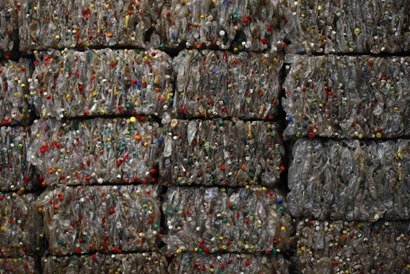
Plastic bottles at a Chinese recycling plantNow that China has closed its doors, from January 1, 2018, to (plastic) waste for recycling from Europe (and elsewhere) the countries of Europe are beginning to drown in (plastic) waste and many are now looking for other developing countries, such as Vietnam, to take this waste for recycling, Britain among them.

Instead of actually reducing waste, especially, though not restricted to, plastic waste, and secondly building our own facilities for recycling the countries are, yet again, looking for places with lower environmental standards to where to dump the waste rather than doing the other.

Obviously, considering the high environmental legislations in the home countries it would be too expensive for the capitalists to do it at home and hence other countries, with lower and fewer environmental laws and legilations have to be found where our waste can poison the unsuspecting workers. Couldn't possibly have those recycling plants properly operated in our own countries now, could we. But that is exactly what we should be doing.

Before even thinking about recycling we should, properly, work on reducing the amount of waste, plastic and otherwise, that we generate and that is where all, but for starters industry and legislators, come in.

Now that China declines to take any more of our garbage we should be doing our own recycling, after reducing as much as we can, of our waste and by doing so lead the way and we would also create jobs.

When, however, we talk about recycling then recycling it really should be rather than, as in the case of most glass recyclables, downcyling said glass into a road aggregate akin to sand. That is not recycling.

As far as single-use plastic is concerned this needs to be eliminated once and for all as it cannot, properly, be recycled, at least not into decent objects and while there is nothing, per se, wrong with good solid, for lack of a better word, plastic that will and can be in use for a long time, we should phase out plastic more and more over time till we are almost, once again, free of the stuff.

As far as other waste, including and especially E-waste is concerned, industry has to come into play and design to once again – yes, we were there once already – to make products that actually last not just for a year or three but for decades and more. Oh, yes, sorry, I forgot that that does not give huge profits to the capitalist shareholders.

Instead of solving the problem at home our respective governments are looking for other developing – we used to call those Third World – countries which we can contaminate, and their unsuspecting residents, with our waste, by having them recycle the stuff that we don't want to recycle at home, in bad conditions. The new colonialism.

We should be doing the recycling – after looking at all the other options of reuse and so on prior to recycling – at home, in good conditions for the workers and the environment, as dictated by law. This would also create jobs, from collecting, to sorting, to the actual recycling. But, alas, that cannot be as that would be expensive.

© 2018

Christmas supermarket till receipts wrap around the world – every week!

by Michael Smith (Veshengro)

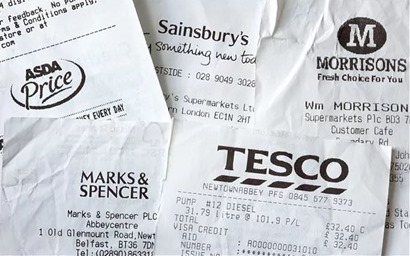
till-receiptsOver 26,000 miles of receipts issued as waste reaches 'epidemic' levels

British supermarkets issue over 26,000 miles of till receipts every week in the run up to Christmas – more than enough paper to go around the entire circumference of the world – and virtually all of it is wasted.

These are the findings of a leading expert in waste and recycling, which has calculated that around 270 tons of till receipts are printed out for customers, many of which are thrown straight into bins along with non-recyclable single-use carrier bags.

Most of those receipts, and everything else that is printed from the till roll, is also on a special kind of paper that does not really recycle well, if at all. It is a so-called thermal paper as the printers does not actually ink but heat to create the “imprint”. In addition to that the paper is laced with BPA, which is a known health risk.

Stores that print out additional offers along with the legally required receipt make the problem worse by producing paper that customers almost always ignore. And those are just the receipts, etc., that are issued over the run-up to Christmas.

Factor in to that the estimated 150 million supermarket and convenience store transactions every week, and a couple of feet soon turns into thousands of miles.

In extreme cases, a customer can sometimes leave a store with:

  • Till receipt

  • Separate bank card receipt

  • Money saving offers

  • "You saved… compared to our competitors" promotions

  • Loyalty vouchers to collect

While the receipt itself is a (legal) requirement, it is the reams of promotional material to which we should object, leaving customers walking away with armfuls of ticker tape that they often bin, along with their carrier bags.

Those estimated 150 million weekly grocery transactions equate to:

  • 26,000 miles of paper, more than enough to reach around the world's 24,000 circumference

  • 270 tons of paper, most of which is discarded rather than recycled because, as indicated already above, some of the paper is mostly non-recyclable

  • A year's worth of till receipts would reach from the moon and back – twice

The frightening thing is that the data is only confined this to grocery stores in the United Kingdom. Add to that other business sectors like DIY warehouses and petrol stations, add in the rest of the world – that weekly till roll is going to wrap the world up like a gift bow, and that's not a good thing.

© 2017

Zero Waste – is it possible?

by Michael Smith (Veshengro)

Sinnlos sammeln und sortieren - recycling bins1Zero Waste is a concept that is very much like the idea of sustainable consumption in that it is not feasible regardless of what some people preach.

While it is possible to reduce waste, all waste, including food waste, to a minimum, zero waste, in that we do not produce any waste at all, just is not possible, regardless of what some people may think or claim, in the same way as there can be no sustainable consumption.

Whatever we do we are going to produce waste in some way, shape or form, though ideally, and that is the operative word and challenge, that waste should be recycled by whichever way. In addition to that we must change the way that we produce things and also produce food and use all the food grown, not just those vegetables, for instance, that have the right shape, size, etc.

As far as products are concerned they must be made so as to keep waste in production to the minimum and made in such a way that they can be kept going ad infinitum, almost, by being repairable, ideally user-repairable. But that is not a model that industry (and, it would appear, government) does not want.

Going further, however, we all must find ways, aside from just reducing waste, to make use of the waste that is still there especially the kind that can, in some ways, be reused, reworked, repurposed and upcycled, and that before we even think whether or not it can be (commercially) recycled.

This is also where upcycling as an economic activity, especially by small workers, comes in. Far too much of commercial recycling destroys the product and does not actually recycle anything but downcycles rather. But I am beginning to digress.

Zero Waste is a nice idea but it just will, I am afraid to say, never really work because there will always be some waste that is being produced though a more-or-less circular process might just reduce it is a very small percentage.

However, the latter process will only work if everyone, from government to every individual person, pulls on the same rope, so to speak. The problem is that already now in the case of ordinary recycling things are not always the way they appear and are made to appear.

While recyclables may be collected by the municipalities they may not actually always end up being recycled even if that means that they are downcycled. Quite frequently, for a variety of reason, one of them though being that at some time the price for the recyclables may be too low, they are sent to landfill.

The problem is that all our individual efforts come often to nothing because there where we can do nothing about things are not on the same level. It is therefore much more important that we see that we can reuse more of the stuff that runs under “waste”, from composting to reworking and upcycling, even in a semi-commercial enterprise, than believing the, let me call them, powers-that-be that they will take care of it.

There has always been waste, with the exception, maybe, in the case of Nature, and there always will be, in some way, shape or form. What way, shape and form this waste is going to be, however, and what we do with it though, is another question in point and that is up to us. Reusing, repurposing and upcycling whatever can be treated in this way needs to be done, up to and including doing this as a business. Those three have to become an economic activity, even if only on a small scale, but in many small enterprises.

We cannot keep pretending to be able to tackle waste by claiming that we can go “zero waste” because we cannot truly and fully. To believe otherwise is conning ourselves. Only Nature knows no real waste as in Nature everything is recycled, truly recycled, in one way or the other.

© 2017

Consumerism – do we need prohibitions?

by Michael Smith (Veshengro)

consumerism1We are living well above our means, in more than one way. Thus the question as to whether we need prohibitions that will halt our over-consumption? Maybe we do need someone who raps us over the knuckles when we go too far? That maybe the only way that the Planet can be saved. But this is not going to happen, not from the side of those that think they are in charge as economic growth is what they are on about and growth – according to them – can only be achieved in that people consume more and then still more. Only growth on a finite Planet does not compute.

But do we really need some higher authority to tell us. Should we not be able to restrict ourselves?

On the other hand most people, even many who think of themselves as as having a high degree of eco-consciousness, are into consuming. Fair enough, we all have to eat, need clothes, etc., and thus we consume and are consumers, obviously, but with consuming in this context I mean the many, often unnecessary, things that we buy, thus consume, just because we are lazy, we believe we need them, and because our friends have them.

Coffee to go, obviously in the one-way cup, because it is so convenient. Coffee from the pod, the most wasteful and expensive way to make and consume coffee. Another new cellphone or even smartphone though the old one that we have is still perfectly good and does what we need it for. But, hey, there is a new version out that has more bells and whistles, not that we will ever use any of those bells and whistles.

Using the car to go to the shops – even though you only live a few minutes away from them on foot or by bike – because it looks like rain. Take out pizza or whatever simple because we can't be bothered to cook. OK, there are people who are so busy and work so many hours just to sustain a lifestyle nowadays who really do not have the time to cook at home, I know, but. And so on and so forth.

But would prohibitions really make a difference. OK, with prohibitions people could not do this or that but is it really so hard for us as individuals, as people, to understand that we must change for the good of the Planet and also for the good of our own finances.

Unnecessary driving costs fuel and unnecessary purchases cost money, but at the same time both have an impact on the Planet in many ways. The prepackaged salads and all the rest generates a great deal of packaging waste, more often than not in the form of plastic, some of which is, while others is not, recyclable and it then ends up in landfill or, via the not so environmentally-minded, in the countryside and eventually in rivers and the sea.

For a change to come about industry, especially, will have to play its part and reduce the amount of packaging, and that includes food producers and supermarkets as much as online retailers like Amazon. Legislation could come into play there in that packaging could be regulated and a reduction demanded by government because we, as consumers, can do little there except shop where we do not have everything prepackaged – and that is not all that easy – and sending a message to industry and supermarkets that way.

Waste or squander is no peccadillo, no trivial offense. Nobody has the right to take more than what he/she needs.

I can hardly see, however, government legislating against consumption per se. That is definitely not going to happen. A change in that department will only come about when the mindset of people changes and you cannot do that by degree and prohibitions. Most people will rebel against any kind of prohibition and unless and until industry actually changes its manufacturing processes which are designed that products break down after a relatively short time or, in the case of PCs, for instance, that software (updates) is no longer compatible with old sets (and that also applies to smartphones, for instance) we have little choice to buy new products every year or every couple of years or so. If products would, like they used to, last for a long time and can be repaired, ideally by the user or in small shops, then we would not have this waste that is generated by having to continually buy new.

On the other front, that of packaging, we don't need to look much further back than half a century or so and we can see that things were not over-packaged in the way they are today. Fair enough, that was also the time when the so-called convenience foods were not about. There were no ready-made salads in plastic bowls and such to be found in the isles of the supermarkets. Produce was sold predominately loose, and was packed in brown paper bags, other things came in simple cardboard boxes, tin cans or glass jars, and almost nothing was double or triple packaged, as today.

There was also once a time when packaging, such as glass jars, and others, had an obvious – obvious to all but the very dense – second use and some manufacturers still do so today. Let's get back to that and maybe, just maybe, we have less of packaging waste. We can hope, can't we?

But when one sees that even people who think of themselves as green and environmentally-minded throw away glass produce jars into the recycling and then go and buy recycled glass jars, in the believe that they do good for the Planet doing that, rather than using the glass produce jars as storage jars then one has to wonder where we have gone wrong.

I think no one can deny that we have to stop this malarkey but can we be made to stop with and by government intervention and should that be done?

Most of us know that much of what we buy and consumer is not good. With that I do not mean that it makes us fat or gives us all manner of diseases. Our consumer behavior does hurt us, but mostly it hurts others. Others who also live with us on this Earth and who we do not see because the live far away, those that still would like to live on Earth after we have long gone, and also the Planet as a whole.

While no one can deny that we have stop (with) this madness of consumption – for the sake of it and the economy, as our respective governments keep telling us – the question is how many of us, of our contemporaries, are prepared, voluntarily, to give up this mad pursuit. But, if we want to sustain ourselves and the Planet we will have to do just that for, as I have said above, our governments are not going to do all that much in that department as it would interfere, as they see it, with economic growth. However, perpetual growth – economic or otherwise – is not feasible on a finite Planet with finite non-renewable resources. And, no, the good Lord is not going to put more oil and whatever into the ground for us, as some, including some American lawmakers, believe and declare from the “pulpits”.

As I have said while legislation might be a way to go I don't see it happening. For one the powers-that-be (but really should not be) won't do it because it fuels economic growth and that is all that they seem to be able to think about and on the other hand legislation often does not work because the mind of the people per se rebels as soon as they are not allowed to do something. Persuasion towards a voluntary reduction appears to me the only way. Though disallowing the use of plastic bags or taxing the use of them might just do something.

© 2017

Plastic, plastic use, and plastic pollution

by Michael Smith (Veshengro)

plastic_waste1Plastic is pervasive nowadays and there is almost no place where you can look and plastic will not be staring you in the face in some for or the other. The computer keyboard, the case of the laptop, of the cellphone; all plastic, and that just for starters.

Since the real commercial production of plastic begun in the 1950s the world has produced more than eight billion tons of plastic which is about as much in weight as a billion elephants. Now let that sink in for a moment. That's an awful lot of the stuff. And that which has not been recycled or burned is in landfills and much of it, in fact, is floating around in the sea, causing problems to marine life, and in the end to us, who eat some of that marine life.

In 1950 the world produced around two million tons of plastic per year, while 65 years later, in 2015, it was 380 million tons in that year alone. Half of the so far produced plastic has been has been made in the last 13 years. Until 2015 only nine percent of this plastic has been recycled while twelve percent has been burned. The rest, alas, is still with us, predominately in landfills.

In some cases, let's face it, there, probably, is no real substitute for plastic and there is plastic and then there is plastic, as I keep saying. Instead of making it from petroleum there are other ways plastic materials could and can be made but even if the plastic is from a plant-based source it remains plastic and compostability is in most cases nothing more than greenwash.

On the other hand plastic can be extremely durable – aside from being light – and I say the can be because some of it is not made to be durable and that is due again to industry's design of needing things to break in order to sell more of the things to us.

It is the single use plastic that really is the greatest of problems, whether it comes in the form of the all present and all pervasive PET-bottle or the other plastic packaging such as fruit punnets, salad bowls, etc. ad infinitum.

What bugs me is that many of those things can be given an extended life if we but put our thinking cap on when we encounter them. Only recently I rescued the bases of some Sainsbury's sandwich trays (the kind you but ready-made sandwiches in for parties) which will become the trays for plant pots when raising seedlings.

I have found that the plastic that is used for those salad bowls with ready-made made salads from supermarkets, for instance, is a fairly flexible and also strong kind in that there is nothing preventing us from reusing those small and not so small bowls for a variety of uses in the kitchen, at table and otherwise in the home (and garden).

Those single-use plastic beer beakers (1pt), often made of a strong and flexible plastic, that are used at festivals and such like, instead of glasses, and then, obviously, being tossed thoughtless into the countryside, make for great propagators put upside down over a small plant pot for raising seedlings.

While, obviously, it would be good if we could get rid off all single-use plastic I, personally, doubt that that is going to happen soon and thus we ensure that we dispose of the stuff responsibly (for recycling ideally though we can but wonder how much recycling actually truly happens) or, maybe better still, must find a way of making use of those things by reusing, repurposing and upcycling them in other ways, stretching their lifespans for as far as possible.

In the case of plastic drinks bottles, be it water or other, I would advocate the introduction of a deposit, as it is done in some countries already, and the use of reverse vending machines where such bottles can be returned to and the deposit given to whoever returns them.

Bottled water is a scam anyway as most of the water is not “spring water” or “mineral water” but simply ordinary, often tap, water filled into bottles and sold at a huge profit. In most places in Europe, bar a couple of countries, the local tap water is better than any bottled water. The US still has a problem despite considering itself to be such a great advanced nation. In some places the municipal water supply there is as bad, sometimes even worse, than that in many a city in the Third World.

The problem nowadays though is also that other drinks and products that used to be packaged in glass come now in plastic bottles and jars, such as wine, spirits, peanut butter, etc. The claim is that this is being done to reduce the impact on the environment as glass is heavier than plastic and thus transportation requires more fuel. Come on, let's be honest dearest people. It is cheaper and the environmental claim is but hogwash or should we better call it greenwash. Fact is that plastic bottles and jars are cheaper than glass and that they are cheaper to transport than glass. Hence the move to more and more plastic.

As consumer we are facing a dilemma when it comes to the above, that is to say drinks and produce in plastic jars, let's not even talk about fruit and vegetables packages in unnecessary plastic (wasn't sure whether to laugh or cry the other day when I saw at ALDI apples packaged in the kind of tube in which tennis balls are sold) as in the great majority of cases we do not have an alternative. It was Sainsbury's a couple of years ago that started the trend of peanut butter in plastic jars and now almost every producer of peanut butter has followed suit.

Wines and spirits, at least those at the lower end of the price scale, now also come in plastic, rather than glass, in our supermarkets and the letters WTF very much come to mind with regards to that.

So, instead of working to reduce the problem industry and supermarkets actually perpetuate the problem by introducing more and more plastic packaging. Get rid off the plastic carrier bag, to some degree, and they just get some more plastic in that you can't avoid, more or less. Sometimes I do wonder whether they actually want to help or not, and it looks more like that they do not want to help at all. Plastic is cheaper to use than glass and much cheaper to ship as it is lighter and there are no breakages. It's all down to money yet again. But where does that leave us, as consumer, who are left without an alternative and choice often?

© 2017

Plastic packaging – the bane of the modern world

by Michael Smith (Veshengro)

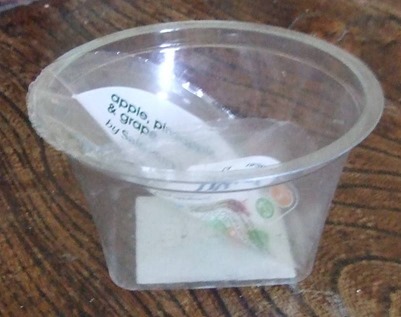
Platic_Tub_Waste1_webAlmost everything that we buy today is packaged in plastic and sometimes double and treble. And the greatest bane, at least in my opinion, is the plastic that is hollow formed into different shapes, whether as dishes, trays, or the shape of an apple or orange and then they are stuck into them individually. Aside from the fact that many of those packages have no secondary use in any way they also take up a lot of space in the bin.

There are some of those though that can be reused and repurposed but very few seem to see the potential. I am thinking here specifically of the bowls and such for prepacked ready-made salads, the apple and other fruit snacks, and such like. Those are bowls that could easily be given a second life by being reused. The plastic often enough is not a bad strength at all and food grade and thus those items could serve in the kitchen and/or elsewhere. (The one in the picture has now got a second life).

While it would be good if we could get away from plastic packaging altogether – which is not all that likely to happen – making use of as much of it as possible is the way to go, I think. Packaging designers too could help here somewhat more in that they could create plastic packaging (and packaging in general, including glass) that would automatically and obviously have a second use. This was the case once, for glass, and should be again and also for such plastic containers. It is not rocket science. But, I assume, that even then the majority would still treat it in the same way as they do now, as disposables. But then they even treat plastic products that they have bought as disposables when they take them on picnics. Somewhere along the line some people definitely have lost the plot, and they didn’t even have an allotment.

© 2017

The Rs and the U

by Michael Smith (Veshengro)

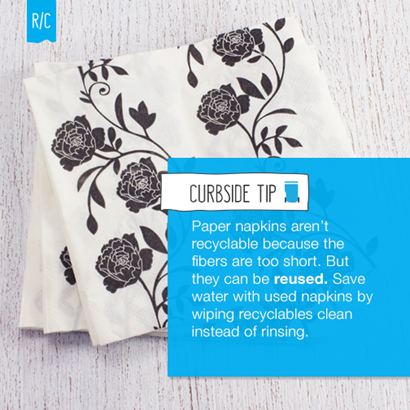
Paper napkins are not recyclableWe have always told, and still are being told, that there are three Rs when it comes to “going green” and that those are “reduce, reuse, recycle” but, in fact, there are more than just those three, or at least there should be. And then there is also the U for upcycle. Recycle should come at the very bottom of the list, and that is why I have put it here.

Reduce: Just use and buy less. Also, obviously, reduce your waste, especially the stuff you send into the waste stream. When it comes to food and food waste use everything and leftovers are used the next day. That's the way our parents and their parents did things. It works, would you believe it. Oh, and guess what, reusable cutlery, plates, cups and such are meant to be washed after use and used again.

Return: Producers should take back what they sell. This is not going to happen very soon, of that we can be certain, even as far as packaging, and over-packaging goes.

Reuse: Almost boring, but we throw too much stuff out too soon. Reuse also must include not just continued use of what we have but reusing and repurposing items of waste such as glass jars and much more. There often is another life for many of so-called waste products.

Repurpose: That is taking reuse to another level in that the product is used for another, often “higher” purpose.

Repair: Fix and mend things rather than replacing them.

Rework: Taking an item of waste and making something new, which could include changing the shape of the original waste product but does not have to be and is akin to upcycling.

Refurbish: This is a little like repair but may go a lot further than just simple repair, that is to say fix and mend.

Refill: In Ontario Canada, 88% of beer bottles are returned to the beer store, washed and refilled; just south of the border in the USA, the number drops to under 5%. In many countries of Europe beer bottles are also returned, washed, sterilized and refilled; alas not in the UK. Apparently, according to government, it was never done in Britain and thus could never work here despite the fact that until the end of the 1970s this was done, last with lemonade bottles and until not so long ago – and in some cases still – with milk bottles.

Rot: Compost what is left over, turning it into valuable nutrients.

Refuse: Simply refuse to accept this crap from the manufacturers any more.

Reducing and reusing also saves money, as do many of the other Rs, aside from being good for the Planet they are good for your wallet and bank balance too. If that isn't an incentive I don't know what ever would be.

And now for the U, even though this one should come well before this stage and that is:

Upcycling: This is the process where (at least) some of the shape and properties of the original waste product are retained and where another useful product is produced from it. Though at times it might also be a decorative item or a piece of art.

Upcycling ideally, however, should be about turning an item of waste into a useful item and product rather than a work of “art”. Although there are times when making artworks out of such waste is the only answer to throwing it and that is still better than doing that.

Recycle: Yes, I have put recycling at the very bottom of the list, and not just of the Rs because of the way recycling, at least commercial recycling, generally, works. The problem with recycling is that it, actually, destroys the “waste” product and more often than not this product is not recycled but downcycled.

Glass is a prime example here where in the majority of instances, aside from being broken into fragments anyway in the first case, it is ground down to make road aggregate, a glass sand, rather than new glass. In other words they are turning it almost into the material that glass is made from in the first place, namely sand. But, as all the colors are being mixed together it is not possible to make new glass products from them, or so they say. Why not make multicolored glass tumblers and such?

Many other “waste” products in commercial recycling also are downcycled rather than properly recycled into what they originally were, hence recycling should always be the very last resort to turn to when everything else has failed. But, for some unexplainable reason, there is no infrastructure there for a proper reuse and upcycling economy, so to speak, and everyone concentrates in commercial recycling on what actually is downcycling.

That is why upcycling has to become a main part of the equation also and especially on a commercial level, from small independent craftspeople to SMEs as recycling does recycle very little and mostly downcycles the materials. This may be good, to some extent, for the large operators and their shareholders but not for the Planet.

Some of us may have already seen the little gadget and “trick” about turning PET bottles into string that makes for an extremely strong rope. There is potential in small and larger scale recycling or upcycling of such bottles (yes, in this instance the original shape is not retained) and using the material thus garnered to make ropes, but also woven products such as mats, and others. And that is just via one simple method.

Just some food for thought, maybe.

© 2017

British festivals are utter rubbish!

by Michael Smith (Veshengro)

festival rubbish1The UK's biggest festivals churn out over 1,600 tons of all kinds of rubbish. Put into perspective that is as heavy as:

2500 cows, 250 T-Rex, 200 elephants, 20 Space Shuttles, or 15 Blue Whales. That is rather heavy, isn't it? And a load of rubbish that does not have to be.

June 2017 – An 800-strong clean-up crew descended on the Glastonbury site following the exit of 200,000 revelers, to tackle around 1,650 tons of waste – the most extensive cleanup effort in history!

Those 1,650 tons of waste include:
- 5,000 abandoned tents
- 6,500 sleeping bags
- 400 gazebos
- 54 tons of cans and plastic bottles
- 41 tons of cardboard
- 66 tons of scrap metal
- 3,500 airbeds
- 2,200 chairs
- 950 rolled mats

But it doesn't need to be this way:

For campers & attendees, why not consider the following:

  • Only pack what is absolutely essential - Remember to only take the bare minimum
  • Take home the tent - clean it up and save it for another festival, recycle it or donate to a homeless or refugee charity.
  • Put your rubbish in bins and recycle points
  • Bring reusable cutlery, crockery and cups
  • Share transport or use public transport

Food & drink providers can support the environment through:

  • Use biodegradable cups and food containers
  • Implement recycling rewards for customers such as half price drink in exchange for 20 recycled cups
  • Bring compost bins and recycling facilities
  • Give discount to those carrying and using their own reusable cups

While the festival season is slowly coming to an end for this year with the next two big ones being the Reading and Leeds festivals which will be finishing off this summer of music, I would like to ask both attendees and merchants to actively consider their impact on the environment, by making small changes. Together we can all make a big change. It is not rocket science.

© 2017

Nation wakes up to coffee cup recycling on-the-go-go

Veolia’s coffee cup recycling bins brew up a solution

by Michael Smith (Veshengro)

NoPapercupUnderpinned by insight into coffee cup disposal habits and with trials supported by partners such as Costa and Starbucks, Veolia, the UK’s leading resource management company, is rolling out a national coffee cup recycling solution.

With 84% of takeaway hot drink consumers still using disposable cups, Veolia’s coffee cup solution aims to collect takeaway cups as soon as the consumer has finished their drink to reduce cup contamination and increase recycling rates.

The solution is now available to existing customers nationwide and to potential new customers, as part of a packaged service, and offers multiple service options. These include a specialist designed in-house recycling bin, a bulk collection option and a post back service – which is available to all business types nationally.

By capturing cups before they enter the general waste stream Veolia’s solution aims to get a higher quality of material that can be reprocessed into a new product. And the public is onboard.

The latest YouGov research shows a staggering 88% of the public would use a purpose-built bin to ensure their disposable paper cups is recycled. Almost half (47%) would even be willing to hold onto their cup for longer if they knew they would pass a purpose-built bin, and nearly a quarter (24%) would go out of their way to use one. As a result, Veolia is calling for more disposal locations, such as train stations, university campuses and offices, to step-up and help solve the coffee cup conundrum with them.

For regular takeaway hot drink consumers, those that buy at least four drinks a week or more, the most popular location for cup disposal is at work. In fact, over half (52%) cite the office as a disposal location, with ‘on-the-go’ locations such as train stations, service stations and on trains, the second most popular (40%) and then in coffee shops third (31%).

Estelle Brachlianoff, Senior Executive Vice-President at Veolia UK & Ireland, comments: “Over the last six months a lot of activities have been taking place with our customers, such as Costa and Starbucks to overcome our biggest challenge – contamination in the cups. As a result, we’ve worked on a solution that will separate the cup from the general waste stream as soon as the customer has enjoyed their drink – and we’re thrilled to see so much public support for cup recycling.

“Coffee cup recycling is now happening across the country but I’d like to take this opportunity to further encourage a mass collaboration between designers, manufacturers, vendors and consumers as we all have a part to play in making all of our packaging more environmentally friendly and ensuring our resources are kept in the loop for longer.”

Once the consumer has ‘Tipped-it, flipped-it and stacked-it’ – a process to ensure any remaining liquid is drained and the lid, sleeve and cup are separated – Veolia undertakes a further separation process to guarantee all rogue items have been removed. This is key because it will help to ensure a higher quality of material that can be reprocessed into a new product.

After the cups have been debagged, separated, checked for quality and contamination, and baled up they go on to further treatment at paper pulping facilities, which recover the fibers and separate the polymer plastic lining. Working with a number of outlets, the fiber could potentially be used to make a multitude of products such as egg boxes or cup holders given back out in stores or alternatively used in the manufacturing of cellulose-based insulation for homes.

OK, so much for what Violia UK says and now let's looks at the way the world really works, at least according to what I am being told by other experts in the waste management industry.

Violia UK is claiming to have a facility that can separate cardboard from the polymer liner of those cups. If that is the case than this is the only such plant and no one else in the waste industry heard of it being possible.

I know that I am a skeptic and rather sarcastic with regards to this but when 99.9% experts in the industry tell me that those “paper” cups with their polymer linings cannot be recycled and that separation of the two components is not possible I find the claims of one or two companies questionable in the extreme.

As I have said it is either the case that Violia UK has a facility that is capable of doing the things that the vast majority, bar one or two, claim cannot be done or somewhere along the line someone is rather economical with the truth.

It would be better by far if the beverage industry would get away from those cups and people would carry their own. There are enough alternatives available.

© 2017

Litter groups and businesses unite to call on government to take a lead on litter

by Michael Smith (Veshengro)

s_logoOn September 1, 2015 major national litter groups and business organizations have made a joint plea to Government to take a firm lead on litter.

In a letter to the Secretaries of State and Ministers at Defra and the DCLG the 23 signatories ask the Government to form an Advisory Committee on Litter in order to deliver a National Litter Action Plan to eliminate all litter. The signatories listed below already have a draft paper that could inform the development of the National Litter Action Plan.

The Advisory Committee will create a single channel to focus resources and will provide advice and expertise to Government Departments and Local Authorities. It will enable all parties to work together, encourage a more consistent message on littering and will also demonstrate Government commitment to reducing all litter.

As stated in the letter, “The formation of an Advisory Committee is an unparalleled opportunity to take a major step to reduce the societal impact of all litter. Without such Government leadership, efforts to deal with littering will continue to be fragmented and so less effective in delivering significant reductions in littering and in the costs of dealing with it”.

Signatories to the letter are:

British Beer & Pub Association
British Soft Drinks Association
British Plastics Federation
Campaign to Protect Rural England (CPRE)
Chartered Institution of Wastes Management (CIWM)
Clean Up Britain (CLUB)
CleanupUK
Costa Coffee
Foodservice Packaging Association
Hubbub
INCPEN (The Industry Council for research on Packaging & the Environment)
Keep Britain Tidy
Keep Northern Ireland Beautiful
Keep Scotland Beautiful
Marine Conservation Society
McDonald’s Restaurants
Packaging Federation
PAFA (Packaging and Films Association)
PlasticsEurope
Pret A Manger
Tobacco Manufacturers Association
Vacherin
Veolia

Although we have also now a plastic bag “tax” in operation in the UK which could reduce the amount of plastic bags littering the countryside though the fact that the government has not actually been firm enough with this legislation means that the reduction will be but a small one.

Furthermore education and enforcement are required to stop people in general being litterbugs and also fly-tipping of all manner of waste must be dealt with much firmer than it is at present if we really want to keep the country tidy.

It would appear that many people just do not understand that litter is not just unsightly but also a hazard to wildlife and, especially plastic will, in the process of breaking down (no, it does not decompose or biodegrade), release ever tinier particles into water courses and also the soil, causing pollution and contamination of animals and plants, some of it which is our food.

In addition to that people wishing not to leave plastic behind, such as in the case of cutlery (flatware) now tend to come into the countryside and parks for picnics with metal cutlery which they then discard in the bins or simply leave laying about. The reason those things are called reusable is because one can take them home and wash them to use again, and again, and again. Somewhere the memo does not seem to have been received, though.

The fact that litter is supposed to be put into litter bins and not by the side of them, on top of them, or dropped near them, also seems to have escaped a great many people in town and countryside alike. One really has to wonder as to whether people are simply lazy, ignorant or simply do not care. Probably they are too busy staring at the screens of the smartphones and thus missing the openings at the bins.

© 2015

Rethinking waste

Waste as resource not as recyclables

by Michael Smith (Veshengro)

We must begin, also at home and at work, to see “waste” not as something to be thrown away because there is no away and we must see “waste” as a resource for reuse and upcycling.

So-called recycling, which best should be referred to as “downcycling”, does not cut it, to be very honest, and we must seriously rethink how we handle and what we do with the waste that we generate, and we generate far too much of it.

The first step in our waste management efforts, no doubt, has to be reduction but more often than not us mere mortals have little to no influence, bar changing our buying habits, and by, maybe, demanding that industry change its ways.

As long as that those changes are not forthcoming, however, and they do appear to be still a very long way off, we have to apply the reuse and upcycling mode to reduce the amount that we throw out. Remember, you can't throw anything away as there is no away.

We must change our attitude and come to see waste – at least most of it – as a resource from which to fashion things and not as so-called recyclables.

I know that this statement is not going to endear me to the waste (management) industry, but so be it.

So-called “recyclables” are, in the main, “downcycled” and that at a high cost in the form of energy and there is a much better way. But this is not one that can be tackled commercially and thus is not of, nor in, the interest of the industry and those “in power”.

When it comes to glass bottles and glass jars those should never ever go into the waste stream not even as “recyclables” but instead should “return to sender”, so to speak, to be refilled and reused. Only when they finally break then it is time to recycle them, but into new glass.

On the other hand glass jar, which you, after all, have paid for in the purchase price of the product that you bought in them, have many uses around the home, etc., and should only be returned, or sent for recycling, if all the reuse and upcycling potential for them has been exhausted.

Wood, including and especially pallets, is a valuable resource that to destroy it and send it to landfill is (almost) a crime, and let us not even mention old furniture and such.

Pallet wood and leftover wood from construction sites – often destined for landfill – can be used in so many ways and many an old piece of furniture, with a little TLC, can live on for many decades and more to come.

Food waste too is a resource though ideally of that there should be as little as at all possible though peelings and such are almost unavoidable. This makes great compost for your garden. Therefore, if you have a garden don't give it to the municipal collection but use it yourself to feed your garden instead.

There are many other items of waste and categories that although “recyclable” or “downcyclable” are candidates for reuse and upcycling. The only problem today is that resourcefulness in that department is sadly lacking with so many of our contemporaries, and that even includes many who claim to be environmentally conscious. It all is destined, in the main, for the recycling bin rather than thinking of a reuse possibility.

Even many plastic containers and such have great reuse and upcycling capacities but many people just cannot see them and see the items only as waste to be thrown (away), not understanding that there is no such place as away. Daily we can see such reusable containers being tossed thoughtlessly into the trash bins simply because either people have no idea about reuse or they simply could not care. But when they require a box to store something in will pop to the nearest suitable store and pay good money for such a container. Sometimes one can but despair about today's society.

© 2015

Reusable metal cutlery thrown into trash after picnics

by Michael Smith (Veshengro)

Reusable metal cutlery is being thrown nowadays almost routinely into trash after picnics in parks and woods.

It would appear that people now buy metal reusable cutlery especially for picnics – the receipts often are with the cutlery in the trash – and then when the items have been used they simply toss them (often placed in plastic bags) rather than taking them home to wash them. This is stupid in the extreme.

While it may not be expensive to buy a set of six knives, forks and spoons, all nicely shining stainless steel, at places such as IKEA – in fact they are very cheap indeed – cheaper almost than plastic cutlery the point is to reuse those items rather than to toss them. That, however, seems to be a point that escapes those folks.

It seems as if people buy the metal cutlery feeling better than getting plastic and then still throwing the pieces after they have been used as if they were “disposables”.

Using reusable metal cutlery instead of plastic and then tossing the pieces into the trash when they have been used and are dirty makes absolutely no environmental sense whatsoever.

But it would appear that those who leave behind their, often newly purchased, reusable metal cutlery, believe that they do the world a favor by not using plastic and trashing that; so they go an trash reusable cutlery instead.

Yes, it is true that metal cutlery can be recycled much better than plastic and, if it does get into the ground ferrous metals, such as steel, rust and in time decay entirely, something that plastic does not do, but again that is not the point. The point is that those pieces of cutlery should, after use, be taken to be washed and reused.

I have to say that over the last couple of years I have amassed enough cutlery that people have thrown after picnics that I could equip a small cafe-restaurant with them. Not that they all would match, mind you, but that hardly matters.

© 2015

How dog-walking turned into plastic waste activism

plastic waste3

A woman from California was so distressed by the amount of plastic waste she encounters daily while walking her dogs that she started posting her pictures online to show people where plastic ends up.

When Heather Itzla goes out to walk her dogs, she takes an extra bag and some tongs – not for the purpose you might imagine, but rather to collect all the plastic waste that she encounters during her hour of walking. She brings it home, spreads it out, and takes a picture that gets posted on her unusual and totally captivating website, “There Is No Away.”

Itzla started doing this several years ago, after watching a TED talk by Captain Charles Moore called “Seas of Plastic.” She told TreeHugger:

“After picking myself up off the floor, plastic became all I could notice out in the world – the phenomenal amount of plastic that passes through our daily lives in the form of packaging and all of the ‘stuff’ we’re marketed to believe we need – and then it was all I could notice on the ground, no matter where I walked.”

Itzla’s collection of photos is eerie and discomfiting. Nearly all the pieces of plastic are recognizable – pens, straws, water bottles, cutlery, wrappers, condiment bags, bottle caps, and food containers – except they’re the dirty, used, cracked, abandoned versions that many of us leave on the ground or toss into a garbage can as quickly as possible. Itzla, on the other hand, bravely collects it all to make a powerful statement. She writes on her website:

Read more here.

It started with a futon in a dumpster

It started with a futon in a dumpster. Now it's a student org that's changing the way we see waste.

It started with a futon in a dumpster. Now it's a a nationwide resource that's changing the way students think about campus waste. Heck yes.

Alex Freid was moving out of his dorm after his freshman year of college when something caught his eye: a futon.

It was still in excellent condition, sticking out of a dumpster on his University of New Hampshire campus. "That's perfect!" he thought. "I can grab that futon and use it for my apartment next year."

Upon further inspection, he saw that the dumpster was chock full of usable items — and there were dozens of others just like it all over campus. What was up with all this "waste"?

Read more here.