Showing posts with label grow your own food. Show all posts

Community garden concept grows in The Woodland

Sarah Mundy, project coordinator of the community garden at the Alden Bridge Sports Park, harvests egg plant during a work session at the garden in The Woodlands on Saturday, July 18, 2015. (Photo by Jerry Baker/Freelance) Photo: Jerry Baker, Freelance

Each week, Sarah Mundy can be found outside either planting or picking fresh produce - but it's not in her backyard.

The garden, where she tends to everything from strawberries to kale, sits in a clearing off Texas 242, nestled between a sports field and a parking lot at Alden Bridge Sports Park. It is one of two - soon to be three - community gardens in The Woodlands Township that are available for residents to rent as a space to get their hands dirty and grow something fresh for their kitchens.

The Woodlands Township approved plans July 16 to establish a third garden in Creekside Park at Wendtwoods Park by the end of the year.

Giving back

What Mundy cultivates reaches beyond her own kitchen. She helps coordinate Veggie Village, a program of Interfaith of The Woodlands where community volunteers grow organic produce to donate to the Interfaith Food Pantry. The Food Pantry then includes the fresh, seasonal produce in grocery bags that are prepared and given to families in need. It also is brought to senior assisted living homes, where the residents can choose from fruits and vegetables in a farmers' market setting.

"There is such a need for fresh produce for people who are food insecure," Mundy said, hanging a basket of just-picked eggplant on her arm. "It's essential to quality of life."

Read more here.

How To Grow Fruits, Vegetables And Herbs In A Container Garden

Not everyone has access to a lovely yard full of rich soil and abundant sunlight. For those of us in cities, container gardens—growing plants in individual pots—is often the only option. But there are special considerations for container gardens. We spoke to Meredith Sheperd, founder of urban agriculture firm Love & Carrots, about how to get the most out of a container.

Most urbanites, and many suburbanites, are restricted to containers when planting a garden. Containers have a lot of advantages: they’re portable, cheap, and can be placed in awkward places, from yards to fire escapes to roofs. But they have special needs, too, and many home gardeners make some key mistakes that can prevent their fruits, vegetables and herbs from delivering home-grown deliciousness. So we’re going to walk you through the basics of setting up an expert-approved container garden.

It’s All About Sun
“When I’m helping someone set up a container garden, the first thing I look at is sunlight. That is the number one limiting factor as far as what’s possible,” says Sheperd. You want south-facing light, because you want the majority of your light to come in the morning. You might think that the more sun you can get, the better, but that’s not always true: harsh, broiling afternoon light can burn your plants and evaporate water too quickly for your soil to really absorb it. And in containers, that problem is amplified. “There’s less soil volume, so things do dry out more quickly,” says Sheperd.

Does The Container Matter?
There are hefty price differences among pots. You might think that a beautiful ceramic or terra cotta or galvanized steel container must have some superior growing ability compared with cheapo plastic containers. You’d be wrong. “It’s not really going to make a difference,” says Sheperd. All of those materials will work equally well (though Sheperd says terra cotta can tend to break down after a few years). If you want an expensive glazed ceramic pot because it looks great, that’s fine! But Sheperd actually recommends a cheap all-purpose bucket of the sort you can get at Home Depot for under $3 apiece.

The most important thing in container gardening, and the thing that almost everyone gets wrong, is not the material of the container but the size. “I’d say that size is the first factor,” says Sheperd. “You want to go bigger. Bigger means more soil volume, which means more root mass, which means it can hold more nutrients and water.” Small ornamental pots are cute when they hold seedlings, but they’re going to significantly retard your ability to grow plants. “I’ll often show up at people’s houses and they’ll have, like, a solo-cup-sized pot with a pumpkin plant in it,” says Sheperd. “And they’re like ‘I don’t know why I didn’t get any pumpkins!'”

Read more here.

Potato Pots make it easier to grow your own potatoes

by Michael Smith (Veshengro)

Agralan Potato Pots

PotatoPot2_webPick your own new potatoes week after week throughout the season with the new Potato pot.

New potatoes ready to pick in 8 weeks (10 weeks if the potatoes haven’t been chitted). Simply lift the inner pot and pick the larger tubers, leaving the smaller ones to grow on.

M681 Potato Pot (single) £7.99

M686 Potato Pot (pack of 3) £21.99

This is one of those absolute great ideas for those who wish to grow some of their own food but who have little garden space or no garden at all.

Pots like this can be places almost anywhere, by the front door, by the back door, on the patio, on a balcony, you name it, and thus some potatoes, that is to say some food, can be grown in even the smallest of spaces.

Growing instructions:

• Place the inner pot in the outer pot and half fill with a multi-purpose compost.

• Place 3 seed potatoes in a triangle shape about 10cm apart in line with the openings on the inner pot.

• Cover the potatoes over with more compost and water them thoroughly and place the Potato Pot in a warm and bright location.

• As the shoots appear and get to between 5-10cm high cover them with more compost.

• Repeat this until the compost level is about 2-3cm from the top of the pot.

• Continue to water regularly, preferably daily and feed with a liquid feed.

• You can follow the development by lifting the inner pot up once the plants are well established (after approx. 5 weeks)

• After approx. 10 weeks you can begin harvesting your own new potatoes - right up until the arrival of the first frost of the autumn.

• To harvest, lift the inner pot and carefully remove the larger tubers, leaving more to grow.

Tips:

• You can start harvesting up to 2 weeks earlier by pre-sprouting seed potatoes, also known as 'chitting'. Place them in a light, frost free location with the bud end upwards. Egg boxes are ideal for this as it stops the potatoes falling over. This can be done from February.

• The process can be started in a greenhouse but once the potatoes have sprouted they should be moved outdoors.

• Do not place outside until after the last frost.

• Potatoes cannot withstand frost. If there is a chance of frost, move the pot indoors or cover with Envirofleece 30g or a Plant Cosie.

• The plants can be cut back to approx. 25cm in height if they become lanky.

New shoots will form.

• Use the 'earlies' potato varieties you like the best.

• Do not use a soil based compost, say Agralan. However, this last recommendation here by the makers is something that I must strongly disagree with as I have grown good crops of potatoes even in “ordinary” soil rather than compost.

This type of pot has given me an idea, and I know I should not really say this as the people would like to sell their potato pots, and that is as to whether it is possible to recycle or upcyle some small tree tubs (pots) that I have got (and which often can be had for little to nothing at garden centers, and especially council yards after municipal tree plantings, into such potato planters. I think it can be done and would be quite easy.

© 2015

Fall Garden Planning

Now is the time to plan for a productive fall garden. Here’s everything you need to know to enjoy fresh, nutritious cool-weather crops this autumn.

With tomatoes, peppers and melons now hitting their late summer stride, it’s easy to forget that autumn can be as abundant as spring and summer. But those who seize the opportunity for a second season will find the planning worthwhile as they munch on garden-fresh produce as Halloween approaches.

The steps to a bountiful fall garden are simple: Choose crops suited to fall growing conditions. Ensure your site has organically enriched soil and adequate water. And start now.

Replace spring-planted crops with new plantings that mature in fall. Seeds and transplants will take off quickly in warm summer soil. When deciding what to plant for fall, gardeners throughout most of the country should focus on greens and root vegetables, says John Navazio, a plant-breeding and seed specialist at Washington State University Extension and senior scientist for the Organic Seed Alliance in Port Townsend, Washington.

In nearly any part of the country, you can grow these cool-weather crops into autumn: leafy greens such as lettuces, spinach, arugula, chard and mâche; root veggies such as beets, carrots, turnips, radishes and rutabagas; brassicas including broccoli, cabbage, cauliflower, collards, kale and Chinese cabbage; and peas. In many regions, some of these fall crops will survive the winter to produce a second harvest in spring.

If you garden where winters are mild, you can grow all of those crops plus heat-lovers. “Here, we set out tomato transplants in late August,” says David Pitre, owner of Tecolote Farm, an organic farm near Austin, Texas. Pitre plants okra, eggplant, peppers, winter squash, cucumbers and potatoes in August and September for winter harvest. In warm climates, wait to plant cool-weather crops until after temperatures cool—in late September or after.

Fall is also prime garden season in the Pacific Northwest, where abundant rain and cool (but not frigid) temperatures are ideal for growing brassicas, root crops and leafy greens planted in mid- to late summer. The hardiest of these crops often hang on well into winter if given protection such as row covers.

Fall Planting

To determine starting dates for your fall garden plants, check the “days to maturity” in the seed catalog or on the seed packet. Add an extra week or two to factor in fall’s shorter day lengths, which delay plant maturity. Then to determine your ideal planting date, count backward, subtracting the days to maturity from your average first fall frost date (find yours at the National Climatic Data Center).

Start broccoli and cabbage seeds indoors (summer soil may be too hot for good germination), then transplant them to the garden about four weeks later, when temperatures are cooler and seedlings are large enough to compete against weeds. Direct-seed greens, carrots, beets and other root crops into prepared beds.

Read more: http://www.motherearthliving.com/vegetable-gardening/fall-garden-planning-zmgz12jazmel.aspx#ixzz3AUQgnNUk

New report predicts value of London’s edible gardens at £1.4 million – and counting

reaping_rewards_front_coverLondon’s food growing gardens and urban farms are producing food worth at least £1.4 million per year, according to a new report published today by Capital Growth, London’s food growing network. Using data collected by a sample of 160 food growing spaces located in community gardens, schools, allotments, parks and farms across the capital, the report shows how veg patches all over London are putting fresh, seasonal and ultra-local food on thousands (and potentially millions) of plates.

The weights of community-grown fruit, vegetables, honey and eggs were recorded by members of the Capital Growth food growing network, which has over 2,000 registered spaces, many based in low-income areas of London. “We know that London can’t feed itself but the aim of this initiative was to see just how much food we can grow, and we have been able to use our innovative online Harvest-ometer tool to record the harvest of a wide range of different growing spaces,” explained Sarah Williams from Capital Growth. “The response has been extremely positive, with about one tenth of our member spaces clocking up over £150,000 of produce during the course of a year, and contributing portions of healthy fruit and veg to over a quarter-of-a-million meals”

The data was used to find out popular crops – which included salad leaves, tomatoes, courgettes, squash, potatoes and onions, as well as the most high-yielding in terms of weight or money, and yield per square metre. It was also used to estimate the potential value – in weight and money – of food produced across the whole of the Capital Growth network, totting up to an estimated £1.4 million worth of fresh produce, grown on our doorsteps. 

The estimate is considered conservative, as London is starting to see the re-emergence of urban farms, such as Sutton Community Farm who took part in the project and contributed almost £45 000 towards the total.   The last few years have seen development of larger sites including Sutton, OrganicLea in Waltham Forest and Forty Hall Farm in Enfield, who are all growing food to sell at a significant scale.

The work of Capital Growth through the Harvest-ometer, is a first in terms of measuring and valuing what is being grown by London’s communities. “We know that growing food is good for people’s health, community spirit, and for creating green spaces that are good for people, plants and bees,” said Ben Reynolds, Coordinator of Sustain, the alliance for better food and farming, “but this is the first time that a cash value has been put on the food that London’s community gardens and farms are producing, showing how they help people to save money on their food bills and contribute to the growth in food enterprise and job creation in urban areas. We hope that Reaping Rewards report and the Harvest-ometer will help food growers to get the support they deserve, whether that be funding, advice or protection in local planning policy.” 

Capital Growth is continuing to work with its members to see how much they are growing and saving and would welcome Harvest-ometer data from many more food growing spaces, including those growing at home, during the 2014 growing season. Anyone wanting to get involved in counting their harvest can sign up for free to the Capital Growth network to access the Harvest-ometer and will also be entered into weekly prize draws when they add their data during August 2014. 

The full report is titled Reaping Rewards: The full report – Reaping Rewards: Can communities grow a million meals for London? is available at http://www.capitalgrowth.org/publications/

www.capitalgrowth.org 

Capital Growth is London’s food growing network, based at Sustain and was launched in 2008 to provide practical and financial help to Londoners wanting to set up or expand food growing spaces. The scheme was funded from 2008 – 2012 by the Mayor of London and by the Big Lottery Fund’s Local Food scheme.

- Data on the type and weight of produce from 160 participating community food growing spaces was collected on the unique online tool developed by Capital Growth – called the Harvest-ometer (www.capitalgrowth.org/millionmeals/harvestometer/).

- Members can record their harvest in weight, or proxy measures, like handfuls, then simply log in, add their data and this is automatically calculated into a financial value, stored and displayed as graphs as well as totals, so people can see how their harvest stacks up over the season.

- Anyone in London wanting to join the campaign and see how much your veggie patch, orchard or garden is worth can register free of charge online with Capital Growth (www.capitalgrowth.org/apply/) and visit the member’s area.

Sustainable Raised Beds

Raised beds are popular with gardeners, growers and allotmenteers. Tom Girolamo from Eco-Building & Forestry explores the need for them to be built with sustainable materials.

Raised-beds.jpgCan raised garden beds be part of a sustainable landscape? I've often pondered this question. Cutting down old growth cedar (or even redwoods) to construct them, using lots of other materials and doing a lot of work just to grow a few dollars' worth of vegetables doesn't sound that sustainable.

However, Sybil's raised beds (above) that I constructed for her, changed how I think. She wanted this protected and raised garden as part of her lifestyle on her property and she wanted it to fit her personality.

Lessons learned

Make raised beds fit your lifestyle and personality

Place the raised beds where you will see and use them every day

Create an outdoor 'room' with a variety of uses including relaxing and even for entertaining

Build in reduced maintenance and easy repair

Read more: http://www.permaculture.co.uk/readers-solutions/sustainable-raised-beds

Grow your own – An act of defiance

by Michael Smith (Veshengro)

Growing your own, as well as making your own, are acts of true (non-violent) resistance and will really upset the applecart – even if you don't grow apples in your garden.

grow your ownWhen you grow at least some of your own things and make many of the things that you want and need yourself you take away many of the measures of control from the government and the powers-that-be.

This is true even more so when you do things for yourself also on other levels and, maybe, even can get others to do the same, as individuals, families and groups.

This, however, tends to scare the proverbial excrement out of the powers-that-be and they will go to all manner of lengths to suppress such acts of defiance of the system, as they see it, is not even as terrorism.

Yes, as acts of terrorism for they even likened thriftiness not so long ago as “acts of domestic terrorism” as those that do not spend, spend, and spend even some more, in order for us to spend our way out of the recession, as just that... domestic terrorists, as they are not supporting the economy.

People who can, and are prepared to, provide for themselves, their families, and their communities, are but an anathema to the powers-that-be. They do not fit into the plan (of total control). Where would the world and the economy come to if everyone would be able to provide for themselves, their families and, maybe, even for their communities? The system would (as it should) collapse.

One of the greatest acts of defiance this is as in doing so we basically tell the government and the powers-that-be to “shove it”.

The most dangerous sentence one can ever hear is” “I am from the government and I am here to help you”. It does not mean what most people seem to think that it does but government interference as soon as the “help” is accepted.

Grow your own, make your own, and do things for yourself, including foraging and be as self-reliant as possible, as individuals, groups and communities. It reduces your reliance on the system and thus gets you away from the control mechanism of the powers-that-be.

Government is doing all that it can, though, to some degree disguised, to stop you from being self-reliant, especially in the food department. It is not in their interest, whatever they may claim, and in some places it is being made quite obvious with the banning of people gardening as regards to the growing of vegetables, of food, rainwater harvesting, and doing things for themselves up to and including homeschooling.

In Britain, and many other European countries, we can still count ourselves lucky, compared to the USA and Canada, in that respect, as far as the gardening is concerned (and also homeschooling in Britain), as we are actively being encouraged to grow our own food, harvest rainwater, and such. Albeit with restrictions as to what seeds we can use and therefore what food we can grow by the European Union. Thriftiness, on the other hand, and total self-reliance is an anathema to the governments here as well, it would seem.

When we grow our own stuff, make our own things, etc. we throw a seriously large spanner into the works of government control. Self-reliance is a powerful statement especially if we do as much as possible ourselves. Growing your own is but a part of it, though a significant part.

© 2013

Living the good life in town and city

by Michael Smith (Veshengro)

Growing your own food and living the good life of a homesteader is, all too often, associated in the minds of most people with living in the country, the sticks, the boonies. This is a fallacy, however, for it is a mindset rather than being dependent on location.

grow-your-own-in-the-city True, it is easier, to some degree, to do it in the boonies, especially if you have a home with a little – or more than just a little – land. That does not mean, however, that living in town has to prevent you from living it; at least to some degree.

“Living the good life” of a homesteader, as said, is dependent on your mindset much more than it is on your location and it also does not just and only mean growing your own food.

Growing your own food, or at least part of it, while being the main stay, so to speak, of living the good life, is only part of living the life of a homesteader, whether in the boonies or the city. Self-reliance in everything, as fas as this is possible and feasible, is the name of the game, and I say deliberately self-reliance and not self-sufficiency as the latter is impossible to achieve, ever, on your own.

There is more, much more, to living the life of a homesteader, whether in the country or town, than just growing your own food.

Making do with what you have got and making things you want and need as much as possible yourself is, and always has been, a very large part of it, as was and is reusing, repurposing and upcycling things that others regard as waste, be that tin cans, glass jars, bits of paper, string, rubber bands, card or pallet lumber, to name but a few. Much more than that can be reused, repurposed and upcycled and our parents and grandparents, and not just in the country, did just that. Everyone, in fact, bar the very rich, was doing it.

It is very much a mindset and one that we must redevelop for the good of the Planet and for our very survival on this Planet. Like then it also can and will save money but it will do more than just that. It will allow us to live a much more fulfilled life and it will save vital resources on a global scale. The good life is about that too.

All too often the other aspects of what makes up homesteading are forgotten and not only when being considered for an urban or suburban environment. Too many eco-warriors are still in a consumer mindset rather than one of producer.

We have to learn once more to make and produce things for ourselves, with the resources to hand, rather than popping to the stores for everything, even if the things we look at buying are ethically produced, are “green”, etc.

An old friend of mine, now sadly deceased, was a great example of a homesteader in an urban setting. He lived in an apartment but canned all manner of things for his pantry and made much for himself, including clothes, and much more besides.

While I know that he would have much rather have preferred to live in a shack in the mountains the fact that he did not did not let it stop him from pursuing his dream of self-reliance and self-sufficiency, as far as possible, in town and that very successfully.

It can be done and do it we must.

© 2013

Growing carrots in containers – yes, it can be done!

by Michael Smith (Veshengro)

Most people believe that carrots, potatoes and other root crops (as well as cabbages) cannot be grown in containers and need large beds of one kind or another. That, however, it not true.
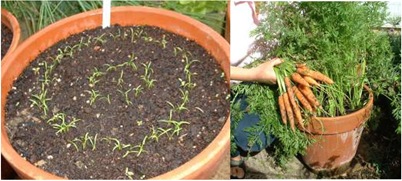
carrots_in_containersIt is easy to grow carrots (and other vegetables) in containers, be those large “flower” pots or other tubs. In fact, as far as container types are concerned the sky – or better your imagination – is the limit. Do NOT, however, plant any vegetables whatsoever in tires unless they did have inner tubes. The steel radial belted tires are not suitable as they leach cadmium into the soil which is taken up by the plants and is harmful to health. In fact, my advice is to leave tires well alone and use only, if you want to, for the growing of flowers, cut or other, but not for food. That means also no nasturtiums in tires as you may want to use the leaves and flowers as they are edible.

In order to grow carrots – and other veg – in containers all you have to do is get the container you want, and this can even be an old bathtub, fill with compost and this can be compost you have bought in or made yourself (or use the lasagna gardening method (and no, you won't be harvesting lasagna, however nice this would be), and then sow the carrots, or other veg. Or you can use plugs you have grown yourself from seed or bought. Do not, however, do this with carrots or their relations as they do not like to be moved.

If you use a round tub you can sow, I tend to do, in a circular fashion and don't fall for the instructions that you have to thin them out. You don't have to.

As I have said, the containers that you use are basically irrelevant. Just ensure there is enough depths of soil.

I have very successfully grown carrots in shopping carts converted to planters and, in fact, this year has me using a cart for this again where last year there had been pole beans growing in them.

Container vegetable growing with carrots has a lot going for it as the environment is so easy to manage, and this goes for about every kind of vegetable imaginable. It is the easiest way I know for how to grow carrots and any other vegetables. I also grow successfully potatoes in containers of various kinds and sizes and,, another word of wisdom from myself: You do not have to use seed potatoes either. Just use any that have sprouted, even supermarket bought ones.

Carrots in containers are target for the dreaded carrot (root) fly in the same way as those that are grown in beds. However, when the planters are about waist height off the ground the problem seems to be reduced to averted, as I found with the ones grown previously in a shopping cart.

If any roots of the carrots begin to show above soil level earth them up to cover the them in order to lessen the chances of a carrot fly attack. The fly is apparently attracted by the carrot smell and also you do not want the tops to green off.

Talking about greens. The greens of the carrots are also edible and make good soup so do not discard the leaves but use them instead. Waste not want not was the old adage of my grandparents and has seen them well through the lean years.

Sowing your carrot seed

Sown over the months from mid-February to July you can be eating carrots from early June to October. Storing this vegetable correctly can increase that period even longer. Below is a list of the average sowing and harvesting dates that will act as a rough guide on how to grow carrots at the correct times in the British Isles. They will vary in other areas, such as the USA, mainland Europe, and especially Down Under.

  • Sow mid February and protect with a cloche. Grow an early variety which you can harvest in early June.

  • Sow March and protect with a cloche. Grow an early variety which you can harvest in June/July.

  • Sow April - no protection necessary. If you grow an early variety expect to harvest July/August. A main crop variety will be ready August.

  • Sow May. Grow a main crop variety and harvest in August.

  • Sow June. Grow a main crop variety and harvest in September.

  • Sow July. Grow a main crop variety and harvest in October.

Remember that for container the spacing does not apply and, as said already, do not worry, necessarily, about thinning them. All too often you end up pulling those that you do not want to pull out with those you aim for.

Caring for your carrot plants

As you are growing them in a container using a hoe, with the exception of a small wire hoe, such as the Agralan Threadhoe, is not possible and thus you will have to remove any weeds by hand.

Water enough to keep the ground damp as splitting of the root can occur if the watering is too irregular. Also water with a liquid feed on a regular basis. They respond well to this.

Carrot pest control

The carrot fly is the carrots' worst enemy. It is a small black fly which lays its eggs in the soil at the base of the plant and it is the small maggot that hatches from those egg that causes the damage. The tell-tale signs of carrot fly infestation are reddish leaves which droop in sunny weather.

As the maggot eats out the carrot root the foliage turns yellow and the root is liable to rot. Needless to say seedlings are shown no mercy and are soon killed. The fly tends to be most common in May.

There is no known treatment against the carrot fly, even if one of the other chemical claims so and thus preventive measures are the only safeguard that you can undertake. It is essential to learning how to grow carrots and indeed any vegetable that you get to know your enemy.

  • Cover seedlings with a plant fleece in spring.

  • Destroy thinnigs immediately - bury, burn or trash can.

  • If carrot fly infestation is bad in your area then harvest early varieties no later than August and do not sow main crop varieties until June.

  • Infestation seems worst on dry soils so keep the ground damp at all times. This also prevents root splitting.

One thing to remember in learning how to grow carrots is that the carrot root fly's 'flight path' is low and in a straight line. It is for that reason that I said about placing the containers above ground at about waist height. Also makes it easier for your back in dealing with the plants.

If you grow at ground level then try erecting a low 'fence' around your carrot growing rows – about 30 cm (12") high. It could be made from fleece, fine netting or similar.

Harvesting your carrots

You can start harvesting the earlier varieties sown from about June onwards. Careful, even if grown in tubs, loosen the soil around the plants – you won't be able to use a garden fork, not even a border one, but a hand one will work – if necessary.

If you intend to store some of your crop of carrots for over winter then October is the best month for doing this. Lift the main crop varieties, clean off any soil – use only undamaged carrot roots – and cut the foliage back to about 12 mm (1/2") above the crown of the root.

Using a stout box place the roots on layers of sand – ensuring that the carrots do not touch each other and then store this box with the carrots in the sand in a dry place and inspect regularly to remove any that may have started to rot. This way they should keep until March.

Canning your carrots in a variety of ways is another great option and thus learning the skills of canning is also a good idea.

© 2013

Starve the system

Starve the system and grow your own food

by Michael Smith (Veshengro)

In fact, grown your own food and make as much yourself as possible. That way you are beating the system and doing it your way.

It is becoming pretty clear that industry and the powers-that-be do not care what the people think and want as regards to genetically modified, or should we better say genetically engineered, organisms. Many of us, no doubt, know where we are headed if this madness does not stop.

It is all about profit for some companies and control over seeds and has nothing whatsoever to do with trying to combat world hunger. In fact it has been proven that GE foods will do nothing to curb world hunger.

The only true answer to this, as far as foods are concerned, is to grow and raise your own. Self-reliance and self-sufficiency, as far as the latter is possible, is the ultimate protest against this. As long, I hasten to add, they will not make it illegal, as they are already trying in some location where the growing of a food garden, even in the backyard, has been outlawed under local ordinances.

Henry Kissinger said some decades ago – in fact just before the so-called oil crisis – that if you want to control nations you have to control fuel (enter the oil crisis, which was nothing but nicely engineered) and if you want to control people you have to control food (enter Monsanto & Co.). We could also add to the people control mechanism water, could we not.

Growing your own means that every vegetable that you do not have to buy takes away from their profits. We have the power to take away their power and we have to do it and the way to do it is through our pocketbooks.

We are the ones who, ultimately, control the system as we have founded it though our purchases. By withdrawing our purchasing and growing our own we can take a stand and send a message.

Aside from growing your own food there are also other methods where big business can be sent a message and also the powers-that-be that we, the people, are no longer going along with the system.

You can make do with what you have got for starters. You co not have to get a new smartphone each and every time that a new one, or a new version of your current one, be it iPhone or other, comes onto the market. If it ain't broke there is no need to replace, and the same applies to computers and other goods.

Furthermore there are many things you do not have to buy at all. You can make them yourself by proper DIY, and by upcycling and reusing and repurposing items of waste or such.

As not everyone is going to travel the same route as which we may be taking there are still those that will stay in the system and buy new things and there, therefore, will be the things that they, often still working or needing just a little TLC, are tossing out and which we can liberate from the trash. There are many people who already live that way and do this for most of their needs.

It is amazing what people actually do throw out and lose, accidentally or deliberately, in parks, open spaces and elsewhere, in way of clothes, bicycles, and many other things, most of which can be reused directly or by passing it on to someone else, with just cleaning or, at times, a little TLC and a tiny bit of repair.

My Blackbery came to me that way as did my Leatherman Wave, and most of my bicycles. The latter where rebuild from a number of thrown or trashed bikes and the two former items were simply thrown away.

My drinking glasses are repurposed glass jars, whether for beer, water, or spirits, and my reusable water bottles from tap water also are reused glass bottles that came with drinks, or where found and cleaned.

My notebooks, and I carry at least one at all times, are homemade from paper that was but printed single sided and the amount of pencils that I have found beggars belief.

I also do grow a garden and also make use of edible weeds, either foraged or actually grown on purpose. A weed is, after all, but a plant whose virtue and uses have not as yet been discovered. Truth is though that for many plants that are commonly referred to as weeds the virtues and uses have been discovered and the edible ones are often better eating than their domesticated cousins. And there are also many weeds out there that are medicinal herbs in fact and have many uses. Just because it grows somewhere where you may not want it to grow does not mean that it does not have a use.

Growing your own food and, where you can, keeping chickens (hens) for eggs, and raising chickens and rabbits for meat, is the easiest way to beat the system. That, and making do with what you have got and making as much as possible yourself. Let's do it and send a message to the powers-that-be that be that we no longer support the system which is not broken; it was designed this way, and therefore we need a new system. One that benefits both man and Nature.

© 2013

No Yard? No Problem?

by Michael Smith (Veshengro)

container-gardenMany people believe that in order to grow their own vegetables they need a large garden but container growing is a great way to have great tasting fresh vegetables even if you don't have the yard space for a full garden.

Container gardening is the answer for those that are short of space as regards to gardening, whether flowers, or as far as we are concerned, vegetables for the table.

Growing in containers, with loose and deep soil, also allows the plants to be closer together and thus the density of them does away with an over-amount of weeds and also makes for a larger harvest.

The type of containers for this kind of growing is legion and you can go out and buy decorative ones at a cost or, alternatively, repurpose any other kind of container, including old bathtubs, sinks and the like. It just depends as to whether you want a certain look or just simply a food garden for as little outlay as possible.

Aside from putting your planters on the ground you can also use containers in the vertical, by hanging them up, putting them on old stepladders, etc.

certain trailing tomatoes, for instance, do well in hanging planters and hanging baskets and some plants can, actually, also be grown hanging upside down.

Pot and other containers hung on a fence or a wall can be used to grow herbs and spices and the do do very well in such situations. Also much easier to harvest if they are at the right height.

I have filled my yard, even though I could have been digging or using raised beds, with containers of all kinds that have been repurposed into planters, including so-called builder bags or tonne bags, plant buckets and tubs from tree planting, etc. Even old shopping carts have been drafted into use, lined with barrier fabric and such, as planters.

The latter are ideal for use with growing carrots as they are above the height of the carrot fly's vector and thus are more or less out of its reach to it.

That does not mean, unfortunately, that a container garden will be immune to pests. It is not, and neither to weeds. However, you have a little better access to each and every plant to check and manually destroy pests or remove weeds.

Using containers in your yard you can still have a garden and grow at least some food for your table even if you do not have the space for a proper garden.

So, go and dig some dirt and grow some tasty veg. You no longer have any excuse.

© 2013

Mixing flowers and vegetables

by Michael Smith (Veshengro)

The majority of people, even gardeners, always think of flower gardens and vegetable gardens as two separate entities, but there is absolutely no reason to think that this is the way it has to be.

flowers&vegOn the contrary. Think about the kitchen garden of colonial days in the United States and the cottage gardens of England. It was a mix of vegetables, fruits, flowers, and herbs.

While some see this as companion planting it is not, necessarily thus, as the plants may not be chosen for the companion value. Companion planting, on the other hand, is something that would make such a mixed flower and vegetable garden even better.

Such a vegetable-flower garden can be seen as an artistic palette, strictly for appearances and enjoyment. And with proper mix there is no reason, other than idiotic ordinances in many parts of the United States (and Canada) to have such a garden also in the front yard. Apparently, however, the powers-that-be in some town halls and such demand that the front yard is but lawn and maybe, just maybe, some pretty flowers.

Your vegetable-flower garden can be orderly or not so orderly. It depends on your personal style and choice. As a front yard food and flower production area it might be best to have it rather orderly as to not to upset some town hall folks.

You do however need to take into account the growing style of the vegetables and flowers. Pumpkins, cucumbers, and squash need lots of horizontal room to grow so you want to avoid planting flowers too close. Unless, that it, you train those plants to climb trellises, which most will quite readily do.

Think about plant forms and foliage too. Peppers are upright and shrub-like. Corn is tall, vertical, and leafy but would look terrific mixed with sunflowers. Or, concentrate on color combinations such as white, purple, and pink for earlier flowering vegetables and flowers, or yellow, red, and orange for late summer crops and blooms. The gold color of marigolds and the dark green of spinach for example or red flowers of nasturiums next to those bright red chile peppers.

You could also add some colorful brassicas into the equation. Despite the fact that some people see them just as, as they are also referred to by seed merchants, ornamental cabbages, they can be eaten and thus make for a great color combination, even still giving color in the depth of winter.

When it comes to planting corn why not follow the Native American approach and plant the Three Sister, that is to say corn, bean and squash together. The corn then acts as a trellis for the beans and even the squash to climb up and they seem to love to live together in perfect harmony.

© 2013