Showing posts with label coppicing. Show all posts

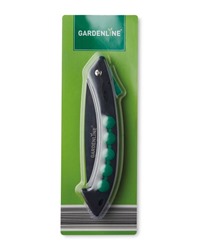
ALDI Gardenline Foldable Saw – Product Review

Review by Michael Smith (Veshengro)

Gardenline-Garden-and-Camping-Saw-AALDI Gardenline Foldable Saw
Length approx. 18cm
Carbon steel saw blade with 3-sides ground teeth, ABS handle with TPR grips
Thickness: 1.2mm (Blade)
Price (when available) £ 4.99

I purchased this saw, more or less, to try it out as to how it would perform and not, like often, given this as a review sample. Having used it on both old and green wood, including rather hard cherry, I must say that it performed if not as well then at least almost as well as some rather expensive makes of saws of this kind, at a fraction of the cost.

Gardenline-Garden-and-Camping-Saw-CI would certainly say that this saw is ideal for gardening, pruning, camping, clearing trails, hiking, tree trimming and light coppice work.

Blade safety lock with a safety locking mechanism that double locks, so to speak, as it also locks the blade once on the way down, thus making the closing of the blade safer reducing the risk of closing it on the hand.

Unfortunately, as with all ALDI special buys offers, these saws are always only available now and then and then only as long as stocks last which, at times, may last for a couple of days or a couple of weeks depending on demand.

Obviously, the question is now as to how this saw holds up in sharpness and other things in comparison to other, more expensive ones of brands that I am not going to mention here.

© 2018

Keeping A Tidy Wood: Yes or No?

by Michael Smith (Veshengro)

The answer should definitely be yes. It has been so in the past and should be so again.

Debris and such left lying around the forest create nothing but a fire ladder and a hazard, for both fire and biological in that such material is a haven for the bark beetle and other pests that gladly will attack your standing timber as soon as they have finished their first lifecycle in the old dead and decaying timber.

The environmentalists who insist that we, the foresters, woodsmen and woodland owners should leave debris such as the cut tops of tress and branches in place out in the woods “for the wildlife”, in my view, do now know what they are talking about and that is also the same as regards to those that insist that we need to leave out old coppice woodlands unattended so they can revert to proper wildwoods as they were hundreds of years ago, and such baloney, in order not to use a rather harsher word.

The only “wildlife” that will take up residence in old branches, tops, and the like are, in general, with a few exceptions, pests that will destroy standing trees as much as they will eat their way thru dead wood. And allowing ancient and not so ancient coppice woodlands to “revert back to wild woods” does not work because as soon as coppice stools are left unmanaged for too long they will break apart, the trees will fall and that is the end of the woodland as most of those trees will break apart virtually at the same time, seeing they more often than not are of the same age. It would appear, however, as if the environmentalists do not want to listen to that as they keep on about that we are only interested in making money out of the woods. Those who say that have no real knowledge of what actually drives a true forester and woodsman in his work. But I digressed. I shall come back to this, however, at some other occasion.

In the days of old and even in the not so distant past very little if any branches were left littering the forest floor; it was all used for crafts such as walking stick making, bodging, heating, etc. and there was still plenty of wildlife – more than today in actual fact – but very little on forest pests.

Today with our mono-cultures of whatever wood – I am not just talking about the often ugly regiments of conifers where they should never have been planted – despite leaving cutting litter everywhere, often rather higgeldy-piggledy there is less proper wildlife but many more pests set to ravage our trees. Combining that with the lack of bio-security when it comes to imports of stock, for instance, and the rather daft practice of collecting seeds here and then sending the very same seeds abroad to be grown on and reimporting them, the result of which is Chalara dieback of ash caused by the fungus Hymenoscyphus fraxineus (and probably other tree diseases) and we have a recipe for absolute disaster.

Many of the pests affecting woods and forests nowadays seem to have been virtually – in their current strengths and numbers – unknown in the past when woodlands and forests were much more intensively managed and kept clean & tidy but which were, also, generally not single species mono-cultures.

In my childhood fallen branches were cleared away rather rapidly and that not by forests staff only who used them for heating their homes but also by people who had permits to collect firewood in the form of fallen branches from the woods and forests.

Might it just be that the so-called management of our woods and forests today is the wrong kind of management? It very much would appear to be the case and much of the blame may have to be, aside from the mono-cultures, laid at the door of the heavy machinery that it used nowadays for felling and timber extraction, especially the so-called timber harvesters.

The weight of those machines and their special wheels seems to churn up the woodland and forest floor to such an extent that it may – and I say may as we do not have proof for that – destroy the mycelium that is the communication network between trees and plants and also all small wildlife, as in invertebrates and other small creatures that live in and on the woodland floor.

It is time to reactivate the old management methods for our woods and forests, with coppicing at the top of the list, to rebuild the woodland communities, the ones of trees and soil, as well as those of people and not try to apply a band-aid on the damage we keep doing by our modern practices of mono-cultures and heavy machinery use.

© 2015

For more on coppicing and why, etc. see “Managing our Woods”, a small book that explains the whys and wherefores of managing our woods in this way and calls for us to return to that way.

Protecting coppice regrowth

by Michael Smith (Veshengro)

Protecting the regrowth of any coppice trees, be they Hazel, Ash, Sycamore (yes, that tree often so maligned for being non-native but ever so useful), or whatever else, is important if we want to see a a return for our labors.

In the British countryside there are a number of deer species roaming about; some of which are native, such as Roe and Red deer, while others, such as Sitka and Muntjac deer, have been introduced (unfortunately, one might say).

Deer pose quite a threat to a coppice system as they have a tendency to munch off the for them rather tasty new seasons regrowth, and if this is left unchecked those stools of whatever tree species will eventually die out, which would completely destroy a coppice woodland. However, deer are not the only “grazers” that pose a threat to coppice regrowth; rabbit (coney) and hare do too.

Deer may be beautiful to watch – and I do love to see them in the wild – but one of the reasons why deer are not popular amongst foresters is the amount of damage they can do to woodland. In late winter/early spring the males use trees to rub the velvet off their antlers, causing great damage to whole stands of trees. For this reason it is often necessary to control numbers of males. Though controlling of numbers – and not just of males – is also necessary, in the absence of predators, in order to preserve health and viability of the herd. Deer can also decimate, as already indicated, an unprotected area of coppice by stripping off all the new buds from the regrowth.

In a stable, fully functioning eco-system the population densities of grazing species are maintained at a sustainable level by top predators and in the past this would have been the case in the British Isles with species such as wolves, bears and lynx that would also have been roaming our countryside.

Now that we have lost those species it is important that we take measures to protect any coppice regrowth to ensure the survival of coppiced woodlands, which in some cases are also classified as ancient woodland.

There are several methods which can be used to protect coppice growth. One of them is to cover up the coppice stools with brash wood from the trees that have been coppiced (brash wood is the twiggy branches from the crown of a tree).The theory is that the brash wood would allow the re-growth the opportunity to grow woody enough so that it is unpalatable to deer. That, at least, is the theory. I have not tried it in practice (as yet). In places where it has been tried the success was not a very good one which could have been due to the brash not being high enough above the stools or the brash piles do not provide a high enough barrier.

Another method is to weave brash wood into a basket-like structure around the coppiced stool. The principle is similar to the previous method; the baskets should provide the new growth protection until they grow over the baskets. By which time they should be woody enough to be left alone.

Large scale coppicing projects often use of temporary electric fences. This is perhaps the quickest and most efficient method if a large coupe has been coppiced. The idea is that deer are completely excluded from the freshly coppiced coupe, hopefully providing complete protection to the new re-growth. Obviously this method will only be suited to certain circumstances where the presence of an electric fence is not a problem, and where there is no problem with interference by vandals.

Other kinds of temporary fences could, I am sure, also be employed, such as those plastic fences that are used often around building sides, road works, and such like and there is also a version available in black if one does not wish to use the more common orange colored fencing.

Perhaps the oldest and most traditional method of deterring deer from browsing a freshly cut coppice coupe is simply the presence of humans and this may have been one of the reasons why woodsmen would traditionally live in the wood for extended periods of time, sometimes full time even, near the woods they were working.

A method that is said to have been used on the European mainland, especially in Germany, to protect coppice regrowth or newly planted trees was a “fence” of rope into which were tied rags every foot or so that had been soaked in some evil smelling liquid. But, much like electric fencing, this will only work where there is no danger of interference by vandals or such. The idea here is that the smell will deter the deer entering the “fenced off” area.

In general forestry operation new plantations of trees are protected by so-called deer fencing, which is just a stronger and taller kind of stock fencing really, though there are also some that have added protection against hares and rabbits entering. But if Mr Bunny wants to get in he might decide to burrow under the fence. Not much that will stop him except for a fence that is dug quite a way into the ground.

As coppice regrowth, in general, does not require a long exclusion period temporary fencing of one kind or the other, and aside from the previously mentioned plastic fencing there is also the split chestnut type that is often used on woodland operations and also in agriculture for penning in or out small livestock.

While it may not look as pretty as a woven basket structure around a coppice stool both the orange or black plastic fencing and the split chestnut type are reusable and quick to erect and remove and thus might be the best option in the book. Split chestnut fencing may not require any stakes, though they do help, while the plastic fencing can be put up with road pins, for instance.

© 2015

For more on coppicing and why, etc. see “Managing our Woods”, a small book that explains the whys and wherefores of managing our woods in this way and calls for us to return to that way.

Coppicing is vital to our woods and our economy

by Michael Smith (Veshengro)

Coppicing, the ancient woodland management practice, is vital to the woods and to the economy, especially the local economy.

In many parts of our country, if you happen to go down to the woods, you may well encounter an enthusiastic group of people from all walks of life reviving a tradition that is as ancient as the managed woodland itself, and it is a revival that is not before its time.

Coppicing, which is the cutting of hazel, and other deciduous trees, to produce usable timber products and encourage animal and plant life to thrive, is making a comeback. This is reckoned to be due to a throwaway remark from a master thatcher about the difficulty of sourcing British made thatching spars. However, there is more to that for not only thatchers are asking for local thatching spars, tool manufacturers also have commented on the lack of British ash for the making of handles for such tools, whether for garden tools or for hatchets, billhooks and axes.

For far too long have we allowed our woodlands to fall into disrepair because we have not managed them in the age-old fashion, by coppicing. Much of this is due to two reasons. One of them being that we have seen imports to be easier to obtain than actually dealing with our own woodlands but the second one, and one that has done the greatest of damage here, is the attitude that has come about by the opposition from the side of many “eco-warriors” who have read the wrong books that the cutting of trees is bad and thus must not be done.

When it comes to sustainability wood for building and for products is hard to beat and many people are well into buying wooden products (again) nowadays, including woven baskets, for the reason that wood is sustainable and carbon neutral and that, at the end of its life, it whether it is but into the ground or is burned, it only releases the amount of carbon that it absorbed during its life. However, most of the wooden products, whether it is kitchenware, baskets, tool handles, etc., do not come from indigenous woods but from woods far afield and often are made for cheap in countries such as China, Vietnam, etc., and then need to be shipped to our shores. The sustainability scale their drops off drastically.

Homegrown wood, from sustainably managed coppice woods could tick a lot of boxes here, although the products might have to cost a little more than the machined ones though wooden that come from abroad in order to be able to give the coppice worker and the producer an income from which they can live.

Thatching alone in Britain is a significant business consuming an incredible 25 to 30 million hazel spars a year which are used to hold the thatching straw, or reed, in place on the roof and at around 10p each that could generate a business worth a potential of £3 million nationally.

As with so many coppice products, though, the price for such spars, as much as for other products, be those beanpoles, walking sticks, etc., are often far too low priced to give the coppice worker an income. Those products take time to make, and the more elaborate the more time is involved, and we need to reconnect the time it takes to make a product with the price if we want local woodland industries to exist and thrive.

While coppicing is not only or even primarily about making money it does have to come into it if we want our woodlands and our woodland industries to exist, to thrive, and new ones to be established, both coppice woodlands and woodland industries.

Coppiced woodlands are part Britain's cultural heritage and thousands of years their management has provided a wide range of habitat for wildlife as a useful by-product to the original primary task which was that of providing essential raw materials for agriculture, housing, industry, and much more.

The surviving copses across many parts of the country are reminders of the local history that has moulded landscape and communities and provide yet more evidence that even what appear to be our wildest places have been managed by man for centuries. And, lest we forget, if we do not take up this management again we will lose those woods for once managed management will have to continue.

And far from compromising wildlife and the natural world, coppicing allows light and warmth into a wood, helping woodland flowers to thrive and, as time goes on, encourages sometimes endangered species to keep a foothold in the countryside, from the dormouse to the rarer kinds of butterfly, like the silver wash fritillary and several species of woodland birds.

Coppicing ticks more or less all the boxes for anyone looking for an outdoor activity that is 100% sustainable, especially if the majority of the activities are carried out in the ancient way by using human- and animal-powered tools and equipment only.

Correctly managed an area of coppice is ready to supply its next crop of rods, poles and other timber within five to 30 years of the first 'harvest', though there is also a great deal to be said for simply getting out in the woods, and creating something useful and beautiful from the natural materials.

Aside from revitalizing and reestablishing coppice woodlands and managing them properly we also must set up the appropriate “industries” and markets for those forest products. And those products must be more than just thatching spars, beanpoles, pea sticks, tent pegs, walking sticks, firewood and charcoal. And we also must take care that little to none of the wood “produced” is wasted.

© 2015

For more on coppicing and why, etc. see “Managing our Woods”, a small book that explains the whys and wherefores of managing our woods in this way and calls for us to return to that way.

Woodlands

by Michael Smith (Veshengro)

Throughout history trees have formed an intrinsic and vital part of our cultural landscape. Our woodlands, and woodlands in general, have been managed and worked by woodsmen since antiquity supplying lumber, the most noble of building materials, and firewood for heating homes and cooking food, as well as wood from which to make the majority of products that were being used, from tools and tool handles, to kitchenware, including spoons, plates, and everything else in between.

Growing trees and using their wood is increasingly recognized as one of the most environmentally sustainable land uses. Yet, in recent decades our relationship with our trees and woodlands has waned, with the UK importing an estimated 80% of its timber, whilst only 20% of the country's woods are actively managed.

The Department of Land Economy of the University of Cambridge has been running a long-term study investigating trends in the management of private woodlands on traditional estates in England and Wales. The study commenced in 1963, continued through the 80's and 90's and the findings from the latest survey in 2006, strongly suggested that there has been a deterioration of the financial performance of many estate woodlands to the point where management has been reduced or even suspended.

It is not just the deterioration of the financial performance of the estate woodlands that we must be concerned with but the deterioration of them in general due to the reduction or even suspension of management. And it is not just the private estate woodlands that are thus afflicted. The same goes, maybe even more so, for council owned woods and woodlands. They are all in dire straights.

Wystan Hugh Auden wrote in one of his works “a culture is no better than its woods” and if we look around us today I would say many of our cultures are not worth much, considering the way we treat our “native” woodlands. However, thankfully, a revival of our “woodculture” seems to be on its way and this is to be more than encouraged; it is the way forward, for the new age, the coming age, is the age of wood, or the Wood Age. We have had the Stone Age, the Bronze Age, the Iron Age, though, theoretically we are still in that one, even though some insist to call the current age the Technology Age.

Wood, however, is the way forward, once again (we have been there once before, I know) for many of the things that today we use plastic, for instance, and what better than that wood being home-grown, coming from a woodland near you. This would benefit not only the local economy and the local woods – and the woods in this country per se – but also the environment and the Planet.

Wood from local forests and woodlands also cuts down on the so-called “woodmiles” and keeps those to the absolute minimum, and this even more so if the sawmills and other wood-using businesses and craftspeople are local and the products sold on markets as local as possible.

The majority of woods in Britain, whether privately owned or owned by local and county councils are in dire straights and lack of market is but one small reason for this lack of proper management which has caused a multitude of problems. Lack of vision and lack of finance is another big part here as is the fact that there are a multitude of misguided “environmentalists” who believe – and are very vocal about this – that cutting any tree is bad for the environment.

Coppicing, the age-old and time-honored and time-proved method of managing hardwood woodlands, in which trees are cut at a certain age and then allowed to naturally regrow from the root stock, the stool, is not harmful to the environment at all. The opposite rather. It benefits both the woodland and the wildlife. In addition to that bringing our woodlands back into production, primarily by means of coppice management, not only benefits the woods and the wildlife but also the local economy as it will create employment and products. It is a total win-win situation. Realizing it though in the right quarters is an entirely different story.

© 2015

For more on coppicing and why, etc. see “Managing our Woods”, a small book that explains the whys and wherefores of managing our woods in this way and calls for us to return to that way.

Weed your woods

by Michael Smith (Veshengro)

It may sound silly at first, but, if you want to make your woodland (more) productive, just treat it like a big vegetable garden. You will grow the best crop if you cut the weed trees, thin the thick spots, and harvest the crop trees before they get too "ripe" to use.

But, let's start where we always should start, namely at the beginning.

A wood, even a forest, is to the forester the same as a field is to the farmer or a garden to the gardener and all of them need management if they are to thrive. The only difference between a gardener or farmer and a forester is that the latter often does not, except in coppice management, ever sees the harvest. He harvests often what others, long before him, have planted, and he manages and plants for the future, for harvests that are carried out by others, often after he is long gone.

Alas all too often there are people about who believe that Mother Nature does a better job than we could ever do and there are time when that is true. If the woodland, however, is to be of use to us and to wildlife and be a thriving ecosystem then management by man is required and this even more so if the woods have been managed before by the hand of man for our use, and this even more so if the produce of such woods are also to benefit us.

Even when managing a coppice woodland weeding certain trees out and doing selective cutting here and there is required and in stands where large trees are to be the result then thinning is a must and it must be repeated every couple of years and, if permitted, over time those cut trees may actually turn into coppice stools and a so-called coppice with standards will result and a good result that is too.

Your goals will greatly affect your management decisions and your management decisions will greatly affect the outcome and the produce. Of course, the existing conditions of your woodland may have an equally great effect on your decisions and the outcome.

A mature stand of timber may dictate a heavy cut to stop further decline while a mixed-age or middle-aged stand of timber is a likely candidate for a selective cut. Any young stands can be like a recently sown bed of carrots, nothing will prosper without a little thinning. When it comes to a woodland of mixed-age or middle-age stands of timber then, if it is hardwood, or deciduous woods, which, hopefully it is, of native trees then one of the best options is to create a coppice with standards and if it is a coppice woodland that was previously managed as such then you may find many an overstood coppice stool that needs immediate attention.

Once you've decided your motives, you need to find out just how saleable your timber is. Become “wood-wise” and learn to recognize the potential in a tree or a stand of coppice. Also the species that you have growing and which are due for cutting and then research the market. The original task of the professional forester was that of recognizing what every tree or part of a tree could become by way of product and use and this “eye” you, as a woodsman, will also have to develop. Once you know all that research your potential market and not, necessarily, people such as sawmills and the like but look at what you, actually, could make out of the wood yourself that could be sold to end-users rather than processors.

Selling to a sawmill or any processor will greatly reduce your income from your woods. On the other hand if you go into production of wooden goods yourself you will have to have the time for doing so, the tools and then a way of marketing them to the end-users. It is all a case of horses for courses. A sawmill or other processor may give you x for the whole tree but processed by yourself into a variety of products, and the same is true for coppice stems, will give you x4 it is obvious that you can make more, in financial terms, from processing most of the wood yourself. But, as said, it requires time, effort, and tools to do so.

When it comes to the felling, especially of larger trees, and you have not used a chainsaw before and/or felled large trees then please do not do it without any training even if it is your land and in all theory you can use a chainsaw there to your heart's content. Chainsaw take no prisoners and are extremely dangerous, as are trees falling. We are talking several tons in weight coming crashing down at a rate of knots. So, I say it again, learn felling of trees or get an experienced lumberjack to do the work for you. Do not take any chances.

Now, what are the weeds and what are the crops?

Well, a crop tree is any reasonably mature tree worth harvesting, or one that has the potential to grow into such a tree. Weed trees may just be species of low value, or may be damaged by rot, fire, lightning, wind, insects, etc. They could also be trees excessively lean or that are rather crooked. Removing those, and those that otherwise interfere with the growth of the other trees, is called thinning, and is much like thinning out a bed of carrots.

In any woodland for trees to develop to the full potential it is important that each of them has enough space to grow and develop. It is a little different in a pure coppice as compared with coppice with standards and a lot different in a stand of timber where all are meant to be single stems growing to maturity.

Thinning (weeding) is a valuable exercise even in a pure coppice where I have begun to referring to it as selective coppicing for here we can do it in two ways. We can either remove stems that are already harvestable for a variety of products and leave other, smaller ones, to grow to a decent size or removing those small stems that are and never will be of any use but which interfere with the growth of those we want to harvest in a year or four, those that are spindly, deformed, or otherwise of no use.

Our main aim, with hardwood trees, is to create, when working to rejuvenate a woodland, a sustainable coppice woodland, either as a pure coppice or a a coppice with standards, and the former is easier to maintain than the latter, in all honesty.

But the latter will make for the production of timber in size that cannot be achieved in a pure coppice and thus often that is the one to go for.

In that case weeding, aka thinning, will be required on a regular basis especially also as you will want to bring on new growth, natural regeneration, and encourage those young trees to grow to mature standards to eventually replace those that you will cut in time.

In order to help them grow, however, the area around them in the woods will need not just thinning but also in this case really weeding. But unlike in the garden you don't have to remove dandelion and such like but brambles and bracken and such vegetation that might encroach and smother the saplings or otherwise impede their growth. Protection from grazers too may be required and some wire-mesh or the chicken-wire variety held by some stakes will, more often than not, suffice. And then there is more weeding and thinning.

© 2015

For more on coppicing and why, etc. see “Managing our Woods”, a small book that explains the whys and wherefores of managing our woods in this way and calls for us to return to that way.

The need for a return to coppice management

by Michael Smith (Veshengro)

The high timber forest consisting of so-called standards, with no small growth trees and coppice beneath, has its place and especially in areas where coppicable deciduous trees do not and cannot grow, and also for some end uses. In general, however, we must return to coppice management in most if not indeed all of our woodlands wherever it is possible in order to bring homegrown wood back into the economy and especially in order to rebuild local woodland industries.

For far too long the old woodland management practice of coppicing has fallen into disuse in favor of growing pine, spruce and fir – relatively quick-growing conifers and others such as larch, as standards (there is no other way as conifers simply do not coppice) to supply lumber, often for low-quality use, rather than hardwoods from full coppice woods and from coppice with standards, the latter which can be used to produce much higher quality products.

A great many of the products that once were made from coppiced wood nowadays are made from plastic or machined from wood in countries far away, or from bamboo, and carried around the globe at a high cost, especially to the environment, that is to say the Planet.

A return to coppicing our woods and using the timber harvested could bring a return of home-grown timber products made to high standards by local craftspeople and though those products would be more expensive than the current imports and those made from plastic they would be hundreds of times more sustainable.

At the same time the woods and the wildlife will benefit and so will the local economy also. The woods and the wildlife both benefit under coppice management because biodiversity is increased once the canopy is opened up every couple of years when sections of the woods are harvested and also because, in comparison to pine, spruce and fir, in broadleaf copses there is a complete set of layers to the woods. In the dark coniferous forests of standards those are generally non-existent due to lack of light penetrating the forest floor.

Coppice woods, while also dark in summer when growing and in leaf, this scenery changes, however, every seven to fourteen years when the stems are harvested. The canopy then is open for a couple of years and the everything changes on the woodland floor and coppice woods, especially coppice with standards, exhibit the entire range of the levels of the forest, benefiting the biodiversity of the woods and representing the healthy balance of a wood.

Die Notwendigkeit zur Rueckkehr zur Niederwaldwirtsschaft

Hochwald hat seinen Platz und ganz bestimmt dort wo Niederwald aus den richtigen Laubbaeumen nicht funktioniert. Aber im Grossen und Ganzen muessen wird zurueckkehren zur Niederwaldwirtschaft in der Grosszahl wenn nicht sorgar allen unsere Waelder (wo immer moeglich) um selbstgezogenes einheimisches Holz wieder zuerueck zu bringen in die Volkswirtschaft und besonders auch um die heimischen Waldindustrie wieder aufzubauen.

Fuer viel zu lange ist die Niederwaldwirtschaft bereits das Steifkind in der Waldwirtschaft und dem Anbau von schnell wachsenden Nadelhoelzern wurde Vorrang gegeben als Hochwald um Holz, oft fuer niderwertige Verwendungszwecke, zu produzieren, an Stelle von Hartholz aus dem Niederwald und dem Mittelwald.

Viele der Produkte die frueher hergestellt wurden aus dem Holz aus dem Holz das aus dem Niederwald und dem Mittelwald kam, oft in Heimarbeit und kleinen Werkstaetten, sind duch Plastik “ersetzt” worden und durch Holzartikel die von Maschinen hergestellt werden, oft im Ausland, im Fernen Osten, oder aus Bambus, und dann um den Erdball transportiert werden, zu hohen Kosten, besonders fuer die Umwelt und unseren Planeten. Das Holz selbst, fuer diese Produkte, oft stammt auch aus dubioesen Quellen.

Einen erneute Hinwendung zur Niederwaldwirtschaft und die Verwendung des auf diesem Wege produziertem Holzes koennte eine Rueckkehr von einheimisch gewachsenen Holzprodukten von hoher Qualitaet, hergestellt von einheimischen und ortsansaessigen Handwerkern, auf dem Markt sehen.

Waehrend solche Produkte, da handgefertigt, teurer sind als die momentanen Importe und Produkte aus Plastik sind sie aber hunderte Male mehr nachhaltig und halten auch laenger.

Zur gleichen Zeit wird sich eine solche Rueckkehr zur Nieder- und Mittlewaldwirtschaft positiv auf unsere Waelder und auf die Pflanzen- und Tierwelt auswirken wie auch auf die heimische Wirtschaft. Waelder und Flora und Fauna profitieren von kirrekter Niederwaldwirtschaft da die biologische Vielfalt sich erhoeht sobald das Blaetterdach des Waldes alle paar Jahre gelichtet wird wenn Holz in bestimmten Abteilungen des Waldes geerntet wird. Und auch weil in Gegensatz zum Hochwald, besonders dem Nadelwald, in Laubwald unter Niederwaldwirtschaft all Schichten des Waldes vorhanden sind, und besonders so im Mittelwald. In den dunklen Nadelwaeldern sind diese jedoch generell nicht vorhanden da wenig Licht auf den Waldboden durchdringt.

Waehrend Nieder- und Mittelwald auch dunkel sein koennen im Sommer wenn die Baeume wachsen unbd im Laub stehen, aendert sich dieses Bild jedoch alle sieben bis vierzehn Jahre wenn naemlich die Staemme geerntet werden. Dann ist das Blaetterdach fuer mehrere Jahre offen und auf dem Waldboden erwacht das Leben.

Im korrekt bewirtschafteten Nieder- und besonders im Mittelwald finden wir das gesammte Spektrum der Schichten des Waldes wieder was wiederum der Biodervisitaet grosse Dienste leistet und das gesunde Gleichgewicht des Waldes darstellt.

Erlaerung:

Mittelwald ist in Englisch “coppice with standards”, d.h es ist Niederwald in dem man bestimmte Baeume zur Hochwaldgroesse empor wachsen laesst.

© 2015

Why coppice?

By Michael Smith (Veshengro)

Were it not for the question mark this could be mistaken for the name of a woodland but while it is not about woodlands and their management it is.

Managing our woods by coppicing is almost – I did say almost – as old as the hills. It has probably come about when humans discovered that some – in fact many – species of trees regrow when cut and that rather vigorously and almost in perpetuity.

In the British Isles, and probably also in other parts of Europe, our woods have been managed in this way since more or less neolithic times, and we have managed them well and they thrived under this care.

Coppicing continued from the early times in its growth, and by the mid 13th century, most of our woodlands in the British Isles, and probably elsewhere, were managed as coppice.

Coppicing remained an important rural industry in Britain until its decline started in the 1850s, when a decrease in the demand for traditional products came about.

This decline increased dramatically after the First World War when major industry started to manufacture products that were once supplied from the woods by coppice workers and went further and deeper into decline after about the Second World War and especially with the advent of (cheap) plastic goods for the kitchen, etc. Products made from coppiced wood just could not compete any longer on price.

Then emerged the false idea (among environmentalists especially) that cutting any tree was bad and the demand misguided quarters to let the wild woods be wild woods.

This has allowed our woods to fall into a serious state of disrepair to the point of total destruction almost. The problem is that if a coppice stool, a tree that once has been coppiced, is not continued to be managed in this way, will eventually, as the trunks emanating from a single rootstock, the stool, break this root, this stool, apart because their weight, as they become “top heavy”. This will destroy such a coppice stool permanently and others, over a short time, in the same plot, are going to follow, which means the end of that particular woodland.

Woods (and forests) do not manage themselves, especially not those that have been coppiced before, despite what some have been led to believe, and if all, the woods, wildlife and we are to have a benefit and use of and from those woods and its products then we have to manage them and manage them well.

Coppicing is the finest management system for our woods and one – probably the only one – under which they thrive and here not just the trees but the entire ecosystem.

The cutting of the trees in rotation of so many years – between about seven to fourteen, depending on what the wood is to be used for – opens up the canopy, in some areas at least as never the whole area is cut, allowing light to reach the woodland floor. This in turn allows seeds that have lay dormant to germinate and emerge and the area will soon we covered in wild flowers of all kinds and the air be resounding to the sound of bees and butterflies will be everywhere. Birds or prey will be able to hunt and soon also tree seeds that have been covering the floor will germinate an new life will start, and not only from the coppice stools who also will begin shooting again. Don't worry, no flak jacket required.

The wood that has been harvested during the cutting will be put to use to benefit humans in many ways, from charcoal and beanpoles to other coppice crafts, including treen ware, such as spoons, spatulas, baskets, and much more.

Most of the wood that our ancestors used, bar the huge beams for building houses and ships, came from woods that were coppiced and very little wood was ever wasted. It heated their homes, provided their furniture, their eating utensils, including bowls and trenchers, tool handles and in some cases the tools themselves, such as pitchforks. The latter were often made all from wood and in a variety of ways, but some were just simply wooden poles that had a natural fork of two or three (sometimes more) tines.

Even in Britain wooden bowls and spoons, even for eating, were still in daily use in the countryside well into the 20th century but after World War One things began to change and wood was less and less used in that kind of daily life and after the Second World War it ceased virtually all together. In some parts of Europe the use of wood for everyday objects continued much longer and in some cases continues to this day and the coppice worker's products are still in demand, such as in some areas of Poland, the Czech Republic, Slovakia, Romania and Bulgaria.

Russian soldiers and partisans carried personal eating spoons from wood still during the Great Patriotic War but then again, someone might say, it was a country that was still rather backwards. Yes, maybe, but it still beat the Nazi war-machine.

The British and European coppice woodlands did and still could produce most of the wood needs of our countries, with the exception of really wide boards, which are not possible to achieve from standard rotation coppice, even if a tree is left for twelve to fourteen years to grow before being cut. Almost anything else, however, can be made from this wood; after all it used to be done before.

For more on coppicing and why, etc. see “Managing our Woods”, a small book that explains the whys and wherefores of managing our woods in this way and calls for us to return to that way.

© 2015

British beanpoles beat bamboo

by Michael Smith (Veshengro)

workerConsidering buying bamboo beanpoles for your runner beans? Well don't! Buy British beanpoles instead which are sourced for local coppice woodlands and your purchase will help those woodlands to thrive.

Slowly but surely, and not before time, our woodlands are being managed, in some places, in the old and time-proven way of coppicing and beanpoles are but one of the products that can be made from those woodlands managed in this way.

We need all to get reconnected with the natural world of wood and its endless possibilities.

Coppicing is a management system – probably the only management system – for our woods that benefits the woods, the wildlife and us and this system has been used in the British Isles since, probably, neolithic times and under this management the woods have thrived as did the wildlife and, to some extent, also the people making a living from such woods. Yes, there was a time when it really was possible to make a living working the woods and selling the produce from them, and it was not just beanpoles, hurdles and charcoal.

At the beginning of the 20th century in many rural places in Britain and elsewhere wooden spoons were still used for eating and wooden bowls and those, in general, were all made by local craftsmen from the wood from local coppice woods.

When it comes to beanpoles, and let us return to them, while they may be more expensive (yes, in fact, they are) than bamboo poles the environmental impact and footprint of them it, however, a very small one, especially if the poles are harvested locally.

Many people seem to believe that such bamboo poles last almost for ever but I have found that a season is about all that they can handle before they become brittle and I must say that I have had hazel poles that have lasted two or even three seasons.

This year's National Beanpole Week runs from the11th to 19th April 2015. Support your local events and buy some British beanpoles for your gardens. For more details see http://www.beanpoles.org.uk/.

© 2015

For more on coppicing and why, etc. see “Managing our Woods”, a small book that explains the whys and wherefores of managing our woods in this way and calls for us to return to that way.

The land shall sing with the promise of Spring

by Michael Smith (Veshengro)

800px-Martenitsa_magnoliaIt is March and where have the first months of this year gone to? Not long ago it was New Year's Day and now we are already a couple of months in and it seems only like yesterday.

The start of March brings the promise of Spring and is a very significant month in the countryside calendar. As the old German poem which translated – no, only the first lines, don't worry – goes “In March the farmer harnesses the horses, he restores his fields and his meadows...”

March is a time of beginnings and of endings. It is the time when winter transitions into spring and the spring equinox later in the month sees the equal balance between light and dark before the light gains the ascendancy in the endlessly shifting battle waged between the two. Though, as we all know, winter will still battle for a while with spring before it finally gives up and spring will succeed.

It is a time of new life, with woodland flowers emerging, birds nesting, bees and butterflies on the wing once again and the expectant arrival of newborn lambs in the coming weeks.

But it is also the time when the woodland tasks of coppicing, woodland restoration and tree planting, as well as hedge laying, come to an end until autumn, when the cycle begins anew.

Also March is the month when the clocks, at the end of it, go forward to summer time (not that farmers generally would agree with it being a good thing), lengthening the evenings in a single giant step, while making the mornings darker again though only for a while. However as, apparently, a Native American chief has said “only the white man would think that by cutting off one end of a blanket and sewing it to the other he would get a bigger blanket.”

For the gardener and the farmer March is the beginning of new planting and then of ongoing maintenance for the rest of the growing season, followed by the harvest, while for the woodland worker it is a period of little activity in the woods. This would have been the time, in the years of old, however, where he would have turned some of the wood that he had hewn during winter into products for sale and the wood that has been left laid up from the winter before. And, for those of us who work with wood from coppice woodlands it is also not a season of idleness nowadays.

So, a happy March to all and let the land sing with the promise of Spring and our hearts too.

© 2015

Coppice Co-operatives - sharing skills in a woodland business

Woodland co-ops enable a range of people to manage woodland, with each person bringing their own skills and knowledge. Claire Godden shares her experience at the recent 'Coppice Co-op Conference'.

Coppicers.jpgThe last three years has seen the emergence of a new generation of woodland co-ops. Back in January in the steep hills of Hebden Bridge, West Yorkshire, our co-op, Blackbark Woodland Management, hosted the first 'Coppice Co-ops Conference' which brought together Blackbark, Leeds Coppice Co-op, The Coppice Co-op in Cumbria and Rypplewood Coppice Co-op from Bristol. It was a charmed weekend, with a magical collision of ideas, advice, problem sharing, honesty and friendship. There were full daytime programmes of serious discussions, followed by delicious laugher and serious fun into the early hours.

There is something wholesome and nourishing about being involved with a network of like-minded woodland lovers, who driven by stubborn determination, inspiration, heartfelt ethical decisions and environmentalist beliefs, are banding together to revive local coppice industries against the odds of 21st century capitalism’s globalised markets.

There’s no way any of us could do what we’re doing on our own. Both practically and emotionally, the support from our fellow members on a local level, and our fellow co-ops on a national level, enables us to find solutions, overcome problems, share ideas, equipment, workloads and skills.

Read more: http://www.permaculture.co.uk/articles/coppice-co-operatives-sharing-skills-woodland-business

Managing our woods

by Michael Smith, RFA, RFS, EcoFor

Britain, for thousands of years, had one of the finest woodland management systems; one that is hardly known and used elsewhere, namely coppicing.

Many misguided people honestly believe that woods and countryside need not to be managed but they do in order to be beneficial to both man and wildlife. And in Britain we have done a great job in doing so, especially as far as woodlands are concerned, for thousands of years. However, since World War Two neglect has set in and that for a number of reasons.

One being cheap imported wood, often tropical hardwoods, hazel beanpoles being replaced by cheap bamboo canes or even plastic ones, and the aforementioned misguided environmentalists what have insisted that trees and woodlands must remain unmanaged as 'Nature manages itself'.

But Nature does not manage Herself and besides we need and want wood for many things and if we replace handles of tools and utensils with plastic we are using a non-renewable resource, predominately oil.

Wood, properly managed, is a resource that continually renews itself and especially if and when the wood is harvested from sustainable coppice operations, and this wood is not just for firewood.

Firewood should never be the first consideration in woodland management when it comes to woodland products as there are many more things that can be created from the timber of much greater value, in more than one sense, than simply firewood or beanpoles.

Using the wood harvest for firewood should be the last resort although it is often seen as the primary one and as an easy way to make some income from a woodland. But it is far better to put the thinking cap on and ass a higher value to the timber produced by turning into other, longer lasting, products that into something that just goes up in smoke, literally.

In the first instance, when the management of a (long) neglected wood begun the timber may, unfortunately, be suited for little else than firewood or charcoal. But even in such cases of neglected woods thought come into play as to whether there is not more that can be made out of the timber; as in value-added products.

A large tree that is felled in the opening up of a neglected wood, be this sycamore, beech, ash oak, hornbeam, birch, or whatever, or a large stemmed coppice stool, has definitely and definitively more uses that just firewood. Marketing the wood, though, may at times be a chore and that is why many shirk from it.

Our woods produced the timber for all our needs centuries ago and most of those woods were managed as one or the other form of coppice. And those woods supplied all, or at least almost all, of our timber needs and they can again, or at least to a large extent.

The wood for tools and tool handles came from our woods, as did the wood for our kitchen- and eating utensils. Also for our fencing, our farm and garden gates, for our wattle and daub walls, and much more.

Today, because of the decline and lack of proper management of the British woodlands, small and large, the wood for our tool handles and sports equipment is, almost all, imported from abroad, such as American Ash for tool handles and cricket stumps, etc. And, despite the fact that English or British Ash is superior and preferred. Lack of wood from British sources, however, forces manufacturers to source timber from abroad.

The same, it has to be said, even applies to firewood and in 2011 Britain imported logs from afar afield as Poland, Western Russia and the Ukraine. Certainly not a sustainable way to go about it and that all because (no, not “because the lady loves Milk Tray”) in Britain the (proper) management of our woods has fallen by the wayside.

Time for a change and to bring our woods, small and large, privately owned or in public hands, including those in parks, back into production. Wildlife and the Planet will thank us for it.

© 2013

Beanpoles and pea sticks

Beanpoles and pea sticks are the mainstay of coppicing operations

by Michael Smith (Veshengro)

Not much that there can be said about beanpoles and pea stick, you may think, but that is where the error could lie.

Most of those poles for your beans today are imported bamboo and that certainly is not a sustainable way and neither does it benefit the local economy.

For almost an eternity gardeners and growers relied for beanpoles and pea sticks on the local coppice worker and both benefited. This can be the way again if we are just prepared to look at it from the right angle.

Beanpoles and sticks are one of the most reliable type of coppice product and can be harvested on a very short rotation coppice. Wood for other uses requires many more years to mature and thus beanpoles and pea sticks can be a reliable source of income to the coppice worker if the user is prepared too change his or her ways and go back to the ways it used to be rather than taking imported bamboo.

While it is true that bamboo is a fast growing grass – it is not a tree by any imagination despite the fact it can grow to forest size – it also has a long shipping distance. But, true, bamboo canes as plant supports generally weigh in cheaper than do coppice product beanpoles and pea sticks. However, on the sustainability scale bamboo canes and poles do not score very high because of their transportation costs, by way of fuel usage and thus emissions.

Locally cut wood products are by far more sustainable than anything else and they support local people and also, as coppice management of woods is a good thing, in creating biodiversity in the local environment even if one does not lend an actual hand in such biodiversity management schemes.

No more than forty years ago one would hardly see any bamboo canes in use as plant supports in vegetable gardens, allotments and even with commercial vegetable growers. Today, however, it is almost all that we do see and it is very rare indeed to see any locally grown and sourced beanpoles and other plant supports in use, which is rather a shame.

Beanpoles and pea sticks are the mainstay of most coppicing operations, closely followed, but larger wood is required for this, lump wood charcoal, and it is for that reason alone that we should, wherever possible, buy locally grown, cut and sourced plant supports and ideally directly from the woodcutter. That way he or she gets the money all and no middlemen take any cut.

Support your local woodland worker by buying his products and at the same time you are supporting the environment, biodiversity and the local economy.

© 2013

Coppice management

by Michael Smith, RFS, RFA, EcoFor

The management of woodlands and forests by means of coppicing – Niederwaldbewirtschaftung in German – is often, especially elsewhere in Europe, but also in the UK, only seen as a means to produce firewood and, maybe, beanpoles and some charcoal.
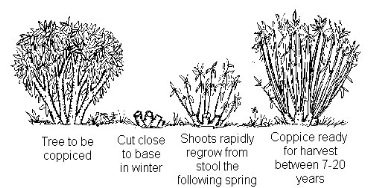
CoppiceHowever, the products that can be made by means of coppice management of woods and forests is far greater and, in fact, this was the way that we managed our woods and forests in Britain for thousands of years, and that very well and successfully. The woods and forests thrived under this case more and better than under any other form of management.

While other countries used this form of woodland and forest management also in the great majority of European countries it has now been abandoned, and has been thus already for many, many decades, in favor of a management that can be done with more mechanized means than coppicing.

The abandonment of coppicing in British woodlands has cost us dearly in terms of almost destroyed woods. In some areas the old coppice stools are almost beyond redemption and this could result in the loss of the entire or almost the entire wood.

The Forestry Commission never did much in that department but then it was not its brief. Its job was the production of timber for the mines and some other applications, including the war effort.

After the Second World War coppicing in our woods started to decline drastically and dramatically, much due to plastic products, and bamboo canes for beanpoles and such rather than wood.

Wooden tent pegs, which were one of the products from coppice woods, were replaced, even by military and scouts with metal and plastic and the same went for so many other products that were once produced from the wood from our coppiced woodlands.

Baskets, once woven from willow from coppicing and pollarding operations, and some other pliable woods, were replaced by plastic and the same for the trugs and such used by bakers and others.

Now, with the revival and renaissance of wood stoves firewood is in great demand but our neglected native woods cannot even provide a small proportion though they could provide it all (at current demand levels) if they would but be managed and we import firewood from as far afield as Poland and Western Russia. Not very sustainable at all.

The same goes for charcoal and most of the charcoal on sale in Britain today, and barbecuing is very much the in thing, also in restaurants, has to come from abroad and, in that case, it comes, primarily, from tropical hardwoods.

The problem, aside from an environmental one, is that that kind of charcoal does not, unlike the local one, light easily and requires chemical accelerants in the form of barbecue fire lighters. Those, however, leave a residue and not just on the coal.

Before the “advent”, so to speak, of coal, charcoal fired the Industrial Revolution in Britain and while it, probably, caused some deforestation, most of it was sourced from coppice operations.

Wooden spoons, spatulas and other wooden kitchen utensils were once made by local craftsmen from local coppiced timber but from a certain time onwards those were made from often imported woods by factories and now the great majority of those utensils are made, in fact, abroad, in the main, nowadays, in China.

In times past almost everything wood came from local woodlands, with the exception of some furniture, that were under coppice management and the woods and the craftsmen prospered.

Coppicing is one of the best ways to maintain the health of woodlands and this system of management has great benefits for the environment. In addition to this this old way of woodland management also will benefit the local economies and that is too very important indeed.

Our woodlands and forest must be brought back under this age old management system in order to restore them to health and for the local economy of craftsmen and -women to be revitalized.

Unfortunately misguided environmentalists for years have been working against this as they, having read only those books that back up their own beliefs, believe that no tree should ever be cut down, for any reason.

In fact many have vehemently campaigned and forced, for lack of a better word, local authorities, woodland and forest owners and managers to leave woods in their “natural” state or allow them too “return” to a wildwood state. But there is no wildwood in the British Isles and has not been any for at least a millennium or more. Not that that has interested those.

Woodlands, many of them state with venom in their voices, do not need to be managed. Nature will do it all itself. Which is a false notion as, alas, left to their own devices those, formerly managed woods, will decay and that will the end of them.

Coppice stools that are not cut will, in the end, break apart and that often almost simultaneously and thus the woods are no more but just a piece of useless “wilderness”.

As soon as brambles and bracken take over – and this is very soon if a wood is not managed – and then not controlled the loss of habitat follows in a very short space of time. Brambles and bracken stop light getting to the woodland floor, and the same is true when the woodland is not being thinned, and anything of value will die and be smothered. But, they keep claiming, Nature will manage it all itself; it just takes a while.

This is not true, however, and man has to keep the regime of management that our forefathers began many hundreds of years ago if we wish to retain those woods and forests.

For thousands of years we have managed our woodlands and forests, more often that not by coppicing, and they thrived under our care and if we want them to thrive again we must bring those woods and forests that have been neglected back under this management regime and it must be done now, before it is too late.

© 2013
The cudgel

by Michael Smith (Veshengro)

Cudgel_Hazel_1_sml

We live in a dangerous world, just as men have done throughout the ages. In some times and places, the dangers may be obvious and clear, and in others, they may be less obvious, yet they remain.

The saying “walk softly and carry a big stick” is a good adage for it is not always convenient, or legal, to carry a gun, of whatever size or type. In the days of old the weapon of the gentleman, more often that not, was the sword, but that was for gentlemen. The poor could (a) not afford one and (b), theoretically, were also not allowed to carry one.

The answer, however, came in the humble cudgel and our predecessors have provided us with elegant (and effective) solutions for these situations.

One of the oldest, most versatile, and satisfying bits of manly equipage is found in the simple cudgel. At times this may also be referred to as a truncheon, sap, bludgeon, or shillelagh. But in truth a cudgel is a cudgel and a truncheon, for instance, which is known as a Billy Club in the US or a Nightstick, is a policeman's weapon. A sap is not a wooden cudgel or club but something rather different and a shillelagh is a knob-handled walking stick, much like the African knobkerrie.

The wooden thing often referred to as a shillelagh, resembling somewhat of a wooden hammer, is nothing of the kind and just a silly invention of the Irish tourist industry.

The ordinary cudgel is perhaps the simplest of all weapons. It is essentially a short stout stick, usually made of some hardwood, and wielded as a weapon, with one hand.

What could be more convenient? Or natural?

As we all know, the male of our species are, almost mystically, attracted to wood, to sticks. Take your kids for a walk in the woods and the boys, no doubt, and the Dad probably too, will pick up a stick to use either as a walking aid or will sparring with them in stick fighting, even if they have never come across this before. It is just like instinct; like a distant memory.

When during the time of King John I the people of England were no longer allowed to carry “fighting” weapons all that was left to them was the cudgel, the walking stick, and the quarterstaff. The latter two, especially, could be claimed to be used for walking and little could be said or done about it.

Under British law today most that you carry could be misconstrued by a law enfarcement officer as an “offensive weapon” and thus a disguise is needed. No, not you are to wear a disguise; the weapon needs to be disguised, and ideally thus it be a walking stick or knobkerrie rather than the shorter cudgel, unless you can think of a way of discribing it away, so to speak.

Another nice thing about cudgels is that they can be so easily crafted to reflect the nature and personality of their owners. Admittedly, many cudgels, in use, are weapons of opportunity but I believe, though, that most men will want to have their own personal cudgels, and I recommend this as an excellent weekend or evening project to undertake.

The old countrymen of days gone by used to watch their cudgels grow, literally, for they would chose the right branch out there in the copse (coppice) while it was still growing and earmarked it, so to speak, for harvest at the right time.

Some would drill a hole into the working end – the larger part – of the cudgel when they had finished fashioning it and filled it with lead, then plugging the hole with a wooden plug. Personally I do not think that this is, actually, necessary and carrying one filled with lead would definitely land you in hot and deep water with the law in most places in the UK.

Keep it simply wood and then it's good... well, more or less...

© 2013

Selective coppicing

by Michael Smith (Veshengro)

Under selective coppicing we must understand the difference between removing all stems from a coppice stool, as is the general practice, and just removing large (overgrown) ones. Selective coppicing is the latter.

Selective coppicing should be considered in order to have a continuous supply of wood available, especially when a wood is being restored, which can take many years. This available wood is what pays, to some degree, for the restoration of the wood and gives an income to the coppice worker.

All too often a coppice stool is being entirely cleared of stems, including small regrowth that is nowhere useful at the time. This regrowth, however, is often a year or two, or even three, old and thus, in the not so distant future could provide income already from the stool, well before others stems have grown enough to do that.

Cutting all stems, including the young ones, when coppicing, is a case of killing the goose that lays the golden eggs, proverbial speaking, and thus one has to be a little farsighted in this department.

Forestry is such a trade where one has to look further ahead than one has to do in farming, for instance, and this also goes for rotation coppicing, even though here rewards arrive earlier than in forestry per se.

Planning, good planning, is part of the process and selective coppicing, is part of this, even though this method seems to be rarely used, it would seem, but should be one to be considered, if it is not.

© 2012

Traditional woodland crafts are, once again, becoming a growth industry

Finally traditional woodland crafts are being regarded as valuable again and not before time

by Michael Smith (Veshengro)

They are a source of food, fuel, building materials, artistic inspiration and stress-relief, and thus is is hard to believe that the link between Britain's people and its woodlands was ever in any doubt. But it was so.

In the years following the Second World War, traditional woodland jobs such as wheel-wrights and bodgers, clog-makers and other woodland workers, were becoming obsolete as, apparently, synthetic materials were far more exciting to have in your home than boring old wood, and the Forestry Commission was busy creating Sitka spruce plantations.

We must, however, not forget that the Forestry Commission was never tasked with woodlands and woodland jobs and -crafts but to be producing timber for the mines and the trenches.

Within a generation, or less even, the relevance of woodlands to the daily lives of most people had become vague. Most products that ones were made of wood had become replaced by plastics and other synthetics.

However, and thank the gods, in the beginning of the second decade of the twenty-first century our woodlands are beginning to enjoy somewhat of a renaissance.

Our woodlands, which have existed for thousands upon thousands of years and have been managed for that time also, and that predominately through coppicing, need to ALL come under that management again as, otherwise, they will not survive.

In many parts of England there are old coppice woods that have not been worked now for fifty years and more and if they are not dealt with very soon and efficiently then those coppice stools that are presently standing will break apart and that will be the end of those woods.

The resurgence of interest in using woodlands and woodland culture has attracted a very diverse range of people, from hobby foresters and entrepreneurs to some very skilled crafts people but what they all need is support from us, as consumers, to buy their goods, and from government as those woodlanders are the custodians of our future.

The new woodlanders cannot make a living from the woods if we will not buy the goods that they provide, from firewood and charcoal to treen goods of all kinds.

The New Woodlanders include not just those of the ancient crafts but artists who work with wood, furniture makers, basket weavers and specialist producers, including those who make wooden jewelery, etc.

When Herbert Edlin wrote his classic book Woodland Crafts in 1949 he was sure that many of the crafts he had recorded would not survive the ravages of the Second World War and in a few cases he was right, but in actual fact many of the woodland crafts have persisted or been revived including the skills of chair-makers, turners, charcoal makers, basket weavers, horse-loggers and herb gatherers.

In economic terms, woodlands can offer income to both groups and individuals. However, the consumer has to get behind those that are reviving the use of our woodlands and buy the products that they produce.

A Forestry Commission survey found that nearly a quarter of people questioned had gathered wild plant material from woodlands or forests in the past five years (the most popular things to collect were berries, mushrooms and firewood).

While the economic recession may have taken the main focus off the environment and on to the economy, I believe that it will not halt the great resurgence in woodland culture that is taking place at present

In fact there may be more of us looking for ways of supplementing our income or diet, or reducing our fuel bills, by returning to the woods and there will certainly be more stressed-out folk seeking the solace they can find in the forest.

Over the years, ever since about World War Two, we have forgotten the value of our woodlands (and forests) other than, maybe, for recreation and this could be seen very much during the protests against the proposed “sell off” of Forestry Commission lands.

But, aside from the amenity value of the woods, we must come to understand, and especially many misguided environmentalists, that we must work and manage our woodlands once again in order for them to survive.

Coppice woodlands that are not being worked in the traditional way will die. It is as simple as that. The stools will become top-heavy and, literally, break apart and that will be the end of the trees and thus of the woods.

© 2012

Act now to save our natural environment or our country's biodiversity will be lost forever

by Michael Smith (Veshengro)

England's green and pleasant land is in catastrophic decline, so we are told, with some of its most precious wildlife at risk of disappearing for ever. This is what the first comprehensive report into the nation's natural life has shown.

In a landmark study into every aspect of the environment, the government advisory body Natural England has compiled research from all corners of the countryside, from woodland and wetland to marine life and salt marsh. Its findings make for bleak reading. Under siege from climate change, development, pollution and aggressive new farming methods, the country's biodiversity is already significantly less rich than it was 50 years ago, “The State of The Environment” report said.

Just 3 per cent of grassland is rich in native plants and a fifth of the countryside is already showing visible signs of neglect, it reported. The collapse of this habitat is having such a devastating effect on native species, including the red squirrel, the turtle dove, the bumblebee and the adder.

"If we don't act now, there's a real danger some of our most precious wildlife will be lost for ever and our lives will be poorer for it", said Helen Phillips, chief executive of Natural England.

Conservation charities echoed her appeal, saying they hoped the report would be a springboard for government action. "This is a timely and hard-hitting call which the Government must heed and act upon," said Sue Armstrong Brown, the RSPB's head of countryside conservation. "We are now seeing the consequences of decades of ignoring environmental limits. Now, with the climate changing and wildlife crashing worldwide, it is time for a new green leadership. There has never been a time when human action has put so much wildlife in peril. The Government should support Natural England's plans and allocate enough money to put them into place."

The report makes clear that, with government commitment, the gradual decline could be combated and even reversed. Its authors are urging action on a series of recommendations which they say could save the natural environment from destruction. "England needs a new approach to conservation if we are to effectively tackle the modern pressures on land created by climate change and development," said Ms Phillips. "We need to find ways to manage our landscape to create a mosaic of uses so that we can help our wildlife survive – be it through new 'national park' around the length of England's coastline, better use of the green belt or improved use of public funding for farmers to deliver a better natural environment."

There are already signs that, with the right level of focus and funding, these schemes can work, with the notable success stories of reintroduced species such as the red kite, the large blue butterfly and the pool frog cited as evidence for the merit of long-term projects.

Numbers of native woodland butterflies species have declined by 50 per cent in 10 years, and their demise is all the more worrying as they are an indicator group – meaning that, as they respond quickly to changes in their environment, they act as a litmus test for the health of the natural world. Natural England has suggested that a return to traditional woodland management might tackle the fall in numbers. By using coppicing – the regular culling of smaller trees – the flowering plants they rely upon will be given the chance to thrive again.

So, the remedy suggested here is to bring back traditional coppicing, regular felling of smaller trees to create open ground for flowers that butterflies rely on.

I can only say that I find it amazing that why the likes of this author and one or two other lone voices have, for the last decades, advocated the return to coppicing the old coppice woodlands in this country which, by the way, is the great majority of the often called “ancient woodlands”, no one wanted to listen, not even the likes of those that are now involved with this report and all claimed that, no, the woodlands had to be left untouched for the betterment of the environment. Well, looks like the old foresters were right after all and those that suggested the bringing back of coppicing.

The management of wetlands and salt marshes has also been analysed in the report, where native species are suffering similarly catastrophic falls. A major decline in wading birds native to unprotected wetlands has been identified, with, for example, the number of snipes down by 90 per cent. Agricultural and urban development has drained the soil in some areas, leaving it too dry for them to survive. However, by preventing further drainage, and reinstating raised water levels, this trend can be reversed.

Natural England has drawn up a manifesto of measures that it believes can change the fate of the countryside. It has put tackling climate change at the top of its spending agenda for the £2.9bn of public money allocated to its cause. To carry this out, it plans to prioritise locking-in carbon, absorbing excess rainwater to prevent flooding and connecting wildlife sites. It will also be helping the Government find space for renewable energy by publishing a map of suitable locations for onshore wind farms.

Another key element of its carbon plan is improved maintenance of upland areas, 29 per cent of which are now in an unfavourable condition. Peat – indigenous to such areas – absorbs more than half of the UK's carbon. But its properties are lost when it dries out, so Natural England has suggested avoiding upland draining and over-grazing in the regions to which it is native.

The Environment Secretary, Hilary Benn, said he believed the right measures, such as the planned investment of £2.9bn in agri-environment schemes over the next five years, could make a difference. "We also now recognise that climate change is presenting us with a new challenge in conserving biodiversity and managing our landscapes," he said. "We need new approaches to conservation, and we are working closely with Natural England to develop these."

But this has done little to reassure environmental campaign groups such as Friends of the Earth, who want a more fundamental overhaul of government policy. The group's campaigns co-ordinator, Paul de Zylva, said: "The Government must do more to safeguard our future. Green speeches are not enough – we need urgent action.

"Ministers must put the environment at the heart of all their policies – including transport, the economy, housing and planning – and invest in clean, green solutions that would make Britain a world leader in developing a low-carbon economy."