Showing posts with label Plastic Waste. Show all posts

Recycling is a fraud, a sham, a scam

by Michael Smith (Veshengro)
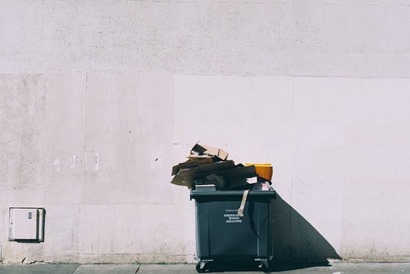
Recycling is a fraud, a sham, a scamRecycling is a fraud, a sham, a scam, perpetrated by big business on the citizens and municipalities to make us all feel good about single use packaging. It won't save the planet.

We blame ourselves, or consumers are getting blamed, that's you and me, by government, for not recycling more plastics, and yet our efforts are like “hammering a nail to halt a falling skyscraper.” It is time we got to the root of the problem.

“People need to get better at recycling” is a comment we often hear as soon as the topic of (plastic) waste comes up. It is a misleading assumption, however, to think that tossing more items in the recycling bin and fewer in the trash can make that much of a difference in dealing with the catastrophic level of plastic contamination that our planet currently faces. In fact, it is actually pretty much pointless. And the same goes for other single-use, or perceived single-use, items of packaging, even for glass jars. Aside from the fact that the latter can be reused in so many ways and do not have to end up as recyclables.

We need to rethink the way that we deal with trash because individual consumer cannot solve this problem as individual consumers are not the problem. We have taken it on as our problem because of some very astute, corporate-driven psychological misdirection in the form of campaigns like Keep America Beautiful and other such “initiatives”, created by industry.

Keep America Beautiful, Keep Our Country Tidy, Don't Be A Litterbug, and others were all, in one way or another created, brought to life or sponsored, by industry in an attempt to place the problem of litter, waste and trash on the shoulders of the consumer rather than keeping it on their own and dealing with it.

Keep America Beautiful was founded by major beverage companies and tobacco giant Philip Morris in the 1950s as a way to encourage environmental stewardship in the public. Later it joined forces with the Ad Council, at which point, "one of their first and most lasting impacts was bringing 'litterbug' into the American lexicon." This was followed by the 'Crying Indian' public service announcement and the more recent 'I Want To Be Recycled' campaign.

We can safely assume that campaigns of a similar nature in other countries were and are sponsored by the same entities, be it the programs like “Keep Our Country Beautiful” (UK), ot others of a similar nature.

While these PSAs appear admirable, they are little more than corporate greenwashing. For decades Keep America Beautiful has actively campaigned against beverage laws that would mandate refillable containers and bottle deposits. Why? Because these would hurt the profits of the companies that founded and support Keep America Beautiful. Meanwhile, the organization has been tremendously successful at transferring the blame for plastic pollution onto consumers, rather than forcing the industry to shoulder responsibility.

The greatest success of Keep America Beautiful has been to shift the onus of environmental responsibility onto the public while simultaneously becoming a trusted name in the environmental movement. This psychological misdirect has built public support for a legal framework that punishes individual litterers with hefty fines or jail time, while imposing almost no responsibility on plastic manufacturers for the numerous environmental, economic and health hazards imposed by their products.

The burden, whether as regards to plastics or other waste, was placed on the should of the consumer, and the same, today, happens also as regards to food waste. The majority of food that is wasted has never even made it to the consumer.

If we are serious about tackling plastic pollution, then corporations' actions are where we should start. They are the real litterbugs in this situation. The focus should be on the source of the plastic, not its near-impossible disposal.

This also goes for any packaging and also for food waste. It needs to start at the source and not at the consumer. When it comes to food waste, as mentioned already, the majority of waste occurs before it ever gets to the shop let alone on the consumer side. When the market buyers refuse vegetables and fruit because it does not fit certain criteria and the farmer is ordered to destroy the crop. That is where the waste starts.

With plastic and packaging it starts at the manufacturers of products who use too much packaging.

But, it would appear that we, the consumers, allowed ourselves to accept individual responsibility for a problem we have little control over. In fact, a problem over which we have almost not control.

I know we all want to feel that we can do something to make a difference and, indeed, we can, but it starts well before we think “recycling”, or at least it should. We can refuse, where possible, to buy things in plastic bottles – though in certain cases it gets more and more difficult. We can refuse to buy bottled water altogether for in most places the tap water is at least as good as to water in those bottles – which often is, by the way, from municipal sources, in other words, it is tap water, just bottled tap water.

I am not saying don't separate your recyclables and put them out for the municipalities to collect, only that that, in itself, is not going to make much of a difference, especially not considering that much of what you are going to put out ends up in landfill again because either the price that can be achieved for the recyclables is too low to make dealing with them viable or, as with China refusing to take the West's garbage, many countries do not know what to do with the stuff. Processing it at home, obviously, wouldn't do – in the eyes of the powers-that-be – as at home there are higher environmental protection standards and thus it would cost a lot of money to do so. So, if they can't dump it on third (world) countries they just dump it in holes in the ground.

We need to start well before recycling but often we have little to no control over that department other than buying products elsewhere where there is no over-packaging but, alas, some cannot afford to do that. Nor is the suggestion to leave all the packaging at the checkout a brilliant idea because for one it often is not possible and also, in some cases, should you have to return anything the packaging, to some extent, such as a box in which some item came, has to go back as well with the item to be returned.

So where does that leave us, as the consumer? It leaves us as the reuse, repurpose, upcycle and such stage. True, you can't do that with everything and how many glass jars (and other items) can you really reuse. Fair enough, I seem to be able to make use of an awful lot of glass jars for storage purposes but not everyone can. I also tend to make things from plastic milk jugs and such for the garden and for other uses. In addition to that many of those things could even be upcyled by craftspeople for sale, but, alas, few seem to think along those lines.

Where it all has to start, however, is with industry and also with design (do you hear me #designers). Designers come in to design packaging either to be compostable, or with a second use automatically obvious. This has been done, and is still been done, with mustard, and similar glass “jars” and containers, such as in France where they have the automatic reuse potential as drinking glasses, such as the ones used commonly for vin de pays in the homes, and even bars.

This should also be possible with other packaging, including plastic packaging, thus making us think as to whether we want to throw the item away in the first place or whether we do not, maybe, have a personal use for it. It can be done because it has been done before. We just need to remember, dearest designers, and adapt some of the things from the past when it was done to the present. Not rocket science but then you have studied design, not rocket science.

For us as consumers, yes, we can do our bit but the recycling bin, please remember, should always be the last consideration.

© 2018

Huskup – Product Review

Review by Michael Smith (Veshengro)

Huskup imageReusable and plastic free, Huskup brings takeaway coffee back down to earth

Durable, biodegradable and entirely free from plastic, Huskup is tackling the UK’s disposable culture one flat white at a time with a brand new reusable coffee cup made from rice husks. Using the outer hull of the rice grain, a natural and robust material that would otherwise be burnt at the mill, Huskup is harnessing an abundant waste product and giving the planet a helping hand even before the first coffee is poured.

Responding to the disposal of 7 million takeaway coffee cups every single day and the nation’s ever growing commitment to cut plastic waste from their lives, the Huskup takes the humble rice husk from earth to earth. Each cup is dishwasher safe and tough enough to withstand temperatures of -30c to 120c, yet the reusable cup can ultimately return to the soil at the end of its life and biodegrade naturally.

Free from melamine and BPA, Huskup is setting a new standard for reusable coffee cups and is ready to make every hot drink on the go that bit greener, from coffee shops and canteens to the workplace and beyond. Saving energy, materials, money and waste using an all-natural bi-product of one of the world’s most prolific store cupboard staples, the Huskup is set to make a big impact with one small change to the morning routine.

The Huskup comes in 12 different designs and can be purchased from www.huskup.com, priced at £10.95 each. Cheap they are not, in comparison to other reusable coffee cups, that is for certain, but then they are also made from a different material in a different way.

Bath-based Huskup was founded in 2018 to harness one of the world’s most abundant food waste materials, the humble rice husk, and begin a new chapter in takeaway coffee with a cup that is both durable and biodegradable. Entirely plastic, tree and toxin free, the Huskup contains no melamine or BPA, meaning that no nasties can make their way into drinks. These eco-friendly cups are also tough enough to take on the dishwasher and safe for reheating coffee in the microwave, but will simply decompose and return to the earth at the end of their lives. Launching with 12 designs, having teamed up with like-minded independent artists to create products that represent the Huskup ethos, these reusable cups are ready to bring takeaway coffee back down to earth.

While the material of the Huskup is free of melamine it has the feel of that plastic material, or that of Bakelite, for those that remember that material, but the material is not even, actual plastic. In my opinion the scope for this material itself, a plastic-like substance that is made from natural ingredients which harmlessly return to the soil, goes beyond just coffee cups.

As far as biodegradability is concerned Huskup are certified to the compostability standards, European EN13432 including the following elements:

1. Biodegradation - materials turn to soil through microbial action

2. Disintegration - the materials fall into small pieces

3. Eco-toxicity - seeds can germinate in the resulting compost - i.e. it is useful for plant growth

4. Heavy metals - the compost is safe to go onto land

The manufacturing process takes the waste rice husk and mixes that with some natural starches – and those are, alas, trade secrets. The cups are then molded and formed into the huskup. No melamine or other plastic binders are used.

The lid and the band around the body of the cup are made of, what in my opinion, would appear to be silicone.

The cup appears to be extremely sturdy and, as I said before, feels like a melamine or Bakelite product, but is neither. It should last for many, many years and when it finally has to be replaced you do not have to have a guilty conscience as to its disposal. That still does not mean that you should thoughtlessly toss it at the end of its life into the countryside.

The only, for some it sure would be, major turn off is the fact that the product is “Made in China” while the company is British. The reason, though, probably is that rice husks are more common in China (and elsewhere in Asia) than, obviously, in Britain and hence the product is Made in China.

Web: www.huskup.com

Twitter: @huskup_eco

Instagram: huskup_eco

Facebook: https://www.facebook.com/huskup/

© 2018

Aldi unveils measures to slash plastics waste

by Michael Smith (Veshengro)

Aldi unveils measures to slash plastics wasteDiscounter Aldi will scrap 5p carrier bags by the end of this year and ensure all packaging on its own-label is reusable, recyclable or compostable before 2022. All I wonder is why it is going to take four years to do something like that.

Aldi has signed up to a new cross-sector initiative from WRAP aimed at transforming the UK's plastics system.

In place of carrier bags, the UK's fastest growing supermarket will offer customers bags for life as reusable 9p bags made from back-of-store plastic waste.

A new taskforce of internal and independent experts has been set up to help Aldi drive innovation in packaging, the company confirmed.

Aldi has also given its backing to a national deposit return scheme for plastic bottles. It will assess the feasibility of how such a scheme could be implemented.

The latter should not really surprise anyone as Aldi, being German by origin, thus hailing from a country where such a scheme – or schemes even – has been in operation for many years already. As per usual Britain is lagging way behind other European countries in that matter.

Aldi UK's chief executive Matthew Barnes said that the chain is committed to bringing its customers along the journey in its ambition to lead the industry on plastic waste reduction.

He also called on Aldi's rivals to work together in order to drive industry-wide change. In support of this aim, Aldi has signed up to a new cross-sector initiative from WRAP aimed at tackling plastic waste.

This latest announcement builds upon a long-standing commitment by Aldi to reduce its environmental impact. Aldi has already removed all plastic stems from its cotton buds and banned all microbeads from its products.

On the cotton bud thing I must then be the only one who has not noticed any change as yet, because I have not. I love Aldi, so don't get me wrong, and those are all good steps but so far I have not noticed – at least not in my local store – a change to the cotton buds. Then again, it may still be some old stock that is knocking around. Just saying.

© 2018

Uses for plastic containers

by Michael Smith (Veshengro)

New uses for plastic containersPlastic packaging and plastic containers are everywhere, they are ubiquitous, and most end up in the landfill for recycling does not always happen in the way that we are being told. In fact, quite often it does not happen. Now that China has closed its doors to plastic (and other) recyclables from the Europe and America the problem is going to get bigger still.

We can also not expect that the uses of plastics, for packaging especially, is going to go away soon and even so-called bio-plastics, biodegradable and even – supposedly – compostable plastics are still plastics and most will only compost, when it comes to the latter, in commercial hot composting facilities and not in Nature per se, and not even on your domestic compost heap or in a composter in your garden.

So, what do we do? Aside from reducing where we can we must look at reusing and upcycling wherever possible. As far as plastic containers are concerned they come in many shapes and sizes and thus to many reuse and upcycling possibilities.

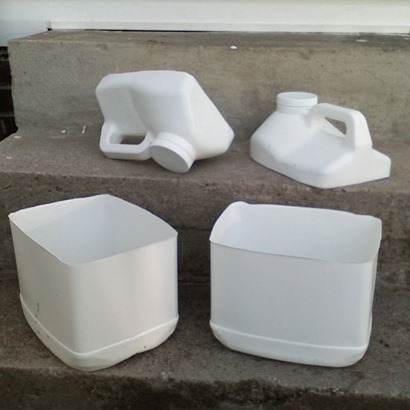
There are the humble milk jugs in a variety of sizes. In the UK they are pint, two pint, four pint and six pint sizes while in the US they happen do be different and also come in gallon size. They all, as far as I am concerned, have reuse potential and I have made a variety of things from them, including a belt-wearable berry picking/dead heading container for gardening (see photo).

Milk jugs, of all sizes, can also be used as planters, for seed starting as well as for growing plants. Larger plastic jugs, like those used in commercial catering and also for other purposes, often small to large jerrycan size and style, can be reused, repurposed and upcycled also into planters.

The same goes for plastic buckets in which many products come when purchased in bulk, or for commercial catering, for instance, such as mayonnaise, oil, etc. Those buckets, often gallon and greater in size, make great planters in the garden. Drill holes into the bottoms, and, maybe the sides, of the emptied and cleaned containers, and then use them for growing vegetables or invasive plants, such as mint. You can also use the plastic buckets to organize and haul garden materials and compost, sort laundry, or store household items.

But they can also be made into other useful items, such as storage drawers, and smaller ones can be used for dividers in desk drawers and such. The only limitation, probably, is set by your imagination or lack thereof.

From plastic lotion containers (bottles) holsters and pocket protectors can easily be made for safely carrying tools, such as, say secateurs. They can either be fitted with “straps” so they can be worn on the belt, or shoulder straps, or they can just simply be put into the pocket. The tool is safely encased in the holster and thus will not damage the clothes or the wearer.

Other bottles from strong plastic, such as those from cleaning fluids, for instance, can become holsters for scythe sharpening stones, the name for which I rather not mention here as nowadays it is considered a cuss word, as it has four letters, begins with a “c” and ends in a “t”. But, honestly, that is the real word for such a holster.

Many other items of plastic packaging also, no doubt, have reuse, repurposing and upcyling potential and I am sure we can all create a whole list of ideas in this department. Often all that is required is the correct mindset, imagination and inspiration.

I strongly believe that there is even potential, as far as plastic containers (and such) are concerned, for upcyling business ventures if people can be brought to understand to buy into the concept – literally as well.

© 2018

Marriott Hotels to remove plastic straws from UK hotels

by Michael Smith (Veshengro)

Plastic-strawsSome good news from one of the big hotel chains. Maybe some other places could follow suit? Chance would be a fine thing, I know.

Marriott International says it is to stop the use of plastic straws at its UK properties, amid growing concern over the levels of plastic pollution.

The group said that it is removing plastic straws from over 60 of its UK hotels, including London properties Marriott County Hall London, Le Meridien Piccadilly, W London Leicester Square and Grosvenor House, A JW Marriott Hotel.

Teams “have been requested to begin removing plastic straws from circulation with immediate effect”.

Customers requesting straws going forward will be offered biodegradable or paper straws.

Commenting on the move Michel Miserez, area vice president, United Kingdom and Ireland, Marriott International, said: “Our UK hotels used 300,000 straws last year. By removing plastic straws from our hotels in the UK we are making a small but significant step in playing our part in reducing the volume of plastic that damages our environment and wildlife.

“Marriott International has a global responsibility and unique opportunity to be a force for good in all aspects of our business. We recognise that how we do business is as important as the business that we do. Incorporating environmental and social initiatives like this one into our business is the right thing to do.”

In October last year Marriott launched a new sustainability and social impact platform, designed to foster business growth while balancing the needs of associates, customers, owners, the environment and communities. More information can be found at http://serve360.marriott.com/.

© 2018

Europe drowning in plastic waste

by Michael Smith (Veshengro)

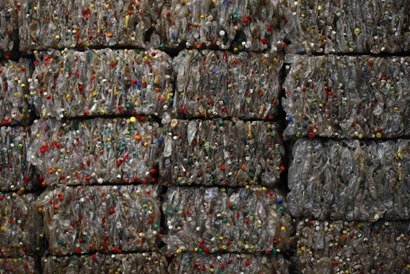
Plastic bottles at a Chinese recycling plantNow that China has closed its doors, from January 1, 2018, to (plastic) waste for recycling from Europe (and elsewhere) the countries of Europe are beginning to drown in (plastic) waste and many are now looking for other developing countries, such as Vietnam, to take this waste for recycling, Britain among them.

Instead of actually reducing waste, especially, though not restricted to, plastic waste, and secondly building our own facilities for recycling the countries are, yet again, looking for places with lower environmental standards to where to dump the waste rather than doing the other.

Obviously, considering the high environmental legislations in the home countries it would be too expensive for the capitalists to do it at home and hence other countries, with lower and fewer environmental laws and legilations have to be found where our waste can poison the unsuspecting workers. Couldn't possibly have those recycling plants properly operated in our own countries now, could we. But that is exactly what we should be doing.

Before even thinking about recycling we should, properly, work on reducing the amount of waste, plastic and otherwise, that we generate and that is where all, but for starters industry and legislators, come in.

Now that China declines to take any more of our garbage we should be doing our own recycling, after reducing as much as we can, of our waste and by doing so lead the way and we would also create jobs.

When, however, we talk about recycling then recycling it really should be rather than, as in the case of most glass recyclables, downcyling said glass into a road aggregate akin to sand. That is not recycling.

As far as single-use plastic is concerned this needs to be eliminated once and for all as it cannot, properly, be recycled, at least not into decent objects and while there is nothing, per se, wrong with good solid, for lack of a better word, plastic that will and can be in use for a long time, we should phase out plastic more and more over time till we are almost, once again, free of the stuff.

As far as other waste, including and especially E-waste is concerned, industry has to come into play and design to once again – yes, we were there once already – to make products that actually last not just for a year or three but for decades and more. Oh, yes, sorry, I forgot that that does not give huge profits to the capitalist shareholders.

Instead of solving the problem at home our respective governments are looking for other developing – we used to call those Third World – countries which we can contaminate, and their unsuspecting residents, with our waste, by having them recycle the stuff that we don't want to recycle at home, in bad conditions. The new colonialism.

We should be doing the recycling – after looking at all the other options of reuse and so on prior to recycling – at home, in good conditions for the workers and the environment, as dictated by law. This would also create jobs, from collecting, to sorting, to the actual recycling. But, alas, that cannot be as that would be expensive.

© 2018

Plastic, plastic use, and plastic pollution

by Michael Smith (Veshengro)

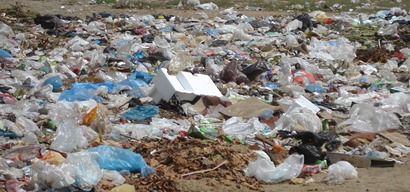
plastic_waste1Plastic is pervasive nowadays and there is almost no place where you can look and plastic will not be staring you in the face in some for or the other. The computer keyboard, the case of the laptop, of the cellphone; all plastic, and that just for starters.

Since the real commercial production of plastic begun in the 1950s the world has produced more than eight billion tons of plastic which is about as much in weight as a billion elephants. Now let that sink in for a moment. That's an awful lot of the stuff. And that which has not been recycled or burned is in landfills and much of it, in fact, is floating around in the sea, causing problems to marine life, and in the end to us, who eat some of that marine life.

In 1950 the world produced around two million tons of plastic per year, while 65 years later, in 2015, it was 380 million tons in that year alone. Half of the so far produced plastic has been has been made in the last 13 years. Until 2015 only nine percent of this plastic has been recycled while twelve percent has been burned. The rest, alas, is still with us, predominately in landfills.

In some cases, let's face it, there, probably, is no real substitute for plastic and there is plastic and then there is plastic, as I keep saying. Instead of making it from petroleum there are other ways plastic materials could and can be made but even if the plastic is from a plant-based source it remains plastic and compostability is in most cases nothing more than greenwash.

On the other hand plastic can be extremely durable – aside from being light – and I say the can be because some of it is not made to be durable and that is due again to industry's design of needing things to break in order to sell more of the things to us.

It is the single use plastic that really is the greatest of problems, whether it comes in the form of the all present and all pervasive PET-bottle or the other plastic packaging such as fruit punnets, salad bowls, etc. ad infinitum.

What bugs me is that many of those things can be given an extended life if we but put our thinking cap on when we encounter them. Only recently I rescued the bases of some Sainsbury's sandwich trays (the kind you but ready-made sandwiches in for parties) which will become the trays for plant pots when raising seedlings.

I have found that the plastic that is used for those salad bowls with ready-made made salads from supermarkets, for instance, is a fairly flexible and also strong kind in that there is nothing preventing us from reusing those small and not so small bowls for a variety of uses in the kitchen, at table and otherwise in the home (and garden).

Those single-use plastic beer beakers (1pt), often made of a strong and flexible plastic, that are used at festivals and such like, instead of glasses, and then, obviously, being tossed thoughtless into the countryside, make for great propagators put upside down over a small plant pot for raising seedlings.

While, obviously, it would be good if we could get rid off all single-use plastic I, personally, doubt that that is going to happen soon and thus we ensure that we dispose of the stuff responsibly (for recycling ideally though we can but wonder how much recycling actually truly happens) or, maybe better still, must find a way of making use of those things by reusing, repurposing and upcycling them in other ways, stretching their lifespans for as far as possible.

In the case of plastic drinks bottles, be it water or other, I would advocate the introduction of a deposit, as it is done in some countries already, and the use of reverse vending machines where such bottles can be returned to and the deposit given to whoever returns them.

Bottled water is a scam anyway as most of the water is not “spring water” or “mineral water” but simply ordinary, often tap, water filled into bottles and sold at a huge profit. In most places in Europe, bar a couple of countries, the local tap water is better than any bottled water. The US still has a problem despite considering itself to be such a great advanced nation. In some places the municipal water supply there is as bad, sometimes even worse, than that in many a city in the Third World.

The problem nowadays though is also that other drinks and products that used to be packaged in glass come now in plastic bottles and jars, such as wine, spirits, peanut butter, etc. The claim is that this is being done to reduce the impact on the environment as glass is heavier than plastic and thus transportation requires more fuel. Come on, let's be honest dearest people. It is cheaper and the environmental claim is but hogwash or should we better call it greenwash. Fact is that plastic bottles and jars are cheaper than glass and that they are cheaper to transport than glass. Hence the move to more and more plastic.

As consumer we are facing a dilemma when it comes to the above, that is to say drinks and produce in plastic jars, let's not even talk about fruit and vegetables packages in unnecessary plastic (wasn't sure whether to laugh or cry the other day when I saw at ALDI apples packaged in the kind of tube in which tennis balls are sold) as in the great majority of cases we do not have an alternative. It was Sainsbury's a couple of years ago that started the trend of peanut butter in plastic jars and now almost every producer of peanut butter has followed suit.

Wines and spirits, at least those at the lower end of the price scale, now also come in plastic, rather than glass, in our supermarkets and the letters WTF very much come to mind with regards to that.

So, instead of working to reduce the problem industry and supermarkets actually perpetuate the problem by introducing more and more plastic packaging. Get rid off the plastic carrier bag, to some degree, and they just get some more plastic in that you can't avoid, more or less. Sometimes I do wonder whether they actually want to help or not, and it looks more like that they do not want to help at all. Plastic is cheaper to use than glass and much cheaper to ship as it is lighter and there are no breakages. It's all down to money yet again. But where does that leave us, as consumer, who are left without an alternative and choice often?

© 2017

Bring Your Own Cutlery needs to become a new trend

Bring Your Own Cutlery (BYOC) needs to become a new trend, no ifs or buts

by Michael Smith (Veshengro)

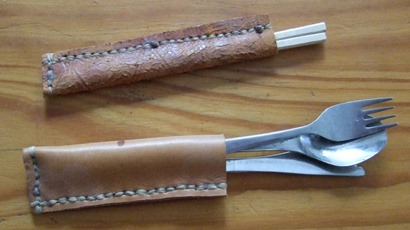
BYOC1_webBring your own chopsticks has become a trend in Japan and Taiwan and this must extend to cutlery elsewhere. Bring Your Own Cutlery (BYOC) needs to become a new trend, no ifs or buts, but, oh, and here is a but, we then also have to take it home again to wash up when it is dirty. It is not difficult and not rocket science.

BYOC wherever you go, instead of using disposable plastic utensils that never biodegrade while littering the world's beaches. Even if plastic utensils are claimed to be biodegradable or worst still compostable they are neither, at least not under normal (composting) conditions.

As an “old” military man – and soldiers and officers always carry their own “mess kit”, at least “in the field” – it is a habit to have my own set of cutlery on me when I know I may be dining out on a take out that might require tools. I also have a set of chopsticks, in a leather sleeve, same as the stainless steel cutlery, for the same purpose. The chopsticks were found, thrown away, still sealed in their original package, after a picnic and the stainless steel cutlery is ex-airline. Those ex-airline knife, fork and spoon are smaller than standard cutlery but similar smaller cutlery can be bought in stores as well.

Plastic forks, knives, and spoons are one of those things that we tend to think are inevitable when eating on the go or feeding a crowd. Even though alternatives do exist, these are not widely known or accessible, which is a pity, considering the impact that plastic cutlery has on the environment. It does not biodegrade, and they are some of the most common trash that is found in parks and open spaces and also on the beaches. The majority of those never ever make it into the recycling stream either.

Along with shopping bags and straws, disposable plastic cutlery is yet another part of the pollution puzzle that is threatening the world's oceans and waterways. And, like bags and straws, it is a direct consequence of our societal obsession with convenience, something that would not need or have to exist if everyone took a few moments to plan ahead before leaving the house.

The strange phenomena that we, who work in parks and open spaces, now encounter is that people take real cutlery to a picnic and then, would anyone believe it, they leave them, once dirty, behind, either thrown into the trashcans or just left behind where they have been sitting.

So, what are the alternatives?

Most obviously, disposable plastic cutlery should be made illegal, which is precisely what France has done. All single-use plastic cutlery, along with plates and cups, will be banned soon: "Manufacturers and retailers have until 2020 to ensure that any disposable products they sell are made of biologically sourced materials and can be composted in a domestic composter." While that is a nice move I doubt that there will be any disposable products going to be coming on the market that are truly compostable in a domestic composter, though they may claim that, in the same way that they claimed that the plastic bags for the food waste caddies were compostable in that way and later industry had to row back saying that that was not what they meant but compostable in a commercial hot composting unit. But that was not what it said, at least not originally.

What we all really should start doing is carrying our own cutlery for eating in restaurants or on the go in the same way that many people travel with water bottles. So why not forks and knives, too?

China, and I understand also Japan, have recently pushed to get people to carry reusable chopsticks, in order to reduce the 20 million trees currently cut down each year to make disposable chopsticks. The campaign has been hugely successful, thanks to celebrity backing.

While we don't, as yet, have celebrity backing for bring your own cutlery it should, nevertheless, become something that we do as a routine. A small set of flatware can be easily carried; every soldier does so in the field, and more often than not in the pocket of the tunic or the shirt. Those military sets that clip together can be purchased as military sets (from many surplus stores) or also for the civilian realm as camping or trail cutlery (from camping and outdoors equipment stores). It was also common practice for Boy Scouts and Young Pioneers when going to camp to have your own clip-together set) or similar).

Many more restaurants should again be offering metal cutlery for eating in and that should also extend to ice cream parlors for spoons. It was the common practice not all that long ago. But washing real dishes and cutlery takes a little effort and that was – probably – the main reason that everything went over to plastic “garbage”.

Let's hear it for BYOC.

© 2017

Report: Plastic pollution in the ocean is reaching crisis levels

Plastic has infiltrated the ocean’s ecosystem, from plankton to whales.

There are 5.25 trillion pieces of plastic trash in the world’s oceans, and each year, 8 million tons of plastic are added to the count. That’s equivalent to one municipal garbage truck pulling up to the beach and dumping its contents every minute. Though the oceans seem vast enough to stomach a lot of plastic, the level of waste is starting to reach a crisis point: According to a new report by the Ocean Conservancy, in partnership with the McKinsey Center for Business and Environment, by 2025, the ocean could contain one ton of plastic for every three tons of finfish.

All these floating bits of plastic–from micron-sized plastic pieces to those six-pack can rings–not only disrupt marine ecosystems, but they also poison the global supply of seafood. “It’s reaching crisis proportions,” says Andreas Merkl, CEO of the Ocean Conservancy. “Plastic breaks down into small pieces that look like plankton and is eaten by everyone from plankton to whales.” Plastic acts as a pollution sponge in the ocean, so when wildlife ingest pieces, the plastic might as well be a poison pill.

Read more here.

10 tips for living with less plastic

Life Without Plastic promo image

It's impossible to avoid plastic entirely, but there are effective ways to limit your exposure.

Plastic is so commonplace in our world today that it’s nearly impossible to imagine I a life without it. Striving for a plastic-free life, however, remains a noble and worthwhile goal – and it’s becoming easier with every year that passes, as more people demand plastic alternatives and refuse to participate in the grotesque plastic waste that’s filling our planet’s landfills. Here are some tips on how to get rid of plastic at home. Don’t worry; it’s easier than you think! 

1. Avoid the worst plastic offenders

If you check the bottom of any plastic container, you’ll see a number (1 through 7) inside a triangle made of arrows. The worst plastics are:

#3 – Polyvinyl Chloride, an extremely toxic plastic that contains dangerous additives such as lead and phthalates and is used in plastic wrap, some squeeze bottles, peanut butter jars, and children’s toys

#6 – Polystyrene, which contains styrene, a toxin for the brain and nervous system, and is used in Styrofoam, disposable dishes, take-out containers, plastic cutlery

#7 – Polycarbonate/Other category, which contains bisphenol A and is found in most metal food can liners, clear plastic sippy cups, sport drink bottles, juice and ketchup containers

Read more here.

How dog-walking turned into plastic waste activism

plastic waste3

A woman from California was so distressed by the amount of plastic waste she encounters daily while walking her dogs that she started posting her pictures online to show people where plastic ends up.

When Heather Itzla goes out to walk her dogs, she takes an extra bag and some tongs – not for the purpose you might imagine, but rather to collect all the plastic waste that she encounters during her hour of walking. She brings it home, spreads it out, and takes a picture that gets posted on her unusual and totally captivating website, “There Is No Away.”

Itzla started doing this several years ago, after watching a TED talk by Captain Charles Moore called “Seas of Plastic.” She told TreeHugger:

“After picking myself up off the floor, plastic became all I could notice out in the world – the phenomenal amount of plastic that passes through our daily lives in the form of packaging and all of the ‘stuff’ we’re marketed to believe we need – and then it was all I could notice on the ground, no matter where I walked.”

Itzla’s collection of photos is eerie and discomfiting. Nearly all the pieces of plastic are recognizable – pens, straws, water bottles, cutlery, wrappers, condiment bags, bottle caps, and food containers – except they’re the dirty, used, cracked, abandoned versions that many of us leave on the ground or toss into a garbage can as quickly as possible. Itzla, on the other hand, bravely collects it all to make a powerful statement. She writes on her website:

Read more here.

Europe heading for dismal fail on its zero waste policy on plastics

by Michael Smith (Veshengro)

The plastics industry is not going to achieve zero waste to landfill until 2037, which is a full 17 years later than its stated 2020 target.

This is the the damning conclusion of new research from European trade association PlasticsEurope which has examined current progress to date on recycling and recovery of waste plastics across the EU.

Back in 2009 the sector set itself the goal of reaching zero plastics to landfill by 2020, but the report states that unless there is a greater sense of stakeholder urgency, this will only be achieved by 2037.

The UK in particular is performing badly with a total plastics recovery rate of just 27.3% - over 70% of this material is still landfilled, placing it in the bottom seven of the EU27+2 countries for diversion.

However last year 1.04m tonnes of plastic post-consumer waste was recovered in the UK, representing an increase in recycling of 9.1% and 11.7% in energy recovery compared to 2010.

While the Department of Environment, Food & Rural Affairs (Defra) has introduced higher recycling targets for plastics, which are set to rise from 32% currently to 57% by 2017, the move has proved controversial.

Many industry experts believe meeting these targets will prove impossible unless there is significant investment in the logistics of collection and recycling such materials.

According to British Plastics Federation (BPF) public & industrial affairs director Philip Law, the Government's policy is "ill thought out" and will leave companies obligated under the targets to foot the bill for recycling that can't be delivered.

It's a view echoed by Packaging & Films Association CEO Barry Turner: "The Government continue to say that the onus is on packaging producers to ensure that enough material is collected, but in reality it is local councils that control collection.

"The fact is that, in the absence of resource-based recycling targets, there is no incentive for councils to invest in collection services - even less so when their budgets are already stretched to the limit."

Compounding the problem is Defra's recent downward revisions of UK recycling capacity estimates and the absence of material-specific targets placed on local authorities.

On a brighter note, the PlasticsEurope report notes that some overall progress has been made in capturing value from plastics waste. In EU-27, 4.8% more post-consumer plastic waste was recovered compared to 2010 while the amount ending up in landfills decreased in a similar way.

According to the study, achieving the zero waste 2020 objective would prevent an estimated 80m tonnes of materials from going to landfill, representing some €78bn in cost savings.

The best way, however, to go about things would be to reduce plastic materials in use of packaging to start with and that could be done immediately without any problems other that those of the plastics industry losing money.

Overpackaging of products in plastics, often mixed with paper and other things, which make recycling a nightmare, is still going strong and, in some cases it is getting worse rather than better. Instead of reduction of plastic use the target is to reduce that amount that goes to landfill after it has been with the consumer. This is about as useful as putting the cart before the horse.

When a product has already been “welded” into plastic does it really have to be “welded” in even more plastic just so the packaging is huge in order to hang it prominently on displays? I think not for if I want to/need to buy that product I will regardless of how prominently it is being displayed.

A general reduction of the use of plastic in packaging – what is, after all wrong with card; it was done years ago without any problems – should be the aim but, as said, there is no profit in it for the industry and neither for the politicians who get their pockets filled with backhanders by the industry and that's why we are in the dilemma that we are in as far as waste, and not only plastic waste, is concerned.

Reduce use before attempting a reduction in the amount that goes to landfill and change the material of packaging. This can be done, by legislation if necessary, tomorrow and the zero to landfill would soon be achieved. But that would be too simple, I guess.

© 2013

Plastic Waste

by Michael Smith

In 2007, 3.9 billion pounds of plastic waste went un-recycled in the United States. The U.S., while not the largest in land nor population, is by far the leading nation in terms of waste. This is not much better, I should think, I Britain either, even though bottles are being collected by the municipalities and people in fact do put them, from their households, into the right bins and such.

This growing problem of waste that is not being recycled has a detrimental effect on the world in which we live. Every plastic bottle that gets thrown in the trash is a missed opportunity to reuse our resources and help preserve the environment.

I have a problem with the plastic bottle and bottled water and more as to the water than the plastic bottles and as far as I am concerned those bottled should be phased out and we should get back to carrying water in reusable water bottles.

The problem is that even if the plastic bottles and other plastics, such as yogurt tubs, and whatever else, is being put into the plastics recycling bins, collected by the municipalities, and then sorted properly and all that, in the present climate – the economical not the natural, the places where we used to ship the stuff to, such as China, do not want any at present as they have no use for it at this moment.

However, as I have said more than once before, why does this material leave this country in the first place and is not reprocessed here, at home?

It is said to be better, financially, to send it abroad and have it processed there as the new plastics are going to be used in places such as China. To me, I am afraid to say, that does not make sense and does not compute and if definitely does not make sense as far as the environmental footprint, often referred to as “carbon footprint”, is concerned.

It is madness to export such resources, those secondary raw materials, as they were called in the German Democratic Republic, the old “communist” East Germany, to places far afield to be processed there and then to come back to us as finished products “Made in China”. Instead the processing into new should be done at home; giving us a new manufacturing industry base. There are some companies who do just that in this country and they are even competitive. So why can we not do it all?

The answer to the latter question is simple: in Britain the powers that be decided some years ago that the UK was going to do financial services, basically, only, and all our manufacturing industry base was sold off to foreign firms who, in the end, closed most of the operations down.

In the looming depression, however, we should look, nay we must, once again, to get manufacturing going at home and we should then, also, keep those industries at home and not allow them to leave again or end up in foreign ownership.

Keeping our manufacturing and other industry “at home” is also a green way of doing things, and one that will benefit the people of our home countries, whichever this may be.

© M Smith (Veshengro), March 2009
<>