Showing posts with label plastic packaging. Show all posts

Recycling is a fraud, a sham, a scam

by Michael Smith (Veshengro)
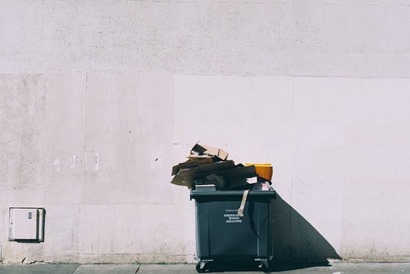
Recycling is a fraud, a sham, a scamRecycling is a fraud, a sham, a scam, perpetrated by big business on the citizens and municipalities to make us all feel good about single use packaging. It won't save the planet.

We blame ourselves, or consumers are getting blamed, that's you and me, by government, for not recycling more plastics, and yet our efforts are like “hammering a nail to halt a falling skyscraper.” It is time we got to the root of the problem.

“People need to get better at recycling” is a comment we often hear as soon as the topic of (plastic) waste comes up. It is a misleading assumption, however, to think that tossing more items in the recycling bin and fewer in the trash can make that much of a difference in dealing with the catastrophic level of plastic contamination that our planet currently faces. In fact, it is actually pretty much pointless. And the same goes for other single-use, or perceived single-use, items of packaging, even for glass jars. Aside from the fact that the latter can be reused in so many ways and do not have to end up as recyclables.

We need to rethink the way that we deal with trash because individual consumer cannot solve this problem as individual consumers are not the problem. We have taken it on as our problem because of some very astute, corporate-driven psychological misdirection in the form of campaigns like Keep America Beautiful and other such “initiatives”, created by industry.

Keep America Beautiful, Keep Our Country Tidy, Don't Be A Litterbug, and others were all, in one way or another created, brought to life or sponsored, by industry in an attempt to place the problem of litter, waste and trash on the shoulders of the consumer rather than keeping it on their own and dealing with it.

Keep America Beautiful was founded by major beverage companies and tobacco giant Philip Morris in the 1950s as a way to encourage environmental stewardship in the public. Later it joined forces with the Ad Council, at which point, "one of their first and most lasting impacts was bringing 'litterbug' into the American lexicon." This was followed by the 'Crying Indian' public service announcement and the more recent 'I Want To Be Recycled' campaign.

We can safely assume that campaigns of a similar nature in other countries were and are sponsored by the same entities, be it the programs like “Keep Our Country Beautiful” (UK), ot others of a similar nature.

While these PSAs appear admirable, they are little more than corporate greenwashing. For decades Keep America Beautiful has actively campaigned against beverage laws that would mandate refillable containers and bottle deposits. Why? Because these would hurt the profits of the companies that founded and support Keep America Beautiful. Meanwhile, the organization has been tremendously successful at transferring the blame for plastic pollution onto consumers, rather than forcing the industry to shoulder responsibility.

The greatest success of Keep America Beautiful has been to shift the onus of environmental responsibility onto the public while simultaneously becoming a trusted name in the environmental movement. This psychological misdirect has built public support for a legal framework that punishes individual litterers with hefty fines or jail time, while imposing almost no responsibility on plastic manufacturers for the numerous environmental, economic and health hazards imposed by their products.

The burden, whether as regards to plastics or other waste, was placed on the should of the consumer, and the same, today, happens also as regards to food waste. The majority of food that is wasted has never even made it to the consumer.

If we are serious about tackling plastic pollution, then corporations' actions are where we should start. They are the real litterbugs in this situation. The focus should be on the source of the plastic, not its near-impossible disposal.

This also goes for any packaging and also for food waste. It needs to start at the source and not at the consumer. When it comes to food waste, as mentioned already, the majority of waste occurs before it ever gets to the shop let alone on the consumer side. When the market buyers refuse vegetables and fruit because it does not fit certain criteria and the farmer is ordered to destroy the crop. That is where the waste starts.

With plastic and packaging it starts at the manufacturers of products who use too much packaging.

But, it would appear that we, the consumers, allowed ourselves to accept individual responsibility for a problem we have little control over. In fact, a problem over which we have almost not control.

I know we all want to feel that we can do something to make a difference and, indeed, we can, but it starts well before we think “recycling”, or at least it should. We can refuse, where possible, to buy things in plastic bottles – though in certain cases it gets more and more difficult. We can refuse to buy bottled water altogether for in most places the tap water is at least as good as to water in those bottles – which often is, by the way, from municipal sources, in other words, it is tap water, just bottled tap water.

I am not saying don't separate your recyclables and put them out for the municipalities to collect, only that that, in itself, is not going to make much of a difference, especially not considering that much of what you are going to put out ends up in landfill again because either the price that can be achieved for the recyclables is too low to make dealing with them viable or, as with China refusing to take the West's garbage, many countries do not know what to do with the stuff. Processing it at home, obviously, wouldn't do – in the eyes of the powers-that-be – as at home there are higher environmental protection standards and thus it would cost a lot of money to do so. So, if they can't dump it on third (world) countries they just dump it in holes in the ground.

We need to start well before recycling but often we have little to no control over that department other than buying products elsewhere where there is no over-packaging but, alas, some cannot afford to do that. Nor is the suggestion to leave all the packaging at the checkout a brilliant idea because for one it often is not possible and also, in some cases, should you have to return anything the packaging, to some extent, such as a box in which some item came, has to go back as well with the item to be returned.

So where does that leave us, as the consumer? It leaves us as the reuse, repurpose, upcycle and such stage. True, you can't do that with everything and how many glass jars (and other items) can you really reuse. Fair enough, I seem to be able to make use of an awful lot of glass jars for storage purposes but not everyone can. I also tend to make things from plastic milk jugs and such for the garden and for other uses. In addition to that many of those things could even be upcyled by craftspeople for sale, but, alas, few seem to think along those lines.

Where it all has to start, however, is with industry and also with design (do you hear me #designers). Designers come in to design packaging either to be compostable, or with a second use automatically obvious. This has been done, and is still been done, with mustard, and similar glass “jars” and containers, such as in France where they have the automatic reuse potential as drinking glasses, such as the ones used commonly for vin de pays in the homes, and even bars.

This should also be possible with other packaging, including plastic packaging, thus making us think as to whether we want to throw the item away in the first place or whether we do not, maybe, have a personal use for it. It can be done because it has been done before. We just need to remember, dearest designers, and adapt some of the things from the past when it was done to the present. Not rocket science but then you have studied design, not rocket science.

For us as consumers, yes, we can do our bit but the recycling bin, please remember, should always be the last consideration.

© 2018

Zero waste myths: should we really be avoiding plastic?

by Michael Smith (Veshengro)

Zero waste myths_ should we really be avoidingnbspplasticFirst of all it also must be said that “zero waste” is a myth itself. There is no such thing as “zero waste”. It will never be possible. Having said that, however, does not mean that we should not reduce waste, especially in way of packaging, and waste that occurs also through planned obsolescence.

Images of ocean plastic pollution are causing so much revulsion that many people are switching to some supposedly more “environmentally friendly” materials to try to reduce their impact. But does this actually work? How much greener are the alternatives?

Also, there is plastic and then there is plastic. Single-use plastic, in my opinion, is a bad idea. We should, with the exception of may be a few things, avoid any kind of single use altogether. Other plastics, for plastic products intended to last for a long time, are a different story and here the material, quite often, is the appropriate one, unless we return to (more) natural materials.

Plastic vs Paper: It is easy to see how paper bags are seen as and appear to be more environmentally-friendly than plastic ones. They are made from trees, which grow in nature, and can biodegrade, in fact compost, when they are finished with.

Research, however, consistently finds that paper bags have a far higher carbon footprint than plastic ones, because the process of making them uses so much energy, and not just energy but also lots of water. Trees may be in harmony with nature, but the process for mashing them up into paper is not.

True, paper bags can decompose, but it is not exactly zero waste to use so much energy producing something that is not designed to last. And if you are careful to reuse and recycle a plastic bag, it should be possible to prevent it ending up as litter or in the ocean, whereas every single paper bag will have made a hefty contribution to global warming, regardless of where it ends up. The best option, of course, is to avoid the problem of single-use waste altogether by using reusable bags.

If you are a business and you want to offer something to customers who have forgotten their own bags, consider doing as Arjuna Wholefoods in Cambridge does, which is to invite people to drop off their old plastic bags to be reused. Alternatively, bags made from recycled materials is the next best thing. Just please don't hand out new single-use bags for free, as this does not reflect how much it costs the Earth to produce them.

As for the idea that paper is “more recyclable” than plastic, this has now been repeated so many times, that it has become almost fact. While it is true that paper can be recycled, the quality of it degrades in the process. Plastic can also be recycled, although some types of plastic are easier to recycle than others, and packaging that mixes plastic with other materials can be more tricky to recycle (single-use coffee cups are the most well-known example of this), but also here, in the main, the quality deteriorates and to make good new plastic from recyclables a great deal of virgin polymer needs to be added to the mix. So, there is no such thing – generally – as 100% recycled plastic, with a few exceptions, maybe. .

So, when it comes to recyclability, there is not that much to be gained from choosing paper-based products over plastic ones, and anyway, it is actually a big mistake to be overly focused on how recyclable something is, when most of the impacts of the stuff we consume is in the process of producing it, rather than what happens to it at the end of its life. This is true regardless of the material, but in terms of paper, we need to factor in how much carbon it takes to produce it.

The best way to lower impacts from packaging waste is to reduce the amount of packaging that we buy, and where possible, buy products packaged in recycled materials. Though it has also be said that often we, as consumers, do have little choice as to the amount of packaging of any kind, be this paper, cardboard (often laminated with foil), or plastic except by voting with our wallet and not buying over-packaged products. This can be a difficult undertaking, however,

Plastic vs Metal: Stainless steel tins and bottles are something of a zero waste style statement. There is no doubt that they look good, but the process of producing metals like stainless steel and aluminium releases scary amounts of carbon into the atmosphere. This means that reusables made from metal will need to avoid a lot of waste before they save more resources than it took to produce them.

The choice is really up to each of us: Option one would be stainless steel (or other) products, which are very high impact to produce, but highly durable, or option two would be plastic bottles and containers, which are more environmentally-friendly to produce, but tend to wear out somewhat more quickly, so that you may end up using more of them in the end. This is essentially a judgment call, based on your personal routines and how much waste you expect to avoid by using your reusable bottle and containers.

Single-use cups vs reusable cups: Several studies have looked into how many times a reusable cup needs to be used before it saves more resources than it took to produce. As they are carried out by academics, there is no simple answer – it depends on which type of reusable cup you are using, which type of single-use cup you are trying avoid, and which environmental impact you are considering – but it seems to range from 5-16 times. So, if you would otherwise expect to use at least 17 single-use cups, consider investing in a reusable one. For top marks, see if you can pick one up in a charity shop or other kind of secondhand store.

Glass jars vs plastic packaging: The jury certainly appears to be out on this one still. Glass tends to lose points compared to plastic because of the high carbon emissions involved in manufacturing and transporting it (think of how much more glass weighs) but can redeem itself by being more efficient to recycle than certain types of plastic. Glass jars, for instance, if we want to be thrifty in the way our grandparents and their parents were, also have a great reuse potential for us, whether as storage jars for all kinds of things or as drinking vessels, etc. And the reuse thought should always come well before any thought of recyclability.

If you can and will reuse or refill jars, the that is your best option. Otherwise, there is, apparently, no clear justification for always choosing glass jars over plastic.

Plastic bags vs cotton or other textile bags: Its a bit of a mystery why cotton has gained a reputation for being an environmentally friendly material. It takes 20,000 liters of water to make 1kg of cotton, and much of it is sourced from countries where water is extremely scarce. Worldwide, cotton production causes pollution and biodiversity loss. But there are alternatives to cotton and cotton bags, such as hessian, aka burlap, canvas, and others, including, though it is oil-based to some extent, woven and non-woven polyester bags.

When it comes to plastic there are – if I may put it this way – good plastics and bad plastics and I am not putting so-called bio-degradable into the category of good necessarily either. Also, as far as plastic water bottles, the reusable kind I mean here, are concerned not all leach chemicals. It all depends on the plastic. The Dutch designed (and produced?) “de Dopper”, as an example, does not, and is also of a rather ingenious design.

The biggest problem is plastic packaging and the over-packaging of products, often products that do not need to be packaged in such a way at all. That is where the changes have to happen and we must force industry to make the change.

© 2018

Bioplastics and biodegradable packaging

by Michael Smith (Veshengro)

bioplasticsA more sustainable solution? Maybe and then again maybe not.

Plastic packaging is all over the media at the moment and that in an incredibly negative light. Consumers have growing concerns about how plastic packaging is managed at end of life, and are worried about leakage into the ocean. This has brought in a focus on what can be done about plastic waste.

The most obvious option is to reduce the amount of plastic packaging, but simply from a cost point of view this has already been on the agenda for brands and retailers for many years. What we are mostly left with now is packaging that has been carefully designed for its function - but not always with end of life considerations.

So, what is the solution? Most logically, several steps must be taken:

1. Reduction of amount of packaging where possible;

2. Rationalization of polymer types used in packaging to simplify the sorting and recycling process;

3. Design packaging with understanding of how it will be handled at end of life;

4. More recycling infrastructure, funded and ultimately subsidized through Extended

Producer Responsibility schemes; and

5. Consumer engagement to ensure as much packaging as possible is captured for recycling

What could the role of bioplastics and biodegradable packaging be in all of this? Should we completely switch all packaging so that it is made from “bioplastics” and which is “biodegradable” so that it will disappear once disposed of and will be made from renewable resources?

The short answer to this is “no”. Bioplastics will certainly have a part to play in the future and in some instances today, but we need to make sure the Life Cycle Analysis (LCA) of such materials is more beneficial than oil based plastics. Oil is not going away anytime soon, and while we are still refining huge quantities for fuel, should we not make use of the plastic that can be produced from its by-products?

As for biodegradable packaging, this is a minefield of confusing messages and lack of transparency. Packaging that will readily degrade in a home composting system, or in the ocean, is great in theory, but ensuring it can do that and deliver product protection is not easy. Many food products need protection from oxygen and moisture, and material that easily breaks down cannot always achieve this. There is a balance to be found to produce polymers that will maintain integrity during product lifetime (which many include many months in warehouses or on shelves) but will readily degrade once the packaging is no longer needed.

Then you come to packaging that is compostable, but only in an industrial composting facility. This then brings same challenges as any other material that is collected for recycling, if not more, because the consumer now must understand a whole new category of packaging which needs its own special disposal route. For example, imagine the confusion if some drinks bottles needed to go in the regular plastic recycling bin while others went in the composting collection. In some closed, controlled systems this may work, but we must be mindful of how material is handled at end of life.

So in some instances a biopolymer or biodegradable pack may have a more positive environmental impact, but very careful consideration is needed before using these materials. It should not be assumed that just because “bio” is in the name, it is better for the planet.

Plastics are wonderful materials, which when used correctly can have massive positive impacts on our lives. There is no better time than now to think hard about the various options, whether that be designing for end of life, improving recycling infrastructure, or replacing current materials with biodegradable or compostable ones. The answer is not always straightforward.

The problem is that many so-called “bioplastics” are not as readily biodegradable and especially not compostable as they are claimed to be. In a marine environment they will not degrade and compost but simply break down, just as “ordinary” plastic packaging material, into microplastic particles which end up in marine life and the food chain.

As said above plastic can be very useful indeed and there is, if I may put it like that, good and bad plastic. There the the (good) products that we can use for many, many decades and which are made of a single kind of plastic that can, at the end of the product's life, be recycled – in theory at least, whether it happens is another story – and then there are the bad plastic products, which include many of the packaging materials that are either non-recyclable or very hard to recycle because, often, they are made of more than one plastic and often, in the case of foils, several different plastics laminated together.

The Tupperware box, the reusable plastic water bottle, such as De Dopper, and the reusable plastic coffee cup, such as KeepCup, are actually your friend, and the Planet's friend, and not the enemy, as are many other kinds of plastics. Not all plastic is bad. It all depends on the type and the use. The current hype about plastic being bad is totally out of context. The problem is what we do with the plastic and the real culprit is us and the single-use plastic products.

It would be better if we would, to some extent, go back to (more) natural materials but for many applications there simply is not another option.

© 2018

Uses for plastic containers

by Michael Smith (Veshengro)

New uses for plastic containersPlastic packaging and plastic containers are everywhere, they are ubiquitous, and most end up in the landfill for recycling does not always happen in the way that we are being told. In fact, quite often it does not happen. Now that China has closed its doors to plastic (and other) recyclables from the Europe and America the problem is going to get bigger still.

We can also not expect that the uses of plastics, for packaging especially, is going to go away soon and even so-called bio-plastics, biodegradable and even – supposedly – compostable plastics are still plastics and most will only compost, when it comes to the latter, in commercial hot composting facilities and not in Nature per se, and not even on your domestic compost heap or in a composter in your garden.

So, what do we do? Aside from reducing where we can we must look at reusing and upcycling wherever possible. As far as plastic containers are concerned they come in many shapes and sizes and thus to many reuse and upcycling possibilities.

There are the humble milk jugs in a variety of sizes. In the UK they are pint, two pint, four pint and six pint sizes while in the US they happen do be different and also come in gallon size. They all, as far as I am concerned, have reuse potential and I have made a variety of things from them, including a belt-wearable berry picking/dead heading container for gardening (see photo).

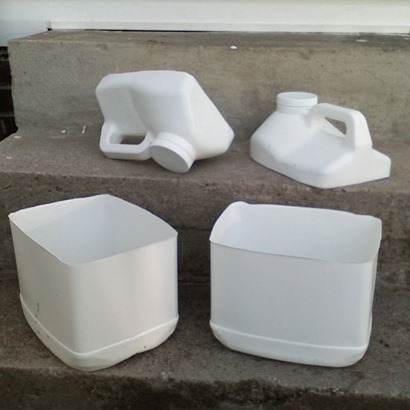
Milk jugs, of all sizes, can also be used as planters, for seed starting as well as for growing plants. Larger plastic jugs, like those used in commercial catering and also for other purposes, often small to large jerrycan size and style, can be reused, repurposed and upcycled also into planters.

The same goes for plastic buckets in which many products come when purchased in bulk, or for commercial catering, for instance, such as mayonnaise, oil, etc. Those buckets, often gallon and greater in size, make great planters in the garden. Drill holes into the bottoms, and, maybe the sides, of the emptied and cleaned containers, and then use them for growing vegetables or invasive plants, such as mint. You can also use the plastic buckets to organize and haul garden materials and compost, sort laundry, or store household items.

But they can also be made into other useful items, such as storage drawers, and smaller ones can be used for dividers in desk drawers and such. The only limitation, probably, is set by your imagination or lack thereof.

From plastic lotion containers (bottles) holsters and pocket protectors can easily be made for safely carrying tools, such as, say secateurs. They can either be fitted with “straps” so they can be worn on the belt, or shoulder straps, or they can just simply be put into the pocket. The tool is safely encased in the holster and thus will not damage the clothes or the wearer.

Other bottles from strong plastic, such as those from cleaning fluids, for instance, can become holsters for scythe sharpening stones, the name for which I rather not mention here as nowadays it is considered a cuss word, as it has four letters, begins with a “c” and ends in a “t”. But, honestly, that is the real word for such a holster.

Many other items of plastic packaging also, no doubt, have reuse, repurposing and upcyling potential and I am sure we can all create a whole list of ideas in this department. Often all that is required is the correct mindset, imagination and inspiration.

I strongly believe that there is even potential, as far as plastic containers (and such) are concerned, for upcyling business ventures if people can be brought to understand to buy into the concept – literally as well.

© 2018

Plastic packaging – the bane of the modern world

by Michael Smith (Veshengro)

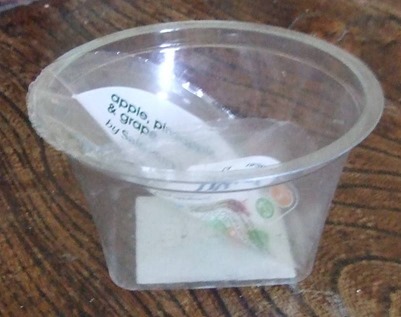
Platic_Tub_Waste1_webAlmost everything that we buy today is packaged in plastic and sometimes double and treble. And the greatest bane, at least in my opinion, is the plastic that is hollow formed into different shapes, whether as dishes, trays, or the shape of an apple or orange and then they are stuck into them individually. Aside from the fact that many of those packages have no secondary use in any way they also take up a lot of space in the bin.

There are some of those though that can be reused and repurposed but very few seem to see the potential. I am thinking here specifically of the bowls and such for prepacked ready-made salads, the apple and other fruit snacks, and such like. Those are bowls that could easily be given a second life by being reused. The plastic often enough is not a bad strength at all and food grade and thus those items could serve in the kitchen and/or elsewhere. (The one in the picture has now got a second life).

While it would be good if we could get away from plastic packaging altogether – which is not all that likely to happen – making use of as much of it as possible is the way to go, I think. Packaging designers too could help here somewhat more in that they could create plastic packaging (and packaging in general, including glass) that would automatically and obviously have a second use. This was the case once, for glass, and should be again and also for such plastic containers. It is not rocket science. But, I assume, that even then the majority would still treat it in the same way as they do now, as disposables. But then they even treat plastic products that they have bought as disposables when they take them on picnics. Somewhere along the line some people definitely have lost the plot, and they didn’t even have an allotment.

© 2017

Reuse ideas for plastic frozen food bags

by Michael Smith (Veshengro)

Frozen food bag as hanging basket liner_webI am one of those people who take reuse and all what is related to that to another dimension at times, as regular readers will know, and I do, yes, tend to keep those bags from frozen food.

Being a vegetarian, single, and not being able to shop for fresh vegetables daily or such, I tend to buy them frozen. Alas, they then come in those bags. But waste not want not they are, after being rinsed out, used for all manner of things.

  1. Sandwich bags: Now this is, more or less, a use that should stare everyone straight in the face. They are fairly strong, can be washed out again and again, and thus can be used for much longer than most sandwich bags that you might buy.

  2. Freezer bags: Well, yes, you could even use them for the original purpose, using twist ties to close them before popping them into the freezer.

  3. Durable hanging basket liner: Especially suitable for small to medium size baskets but even then you may need two or three. But, hey, that, they are free and would otherwise end up in the waste stream.

  4. Basically anything you would use a small plastic bag for.

I am sure that the readers, themselves, can come up with a lot more ideas. They are, after all, quite strong “little” plastic bags and have great reuse potential and reusing them can keep them out of the waste stream for longer.

© 2017

Reuse and Upcycling of Plastic Packaging

by Michael Smith (Veshengro)

As much as we may wish to avoid plastic (in our lives) the fact remains – at least for the foreseeable future – that it is with us, especially as far as packaging containers are concerned, and thus reuse and upcycling of those is better than any other solution.

The recycling of plastics – as much as that of everything else – still requires a great amount of energy, even though maybe not as much as creating plastic from virgin polymer. But we do have to consider the collecting, etc., of the plastic recyclables as well, and it takes lots of energy in the form of diesel and other sources.

Thus the greener option by far is reuse and recycling before we even as much as think of the recycling bin and tossing those things into it.

Many plastic packaging containers just simply ask to be reused, be those certain ice cream tubs or others.

But other plastic packaging too is a candidate for reuse and, especially, upcycling, such as shampoo, detergent and other such bottles, including plastic milk jugs and even PET bottles.

PET bottles can be reused, or better upcycled, into various things and in a variety of ways. One thing to say first, however, and that is never, repeat never, reuse them for drinks.

  • plastic ollas for the garden

  • cloches for seedlings and plants

  • etc.

Small drinks bottles filled with pebbles, beans or rice, make great maracas, that is to say, percussion instruments.

Milk jugs are another kind of plastic packaging that many of us get more than enough of and they can be reused and upcycled too into a variety of things for home and garden, from storage solutions, over boxes, to scoops and cloches, and even watering cans. To toss out those jugs, even into the recycling bin, before you have exhausted all the reuse and upcycling possibilities, would be a crime.

There are, obviously, some plastic packaging containers and materials that cannot be reused and upcycled and some of those cannot even, alas, be recycled. Those that cane be reused and upcycled, however, should be before even the thought of the recycling bin comes into play, especially as reuse and upcycling has a much smaller impact on the Planet as does recycling even.

Recycling plastic packaging (and other materials as well) has a large environmental footprint that often we are being kept in the dark about. Not only does the recycling process take a large amount of energy still (and water) the collecting of the recyclables, the sorting, the redistribution, etc., too require a high energy input. While it may be a little less than producing from virgin polymer this footprint is still immense.

Thus, let's see to it, as said before, that we reuse and upcycle all these materials before we even think about tossing them into the recycling.

© 2015