Review by Michael Smith (Veshengro)
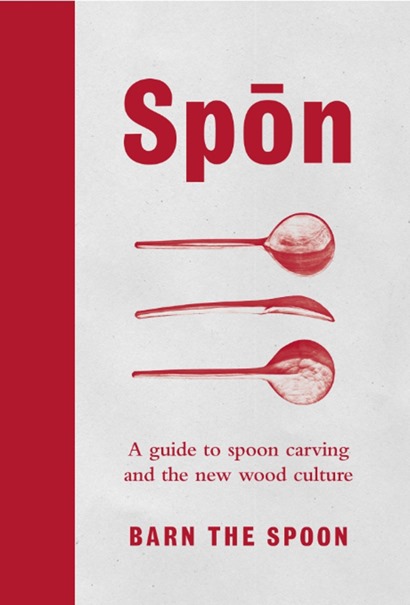 Spon: A Guide to Spoon Carving and the New Wood Culture
by Barn the Spoon
224 pages, Hardcover, 16.5 x 2.2 x 23 cm
Published by Virgin Books (25 May 2017)
Language: English
ISBN: 978-0753545973
Price: £20.00
I was send this book by the publishers upon my request having just learned of the publication of it. Knowing of Barnaby Carder, better known as Barn the Spoon, I was most interested to have a look at it and I was in no way disappointed.
The book itself is a spoon carving guide but also introduces the reader to the new wood culture, or wood renaissance, and that being right up my street being a forester by original trade, and a carver of wooden things, including spoons as well.
Spōn is not really a technical manual like, for example, Willie Sundqvist's 'Swedish Carving Techniques', but instead takes the reader through a personal journey that Barn himself has taken, though it does give the reader many instructions, hints, and tips.
In his book Barn the Spoon explains to the reader the how and why as regards to certain woods, tools, and techniques that he has found best suited for carving usable spoons and he then explains it all in more detail and shows the reader some of his favorite spoon designs to try.
Aside from that he walks the reader through every aspect, from choice to tools and how to keep them sharp and well maintained. Personally, though, I have different ways of sharpening knives, including hook knives and I believe that too much emphasis is placed on certain ideas, such as the supposed Scandi grind not having a secondary bevel. But I have only been a professional knife grinder for almost my entire life and have never encountered such a grind, not even on Scandinavian knives.
Spōn is a lovingly written book, with many color illustrations, that is full of the passion of someone who really appreciated wood and its properties and what can be made from it, though Barn mostly touches on wooden spoons only.
As a Romani-Gypsy by birth I very much enjoyed and appreciated the fact that the “Roma Spoon”, as Barn calls it, the traditional one of the Roma of Romania, in included. It is more a serving spoon that for any other purpose; the eating spoons are often different.
But that spoon, however, is only one of many different Romani spoon designs that used to be and are still carved by Gypsies in Eastern Europe (and beyond), such as by those in Poland where the bowl is the egg shape, reversed, and not as pronounced in the reverse.
In Russia the Romani carve spoons that are akin to those of the Doukhobors which are similar to the Welsh Cawl Spoon though without the pronounced crank in the handle and a handle that is almost round. But I digressed.
As I said before, Spōn is not really a technical manual but a book that, while teaching the reader about spoon carving, leads you more on a personal journey of the way the author does things and why and also introduces the reader at the same time to the new wood culture, or wood renaissance. I hope that readers will discover the joy of carving spoons and other treen objects from reading this book but also be encouraged to connect without our woods and trees and to value the handmade wooden kitchen utensils and such like. Handmade goods are so much different to factory and machine produced and thus are also higher priced. A good wooden spoon is not tuned out in five minutes flat. It often takes hours and the price does then often not even reflect an hourly minimum wage. Let that sink in.
A very good book that I can most certainly recommend.
© 2017