Showing posts with label wind power. Show all posts

Wind power is cheapest energy, EU analysis finds

Onshore windfarms far cheaper than coal and gas when health impacts are factored in, report shows

Dawn over Whitlee wind farm on Eaglesham Moor just south of Glasgow, Europe's largest onshore wind farmOnshore wind is cheaper than coal, gas or nuclear energy when the costs of ‘external’ factors like air quality, human toxicity and climate change are taken into account, according to an EU analysis.

The report says that for every megawatt hour (MW/h) of electricity generated, onshore wind costs roughly €105 (£83) per MW/h, compared to gas and coal which can cost up to around €164 and €233 per MW/h, respectively.

Nuclear power, offshore wind and solar energy are all comparably inexpensive generators, at roughly €125 per MW/h.

“This report highlights the true cost of Europe’s dependence on fossil fuels,” said Justin Wilkes, the deputy CEO of the European Wind Energy Association (EWEA). “Renewables are regularly denigrated for being too expensive and a drain on the taxpayer. Not only does the commission’s report show the alarming cost of coal but it also presents onshore wind as both cheaper and more environmentally-friendly.”

The paper, which was written for the European commission by the Ecofys consultancy, suggests that the Conservative party plan of restricting new onshore windfarms will mean blocking out the cheapest source of energy when environmental and health facts are taken into consideration. It has been suggested the Tory plan could be done through a cap on onshore wind turbines’ output, lower subsidies or tighter planning restrictions.

“Any plans to change policy for onshore wind must be looked at in the context of this report,” said Oliver Joy a spokesman for EWEA. “Investors need long-term visibility. ‘Stop-start’ policies as well as harsh retroactive changes can blindside investors, driving up the risk premium and cost of capital.”

The documents’ contents may also be unwelcome in some quarters of the commission, which early today published selective results from it that did not include external health and pollution costs.

These showed that renewable energy took €38.3bn of public subsidies in 2012, compared to €22.3bn for gas, coal and nuclear. The EU did however note that if free carbon allowances to polluters were included in the data, it “would reduce the gap between support for renewables and other power generation technologies.”

Read more: http://www.theguardian.com/environment/2014/oct/13/wind-power-is-cheapest-energy-unpublished-eu-analysis-finds

Autarkie vom Stromnetz mit Solarspeicher und Mikrowindkraft

KfW geförderte Photovoltaikspeicher mit Windkraft optimal nutzen

690836Steigende Strompreise lassen die Energiewende im Kleinen weiter voranschreiten. Vor allem die Besitzer privater Immobilien und kleiner Betriebe setzen zunehmend auf Speicherlösungen wie die 'Sonnenbatterie'. Solche Systeme speichern einen Teil der erzeugten Energie in Akkus um Ihn dann zu den Hauptlastzeiten bereitstellen zu können. Staatliche Förderungen lassen diese Art der Netzentlastung aktuell schnell Marktanteile gewinnen.

Doch hat die Technologie noch erhebliches Ausbaupotential, denn längere Zeiträume ohne die benötigte Sonne auf den Solarpanelen erschöpfen die Akkus schnell. Im Winter oder bei Schlechtwetter können gerade kleinere Speicher Ihren Nutzern daher kaum noch Strom liefern.

Die Lösung dieses Problems ist vieler Orts bereits verwirklicht - Windkraft. Der Wind weht fast immer genau dann wenn Solaranlagen schwächeln. Im großen Maßstab übernehmen dann ganze Windparks die Aufgaben der vielen tausend deutschen Solaranlagen. Doch was im Großen funktioniert war im Kleinen bisher unmöglich - kleine Windkraftanlagen bekamen kaum Genehmigungen und kosteten im Schnitt 5.000€ pro Kilowatt. Das entspricht mehr als den doppelten Kosten die eine Solaranlage heute verursacht. Hinzu kam, dass viele Anlagen kaum deutschen Qualitätsstandards entsprachen und die Wahl des richtigen Gerätes selbst für Profis eine Herausforderung darstellte.

Für den optimalen Einsatz einer Solaranlage mit Speichersystem wird eine Windkraftanlage benötigt die schnell und sicher auf dem Dach installiert und an das vorhandene System angeschlossen werden kann. Teure Masten und aufwändige Genehmigungen sind dabei ebenso ein Ausschlusskriterium wie unkalkulierbare Lebensdauer und hohe Kosten. Mit diesen Gegebenheiten im Hinterkopf startete Anfang 2014 das innovative Start-Up Unternehmen 'FuSystems SkyWind' in der Hauptstadt des Windkraftlandes Niedersachsen. Ziel war es eine Windturbine zu entwickeln die die Kosten halbiert, die Leistung absichert und die Installation vereinfacht. Das Ergebnis ist der SkyWind NG, eine sogenannte 'Mikrowindturbine'.

Mit seiner Größe von nur 1,5m kann der SkyWind ohne Kran mit Standardhalterungen auf nahezu jedem Dach montiert werden. Seine Kosten von nur 2.249€/kW sorgen für eine wirtschaftliche Integration in das Gesamtkonzept, während seine patentierte Bauart aus Metall eine lange Lebensdauer sichert. Aktuell wird der SkyWind auf dem einzigen deutschen Windtestfeld für Binnenlandkraftwerke unabhängig vermessen und seine Leistung nach den Standards der großen Windkraftanlagen zertifiziert. Mit nur zwei dieser Anlagen könnte so in Zukunft jeder Besitzer von Speichersystemen die Verfügbarkeit seines Speicherstroms verdoppeln. Denn auch in Schwachwindgebieten steht Windkraft bei Schlechtwetter und im Winter für die Nutzung im eigenen Haushalt zur Verfügung.

Auch wenn erste Projekte bereits umgesetzt sind sieht sich das Team hinter dem SkyWind weiter vor großen Aufgaben. Ihr erklärtes Ziel ist es Windkraft zu den Verbrauchern, nicht nur in den windstarken Regionen, sondern auch in Länder wie Bayern und Baden-Württemberg zu bringen. Denn hier ist der Gewinn an Autarkie aufgrund der mitunter langen Zeiten in denen die Solaranlagen verschneit sind besonders groß. Wenn durch diese 'Windkraft zum Anfassen', dann auch die Akzeptanz der erneuerbaren Energien allgemein steigen würde sei das ein Gewinn für alle, so das Team.

Full Disclosure Statement: The GREEN (LIVING) REVIEW received no compensation for any component of this article.

This article is for your information only and the GREEN (LIVING) REVIEW does not (necessarily) approve, endorse or recommend the product, service, company or organization mentioned.

Court rejects Northants wind farm plan

by Michael Smith (Veshengro)

Reacting to March 8, 2013's High Court ruling against plans to build a wind farm on farmland at Barnwell Manor in Sudborough, Northamptonshire, Friends of the Earth's Head of Campaigns Andrew Pendleton said: "It's understandable that changes to our much-loved green and pleasant land will often cause controversy, but the biggest threat by far - to people and nature - is climate change.

"It's time to stop tilting at windmills – there are some locations where turbines shouldn't be built, but if we want a clean and affordable energy future, we must find space for them in our landscape."

It might be good to check as to who paid the piper in this fight against the windmills. Don Qichote definitely was not involved.

Large turbines are not the general answer. Every building must become a power station with PVs and small wind. This has been proven in Germany in many places in that small solar and wind can produce more energy than over ten nuclear power stations, and even in Germany this is but a small amount of homes that thus far have been equipped in such a way, though more than in the UK and the USA combined.

Large wind installations in Germany also do not seem to be perceived in the same negative way as they are in Britain and one can see turbines all along the ridge of the Harz Mountains, for instance, on the line that once was the German-German border. They stretch as far as the eye can see but in nicely spaced intervals and thus do not become a blot on the landscape.

Small wind and roofs with PVs should become the norm rather than the exception everywhere making every building a power generating plant regardless as to whether it is a modern house or office building or a listed building.

It must become a rarity to see a building that does not have power generating arrays on them rather than the opposite, as it is now. Only in that way can we transition to a carbon free future and have energy security.

© 2013

Over 50% of Germany's renewable energy is owned by citizens & farmers, not utility companies

by Michael Smith (Veshengro)

Sometimes, while not liking them for other reasons, I must wonder as to whether Germany and the Germans are some of the only ones, if not indeed THE only ones, who actually get green and eco properly.

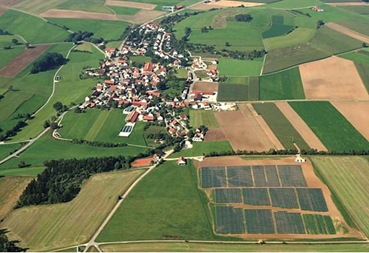
A solar complex in Bavaria, southern GermanyA solar complex in Bavaria, southern Germany

Germany's promotion of renewable energy rightly gets singled out for its effectiveness, most often by me as an example of how to do things well versus the fits and starts method of promotion common in the USA and even the UK.

There is another interesting facet of the German renewable energy saga: 51% of all renewable energy in Germany is owned by individual citizens or farms, totaling $100 billion worth of private investment in clean energy.

When one breaks that down into its components, that is to say, solar power and wind power, then the figures are that 50% of Germany's solar PV is owned by individuals and farms, while 54% of its wind power is held by the same groups.

While the UK has a serious load of wind turbines most of them, however, are not privately or farm owned but are owned by the electricity generating companies, with only a few farms holding such as private possession. Private wind and solar PV installations are rarely coming up in calculations, especially not the individual homes and farms.

In total there's roughly 17 GW of solar PV installed in Germany – versus roughly 3.6 GW in the US (based on SEIA's figures for new installations though the third quarter of 2011 plus the 2.6 GW installed going into the year) and recent figures for the UK are just a little above 6 GW (given by Renewables UK in January 2012). This is for a country which, I am sure, has more wind than Germany, though still, considering our sizes, better than the USA.

Germany now produces slightly over 20% of all its electricity from renewable sources and proves that those things can be done. The real stupid thing is that every time that countries, such as Germany, and their achievements in the real of renewable energy as well as recycling, etc., are pointed out the British government goes into turtle mode, pulling its head into its shell and proclaiming that that cannot work in Britain and Britain is different to all those other countries where it can be done.

The main thing though, other than the huge lead in solar PV installations Germany has over the US, thanks to good policy, and the fact that so much wind power isn't owned by utilities, is what slightly over half of renewable energy being owned not by corporations but by actual biological people mean. Namely an obvious democratic shift in control of resources and a break from the way electricity and energy has been produced over the past century.

This is a good thing indeed and is leads to decentralized power generation, more re-localization and re-regionalization of economic activity, the world getting smaller while more connected and therefore in a way bigger at the same time... taking a step backwards, and perhaps sideways, while moving forwards.

In “Small is beautiful” small power stations for every village were being advocated rather than large corporation owned ones and we must get down to that level.

It is also a much more resilient system in that the entire grid cannot be knocked for six by this or that incident when the entire country has small, personal or community owned power generating plants, whether wind, PV, or biomass.

© 2012

Wind industry welcomes climate change report

Wind industry welcomes climate change report

BWEA, the UK’s leading renewable energy trade body, today welcomed the publication of the Climate Change Committee’s first report Building a Low Carbon Economy.

The report explains the case for the new 80% emissions reduction target and recommends the level for the first three national carbon budgets under the Climate Change Act.

The report also highlights the vital role that renewable energy will play over the next decade in tackling climate change. It stresses that wind power can deliver 30% of the UK’s electricity supply by 2020 and be part of a radical decarbonisation of the economy by 2030.

Maria McCaffery MBE, BWEA Chief Executive, said “Renewable energy is not a luxury item. Without a dramatic change in the way we use and produce our energy we will not stop climate change.”

The CCC calls for a 34% reduction in greenhouse gas emissions by 2020, at the cost of less than 1% of GDP growth. The report recognises that higher renewable costs would be just one part of the impact, with greater spending on renewables offset by savings elsewhere. There are currently 3GW of installed wind schemes operating in the UK today, but a further 20GW are already at one stage or another of development.

McCaffery added “By 2020 there could be over 30GW of wind energy installed in the UK. This report should help to lay to rest the misconceptions and misinformation about the role and viability of wind power over the next decade and beyond.”

Source: BWEA
<>

Horse and Buggy plus Wind Turbine

Indiana Amish Begin Embracing Renewable Energy

by Michael Smith

The junction of spirituality and environmental awareness seems to be getting more crowded. Even the Amish are now – and this is not actually all that new, as some of the orders that are not so strict have been at this already for a while – getting in on the act.

It is not the electricity but connection to the grid that the Amish object to.

While the majority of people probably associate the Amish with living outside of modern life, without electricity and machinery this is not entirely correct and true. While initially (like in the 1920s...) there was hesitation to adopt electricity, it was not so much the electricity itself that was the issue but the connection to the grid and therefore the outside world. Low-voltage electricity is perfectly permissible and will rising diesel prices, the cost of fueling generators is causing some people to look to renewable energy to fulfill their needs.

When it comes to machinery there are many places where the lathes and such for the workshops are either powered by water or even by steam engines. Again it is not the power, and such, but the connection, via the grid, to the outside world, that the Amish have a problem with.

When it comes to electricity some are turning to solar power and others are turning to wind power. Wind turbines can now be seen in a fair number of Amish places as can photovolatic cells on roofs and elsewhere. In many places it is a combination of anything renewable they can find, including water.

In some instances renewable sources of electricity supplements other off-grid options such as diesel generators, with which to power lights, refrigerator, freezer and machinery.

Some businesses too are getting gin on the renewable act in Amish territory Brian Burkholder owns Solar Energy Systems in Nappanee, Indiana and probably 70% of his customers are Amish. This is probably not least partially because he himself is Amish.

Off-grid is good for the Amish directly as well as for their businesses, whether they sell the technology or whether they use it for whatever they produce.

The interesting thing in this is that at least in a certain part of Indiana, a group of people associated with largely eschewing the modern consumer world seem to be adopting renewable energy faster than the surrounding population. I doubt that that is a bad thing though.

Whether we agree or disagree with the Amish on a religious basis and also on the way some seem to live and raise their families and such, some of their ways could teach us a lot as to how we could take pack some of our peace in life and on the planet. Their system, in general, has a lot lower impact on the environment than our hectic modern life has.

When we see Amish embracing the Internet and technology, even though, probably, with filtering systems, and who could blame them for that, then I know that the time is right to take a few more leaves out of their books.

However, their rather lower impact life could be a guide to some of us ate least. While I am not sure how horse and buggy would go down on the streets of London, and even in my location just outside the British capital, it is, to some extent, doable and it does not have to be horse and buggy but just the humble iron horse, aka the bicycle, and trailer.

I always do, to some extent, admire the Amish not to have taken up, in general, the infernal combustion engine. Mind you, when Henry Ford invented it, it was never meant to run on gasoline. But gasoline became to cheap hence the use of gas as fuel and what have we done...

© M Smith (Veshengro), September 2008
<>

FuturEnergy Wind Turbine Powers Britain's Best Eco-Home


The installation of a FuturEnergy high-power wind turbine has helped a unique two-storey house made from straw to win the title of Britain's Best Eco-Home. The accolade was presented as part of Channel Four television's Grand Design Awards.

Built on top of a remote hill overlooking the Teifi estuary and the west Wales coastline, 'Penwhilwr' is the UK's first two-storey loadbearing straw house, with walls made solely from stacked straw bales without a framework. Only natural materials and techniques were used during the construction process, which was carried out by amateur volunteers from around the world.

Five-years in the building, Penwhilwr was designed and conceived by its owner Rachel Shiamh as both a home and base for her natural essences and jewellery business and for the Quiet Earth Centre for Alternative Living, which provides a range of courses, retreats and conferences in the ways of authentic living.

A total commitment to non-impact self-sustainable living is reflected throughout the design of the building with all electrical power generated cleanly on-site by the one-kilowatt FuturEnergy wind turbine supplemented by five 125-watt Kyocera solar PV (photovoltaic) panels. The hybrid mix of wind and solar power provides sufficient all-year round electricity to cover all the building's current and future needs including the running of low-energy lights, laptop computers, sound system, pumps for the solar thermal system and underfloor heating and appliances including washing machine.

The FuturEnergy wind turbine is mounted on a seven-metre tall mast on the edge of a field, some 20-metres from the house. Power from the turbine and the solar panels is stored in an insulated battery bank comprising eight six-volt cells, with a 24-volt output inverted to produce a standard 240-volt AC supply.

Further reducing Penwhilwr's impact on the environment, all heating is provided by a bio-mass heating system fueled by wood coppiced from the surrounding woodland, with hot water produced by a solar thermal heater. Natural spring water is supplemented by a rainwater harvesting system, whilst all waste including human waste is composted naturally on site.

“We chose the FuturEnergy wind turbine due to its UK manufacture and because it and the company's representatives were highly recommended to us,” comments Rachel Shiamh. “The turbine also needed to be aesthetically pleasing to soothe a neighbour's concerns.”

“It's beautiful being powered by the sun and the wind, as it gives one the chance to truly live with rather than against nature.”

www.gwaliaessences.co.uk
www.quietearth.org.uk
www.futurenergy.co.uk

Source: RightanglePR
<>

The Most Powerful Wind Turbine Anywhere

Enercon GMBH of Germany, probably one of the most innovative wind power companies in the world, has just announced that it has begun selling a six-megawatt wind turbine! That is a good 20% more powerful than any other turbine currently on the market, producing enough power per turbine to power 4,000 homes, making it the most powerful wind turbine anywhere, at this moment in time.

Enercon does not waste much time figuring out fancy names for its turbines. Their most popular model, the E-40, has a turbine diameter of 40 m, while this new turbine, the E-112, has a turbine diameter of 112 meters. It is that simple. Who needs fancy names anyway for turbines?

Interestingly, this isn't the world's largest wind turbine; it just produces the most power, a testament to Enercon's innovative strategies. The turbine blades are specially designed, and Enercon's patented gearless generator keeps noise, friction, and maintenance to a minimum.