Showing posts with label Pope Francis. Show all posts

Pope Francis calls for new economic order, criticises capitalism

Pope Francis blesses a woman as Bolivian President Evo Morales (R) looks on, during a World Meeting of Popular Movements in Santa Cruz, Bolivia, on July 9.

In Bolivia during his tour of South America, Pope Francis on Thursday urged the downtrodden to change the world economic order, denouncing a "new colonialism" by agencies that impose austerity programs and calling for the poor to have the "sacred rights" of labour, lodging and land.

In one of the longest, most passionate and sweeping speeches of his pontificate, the Argentine-born pope also asked forgiveness for the sins committed by the Roman Catholic Church in its treatment of native Americans during what he called the "so-called conquest of America".

Quoting a 4th century bishop, he called the unfettered pursuit of money "the dung of the devil", and said poor countries should not be reduced to being providers of raw material and cheap labour for developed countries.

Read more here.

No punches pulled in Climate Change Encyclical

by Michael Smith (Veshengro)

Pope Francis pulls no punches in Climate Change Encyclical

The care of the Planet is at the heart of The Holy Father's attention in this Encyclical

1533868_838329846249672_1185197550952132137_n“Praised be You, my Lord, for Brother Sun and Sister Moon, for Brother Wind and Sister Water, for Brother Fire; praised be You, my Lord, for our Sister Mother Earth, our common home, which sustains and governs us.” (Adapted from the Canticle of the Creatures by Saint Francis of Assisi.)

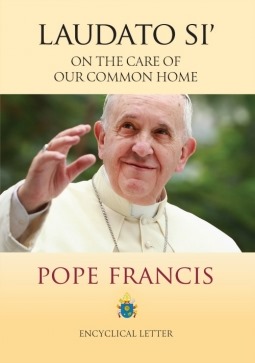
“What kind of world do we want to leave to those who come after us, to children who are now growing up?” is the question that is at the heart of Laudato si’ (May You be praised), the Encyclical on the care of the common home by Pope Francis.

“This question does not have to do with the environment alone and in isolation; the issue cannot be approached piecemeal”. This leads us to ask ourselves about the meaning of existence and its values at the basis of social life: “What is the purpose of our life in this world? What is the goal of our work and all our efforts? What need does the earth have of us?” “Unless we struggle with these deeper issues – says the Pope – I do not believe that our concern for ecology will produce significant results”.
laudato_si

“The economic powers shall continue to justify the current world system, in which speculation and and the aim for financial returns to prevail that tend to ignore each context and the effects on the environment and on human dignity. So clearly it reveals that environmental, human and ethical degradation are intimately connected,” the Holy Father also wrote in this letter to the faithful.

“Authentic development includes efforts to bring about an integral improvement in the quality of human life, and this entails considering the setting in which people live their lives. These settings influence the way we think, feel and act. In our rooms, our homes, our workplaces and neighbourhoods, we use our environment as a way of expressing our identity. We make every effort to adapt to our environment, but when it is disorderly, chaotic or saturated with noise and ugliness, such overstimulation makes it difficult to find ourselves integrated and happy.”

This Encyclical takes its name from the invocation of Saint Francis, “Praise be to you, my Lord”, in his Canticle of the Creatures. It reminds us that the earth, our common home “is like a sister with whom we share our life and a beautiful mother who opens her arms to embrace us”. We have forgotten that “we ourselves are dust of the earth (cf. Gen 2:7); our very bodies are made up of her elements, we breathe her air and we receive life and refreshment from her waters.”

Now, this earth, mistreated and abused, is lamenting, and its groans join those of all the forsaken of the world. Pope Francis invites us to listen to them, urging each and every one – individuals, families, local communities, nations and the international community – to an “ecological conversion”, according to the expression of Saint John Paul II. We are invited to “change direction” by taking on the beauty and responsibility of the task of “caring for our common home”. At the same time, Pope Francis recognizes that “there is a growing sensitivity to the environment and the need to protect nature, along with a growing concern, both genuine and distressing, for what is happening to our planet”. A ray of hope flows through the entire Encyclical, which gives a clear message of hope. “Humanity still has the ability to work together in building our common home”. “Men and women are still capable of intervening positively”. “All is not lost. Human beings, while capable of the worst, are also capable of rising above themselves, choosing again what is good, and making a new start”.

Pope Francis certainly addresses the Catholic faithful, quoting Saint John Paul II: “Christians in their turn “realize that their responsibility within creation, and their duty towards nature and the Creator, are an essential part of their faith”“. Pope Francis proposes specially “to enter into dialogue with all people about our common home”. The dialogue runs throughout the text and in ch. 5 it becomes the instrument for addressing and solving problems. From the beginning, Pope Francis recalls that “other Churches and Christian communities – and other religions as well – have also expressed deep concern and offered valuable reflections” on the theme of ecology. Indeed, such contributions expressly come in, starting with that of “the beloved Ecumenical Patriarch Bartholomew”, extensively cited in numbers 8-9. On several occasions, then, the Pope thanks the protagonists of this effort – individuals as well as associations and institutions. He acknowledges that “the reflections of numerous scientists, philosophers, theologians and civic groups, all […] have enriched the Church’s thinking on these questions”. He invites everyone to recognize “the rich contribution which the religions can make towards an integral ecology and the full development of humanity”.

While the Holy Father is, in this Encyclical, primarily, obviously, addressing the Catholic faithful, and those of other Christian traditions also, the message is for all of us, whether of a faith or none, and also and especially for those who think themselves in power to lord it over us.

In the light of the message of his Encyclical the Holy Father has already been declared the most dangerous person on Earth by a great many of American politicians, especially in the Republican Party. No surprise there that they do not like the Pope's message as (1) they are climate change deniers to the hilt and (2) they see the Holy Father as the Antichrist (and I kid you not there).

Several main themes run through the text that are addressed from a variety of different perspectives, traversing and unifying the text:

*the intimate relationship between the poor and the fragility of the planet,

*the conviction that everything in the world is connected,

*the critique of new paradigms and forms of power derived from technology,

*the call to seek other ways of understanding the economy and progress,

*the value proper to each creature,

*the human meaning of ecology,

*the need for forthright and honest debate,

*the serious responsibility of international and local policies,

*the throwaway culture and the proposal of a new lifestyle.

"Laudato si' – Pope Francis' Encyclical on care for our common home can be downloaded as a PDF file here...

© 2015

Fox News Pundit Calls Pope Francis 'The Most Dangerous Person On The Planet'

Fox News Pundit Calls Pope Francis 'The Most Dangerous Person On The Planet' For Suggesting Climate Change Is Real

POPE FRANCIS

Pope Francis's newly released papal letter on outlining the moral imperative of protecting the environment has upset some Catholics and conservatives who say the pontiff should stay out of the "political realm." But one conservative pundit went a step further by calling the pope "the most dangerous person on the planet."

Pope Francis earned such a title in Fox New pundit Greg Gutfeld's eyes for "seeking strange new respect" from his "adversaries" -- among whom, Gutfeld presumes, are liberals who might disagree with the pontiff's more conservative perspectives on gay marriage, women's ordination and contraception.

The pope opened the leaked draft of the encyclical by saying climate change is the Earth’s way of protesting “irresponsible use and abuse of the goods that God placed in her.”

“We have grown up thinking that we were her owners and dominators, authorized to loot her,” the draft read, according to a translation by The Guardian. “The violence that exists in the human heart, wounded by sin, is also manifest in the symptoms of illness that we see in the Earth, the water, the air and in living things.”

Read more here.

Throwing away food is like stealing from the poor – Pope Francis

by Michael Smith (Veshengro)

POPE-FRANCIS-WORLD-ENVIRONMENT-DAYPope Francis denounced on the occasion of World Environment Day 2013 the what he called a “culture of waste” in an increasingly consumerist world. He said that throwing away good food was like stealing from poor people.

“Our grandparents”, he said in his speech, “used to make a point of not throwing away leftover food. Consumerism has made us accustomed to wasting food daily and we are unable to see its real value”. This, alas, is so very true indeed.

“Throwing away food is like stealing from the table of those who are poor and hungry,” he continued.

Around 1.3 billion tonnes of food, or one third of what is produced for human consumption, gets lost or wasted every year, according to the United Nations' food agency, and some estimates are even as high as 50 percent.

In the industrialised world the majority of waste is by consumers, often because they buy too much and have to throw away what they do not manage to eat.

A U.N.-backed study released on the same day said simple measures such as better storage and reducing over-sized portions would sharply reduce the vast amount of food going to waste.

The Holy Father said that the “culture of waste” was especially deplorable given the prevalence of hunger in the world. According to the United Nations hunger affects some 870 million people, while 2 billion suffer from at least one nutritional deficiency, and that not only in the Third World. We have serious hunger at our very own doorsteps
The Argentinian-born pontiff warned that too much focus on money and materialism meant financial market dips were viewed as tragedies while human suffering had become normal and ignored. And that in this way people are discarded as if they were garbage.

Since taking office Pope Francis has made great efforts to get the Roman Catholic Church to defend the poor and to practice greater austerity itself. He, himself, has decided on a much more austere lifestyle than all of his predecessors and has also made several calls for global financial reform.

We are in a culture today that could well be described, as the Pope did, as a culture of waste and it is an absolute throwaway society in almost all regards despite all the recycling claims and supposed efforts.

We don't need to recycle more; we need to consume less, make do with what we have and reuse things on all levels.

As far as food waste is concerned it is true that much is wasted by household in the developed world where people buy too much stuff and then throw food that is going rotten away. At the same time they do not know what to do with leftovers either, as many people today, in the modern developed world appear to be unable to cook properly.

On the other hand much of the food waste occurs between field and store and in the stores too. In the first instance it is food that is being rejected by the buyers because of shape, size, etc., and in the second instance stores throw out perfectly good food because of blemishes and such like.

In the days of old a greengrocers would be allowed to give such fruit and vegetables that he could not sell at the end of the day away to needy folks but the litigation culture put an end to that too, as did other laws.

Through our culture of waste we steal not just food from the poor, so to speak, but we steal from the Planet also, and that too is a tragedy.

© 2013

Hopes for an ecological Church raised by new Pope's choice of name

by Michael Smith (Veshengro)

StFrancisThe choice of the name Francis, in honor of the Catholic Church’s patron saint of animals and the environment, by Cardinal Jorge Mario Bergoglio upon becoming 266th and current Pope of the Roman Catholic Church, elected on 13 March 2013, has awakened the hopes of ecologists and others who are concerned about rampant consumerism and the deterioration of the Planet that the Church will become more environmentally conscious.

In 1979, then Pope John Paul II proclaimed St. Francis of Assisi (1181/1182-1226) the patron saint of ecologists. In his first mass as Pope, on March 19, 2013 Pope Francis I said: “Let us be protectors of creation, protectors of God’s plan inscribed in nature, protectors of one another and of the environment.”

With the Church’s ability to reach people, the fact that the environment is part of the Pope's discourse is very important, because it will get more people involved.

In Latin America and Africa, environmental problems are closely linked to poverty, with the poor living in areas that are the most vulnerable to climate change and the degradation of the soil,” he said and in other areas too the Pope could possibly turn out to be an ally such as excessive consumption, which is verging on squander and has a huge impact on natural resources.

Environmentalists and bishops in Latin America both criticize consumerism and urge people to follow a simpler lifestyle and the Pope’s homily was in line with the recommendations set forth in the final document of the 5th General Conference of the Council of Latin American Bishops in Aparecido, Brazil, in 2007.

With the Pope hopefully leading the Catholic Church in a new way, and his decision not to live in the Papal apartments in the Vatican but to reside in the Vatican guesthouse also seems to point to a new broom intend on doing some serious housecleaning in the HQ of the Roman Catholic Church, great steps might be taken as to reducing man's impact on the environment.

The proof of the pudding, as they say, is in the eating and we will have to wait as to how things are going to pan out and how far Pope Francis I actually will be allowed to go with this by the Curia and Vatican insiders.

We can but wish Pope Francis I good luck in his endeavors too make the Church a poor Church and a Church for the poor that also takes the environment and protecting of the environment to heart in the way of Saint Francis.

© 2013