Bring Your Own Cutlery (BYOC) needs to become a new trend, no ifs or buts
by Michael Smith (Veshengro)
BYOC wherever you go, instead of using disposable plastic utensils that never biodegrade while littering the world's beaches. Even if plastic utensils are claimed to be biodegradable or worst still compostable they are neither, at least not under normal (composting) conditions.
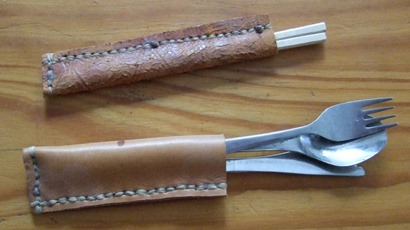
As an “old” military man – and soldiers and officers always carry their own “mess kit”, at least “in the field” – it is a habit to have my own set of cutlery on me when I know I may be dining out on a take out that might require tools. I also have a set of chopsticks, in a leather sleeve, same as the stainless steel cutlery, for the same purpose. The chopsticks were found, thrown away, still sealed in their original package, after a picnic and the stainless steel cutlery is ex-airline. Those ex-airline knife, fork and spoon are smaller than standard cutlery but similar smaller cutlery can be bought in stores as well.
Plastic forks, knives, and spoons are one of those things that we tend to think are inevitable when eating on the go or feeding a crowd. Even though alternatives do exist, these are not widely known or accessible, which is a pity, considering the impact that plastic cutlery has on the environment. It does not biodegrade, and they are some of the most common trash that is found in parks and open spaces and also on the beaches. The majority of those never ever make it into the recycling stream either.
Along with shopping bags and straws, disposable plastic cutlery is yet another part of the pollution puzzle that is threatening the world's oceans and waterways. And, like bags and straws, it is a direct consequence of our societal obsession with convenience, something that would not need or have to exist if everyone took a few moments to plan ahead before leaving the house.
The strange phenomena that we, who work in parks and open spaces, now encounter is that people take real cutlery to a picnic and then, would anyone believe it, they leave them, once dirty, behind, either thrown into the trashcans or just left behind where they have been sitting.
So, what are the alternatives?
Most obviously, disposable plastic cutlery should be made illegal, which is precisely what France has done. All single-use plastic cutlery, along with plates and cups, will be banned soon: "Manufacturers and retailers have until 2020 to ensure that any disposable products they sell are made of biologically sourced materials and can be composted in a domestic composter." While that is a nice move I doubt that there will be any disposable products going to be coming on the market that are truly compostable in a domestic composter, though they may claim that, in the same way that they claimed that the plastic bags for the food waste caddies were compostable in that way and later industry had to row back saying that that was not what they meant but compostable in a commercial hot composting unit. But that was not what it said, at least not originally.
What we all really should start doing is carrying our own cutlery for eating in restaurants or on the go in the same way that many people travel with water bottles. So why not forks and knives, too?
China, and I understand also Japan, have recently pushed to get people to carry reusable chopsticks, in order to reduce the 20 million trees currently cut down each year to make disposable chopsticks. The campaign has been hugely successful, thanks to celebrity backing.
While we don't, as yet, have celebrity backing for bring your own cutlery it should, nevertheless, become something that we do as a routine. A small set of flatware can be easily carried; every soldier does so in the field, and more often than not in the pocket of the tunic or the shirt. Those military sets that clip together can be purchased as military sets (from many surplus stores) or also for the civilian realm as camping or trail cutlery (from camping and outdoors equipment stores). It was also common practice for Boy Scouts and Young Pioneers when going to camp to have your own clip-together set) or similar).
Many more restaurants should again be offering metal cutlery for eating in and that should also extend to ice cream parlors for spoons. It was the common practice not all that long ago. But washing real dishes and cutlery takes a little effort and that was – probably – the main reason that everything went over to plastic “garbage”.
Let's hear it for BYOC.
© 2017