Showing posts with label outdoors. Show all posts

How eco-friendly are barbecues?

by Michael Smith (Veshengro)

0d2a551c159ec5aa5b34bb0e123e6427--barbecue-party-summer-barbecueNot very unless you use charcoal from local sources.

As the season is upon us, once again, it is time to talk about it.

Gas barbecues are certainly cleaner than charcoal but whether they are better, and especially greener and more eco-friendly, is another question. Presently the gas we use for those, be it propane or butane, is fossil fuel and thus non-renewable, charcoal on the other hand, if from sustainable sources, is. But for those determined to stick with old-school pit mastery, the central message is: check your fuel and especially check the origin of it. Far too much charcoal that is being used comes from far away and often from tropical rainforests.

This edict is inspired by a recent report from forestry NGO Fern.org “Playing with Fire: Human Misery, Environmental Destruction and Summer BBQs”. It is definitely not the cheeriest of summer reading but it certainly is eye-opening. Small-scale charcoal production has the potential to be a lifeline in rural economies all over the world. Sadly that is not happening.

The allegations against charcoal go much further than pollution. Somalian charcoal is linked to funding for Al-Shabaab. The trade in Brazil and Nigeria is linked to human rights abuses, including, in some cases, not just child labor but child slavery, much like with the mining of cobalt, illegal logging and increased emissions.

Thus it is best to buy homegrown charcoal with a good supply chain and suppliers of guaranteed homegrown and home-produced charcoal do exist. But in the UK we run a charcoal deficit. We only make 5,000 tons versus the 60,000 we go through every summer.

If you are shopping on price, and there are some who will, no doubt have to, alas, that charcoal will arrive typically via Felixstowe on a giant container ship from Namibia, 5,000 miles away, of from other, far away places.

Charcoal producers, in Namibia, and elsewhere, are paid by the tonne, and it is easy to chop down a large, protected tree, so charcoal is fueling deforestation. A 2010 investigation, “Namibia's Black Gold?”, found charcoal producers and their families living under plastic sheeting without access to running water or sanitation. And this kind of conditions prevail everywhere in those places.

Not that you would guess all this when you pick up a bag of charcoal from a supermarket. You are unlikely to see any country of origin on the bag. You should always look for an FSC (Forestry Stewardship Council) symbol if possible. But that symbol and certification often is also not worth the paper that it is printed on.

Charcoal is excluded from EU timber regulation which requires all timber and many timber products to be legally sourced. So were it included, it would make it a criminal offense to import illegal charcoal from Namibia (and elsewhere).

Seasonal products, apparently, can get away with dodgy supply chains because they hold our attention for such a short time. Not just for us, as consumers, but also, it would appear, for any regulators. Too the detriment of ethically and locally produced product, and, obviously the Planet and the workers.

Thus, as with beanpoles and pea-stick, buy charcoal wherever possible from local producers, from coppice workers. Also local lumpwood charcoal is better in many other ways, and that includes the lighting of it. It should not require any BBQ-lighter fluid or blocks of any kind and should start just by using paper or other tinder.

Considering that the lighter fluid or bricks are petroleum product do you really want gasoline or kerosene with your food?

© 2018

Dead-simple pocketknife is the best

by Michael Smith (Veshengro)

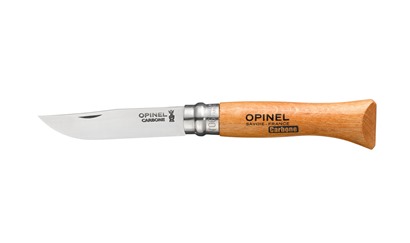
ndeg06_carbone_web (1)A dead-simple pocketknife is the best to carry, especially on a daily basis, and the Opinel fits that bill on all levels.

Over the years I have owned and used many different pocketknives, some of them not directly cheap, single and multi-bladed, but I have found none as good and reliable than the first kind that I ever owned (or one of the first ones, for my very first was a different one, if I remember, but I was given that as a rather small boy of five), the Opinel. The next one that I was given was an Opinel #6, about two years later, and an Opinel #6 or #8, the latter though rarely, has been a constant companion ever since.

Many of us, outdoorsmen, bushcrafters, and such, seem to be gadget lovers when it comes to knives and other things and many seem to believe that the bigger the blade(s) and the more of them the better. The bigger the better belief is also there as regards to size when it comes to fixed-bladed knives. I seem to be an exception as I don't run after all those gadgets and such and neither do I like knives that are too big, unless I want to use a machete.

However, the best blade is the one that is just big enough for the job and your knife, whether belt knife or pocketknife is not a hatchet or a machete; it is a knife; simple.

The Opinel #6 is my daily-carry-knife, and has been for very many years, and that for more reasons than one. The main one, nowadays, is that carrying any knife – even a folding one – with a cutting edge longer than 3-inches can get one into very hot water with the police. Another the fact that the knife is big enough for almost all jobs that require a knife; a bigger one is not, actually, needed on a day-to-day basis. Then there is the fact that is is light and handy and I just love the lock and the wooden handle.

I do have many other pocketknives as well – I have sort of got a few over the years – but when it comes to it my first choice is always the Opinel, but never bigger than the #8 to be very honest though. As indicated, the #6 is the one that is always with me.

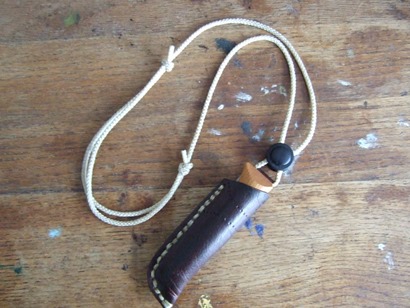
And to make sure that I have one definitely with me at all times I have, because there was not one available to buy – made my own sheath for it (see picture) that enables me to carry it around the neck. Well, I guess even if I could have bought a sheath of this kind I would have still made it myself, as I do love working with leather, as well as with wood. Not only do I make such and other leather goods for myself. Nay, I also make those and others to order.

Neck holster for Opinel #6As far as performance of this dead-simple pocketknife goes the Opinel is, in my opinion, though not just in mine alone, I understand, second to none. All Opinel from #6 upwards come with the rotating ring lock and I have yet to be able to break that lock. I have managed to break the handle at the lock before through misuse and abuse but not the lock itself, unlike with some, even expensive lock-back knives. And in the latter case(s) with very little abuse, so to speak.

The design of the Opinel is timeless and has changed little since its inception, with the exception of the introduction, in the mid-1950s, of the Virobloc rotating lock, and then at the beginning of the 21st century the redesign of this lock so the blade can also be locked in the closed position. Otherwise, generally, it has not change since almost day one. But then why change something that works and works well.

The KISS system is always best, especially when the tool is to be used in the great outdoors, or even not not so great one. It is because of its simplicity and reliability, I am sure, that the German forest schools use the smaller lockable Opinel knives, that is to say the No.6 and the No.7 versions, and that in the standard blade and not the child's version, and we are talking here about those blades being used by children between 4 and 6 years of age. That speaks volumes for the knives' safety.

The Opinel pocketknife embodies the KISS system in its design, reliability and simplicity, to its fullest and makes it the ideal day-to-day companion, and not just in the outdoors. I don't think that it can be beat and definitely not as far as quality and value for money is concerned, considering the relatively low price that it is being sold for. Generations of French mountain people can't be wrong to having stuck with the Opinel knife.

© 2017

Himalayan salt lamps

by Michael Smith (Veshengro)

salt_lampHimalayan salt lamps are not made with salt from the Himalayas for starters. They also do not release any negative ions or anything like that. They look pretty when lit by a light bulb or a candle, but that is about all.

Claims that salt lamps release any appreciable amount of negative ions have been shown to be untrue, and from a scientific point of view, not possible. You simply cannot alter the chemistry of salt using a light bulb or candle flame. But they can be quite pretty, so enjoy them for that reason, but don't get sold on any unproven therapeutic powers. http://www.snopes.com/salt-lamps-cure-everything/.

The so-called Himalayan salt is more than a bit of a misnomer as it does not actually come from the Himalayas but from the Pakistani Khewra Salt Mine in the Punjab region of Pakistan which is nowhere remotely near those mountains.

What goes for the lamps also goes for the so-called Himalayan salt that is claimed to have such great health benefits. Hello folks, it is just rock salt, only difference is that it is orange due to iron oxide, in other words "rust". This rock salt, aside from the color, is no different than any rock salt that you may buy in the shops, except that some cooking salt, as well as table salt, which is all rock salt unless it is sea salt, has iodine added.

While some self-proclaimed health experts will now scream that iodine is bad and should not be added, etc. ad infinitum, what is it that you would (hate to) take in the event of a nuclear accident or such? Yes, you got it, iodine. In fact, the iodization was done for health reasons. Iodised salt is table salt mixed with a minute amount of various salts of the element iodine. The ingestion of iodine prevents iodine deficiency.

So, just to recap on Himalayan Salt: it is rock salt that does not come from the Himalayas and is orange in color because it contains iron oxide, which is another word for rust. It has no negative ions and is not different to any other rock salt, such as you ordinary table or cooking salt, whether iodised or not. Don't fall for the clap-trap of the snake oil salesmen and -women.

© 2017

The Nature Prescription

Six all-natural (yet scientific) strategies for improving your mind and body

Florence Williams went to the forests of Japan to uncover the science behind the health benefits of mother nature. For those of you without the time to travel deep into the Japanese wilderness, here are six quick, easy, and natural ways to help your body and mind.

Temper Your Screen Time

What happens to a mind in constant motion? That’s a question we seem intent on answering, one laptop and DVR at a time. In a now famous, years-long study of employees at the Boston Consulting Group, led by Harvard Business School professor Leslie Perlow, 26 percent of participants admitted to sleeping with their smartphones within reach. Fifty-one percent said they check email obsessively while on vacation. Kids are even worse. According to a 2010 survey by the Kaiser Foundation, American teens spend about 7.5 hours a day toggling between text messages, Instagrams, and streaming episodes of Jersey Shore.This nonstop engagement changes how the brain processes information—and, in some cases, changes the brain itself. One alarming study of Internet-addicted Chinese teenagers found signs of “abnormal white matter structure”—atrophy of connective tissue—in areas of the brain involved with behavior and emotional control.

The cure is, quite literally, out there. “An expanding literature suggests that exposure to nature—either a walk through a park or looking at nature photographs—can enhance attention and memory,” says Arthur Kramer, director of the Beckman Institute for Advanced Science and Technology at the University of Illinois at Urbana-Champaign.

Read more here.

We must teach kids to run wild again

Today’s youngsters ‘don’t know what they’re supposed to do’ when left to their own devices outdoors, Michaela Strachan has said (pictured with her son Ollie)

There was a time when children would play outside all day in the summer, returning home hungry, thirsty and in need of a good bath.

But today’s youngsters ‘don’t know what they’re supposed to do’ when left to their own devices outdoors, Springwatch presenter Michaela Strachan has said.

The 49-year-old has called for the ‘re-wilding’ of children who spend too much time playing with gadgets.

She said that children have not learnt how to entertain themselves outside, instead spending their time glued to iPads.

The mother-of-one said: ‘Re-wilding kids is something I think is really important.

‘We live in a very technical, digital world and a lot of people are only experiencing the outdoors through their screen – which is really sad.

Before we had all this technology children would just be left outside to play and entertain themselves with their own imagination – they knew what to do.

Read more here.

Woodsrunning knives that don't cost the Earth

by Michael smith (Veshengro)

FrenchGauchoKnifeMine1The first knives of the men of the backwoods, of the Eastern Longhunters, of the Rangers and Woodsrunners, the “coureurs des bois” or “coureurs de bois”, and also those of the Mountain Men of the Rockies, in North America, were not purpose-made knives but simple cook’s or butcher’s knives that had been given a rawhide or other kind of leather sheath, and at times converted somewhat for the tasks they had to perform in the backwoods.

The once standard outdoors' knife of the Australian Bushman for a long time was the so-called “Queensland Butcher”. Those were, basically, ordinary butcher knives, more often than not made in Sheffield, England, and put to use and that even by the mounted constabulary of the various territories of Australia, often worn in a sheath in the riding boot.

The Woodsrunner of old, much like the thrifty homesteader of old and of today, mostly converted other blades for his use or made his own knives from scrap steel.

This method of simply appropriating a knife of this kind, without or with reworking, still works today and is still often the best and certainly the cheapest way to acquire a good working knife for use in the great backyard.

The specially made blades that are associated with the Backwoodsmen and the Mountain Men – such as the predecessor of the Bowie and the Bowie knife itself – arrived much later on the scene.

Personally I find it very satisfying indeed to lay my hands on an old butcher’s or cook’s knife and by sharpening it up, maybe also regrinding the shape of the blade if need be, and otherwise reworking it, and then making a sheath for it (often also by making use of the leather from an old and discarded leather bag of sorts), knowing that I could not have bought a woods knife like that one anywhere or if then it would have cost me a great sum of money. What comes out at the end when one does this is, basically, a custom knife and custom knives are rather costly.

What I am trying to say with this all is that you do not have to spend lots of money in order to get yourself the perfect outdoors knife for yourself or for the youngster in your family who is a budding backwoodsman.

Look at Thrift Stores or at Flea Markets for good old cook’s knives and the like and you will find one, I am sure, that, with a little work, will become the perfect backwoods companion. I have been lucky at some of the so-called Charity Shops in the UK in the past to get such old knives. Alas nowadays they are not allowed to even give them away against a small donation but have to throw any knives, other than table knives, away.

The photo shows just one of the knives that I have got and converted, and this with actually very little effort. I call it my “French Gaucho Knife”. It is a small French chef’s knife and with the sheath that I have given it the knife does look a little like the knives that are carried by the Gauchos on the Argentine Pampas.

This particular knife was bought on a Flea Market for a less than 20 cents US equivalent and with a sheath recycled from an old bag that cost virtually nothing it has become one of my companion for the woods.

While that may not be the shape that suits you or that you like it is but an example and I have many others converted that equally can serve as an as such a wodsrunning knife and the same goes for you. There are surely other knives out there at certain sales that you can find for conversion into your own personal outdoors companion.

Don’t shy away from it just because you haven’t done it before. There is always a first time with everything. But aim to produce the best you can even in your first attempt. If it is not the highest quality immediately do not despair, however. Those things come with time.

Today we keep seeing those so-called Nessmuk knives, and knives that are based upon G W Sears' (“Nessmuk”) design, and other so-called Bushcraft knives, that run into hundreds of Dollars and Pounds in price and this is totally unnecessary and silly. Sear's knife, however, was also a rework, originally, of a knife that was to hand and intended for a different purpose and what he could do we can do too. It is not rocket science.

I have seen many designs of so-called Bushcraft knives – I will not name the Bushcraft schools or or such whence they come – and with some of them I must say that I wonder how they actually are supposed to perform all the tasks, as they often are too long and the thickness of the blade is a little on the fat side. That is because the designers believe that the knife must be capable of chopping firewood or at least kindling.

The next person who wants to chop firewood with a knife I hand a hatchet, I think. Even in an outdoors “survival” situation with only your knife as partner you do not want to chop firewood, not even kindling, with a knife (unless the knife happens to be a machete and then it is all but useless for the smaller tasks).

I think that you get the idea now and also that you realize that all the hype about those knives is all just that, hype. You do not need that kind and do not pay out that kind of money to have a good knife – or knives, for even the backwoodsmen would not have just carried one knife on them – to use in the great outdoors.

© 2015

The Surprising Side Effect of a Winter Hike

Why you really need to spend more time outside, no matter how cold it gets

Go hiking, then come home and write the Great American Novel? Spending two days hiking in the Tetons might not turn you into William Faulkner, but research published in PLoS Onesuggests that a few days in a national park may make you more creative in other ways.

The study followed 56 hikers on a four-day hike, without their laptops, cellphones, or any other technology, and the authors found that spending time communing with nature boosted the hikers' creativity by 50 percent, based on the results of a creativity test they took either before they left or toward the end of their journey.

It's all about giving your brain a break from the daily grind of technology and stress, says the study's lead author David Strayer, PhD, a professor of psychology at the University of Utah. "The human mind is heavily influenced by the environment we're in," he says. "It's not useful to become a slave to technology." Disconnecting from social media, cellphones, computers, and stress allows your prefrontal brain circuits, which are associated with creativity and higher-level thinking, to get restored.

Read more: http://www.organicgardening.com/living/the-surprising-side-effect-of-a-winter-hike

Survival Kits

by Michael Smith (Veshengro)

Most are absolutely useless...

pocket-survival-kit_sml_noRegardless as to whether they are the commercially assembled and sold ones or the instructions that are given to assemble your own “survival kit” most of them are totally and utterly useless and a waste of time and money, and in addition to that most of the kits that are cheap contain items that are of inferior quality and thus make the kit more useless still.

The great majority of those kits, whatever name they go by, contain first of all many items you never ever will have to use, and thus are but a burden to carry and secondly for a knife they often have a cheap, single edge razor blade included which is not just useless but dangerous. Most, if not indeed, all of the so-called SAS survival kits the SAS troops would not be seen dead with.

The so-called wire saw also is a waste of time and money, even though they are cheap. As is the fishing kit, the wire snares and such like. For, when you are lost in the wilderness you don't what to stay there, you want to get out.

I have seen so much garbage included in so-called pocket kits that made the mind boggle but people cannot – it would seem – understand and do not want to believe that those kits are all but useless because, they say, this or that survival expert recommends doing it this way. You do not get a decent kit for under $10 or even under $20. A really good small kit even costs you a great deal more and it will be but a few, but quality and really useful items. However, that is not what the vendors want to tell you or sell you. There is not profit in it for them.

On the other hand you should not, in my opinion, unless you really want to, buy a ready-made kit but compile one for yourself that really will fulfill your needs.

pocket-survival-kit2In most cases you will but need a small number of items and how you store them is entirely up to you and I really mean but a small number of items.

  1. A good sturdy single bladed folding pocketknife – ideally with a lock that will not break – and the only one that I really would ever recommend for this purpose is the Opinel #6

  2. Emergency whistle of some kind

  3. A good small fluid filled compass with base plate (about the size of a large postage stamp) from Suunto or Silva

  4. A folding bit can opener – P-38 would be the most common one

  5. About 10 assorted safety pins, with the smaller ones threaded onto the pin of the largest one

  6. A BIC butane cigarette lighter

  7. A pencil (stub if you want to have a really small kit) and a small notepad

  8. A small flashlight, such as a Mini Maglite might also be good to have in your kit.

And that is about it...

Fishing kit, wire snare, wire saw, and other gimmicks are not something that you will need, though a small heliograph (signal mirror with aiming hole) could be useful should you have to attract search aircraft or such like.

Also forget the multi-tools, even good ones like Leatherman and such in any small personal daily carry survival kits as you will tend to leave the entire thing at home because it is getting too big and heavy. And, I am sure, you do not wish to walk around town in a load bearing vest with all the pockets full of kit, especially not when you happen to be going to the office and neither do you want to carry it in your rucksack or briefcase.

© 2014

Real Survival Kit

by Michael Smith (Veshengro)

Far too many kits that people put together and then recommend on the Internet and those that are for sale are a waste of money and useless...

The same is true and even more so with the commercially available ones, and here I am referring especially to the “pocket survival kits”.

Why? Because they contain items of stuff that may feel good to have around but are a total waste of space, money and time.

If you are really lost in the wilderness you want to get out and home and you do not want/need fishing kit, wire snares, etc. in a pocket survival kit. In a bug out bag that may be one thing – I said, maybe – but not in a pocket kit or a “kit” that you carry in one way or other on your person.

But you do need a good knife, a flashlight, an emergency whistle, a good compass, maybe some first aid bits such as some Band Aids, and some means to make a fire, a couple of safety pins, and that is about all. Everything else is a waste of space and money.

As I have said and stressed above the word “good” is what counts for those items that you do carry in your personal (pocket) survival kit.

Most of the pocket survival kits on the market are cheapish and thus the quality of the contents is more than questionable. Also you want a knife, even if the blade if but 2.5 inches long and not a single-sided razor blade.

So, let's look at the real thing...

  1. Knife: Obviously we are talking here (folding) pocket knife and my advice is a single bladed one and nothing can beat the Opinel #6 in price and quality and thus value for money.

  2. Compass: Don't skimp here. This thing may get you out of trouble. Do not go for those little button compasses but for a slightly larger one from the likes of Silva or Suunto. My choice would be the Silva “Starter” or similar.

  3. Light: A small, wind-up flashlight also would be a great choice and there are some rather small ones available with two LEDs that are extremely bright and are intended to be put onto a key chain.

  4. Whistle: My favorite choice is a metal whistle as used to be used by the Metropolitan Police in London (England) or a Thunderer whistle. Unless you do not wish to be found then a whistle is a must to attract rescuers.

  5. Fire tool: No, not a silly magnesium and flint fire lighter. Another waste of money. Just get a refillable butane gas lighter such as those plastic such as “Clipper” or “Cricket” (both look very similar) and use replaceable flints and can be refilled. An alternative are those refillable cigarette lighters that use electronic ignition. When they get wet though they take a lot to get going again. Stick with the flint ones, would be my advice here.

  6. The final bits would be some string (paracord would be good), some assorted safety pins and a couple of Band Aids.

As some of the items in this kit are not the cheapest of the cheap the cost will be a little bit more than the cost of one of those commercially available cheap ones but putting your own kit together from real quality ingredients, so to speak, will be better than relying on cheap tools and bits.

Now, let's be careful out there...

© 2012