Showing posts with label survival. Show all posts

Crisis Preparedness

by Michael Smith (Veshengro)

krisenvorsorgeWhen we look at the world today we can see that preparedness, being prepared and equipped to deal with any kind of crisis, is very important. The world in which we live today, being overly dependent on technology, especially the electronic kind, can easily be brought out of its equilibrium.

The next financial crash is only around the corner especially considering the way that many banks are back playing the same ponzy schemes that they played last time round and there are many economists and others who predict that the next crash is already on its way – probably just a year or a couple away – and that it will be worse than the last and probably worse than the Great Depression even.

But, unlike when the Great Depression hit, the majority of the people today live a life that is so far removed from reality that they do not have the skills and also not the mental frame to do things for themselves. They have to learn this from scratch and while today we have all the knowledge we – the majority at least – do not have the practical skills. Some cannot even cook from scratch let alone be capable of growing their own food, know where to get wild food, or now to make this or that they need or want for themselves.

Many people who are more or less self-appointed and self-acclaimed experts in the field of preparedness always suggest that people should have gold and silver coins as means of cash/currency. That is utter baloney as nowadays gold and silver, unlike in the days of the Great Depression and even still after WW2 are not recognized (as currency) and thus are absolutely useless. They offer no means of and for barter whatsoever. Gold and silver in whatever kind of coins are just a way for you to waste your money. In addition to that if those coins are not old currency coins how can you be sure, if they come from some “wild” mints, that they actually have the gold or silver content that is being claimed?

Your best bet is not gold and silver coins but skills and tools to perform jobs or produce goods that other want and need. Knowledge and skills are the key here. And knowledge must be more than just theory.

In times gone by people always prepared for the unexpected and for lean times and that not just by having some cash under the mattress or such place. They canned, the preserved food in other ways, and they knew how to make things from almost nothing. Today most do neither and do not have the skills either.

Cash under the mattress is not going to be an option anymore today where the coins and notes are changed in design every five minutes – well, almost – and the old version being no longer legal tender within a short space of time. All done in order to make us dependent on the state and its agencies. Therefore it will have to be other supplies – and especially skills – that you have to make it possible for your to live well enough after such an event and which also provide a means of barter with other, perhaps.

Theoretically, properly prepared there is no reason to fear a crisis nor is there any need to get into a panic and tiswas, when it happens. I did say theoretically, for the world today is not the world of the 1920s and 30s when people still had proper community and also knew how to do things.

Books on the various subjects of preparedness, homesteading, gardening, survival, and the many crafts and whatever, are good to have as a reference library but they are not something that you would want to go to when the proverbial already has hit the air moving device but you want to learn from them, and ideally also from live teachers, and acquire the knowledge and especially the practical skills well before well before any such event.

In the event of a crisis, which, more than likely will be a global one, you cannot rely of the state or other body for help. You have to know how to help yourself and you can only rely on yourself.

You may have the skills, the knowledge, and the provisions. Others that don't, however, are the danger; a danger to you, your loved ones and your survival. In a crisis you also cannot rely on the state and its agencies to protect you from any marauders; in fact the state and its agencies themselves will become a threat to you and your freedom.

So, thus, when it comes to protection from marauders it would appear that you will be, in the event, more or less on your own. The agencies of the state, as I have just said, will not (be able to) protect you and therefore you will have to do that yourself and you may also need to protect yourself and your loved ones from the very agencies of the state.

© 2017

The myth of self-sufficiency

by Michael Smith (Veshengro)

Self-sufficiency is a dangerous myth. We need each other. Love your circle, cultivate it, and enlarge it. Share food you grow or make with your community, and encourage others in their food production activities. Community is never perfect and takes hard work, because people have such varied visions, ideas, and values. But do the hard work of finding common ground, and build community with the people around you.

While self-reliance, as I have said in writings many times before, is possible and desirable even (total) self-sufficiency is impossible and thus also a dangerous myth. Dangerous because some people believe that this can be achieved.

No man is an island.

The term self-sufficiency became used, I believe, as a substitute for self-reliance in the early days, such as in the early 1970s when Seymour and others wrote books on the subject of self-sufficiency. More or less it was an error in the choice of words. In due course, however, it was being adopted by other writers and advocates to mean not self-reliance but in actual fact self-sufficiency, of being able to do everything on one's own, not needing other people.

Even the Native Americans were not self-sufficient in that they, even as a band or tribe, would not do everything alone. They traded with others who had and made things that they did not make or have and the same goes for many other such indigenous peoples. For an individual or even a family total self-sufficiency, without trading with and getting help from other people is just not feasible, at least not in the long run.

Man was never entirely self-sufficient on his own. He always was in a group where some had skills that others did not have. No one can be a master of all trades, so to speak, and there are limits to what anyone, even as a nuclear family, can achieve.

Self-reliance is a different kettle of fish and that is achievable but it does not mean that you can do everything and live without the help and skills of others.

Why did I say that self-sufficiency is a dangerous myth and why call it dangerous?

It is a dangerous fallacy even to believe that anyone, on his or her own, or even in a small nuclear family, can be entirely self-sufficient. That, however, is a tale we are often being told by those who want to sell us this or that tool to make self-sufficiency easier for us. Hello! Let's try it again. Self-sufficiency cannot be achieved and all you do is throw your money at someone who is just out to make a buck to your detriment.

As said, we can be self-reliant and live with less, much less, but we cannot be ever entirely self-sufficient all on our own. You can have a self-sufficient – or almost self-sufficient – settlement or village but self-sufficiency for an individual or a family is something that is not attainable and the belief that it I can lead to fatal consequences. Hence me saying that it is a dangerous myth.

© 2015

A Knife Made From An Old Wrench

old-wrench-knife

Turning an unused household object into a fine tuned tool is not new. Even though you might be tempted to believe reusing stuff is a modern trend, people have been resorting to this technique for many ages. But you can still support the method of reshaping metal in an interesting modern way. The next video provided by Trollsky will show exactly how to turn a wrench into a knife. Yes, you read correctly! The man behind this DIY project grinds away an old unused wrench, actually only a part of it, until he has a rough blade. Afterwards, he puts it in a pinecone and charcoal fire. So the heating process begins and you should stop it only when the metal gets super hot. Then shape the new knife, just like in the old days. Watch more in the video provided before you replicate this DIY idea at home.

More here.

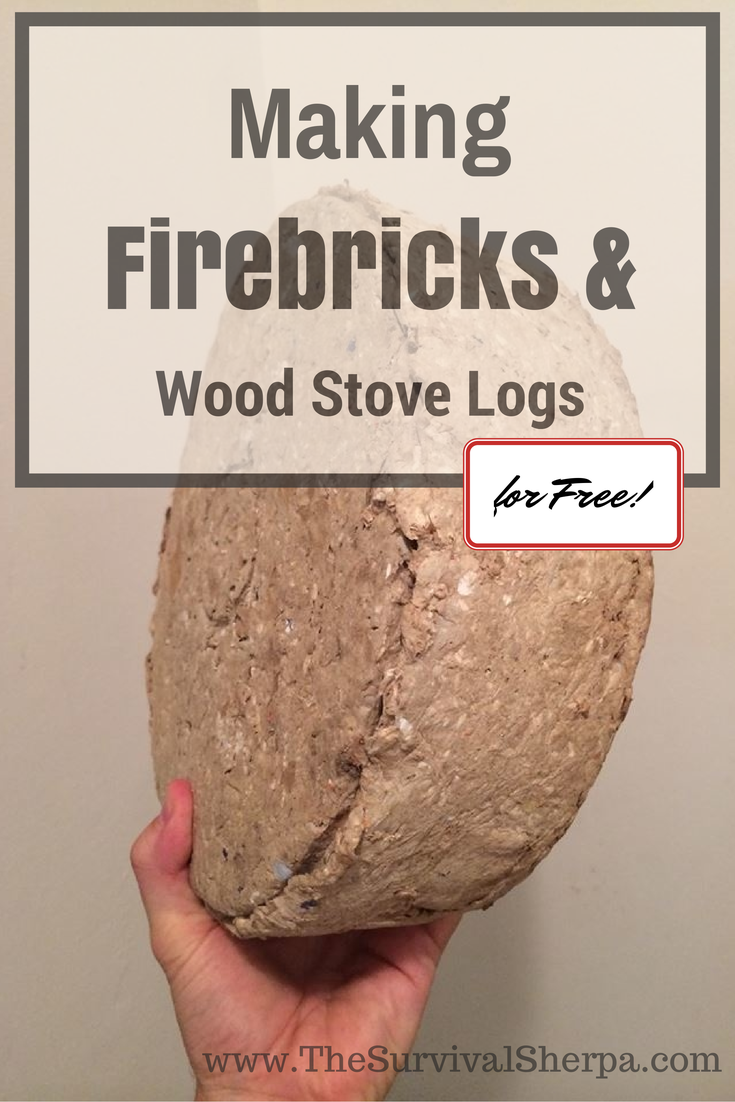
How to Make Firebricks and Wood Stove Logs for Free!

Today we’re proud to present another DIY project from a fellow Doing the Stuff Networker. Jamie Burke repurposes all kinds of useful stuff from trash and junk. His latest project shared on our DTSN Facebook Group not only saves money, but would be very useful both now (free is always good) and after a SHTF event.

If you’d like to see more of how he and our other members are Doing the Stuff, join us on our journey to self-reliance and preparedness!

Here’s Jamie’s down and dirty tutorial…

diy-firebricks-woodstove-logs-firewood

Firebricks and Wood Stove Logs Tutorial

This process only requires: Two buckets, a drill (or stabbing weapon), piece of wood (or bottom of another bucket), kinda a custom drill bit, water. + your TRASH!

Out of all of the physical spam you receive in the mail, leaves you rake, dead foliage, paper towel rolls, paper plates, napkins, beer boxes, egg cartons, etc., etc., etc., (any biomass material you can think of) – why not turn it into useable logs for your furnace, campfire, or cooking? Just don’t use the plastic coated things.

I’ve seen ‘devices’ you can buy that makes ‘newspaper logs’, but they never seem efficient, require you to pre-shred, take way too much time and the logs are not very solid. This is a much better method and doesn’t really cost anything.

Step 1

Get two 5 gal buckets. $3 each at walmart. Drill a lot of holes in it, about 2 inches down from the lips and around 3/16 size-ish. I used a soldering iron. You can use a screw driver and stab holes all in there. Go around all the bucket and on the bottom. [Todd's note: Buckets can be had for free at bakery's and construction sites]

Read more: http://survivalsherpa.wordpress.com/2014/07/24/how-to-make-firebricks-and-wood-stove-logs-for-free/

Survival Manuals

by Michael Smith (Veshengro)

Survival H-B_1The problem with many so-called survival manuals, or survival handbooks, and even the book entitled “When Technology Fails”, is that they all too often looks at escaping into the wilderness in the event of this or that but that is really not a feasible option in most cases.

When it comes to a time after the failure of technology or collapse of the modern way the most important thing to have are good old-style hand tools and also the likes of pens and ink and typewriter plus the skills of the mid-to-late nineteenth century and the early twentieth century and not stone age ones.

While being able to make fire with flint and a good steel striker is most useful learning the making stone tools via flint-knapping is. However, a total and utter waste of time. The wheel has already been invented. No need to do it again.

An important thing to know, realize and understand is the fact, regardless what some authors and even instructors may try to tell you, that you cannot master all the necessary skills and thus you cannot go it alone.

Unless the manuals are survival after an accident or military scenario, as in escape and evasion, then, in the modern setting, most of them are all but useless.

When modern society collapses, as it one of these days will, through technology failing, you are not stranded out in the woods, the desert or the jungle but in your home town or -village and it is important that you know how to deal with such an event and its aftermath there in that setting.

And for that you do not need to know how to catch fish with your bare hands, make fire by rubbing two boy scouts, or was that sticks, together, or building a shelter from twigs and leaves, traveling by the stars or such. But other, a little more modern things and skills are required and especially how to make things for your daily life (from scratch and scrap) and how to grow food.

Many manuals recommend the acquisition of gold and silver coins, especially so-called trade rounds, in lieu of fiat currencies for after when the proverbial hits the fan, but, while such may have been accepted by people as barter currency in the German inflation period after World War One, the Russian famine of the civil war after the Bolshevik Revolution and to some extent even after World War Two in the war ravaged Germany today to believe that it will still work is an illusion. That that peddle the myths are but those who will also trade in those metals and coins.

The currency that you will need after the event is skills, and goods that people want, which you, hopefully, have the skills and tools to make, from materials available.

Also forget every notion that you can live self-sufficient in all things, far away in the wilderness. That too is an illusion and a myth peddled. Total self-sufficiency is not achievable. Even the Native Americans and other such peoples did not manage to do that and had to trade with others. It is especially unattainable for an individual.

However, around every corner there seems to be someone who talks about, writes about, and so on, about the goal of total self-sufficiency. What they do is to confuse self-reliance with self-sufficiency. Self-reliance is possible, self-sufficiency simply is not. Thus we must understand the difference.

You do not need stone age skills nor do we have to reinvent the wheel. The skills required for life after the event are those of the pre-industrial age. Flint-knapping, except for the making of flints for flintlock firearms, should this be necessary, is not a skill needed.

Don't waste your time learning skills that are of little to no use, especially not as barter. In the time after the event people want steel knives and not flint blades.

Skills will be your barter currency when the chips – literally – are down and the modern system, due to our over-reliance on vulnerable technology, has collapsed, that is to say being able to make things that you and others want and need.

But still many so-called survival manuals – and by the gods do I hate the term – and their authors advise all those stone age skills to learn as if we would have to reinvent the wheel and everything else after some collapse of society due to this or that event.

Stone age skills will not cut it as skills for barter currency and neither will they cut it as regards to you and yours being able to live a life that will sustainable by way of food and all that. The stone age is gone and we have even left the bronze age far behind by now and, as said, there is no need to reinvent the wheel, as we already know how to make it, and the same goes for many other things.

Should it really come to a deep crunch then, as far as firearms are concerned, for instance, we may have to resort, once again to muskets rather than rifles even, of the flintlock variety, as such can be relatively easily made, as car the blackpowder required to shoot them. And, as far as bullets are concerned, those can either be cast from lead but, in case of a musket, even pebbles can be used and will work for hunting.

The fact is, however, that the majority of us will live in the cities and suburbs, in towns, large and small, and villages, rather than in the boonies and the skills required are not those that are mostly advocated and “taught” in such manuals but the skills of the nineteenth and early twentieth century in way of growing food and everything else.

The great majority of those “manuals”, with bar one or two exceptions, seem to be almost copies of each other and have been ever since they first appeared. One of the only ones that are different is “The Survival Handbook” by Michael Allaby, that was co-authored by John Seymour and others, and published in 1975. And that is the only one, though it would be nice to have it updated a little, that you will ever need. Maybe, though, in addition to that also the “Complete Book of Self-sufficiency” by John Seymour. And then acquaint yourself with those skills thoroughly and don't just try to learn them when the chips are down.

© 2014

Blackout Channel 4TV

A “review” by Michael Smith (Veshengro)

“Blackout” was a feature-length 'What-If' drama exploring the effects of a devastating cyber-attack on Britain's national electricity grid that was broadcast in the beginning of September 2013 on Channel 4 TV in the UK.

BlackoutBased on expert advice and meticulous research, Blackout combined real user-generated footage, alongside fictional scenes, CCTV archive and news reports to build a terrifyingly realistic account of Britain being plunged into darkness.

The film plotted the days following a nationwide power cut, as experienced by a cast of ordinary characters struggling to feed and protect themselves and their families. These eyewitness accounts reveal the disastrous impact of a prolonged blackout on hospitals, law and order, transport, and our food and water supplies.

The program cast members of the public from user-generated footage, weaving real-life archive with scripted drama to tell the story of how Britain could descend into chaos and anarchy without power.

It is rather a wake-up call but amazing how many people, judging from Twitter and other communications in regards to this TV pilot, as to how vulnerable the electricity grid is and that their TVs are also powered by the grid. And comments like that are rather scary. Britain seems be becoming more and more Americanized, also in stupidity.

A number of interesting points were raised, so to speak, in the program and people would do well to understand and to heed them.

Number one is that there are priorities and that the government is not going to be able to protect and provide for the individual and that people will be, more or less, on their own.

The fact that everything is, basically, reliant on electricity almost nothing will work and that includes telephone, Internet, television and wireless (radio) reception only via battery-powered or wind-up radios. Gas and water also will be affected and will not work, that includes the water treatment plants and thus it is advisable to have alternative means and prepping is very important.

Supermarkets and shops in general rely on daily deliveries and in a crisis will be out of food and bottled water within an hour ow two and thus having a supply of food and water at home is important.

However, and this message was also given loud and clear, if you are making and having your own preps, including generator and such, do not broadcast it far and wide but keep it well under your hat.

While in the movie people kept using their cell phones it has to be understood that (1) in the event of any crisis, as we saw in London with 7/7 the cell phone network will be prioritized for emergency services use ONLY and thus the ordinary user will be left in the dark, and not just as far as the lights are concerned. And (2) that the batteries of such devices do not last for ever and most of them will be dead within hours if they have to be trying to lock onto a signal all the time.

Fuel will be for essential services only and the ordinary motorist better understand that he will have no chance to get the stuff. Thus driving around looking for fuel or trying to get to somewhere is not going to work, aside from the fact that, which was not shown in the program though, most places will be locked down under emergency powers. You will not be able to leave the area where you are and it has to be understood that under the Civil Contingencies Act 2004 the armed forces will be deployed on the streets and a lot earlier than the movie suggests. And you can bet your bottom dollar that they will not just be there with batons to keep order. They will be authorized to use lethal force as they deem appropriate.

That means that even if you have a full tank in your car, which will not get you all that far, you may not be able to use it to leave your area. Better also consider some means of alternative transport such as and especially the humble bicycle. Not that the towns and cities will be very safe to be out and about with that either.

Even once such a crisis ends, as in this scenario the electricity grid having been reestablished food and other commodities may still be days or weeks away before they turn up again in the supermarkets, if the latter have not been looted and burned out, requiring some time to rebuild and restock.

Our electricity grid is not just vulnerable to cyber attacks and thus making it not “smart” at all but also to electromagnetic pulse (EMP) which can come about as a result of enemy action as well as from natural sources such solar flares of the right magnitude or the explosion of an asteroid in the Earth's atmosphere. In the latter cases this could knock out more than just one country's electricity network and EMP will do more damage than any cyber attack possibly could.

What also does not work in any such event are ATMs and only cash will do. But when you have got all your money, as most of us have, in the bank then getting at it will be impossible. “Oh, for that reason you should hold gold and silver coins”, say many preppers. OK, and you show me a filling station, in such a crisis, where they will accept gold and silver coins as payment.

In fact, almost everything depends on electricity and computer networks and that includes your bank and even if they would be open they would not be able to open the safe. It has a time delay lock that is, guess what?, powered by electricity. The way things are when the grid fails – this “smart” grid – we are all basically screwed.

Instead of investing in an ever more sophisticate “smart grid” the government should concentrate on localized renewable power generation so that the grid would hardly matter anymore, and allowing communities to create their own power systems.

The movie also so rightly pointed out, as with the words of the “survivalist”, that people are stupid when it comes to such a situation in that the looters took plasma TVs and other such items for which they would need electricity, not that anyone would support looting, I am sure.

Hopefully this movie served as a wake-up call for many who saw it to the fact that (1) our electricity grid is extremely vulnerable to cyber attacks and, alas though this was not mentioned, EMP, (2) that we cannot rely on the authorities in such an incident (or any other for that matter) and (3) that one needs to make some preparations for such events and that means having food and water and other supplies at home (but without letting the entire neighborhood know).

As far as radio reception is concerned it will have to be battery-powered or wind-up and for person-to-person communications you will have to think of things other that cell phone or even landline. Two-way radios are useful for family short range communications but they, and that is to be remembered, are NOT secure.

As the movie also made clear, though it could have done more on it and properly, bugging out is not an option as you will be stuck for, unlike in the movie, the authorities will shut down towns and cities much faster than it showed and secondly you will not be able to rely on obtaining fuel for a motor vehicle if that is your option of travel.

How far do you think even a full tank of fuel in your car, even if there are no roadblocks, will get you, especially if you live in the big urban areas? Not very far at all and not far enough to do your own thing.

Be prepared and prepared to hunker down, to bug in, rather than to bug out.

© 2013

Why silver and gold won't protect you from the economic collapse that's coming

by Michael Smith (Veshengro)

Silver and gold, especially in the form of so-called trade rounds, are often advocated by people in the survivalist community – who also have a vested interest in doing so – as the currency after the event of an economic collapse or such like.

old-us-silver-and-gold-coinsHowever, silver and gold coins, and even less so bullion, will not be accepted as a means of exchange, that is to say as currency, by anyone after such an event and the reason for this is first and foremost that no one has the faintest idea as to how to value such coins nowadays.

There may come a time, long after the initial collapse, that such coins will become the coin of the realm, so to speak, again but even that is questionable. Thus acquiring and hoarding such – and investing money in them – would be more than foolish.

Mean of exchange after an economic collapse or other such or similar event will not be silver and gold coins or bullion, unlike it was the case after the two world wars and during the Great Depression but skills and products and, yes, the original currency of the country, in cash. Anyone who thinks and believes otherwise will be in for a very rude awakening.

The skills that will enable you to barter for things you want and need and cannot produce yourself will also not be academic or high-tech but will be skills of the hand and of working the land. Anyone not possessing such skills will do well to learn them and, in addition to that, it will be advisable to keep money, in the form of the currency of the realm, in cash somewhere safely stashed.

Look at the sites that advocate silver and gold coins and also bullion and think laterally when you see all the adverts for the vendors of such coins and bullion advertising on the site (or in the magazines). It should give you some idea as to why they are advocating such as means of economic exchange. They pander to their advertisers or, alternatively, they are very naïve and believe that people really will accept silver and gold coins and precious metal in other forms as means of payment for goods and services.

This, as said, while that worked after the two world wars will not in the modern world when the economy collapses or the political structure as we know it today, and it will. The reason is a simple one. After World War One and World War Two people still understood the value of silver and gold, having not so long ago had such coins in their currencies, very much in the way that the Pound notes in Britain did state “I promise to pay the bearer one, five, or whatever Pounds Sterling” and the Sterling here referred too Sterling Silver. It was directly valued against the value of such silver. Not any longer and thus the belief that such coins will be accepted are total hogwash.

The means of economic exchange after a collapse will be barter, and that means skills or products, and cash, and, maybe, much later, when the current cash no longer circulates, in the form of tokens, alternative currencies, and, maybe, later still, once again in silver and gold. Though I cannot see going any further than the alternative currency part, to be very honest. “Money” issued by regions, towns, villages, and such like, similar to today's Ithaca Hours, Mountain Hours, LETS (local exchange trading systems) or such like.

So, invest in skills and lay by cash, and don't waste money and time on acquiring silver or gold. Be wise not foolish.

© 2013

Be safe, be secure

by Michael Smith (Veshengro)

Our safety and security first and foremost is down to each and every one of us ourselves and we must get that message across to the governments also and we must take responsibility for it (and be allowed to do so).

slapperPeople, however, have abdicated their own responsibilities to the government, local and central, and ask for more and more liberties to be taken away from them so that they can feel safer.

Crime prevention is the job of each and every one of us and should not be farmed out to some agency. It used to be that way. The law and its enforcers should only come in as a last resort.

That means that we must deny any potential thief or burglar the opportunity to commit a crime against us and the same goes as far as attacks, such as robberies and muggings are concerned.

Walking about town and country with earplugs in and listening to an MP3 player or iPod not for safety makes. In fact it makes you vulnerable as you are no longer (fully) aware of your surroundings and any potential attacker realizes that as well.

After the leaks, in June 2013, about the NSA and FBI, even in the UK (and elsewhere), spying on people using the Internet the President of the USA, Barack Hussein Obama, states that in order to have the security required people have to be prepared to give up (some of) their freedoms. That is how the powers-that-be have gotten to us already in that people have, as said, abdicated more and more of their freedoms to the governments because they, the people, are not prepared to be responsible for their own security and safety. Not that many governments will even permit that anymore.

In a ruling some years back the US Supreme Court stated that it is not the job of the police to prevent crime but that it is the police's job to enforce the law and this is more and more the case, done by methods the Nazis would have been proud of.

So, if crime prevention is not the task then why the CCTV and all that jazz which is supposedly there to fight crime? Because all that surveillance stuff is only there so they can spy on the people.

In a statement a US official said that they are not using CCTV and other methods to spy on all American but only on anti-government Americans. And how precisely are the cameras and other electronic eavesdropping devices distinguish between a “good” and a “bad” American? Think, people, think. Government does not have our safety and security at heart with all those measures but the total control of the people.

The protection of ourselves and that of our loved ones rests with us and we must wrest the powers back from the governments in order to be able to provide for ourselves in this, and other, departments.

The state is not our friend when it comes to safety and security; the opposite rather. More and more the state is reducing our own ability to defend ourselves more and more under the guise of needing to provide security and safety for all, by more and more methods of control over the means at our disposal.

A people who can, and who are prepared to, take care of themselves are a threat to the powers-that-be, that is to say the state and those that rule from behind the smokescreen, and it is for that reason that any attempt of the people to do things for themselves is being undermined.

A free people have the right and the duty to defend themselves and to look after their own affairs without anyone lording it over them. However, the people themselves, in the majority, have abdicated their rights to the governments by demanding more and more protection which they, the people, are not prepared to provide for themselves and thus we have all those restrictions to our liberties that we have no, with more of them in the offing.

In Britain self-defense has more or less become a thing of the past and people are told to call the police rather than to take actions themselves. In fact, defending against an attacker or burglar, who then may end up getting injured, could land the victim in jail rather than the perpetrator and this is purely and simply wrong.

While the law states one thing the interpretation of it by the prosecuting authorities and the judges more often than not is a different thing altogether.

Theoretically civilians can defend themselves and even arrest, by use of restraints, such as handcuffs even, a criminal, the practice often is very different indeed with the victim having to defend his or her action rather than the perpetrator being taken in, no questions asked.

Going prepared for defense is seen as carrying offensive weapons, even if this is just a stick or cudgel though there was a time when this was the way everyone went about their business in Britain, including in the cities. The cudgel was a common accoutrement of the gentleman and trader and it was the same in the countryside where every man and boy did carry such as defensive tool and it was accepted that this was the case.

City areas where patrolled, even when the police was already established, by vigilance committees, armed with cudgels, in order to provide security for residents and most able males were enrolled in such committees. What is more, it worked. Then the powers-that-be decided that it was the job of the police, and only of the police, to provide security for people and ever since then we have had problems.

It is up to each and everyone of us to do what is right and to claim back our powers that rightfully belong to us.

© 2013

Foraging in your backyard

Growing edible weeds on purpose

by Michael Smith (Veshengro)

Edible_weeds_in_gardenMuch has been written, and talked, about foraging for wild foods in the wilds but no one, so far, seems to have considered – or if so then a very small number – growing those foods purposely in the backyard or the allotment.

When it comes to doing this on your allotment often the management of the allotment society will object to the growing of “weeds”, as some people have found out even when growing Jerusalem Artichokes (Sun Chokes). Some of those little Hitlers classify those vegetables as “invasive weeds” also. Thus growing wild edibles may only work in your backyard therefore.

However, as far as I am concerned, growing wild foods, aka wild edibles or edible weeds is a good idea as firstly many of them are more nutritious than cultivars and secondly they grow almost without any attention and many would grow without being introduced in your garden anyway and many a gardener is fighting a losing battle with the likes of dandelion, fat hen (aka lamb's quarter), ground elder and nettles. So why not let them grow and eat them rather than battling to remove them.

Some while back I decided to deliberately leave dandelion in place and use the leaves for use as salad leaves as they are very much like rocket; best when young. They can also be cooked like spinach, and then the age of the leaves does not matter much. The flowers, if one wanted to, can be used to make dandelion wine and the roots can be roasted and ground to make a coffee substitute. Dandelion is, after all, a relation to the Chicory from which the French do make a coffee.

Stinging nettle, like dandelion, is a plant that needs no introduction as to looks, and nettle is also, in the form of the younger leaves, a great vegetable as it can be made into soup, or cooked like spinach, and also makes a great herbal tea. So, again, why battle to remove it when it is that useful.

Ground elder is a seriously invasive plant and if you deliberately want to grow it – which I will be doing – it should be contained as it spreads via the roots.

It is another one of those wild plants that are very good to eat and thus well worth using, especially when the plant has decided to colonize your garden as eradication of ground elder is nigh impossible once it has established itself, and that happens fast. So, don't battle, eat.

Other great wild edibles to get into your garden are Sorrel (Rumex acetosa) which is, basically, a wild spinach and of the cut-and-come-again variety, and Ransoms, a wild garlic of which, however, predominately the leaves are used, again like spinach.

The previously mentioned lamb's quarter is a relation to the Amaranths and can be used in a variety of ways. They leaves, yet again, cooked like spinach. It is being advised that this vegetable should be eaten in moderation as it contains high levels of oxalic acid. People who use it a lot, however, consider that the acid is being destroyed in the cooking process.

The stems of Chenopodium album, which is the scientific name of this plant, can be steamed and eaten like asparagus and the mature flower heads in the same way processed like broccoli.

The Asian community in the UK likes to use fat hen, aka lamb's quarter (Chenopodium album) in curries where spinach is also used and the same wish sorrel (Rumex acetosa) and tend to grow both because of this purposely in their gardens. Chenopodium album is extensively cultivated and consumed in Northern India as a food crop, and in English texts it may be called by its Hindi name bathua or bathuwa.

This is just a small selection of wild edible and edible weeds that I am considering and I am turning over some of the beds in my vegetable garden to the deliberate growing – have done some already – of wild edibles to enable me to go foraging just outside the backdoor and will also harvest and eat those edible weeds that turn up in other beds among the crop plants.

Don't weed you weeds; eat them instead.

© 2013

Some recession survival tips

by Michael Smith (Veshengro)

#1 Stop buying useless stuff: This is one of the easiest things to do. Simply refuse to consume for consumption and consumerism's sake. It is true we all have to buy things to live, such as food, and other necessities but you do not need a new cellphone if your old one works fine and neither do you need a new PC, new fridge, etc., while those are still working fine.

But time and again you hear people say that they “need” a new PC simply because the new one has a faster processor, or the latest Windows operating system, or that they “need” the latest model of this is that smartphone – an ordinary cellphone no longer suffices either. Why do they think they “need” this latest one? Because it has, so they have been told by the advertisers, more bells and whistles than the one they have which may only be six months old.

It is not need but desire for the latest new stuff that drives those wants, which masquerade as “needs” in their brains because the adverting in the media suggests that they need the latest gadget.

Fact is that they, unless their older one is broken, do not need a new one. And that brings us nicely to point two.

#2 Stick with what you have: Stick with what you have means that, namely to be content with the stuff that you have – as long as it works and does the job you require it to do.

So, you have got an older PC that Microsoft tells you will not work with the new version(s) of Windows. Then you need a new one, yes? No, you do not for Microsoft is not the only computer operating system about and neither is it the best.

First of all it is not necessarily true that an older computer is not going to work with a newer Windows operating system. Often all that is required is a cheap upgrade in that a larger memory is required.

On the other hand if you do have an older computer which has less than a gigabyte of memory chances are that many of the new versions of Windows do not work. That still does not mean that you have to toss out the old computer. Quite the opposite. Just load a new operating system on the machine, such as one of the many Linux versions. Ubuntu Linux is a great choice and with a footprint of the entire operating system with almost everything you could wish for on the CD (yes, CD, not DVD) being just around 700MB you will have a faster and better PC than any new one.

#3 Make your stuff last: This is something that in today's modern world of (cheap) consumer goods we seem to have entirely forgotten.

Kids and adults alike do not seem to take care of their possessions anymore and this can be seen rather frequently how they never come back for anything that they, for instance, lose in a park or such.

Bicycles and scooters are left behind because they have a flat tire or because a nut or bolt has come off. Items of clothing and even cellphones are lost and never inquired about. And the list could go on and on.

#4 Reuse, repurpose, upcycle, repair: Reuse of whatever came to hand was the norm in days gone by when people did not have the mentality of spend, spend, spend, and this attitude of reusing and repurposing was good for their wallets and the environment.

Now with the Great Recession in full swing and, regardless of the promises by our dear leaders, no end of the same in sight, the mindset of thrift has to come back into its own and reuse must become the norm again. But, as we have seen when the Great Recession came into full action those that refuse to be part of the spend, spend, spend, society are branded terrorists even by the governments for, as it was stated, undermining economic growth.

With a finite planet with finite resources, bar those that are renewable if but properly managed, the idea of a constantly growing economy is total fallacy and the sooner we come to realize this the better.

Our grandparents and their parents, and for many of us even our parents, used and reused as much as possible. No glass jar went into the trash if it would be used for something else, and the same applied for almost anything else too that people today would consider trash.

Paper was reused. Wrapping paper and paper bags too. The latter two were carefully flattened and put away for future use and pencils were used until there was almost nothing left, by using a pencil extender which could be bought in any stationers.

Today, as far as container reuse is concerned, this can be extended to many other kinds, and even plastic milk jugs can be upcycled into storage container and other kinds of useful things for the home and office.

In the days of our grandparents, and so some extent even those of our parents, everything could be repaired, either by DIY, and many a book was written on those subjects and skills, or by the repairman. Today everything is being made so that it cannot be repaired – at least not easily – and repair is made more costly than buying new. And thus things end up in the trash and ultimately, regardless of recyclability, in holes in the ground. All so that the economy keeps growing. But it is an artificial growth based on finite resources and thus the growth is but an illusion.

It is bad for our wallets and it is bad to the environment, for the Planet.

With the right mindset there is very little that one has to buy if one does not have the money or the inclination to be part of the spend, spend, spend stupidity.

Don't go out to spend $7 on a pencil bin, even if it is “green” and made from recycled steel. A clean tin can will do the same job at zero cost. The same is true for glass storage containers where large glass jars from produce of one kind or another will do the job equally well, and that for almost nothing.

We have moved so far away from sanity, it would appear, that people have to be told, on sweet tins, for instance, that those containers can be reused for a variety of things. To our grandparents this thinking would have come more or less natural and they also passed it on to their children and grandchildren.

#5 Grow your own food: Growing your own food, or some of it, and here especially those vegetables and herbs that you use commonly, reduced your bills and also gives you a greater food security.

Besides growing your food also learn to preserve your harvest by canning, drying and freezing, so that nothing goes to waste.

Learn how to cook properly from scratch and be aware of what can be done with leftovers.

Don't forget either that many weeds in your garden are, in fact, edible and that they could, and should, become part of your diet. One of the easiest and simplest to identify are dandelion and stinging nettles. Both are very good eating and also very good for you. Furthermore there is chickweed, sorrel, lambs quarter aka fat hen, and many more. Learn to identify them and, if you are thus inclined, as I am, even “cultivate” them for use. Why battle with them when you can eat them and they grow without any input.

#6 Foraging: Foraging for wild edibles is possible even in city parks though the legality could be a question. But learn what grows where and be sure that you can identify the plants safely. Some have poisonous lookalikes.

#7 Learn DIY skills: Being able to do things yourself, from wiring a plug to building your own furniture, and everything in between, are skills that can prove very important in order to live well in this Great Recession of the early part of the 21st century and we do not know how long this is going to last.

Regardless of how long it is going to continue, and my guess would be that it is going to go on for a lot longer than what our dear leaders are trying to make us believe, being able to do things for yourself, and here especially being able to repair things, will be very useful skills to have. The problem of the lack of repairability of today's products does come in here, however. Too many are made in such a way, as said before, that they cannot be repaired easily or not at all, at least not with ease of access, and thus we must demand that goods are made again in such a way that they can be repaired.

Being able to make things, however, is not just something to use in order to overcome times of recession when money is not as freely flowing. It is something that will be useful to simply make you more self-reliant and, in addition to that, it is fun to make things that you can then say “I made this (and I did not have to go out to buy it)”. To do that give me the greatest satisfaction, especially if the “raw materials” were items of waste.

There are many books available and the best of those books are the older ones that we published in the first half of the 20th century and even before. But you can also find many instructions of how to do this or that, and how to repair this or that, on the Internet and often entirely for free.

Make use of all those resources and learn as many DIY skills and then perfect them as you possibly can. The Great Recession may just be the beginning and a sign of things to come.

This is just a small list of tips as to how to live well in a recession and the aftermath of one. I have probably missed a lot of other things but I am sure that you can put your own mind into gear and adjust things to your own needs and environment.

© 2013

If lost in the Wilderness what is the first thing you should do?

by Michael Smith (Veshengro)

Which should it be?

  1. Find food

  2. Find water

  3. Find shelter

  4. Make a signal fire

  5. Take a moment to relax, accept that you are lost and go from there

The vast majority of people would either answer 2,1,3 or 2,3,1 in that order and some would even consider shelter or food the first priority. The truth, however, is another one.

The answer should and must be 5: Take a moment to relax, accept that you are lost and go from there. This one is also referred to as “taking stock”.

It is no good running about like a headless chicken looking for water or food or for materials for a shelter. First sit down quietly, control your emotions and with a more or less cool head take stock of your situation.

Check as to what you have got with you, try to remember how you got here, and such. If you are expected to be back at a certain time somewhere and people are aware approximately as to where you are or should be then stay put where you are, if possible.

Why? Because trying to retrace your steps or, even with a compass and a map, setting out into an unknown direction, could simply get you into deeper trouble and that is what we do want to avoid.

Hug a tree is a system by the RCMP called for children who have gotten lost in the Canadian bush. This is also a good advice for any of those of use who are expected back at a certain location and therefore we can be certain that someone will come looking for us if we are not back.

The situation is, obviously, somewhat a different one if there is no one expecting us at a certain location but the #1 step remains the #5 on the list. Sit down and quietly take stock and decide, calmly, without panic, the next move.

As long as you are not injured and are not losing blood and you are just simply lost then there is no need for urgency. But even if injured panicking is the last thing that you need.

If you are deciding to stay put until someone might search for you then the second priority after taking stock is the construction of a shelter and, about as important, finding potable water. Then, depending on the time of year and as to whether you need to keep wild dangerous animals at bay a fire. Food is the least of your priority. You can go for about 30 days without food, if need be.

© 2012

Pioneer skills you may need

Pioneer skills you may need and and why you may want to learn them

by Michael Smith (Veshengro)

Often referred to “pioneer skills” as, in the US, they are associated with the pioneers that “opened” the West those skills were also common almost everywhere in the Old World in those days, especially in the countryside.

Those skills will not only come in handy when the chips are down and things have failed, they already can make you and yours more independent from the system now. Also, you don't want to be looking for the manuals for those skills after the event and then slowly learn them. Nay, you want to learn them now and become proficient in them.

Here are some of the skills that were very much everyday to the pioneers and to our forefather and -mothers that you may want to learn.

Most of those are skills that will be useful even now, while some may be more necessary in a grid down type situation.

Gardening: Growing your own vegetables and fruits, knowing soil conditions, how to get water to your plants, extending your harvest season, and common garden pests will be vital to having a continuous food supply.

Saving seed: The other end of gardening is being able to plant again next year. Saving seed can be kind of intimidating and mysterious, especially for plants like carrots that don’t go to seed in their first growing season. Start with non-hybrid seeds and a reference book and practice saving some kind of seed from your next garden. This is definitely a learned skill, but could be vital to a continued food supply. The easiest seeds to start with are beans, peas, as it is also the seeds that you eat and store, dried, for use during winter.

Blacksmithing: Being able to make something useful like a horseshoe, tool, a knife or cooking utensil from scrap metal could come in very handy. This is a skill people will happily barter for. Blacksmith work does require a good deal of practice and some “special” equipment, but it’s a skill worth learning.

In all honesty, at least for the learning process, there is not all that much required as far as “special” equipment goes. You can use a short section of railroad line or the head of an old sledgehammer for an anvil and a couple of hammers of different weights. Learn cold forging first before you start with the hot stuff.

Making a fire: Before you can cook on a fire, whether open or in a wood cook stove, you will have to know how to make a fire first and for both open fire and a fire in a wood cook stove the methods of setting up the tinder, kindling, etc., are very much the same. Try some methods without using matches for an extra challenge because matches and/or lighters may be in very short supply.

Cooking over an open fire: You may have other methods to cook your food available, like a solar oven or barbecue grill, but an open fire is the most primitive and one of the most common means of cooking in a grid down emergency.

Knowing and preparing wild edibles: Learn which wild plants in your area are safe to eat and what parts of them are edible. A little foraging can add variety to your diet or even sustain life if there’s nothing else to eat. You can also grow such wild edibles and edible weeds in your garden. Nutritious weeds grow often where nothing else will grow and thus you need less time to look after them.

I purposely grow dandelion, sorrel and lambs quarter (aka fat hen) in my garden and am looking to introduce some more too. And I am also aiming to do the same with healing herbs.

Herbal remedies: If the doctor’s not around, knowing which herbs to use and how to use them to treat common ailments like cough, fever, headache, etc. can be a great blessing to your family or others around that may need the help.

Grow you own drugs, which is also a book by the same title, is better than having to hunt for the appropriate herb when the need arises.

Sewing: Patching, fixing tears, altering hems and waistbands, or creating an entire new piece of clothing or bedding could help you stay warm and keep you from running around half naked or even naked altogether. The kids might enjoy that but...

In addition to that it may be a good idea to learn to shooting your dinner and shooting to protect yourself. Learn how to dress that game that you have shot or trapped. Learn to ride a horse and drive a buggy and wagon. The building a home or shelter, or a fence, or something else is also one of those skills to learn and it will come in handy in so many way.

Besides their obvious uses to yourself and your family, most of these skills can be used to barter with as well. So while you’re acquiring your preparedness gear, remember to add some skills to your inventory also.

To the above list we also must add skills of working in wood and to fashion tools and weapons from green wood and from seasoned wood. Preparing wood for use as building materials and for the making of furniture.

In the aftermath of a breakdown of the way of life as we know it there will be a lot more “raw materials” about than there was in the days of the old pioneers and homesteaders, and the folks in the countryside in Europe.

This “raw material” comes in the form of scrap and waste and we can make use of it now already and we should. Reusing is a must because the Planet cannot be recycled.

Our parents and grandparents and their parents, and not just the pioneers and those in the countryside, were masters in reuse and upcycling but today we have been brainwashed into tossing those things that could be reused into the recycling bin and then going to the stores to buy the very things that we could have reused this or that item of waste for.

We need to change our ways to be able to survive the future...

© 2012

Scandi Grind Bull Dust

by Michael Smith (Veshengro)

A lot of American “survivalists” keep harping on about the superiority of Scandi Grind, a single bevel grind, that they claim Scandinavian knives come with. I hate to ask where they got this from?

I have many a Scandinavian knife; Norwegian handmade, Swedish and Finish, and not a single one of those has this chisel grind, for that is what it is; not one single one. I also happen to be a knifemaker.

The Viking “Seax” may have had such an edge in some examples as may have some carving and whittling knives but the great majority of knives, Scandinavian or other, have not and that with good reason, I should think.

The true Scandinavian (Scnadi) grind, in fact, does have two bevels and not one and thus the single bevel claim is nothing but, as our Australian cousins would say, bull dust.

The single bevel, or chisel, grind (Scandi grind is a misnomer as 99% of all Scandinavian knives are NOT made with that single bevel) is a lazy knifemaker's choice, though it has its uses, especially in carving wooden tools and such.

This single bevel grind, wrongly referred to, rime and again, as Scandi grind, came about predominately by knifemakers (manufacturers) wanting to save time and thus money and, in fact, was probably first used in cheap kitchen knives.

As far as I, as a knifemaker, knife-grinder and knife user, are concerned the erroneously called Scandi grind is not a grind that lends itself well to fine slicing, for instance, or careful skinning, amongst other things.

The single bevel grind, which could also be called a chisel grind, is not a Scandinavian knife grind and thus not a Scandi grind,

All the talk about this single bevel being such a superior grind for a knife is as false as calling it by the name that some have given it. Scandinavian knives, per se, have a simple two bevel grind and that is the best of all grinds.

So, let's cut all the garbage...

© 2012

Real Survival Kit

by Michael Smith (Veshengro)

Far too many kits that people put together and then recommend on the Internet and those that are for sale are a waste of money and useless...

The same is true and even more so with the commercially available ones, and here I am referring especially to the “pocket survival kits”.

Why? Because they contain items of stuff that may feel good to have around but are a total waste of space, money and time.

If you are really lost in the wilderness you want to get out and home and you do not want/need fishing kit, wire snares, etc. in a pocket survival kit. In a bug out bag that may be one thing – I said, maybe – but not in a pocket kit or a “kit” that you carry in one way or other on your person.

But you do need a good knife, a flashlight, an emergency whistle, a good compass, maybe some first aid bits such as some Band Aids, and some means to make a fire, a couple of safety pins, and that is about all. Everything else is a waste of space and money.

As I have said and stressed above the word “good” is what counts for those items that you do carry in your personal (pocket) survival kit.

Most of the pocket survival kits on the market are cheapish and thus the quality of the contents is more than questionable. Also you want a knife, even if the blade if but 2.5 inches long and not a single-sided razor blade.

So, let's look at the real thing...

  1. Knife: Obviously we are talking here (folding) pocket knife and my advice is a single bladed one and nothing can beat the Opinel #6 in price and quality and thus value for money.

  2. Compass: Don't skimp here. This thing may get you out of trouble. Do not go for those little button compasses but for a slightly larger one from the likes of Silva or Suunto. My choice would be the Silva “Starter” or similar.

  3. Light: A small, wind-up flashlight also would be a great choice and there are some rather small ones available with two LEDs that are extremely bright and are intended to be put onto a key chain.

  4. Whistle: My favorite choice is a metal whistle as used to be used by the Metropolitan Police in London (England) or a Thunderer whistle. Unless you do not wish to be found then a whistle is a must to attract rescuers.

  5. Fire tool: No, not a silly magnesium and flint fire lighter. Another waste of money. Just get a refillable butane gas lighter such as those plastic such as “Clipper” or “Cricket” (both look very similar) and use replaceable flints and can be refilled. An alternative are those refillable cigarette lighters that use electronic ignition. When they get wet though they take a lot to get going again. Stick with the flint ones, would be my advice here.

  6. The final bits would be some string (paracord would be good), some assorted safety pins and a couple of Band Aids.

As some of the items in this kit are not the cheapest of the cheap the cost will be a little bit more than the cost of one of those commercially available cheap ones but putting your own kit together from real quality ingredients, so to speak, will be better than relying on cheap tools and bits.

Now, let's be careful out there...

© 2012