Showing posts with label plastic bags. Show all posts

Reuse ideas for plastic frozen food bags

by Michael Smith (Veshengro)

Frozen food bag as hanging basket liner_webI am one of those people who take reuse and all what is related to that to another dimension at times, as regular readers will know, and I do, yes, tend to keep those bags from frozen food.

Being a vegetarian, single, and not being able to shop for fresh vegetables daily or such, I tend to buy them frozen. Alas, they then come in those bags. But waste not want not they are, after being rinsed out, used for all manner of things.

  1. Sandwich bags: Now this is, more or less, a use that should stare everyone straight in the face. They are fairly strong, can be washed out again and again, and thus can be used for much longer than most sandwich bags that you might buy.

  2. Freezer bags: Well, yes, you could even use them for the original purpose, using twist ties to close them before popping them into the freezer.

  3. Durable hanging basket liner: Especially suitable for small to medium size baskets but even then you may need two or three. But, hey, that, they are free and would otherwise end up in the waste stream.

  4. Basically anything you would use a small plastic bag for.

I am sure that the readers, themselves, can come up with a lot more ideas. They are, after all, quite strong “little” plastic bags and have great reuse potential and reusing them can keep them out of the waste stream for longer.

© 2017

Surprise: Biodegradable plastic bags usually aren’t

Reducing waste is hard. Who really knows what packaging is safe to recycle or compost when labeling standards are weak, companies regularly get away with green fraud, and seemingly every city has a different sorting game to play with bins? Straightforward rules and enforceable standardization would certainly go a long way toward clearing things up.
Even with the confusion, most people agree plastic bags suck. Perhaps sensing that we’re finally catching on, plastic bag makers have unleashed the greenwashers to make tiny changes to their product (like add a little metal) and then make up stories about how the “new” bags just disappear like magic.

In 2010, the U.S. Federal Trade Commission proposed some recommendations for environmental marketing claims. Since then, the market-regulating agency has actually started actively eradicating eco-bullshit.

Last year, the FTC cracked down on unsubstantiated claims of “biodegradable” and “compostable” bags. The Guardian’s Circular Economy series updates us on the latest distorted marketing word, “oxodegradable”:

Last month, the FTC sent warning letters to 15 additional marketers, informing them that their claims “may be deceptive”. The FTC also requested “competent and reliable scientific evidence proving that their bags will biodegrade as advertised”. This time, the term of offense is “oxodegradable”, implying the bag will break down in time when exposed to oxygen.

Though the names of the companies have not been released by the FTC, all are said to market traditional plastic products that have been amended with additives –metals, typically – intended to break the bags down in the presence of oxygen. As many bags are dumped in the low-oxygen environment of a landfill, the FTC has said those advertised benefits are dubious.

More to the point, isn’t the goal of making biodegradable products that they don’t have to go in a landfill at all? Food scraps are super biodegradable, and that’s why they go in the green bin or a compost pile. Biodegrading into nutritious soil in the landfill is worthless.

Read more: http://grist.org/news/surprise-biodegradable-plastic-bags-usually-arent/

UK opposition could doom EU efforts to curb plastic bag use

UK is leading opposition to a proposal for an 80% cut to the 100bn single-use plastic bags used each year in Europe

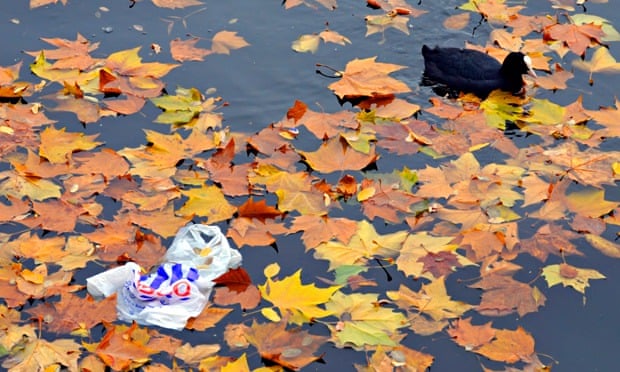
Plastic bag use in UK : Autumn leaves floating in water with Tesco bag and a duckA bid by the European parliament to impose an 80% cut in the 100bn plastic bags used by Europeans each year could be scuppered by several states opposed to Europe-wide action, and a European commission that increasingly views targets as an unnecessary distraction.

‘Single use’ plastic bags are light, convenient and easily thrown away but their very disposability creates an environmental threat. As many as a million seabirds and 100,000 sea mammals – including large numbers of seals and turtles – are killed each year by ingesting plastics or becoming entangled in the growing number of plastic islands that gloss large swathes of the world’s oceans.

But several countries led by the UK and Croatia are opposing EU-wide mandatory pricing or product restrictions for plastic bags. France and Spain are more supportive but the commission’s first vice president Frans Timmermans on Wednesday said that he was “not sure” whether the proposal reflected the previous commission’s original intent.

The Guardian has learned that the commission’s secretariat-general is currently discussing whether to reject the proposal in a final negotiating round on Monday, sending it back to a council of EU ministers where it would likely be blocked by the need for unanimity.

“I fear that although the member states agree that we have to act, they do not want us to tackle it at the European level altogether,” said the Dutch Liberal MEP Gerben-Jan Gerbrandy. “It is extremely worrying as this is the fundament of EU environmental legislation.”

“Plastic bags are a huge environmental problem that can be very easily solved, and that doesn’t happen very often anymore in the environmental field,” he added.

Read more: http://www.theguardian.com/environment/2014/nov/13/uk-opposition-could-doom-eu-efforts-to-curb-plastic-bag-use

Plastic bag 'tax'

by Michael Smith (Veshengro)

In October 2013, after the gods only know how long, it was announced that the government has at long last decided to follow the lead of some other countries by introducing a charge, albeit a paltry 5 pence, which is about 8 cents Euro and about the same in US money, for plastic bags from 2015. Better late than never I suppose but one can but asked what (a) has kept them that long and (b) why will it almost two years before the levy will be introduced.

plastic-bagsNow, in a way that only politicians can, they appear to have completely confused a simple issue by – firstly – making biodegradable bags exempt, which will clearly do nothing to prevent bags littering our environment, and – secondly – by exempting retailers with fewer than 250 employees.

The problem with biodegradable shopping bags is that they are still plastic and the biodegradable part to this is rather a questionable one as well. Very much in the same way that we keep hearing abut bio-plastic, that is to say, yes, plastic made from bio-matter. And even if it is so-called compostable and biodegradable (only in commercial composting plants, however) it is still plastic and much of the plant-based plastic in fact is neither compostable nor anything else but PET. But, according to some in the recycling industry, cannot be recycled in the same way as oil-based PET.

But back to the issue of the plastic one-time shopping bags. The first thing is that the bags should be at least charged at 10 pence at least in order for people to remember to bring their own reusable shopping bags and secondly, as said before, I cannot understand why (a) so-called biodegradable bags are exempt and retailers with fewer than 250 employees. I am totally lost as to what difference the number of employees of a retailer makes to the use of shopping bags.

Once again inconsistency, incomprehension and confusion reign! In fact, I believe the government has, once again, lost the plot (if ever they had any).

© 2013

Brits call for reduction in free carrier bags

by Michael Smith

According to a survey carried out a majority of all British people call for a reduction in the use of free carrier bags (plastic grocery bags to our Transatlantic cousins)

82% of those surveyed believe a 5p or 10p charge would encourage people to switch to reusable bags and more than 80% of people in Britain believe that retailers should stop giving away free plastic bags to their customers.

A poll by eco-bags company Reusabags (http://www.ecobagswholesaler.co.uk/home) found that 69% of respondents believe the current promise by retailers to reduce the number of bags given away by 50% by the end of spring 2010 is not enough.

More than 80% also believe a ten to fifteen pence charge on plastic bags would encourage shoppers to switch to reusable bags and 92% are worried about the impact the proliferation of free carrier bags is having on the environment.

The online poll of 2,000 people was carried out by London-based entrepreneur Chris Amos, founder of Reusabags after he read the results of a similar poll carried out by a popular UK newspaper last year.

After contacting the paper, he used the same questions to conduct his own poll and see whether attitudes had changed in the intervening months.

"The figures are up on last year's survey and people's awareness of it has increased," he told the media. "I think there's definitely a shift happening."

Mr Amos, who is originally from Australia, said he hopes the UK will follow the same trend that has already happened in his homeland, where most people already opted to use sturdy, reusable bags before a ban on free plastic bags was announced.

"In Australia it has got to a point where if you take free plastic bags at the counter you feel embarrassed," he said.

He echoed concerns raised by many of those that took part in the survey that the voluntary reductions in free plastic carrier bags being led by some of the UK's top retailers are not tough enough.

A Government-led initiative – whether that is a ban or a charging scheme – would cut plastic bag waste more quickly and ensure that more of the revenue from the sale of reusable bags is reinvested in environmental causes, he said.

But the British Retail Consortium opposes the idea of bag charging and said voluntary agreements by the major retailers are working well.

However, you literally have to have, with the exception of Sainsbury's and one or the other larger retailer, and also including Staples, to have “I do not want a bag” tattooed to your forehead for people to understand that you do not want a bag. All too often the product is in one before you can even say “no, thanks!”

In other words, whatever the BRC says, the voluntary agreements are not working, especially as only the major retailers are involved in it.

While the poll was under way, the Welsh Assembly Government announced plans to ban free plastic bags.

There is no excuse for not carrying a reusable shopping bag. Sainsbury's have down their best last year by giving those “Bags for Life” of theirs away and there are also many places where good sturdy reusable shoppers are literally given away.

On the other hand, the few quid that good version of such bags cost is a great investment, and if all else fails, you can always go and make your own. Instructions for such home-made shopping bags can be had at “morsbags.com”.

© M Smith (Veshengro), 2009
<>

Plastic bags are bad but they are not (all) “made from oil”

by Michael Smith (Veshengro)

It is a misconception that the majority of those “free” plastic grocery bags are made from oil, especially foreign oil.

Plastic bags are either made of a byproduct of natural gas or of a byproduct of oil, not of oil or natural gas itself. It is a misconception to say that they are made from oil.

Plastic bags are made from ethylene, a byproduct of natural gas or from ethylene created from naphtha, a byproduct of petroleum.

Chemists string together long chains of ethylene to form polyethylene. Depending on the process used to create the chains different densities of polyethylene can be produced.

As polyethylene is a byproduct, whether from natural gas or made from naphtha, which is a byproduct of the petroleum industry, those bags, really, but no more demand on the oil reserves and oil imports or those of natural gas, than does the demand for oil for the refineries anyway but they still remain unsustainable products.

The bags you are given at retail and grocery stores checkouts are High Density Polyethylene or HDPE. They are fairly sturdy, able to hold quite a bit of weight without breaking, optically cloudy, and can be dyed any color.

Low Density Polyethylene or LDPE are optically clear bags, very light, and often described as wispy. These bags are likely to be found in the produce market or covering your clothing at a dry cleaner.

In some countries, such as the USA, for instance, most of the plastic bags given away by grocery stores and others are made not from oil but natural gas, and the USA has ample supply of natural gas within its own borders – so no costly imports. Other countries are not so lucky.

In addition it has to be said that that only applies if the bags are actually produced in the USA and not, as will be more likely the case, in places such as China (or India). The source of the ethylene from which the polyethylene is then constructed we do not know.

Whatever the source, the fact remains that Plastic Bags Are Bad For The Environment

Most of what you have read about plastic bags is true. Plastic bags kill wildlife, cause pollution, clog landfills and indirectly raise the price of food at the grocery store. There are also, aside from those made from PLAs, that is to say those that are made from a plastic made from corn starch and lactic acids and such, no biodegradable plastic bags about. That is a fallacy and absolute greenwashing. Ordinary polyethylene shopping bags do NOT biodegrade; they photodegrade. That is to say they break down into ever smaller and smaller particles of plastic in the environment, all the while releasing harmful substances into the soil and water.

I strongly recommend the use of reusable grocery bags. They hold more, look better, and are not likely to leave your groceries strewn around the grocers parking lot.

Let us, however, clear up the misconception that plastic bags are made from oil. If they are made “from oil” then it is from a byproduct of the petroleum industry, namely naphtha. They are not, however, made from oil as oil goes. Therefore they are neither made from primarily from foreign oil or such.

We have enough strong and valid points as to why we should reduce or even ban the use of plastic bags without mentioning the oil factor in it at all.

However, whether made from a byproduct of oil or natural gas, that is to say from ethylene, they may actually come a long way to us as well, as I have said already. That too should be another reason, atop of the others, why we should get away from the free plastic grocery bag.

© M Smith (Veshengro), July 2008

The Bane of the Plastic Carrier Bag

While those bags are, I know, very convenient indeed when shopping at supermarket and general stores as well – one does not have to remember to bring a shopping bag of one's, as one had to in years past before the advent of the plastic grocery bag – they come with a big environmental price tag attached and footprint.

Trees all over parks and countryside are festooned with plastic bags in different colors and hues and while decorations may be nice and fine and suit a Christmas Tree, in the countryside and in parks this is rather unsightly. In addition those plastic bags are also bad for wildlife.
Because of their very nature of being extremely light they get blown everywhere, high up into the canopy of the trees and deep into the undergrowth, and they end up hung from branches in the same way as stuck to brambles and thorn bushes deep in hedgerows and in the under storey of woodlands and parks, making everything look tatty and neglected, even if countryside and parks staff do their very best to make the places look nice.

In addition to this those plastic carrier bags, unless made from corn starch or other such biological material, are made from oil based plastic and are NOT biodegradable. They photo-degrade instead, slowly breaking down in the environment into tiny, even microscopic plastic particles and also leaching at the same time chemicals into the soil, all of which further contaminates the environment.

Moves are under way, so I understand, from a number of “sources” to outright ban the use of those plastic bags, even biodegradable corn starch ones, maybe, and while I must admit that I do use them as and when, the plastic bag that is, for they come in handy as free bin liners for waste bins at home and in the office, which means they get used at least two or three time with me, I am taking my own reusable ones, often tote bags that come FREE from the variety of fairs I attend, to the stores nowadays and we must all get back to doing this, that is to bring our own shopping bags, just like in the old days. If not always then at least most of the time.

As to tote bags, I would say, that there is no need, I am sure, to go out and buy such sturdy cotton or jute tote bags (he has good talking I sure some will think now for he has just told us that he gets them FREE on trade fairs) if you can sew, whether by hand or sewing machine. It is quite simple to knock up a couple of sturdy shoppers from some old denim of some other sturdy cloth, such as a bit of Hessian or canvass.

While you and I, and even all the remaining readers of this journal, if we all did it, may not save the planet on our own be refusing to use the plastic carrier bags, we may, however, contribute to the countryside and parks looking less tatty.

The problem is that, even if we all stopped using plastic carrier bags tomorrow, the unsightly bags in trees and such will still be with us for some time to come, simply because those that still fly about and hang about the trees will take a while still to break down, before they ultimately sort of disappear.

Having said this, that should not stop us, though, to make a start now and stop using and begin refusing the offered plastic shopping bag. Mind you, often you do not even get the chance to refuse for you do not even get asked as to whether you want a bang; the purchases are shoved into the bag before you even know it.

If we do end up with bags of this kind, for one reason or the other, then we must also make sure that we use them at least more than once and then – in the final end – dispose of them responsibly. However, best is no plastic bags.

© Michael Smith (Veshengro), February 2008