Showing posts with label garden tools. Show all posts

Spear & Jackson Precision Snips – Product Review

Review by Michael Smith (Veshengro)
Spear & Jackson PRECISION SNIPS
SK5 steel blades for lasting sharpness
with a built-in locking catch for safe transportation
and storage
SRP: £6.49

Spear & Jackson PRECISION SNIPSDon’t be fooled by their diminutive size; these Precision Snips with their long narrow blades are perfect for dead-heading, says the website and promises the advert.

Well, hmm, perfect for dead heading, they say. The accuracy leaves much to be desired as does the strength of the blades; in my tests, at least. In other words, impressed I am not. OK, those snips only cost about £7 but why where something else would work equally as well, namely a pair of (old) scissors.

Alternatively get a decent pair of garden scissors, such as Fiskars, but an ordinary (old) sharp pair of scissors repurposed for the garden will do just as well, as those snips, if not better even. The only advantage, maybe, that this pair of snips has is the fact it has the spring in the middle like a pair of secateurs has. But I have found that a pair of scissors has better accuracy also.

There are many “special” garden tools that you do not need – nay, not even want – to buy, and this one falls firmly into that category, but is just one of many.

Oh, I guess you now want to have my rating for this product. Hmm, zero would just about sum it up. A pair of scissors or snips from Poundland would offer a better deal. I know the company won't like me after this but so be it.

© 2018

Spear & Jackson Select Stainless 3-Piece Mini Tools Set – Product Review

Review by Michael Smith (Veshengro)

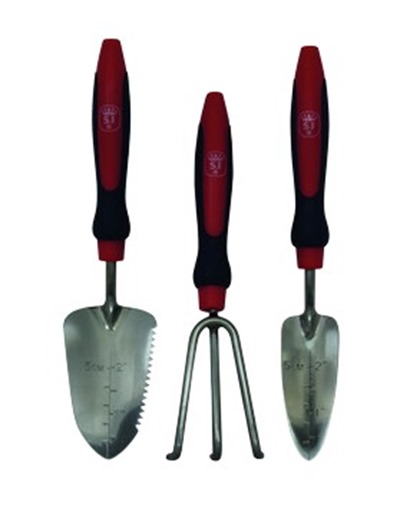
Spear & Jackson SELECT STAINLESS 3-PIECE MINI TOOLS SETSpear & Jackson Select Stainless 3-Piece Mini Tools Set
• Mirror-polished stainless steel heads for rust resistance, easy clean and minimal soil adhesion
• Bi-material, soft grip contoured handles for added comfort
• An ideal set for container gardening
SSP incl VAT £17.99

A small but perfectly formed set of three miniature Select Stainless hand tools: hand trowel, transplanting trowel and three-pronged cultivator, ideal for working in the confined spaces of pots, planters and baskets.

While, originally, intended for use by adults in confined spaces of pots, planters, baskets and otherwise in container gardening, the set is also ideal for the little ones to be introduced to proper gardening, whether in containers or raised bed, by being given proper tools and not plastic things.

Personally I always suggest to refrain from giving a child inferior tools when introducing them to gardening. The plastic play tools do not cut it if you really want them to take gardening serious.

I particularly like the serration on the left-hand side of the trowel as, aside from giving a cutting edge, so to speak, if and when the soil is a little compacted, it also can be used to open bags of soil, compost, etc.

A real nice handy set of tools for the adult gardener pottering around in pots or, and especially, for the young gardener.

© 2018

Garden scissors and their uses

by Michael Smith (Veshengro)

What are garden scissors used for and learn how to use scissors in the garden

gardening scissorsGarden scissors vs pruner shears or secateurs

When you mention garden scissors to some people they will counter with “oh, you mean pruning shears” (or they may say secateurs instead, depending where they are from in the English speaking world). But no, that is not what I mean. I mean scissors for use in the garden. While, to some extent, secateurs can be used for the same tasks in the garden as scissors there are many tasks that scissors either do better or can only do properly.

What are garden scissors used for?

OK, as I have said above your secateurs can do a lot of the cutting tasks that (garden) scissors would be employed for as well, such as deadheading, cutting off dead and dying leaves, and harvesting fruit and vegetables, but they will have to be very sharp to do that well. Scissors are much better suited for this task and when it comes to opening seed packets, or bags of compost and such then they will always outperform secateurs by miles.

Garden scissors are not something you would want to use for pruning, however, unless you are trimming and shaping small box trees or such. General pruning is done with bypass secateurs for green material and with anvil secateurs for dead woody matter. Unless you are using Rolcut or Original Loewe, their parent. Those are anvil secateurs that can do both equally well.

How to use scissors in the garden?

Many readers may now wonder as to whether they need spacial garden scissors for use in the garden and the simple and short answer here is a firm no. No, you do not. You can use ordinary common-garden (pardon the pun) plain household scissors though most garden scissors have two equal size blades (in width and design) which is not always the case with ordinary household scissors.

Scissors can be used in the garden to deadhead flowers, remove dead leaves, harvest vegetables, and snip herbs. You definitely cannot beat scissors for cutting seed packets or potting soil bags. Scissors are invaluable when you need to get into the impenetrable packaging, whether of new pairs of secateurs, or whatever, and for many other tasks.

I, personally, would not got as far as using them for edge paths or beds in the garden but I know that some people do that.

As you can see, there are many uses for scissors in the garden, be it those trusty household types of scissors or those that are specifically sold for use in horticulture. Either of will do the job but one thing they should be, ideally, and that is sharp.

If you have an old pair of small to medium household scissors that no longer are the best for use in the home or an old one that you can refurbish – at, ideally, zero cost bar a little penetrating oil and cleaning – then go for and with that. Otherwise you will find Poundland – or Aldi or Lidl at times – having cheap garden scissors for between a Pound and three.

On the other hand car boot sales or charity shops may have a good useable pair of scissors just asking to be used in the garden in the 25p or 50p box which, with a small file and worked in the right way, can be just the ticket for use as a pair of garden scissors.

But, whatever you do a pair or (garden) scissors would be in your armory for your garden. A pair of garden scissors can reach parts other garden tools can not.

© 2017

Garden tool care

by Michael Smith (Veshengro)

tool-careLike the hunter who uses his so-called season time, when game may not be pursued, to maintain his weapons and kit so the gardener must use his quiet season – mostly winter time – to maintain his equipment.

Regular cleaning and sharpening of any cutting tools, and that includes hoes and spades, should be routine anyway and tools should be cleaned – if possible – at the end of the “working day”. There is, however, some maintenance that will take longer and winter is the time for the gardener to do these jobs.

In order for your tools to be in top condition and to last for a very long time a little tender loving care, aka TLC, - or a bit more than just a little – will go an awful long way.

Power tools, whether lawnmower, brush cutter, grass trimmer or hedge cutter, should go to their annual service at this time, unless you are well capable of doing it yourself. And if you use a human-powered reel mower then that should also be serviced but most handy gardeners should be able to do (most of) that themselves. However, the cylinder may, depending on use, need a regrind and that can only be properly done on the right kind of work bench. The blades of a rotary mower, on the other hand, can easily be resharpened by anyone with the right knowledge and skills with only a good mill bastard file.

Hand pruning shears, aka secateurs, and loppers should be throughly cleaned and hand reground (Do not use a bench grinder or any other power grinder). With the right kind of tools this can even be done without the need of taking them apart, as long as no serious regrinding is required.

In the case of the latter it will mean taking the secateurs or loppers apart and regrinding the blade while clamping the blade down onto a workbench. The same as above goes for grass and hedge shears.

When sharpening complete and, if need, tools are reassembles – hopefully correctly – then all moving parts and springs need to be given a thorough coating with oil or even thin grease. Blades too should be coated in oil or thin grease and then the tools can be put away, ideally wrapped in greased Kraft paper (Oh dear, am I old-fashioned).

Digging and border spades and forks should be thoroughly cleaned and all rust – as far as possible – removed with a wire brush, wire wool and emery cloth. Spades should then be reground (by hand) using a file, the metal parts oiled and the wooden handles coated with vegetable oil. They should then be hung up in the shed. The same goes for your hoes, your edging iron/edging knife, etc.

Your most valuable hand tool, as you will already have discovered, for the garden is the humble garden trowel and for that very reason alone it should receive lots of TLC. Where would any gardener be without at least one good one?

Basically you treat your trowel (or trowels) (and other hand-held metal tools) in the same way as you do your spade, etc. in that you give it/them a thorough clean and them oil them in the same way. Also check the handles, if of wood, for any splinters and such and remove using glass paper. Afterwards apply vegetable oil and the wrap in Kraft paper and store indoors.

Wooden garden tools: There are few wooden tools in the garden – sadly – today. Almost everything has – nowadays – been replaced by and with plastic though we are beginning to see somewhat of resurgence in wooden tools for the garden and in the garden, such a dibbers, dibblets, trugs, baskets and a few others.

Not so long ago even wheelbarrows were made of wood, almost entirely even and they served us well. Yes, they were a great deal heavier than today's ones made of steel, aluminum and even plastic with their pneumatic tires but they had less of an impact on the environment in the making and were sturdier.

When it comes to the care of wooden tools first and foremost they should be cleaned well at the end of the working day and every now and then be treated with vegetable oil (or even a beeswax mix) to remain in good condition.

During the end of gardening year maintenance they should be thoroughly cleaned and rubbed down gently with fine wire wool after which they should be place in a “bath” of vegetable oil to refurbish them properly. They should then, after some hours, wiped down (without removing all oil) and placed, wrapped in oil cloth, in a dry place until they are required again.

If you look after your garden tools – and that goes for almost everything else – your garden tools will look after you in the garden and will last for a very long time (as long as they are well made).

© 2013

The Anvil Pruner is 90 years old

by Michael Smith (Veshengro)

The Anvil Pruner is 90 years old and the world's first was the Original Löwe 1 made, as it is still today, in Kiel, Germany, by what is now Gebr. Schröder GmbH. Happy Birthday Löwe and the Anvil Pruner.

Loewe1It is now 90 years ago that Walther Schröder invented, produced and patented the first ever anvil pruning shears in Kiel, in Northern Germany and his grandson, Randolph Schröder, who is now the managing director of Gebr. Schröder, continues this tradition of high quality products for the horticultural, viticultural and aboricultural trade.

Many professionals appear to advise the use for anvil pruners only for dry wood and bypass pruners for green but I have found that anvil pruners can do both equally well. It is a myth that anvil secateurs cannot deal with thin green materials and that their cut is not good enough for green wood. The opposite rather. But only if the pruners are made to the highest standards and many anvil pruners of the budget range simply are not.

Anvil pruners will cut green wood perfectly, as they will dry, and the thicker the branch will be, the easier the cut with an anvil pruner is. But, if the blades are well sharpened and the tip is being used even the smallest plant materials can be cleanly cut with ease.

It is a popular misconception that anvil pruners will squeeze the branch, that is to say good anvil pruners will not squeeze, and especially not those of the company that invented the anvil pruner, namely Gebr. Schröder, under the Original LÖWE brand, because the secret is the quality of the blade and general construction.

Many cheap anvil pruners from Asia or of medium quality will lose their sharpness immediately after several cuts, and from this point on they may squeeze more than provide a clean cut. And that fact, the medium quality of other brands, discredit the standard of our products and how an anvil pruners has to be. In general it has to be said that anvil pruners offer much more advantages in comparison to bypass pruners. Having a good pair of anvil pruning shears mean the user can cut both dry and green wood without the need for changing tools.

For many years, Löwe anvil pruners – first invented by Walther Schröder in 1923 – were manufactured and sold under license in the UK as 'Rolcut Secateurs'.

In fact, they were manufactured in the UK under license in the time when, after World War One and later World War Two, German products were not permitted to be imported to Britain. “Made in Germany” certainly was not welcome in Britain as too many “Made in Germany” products had been dropped onto the country in a destructive way.

Although Rolcut was a well known brand in the UK the tool design was from a German company using the “Original LÖWE” brand who had patented the first anvil pruner in 1923. The all metal design and anvil blade made them the toughest pruner available and they were the choice of many professionals and enthusiasts.

In 1928 came the “invention” of the Original LÖWE pruning shear under the "Rolcut" brand in England by Colonel B.J. Walker. In 1933 Foundation of the company "Fritz Howaldt Ltd." in London where in 1945 Rolcut took over the manufacture in London. In 1994 Rolcut was taken over, so I understand, by Fiskars and deliberately destroyed. Guess they were just too much of a competition.

Mind you, we have seen this same action in Germany when the German Democratic Republic was annexed after the fall of the wall and great companies such as Zeiss Jena and other were deliberately destroyed; in the former case because the original owners of Zeiss Jena are now Zeiss Wetzlar and did not wan the competition from the Jena factory.

I still have a very old small pair or Rolcut pruning shears, much smaller than the Original LÖWE 2 or the Rolcut 7 that I found in a park and have refurbished myself (spare parts are not available for those old Rolcut ones anymore unfortunately). It is probably some 50-60 years old and, aside from some rust on the chrome and the blade, being carbon steel, showing some tarnishing, the secateurs still perform well indeed.

On the occasion of the 90 years anniversary LÖWE have designed pruning shears that are visually representative of their first shears – the Original LÖWE 1 anniversary shears, the LÖWE 1.102.

OL1102__1This Anniversary Edition of the well-known LÖWE 1 combines the most modern technology with nostalgic design:
- Typeface an logo reflect the first shears from the 20s
- Engravings of plant shoots embellish the metal grips and offer a higher resistance to slipping
- Simple, clean cutting of branches up to 25 mm, 1''
- Suitable for the most versatile of applications with almost any species of trees and shrubs
- Nostalgic packaging design

The design is exactly the same as the original LÖWE 1 with the same designs on the handle but made with modern materials and a better lock than those of the ones of the 1930s, 1940s and 1950s.

All parts are replaceable which means should any part ever get damaged in a way that it needs replacing it can and thus the shears can live almost for ever.

Today there are anvil pruners made by and for many different companies and most are now made in the Far East, and in addition to that there are even ratchet secateurs of this Nature. However, none equal, in quality of materials and workmanship the originals made by Gebr. Schröder under the Original LÖWE brand.

When it comes to the using of anvil pruning shears, as with pruning shears in general, the size of the branch to be cut should always be considered and anything that is too big is a job for loppers and not for pruning shears, period. And if that fails then it is a job for the pruning saw. When you have to apply herculean force then you are using the branch is too large and you need to change the tool.

© 2013

Make you own garden tools...

...or at least some of them.

by Michael Smith (Veshengro)

There are many small (and not so small) tools that we can make from wood, from wire, from tin cans and even from large glass jars and from plastic bottles of various kinds. Glass jars and some plastic bottle reuse is not so much for tools as for aids for the garden, but we shall include those here nevertheless.

big_dibber&little_dibber_sml

Dibbers hand-carved from Ash (above) and Blackthorn (below)

Admittedly it will not be possible to make all your own garden tools yourself, especially not the likes of digging spades and -forks, shovels and such like, and even some smaller ones such as trowels, unless you have a forge and blacksmith skills. But there are still many tools and aids for the garden that you can fashion from a variety of “raw” materials.

The “raw” materials for making your own garden tools and garden helpers are wood and waste materials. The latter in the form of discarded fence wire or similar, salvaged; tin cans; plastic bottles and such; and large glass jars. The glass jars primarily for one use, that of single plant cloches.

There are many tools and aids for the garden that can be made, with little or no skills, from wood, that is to say virgin wood and waste lumber, and from “waste” wire and other items of waste. One man's waste is another man's resource.

Wood has once been a primary material even for garden and farming tools and implements, and this even included the plow in the beginning of farming. Other tools were still entirely wood until not all that long ago.

In parts of the Third World the digging stick is still the main tool in the vegetable garden and small fields. In principle the digging stick is but a large dibber that is used for, well, digging but not for digging wells.

When it comes to using wood from which to fashion garden tools and -aids the easiest, and very useful, tool to make is a dibber, and also the dibblet. The former for use of planting out plants into the beds and the latter for pricking out and transplanting seedlings.

There are others tools for the garden and the small farm that can and used to be made from wood. The pitch fork, originally two-pronged, was and is one of those, and quite simple to make. The hay rake is a little more elaborate but it is still possible to make this and other tools yourself with some forethought and skills.

Wire weeder handmade from wire coat hanger

Wire weeder handmade from wire coat hanger

Aside from wood, from the woods directly or “waste” lumber, there are other “waste” materials from which to make some tools for our garden that costs us nothing but time and a little effort.

“Waste” material resources stretch from tin cans, (fence) wire, glass jars, plastic bottles and containers all the way to pallets and ton bags. All of those, in one way or the other, can be used to fashion tools and aids for the garden, inclusive of fencing. But let's concentrate on tools and aids for gardening itself for the moment.

A tin can, without much ado, and without any conversion, can become a simple soil scoop for filling plant pots, or a scoop, though this is not necessarily gardening, for feeding your backyard hens, and tin cans have thus been used in gardening for almost as long as the tin can has been in existence. You can put aside several different sizes of them to be able to fill all manner of plant pots effectively.

Add a wooden handle to a tin can and, maybe, cut it to a shape using tin snips and then working it a little and you have got almost the equivalent of a (designer) soil scoop that would cost you in the region of US$25. It is that simple.

Leftover lengths of (thick) fence wire (or wire from those wire coat hangers that are tossed out by the ton by dry cleaners) can easily be fashioned into very effective weeding tools of the “Wonder Weeder” kind.

This simple tool works and, in fact, works fantastic and when it comes to weeding by hand, as is, more often than not, the case in gardening an effective tool of this nature is a great asset.

Many items of “waste” can become our raw materials – at times combined with wood or waste lumber – for making tools (and aids) for the garden and gardening. It is not always necessary to go to the store to buy or order via a catalog.

Glass jars, plastic bottles and containers, pallets, ton bags, general waste lumber, wire waste and much more all can be, in one way or another, converted to tools and aids for use in the garden.

But when it comes to the making of tools from waste materials (and not virgin wood) then it is tin cans; waste wire, be this left over lengths of fence wire or wire coat hangers; plastic containers cut up for a purpose and bits of waste lumber, and, at times, virgin wood for handles, that are our main resources and raw materials.

Depending on the thickness of the material some plastic bottles can be made into scoops and even garden trowels for use in soft and loose soil, and that simply by cutting out the right shape from the bottle with a pair of strong scissors or snips.

Farmers and gardeners have always be inventive with whatever came to hand until not so long ago, that is to say before the time of consumerism gone wild and made many of the things they needed from natural materials and “waste” products. Everything that could be was reused or recycled into something else, etc. to be useful as a tool or aid on the farm and in the garden and we should take a leaf out of this old book, or quite a few pages, and do likewise.

© 2013

More on making your own garden tools and -aids, and the detailed making of some of them, in a book aimed to being ready for the gardener's quiet season.

The garden trowel: The gardener's utility tool

by Michael Smith (Veshengro)

Much like garden gloves, and possibly even weeding tools, the garden trowel is one of several gardening tools that the hobby or professional gardeners simply cannot live without.

garden trowelThe garden trowel is nothing more than a small shovel really, but it is a piece of gardening equipment that gets almost constant use.

In addition to the basic garden trowel most people are familiar with, some trowels have serrated edges on the shovel blade, and when it comes to handles, there are several options.

The original trowel was different however and some are still made in that way. It was, basically, a bricklayer's trowel and it was used in a backwards pulling motion to open a hole in which to put the plant. Sneerboer from the Netherlands still forges a similar style today and it is that kind of trowel that is the one used in the tulip fields of Holland.

If you are buying a trowel for the first time, it is probably a good idea to visit the local garden center and give the trowel a “test drive”, so to speak to get the right one for you.

It should feel comfortable and be well constructed with a sturdy handle and a forged carbon- or stainless steel blade. Do not skimp on quality and chose a cheap one just because it is cheap.

If you prefer a hardwood handle make sure it’s smooth to prevent splinters with a reinforced interface between the handle and blade. Other handle options are available and work just as well including those that allow for a soft grip like the OXO Good Grip versions with a gel filled handle or the Thingamedig from Dalsonware Pty Ltd, Australia.

Another option for finding garden trowels and other small garden tools is to visit flea markets or antique and collectible shops that specialize in antique garden and farm tools. These tools were built to last so in most cases you can’t go wrong. Avoid too much rust (you can always get rid of a little bit of rust), worn and splintered handles, or excessive wear.

But latter source, as far as antique tool markets and such are concerned can be a more expensive option to buying a quality trowel new. On flea markets, trunk sales (car boot sales) and in so-called Charity Shops (if the latter have any) good secondhand garden tools may be had for less than in the garden centers.

Also, I am sure, you will want for more than just one single garden trowel as they are a little like horse for courses and a small transplanting one also will come in very handy indeed.

© 2013

Tools for (new) gardeners

by Michael Smith (Veshengro)

cultivating-hand-tools-2Give a man a fish, and he’ll eat for a day; teach a man to fish, and he’ll eat for a lifetime” is an adage that applies to gardening, too.

To introduce a friend to the joy of “grow your own,” offer a useful tool along with the promise of your support and advice. With all there is to learn, gardening can sometimes seem overwhelming. But guidance from a seasoned veteran can set the spark for a lifetime of gardening joy.

We were all beginners once, as well, and thus being prepared to assist a newbie with advice on tools and gardening in general will help raise new generations of gardeners, hobby – I hate to say amateur, as may are as least as good as the professional – and professional.

When it comes too tools there are a few basic ones that the new gardener will need and, in order for him or her to continue on the path the advice must be and should be to get the very best that they can afford.

Garden Fork

The garden fork is one of the most important tools in the armory of any gardener, not just the newbie, and thus it is best to invest in the best. Wow! That even rhymes...

Some old timers will tell you that a garden fork is about all you need and they are about right in that too. The garden fork is perfect for prepping new beds, turning the soil in old beds, and cultivating between rows during the growing season. In addition to that it is probably one of the best tools to turn your compost.

A garden fork is probably more important in the garden than is the spade though that too has its places and once again it the advice if to get the best that you can afford.

Garden spade

A good garden spade (or two), like with the fork, is also a tool that the true gardener cannot do without. While the fork can turn over soil very well, and in some instances better than a space, it cannot dig a hole for planting a tree, or dig a trench, and such. So, best to have a good one of each.

Trowel

For planting out plugs and pot-grown plants you will need a garden trowel.

Many people tend to use the trowel a little like a small hand spade and use it too dig holes with it in which to put the plants. However, there is a reason that it is called a trowel for the first tools used for transplanting were, in fact, bricklayers' trowels.

The right use of a trowel is not as a little spade for digging a whole when planting but to stick it into the ground and then pulling it towards you to open a whole into which to insert the plant.

In fact, if you have a lot of plug plants or those grown on in pots to plant then I recommend to actually use a good quality builder's trowel, as used for bricklaying as it works faster, especially with the right technique. Stick ground with top of “blade” towards you and pull, put in plant, and close hole. Repeat until finished.

Pruning Shears aka Secateurs

Secateurs (pruning shears) are a must for any gardener and here again I like to reiterate to go for the best. The best is not necessarily the most expensive ones either and my favorite has always been Rolcut, a brand of UK-made pruners, which no longer exists but it's parent, Loewe of Luebeck, Germany still makes the same tools.

The Rolcut pruners, as well as most of Loewe's ones, are not bypass secateurs, so beloved by many gardeners, but anvil ones which many often disregard as being of little use to them. The fact, however, is that anvil secateurs are much more useful often than are bypass ones, as the former can handle both green and dry wood easier.

Loewe has created a range of secateurs that a hybrid of the bypass and the anvil versions and I find them especially good.

Weeder

It would probably be a good idea to have more than one weeding tool and depending how you garden, whether raised beds, containers and grow bags, as myself, or in rows in basically a field weeds will always be there to be removed.

At times there is but one way to deal with them, aside if they are edible when you eat them, and that is to pull them out by hand. That time is when you have allowed them to get out of hand.

Other times using a hoe will suffice and here my recommendation would always be to use the CobraHead hoe, whether long-handled or hand-held, as it is just one of the best hoes I have ever encountered.

If you do not want to invest in that one then go for something else, obviously, but chose a drag hoe, that is to say one that you pull towards you as you have much better control over what you do with it than with a Dutch hoe. Many a little vegetable plant or flower has been cut off because of lack of control.

A good old-fashioned cultivator, ideally with removable tines, is also a good investment and you should also have a good hand weeding tool.

There is a wire weeder on the market called the Wonder Weeder, which is made of strong wire only and, to all intents and purposes, you could even make one yourself. I have done so. But still, my favorite is something that is very similar to the Wonder Weeder and that is a simple humble hoof pick.

Tubtrugs

While not a necessity, unlike the tools above, Tubtrugs are extremely useful in the garden, and not only the garden but also the home, the garage, the workshop, etc.

Tubtrugs garden buckets are light and flexible, yet strong, and don’t blow away like bags can. They can be used to blend potting soil, hold plant trimmings, collect weeds, and even mix concrete. I carry mulch, soil, leaves, and gravel in them. They are made of food-grade plastic that’s frost-proof, and the colors are cheerful.

They are made by a variety of companies and there are also some, which are extremely strong, that are made from old tires.

Sure there are many more tools that you may want for the garden, such as a soil rake and to create a good tilth after digging you more than likely will want for a good soil rake even though this can also be achieved with a garden fork by dragging it through the soil. Not as good and efficient though as a rake will do it.

So, let's go and dig some dirt...

© 2013

Weeding tools

by Michael Smith (Veshengro)

What do monks and gardeners have in common? They spend much of their time on their knees.

Where monks spend this time in prayer gardeners spend this time battling weeds and often the only way to do that is, simply, by doing it by hand and kneeling is part of this exercise.

hoof-pick1While some weeds are beneficial and many even are edible others are a nuisance and thus must be removed if our plants, especially our vegetables, are to thrive and, as said, often the only way to do that is removing those plants in the wrong place, aka weeds, by hand.

The fingers may be able to do some of the work there are definitely times, and I know that for certain, when weeding tools are called for. Many gardeners will use trowels or hand forks to loosen the ground and then pull the weeds by hand and, yes, that does work. Others, on the other hand, and pardon the pun, swear by the use of a weeding claw, much like the old-time cultivators.

To a degree, as with many gardening tools, it is a case of horses for courses but, as far as I am concerned, the best tool for hand weeding plant beds of any kind is a wire weeder, sold under the name of Wonder Weeder, but which can be made by easy DIY, or substituted with a hoof pick.

I have made my own wire weeders and do, more often than not though, use an old hoof pick for this purpose.

The advantage of a wire weeder or hoof pick to loosen the soil and pick out weeds is that you do not have to lay the tool aside when picking the weeds up with the hand and disposing off them into a trug, for instance. The tool just rests inside the palm of the hand while picking and then is ready for use again straight away. Saves time.

There are, no doubt, times when you have to remove a larger weed, or one with a deep root that has become rather established and other tools are required, whether this the hand fork, trowel, or a weed removal tool such as Grampa's Weeder or the Fiskars Weed Puller W52 or W82.

In general, however, a wire weeder is all you need, with the other tools as a back up

© 2013

The long-handled spade: saving the gardener's back

by Michael Smith (Veshengro)

Standwell Long Pattern Spade1[6]The long-handled spade, not really seen in (ordinary) gardening for decades, is coming back into use, or so one should hope.

In the USA the common digging tool in the garden, especially the vegetable garden, is the long-handled “Irish” shovel, also known as “West Country” shovel, with a “face” similar to that of the sign for Spades on a deck of cards, and having a long handle.

Using a long-handled tool such as this shovel or a long-handled spade gives much better leverage and makes for a better standing position during digging then does the use of the kind of spade that we are used to, especially in Europe.

Now a number of makers have begun to bring out long-handled spade which are, well, ordinary digging spades (or shrubbery/border spades) with long “Irish” shovel handles, and they (that is the spades not the makers) do rather work a treat.

With the correct technique applied those spades lessen the strain on the gardener's back. However, this kind of spade is not to be used for the breaking of new virgin ground as the leverage applied could cause the handle to break (and lead to injury).

Obviously, like in America, you can use an “Irish” shovel for digging long-handled though a spade of this kind is better though especially if you want to have more or less straight edges. Long-handled garden forks are also in the coming and shrubbery/border ones are already available from at least one manufacturer.

In the UK the only long-handled spades that I have seen available on the market thus far are the “StandWell Long Pattern Spade” (a real beauty) and the “48”-long-handled garden spade” from Rollins-Bulldog. The latter also do the border fork and spade in long-handled version.

When it comes to serious digging in vegetable beds there's nothing better than a long-handled spade, especially for double-digging.

If you cannot get a long-handled spade in your location or do not want to buy one there is always the DIY option of converting an ordinary spade to long-handled, and it should not be difficult at all.

© 2013

Keira Watering Can – Product Review

Review by Michael Smith (Veshengro)

The Keira watering can is of a very snazzy and funky design which is beautiful but also practical and useable.

Keira watering can apple greenDesigned by world-renowned designer Igor Juric, creator of the first Croatian electric car and owner of several international patents who is guided by the motto "Design for the Planet” under which the mentioned electric car was designed and produced.

The Keira watering can is the first and only 2 liter, 5 liter and 10 liter stackable watering can in the world and the design concept enables easy transportation, storage and positioning inside stores. This is not necessarily something that will benefit the user in the garden shed as he or she will more than likely not have several of the same size but nevertheless it will benefit the Planet as far as the environmental footprint of shipping is concerned.

Made in Croatia by Strazaplastika, a manufacturer and distributor of plastic goods with over 50 years of experience, from polypropylene. While the Kiera watering can is made from virgin plastic, as said PP, it is an easily recyclable material, does not contain BPA (generally) and being, as said, Made in Croatia instead of Made in China, as is generally the case with the great majority of plastic products, and this is already a plus point.

The second plus point is that the Kiera watering can looks great and works a treat. It is easy to fill and pours well and accurately (no spilling with watering my houseplants unlike with the can that is – or was – normally being used by a maker who shall remain nameless bar it shall be said that that maker was one THE maker of watering cans in Britain).

I received my review sample of the Kiera watering can on the Press Day of the RHS Chelsea Flower Show 2013 and I chose the apple green color in the 2 liter version. It does, however, come in quite a range of colors and in three sizes, 2 liter, 5 liter and 10 liter. For indoor gardeners I would suggest the introduction of a one liter can to the range as well as this would be a great asset to the range, no doubt.

The company aims to bring other new attractive garden products onto the market that will, so it is hoped, catch the attention of consumers.

While this definitely is not your – pardon the pun – common garden watering can and does not have the traditional rose it is definitely a nice watering can that looks good, even indoors. Instead of the old common rose the Kiera watering allows water to flow from its graceful and dramatic lip, allowing the user to target the root areas of the individual rather than watering an entire planter thus also saving water in watering and evaporation. Another plus point for sure.

The design of the Kiera watering can will go well with some of the new planters that are on the market albeit by different manufacturers that, for instance, can be placed over a railing and such, and also come in many funky colors.

The handle of the Kiera watering can is contrasted in a different color, in the case of my one, maroon, which really gives it class.

What more can I say... I like it...

© 2013

How to make “The Dibbler”, a useful gardening tool

by Michael Smith (Veshengro)

dibbler-flat-01-09Weathervane Farm blog share directions and a video how to create this gardening tool.

This tool makes creating holes in which to plants seeds with exact spacing and depth a simple task. Instead of long periods on time on your hands & knees bent over, you can do it in minutes and thus it makes this tool is a “lifesaver” for disabled & senior gardeners especially.

Click here to read the article and watch the video:
http://weathervanebv.wordpress.com/2009/05/05/garden-carts-and-greenhouse-dibbler/

Meet the man who more or less calls himself the inventor of “The Dibbler” it says and it further says that he refused to sell the concept but to let all gardeners share and enjoy it. However, this idea and design has been around in professional gardening for decades, only the pegs were wood then.

While the idea is great and especially the use of steel bolts, washers and locking nuts it a novel way, it is not this gentleman's invention and taking credit for something that has been in the ether in many different countries for years is taking things a little too far.

It has, in fact, been about, as said, for ages, but went in most places by the name of “dibber board” and is used to make holes for planting also in the garden itself and not just for plant packs.

While I am a Reuse Consultant teaching people the reuse of many items of “waste” such as tin cans for pencil bins, scoops, etc., and glass jars for drinking vessels, storage jars and the like, making coat racks from waste lumber and wine and champagne corks, it would never occur to me to pass any of it off as being invented by me. It just would not be ethical as those ideas have been in the ether for ages.

I may, indeed, sell my reuse creations based on what I teach to those that are not willing to make their own (straight away), like my coat racks made from waste lumber and corks I would never even try to claim them to be my invention, though they might, in fact, be.

Some original ideas of mine, and I knew that they, basically, were my original ideas commercially used, have been used, or should I say appropriated, by others, such as the pairing up of lost gloves that have been found, under the name of “Glove Love”, for example, who also claim it as their original idea.

Nevertheless, I have never claimed to be the inventor as the idea was, to me at least, a simple common sense one that frugal people would have done and would do. Period.

While the dibber board is a great idea and labor saving device it is not the invention of he who, more or less, claims it as such at the present day. It has been around, though a little different, for many decades if not even a century or more.

Honesty goes a long way and credit should be given where credit is due.

© 2013

The Rolcut returns to Britain!

Rolcut secateurs and pruners return to Britain after long absence

by Michael Smith (Veshengro)

After a fairly long absence those German-made professional secateurs return to the UK under the original Lowe brand name.

Although Rolcut was a well known brand in the UK the tool design was from a German company called Löwe who had patented the first anvil pruner in 1923. The all metal design and anvil blade made them the toughest pruner available and they were the choice of many professionals and enthusiasts.

In 1928 came the invention of the Original LÖWE pruning shear under the "Rolcut" brand in England by Colonel B.J. Walker. In 1933 Foundation of the company "Fritz Howaldt Ltd." in London where in 1945 Rolcut took over the manufacture in London. In 1994 Rolcut was taken over, so I understand, by Fiskars and deliberately destroyed. Guess they were just too much of a competition.

Mind you, we have seen this same action in Germany when the German Democratic Republic was annexed after the fall of the wall and great companies such as Zeiss Jena and other were deliberately destroyed; in the former case because the original owners of Zeiss Jena are now Zeiss Wetzlar and did not wan the competition from the Jena factory.

Rolcut small secateurs_smlI have a small old Rolcut pair that was found abandoned in a park and which I have now – more or less – refurbished, the impetus to which came meeting a representative of Lowe at IOG Saltex 2012 where he was on the Stand of Quality Garden Tools with Dominic Elson.

I had the opportunity at the stand to test a few of the tools and also to take one with me for review, courtesy of Dominic of QGT. Review to follow soon.

All of Lowe's tools are 100% Made in Germany, which is not something that everyone can claim for the legal situation is that if 40% or more is made in Germany it can be called thus. Every part of the tools are made in Germany and all assembly, grinding, etc., are done at the factory in Kiel.

There are a number of improvements to the Lowe secateurs such as the new locking devices and also the fact that some have adjustable jaws and some have adjustable handle opening widths which is also is an aid to keep the cutting action smooth when the blade has begun to wear down though use and resharpening.

The tools that I tested in that short time at the show performed well and were superior to the equivalent competition secateurs that were used and which were Felco.

The anvil system is superior in most cases, bar, maybe, where very close cutting at the stem is required, which could not be used for ordinary pruning anyway, to the bypass secateurs even though it is always claimed, in recent times at least, that anvil pruners should be used for dry wood only and bypass for green.

A sad fact is, however, that the spare parts for the modern Lowe tools do not fit the old UK made Rolcut tools. I would have loved to be able to get some replacement blades for that old little Rolcut pair which I have got.

The Löwe 5.104 of today, though it has plastic handles, is about the size of that small Rolcut which I have but the blade's foot is a slightly different shape to that of my original Rolcut.

Löwe (Loewe) pruning products launched in the UK November 2011 and Quality Garden Tools have been appointed as the sole agent for the UK.

© 2012

Garden gloves

by Michael Smith (Veshengro)

Whether you are a professional gardener or garden just for the fun of it, a good pair, or two, or more, of gardening gloves is essential.

Garden gloves protect your hands from the elements as well as soil, thorns, chemicals, sharp or angular tools, and while you're puling up those pesky weeds.

Gardening/work gloves are little like horse for courses and you may not want to use the heavy leather gloves that you use for pruning thorns and briers for weeding, or for using chemicals (though it is best not to use chemicals in your garden, especially if growing food), etc.

It's important that gardening gloves fit properly, are comfortable, allows tactile sensation, and for some, look attractive. And, while it is possible to own just one pair of garden gloves, many people often own two or three pairs depending on what activity they are attending to. For instance, if you're pruning rose bushes it's prudent to wear a pair of heavier duty gloves than if you are doing light gardening chores like watering.

Cotton gloves are inexpensive and fine light gardening, but the downside is that they usually don't fit very well and may be slippery when handling garden tools. All purpose gardening gloves for general gardening chores are made from leather or synthetic suede, or leather.

When handling water or chemicals, garden gloves made from rubber material are your best option and there are some great products that have a very heavy PU applied to them but which can even be washed.

When dealing with roses, briers, thorn bushes, etc., look for garden gloves that will protect your hands from thorns.

When doing hand weeding your ideal choice of gloves might actually be, dare I say it, disposable gloves such as the Nitrile gloves that police officers nowadays wear at the scene of a crime or when having to touch someone.

As said, much of it is a case of “horses for courses” and therefore it may mean to have an appropriate pair for each and every task in the garden.

If you use a chainsaw then there is another type that you might want to have and that are chainsaw protective ones with Kevlar in the back of the hand.

Whatever the case it is my advice that if you are doing anything where there is the possibility of contamination, beyond just soil and soil bacteria, that you wear the appropriate kind of gloves.

© 2012

Freebies for gardeners

How to get free gardening tools, supplies, and ideas because gardening is even more fun when it is free, in the main

by Michael Smith (Veshengro)

Yes, it is possible, to some extent, as you can make many things for yourself from what others would consider waste, etc.

Free compost

The first step, of course, is to make your own compost at home from your food and yard waste. Why send it to the council yard to be processed where you – often – have to pay to get compost back, though, and I will get to that in a minute, there are some municipalities that give away compost from their facilities for free.

Many communities also maintain large compost piles from yard waste the waste management department gathers from residents. Call your council or public works department to find out if your town offers free compost to its residents. As I have said above, some councils do while some will charge you a fee for it.

Free compost bin

If you don’t mind a compost bin with a rustic appearance, you can make one from discarded wooden pallets. Building sites, warehouses, and many other places regularly discard pallets, so ask if you can take them away. While it once was only damaged pallets that were thrown out nowadays it is pallets per se, and often you can find even those wooden “bins” in which bricks are delivered.

If you use pallets then wire together four pallets for a closed bin, or three pallets for an open model. If you get hold of one (or better still more than one) of those wooden “bins” then make those into a compost bin.

Some councils, in the UK at least, give away composers that look like the those Daleks featured in Dr. Who, while some allow you to buy them at a very reduced rate.

Old plastic dust bins with the bottoms cut out also work very well as composters.

Free containers

Container gardening is, in my view, the way to go, and that also and especially includes the growing of vegetables. Forget the ordinary raised beds; use builder's bag, the tonne bags, filled with soil, instead. You keep waste out of landfill and have great deep root growing beds that are easily maintained.

Other items of trash also make great planters and I could go on and on about this. But a few more examples. Old bathtubs from fly-tips are, for instance, employed in my garden too for growing of a variety of things, as are abandoned shopping carts.

To be honest, anything that is or can be made into a container can be used as a planter, as long as you remember to drill drainage holes into the bottom.

Free manure

Many stable yards have manure available for free just for the hauling away and some will even deliver to you if local in order to get rid off the stuff. Remember, however, that fresh manure MUST NOT be used immediately and must be allowed to rot down for at least a year or two but it can be added to the compost heap to help you stuff break down faster, as it has lots of heat.

Also, add manure as compost booster to help your leaves break down that you collect in fall.

Free mulch

Check with your local council or public works to explore the possibility of free mulch. Utility companies must often trim trees, and can drop the shredded remnants in your driveway rather than pay a dumping fee and the same is true for many a tree surgeon. Just ask them when you see them.

Free seeds

A lot of garbage is often being talked as to hybrid seeds and their seeds. I have successfully grown beans, for instance, for the seeds of F1 hybrids and had better results from those from the seeds than from the original plants.

The claim that we often hear and see that the seeds of hybrids are either sterile, will not properly germinate, or whatever, I have found not to be true in the main and hence I would suggest you save seeds, regardless, and try.

Free plants

Starting plants from cuttings or divisions is even easier than growing from seed. If you haven’t had luck with plant propagation in the past, pin down a branch from your favorite shrub and cover it with soil. The mother plant continues to nourish the new plant until roots form. Check for roots after six weeks.

Free row covers

Row covers cost money when you want to buy them. However, dry cleaning services usually send your garments home encased in a large plastic bag. Try to get as many of those that you can from friends, family and others and reuse those bags as row covers (long row cloches) by stretching them over supports that you have made from bent wire or such. As this plastic material is a little on the thin side layer several sheets for added protection from late spring frosts.

Free garden cloches

While heavy glass bell jar cloches of the Victorian style look lovely as a garden accent few gardeners can afford to buy enough of these protectors to cover every plant. In addition to that they are (1) breakable and (2) the glass bobble – for lack of better word – on the top is a problem as it concentrates the sun's rays and often burns plants. Hence you will see most serious gardeners knocking that glass ball off the top.

However, you can easily make your own cloches, even though they may not look as good, from items of waste. Cut the bottoms off 2-liter soda bottles and gallon milk jugs to help transplants adjust to the garden. Remove the caps on hot days to provide ventilation.

Free garden tools

Well, DIY is here the order of the day rather than someone or some company putting tools your way unless you are lucky like me, as a writer, who gets tools for review.

However, quite a few things you can make yourself. You really do not have to buy a dibber. One of those is easily made from a broken broom or other wooden handle, and a little whittling.

Many other wooden garden tools can also be made in this way, such as a diblet, whittled from some other “sticks”.

Use Popsicle sticks for row markers by writing the name of the plants on the wood by means of a marker pen.

Wire weeder handmade from wire coat hangerA wire weeding tool, a copy of the “Wonder Weeder”, can easily be made from a piece of fence wire or a wire coat hanger, by hardening the wire by means of vice and small hand drill, and then forming it similar to the one in the picture.

Milk jugs and other plastic bottles can be cut into a variety of useful garden tools including, if you can get some of relatively hard plastic material, into trowels, scoops and such like.

Tin cans too can be refashioned into tools for the garden such as soil scoops and the like. You can find ideas for this all over the Internet.

The Internet is also a great source for much free gardening advice & literature and quite a few of those books and publications, especially the older ones, are free for the download as PDF documents.

Otherwise there is a wealth of other information out there for the taking and the asking that our parents and grandparents could have only dreams of, and all for free. Well, basically...

© 2012

Garden equipment and tools get stolen as well

If you’re looking at investing in new gardening equipment this summer, such as it is, make sure that whenever possible, the equipment is stored securely inside the house. Out buildings such as sheds or ‘polytunnels’ are easy targets for thieves

by Michael Smith (Veshengro)

locked up spade If you’re looking at investing in new gardening equipment this summer, make sure that whenever possible, the equipment is stored securely inside the house. Out buildings such as sheds or ‘polytunnels’ are easy targets for thieves, and this is even more so the case if you garden an allotment. In that case always take all tools home with you and do not leave them on the allotment, however secure you may think that the lock on your shed is.

The occurrence of tool theft is becoming a lot more common now; every week, there’s a new story featuring in local news detailing the latest tool theft. It can range to someone breaking into a van for power tools, to several people climbing over a fence and breaking into a shed for gardening tools – it’s not safe to leave anything outside at present.

In June 2012 news uncovered a group of thieves stealing over £500 pounds worth of gardening equipment from a small family run business in Southend in the UK.

Lawn on Order, a garden maintenance company was the latest to get hit by thieves when Rick Davis woke up to find his polytunnel slashed open and all of his tools stolen. Some of the most valuable tools that were taken during the night were his hedge trimmer and chainsaw which combined came close to £500 alone. Despite capturing images of the suspects on his CCTV camera, nobody has come forward with any further information.

In these down turned economic times, more and more people are looking for easy ways of attaining extra cash, no matter what action it calls for. Sadly, theft is one of these actions that can provide quick, easy cash. A lot of gardeners are happy to leave their tools in a garden shed or polytunnel, thus I recommend bringing anything of value inside overnight.

While it is reckoned that lawnmowers and other equipment is less susceptible to being stolen, from what I, personally, have seen as regards to thefts from allotments where everything seems to get stolen, from hand tools such as spades, to wheelbarrows and power equipment the best place for your tools, if they are expensive, is at home, and even some spades can be quite pricy. I know mine are.

While having a secure shed with a good locking mechanism is strongly advised it still does not guarantee that a break in by someone after your tools is not going to happen and even your garage might not be a safe place.

Although it may seem like a lot of hassle to constantly move all of your gardening equipment around, it’s much better than having to replace hundreds of pounds worth of tools.

Also do not follow the advise given by the police in a number of areas of a couple of years back of leaving your sheds unlocked so that the thieves would not cause damage by breaking in. If you do that any insurance is invalid and any thief can, eventually, also not be done for breaking in but just for theft.

Do not leave valuable tools on display or within easy access of criminals. The harder it is to get to, the less likely they are to try – keep tools safe and bring them indoors.

© 2012

Homemade Wire Weeder

by Michael Smith (Veshengro)

Recently I have seen this little tool in constant use by a gardener and was wondering how easy it would be to actually make one of those myself.

The answer is: “Extremely easy and it takes but a few minutes”.

Wire weeder handmade from wire coat hanger_smlAll you need is some strong wire – I used a piece of wire from a wire coat hangers as they are being used by dry cleaners – and a wire cutter and a pair of pliers.

The original wire for this would be the Imperial or British Standard No.8 wire which, in today's “money”, equals a 4.0mm gauge wire. The latter, which is a fencing wire, is probably stronger and better than a wire coat hanger but in the latter case you do some useful recycling.

You will need:

  • a length of strong wire (recycle some wire coat hanger)
  • a pair of combination pliers
  • a pair of wire cutters (though often there is a wire cutting notch in the combination pliers thus the need for additional wire cutters may not exist)
  • and
  • about five minutes of time (give or take a few)

That's it and, made with a little care, this will be the most useful tool in your gardening armory that you will ever own.

© 2012