Anti-Putin Demonstrations in Russia

by Michael Smith (Veshengro)

Putin_with_flag_of_RussiaOn Saturday, April 29, 2017 there were demonstrations in several Russian cities where, in all, a couple of hundred the protesters called for the President, Vladimir Putin, to leave office and not stand for another election.

The Western media and governments declare this already as the overwhelming will of the Russian people. The truth, however, is a different one altogether.

When, however, thousands upon thousands demonstrate against government decrees and politicians in Western countries then it is said not to be representative. Talk of double standards.

<>

Anti-Putin Demonstrationen in Russland

von Michael Smith (Veshengro)

Am Sonnabend, den 29. April 2017, fanden in einigen Städten der russischen Föderation Demonstrationen statt an denen, zusammen, ein paar Hundert Menschen teilnahmen. Die Demonstraten riefen den Präsidenten, Wladimir Putin zum Rücktritt auf und und verlangten dass er sich nicht zu einer Neuwahl stelle.

Die westlichen Medien und Regierungen stellen diese Demonstrationen als den Willen des russischen Volkes dar. Die Wahrheit, jedoch, ist eine ganz andere.

Wenn, dagegen, tausende und abertausende von Menschen gegen die Regierungsaktionen und Politiker in westlichen Staaten protestieren dann werden solche Demonstrationen als nich repräsentant abgeschrieben. Komische Doppelmoral.

© 2017

In the Garden with Charlie Dimmock and Poundland

by Michael Smith (Veshengro)

Gardening_headerGardening does not have to be expensive, not even as far as tools go, especially not if you are using hand tools and are not working in heavy soils or are using containers (as I do).

Spring 2017 saw the launch of the anniversary collection of our Charlie Dimmock gardening range at Poundland and, yes, each tool costs just, well, one British Pound. It is Poundland after all where things cost (mostly) just one Pound.

I have just been sent a couple of samples of this new range from the Poundland Press Office, including two of the wooden-handles tools, namely the trowel (which on the website, alas, is being referred to as a hand spade) and the Hand Hoe. Also included were the tool bag, the multipurpose garden scissors and garden string in a lovely little light olive green tin with hole and cutter on top. I shall review all of those, individually, in due course.

From what I have seen, so far, just by handling the tools without, as yet, having put then to any kind of test, they appear to be well made, even though the trowel is what I would call stamped steel rather than forged, and the wooden handles appear to be fitted well and are a fairly good wood. There is even a leather thong there for hanging the tools in the shed. Though as it is rather a thin thong of a rather soft leather one might want to replace that with either stronger leather thong or another kind of string.

How they can have tools that are able to do the job – endorsed, after all, by Charlie Dimmock – selling for just one Pound I cannot answer either but it would appear that they can. Do not expect Bulldog or Burgon & Ball quality for that price but then every tool is just one Pound. Taken care of they will even last more than one season, the hand tools with the wooden handles for sure.

Well, that was on April 25 and on April 27, just two days later, another parcel arrived from the Poundland Press Office with another set of samples, so be prepared for even more reviews.

In this case those are a pair of Gardening Gloves, a set of two pots with propagator tops, a small watering can, a set of two spray bottles and a set of 4 small metal plant pots. The latter I would consider to use as over-pot for small plant pots rather than as pots for plants themselves, as they do not have a drainage hole. They are intended for herbs on the kitchen windowsill more than anything. But, as said, reviews of the individual products will follow one by one.

© 2017

Spanish cannibal slugs invading Britain and creating 'superslugs'

An amorous Spanish slug is invading Britain and mating with native species to create "superslugs" which threaten to ruin gardens and crops this summer, experts fear.

The six-inch long cannibal, which breeds at twice the pace of its British cousins, is immune to common control methods and can eat up 20 slug pellets without being harmed. 

Known officially as the Arion vulgaris, it is classed in the top 100 invasive species in Europe and alongside crops they have been found eating dead mice, dog mess and even each other.

The slugs, which are believed to have arrived on salad leaves, were first spotted in the UK in 2010 but were wiped out by cold weather.

Now not only are they munching their way across the country, but it is feared that they are mating with native species to create "superslugs" which can survive in both hot and cold climates.

Dr Leslie Noble, from the University of Aberdeen, said any Anglo-Spanish hybrids are highly fertile and could breed the native species out of existence.

Read more here.

Nudossi aus Sachsen bietet Brotaufstrich jetzt ohne Palmöl an

Süßer Start in den Tag, aber nachhaltig? Der Nuss-Nougat-Fabrikant Nudossi aus Sachsen bietet seinen Brotaufstrich jetzt auch ohne Palmöl an. Umweltschützer bemängeln, dass Palmölplantagen Regenwald vernichten.

Nudossi stellte als neues Produkt seine palmölfreie Nuss-Schoko-Creme vor.

Leipzig. Wer gern mit Schokocreme auf dem Brot in den Tag startet, wird aufhorchen: Der Radebeuler Nuss-Nougat-Fabrikant Nudossi bietet seinen Brotaufstrich jetzt auch ohne Palmöl an. Die Alternative zur Traditionscreme gibt es auch in neuer Verpackung, nämlich im Glas.

Seit Längerem habe das Unternehmen an einer modernen Zusammensetzung des Produkts gearbeitet, die das Thema Nachhaltigkeit in den Fokus stelle, so Geschäftsführer Thomas Hartmann. Das neue Nudossi-Produkt wird mit Sonnenblumenöl hergestellt und unterscheide sich sonst nicht von der klassischen Rezeptur des Aufstrichs, so das Unternehmen aus Sachsen. Das herkömmliche Produkt wird auch wie bisher im Plastikbecher angeboten.

Fans schwören auf den nussigen Geschmack der Creme, denn der Haselnussgehalt liegt laut Unternehmen bei 36 Prozent. Dazu werde Kakao verwendet, der durch das internationale Nachhaltigkeitsprogramm UTZ zertifiziert sei. Der palmölfreie Brotaufstrich wird zunächst nur in den Märkten der Konsumgenossenschaft Dresden sowie online und im Werksverkauf vertrieben, teilt die Firma mit.

Hier weiterlesen.

City of Denver is moving towards natural playgrounds

by Michael Smith (Veshengro)

Denver natural playgroundsThe City of Denver in Colorado is moving towards natural playgrounds, should other cities and municipalities emulate and follow suit?

The old playgrounds in some parks in Denver, Colorado, in the USA, might look a lot different in the coming years when they are replaced as the Parks and Recreation department is focusing on nature play options in its parks moving forward.

Natural playgrounds, made of “recycled” trees and boulders (the recycled seems to mean, in the statement from the city, that the trees were not burned or otherwise destroyed), have become a popular option over traditional playgrounds with slides, monkey bars and swings, and Denver Parks and Recreation has multiple natural playground projects planned.

Studies have shown that when children go to a traditional playground, they get bored quickly, whereas with nature play done well, they stay longer and come back more frequently.

It is a shame though that we have to create a fake natural setting for them and children no longer have much of an opportunity to actually play in Nature proper. But this is better than the sterile environments of the old-style traditional playgrounds with kind of play equipment that does not give much room for imagination and spontaneity of play as they can only be used for one thing or another, really.

Denver's projects are designed by Bienenstock Natural Playgrounds, a Canadian company that has built natural play areas worldwide since the 1980s.

The wood comes from trees that come from city parks or from trees the city has to take down elsewhere. The boulders come from Urban Drainage. The trees are secured into place, just above the ground, and mulch will cover the separation between the ground the and log. This will help preserve the wood for a 15-to-25-year life span.

This should really be the way to go for children's play areas in parks and elsewhere though there may also be still a place for the more traditional swings, slides, monkey bars, seesaws, etc., though swings could also be created in a more natural way.

© 2017

Apple Forces Recyclers to Shred All iPhones and MacBooks

Documents obtained by Motherboard: "No reuse. No parts harvesting. No resale."

Apple released its Environmental Responsibility Report Wednesday, an annual grandstanding effort that the company uses to position itself as a progressive, environmentally friendly company. Behind the scenes, though, the company undermines attempts to prolong the lifespan of its products.

Apple's new moonshot plan is to make iPhones and computers entirely out of recycled materials by putting pressure on the recycling industry to innovate. But documents obtained by Motherboard using Freedom of Information requests show that Apple's current practices prevent recyclers from doing the most environmentally friendly thing they could do: Salvage phones and computers from the scrap heap.

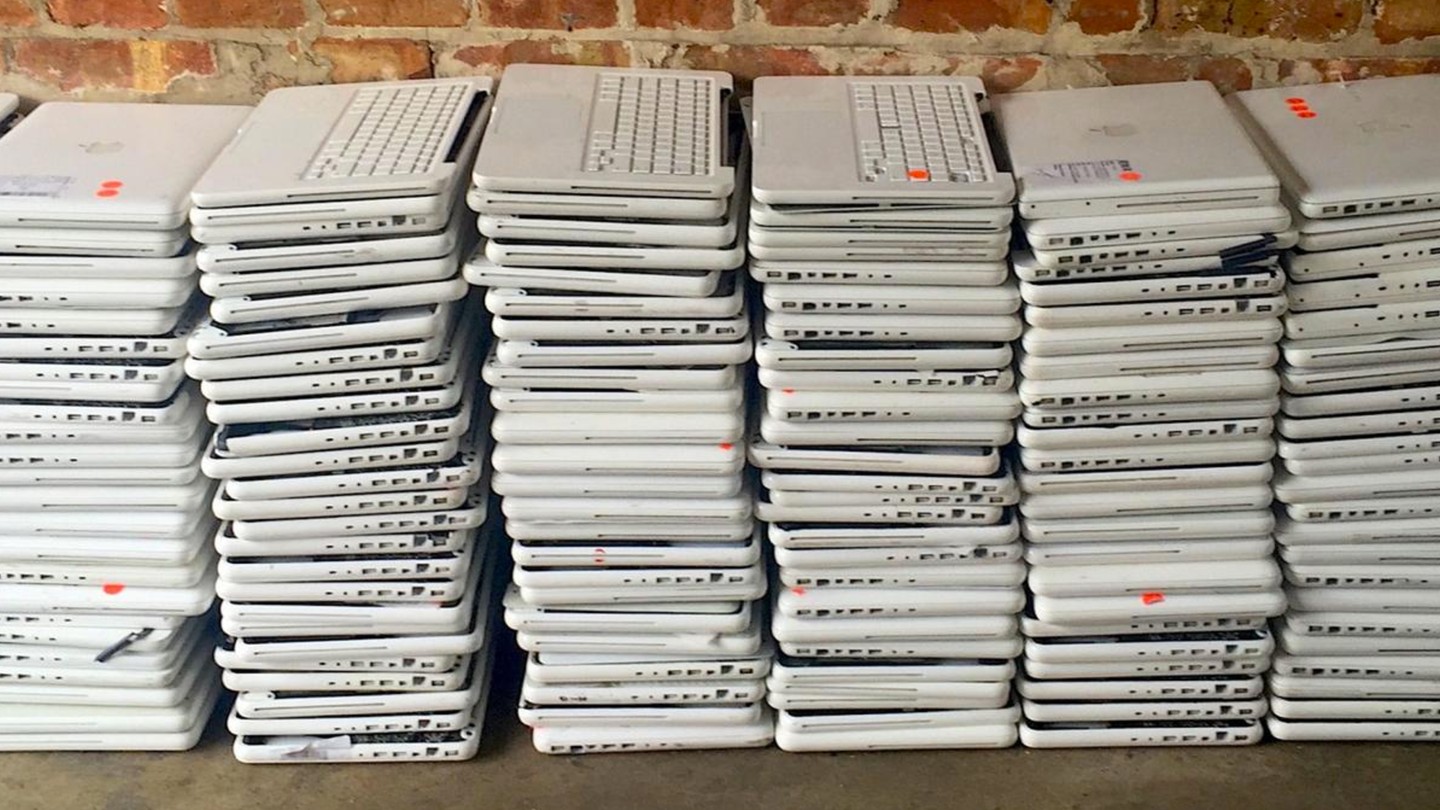
Apple rejects current industry best practices by forcing the recyclers it works with to shred iPhones and MacBooks so they cannot be repaired or reused—instead, they are turned into tiny shards of metal and glass.

"Materials are manually and mechanically disassembled and shredded into commodity-sized fractions of metals, plastics, and glass," John Yeider, Apple's recycling program manager, wrote under a heading called "Takeback Program Report" in a 2013 report to Michigan Department of Environmental Quality. "All hard drives are shredded in confetti-sized pieces. The pieces are then sorted into commodities grade materials. After sorting, the materials are sold and used for production stock in new products. No reuse. No parts harvesting. No resale."

Read more here.

Recycling is in trouble — and it might be your fault

636282189162779270-XXX-JJC16661

ELKRIDGE, Md. — If you are recycling at home, you are probably doing it wrong.

That is why a worker lunged to grab a garden hose off the conveyor belt at a Waste Management recycling facility here Wednesday before it got caught in a giant sorting machine. Such tangles frequently require the plant to stop the waste processing line and clean out the jaws by hand.

"Our contamination changes by the season," said Mike Taylor, the company's director of recycling operations here. Since it's spring, the facility is getting a lot of garden hoses. Around the holidays, they get broken strands of Christmas lights, another choking hazard for the sorting line. And all day every day there are plastic shopping bags (recyclable at a grocery store but not from a household), chunks of styrofoam, diapers, syringes, food-contaminated containers ... a nearly endless litany of things that residents throw into their curbside recycling carts figuring they are or ought to be recyclable. One worker grabs the remnants of a screen door off the sorting line while another snags a wire rack from a DIY shelving unit.

Many cities around the country will celebrate the 47th Earth Day on Saturday by highlighting their recycling programs, but the industry is grappling with a dual threat: The value of recovered waste products has plummeted over the past five years, and the amount of effort required to extract them has risen.

A study by Rob Taylor with the State Recycling Program in the North Carolina Department of Environmental Quality estimated that the average market value of a ton of mixed recyclable material arriving at a recovery facility in the state dropped from just over $180 in early 2011 to less than $80 at the end of 2015. That value has since rebounded a bit, Taylor found, to a little over $100, but it still leaves the industry struggling to extract profit from the millions of tons of recyclable material Americans throw away every year.

Read more here.

The Train Now Standing at Platform 3 is a Co-op?

Rob Hopkins spoke with Alex Lawrie about Go-op, a highly ambitious attempt to create the first co-operatively owned train operating company in the U.K.:

I come to this really as a frustrated rail traveller. As someone who is a regular user of the railways, but who always seems to end up in places that the rail network, radiating as it does out from London, fails to serve. I found myself in Somerset and I was just endlessly frustrated that I could see that train lines went from A to B, but no trains appeared to operate on them, unless, as I say, I wanted to go to London. Which sometimes I do, but often I do not.

I thought, "What is needed is for a train operating company that is a co-operative to start bringing ideas forward that meet the needs of people at the grassroots, and meet the needs of communities that have been isolated and forgotten about." We were able to get a little team together and we got a small grant from the Co-operative Group, bless them, and we started doing some early feasibility studies.

I suppose the first conclusions that we came to were that although there were some very romantic ideas out there about re-opening branch lines and laying new track and building new stations, the blunt honest truth was that that was going to be borderline impossible for us as a small group starting from scratch to pull off. That was too advanced. That we had to find some more manageable goal to work toward in the first instance.

To cut a long story short, we find ourselves in the present with a good credible route, from Taunton to Nuneaton, so that’s using that linking track through Melksham, it's using the little cord that links Swindon and Oxford. There is absolutely no convenient way at present to go from Taunton to Frome on a regular basis, from Frome to Swindon, no really easy way to go from Swindon to Oxford, or from Swindon to Coventry, and no very convenient way to go from Oxford to Nuneaton, or Oxford to Coventry. Bear in mind, Coventry is going to be one of the closest points to the high speed rail terminal for the north of England. And Nuneaton is on the west coast mainline. So these are really important places to be able to get to for all sorts of longer journeys.

It's quite a clever route. Really achieves a lot of things, and the plan is to operate it with one train every two hours, which is a modest starting point, and we've proved that 30 percent of the revenue that we generate on that route will be new travellers on the rail network. People who would otherwise be driving cars. The rest admittedly will be shifting from other less convenient trains to our train.

Read more here.

While a great idea, co-operative train company, personally I would rather see British Rail back as a national company, and why could it not be a co-op?

Affordable solar power is coming to low-income minority neighborhoods

Lower electric bills are the big attraction for financially stressed families

In the predominantly African-American neighborhood of Broadway Heights in San Diego, nearly half of the 192 homes have rooftop solar panels. Neighbor after neighbor talks about what they could now afford. They were paying $200 and $300 a month in electric bills. Now they’re paying zero to $50.

“Now I can get my air conditioner!” said Thresia Route, 62, an information technology administrator.

In Southern Homes and Gardens, an affordable townhouse cooperative in predominantly African-American Southeast Washington, 55 of 90 residences have rooftop solar panels. On-site manager Telana Felder calls solar “my best friend” to escape her former monthly bills of $150 to $200.

“Last month the bill was $4, then this month it was $14,” Felder said. “It was so low I said something was wrong, so I called. They said it was because I had credits from the solar.”

These are among the thousands of moderate- to low-income families and fixed-income retired seniors who are the vanguard in communities of color that are now enjoying solar power. Under a wide variety of state and federal policies and funding mechanisms, and under both nonprofit and for-profit business models, such families are changing the face of renewable energy, broadening the diversity of solar customers with respect to race and income.

Read more here.

Antifa, Black-bloc and other so-called Anarchists

by Michael Smith (Veshengro)

Antifa-BlackBlocAll around the “Western” world, at almost any kind of demonstration, we will see them, those black clad figures who go by whatever name they may chose, who do not just dress alike but act all alike as if they have been trained at the same “academy”, hellbent on causing mayhem and turning even the most peaceful demonstration into a riot.

They claim to be anarchists, anti-fascists, left-wing radicals, and more but are they? They would not recognize anarchism means if it would bite them in the proverbial and they are neither left, as in socialist or communist. They are the stormtroopers of the neo-liberal elite and they are funded and trained by various neo-liberal foundations, and one in particular.

Those so-called Antifa, Anarchists, or by whatever other name they may go, are not the friends of the people and neither of democracy, liberty and socialism. They are the complete antithesis of this. They are wearing a mask, and that not only literally, behind which they hide their true intentions and their true masters we do not know but masters they certainly do have, masters with lots of money, which they hand out freely to those doing their bidding, namely those black clad and masked agent provocateurs.

Those that believe that those Antifa, etc., are left and anti-fascists better wake up and that fast. They are not even left Fascists; they are Fascists, namely neoliberal ones and neoliberalism, together with neo-conservatism, form one side of the same coin, the other side of which is fascism.

© 2017