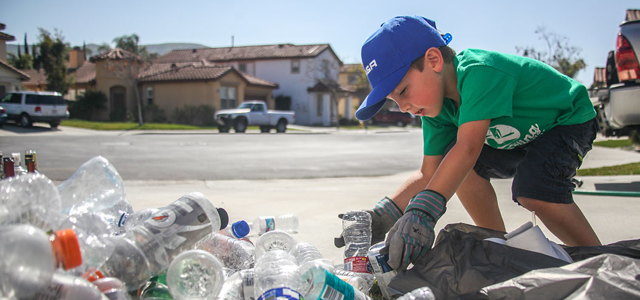
7-Jähriger wird Recycling-Idol

Mit 3 Jahren war Ryan das erste Mal auf dem Recyclinghof seiner Heimatstadt. Aus dem Hobby, Müll zu verwerten, ist ein großes Geschäft geworden. In den letzten Jahren hat der 7-Jährige 2,5 Tonnen Glas, Plastik und Aluminium gesammelt und damit über 10.000 Dollar verdient.

Orange County, Kalifornien: Vor vierJahren begann Ryans Recyclinggeschichte. Mit drei Jahren fährt er mit seinem Vater zum lokalen Recyclingcenter und ist beeindruckt, dass man mit Müll Geld machen kann, zugleich fragt er sich, wieso das nicht alle tun. Ryan hat eine Idee: Er verteilt Müllbeutel an die Freunde seiner Eltern und die Eltern seiner Freunde: Sie sollen Ihre Dosen und Flaschen sammeln und er bringt sie dann für sie zum Recyclinghof. Der Tatendrang des kleinen Jungen inspiriert die Menschen vor Ort. Mittlerweile sammelt er Glas- und Plastikflaschen sowie Aludosen in ganz Orange County.

Über 200.000 Dosen und Flaschen hat er bereits abgeliefert. Die 10.000 Dollar, die er mit den 2,5 Tonnen Wertstoff bisher verdient hat, möchte er fürs College sparen, oder für einen Mülltransporter, da ist sich Ryan noch nicht ganz sicher. Doch nicht nur für sich selbst sammelt er Geld. Auf seiner Website vertreibt er mittlerweile auch T-Shirts: Der Erlös geht zu 100 Prozent an des „Pacific Marine Mammal Center“.

Hier weiterlesen.

The myth of glass recycling

by Michael Smith (Veshengro)

Glass jars and bottlesThe great majority of people, I am sure, firmly believe that the glass bottles and glass jars, of which they so diligently remove the labels and then put out for the kerbside recycling pick-up are going to make new glass bottles and -jars. But this is a myths that needs busting.

The great majority of those items of glass recyclables does not go to some glass-works to be melted down into glass products again – some of it does get recycled in that way but the majority of it does not – but gets ground down to make basically that from whence glass is made, namely sand, in this case mostly for road building.

Instead of breaking up those bottles and jar when we generally put them into the recycling bin still being whole they should be, as bottles were until about 1980, returned and reused. The bottles from the dairies that still have doorstep deliveries still are being treated like that, at least for the moment.

As most glass jars have but a few different neck sizes – lid sizes – they could, like they were done during World War Two, also be going back for reuse. It would not take much to make people do that, for both bottles and jars. All that would be needed to have a deposit incorporated again in the price.

Unfortunately, it would appear, the political will is not there to do this (again) and I guess – OK, time for the aluminum hat – somewhere along the line new bottles are better for the economy – you see, we just have to make new stuff and consume it all the time otherwise the economy, according to government and economists, would fail – and reuse just does not fit into that equation.

There have been statements, some years back, from ministers of the British government actually claiming that such a system simply could not work in this country as it had never ever been used. I have no idea where they were during the years before 1980 to say things like that. Some may be too young to actually remember that time, maybe, but just maybe. Or they simply, as children, never collected glass bottles that had been tossed away by people top bring back to the shops for the refund money. Those from the rich background, as most of them are, probably never did this or especially never had to do that.

Recycling is not the answer to glass bottles and jar. Only reuse it. That is as long as they, obviously, are not broken. And in order to get to the reuse part of it we must bring in incentives for people to return such glass items and the system of deposit was that and would work again. It does in other countries, at least as far as bottles are concerned. In Germany there is even a deposit on plastic bottles and thus a great many of them go back, though they are not cleaned and refilled, that is to say reused, but go for recycling. But, obviously, this does not work in this country, as far as our politicians are concerned.

As with much of the recycling we are being sold a half-truth, one could almost say a lie. Much of the recyclables are, more often than not, actually landfilled because there is a lull in the market or the prices for them are considered too low. Few of the recyclables, glass may be an exception to a degree, are also not reclaimed and reprocessed in the home country but are shipped to China and countries in Africa. Most of it due to the fact that environmental protection laws there either do not exist or are much more lax than are those in the UK, the Eu and even the USA.

As far as glass is concerned no glass jars ever get near the recycling bin in my house. They are reused for all manner of things. Bottles, if I cant reuse them in any other way become woodworking scrapers, aka glass shave. For that I do have to smash them up, yes, and that glass can then, when it has done the job I need it to do, go to recycling into whatever.

Reuse is always better than recycling, and, as far as glass jars are concerned I reuse them for all manner of things, from drinking vessels to storage containers and vases.

© 2017

Metro Buses Converted Into Mobile Food Markets For Low Income Neighborhoods

Former bus turned mobile food market in Toronto, Canada

Back in 2010, the city of Toronto (in Ontario, Canada) decided to launch a program that converts old unused metro buses into mobile grocery stores called Mobile Good Food Markets, and ever since, they've been traveling across the Toronto metropolitan area selling affordable fresh food. They have been especially successful (and helpful) in low income neighborhoods.

How they got started?

It started out as a collaboration between FoodShare Toronto, the city of Toronto, and United Way Toronto. They came up with the idea to take an old bus and convert it into what is now a mobile food market.

Everything from broccoli and lettuce to apples and onions are available when the bus comes to town, twice per week. Because the costs involved by the bus have to be taken care of, food prices aren’t much lower than what might be found in a supermarket. However, at least families have the opportunity to purchase higher-quality, nutrient-dense food when the bus visits.

Read more here.

Hate having weeds in your garden? Here’s how cardboard can protect your garden

cardboard_gardening_for_weed_control_featured

If you’re struggling with weeds in your backyard, you’ve probably looked up and found nearly a million different ways to deal with them. If you think that you’re just stuck with these weeds, think again. There’s a new trend that’s been blowing up online and for good reason: cardboard gardening.

If you’ve never heard of cardboard gardening before, you’re not alone. Essentially, you’re putting down a decomposable shield between your garden and the actual soil of your backyard. Some weeds, even after being uproots or killed, can grow back thanks to leftover roots in the soil or other neighboring weeds. Cardboard gardening stifles the weeds while still allowing the plants you want to flourish.

Another great reason to cardboard garden is if you find yourself lacking garden space due to an oversized lawn. If you don’t want to tear out your garden, try just cardboard gardening right over it!

Let’s break it down.

1. Start with a thin layer of newspaper.

Now’s the time to dig into that pile of leftover newspaper you have gathering dust in your garage. Once you’ve cleared out the area that you want to cardboard, put down some newspapers first. These will help soak up water and create a primary barrier between your garden and the soil.

You’ll want to fold out each newspaper and layer about 5-10 pages per square foot. Make sure no area is too thin or too thick, as this will make the next step much more difficult.

Read more here.

Renewable energy will not support economic growth

by Michael Smith (Veshengro)

Renewable energy will not and cannot support perpetual economic growth, the way we have been doing it for so long, for too long, in fact. But this does not, actually, have to be a bad thing at all.

smallwind1The globalized consumer society has always been and will always be unsustainable anyway, and we might be happier without it. But unless we plan for the post-growth renewable future, and do this now, existing economic institutions may tend to shatter rather than adapt smoothly.

Industry, and its practices, as is the case today, requires large amounts of energy in the form of electricity and gas (not to mention water also often) and is not sustainable in in its current way. Solar, wind and small-scale water, cannot provide for such requirements. Thus a total and complete change of working practices is required and that also means a change in the attitude of consumers.

Oh, and while I am at it let me throw yet another rather large monkey wrench into the works and that is that electric vehicles, that is electric (battery-operated) cars, vans and trucks, etc., are also not going to make the grade. Aside from the fact that the “rare earth” and minerals required to make both vehicles and their batteries are close to running out the charging of large amount of electric vehicles by use of electricity from renewables just will not work. Aside from that a great majority of car and van users today – on a personal, not fleet level – use on-street parking and it just would not compute to run a charging cable to each and every car right across the sidewalk.

While battery technology may be improving in time making such vehicles more energy efficient and thus giving greater range and quicker battery charging times the restriction that will come about from a full transition and uptake – as must happen – of renewables will make the manufacture of both electric vehicles and batteries almost impossible if not even entirely impossible.

Renewables, and we must face this, and that despite the fact that we have no other option than to move over to renewables, cannot ever fulfill all the energy needs of today because (1) we simply waste too much of it and (2) many of the practices are far too energy hungry.

In the post-growth society (and economy) things will have to me done differently, made differently, and we will have to change many of our current ways and practices.

While this may mean a great deal of change and the need to adjust and acclimatize, which will take some time, considering that most of us have been living in this current way of things all our lives, it is the only way that we, as a species, and the Planet, can survive.

It will mean a reconsideration as to where we live and work, what we do for a living and where and how, and how we travel to and from work, and so on. Living miles and miles, in many cases ten, twenty or even more miles, away from our place of work and having to commute by car or, maybe, by rail just will not longer be an option.

Unless we want to continue with a “the devil may care” attitude destroying the Planet and our own source of life then we will have to change, and we will have to begin that change, that transition to a different way yesterday, or preferably the day before that. As that, however, does not compute it will have to be today and we cannot put this off to some time in the future. We must act now.

In order, however, to make this transition to a post-growth and post-carbon society and economy we must change society first of all into one where people and the Planet matter from the current one where profits come before everything. Not an easy task, I know, and especially not in view of so many people wanting everything for almost nothing and immediately.

In this new economy things will no longer, as they won't be able to, made by large factories but mostly, no doubt, by hand and thus prices will be higher but quality too will be much, much better and those products will then, once again, be made to last and be repairable, unlike currently where everything is made in such a way – built-in obsolescence it is called – that they break soon after the warranty expires.

Factories of the kind that we know today that are consuming vast amounts of energy and other resources we will not longer know in this new economy and society and to some extent it should also mean a return to making many things that we want and needs ourselves once again, as used to be the case a time past when things were similar to those at the threshold of which we stand today.

But this new society and economy where people and Planet matter and where exploitation of man and Nature will be a thing of the past will not come about on its own nor can we rely on the powers-that-be, but should not be, to bring it about. It is not in their interest and their capitalist cronies. We must do it. We must create it. So, let's get to it.

© 2017
DIY Rotating Canned Food System

DIY Rotating Canned Food System

Storing canned food in your kitchen cabinets is an inefficient use of space and you will often find old cans in the back that have been there for years. This easy-to-build shelf system will solve the problem by rotating the cans. The cost is a small fraction of the price of retail canned food systems. There are many variations, so modify the plans to suit your needs and abilities.

Read more here.

Port Macquarie residents promote sustainable living through thriving community garden

Ali Bigg standing in the Lost Plot community garden which she said was flourishing and encouraging sustainable living.

A community garden on the New South Wales mid north coast is thriving and playing a key role in promoting sustainable living.

The Port Macquarie garden called The Lost Plot was initiated by the Port Macquarie Hastings Council and started in April 2014.

It is now entirely managed by volunteers through not-for-profit organisation Port Macquarie Community Gardens.

President Ali Bigg said the garden was a vibrant space where community members could grow and harvest food together, as well as socialise.

"It's a beautiful space. It's a place for growing food but also for people to come and meet and gather, hold community events, learn new things, just hang out and have a good time really," she said.

Ms Bigg said the garden food was organically grown, and working bees were held twice a week for members who, in return for a small annual fee, were able to share in the garden harvest.

"It's a true community garden, rather than an allotment style garden," she said.

Read more here.

Ikea launches kitchen range made from recycled plastic bottles

The world's biggest furniture retailer Ikea has launched a new range of kitchen fronts made from recycled polyethylene terephthalate (PET) plastic bottles and reclaimed wood, eliminating the need for virgin oil-based plastics in the range.

In future, other Ikea products such as the REINSVOLL wardrobe doors, set to launch in August 2017, will feature the recyclable foil

The new kitchen fronts, listed as KUNGSBACKA, went on sale online and in-store this month. Ikea stated that around 25 half-litre PET bottles are used to make a plastic foil coating that covers and protects the wood kitchen fronts.

Ikea’s product developer Anna Granath said: “What we do at Ikea has a big impact on the environment due to the large quantities we produce so by using recycled materials, we can create products which are more environmentally-friendly and sustainable.”

“Our ambition at Ikea is to increase the share of recycled materials in our products so we are looking into new ways to re-use materials, such as paper, fibre, foam and plastic, so that we can give them a new life in a new product.”

Ikea claims that the use of PET bottles, which are recyclable but often end up in landfill, doesn’t compromise on the quality, design or price of the product. Ikea notes that 70% of all PET bottles are either sent to landfill or end up in the seas and oceans. Replacing the virgin oil-based plastics traditionally used also enhances environmental protection, the firm states.

Traditionally, corporate efforts to introduce PET bottles into portfolios has seen the products remain largely untouched, although attached with improved recyclability. Some of Procter & Gamble’s (P&G) flagship brands now incorporate new packaging, which is composed of up to 50% post-consumer recyclate (PCR).

Coca-Cola used recyclable PET plastic in 1991 and has since pledged to ensure that 40% of the PET it uses is made from recycled or renewable materials by 2020. In 2009, the company became the first beverage company to introduce PlantBottle, a plant-based bottle package, with more than 40bn rolled-out into circulation across 40 countries.

Positive momentum

In future, other Ikea products such as the REINSVOLL wardrobe doors, set to launch in August 2017, will feature the recyclable foil. All products consisting of the foil coating will come with a 25-year guarantee.

Ikea UK & Ireland’s business leader David Vine said: “The new KUNGSBACKA range is a start in turning everyday waste into beautiful furniture. Today, 90% of waste created in the kitchen is recycled but few think about the kitchen itself, we hope that the launch of this range will help people to think about the materials that are in their home furnishings and create a more sustainable home setting.”

It’s been a positive couple of months for Ikea, as it pushes ahead with its People & Planet Positive sustainability strategy. Backed by a new €1bn financial framework, Ikea revealed that it has almost trebled the sales from its 'sustainable life at home' products, which are designed to promote sustainable living to its customers.

The company also sent zero waste to landfill across all of its UK and Ireland facilities in 2016, achieving a 90% recycling rate in the process.

Source.

Pruning Old Apple Trees

Prunig Old Apple TreesIt’s the time of year to prune apple trees. We used to have an old orchard, and I loved renovating the apple trees there; it was amazing to see them springing back into life with renewed vigour. They must have been around 80 – 90 years old, so towards the end of their time, although pruning will extend their lives. This is one of the reason why orchards are such good habitats. Apple trees don’t last long, so there is always lots of dead and rotting wood around, with their attendant flora and fauna.

There are several reasons to prune, which you should bear in mind. Firstly, remove badly placed and rubbing branches, which can be an entry point for infection. Then think about increasing the light and air flow through the tree, to reduce the risk of infection and help apples ripen properly. I also cut out diseased wood rather than spraying a tree with fungicide to help biodiversity. You also want to manage the tree’s shape so it doesn’t blow over or risk losing major limbs in windy weather.

I was always told not to be frightened of taking too much off an old tree – up to 25% as a guide is fine – and to concentrate on taking bigger branches off to reduce the number of wounds. An old apple grower in Kent used to say a well pruned tree was one you could throw your hat through!

Read more here.

Beat the science – grow your own tomatoes!

Don’t wait for science to put the taste back into mass-produced supermarket tomatoes – grow your own at home!

Journalists are reporting a scientific breakthrough by a professor of horticultural sciences at the University of Florida.  Dr Klee says he’s found the answer to tasteless supermarket tomatoes and having sequenced the genome of nearly 400 varieties and identified 26 genes which are involved in the production of the unique tomato flavour, he’s planning to breed a better-tasting tomato.

Tomato Sweet Aperitif_TM use only copyright Thompson and Morgan_webThe research work has apparently taken years, but they could have just asked Paul Hansord, Thompson & Morgan’s Commercial Director, whose answer to bland-tasting shop-bought tomatoes is simple: grow your own!

Of course it’s clear that Dr Klee’s research is aimed at the bulk tomato growers who are paid by the pound (or kilo in Europe) to mass produce tomatoes for sale in supermarkets, but Thompson & Morgan maintains that those in the know have been growing delicious tomatoes with that traditional tomato taste for years.

Tomato Sungold_TM use only copyright Thompson and Morgan_web“It’s just so easy to grow your own tomatoes at home. All you need is a grow-bag, a sunny spot and a watering can”, says Paul Hansord. He also suggests adding a bit of tomato fertiliser and reading Thompson & Morgan’s top tips on growing tomatoes which help guide gardeners through the tomato growing process.

“There really is no fresher, more aromatic and naturally delicious taste than a home-grown tomato, picked from your own plant and still warm from the sun”.

Top-Tasting Tomatoes

For really fabulous tasting tomatoes, Paul recommends growing Tomato ‘Sungold’ F1 Hybrid and Tomato ‘Sweet Aperitif’. Both are available from http://www.thompson-morgan.com/tomatoes

Tomato ‘Sungold’ F1 Hybrid £3.69 8 seeds

Tomato ‘Sweet Aperitif’ currently 79p for 10 seeds – save £2.50

Based in Ipswich, Suffolk since 1855, Thompson & Morgan is the UK’s most successful horticultural mail order company. It is the only mail order seed and plant specialist to develop its own plant lines in the UK. Due to the continued success of its breeding programme, the company has introduced more species and varieties to the British gardening public than any other mail order company in the industry. Its product range includes an award-winning choice of seeds, young plants, bulbs, seed potatoes, onion and garlic sets, soft fruit and fruit trees, as well as an extensive range of gardening equipment and supplies.

This press release is presented without editing for your information only.

Full Disclosure Statement: The GREEN (LIVING) REVIEW received no compensation for any component of this article.