Showing posts with label woodland crafts. Show all posts

AUTHOR AND JOURNALIST ROB PENN TELLS US WHY BRITISH WOODLANDS ARE SO IMPORTANT

heathlandAuthor, journalist and TV presenter Rob Penn tells Grown in Britain what makes British woodlands so important

I am writing this at my new desk. Andy Dix, a local furniture maker, made it from an ash tree felled near my home in the Black Mountains, South Wales. It is both exquisite and functional. It would have been easier to go to IKEA, or buy a new desk on-line but I felt the need to make a point: the pleasure we take from things made from natural materials is an extension of the pleasure we take from nature itself. In a generation, we seem to have forgotten this.

I’m particularly interested in the European ash (Fraxinus excelsior). It is arguably the tree with which man has been most intimate in temperate Europe over the course of human history and it is now under serious threat. Ash has been used for wagons, ploughs and, of fundamental importance from the Iron Age until the middle of the 20thcentury, the rims of wooden wheels. The unique combination of vigorous strength, durability and elasticity meant ash was used to make tool handles, ladders, hay rakes, hop-poles, hockey sticks, hurley sticks, walking sticks, tennis rackets, looms, croquet mallets, crutches, coracles, cricket stumps, oars, cups, spars, paddles, skis, sledges, cart shafts, the best blocks for pullies, tent pegs, snooker cues, musical instruments, car bodies and even the wings of airplanes. This list is far from comprehensive, and ash is just one of our native tree species. Yet in just half a century, we have almost entirely forgotten how to use ash timber. Mention ash today and the majority of people think only of firewood.

Read more: http://www.growninbritain.org/rob-penn/

Is wood more hygienic than plastic?

by Michael Smith (Veshengro)

The lie about plastic

We have been told, including by the so-called experts, that plastic is by far more hygienic than wood as wood being a natural material. It is hardly surprising seeing how man-made materials and especially plastics of all kinds were and are feted as the be all and end all.

cutting-boardsAs far as plastic chopping boards and kitchen utensils are concerned it is very difficult indeed to get them to go moldy or such but does that really mean that they are better? No, for this is about the only advantage of a plastic chopping board compared to a wooden one. But then again you do not have to leave your wooden chopping board laying about in the damp. After you clean it you hang it up, as people used to do it.

As said, and here ends the good part of plastic as to chopping boards and other things in the kitchen. At least since Plastic Planet and other criticism as regards to plastic and especially the noxious chemicals that it contains that constitute a risk to health plastic has lost its celebrity status.

Wood is more hygienic and environmentally friendly

While it is true that there are some woods that should on no account come into contact with foods during chopping and cutting – as fruit bowls many of those will be fine – such as Yew and Horse Chestnut and a few others as they are poisonous most woods, however, have very high antibacterial and antiseptic properties and the leading one here is the much maligned Sycamore (Acer pseudoplantanus) and the heartwood of the Pine (Pinus silvestris). Other woods too exhibit the same antibacterial properties, though some to a somewhat lesser extent.

Wood, in comparison to plastic and also stainless steel, which often contains heavy metals such as chromium and nickel – that's why using cast iron for cooking pots and pans is so much better than anything else – is biodegradable in that wooden utensils can be simply put onto the compost heap at the end of their life to return to the Earth (or burned). Plastic, as we all know, does not biodegrade and cannot be composted (regardless of what industry is trying to tell us) and even stainless steel needs to be recycled in an energy intense process.

Some decades ago all the butchers and catering establishments have been forced, by law, to throw out all their wooden blocks and boards but some clever souls decided to carry out a test – so I have been told – and they dumped a culture of salmonella each onto a wooden butcher's block and onto a plastic block and left them overnight. The ones on the plastic one apparently had read Genesis and had gone forth and multiplied while the ones on the wood were all rather dead. Killed by the tannin in the wood and the fact that wood, be water absorbent, had deprived them of their growing medium, namely moisture.

There you have it. Not only does wood look good, it also is good, and especially in the kitchen. You can now, with a clear conscience, dig out those wooden chopping and cutting boards that you put way, clean them gently, sand them down and oil them and use them again.

© 2014

Wooden chopping boards vs. plastic

by Michael Smith (Veshengro)

For as long as the gods only know wooding cutting and chopping boards have been in use in domestic kitchens, the kitchens of the big houses and palaces, and in food business.

cutting-boardsIn the latter part of the 20th century, however, hygiene people insisted that wood was bad and that plastic cutting and chopping board and blocks must be used instead, especially in food businesses. All butchers' blocks and wooden boards – in commercial catering and food environments – were, by legislation, basically, replaced with plastic ones.

Plastic-Non-Slip-Cutting-BoardGreat claims of hygiene benefits, etc. were made until some food scientist decided to conduct a test using salmonella cultures on plastic – cleaned with disinfectant – and on wood – just scrubbed the old-fashioned way – and found the next morning that the bacteria on the wooden board were dead while the ones on the plastic one had gone forth and multiplied and were very much alive. It was then wooden boards and blocks were exonerated and deemed safe (again).

Some hardwoods – conifer softwoods are not suitable for use in the kitchen in any case because of their resin content – have higher anti-bacterial properties than others while some are not suitable at all due to tannins or saponins or other toxins.

Sycamore (Acer pseudoplantanus) – yes, the wood of the often as “non-native” maligned tree in Britain – is one of the best woods – if not indeed the best wood – for chopping and cutting boards, and other kitchen utensils in general, as it has the highest anti-bacterial properties. Also sycamore is extremely taste-neutral, as it lacks tannins.

Maple then follows in the list – in fact sycamore is in the maple (Acer) family – and then beech (Fagus sylvatica) and then Ash and Birch. This is at least the case in Northern and Central Europe. Woods in other countries and areas will be different ones, for sure, but wood will always be the best choice over plastic and that also with regards to the environmental footprint.

Hazel is also a good choice for treen products in the kitchen but, as predominately worked – or should be worked – in rotation coppice may not produce pieces of trunk large enough for chopping boards.

For thousands of years we have used wood in the kitchen and it is doubtful that anyone ever got sick from the use of it. From chopping and cutting boards over utensils for cooking to serving spoons and eating utensils everything was made of wood. Everyone used to, once upon a time, have his or her own personal wooden eating spoon. That was before the arrival of cheap metal utensils and the latter caused more grief than wood, especially the metals the use of which is not that good for us.

When you see the grooves you create by cutting on plastic and the depth of them you will realize how they can and will harbor all manner of nasties. This does not happen in the same way with good hardwood. Considering then that wood kills the germs more than likely with its anti-bacterial properties without the need of impregnating it with, as done with some many plastics, Microban, which is but Triclosan under another name. A chemical which is not all that good for us and in fact has been linked to the emergence of the super bugs.

Thus, chose wood over anything else for chopping and cutting boards, as well as for breakfast boards, in the kitchen. It is a safe and healthier choice than plastic. Ensure, however, that the surface is not lacquered, varnished or painted. It should be oiled only. You would not want bits of PU varnish or paint ending up in your food.

© 2013

Managing our woods

by Michael Smith, RFA, RFS, EcoFor

Britain, for thousands of years, had one of the finest woodland management systems; one that is hardly known and used elsewhere, namely coppicing.

Many misguided people honestly believe that woods and countryside need not to be managed but they do in order to be beneficial to both man and wildlife. And in Britain we have done a great job in doing so, especially as far as woodlands are concerned, for thousands of years. However, since World War Two neglect has set in and that for a number of reasons.

One being cheap imported wood, often tropical hardwoods, hazel beanpoles being replaced by cheap bamboo canes or even plastic ones, and the aforementioned misguided environmentalists what have insisted that trees and woodlands must remain unmanaged as 'Nature manages itself'.

But Nature does not manage Herself and besides we need and want wood for many things and if we replace handles of tools and utensils with plastic we are using a non-renewable resource, predominately oil.

Wood, properly managed, is a resource that continually renews itself and especially if and when the wood is harvested from sustainable coppice operations, and this wood is not just for firewood.

Firewood should never be the first consideration in woodland management when it comes to woodland products as there are many more things that can be created from the timber of much greater value, in more than one sense, than simply firewood or beanpoles.

Using the wood harvest for firewood should be the last resort although it is often seen as the primary one and as an easy way to make some income from a woodland. But it is far better to put the thinking cap on and ass a higher value to the timber produced by turning into other, longer lasting, products that into something that just goes up in smoke, literally.

In the first instance, when the management of a (long) neglected wood begun the timber may, unfortunately, be suited for little else than firewood or charcoal. But even in such cases of neglected woods thought come into play as to whether there is not more that can be made out of the timber; as in value-added products.

A large tree that is felled in the opening up of a neglected wood, be this sycamore, beech, ash oak, hornbeam, birch, or whatever, or a large stemmed coppice stool, has definitely and definitively more uses that just firewood. Marketing the wood, though, may at times be a chore and that is why many shirk from it.

Our woods produced the timber for all our needs centuries ago and most of those woods were managed as one or the other form of coppice. And those woods supplied all, or at least almost all, of our timber needs and they can again, or at least to a large extent.

The wood for tools and tool handles came from our woods, as did the wood for our kitchen- and eating utensils. Also for our fencing, our farm and garden gates, for our wattle and daub walls, and much more.

Today, because of the decline and lack of proper management of the British woodlands, small and large, the wood for our tool handles and sports equipment is, almost all, imported from abroad, such as American Ash for tool handles and cricket stumps, etc. And, despite the fact that English or British Ash is superior and preferred. Lack of wood from British sources, however, forces manufacturers to source timber from abroad.

The same, it has to be said, even applies to firewood and in 2011 Britain imported logs from afar afield as Poland, Western Russia and the Ukraine. Certainly not a sustainable way to go about it and that all because (no, not “because the lady loves Milk Tray”) in Britain the (proper) management of our woods has fallen by the wayside.

Time for a change and to bring our woods, small and large, privately owned or in public hands, including those in parks, back into production. Wildlife and the Planet will thank us for it.

© 2013

Beanpoles and pea sticks

Beanpoles and pea sticks are the mainstay of coppicing operations

by Michael Smith (Veshengro)

Not much that there can be said about beanpoles and pea stick, you may think, but that is where the error could lie.

Most of those poles for your beans today are imported bamboo and that certainly is not a sustainable way and neither does it benefit the local economy.

For almost an eternity gardeners and growers relied for beanpoles and pea sticks on the local coppice worker and both benefited. This can be the way again if we are just prepared to look at it from the right angle.

Beanpoles and sticks are one of the most reliable type of coppice product and can be harvested on a very short rotation coppice. Wood for other uses requires many more years to mature and thus beanpoles and pea sticks can be a reliable source of income to the coppice worker if the user is prepared too change his or her ways and go back to the ways it used to be rather than taking imported bamboo.

While it is true that bamboo is a fast growing grass – it is not a tree by any imagination despite the fact it can grow to forest size – it also has a long shipping distance. But, true, bamboo canes as plant supports generally weigh in cheaper than do coppice product beanpoles and pea sticks. However, on the sustainability scale bamboo canes and poles do not score very high because of their transportation costs, by way of fuel usage and thus emissions.

Locally cut wood products are by far more sustainable than anything else and they support local people and also, as coppice management of woods is a good thing, in creating biodiversity in the local environment even if one does not lend an actual hand in such biodiversity management schemes.

No more than forty years ago one would hardly see any bamboo canes in use as plant supports in vegetable gardens, allotments and even with commercial vegetable growers. Today, however, it is almost all that we do see and it is very rare indeed to see any locally grown and sourced beanpoles and other plant supports in use, which is rather a shame.

Beanpoles and pea sticks are the mainstay of most coppicing operations, closely followed, but larger wood is required for this, lump wood charcoal, and it is for that reason alone that we should, wherever possible, buy locally grown, cut and sourced plant supports and ideally directly from the woodcutter. That way he or she gets the money all and no middlemen take any cut.

Support your local woodland worker by buying his products and at the same time you are supporting the environment, biodiversity and the local economy.

© 2013

Coppice management

by Michael Smith, RFS, RFA, EcoFor

The management of woodlands and forests by means of coppicing – Niederwaldbewirtschaftung in German – is often, especially elsewhere in Europe, but also in the UK, only seen as a means to produce firewood and, maybe, beanpoles and some charcoal.

CoppiceHowever, the products that can be made by means of coppice management of woods and forests is far greater and, in fact, this was the way that we managed our woods and forests in Britain for thousands of years, and that very well and successfully. The woods and forests thrived under this case more and better than under any other form of management.

While other countries used this form of woodland and forest management also in the great majority of European countries it has now been abandoned, and has been thus already for many, many decades, in favor of a management that can be done with more mechanized means than coppicing.

The abandonment of coppicing in British woodlands has cost us dearly in terms of almost destroyed woods. In some areas the old coppice stools are almost beyond redemption and this could result in the loss of the entire or almost the entire wood.

The Forestry Commission never did much in that department but then it was not its brief. Its job was the production of timber for the mines and some other applications, including the war effort.

After the Second World War coppicing in our woods started to decline drastically and dramatically, much due to plastic products, and bamboo canes for beanpoles and such rather than wood.

Wooden tent pegs, which were one of the products from coppice woods, were replaced, even by military and scouts with metal and plastic and the same went for so many other products that were once produced from the wood from our coppiced woodlands.

Baskets, once woven from willow from coppicing and pollarding operations, and some other pliable woods, were replaced by plastic and the same for the trugs and such used by bakers and others.

Now, with the revival and renaissance of wood stoves firewood is in great demand but our neglected native woods cannot even provide a small proportion though they could provide it all (at current demand levels) if they would but be managed and we import firewood from as far afield as Poland and Western Russia. Not very sustainable at all.

The same goes for charcoal and most of the charcoal on sale in Britain today, and barbecuing is very much the in thing, also in restaurants, has to come from abroad and, in that case, it comes, primarily, from tropical hardwoods.

The problem, aside from an environmental one, is that that kind of charcoal does not, unlike the local one, light easily and requires chemical accelerants in the form of barbecue fire lighters. Those, however, leave a residue and not just on the coal.

Before the “advent”, so to speak, of coal, charcoal fired the Industrial Revolution in Britain and while it, probably, caused some deforestation, most of it was sourced from coppice operations.

Wooden spoons, spatulas and other wooden kitchen utensils were once made by local craftsmen from local coppiced timber but from a certain time onwards those were made from often imported woods by factories and now the great majority of those utensils are made, in fact, abroad, in the main, nowadays, in China.

In times past almost everything wood came from local woodlands, with the exception of some furniture, that were under coppice management and the woods and the craftsmen prospered.

Coppicing is one of the best ways to maintain the health of woodlands and this system of management has great benefits for the environment. In addition to this this old way of woodland management also will benefit the local economies and that is too very important indeed.

Our woodlands and forest must be brought back under this age old management system in order to restore them to health and for the local economy of craftsmen and -women to be revitalized.

Unfortunately misguided environmentalists for years have been working against this as they, having read only those books that back up their own beliefs, believe that no tree should ever be cut down, for any reason.

In fact many have vehemently campaigned and forced, for lack of a better word, local authorities, woodland and forest owners and managers to leave woods in their “natural” state or allow them too “return” to a wildwood state. But there is no wildwood in the British Isles and has not been any for at least a millennium or more. Not that that has interested those.

Woodlands, many of them state with venom in their voices, do not need to be managed. Nature will do it all itself. Which is a false notion as, alas, left to their own devices those, formerly managed woods, will decay and that will the end of them.

Coppice stools that are not cut will, in the end, break apart and that often almost simultaneously and thus the woods are no more but just a piece of useless “wilderness”.

As soon as brambles and bracken take over – and this is very soon if a wood is not managed – and then not controlled the loss of habitat follows in a very short space of time. Brambles and bracken stop light getting to the woodland floor, and the same is true when the woodland is not being thinned, and anything of value will die and be smothered. But, they keep claiming, Nature will manage it all itself; it just takes a while.

This is not true, however, and man has to keep the regime of management that our forefathers began many hundreds of years ago if we wish to retain those woods and forests.

For thousands of years we have managed our woodlands and forests, more often that not by coppicing, and they thrived under our care and if we want them to thrive again we must bring those woods and forests that have been neglected back under this management regime and it must be done now, before it is too late.

© 2013

The walking stick

by Michael Smith (Veshengro)

Walk softly and carry a big stick someone, I believe it was a US President, once said and this is a very valid adage.
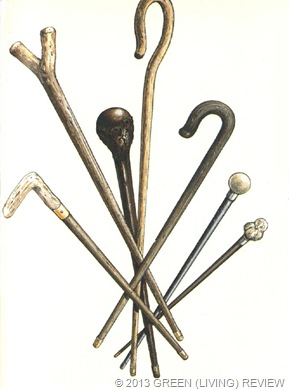
Walking SticksHowever, there is no need to look at a walking stick primarily as a weapon for defense, though that it sure is and very effective can be too ion this department.

Primarily the walking stick is a truly functional thing and well worth having at hand, pardon the pun. A good walking stick provides that extra bit of support we sometimes seek and need when crossing a raging torrent, traversing shale or loose soil on precarious slopes, or staggering homeward, late at night, from the pub. And, as said, a good walking stick is an excellent weapon when needed.

Walking sticks come in a many different styles, and are made from a wide variety of materials, though all the most pleasing and proper are crafted of close-grained woods. And among these many varieties, though, the penultimate walking stick to a great many is the honorable Irish walking stick, the true Shillelagh, usually crafted of Blackthorn wood, and with a fine hard knot of hardened root at the gripping end.

Having said this, however, with walking sticks, as with so many other things, it is often a case of horses for courses and other hardwoods are also great, and one of my favorites is Hazel, cut from well-managed coppice stools.

It does not have to be Blackthorn, not even for a Shillelagh. The fact is that many a Shillelagh in Eire was, in fact, not made from Blackthorn at all in the olden days but from Bog Oak.

Many people believed, falsely, and still do, that a Shillelagh was and is an Irish cudgel, shorter than a walking stick, crafted of blackthorn wood and featuring a knob or head of root wood.

It turns out that, what many have mistakenly called a Shillelagh all these years, and what is a popular tourist item sold in shops in the town of Shillelagh, after which the stick is named, was once a very popular weapon in 19th-century London. Very handy to have – but not something that the Irish would have used at that time, or earlier.

Their weapon of choice would have been a cane made from oak, blackthorn, ash or holly. An English writer who, on seeing an oak cane and knowing where it came from (the Shillelagh Forest in County Wicklow), coined the term Shillelagh. Eventually, it became synonymous for any Irish walking stick.

Blackthorn is looked upon by some as the best wood for the shaft of a cane. It is a very hard, close-grained wood and if growing from the trunk of the tree or bush, is covered with very sharp, vicious spines.

Those spines are also indicated in Blackthorn's Latin name of Prunus spinosa with the spinosa indicating the spines. Those spines are not thorns at all but hard wooden spines and other varieties of prunus also tend to have those spines.

The most notable features of blackthorn wood are the deep reddish-black bark and often numerous knots. The bark is left on for added toughness and often a metal ferrule is secured at the end opposite of the knob.

While at some time the wood was crafted green and thus to keep the wood from splitting during the drying process, sticks were often buried in a manure pile, or smeared with butter and placed in the chimney to cure, I would recommend, although that makes for harder work, to cut the shank long enough and to also leave wood on in other areas and allow the stick to season gently out of the wet but outside.

If you don’t have good walking stick yet and consider getting one, please bear in mind that the quest to find the right one may take some time.

If you can't find one to buy, though there should be enough good makers about, make your own. Keep your eyes peeled, and when the time comes the right stick will call for you and you will have found a lifelong companion.

Aside from being able to be used for defense a walking stick is, as earlier indicated, a walking aid, a third leg, that can and will give support in a variety of situations.

There are many other types of walking sticks than just the knobkerrie, as the Shillelagh one would be called in Southern Africa. There are thumb sticks, there are the ones with the bent handle, caned with antler and bone handles, and then there are the large staffs, akin to a quarterstaff, used by serious walkers and hikers and by wizards, such as Gandolf in Lord of the Rings.

All those sticks have their uses and the thumb stick, for instance, was, with a large(r) fork originally used as a rest for a musket and later a rifle and many a deer hunter still uses such a stick to rest his rifle for a more accurate and steady aim.

As far as a walking stick as aid in walking is concerned I would never ever put my trust in any of those non-wooden contraption called hiking sticks, hiking poles, or whatever their names and titles may be. They break, as I have found out testing a couple. Only a wooden stick can give the needed support. And as a defensive weapon those modern – often telescopic ones – are entirely useless. Again here only a wooden stick will do.

The shank should be chosen from sustainable managed woods, ideally coppice operations, making it thus a very green choice. Aside from Blackthorn, which coppices well and can be grown for the purpose of making stick, Hazel and Ash are also great choices as woods for sticks, whether you buy your stick or make it yourself. Other countries, obviously, have other woods for sticks, such as Osage Orange, Hickory, etc., in the USA, or Red Mopani Wood in Southern Africa, as an example.

My personal favorite wood from which to craft walking sticks, whichever kind, is Hazel and Ash, taken from coppice woods or as saplings when they are in the wrong place, as far as forestry operations are concerned, such as during thinning.

© 2013

Traditional woodland crafts are, once again, becoming a growth industry

Finally traditional woodland crafts are being regarded as valuable again and not before time

by Michael Smith (Veshengro)

They are a source of food, fuel, building materials, artistic inspiration and stress-relief, and thus is is hard to believe that the link between Britain's people and its woodlands was ever in any doubt. But it was so.

In the years following the Second World War, traditional woodland jobs such as wheel-wrights and bodgers, clog-makers and other woodland workers, were becoming obsolete as, apparently, synthetic materials were far more exciting to have in your home than boring old wood, and the Forestry Commission was busy creating Sitka spruce plantations.

We must, however, not forget that the Forestry Commission was never tasked with woodlands and woodland jobs and -crafts but to be producing timber for the mines and the trenches.

Within a generation, or less even, the relevance of woodlands to the daily lives of most people had become vague. Most products that ones were made of wood had become replaced by plastics and other synthetics.

However, and thank the gods, in the beginning of the second decade of the twenty-first century our woodlands are beginning to enjoy somewhat of a renaissance.

Our woodlands, which have existed for thousands upon thousands of years and have been managed for that time also, and that predominately through coppicing, need to ALL come under that management again as, otherwise, they will not survive.

In many parts of England there are old coppice woods that have not been worked now for fifty years and more and if they are not dealt with very soon and efficiently then those coppice stools that are presently standing will break apart and that will be the end of those woods.

The resurgence of interest in using woodlands and woodland culture has attracted a very diverse range of people, from hobby foresters and entrepreneurs to some very skilled crafts people but what they all need is support from us, as consumers, to buy their goods, and from government as those woodlanders are the custodians of our future.

The new woodlanders cannot make a living from the woods if we will not buy the goods that they provide, from firewood and charcoal to treen goods of all kinds.

The New Woodlanders include not just those of the ancient crafts but artists who work with wood, furniture makers, basket weavers and specialist producers, including those who make wooden jewelery, etc.

When Herbert Edlin wrote his classic book Woodland Crafts in 1949 he was sure that many of the crafts he had recorded would not survive the ravages of the Second World War and in a few cases he was right, but in actual fact many of the woodland crafts have persisted or been revived including the skills of chair-makers, turners, charcoal makers, basket weavers, horse-loggers and herb gatherers.

In economic terms, woodlands can offer income to both groups and individuals. However, the consumer has to get behind those that are reviving the use of our woodlands and buy the products that they produce.

A Forestry Commission survey found that nearly a quarter of people questioned had gathered wild plant material from woodlands or forests in the past five years (the most popular things to collect were berries, mushrooms and firewood).

While the economic recession may have taken the main focus off the environment and on to the economy, I believe that it will not halt the great resurgence in woodland culture that is taking place at present

In fact there may be more of us looking for ways of supplementing our income or diet, or reducing our fuel bills, by returning to the woods and there will certainly be more stressed-out folk seeking the solace they can find in the forest.

Over the years, ever since about World War Two, we have forgotten the value of our woodlands (and forests) other than, maybe, for recreation and this could be seen very much during the protests against the proposed “sell off” of Forestry Commission lands.

But, aside from the amenity value of the woods, we must come to understand, and especially many misguided environmentalists, that we must work and manage our woodlands once again in order for them to survive.

Coppice woodlands that are not being worked in the traditional way will die. It is as simple as that. The stools will become top-heavy and, literally, break apart and that will be the end of the trees and thus of the woods.

© 2012