Showing posts with label toxins. Show all posts

Roundup Weedkiller Found In 75% of Air and Rain Samples, Gov. Study Finds

The GM farming system has made exposure to Roundup herbicide a daily fact of our existence, and according to the latest US Geological Survey study its probably in the air you are breathing…
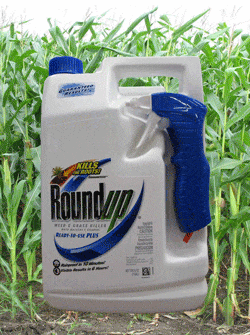
roundupA new study from the U.S. Geological Survey, accepted for publication online ahead of print in the journal Enviromental Toxicology and Chemistry, titled, “Pesticides in Mississippi air and rain: A comparison between 1995 and 2007,”[i] reveals that Roundup herbicide (aka glyphosate) and its still-toxic degradation byproduct AMPA were found in over 75% of the air and rain samples tested from Mississippi in 2007.

The researchers evaluated a wide range of pesticides currently being used through weekly composite air and rain sampling collected during the 1995 and 2007 growing seasons in the Mississippi Delta agricultural region.

The researchers discovered the following:

  • Thirty-seven compounds were detected in the air or rain samples in 2007; 20 of these were present in both air and rain.
  • Glyphosate was the predominant new herbicide detected in both air (86%) and rain (77%) in 2007, but were not measured in 1995.
  • Decreased overall pesticide use in 2007 relative to 1995 generally resulted in decreased detection frequencies in air and rain, but observed concentration ranges were similar between years even though the 1995 sampling site was 500 m from active fields while the 2007 sampling site was within 3 m of a field.
  • Mean concentration of detections were sometimes greater in 2007 than in 1995 but the median values were often lower.
  • Seven compounds in 1995 and five in 2007 were detected in ≥50% of both air and rain samples. Atrazine, metolachlor, and propanil were detected in ≥50% of the air and rain samples in both years.
  • Total herbicide flux in 2007 was slightly greater than in 1995, and was dominated by glyphosate.

According to the report, 2 million kilograms of glyphosate were applied statewide in 2007, or 55% of the total herbicide flux for that year (~129 μg/m2), leading them to state the high prevalence of glyphosate in air and water “was not surprising.”  Even though glyphosate was only tested in 2007, based on the 1995 figures on glyphosate use (147,000 kg state-wide) the researchers estimated that glyphosate added 3% of the total herbicide flux for 1995, or approximately 7 micrograms per centimeter (~7 μg/m2) per sample. This estimate, if correct, reveals that there has been an ~ 18 fold increase in glyphosate concentrations in air and water samples in only 12 years (1995-2007).   

Read more: http://www.cornucopia.org/2014/03/roundup-weedkiller-found-75-air-rain-samples-gov-study-finds

Why manchineel might be Earth's most dangerous tree

The manchineel tree, which ranges from South Florida to northern South America, is an endangered species. It's also a very dangerous species, dubbed 'little apple of death' by Spanish conquistadors.

The manchineel tree may be endangered, but so is anyone who messes with it. That's because this rare tropical plant, which offers deceptively sweet fruit, is one of the most poisonous trees on Earth.

Manchineels are notorious in their native habitats, the sandy soils and mangroves of South Florida, the Caribbean, Central America and northern South America. Many are labeled with warning signs like the one pictured below. But aside from poisoning the occasional conquistador, tourist and literary character, manchineel is relatively obscure considering it holds the world record for most dangerous tree.

The fruits are the most obvious threat, earning manchineel the name manzanita de la muerte, or "little apple of death," from Spanish conquistadors. Resembling a small green crabapple about 1 to 2 inches wide, the sweet-smelling fruits can cause hours of agony — and potentially death — with a single bite.

"I rashly took a bite from this fruit and found it pleasantly sweet," radiologist Nicola Strickland wrote in a 2000 British Medical Journal article about eating manchineel with a friend. "Moments later we noticed a strange peppery feeling in our mouths, which gradually progressed to a burning, tearing sensation and tightness of the throat. The symptoms worsened over a couple of hours until we could barely swallow solid food because of the excruciating pain and the feeling of a huge obstructing pharyngeal lump."

Read more: http://www.mnn.com/family/protection-safety/blogs/why-manchineel-might-be-earths-most-dangerous-tree