by Michael Smith (Veshengro)
 The problem with many so-called survival manuals, or survival handbooks, and even the book entitled “When Technology Fails”, is that they all too often looks at escaping into the wilderness in the event of this or that but that is really not a feasible option in most cases.
When it comes to a time after the failure of technology or collapse of the modern way the most important thing to have are good old-style hand tools and also the likes of pens and ink and typewriter plus the skills of the mid-to-late nineteenth century and the early twentieth century and not stone age ones.
While being able to make fire with flint and a good steel striker is most useful learning the making stone tools via flint-knapping is. However, a total and utter waste of time. The wheel has already been invented. No need to do it again.
An important thing to know, realize and understand is the fact, regardless what some authors and even instructors may try to tell you, that you cannot master all the necessary skills and thus you cannot go it alone.
Unless the manuals are survival after an accident or military scenario, as in escape and evasion, then, in the modern setting, most of them are all but useless.
When modern society collapses, as it one of these days will, through technology failing, you are not stranded out in the woods, the desert or the jungle but in your home town or -village and it is important that you know how to deal with such an event and its aftermath there in that setting.
And for that you do not need to know how to catch fish with your bare hands, make fire by rubbing two boy scouts, or was that sticks, together, or building a shelter from twigs and leaves, traveling by the stars or such. But other, a little more modern things and skills are required and especially how to make things for your daily life (from scratch and scrap) and how to grow food.
Many manuals recommend the acquisition of gold and silver coins, especially so-called trade rounds, in lieu of fiat currencies for after when the proverbial hits the fan, but, while such may have been accepted by people as barter currency in the German inflation period after World War One, the Russian famine of the civil war after the Bolshevik Revolution and to some extent even after World War Two in the war ravaged Germany today to believe that it will still work is an illusion. That that peddle the myths are but those who will also trade in those metals and coins.
The currency that you will need after the event is skills, and goods that people want, which you, hopefully, have the skills and tools to make, from materials available.
Also forget every notion that you can live self-sufficient in all things, far away in the wilderness. That too is an illusion and a myth peddled. Total self-sufficiency is not achievable. Even the Native Americans and other such peoples did not manage to do that and had to trade with others. It is especially unattainable for an individual.
However, around every corner there seems to be someone who talks about, writes about, and so on, about the goal of total self-sufficiency. What they do is to confuse self-reliance with self-sufficiency. Self-reliance is possible, self-sufficiency simply is not. Thus we must understand the difference.
You do not need stone age skills nor do we have to reinvent the wheel. The skills required for life after the event are those of the pre-industrial age. Flint-knapping, except for the making of flints for flintlock firearms, should this be necessary, is not a skill needed.
Don't waste your time learning skills that are of little to no use, especially not as barter. In the time after the event people want steel knives and not flint blades.
Skills will be your barter currency when the chips – literally – are down and the modern system, due to our over-reliance on vulnerable technology, has collapsed, that is to say being able to make things that you and others want and need.
But still many so-called survival manuals – and by the gods do I hate the term – and their authors advise all those stone age skills to learn as if we would have to reinvent the wheel and everything else after some collapse of society due to this or that event.
Stone age skills will not cut it as skills for barter currency and neither will they cut it as regards to you and yours being able to live a life that will sustainable by way of food and all that. The stone age is gone and we have even left the bronze age far behind by now and, as said, there is no need to reinvent the wheel, as we already know how to make it, and the same goes for many other things.
Should it really come to a deep crunch then, as far as firearms are concerned, for instance, we may have to resort, once again to muskets rather than rifles even, of the flintlock variety, as such can be relatively easily made, as car the blackpowder required to shoot them. And, as far as bullets are concerned, those can either be cast from lead but, in case of a musket, even pebbles can be used and will work for hunting.
The fact is, however, that the majority of us will live in the cities and suburbs, in towns, large and small, and villages, rather than in the boonies and the skills required are not those that are mostly advocated and “taught” in such manuals but the skills of the nineteenth and early twentieth century in way of growing food and everything else.
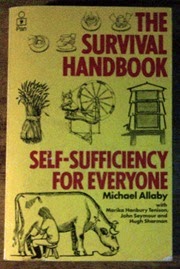
The great majority of those “manuals”, with bar one or two exceptions, seem to be almost copies of each other and have been ever since they first appeared. One of the only ones that are different is “The Survival Handbook” by Michael Allaby, that was co-authored by John Seymour and others, and published in 1975. And that is the only one, though it would be nice to have it updated a little, that you will ever need. Maybe, though, in addition to that also the “Complete Book of Self-sufficiency” by John Seymour. And then acquaint yourself with those skills thoroughly and don't just try to learn them when the chips are down.
© 2014