Showing posts with label book review. Show all posts

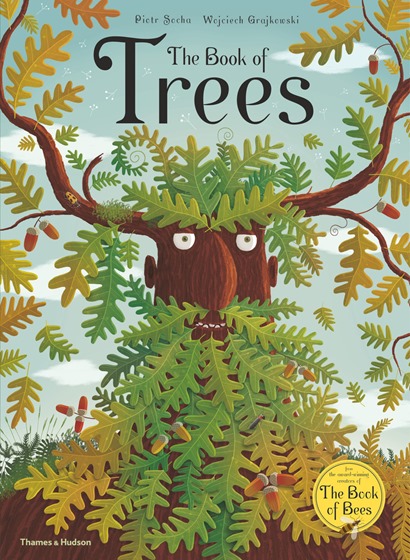
The Book of Trees – Book Review

Review by Michael Smith (Veshengro)

The Book of Trees
by Piotr Socha  (Author), Wojciech Grajkowski (Author)
Published by Thames and Hudson (Big Books) (13 Sept. 2018)
Hardcover: 80 pages
Size: 15 x 2.2 x 21 cm
ISBN-13: 978-0500651698

The Book of Trees

Why are trees so important? How many types are there? How do they benefit the environment and wildlife?

This book, by the award-winning author Piotr Socha, answers these questions and more, tracking the history of trees from the time of the dinosaurs to the current day.

A very nice and informative, and beautifully color-illustrated book, that should especially be interesting for younger readers.

The one thing that is, unfortunately, missing as far as the uses of trees and wood are concerned is wood for kitchen utensils and much more. But then there is only so much one can get into an 80-page book, even a large format one as this.

A well written – and well translated – book with an easy text that should appeal to any reader, but one that is also easy enough to be understood by younger ones and with great double-page illustrations.

A very nice and informative book.

© 2018

The Happy Hero – Book Review

Review by Michael Smith (Veshengro)

The Happy Hero
Solitaire Townsend
Published by Unbound October 2017
Paperback 192 pages £8.99
ISBN: 978-1-91158-639-5

  • The Happy Hero comes with a promise: that you can be happier and healthier by simply making a difference to the world around you.
  • Named ‘Ethical Entrepreneur of the Year’ in 2008, Solitaire Townsend is co-founder of ‘change agency’ Futerra and passionate about making sustainability so desirable that it becomes the normal.
  • Offering practical examples to get the individual started on helping to save the world, The Happy Hero shows us how we can combat even seemingly insurmountable global problems like climate change.

We have a world to save. Capes and masks are optional ….

Happy Hero cover

The Happy Hero reveals the secret of enjoying a better life and sets out the principles of how to feel good by doing good. Sounds simple, but where do you start? Everyday we are bombarded with fear and negativity from the media and have been trained out of happiness by these stories.

The Happy Hero offers a simple solution; stop worrying about the future and start making it better. Whether it’s donating blood, only eating meat at the weekend, buying vintage/pre-loved clothes or picking up litter in your street. Luckily, many of the changes we need to make to build a better world, we want to do anyway.

New research shows that trying to make a difference, even in the smallest ways, can extend your life, improve your relationships and even help you recover from a cold. So Superheroes, what are you waiting for …?

While I have enjoyed the book immensely at some points the author is a little out of touch with reality and as far as energy is concerned, oh my, oh my...

Nuclear fusion works and the Soviet Union has had a working nuclear fusion reactor – albeit a small one – operational in the 1980s. Not that the West took any notice of it and the idea. Why? Because they wanted to continue with fission reactors for one simple reason – reprocessing into weapons grade material.

As far as antimatter... dream on...

We have to reduce our energy consumption if we – as we must – want to ditch fossil fuels. Solar, wind, wave, and hydro (and the environmental impact of the large-scale ones of those, the dams, is far too great to continue with them) will not fulfill the needs of today, let alone those of tomorrow, in the way we are abusing energy.

On the other hand, though there is some CO2 emission as it is still being burned, there is methane gas. Methane digesters have been in use on Chinese farms ever since some time in the last century, if not before, and, theoretically, every farm, anywhere, could be self-sufficient in gas for heating and cooking, and with the help of also a rather old piece of technology, namely the Sterling engine, electricity. Add to that a few PV panels and a couple of “small wind” turbines – and a change in voltage used – and every farm could export to the neighborhood as well.

It is a well written book that also has a lovely story inside of it of a “Happy Hero” which, in itself, could become a book. Just a suggestion to the author for presenting the story in the form of a novel might get even more people reading about the matter in hand and being prepared to get involved in a direct way, whether small or large.

Solitaire Townsend has been trying to make the world a better place for nearly 30 years. As co-founder of Futtera she advises governments, charities and big brands like Danone and Nike on ways to solve social and environmental problems. With offices around the world she admits that making the world a better place was a damn good business plan. Solitaire was recently Chair of the UK Green Energy Scheme, a member of the United Nations Sustainability Lifestyles Taskforce, and a London Leader for Sustainability. Her master’s degree in both Shakespeare and Sustainability are put to good use in The Happy Hero.

© 2017

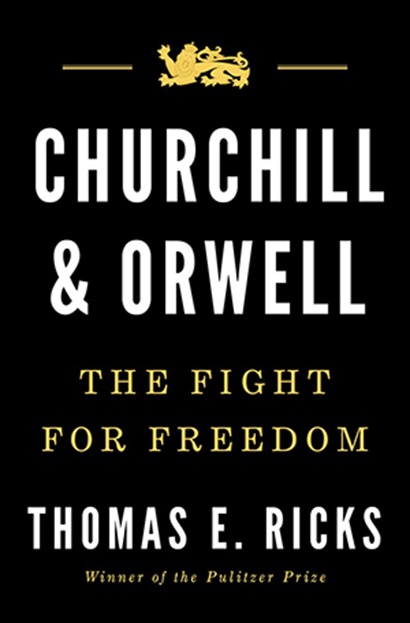
Churchill & Orwell – Book Review

Review by Michael Smith (Veshengro)

Churchill & Orwell – The Fight For Freedom
by Thomas E. Ricks
Published 1st June 2017
Royal Hardback, £25
352 pages, with 26 b/w photographs
ISBN 9780715652374

9781594206139_ChurchillAnd_JKF.inddLiberty and truth have never been so topical. In an era when belief and freedom are being questioned, and increasingly challenged, the figures of Churchill and Orwell – those two exemplars of Britishness who preserved individual freedom and democracy for the world, through their far-sighted vision and inspired action – loom large, casting a long shadow across British culture and politics. This new, overarching work by the #1 New York Times bestselling and Pulitzer Prize-winning author Thomas E. Ricks explores their extraordinary, epoch-defining lives in detail.

Churchill and Orwell, the two great thinkers who indelibly marked post-war history, are titans of their age, each standing in political opposition to the other, but each committed to the preservation of freedom. However, in the late 1930s they occupied a lonely position: democracy was discredited in many circles and authoritarian rulers, fascist and communist, were everywhere in the ascent. Churchill and Orwell had the foresight to see clearly that the more salient issue was human liberty – and that any government that denies its people basic rights is a totalitarian menace and has to be resisted.

Churchill and Orwell proved their age’s necessary men. The glorious climax of Churchill & Orwell is their drive in the 1940s to triumph over the enemies of freedom. Churchill may have played the larger role in the defeat of Hitler and the Axis, but Orwell’s reckoning with the menace of authoritarian rule in Animal Farm and 1984 (which Churchill admired so much he read it twice) would define the stakes of the Cold War for its 50-year course, and they continue to inspire to this day.

With Orwell’s 1984 at #1 on Amazon and so many other bestseller lists and the intricacies of freedom in national and international politics thrust into the limelight once more, Churchill & Orwell elucidates the extraordinary men behind a victory hard won, and as important to our lives today as it ever has been.

‘If liberty means anything at all it means the right to tell people what they do not want to hear’ ~ George Orwell

‘We seek only the right of man to be free; we seek his rights to worship his god, to lead his life in his own way, secure from persecution’ ~ Winston Churchill

Thomas E. Ricks is the bestselling and award-winning author of The Gamble, The Generals, and the no. 1 international bestseller Fiasco – ‘the most authoritative account of how the Bush administration and the US Army created a disaster in Iraq’ (Max Hastings, Sunday Times). He is a former writer for the Washington Post and the Wall Street Journal, and has covered military operations across the globe. He now contributes to the New York Times, Washington Post and New Yorker, and has appeared on the BBC, Sky News and in the Guardian and other UK press. He is also contributing editor at Foreign Policy magazine, for which he writes the prize-winning blog The Best Defense.

Today probably more than ever Orwell's books “Animal Farm” and “1984” are important. In “Animal Farm” we find the idea that all are equal but some more equal than others and this is exactly how the neoliberals operate today while “1984” presents us with the nightmarish scenario of an all pervasive totalitarian surveillance state. While it is claimed that Orwell was aiming at the Soviet Union of the day with it today it more appears like a scenario that we are sleepwalking into right this very moment in our neo-liberal capitalist societies. Neo-liberalism is but one side of the coin the other side of which is fascism.

While in their day Churchill & Orwell, especially the latter, were concerned with the rise of totalitarianism that is to say Hitler (& Stalin), today totalitarianism is on the rise again in the guise of neo-liberalism.

Personally I do believe that Orwell may have been mistaken as to Stalin – or why would Stalin still be loved by the Russian people today – and much if not indeed all of what may have happened was more due to Stalin's lieutenants rather than Stalin himself and he, Stalin, may have trusted his lieutenants far too much than was good.

When the author praises the likes of Solzhenitsyn and Lech Wałęsa so much as change makers he is either not aware of who and what they were or is mislead or otherwise confused. Both were not mere dissidents but paid agents of the Western intelligence services, and the same goes for Václav Havel. His name best be not mentioned to many young and not so young Czechs today.

This is a book for anyone interested in politics, especially how today's neo-liberalism is headed towards a totalitarian system, by increments in such a way that most people do not even realize it and call anyone pointing this out conspiracy theorists.

© 2017

Growing Self-Sufficiency – Book Review

Enjoy chicken, eggs, fruit, veg? A simple way to grow your own

Review by Michael Smith (Veshengro)

Growing Self-Sufficiency
Realize your dream and enjoy producing your own fruit, vegetables, egg and meat.
By Sally Nex
Published by Green Books September 2017
240 pages, paperback, 255mm x 205mm
ISBN: 9780857843173

Growing-Self-suffiencyGrowing Self-Sufficiency is a practical and inspirational guide for both the beginner and the experienced gardener. It explains how you can enjoy the satisfaction and pride of providing food for yourself and your family, whether you have just a small balcony or back yard, a large garden, or a homestead or smallholding.

Learn how to:

  • Enjoy fresh and tasty vegetables in season
  • Grow delicious fruit for eating all year round
  • Produce your own chicken, eggs and lamb, guaranteed free from harmful chemicals and additives
  • Preserve your produce – from freezing and drying to making jams, chutneys and pickles
  • Make your own drinks: juices, cordials, cider, wine and liqueurs
  • Grow medicinal herbs and make your own herbal remedies
  • Provide more food from your plot than you ever thought possible!

If you ever feel a pang of guilt as you look at the label on your food, realizing that it has traveled thousands of miles to get to your dinner table, then Sally Nex’s Growing Self-Sufficiency will inspire you to make the change and shrug off of the type of 'salad crisis' we had this winter when shop shelves were bare and produce was rationed.

But not only have your fruit and vegetables from abroad traveled long distances. Even the “fresh” fruit and vegetables that you buy at the greengrocers and which do come from the UK have first been heading from the farm to the large wholesale markets and then, via some other buyers, to the greengrocers in your city, town or village, even if the fruit and veg have been grown virtually next door. That is the way the market operated, unfortunately.

Then there is the thought of the additives that keep vegetables artificially fresh for so long. Now think how much healthier you will be and how much needless pollution you will prevent by eating the most local of food, namely that that you have grown yourself.

Sally’s unique three pot method will guarantee you a supply of tasty, inexpensive home-grown food throughout the year. Not just helping to save the planet, it will help to save money too and Sally has plenty of tips on how you can feed your family at only a fraction of the cost. She explains how you can:

  • start a vegetable plot on your balcony
  • create a herb garden on your windowsill
  • grow a mini orchard in pots

This book deals with about every aspect of growing and raising your own food, as well as preserving the harvest, collecting seeds, etc.

The 240 page are jam packed with information on every aspect of home grown and the advice about growing in containers should be of interest to all those that do not have much of garden space, by way of ground in which to grow things.

Personally I almost exclusively garden in containers though my containers are all kinds of things, from tree pots and tubs of various sizes, all the way up to shopping carts, and everything else in between, such as window boxes, hanging baskets, and any other kind of receptacle that can be repurposed into a growing container.

"Taking control of your own food is one of the easiest ways to tread lighter on the earth: as easy, in fact, as planting a seed." Sally Nex

Sally Nex has been feeding her family with home-grown fruit, vegetables and preserves for the last 20 years or so, as well as eggs from a motley gaggle of hens and more recently, lamb from her small flock of rare-breed sheep.

It all started with a few beans in a concrete handkerchief of city garden in London, but an allotment, job change, house move and several rented fields later, it's probably true to say the 'hobby' is well out of hand.

In 2006 she left 15 years as a journalist on BBC radio, television and World Service to devote her time to horticulture. She is qualified in horticulture to RHS Level 3, and has a planting design diploma from Capel Manor College. Sally now writes, teaches and gives talks about veg growing and self-sufficiency all over the country and is a regular writer and columnist for BBC Gardeners' World Magazine, the RHS journal The Garden, Grow Your Own, and The Guardian.

As far as self-sufficiency is concerned we all have to bear in mind though that, to all intents and purposes, no one can ever be truly self-sufficient in all things, and that includes growing food.

© 2017

The Scent of Time – Book Review

Review by Michael Smith (Veshengro)

The Scent of Time cover_Blog

The scent of time
A Philosophical Essay on the Art of Lingering
By Byung-Chul Han
Published 1st September 2017 by Polity Books (Part of Wiley)
Paperback 146 pages
Price: £9.99
ISBN 9781509516056

In his philosophical reflections on the art of lingering, acclaimed cultural theorist Byung-Chul Han argues that the value we attach to ceaseless activity is producing a crisis in our sense of time. The hyperactivity which characterizes our daily routines robs human beings of the capacity to linger and the faculty of contemplation. It therefore becomes impossible to experience time as fulfilling.

Han argues that we can overcome this temporal crisis only by relearning the art of lingering. For what distinguishes humans from other animals is the capacity for reflection and contemplation, and when life regains this capacity, this art of lingering, it gains in time and space, in duration and vastness.

Drawing on a range of thinkers including Heidegger, Nietzsche and Arendt, Han argues that we can overcome this temporal crisis only by relearning the art of lingering. For what distinguishes humans from other animals is the capacity for reflection and contemplation, and when life regains this capacity, this art of lingering, it gains in time and space, in duration and vastness.

Byung-Chul Han is a Korean-born Professor of Philosophy and Cultural Studies who teaches at the University of the Arts in Berlin. He is the author of more than 20 books. Polity has committed to translating his work into English, and The Scent of Time will shortly be followed by Saving Beauty, which also publishes in Fall 17, and other titles in 2018.

While the notion of this book about the need for deceleration of our lives is good and true the book itself is very much a serious philosophical work that is not something for the reader looking for a how-to approach. It is also rather heavy reading so not s book for anyone thinking to get a light read for bedtime.

Many of the points made are extremely valuable and important though it would have been good if G-d would have been left out of the discussion. Alas, time and again the author harps on about G-d in the book.

Notwithstanding the above our lives have become far too hectic and fast and we seem to want to go faster and faster still. In doing so we miss the entire point. More productivity say the capitalists, more growth, more experiences. But what for? For our own sake and for that of the Planet we need to slow down life and everything that goes with it.

© 2017

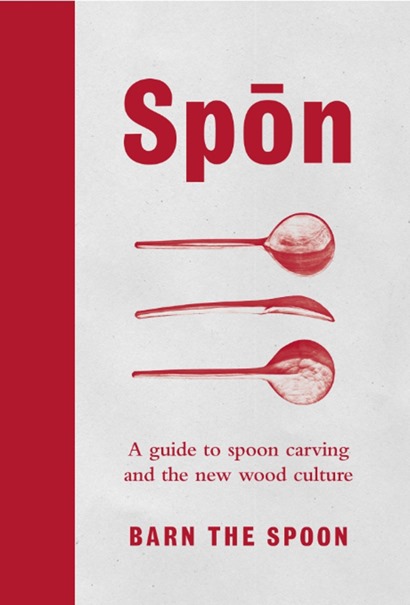
Spōn by Barn the Spoon – Book Review

Review by Michael Smith (Veshengro)

Spon coverSpon: A Guide to Spoon Carving and the New Wood Culture
by Barn the Spoon
224 pages, Hardcover, 16.5 x 2.2 x 23 cm
Published by Virgin Books (25 May 2017)
Language: English
ISBN: 978-0753545973
Price: £20.00

I was send this book by the publishers upon my request having just learned of the publication of it. Knowing of Barnaby Carder, better known as Barn the Spoon, I was most interested to have a look at it and I was in no way disappointed.

The book itself is a spoon carving guide but also introduces the reader to the new wood culture, or wood renaissance, and that being right up my street being a forester by original trade, and a carver of wooden things, including spoons as well.

Spōn is not really a technical manual like, for example, Willie Sundqvist's 'Swedish Carving Techniques', but instead takes the reader through a personal journey that Barn himself has taken, though it does give the reader many instructions, hints, and tips.

In his book Barn the Spoon explains to the reader the how and why as regards  to certain woods, tools, and techniques that he has found best suited for carving usable spoons and he then explains it all in more detail and shows the reader some of his favorite spoon designs to try.

Aside from that he walks the reader through every aspect, from choice to tools and how to keep them sharp and well maintained. Personally, though, I have different ways of sharpening knives, including hook knives and I believe that too much emphasis is placed on certain ideas, such as the supposed Scandi grind not having a secondary bevel. But I have only been a professional knife grinder for almost my entire life and have never encountered such a grind, not even on Scandinavian knives.

Spōn is a lovingly written book, with many color illustrations, that is full of the passion of someone who really appreciated wood and its properties and what can be made from it, though Barn mostly touches on wooden spoons only.

As a Romani-Gypsy by birth I very much enjoyed and appreciated the fact that the “Roma Spoon”, as Barn calls it, the traditional one of the Roma of Romania, in included. It is more a serving spoon that for any other purpose; the eating spoons are often different.

But that spoon, however, is only one of many different Romani spoon designs that used to be and are still carved by Gypsies in Eastern Europe (and beyond), such as by those in Poland where the bowl is the egg shape, reversed, and not as pronounced in the reverse.

In Russia the Romani carve spoons that are akin to those of the Doukhobors which are similar to the Welsh Cawl Spoon though without the pronounced crank in the handle and a handle that is almost round. But I digressed.

As I said before, Spōn is not really a technical manual but a book that, while teaching the reader about spoon carving, leads you more on a personal journey of the way the author does things and why and also introduces the reader at the same time to the new wood culture, or wood renaissance. I hope that readers will discover the joy of carving spoons and other treen objects from reading this book but also be encouraged to connect without our woods and trees and to value the handmade wooden kitchen utensils and such like. Handmade goods are so much different to factory and machine produced and thus are also higher priced. A good wooden spoon is not tuned out in five minutes flat. It often takes hours and the price does then often not even reflect an hourly minimum wage. Let that sink in.

A very good book that I can most certainly recommend.

© 2017

The End of Plenty – Book Review

Review by Michael Smith (Veshengro)

The End of Plenty
The Race to Feed a Crowded World
by Joel K. Bourne, Jr
Published by Scribe UK September 2015
400 pages Paperback
Price: £16.99
ISBN: 9781925228120

the_end_of_plenty_0-1An award-winning environmental journalist introduces a new generation of farmers and scientists on the frontlines of the next green revolution.

When the demographer Robert Malthus (1766-1834) famously outlined the brutal relationship between food and population, he never imagined the success of modern scientific agriculture. In the mid-twentieth century, an unprecedented agricultural advancement known as the Green Revolution brought hybrid seeds, chemical fertilizers, and improved irrigation that drove the greatest population boom in history – but left ecological devastation in its wake.

In The End of Plenty, award-winning environmental journalist Joel K. Bourne Jr. puts our race to feed the world in dramatic perspective. With a skyrocketing world population and tightening global grain supplies spurring riots and revolutions, humanity must produce as much food in the next four decades as it has since the beginning of civilization to avoid a Malthusian catastrophe. Yet climate change could render half our farmland useless by century's end.

Writing with an agronomist's eye for practical solutions and a journalist's keen sense of character, detail, and the natural world, Bourne takes readers from his family farm to international agricultural hotspots to introduce the new generation of farmers and scientists engaged in the greatest challenge humanity has ever faced. He discovers young, corporate cowboys trying to revive Ukraine as Europe's breadbasket, a Canadian aquaculturist channeling ancient Chinese traditions, the visionary behind the world's largest organic sugar-cane plantation, and many other extraordinary individuals struggling to increase food supplies – quickly and sustainably – as droughts, floods, and heat waves hammer crops around the globe.

Part history, part reportage and advocacy, The End of Plenty is a panoramic account of the future of food, and a clarion call for anyone concerned about our planet and its people.

Right, so much for the press release from the publishers now to my take of this book.

I do not really care how many positive endorsements a book receives I always will give my own take on a book the way I see it.

The first comment I will have to make, as regards to the Paperback version of this book for the British market and that is that the binding of the cover is very poor and came almost undone within a few times opening it. But that is a physical one and not necessarily brings the book into disrepute.

Now to the books itself, other than the physical attributes. While it all started out in an interesting way it became soon evident (which was this was headed) that, aside from the fact that the author appears to believe that the world's population must be reduced and also seems to see the forces of the capitalist market to be the be all and end all.

When the author arrived, after initially giving the so-called “Green Revolution” a thumbs down, where I agreed with him entirely, at advocating genetically-modified and genetically-engineered seeds with the claim that that genetic engineering of seeds has been done by farmers and seed breeders for thousands of years I was about too hit him. He either on purpose or through lack of knowledge confuses genetic-modification and -engineering with selective breeding. The latter is not genetic modification or -engineering, as no genes from other organisms are being “injected”, as is the case with genetic-modification and -engineering. At this point an otherwise relatively good book turned into trash.

This was then followed by his almost promotion of glyphosate (Roundup), now regarded by many agencies as carcinogenic, and even toxic, the author's credibility hit rock bottom on page 231 in the UK paperback version of this book and it was at that page that I closed the review of this book and added it to my collection of trash books. It must be obvious even to the most blind that a product that is, basically, a diluted form of the nefarious warfare agent “Agent Orange” cannot be considered safe in any way, shape or form. Not that Monsanto would admit that that is what their product Roundup, aka glyphosate, is.

Various agencies around the globe, including in the US, have marked Roundup and thus glyphosate, as a dangerous to people and the environment and we best took note of that, especially in light of the fact that many of the same agencies, for years, refused to do so.

On the other hand, when it comes to feeding the growing population of this Planet the UN and others have stated very clearly that we must get away from industrial agriculture and large farms that damage soil and environment and return too small farms and organic farming. The Russian dachas – the, what some call weekend homes, which most of them actually are not – with their small acreages, often less than a hectare, are what is supplying 80% of all fruit and vegetables to the Russian market and population. Imagine what could be done if more of those small farms and market gardens would be in existence.

It is for that reason that the Russian President and parliament are drafting a law that will give every Russian the right to between one and six hectare of land to work, with financial help or even outright grants to build a home there on that land also, to grow food for themselves and their families and for sale on the markets.

We can feed the world, especially if we all would change to a more plant based diet than consuming meat at the rate that most countries are doing, and those fruit and vegetables could be grown on smallholdings rather than large scale industrial farms that pollute the Planet in an organic way. But it would mean a complete change of system, including political system, and as long as capitalism is permitted to rule the market in foods it is hardly going to happen, for it would also require a real land reform.

© 2015

How to Thrive in the Next Economy – Book Review

Review by Michael Smith (Veshengro)

How to Thrive in the Next Economy: Designing Tomorrow's World Today
by John Thackara
First published by Thames & Hudson, August 2015
192 pages, Hardback, 23.40 x 15.60 cm
£18.95
ISBN 9780500518083

HowToThriveInTheNextEconA visionary yet practical guide to building a more sustainable future, by one of the leading voices of the environmental movement today. Marvelling at the power of small actions to transform the bigger picture, Thackara believes that a great transition is under way. It’s the end of one civilization – but the birth of another

Is there no escape from an economy that devours nature in the name of endless growth? John Thackara’s answer is a rousing ‘yes, there is!’ Drawing on a lifetime of travel in search of real-world alternatives that work, he describes in this book how communities the world over are creating a replacement economy from the ground up.

Are there practical solutions to the many global challenges – climate change, poverty, insufficient healthcare – that threaten our way of life? Author John Thackara has spent a lifetime roving the globe in search of design that serves human needs. In this clear-eyed but ultimately optimistic book, he argues that, in our eagerness to find big technological solutions, we have all too often ignored the astonishing creativity generated when people work together and in harmony with the world around them.

Each chapter is devoted to the creative ways people in diverse contexts tackle timeless needs: restoring the land, sharing water, making homes, journeying, growing food, designing clothes, caring for each other. From Bali to Brazil, as well as Delhi, London, and California, Thackara writes of soil restorers and river keepers, seed savers and de-pavers, cloud commuters and e-bike couriers, care farmers, food system curators, watershed stewards, citizen foresters, money designers and more.

Drawing on an inspiring range of examples, from a temple-led water management system in Bali that dates back hundreds of years to an innovative e-bike collective in Vienna, the author shows that below the radar of the mainstream media there are global communities creating a replacement economy – one that nurtures the earth and its inhabitants rather than jeopardizing its future – from the ground up. Each chapter is devoted to a concern all humans share – land and water management, housing, what we eat, what we wear, our health, how and why we travel – and demonstrates that it is possible to live a rich and fulfilling life based on stewardship rather than exploitation of the natural environment.

Read together, these encounters add up to a joyful new story about what an economy is actually for. In place of an obsession with stuff, money and endless growth, this book describes social practices that cherish all-of-life, not just human life.

“How to Thrive in the Next Economy: Designing Tomorrow's World Today” is a most interesting book with lots of examples of positive changes already afoot of the next, the new, economy and of the new society. It is a good guide to understanding that we are not alone in our endeavors as often we feel rather alone in what we do in our small efforts to change the world for a better one. But, hey, we are not alone and if we but all knew that we existed and found a way of sharing ideas and cooperating things indeed would change.

However, what is missing are the true grassroots projects, the small ones, and happenings, including the Russian dacha system and especially that of the Familienlandsitz Movement based on the Anastasia books; plus others. But then again it is not really possible to list everything that is happening in a book unless one intends to create a large volume that no one is going to really read.

Government is not going to give us the changes that we need to bring about the new society that is needed, we must do it ourselves and create the framework that can take over when the old is dismantled.

On the other hand this is one of the few books only that tells me that I am no delusional when I say, for instance, that renewables are not going to cut it as far as the growth economy and the way we do things presently are concerned. We need a serious reevaluation of how we do things if we want to keep the lights on and when we have to – as we will – rely on renewables only for our electricity needs we best learn to reduce our consumption now.

The author must be commended for his diligence in putting together #the gathered information as to the moves afoot with regards to creating the new economy and new society which must be brought forth out of the ruins of the old. And if you do not realize that the old one is dead, both economy and society, or at least dying, then I am not sure what Planet you are living on.

The perpetual growth economy and society of today where only money, possessions and ego count are both not sustainable; they never have been, in fact, sustainable and that is why our Planet is in such a dire straight that it is in and I am not just talking about carbon emissions, the only thing that everyone seems to be talking about almost exclusively. There is general pollution and it would be better to consider them all rather than just CO2, and then there is loss of species and loss of habitat and even loss of soil.

But, back to the book...

John Thackara is a writer and event producer who has spent a lifetime searching for live examples of what a sustainable future can be like. He writes about these stories at his blog, Doors of Perception, and organizes festivals that bring the project leaders he has met together. His ten previous books include Design After Modernism: Beyond the Object and In the Bubble: Designing in a Complex World.

A definite 5 out of 5.

© 2015

Urban Transport without the hot air – Book review

Review by Michael Smith (Veshengro)

Urban Transport without the hot air
Volume 1: Sustainable solutions for UK cities
By Steve Melia
Published in hardback and paperback, 264 pages
by UIT Cambridge June 4, 2015
Hardback ISBN: 9781906860271
Paperback ISBN: 9781906860264

Urban Transport without the hot air - bookcoverThe UK population will reach 70 million by 2027. How will all these people get around? Is building more, wider roads really the solution? In this book, Steve Melia:
• dispels long-standing transport myths;
• looks at the successes of London and other UK and continental cities in providing 21st century transport;
• and suggests solutions for a sustainable future.

By drawing on the experience of London, Bristol, Cambridge and other European towns, we can have cleaner and more pleasant places to live, and a more sustainable economy.

The book is accessibly written, and is a must-read for the interested lay person as well as those involved in transport and urban-planning.

In Volume 2, (published 2016) Alan Cunningham considers the situation and solutions for the USA. Each volume can be read alone, or they can be read together to look at the wider global-context.

Foreword by Prof Phil Goodwin
1. The myths of urban transport

Part 1: Myths and problems

2. The problem
3. "There has been a war on the motorist"4. "Roads and airports benefit the economy"
5. "All we need is better public transport"
6. "Car ownership isn't a problem - only car use"
7. "You'll never get people over here cycling like the dutch"
8. "The car can be a guest in our streets"
9. We are building too many flats"
10. Summary: myths, values and challenges

Part 2: Sustainable Solutions

11. Four options for traffic in towns
12. European cities: inspiration and similarities
13. Carfree developments
14. London: the politics of bucking the trend
15. Progress in other British cities
16. What sort of cities do we want?
17. What can I do?

Dr Steve Melia lectures in transport and planning at the University of the West of England, Bristol. He has advised two government departments on how to achieve more sustainable transport and helped with the transport planning of the London Olympic Park. The ideas in this book began while cycling 5,000 miles across three summers and seven European countries, studying cities making progress on transport problems and improving the urban environment.

If there is one thing that I think I have to take issue with with this book and the author then it is with regards to cycling and car use in places such as Germany and the Netherlands.

When it comes to cycling and cycling provisions in Germany – and we have to admit that judging from the book the author may not have been in some of the areas where this writer, namely myself, has been – many are exemplary including along roads outside towns and cities. The federal roads, in the main, all have cycle paths on either side of the road, and those continue right through the towns and cities, more often than not. It is, however, more than possible that they vary from state to state as the federal states all have their own legislation and all make their own provisions as to roads and thus also cycling provisions.

Cycling has always been – despite high car ownership and no more so, as regards to car ownership, than in the towns and cities where the motor industry, whether Volkswagen or others, are at home – a mode to transport even for commuting to and from work, and that even in the car towns. More workers at the VW plant in Wolfsburg traveled to and from work by bicycle than were using their cars, at least this was true in the mid-1980s, and that despite the fact that they all could purchase cars from VW at cost almost, and changed their cars – most of them – annually, selling the previous year's one at a profit.

The wife, if not at work, would go shopping by bicycle and the children walked or cycled to school. The school run as we experience it daily in Britain was something that did not exist. It has to be said, however, that the provisions for shops and schools were also very good and they were in easy enough reach to where people lived. But on the other hand children thought nothing of it to cycle 3-5km (and in some cases more than that) to school each way, especially in the case of secondary schools and the high schools. Neither of those schools are to be confused with those in UK or the USA, but that shall not be the mater of discussion here.

I have crossed and crisscrossed much of at least northern and central Germany by bicycle, as well as by armored carrier, and have seen cycle provisions in the form of separated paths in 99 out of 100 cases, and that even along the federal roads in the countryside. Smaller country roads at times did not have such provisions, at least not on both sides of the road, but there also seems to be a completely different attitude towards the cyclist from the side of the motorist as compared with Britain. I assume that this is more than likely due to the fact that many a motorist is also at times a cyclist and appreciates the issue much better therefore. The attitude of motorists that cyclist should not have provisions made for them and that they should not be on the road (if there is no cycle path available), as is the case in Britain with a great number of them, in Germany (not to speak of the Netherlands, Denmark and other countries) just does not seem to exist. I do not think that I have once heard the comment so frequent in Britain that cyclists should not be on the road, that they have to be no right to the road and to provisions, etc.

But that is the only thing where the author and myself differ, I should say. An very important thing to also, I think, that the reader should take from this book, and I urge all, those with a professional interest in the matter such as planners, etc., but also those in the green movement, and others, is the point that Steve makes as to the electric car, especially when it comes to the common, in British towns and cities at least, on street parking and how they just cannot be charged overnight in such a setup. But that is but one of many things that the reader will come to understand by reading this book with an open mind.

While not really wishing to hijack this review for my own end I just would like to say as to electric vehicles, as I have said many a time before in articles, that I do not believe that they are the answer and we will not, after oil, be able to keep the status quo as to personal transport today and that aside from the simple logistics as to where to charge those cars overnight.

A very detailed and informative book that should be read by as many as possible, professionals and laypeople alike.

© 2015

The Communist Manifesto – Book Review

Review by Michael Smith (Veshengro)

The Communist Manifesto
by Karl Marx & Friedrich Engels
Originally published February 21, 1848

Marx_and_Engels“There is still a compulsive quality to its prose as it provides insight after insight into the society in which we live, where it comes from and where its going to. It is still able to explain, as mainstream economists and sociologists cannot, today's world of recurrent wars and repeated economic crisis, of hunger for hundreds of millions on the one hand and 'overproduction' on the other. There are passages that could have come from the most recent writings on globalization.” writes the English Marxist Chris Harman in 2003 and one cannot disagree with that at all.

As The Communist Manifesto has, in early 2015, experienced somewhat of a revival and has become a best seller in the newly released Penguin Classics series I decided to re-read it and reacquaint myself with it once again as well.

What does “The Communist Manifesto” have to offer more than 165 years after its publication?

The answer must be: “A great deal and then some”.

Reading the words by Marx and Engels made me thing with almost every sentence, at least in the first parts, “has no one read it?” as they describe so very well what is going on in our world and society (again) today. And this is not just about the economic state of affairs, though they are definitely spot on in that department.

While one may not agree – necessarily – with everything as I, for one, do not believe in political parties any more than I believe in religions and I also believe that we must return to a much different life and society, much of what Marx and Engels wrote in the Manifesto is as valid today as it was in their days.

Why a review of The Communist Manifesto seeing that it is that old already?

One reason is that it has, as said already, recently – in early 2015 – become rather a best seller since it was releases as part of the newly released Penguin Classics series in the style of the old paperback of the range of bygone years.

The second is because the message – with some caveats, I like to add – is today as important – more so probably even – as it was in the days when it was first published in the first half of the 19th century.

Marx and Engels were well ahead of their times in many aspects in their analysis of the problems of and with capitalism but, as with Orwell's “1984”, no one seems to have read the writings or, if they did, they did not heed the messages and warnings.

Overproduction, of which Marx and Engels speak in the Manifesto has gone berserk to such an extent that products are made to be tossed out in six months to a year and all of it in order to keep the economy artificially growing, by forcing people to buy new every so often.

This overproduction is also rather frequently mentioned and exposed as a major problem for the situation of the working class in the book “The Ragged Trousered Philanthropists” and that book too should be read by all.

Marx and Engels write about the vision of “Utopian” Socialism of Robert Owen and others – a return to a simple life with equal status for all – as something almost disdainful. I, for one, however, believe that today that may just be the way forward. Industrial production is almost history and if all indicators are correct has but a short time left to live.

The “means of production in the hands of the state”, as espoused in the Manifesto is not the original ethos of “the means of production in the hands of the workers”. The state and the workers are not one and the same and by no stretch of imagination can they be seen interchangeable, even if the means of productions are nationalized. No, not even under communism. This leads and has lead to state capitalism masquerading as communism where the worker exchanges but the state as master over the corporate boss. Only when truly the means of productions are in the hands of the workers, physically and not just “on paper”, will the wage slave system and the slavery of the working class cease.

While Marx and Engels, maybe rightly so, rant – for lack of a better word – against what the call Bourgeois Socialism the fact remains that political change without social change, in the same way as social change without political change, as many later communists realized, will not help the proletariat much either. Both need to go hand-in-hand together. Political change on its own may not lead to social change in the same way as social change will not – necessarily – lead to political change.

When it comes to Robert Owen, et all, the harshness, I believe, is not justified as they and the Levellers – and yes, there was, maybe, no real working class in existence then if we see the working class only as the industrial factory workers – had in mind a society where all are equal and live and work under equal conditions. Should that not be our aim and goal?

If the dictatorship of the proletariat is to mean that only the proletariat will have the real rights and the rest, especially the former owners of the means of production, the landowners, and others, will be treated as second class people, then communism will never sit easy with all but the most violent of the working class, who would like to see all those that once held power be lead to the guillotine.

Also, and this was recognized to well by Ernst Thaelmann, the working class or not only those who work in manufacturing industry but the working class are all, theoretically, who work for an employer, for a master, be that the state, whether in the service of the state or in nationalized industries, or for a private or corporate boss.

He or she who works on the farms, as employee of the farmer, in the forests, and in public service, is as much a member of the working class as the miner or the factory worker at the production line.

Apart from the Bible, “The Communist Manifesto” has become the most widely read book in the world. Whenever there is trouble, anywhere in the world, the book becomes an item; when things quiet down, the book drops out of sight; when there is trouble again, the people who forgot remember. When fascist-type regimes seize power, it is always on the list of books to burn. When people dream of resistance “even if they are not Communists”it provides music for their dreams.

So, what would we then conclude from this about the fact that, in the beginning of 2015 the book is seeing a revival as far as purchases of copies are concerned, not that it cannot be gotten, nowadays, for free from sources on the Internet?

The nineties began with the mass destruction of Marx effigies. It was the “postmodern” age: We were not supposed to need big ideas. As the nineties end, we find ourselves in a dynamic global society ever more unified by downsizing, de-skilling and dread” just like Marx said. All of a sudden, the iconic looks more convincing than the ironic; that classic bearded presence, the atheist as biblical prophet, was back just in time for the millennium and times beyond. At the dawn of the twentieth century, there were workers who were ready to die with The Communist Manifesto. Now, in the first part of the twenty-first, there may be even more who are ready to live with it.

Marx saw the modern working class as an immense worldwide community waiting to happen. Such large possibilities give the story of organizing a permanent gravity and grandeur. The process of creating trade and labor unions is not just an item in interest-group politics but it is a vital part of what Lessing called “the education of the human race.”

It is not just educational either but existential: the process of people individually and collectively discovering who they are. And, as they learn who they are, they will come to see that they need one another in order to be themselves. They will see, because workers are smart: Bourgeois society has forced them to be, in order to survive its constant upheavals. Marx knows they will get it by and by. Solidarity is not sacrifice of yourself but the self's fulfillment. Learning to give yourself to other workers, who may look and sound very different from you but are like you in depth, gives a man or woman a place in the world and delivers the self from dread.

But the one important thing also to consider, as I have mentioned before, is to what actually is the “working class”?

Marx (and Engels) apparently only saw the working class as being those that were industrial workers and it took Lenin and Thaelmann in Germany to make the point that all workers are part of the working class and not just those working in heavy industry and the mines, for instance. In today's world the working class is far broader than what Marx and Engels envisaged and we must recognize that.

© 2015
The Fifth Sacred Thing – Book Review

Review by Michael Smith (Veshengro)

The Fifth Sacred Thing
by Starhawk
published 1993 by Bantam (New York)

5thSacredThingCoverThe Fifth Sacred Thing is a 1993 post-apocalyptic novel written by Starhawk. The title refers to the classical elements of fire, earth, air, and water, plus the fifth element, spirit, accessible when one has balanced the other four.

This tale is set in California in the year 2048 after a catastrophe, which has fractured the United States into several nations, and a time of ecological collapse. The hideously authoritarian and corporate-driven Stewards have taken control of most of the land and set up an apartheid state, one region has declared itself independent: the Bay Area and points north. Choosing life over guns, they have created a simple but rich ecotopia, where no one wants, nothing is wasted, culture and cooperation are uppermost, and the Four Sacred Things are valued unconditionally.

They have reverted to a sustainable economy, using wind power, local agriculture, and the like. The City of San Francisco has turned into a mostly pagan city where the streets have been torn up for gardens and streams, no one starves or is homeless, and the city's defense council consists primarily of nine elderly women who "listen and dream". The novel describes "a utopia where women are leading societies but are doing so with the consent of men.”

In this new City of San Francisco every house is equipped with a small garden plot. The food is available to everyone and access to food (and water) is not limited by money, power, or ownership. Farms where the city's fruit and vegetables grow are hidden behind the blocks of homes. There is plenty of food and everyone is said to have more than enough to eat. The only remnants of the pavement that once existed are narrow paths meant for walking, cycling, or rollerblading. These paths are accented with colorful stones and mosaics. The city is depicted as a beautiful town where everything is shared yet nothing is lacking.

But the Stewards are on the march northward, bent on conquest and appropriation of the precious waters. It’s the love story of Bird the musician and warrior and Madrone the healer, and of Maya, Bird’s grandmother, ninety-eight year old story teller, whose vision provides a way for them to defend their city from invasion without becoming what they are fighting against. The story is primarily told from the points of view of 98-year-old Maya, her nominal granddaughter Madrone, and her grandson Bird. Through these and other characters, the story explores many elements from ecofeminism and ecotopian fiction.

The novel explores the events before and during the ensuing struggle between the two nations, pitting utopia and dystopia against each other.

Yes, it is true that this book was published some time ago and no, unlike usual for a book review, I did not receive a free copy from the publisher, but bought this one a number of years ago secondhand from a charity shop.

However, as a book it deserves a review, especially in view of the fact that, so I understand, the book is soon to be made into a movie, all things being equal.

This book falls, to some degree, under the label “post-apocalyptic” but it is also utopian, but in a positive way. Though in all its utopianism it could just be a vision of something that could work and we don't have to wait till everything has collapsed to establish a society such as this. In fact, we must create such examples of new a new society in settlements of all kinds now so that when the inevitable happens and the system that we know finally collapses new different kinds of alternatives are ready to spring into action.

Despite the fact that the novel is being made into a movie at some time in the maybe not so distant future I would suggest to read the book rather first. Especially as the book could almost be used as a manual from which to draw inspiration as to how to set us such communities and to run them.

We must find a new way of living and working and of living together and working together and there, I am sure, is no “one size fits all” model that can just be placed in front of people, and also the various groups in the book, even those that cooperate with the people of the city do not, necessarily, all sing, at times, from the same hymn sheet, to some extent.

On Starhawk's website a free e-book is available based on her latest book “The Empowerment Manual: A Guide for Collaborative Groups called “The Five-Fold Path of Productive Meetings” which may also be of use to those wishing to establish an ectopian style community.

© 2015

The Ultimate Guide to Old-Fashioned Country Skills – Book Review

Review by Michael Smith (Veshengro)

The Ultimate Guide to Old-Fashioned Country Skills
Edited by Abigail R. Gehring
Published by: Skyhorse Publishing (5 Aug. 2014)
Just under 800 pages, Paperback, 5.7 x 21.6 x 27.9 cm
ISBN 978-1629142166
List Price: US$ 24.95

Old-Fashioned Country Skills1Here is how the publishers introduce the book:

Whether you’re a suburbanite looking to live more simply or a die-hard homesteader interested in taking your garden to the next level, this guide is packed with step-by-step instructions, useful tips, vintage photographs and illustrations, and time-honored wisdom – creating one of the most comprehensive books on country skills available. This book is compiled of tested and practical experience passed down from generations of farmers and homesteaders.

Here readers can learn about:

  • Creating a vegetable garden
  • Canning and preserving
  • Keeping poultry
  • Soap making
  • Natural medicine
  • Bridge building
  • Farm mechanics
  • Crop rotation
  • Cattle and dairying
  • The basics of beekeeping
  • Foraging for wild food
  • Fertilizing, soils, drainage, and irrigation
  • Building a barn

And much, much more!

Success comes to the person who works the most efficiently – not simply the person who works the hardest. Learn invaluable advice and tips for how to create a sustainable lifestyle and live off the land.

And now let's come to my take on this publication:

I must say that I was not prepared for the size of this book. When it arrived I thought that the book had been over-packaged as Amazon tends to do as I had expected it to be a much smaller book. That, however, I am afraid, is about the only positive thing one can say about this book really.

What we have here is an almost 800 page letter format book filled with pages culled from old books such as “Good Housekeeping Family Cook Book” from 1909, “Carpentry” from 1916, “Fences, Gates and Bridges”, edited by George A Martin (no date), “Shelters, Shacks and Shanties” (1920), “The Amateur Carpenter” (1915), etc., and while it is quite useful, maybe, to have important extracts from such old books in one volume the cover did suggest a book of much greater interest, something more modern, and not something rather edited together from books, some of which are out of copyright. Please note that I say that some of those books are out of copyright here deliberately as some of those books of which extracts have been used, such as “Shelters, Shacks and Shanties” have not so long ago been republished and thus are, once again, under copyright protection.

At a price of almost US$ 25 for information and instructions, alas the pictures are so small in most instances that they are of no use at all, that can today be gathered together on the Internet I, as a reviewer and writer, can but despair at the audacity.

Never judge a book by its cover the old adage goes and in this instance it is more than true. The cover also never indicated that it was a book that was edited together out of stuff culled from other books but list the editor, as does Amazon, as the author, as it simply says “by Abigail R. Gehring” and not “edited by Abigail R. Gehring”, as it should in this case. Thus the cover and the publicity coverage about this book is misleading as, as said already, the cover promised a book of a much different nature and one that one hoped was actually written by someone with knowledge on the subjects and not culled from books by other authors, even though the books and authors are mentioned.

All I can say in summing up this book and my take on it, though it will neither make me very popular with the, well I cannot call her the author, nor the publishers, that it is a shame that so much paper has been wasted on this book. But, even though I will not be very popular after this in certain quarters it is not my business to ingratiate myself with publishers or authors, editors, writers, but to present to my audience the truth.

Had I bought this book and not received it as a review copy I would certainly not be very happy at all and would have been felt misled by the cover and the write up concerning the book.

Let's just leave it at that, I think...

© 2015

How to Create a new Vegetable Garden – Book Review

Review by Michael Smith (Veshengro)

How to Create a new Vegetable Garden
Producing a beautiful and fruitful garden from scratch
by Charles Dowding
Published by Green Books, 12th February 2015
Hardcover,  224 pages, 23.5 x 16.5 x 1.8 cm
ISBN: 978-0857842442
£19.99

How to Create a new Vegetable GardenCharles Dowding draws on his years of experience to show how easy it is to start a new vegetable garden. Any plot – whether a building site, overgrown with weeds or unwanted lawn – can be turned into a beautiful and productive vegetable area.

In his foreword to the book Steve Mercer, former journalist for Which? Gardening magazine, says: “Charles has had years of experience growing his own veg (not forgetting fruit and ornamentals) and his advice is founded on his experimental approach to growing, which is the real strength of his latest book. It doesn't just provide advice on starting your own veg plot, but also documents in detail the first year in his own new garden. If there are alternative techniques for clearing land and building fertility, you can be sure Charles has tried them – as you would expect of a teacher and experimenter.”

This is a great book in which the author leads the reader step by step, with every chapter, from planning to running a garden, through the task of establishing a new vegetable garden from scratch, with all different methods and findings presented in a very understandable way, covering all the possible aspects and stages and various different ways of creating and establishing a new vegetable garden (from scratch) via using as example his own experiences and trials establishing a new at Newacres. Not that I would have expected anything less from Mr Dowding.

While this book, or should I better call it manual, is more or less aimed at those starting a new vegetable garden those of us who have an established garden can learn a great deals for it as well, especially as regards to the “no dig method” of gardening for which he is famous.

He proves in this book that there is no plot of land too wild to tame, nor does anyone have all the answers – if you have but a vision then this book will give you the helpful hints and tips to save you time as well as giving you the confidence to have a go and find your own solutions.

Charles Dowding won the 2014 Garden Media Guild Practical Journalist of the Year award. He has written several books including, Organic Gardening, Salad Leaves for all Seasons, How to Grow Winter Vegetables and Gardening Myths and Misconceptions. He is the leading authority on no-dig gardening as well as a gardening writer. He also grows vegetables commercially and runs popular courses for amateur gardeners.

This is yet another book that I would love to be able to give six out of five, but alas, as said so often, as this does not compute it will have to be five out of five. And let's add a star for good measure even though that, once again, does probably not work either. This is yet another book that will, as a manual, be on my bookshelf, but it will sure spend more in my hand than on the shelf, I should guess.

© 2015

Abundant Living – Book Review

Review by Michael Smith( Veshengro)

Abundant Living in the Coming Age of the Tree
by Kathleen Jannaway
Published by Movement for Compassionate Living 1991
44 Pages A4

This book is available as a free download from http://www.mclveganway.org.uk/Publications/Abundant_Living.pdf

abundant_living-1Kathleen Jannaway's classic text sets out the practical and philosophical basis for ecological veganism – that we can feed the world healthily and compassionately and protect the planet with a diverse, mostly home grown, plant-based diet that includes tree crops – from the Movement of Compassionate Living http://www.mclveganway.org.uk

“We are faced with the challenge”, they say, “of providing for the needs of a rapidly increasing world population from the diminishing resources of a finite and endangered planet. Fundamental changes in the values and practices of the dominant world system, which has created a situation in which millions of people and animals already suffer extreme deprivation and die prematurely, is essential. What is needed is a trend towards compassionate living the vegan way, with the emphasis on the use of trees and their products. As people face the challenge of environmental crises, as the supreme importance of using awesome intellectual powers with compassion for all sentient beings is realized, an evolutionary leap will be achieved. An era of truly abundant living will dawn in which humans, at peace with themselves, with each other and with all living creatures, will reach heights of creativity as yet unimagined.”

While the principal point of the book is that of promoting veganism the book does, however, not just deal with veganism but with the importance of trees and wood and the many products and food that can be had from trees, and that line of thought can surely not be faulted.

There are a few things in this small volume one can and maybe even must disagree with such as some claims as to the vitamin B12 issue but more importantly the production of Rayon from frees, as it is still a chemical production path and thus a man-made fiber and products from Rayon are not biodegrabale. The use of flax, hemp and nettle for plant fibers from which to make clothing and other cloth products would be a much better choice.

When the author makes mention of the use of human excreta for fertilizer on crops it is not a new approach and this has been done by gardeners in many countries, including China and also Germany, without any ill effect. While it may be good to “carefully treat” it, as she puts it, but it has been used untreated in China and years ago in Germany. In those cases, however, it was from the pits of the outhouses though rather than from today’s sewage system. In actual fact we may entirely change the way we deal with our bodily wastes, and use composting toilets as a rule. Still in the early part of the 20th century night soil was collected and it was indeed spread as fertilizer on farms.

Though with reference to forest and woodland management the author could have done with doing a little more research, especially with regards to the ancient system of coppicing and the benefits of the same for woodland health and a continuous supply of wood for all manner of things, without the need to ever having to fell and replace trees as, in rotation coppice, the felled trees regenerate into more stems and a stool, as that is what a coppiced tree is called, can live for a thousand and more years. For more information on this kind of woodland management “Managing our Woods” (Michael Smith (Veshengro), 2014).

© 2015

One Magic Square – Book Review

Review by Michael Smith (Veshengro)

One Magic Square
Grow your own food on one square metre

by Lolo Houbein
368 pages Hardback, 20 x 20 cm
Published by: Green Books, 5th February 2015
Price: £19.99
ISBN: 9780857842800

3929Little Lolo Houbein was delighted with her gift of a cabbage from the friendly German soldier. During World War II, starving during the famine in occupied Holland, she was too weak to carry it, but managed to drag it home to her family. Ever since then, she has been preoccupied with food security and food self-sufficiency and One Magic Square is the result.

Lolo shows how you can have a productive food garden on a single square metre. She provides inspiration for everyone, with easy plot designs for hardy vegetables, and others for tender and exotic produce. She starts with five seasonal plans for salads and leads you in easy stages to just the degree of food self-sufficiency that you want.

62161238-13eb-4424-b567-107498e92581

Little Lolo feeding the chickens in uncle Wim's garden

Lolo Houbein sees the vast areas of unused spaces around our homes as an opportunity to be more in control of our food supply, with fewer food miles and a healthier diet: you can do a lot in one square meter. You do not have to live in the country or have a large garden, or an allotment. Food will grow where you are. Square meter gardening is perfect for growing in:

  • Balconies, terraces and courtyards

  • Small gardens with limited space

  • Large gardens or allotments with abundant space

It's a myth that you need to spend ages gardening to grow your own food. Some foods you plant once and forget until harvest time. People sometimes see gardens laden with produce and then take on a huge allotment, never having gardened before and fail, dejectedly. Don't to this to yourself! Small is Beautiful, so no matter how unkempt your patch, you can weed one square meter, plant it and keep it tidy and productive. Gradually increase the area if you want, as you get used to the peaceful routine of gardening and the rhythm of the seasons.

You can change your lifestyle instantly by digging up one square meter. It won't take much time or work, but it will relax and delight you, rejuvenate you and get you in touch with your wild side without leaving home! In no time at all, you'll discover a great sense of achievement in growing the smallest salad, carrot or potato. You'll be eating a wider variety of fresh food, some of which is not available in shops.

This is a very detailed and highly informative book on all aspects of square foot gardening, only that here it is geared at a square meter rather than a square foot, and a square meter equals approximately three square foot (or should that be feet), though I will continue to refer to the method as “square foot gardening”, if the reader does not mind. It is easy and even fun to read and fact-filled book that also makes you look at the toilet roll tube with completely different eyes.

“One Magic Square” is, probably, one of the most detailed manuals for square foot gardening I have – so far – seen. At the same time it is easy to read and not just full of theory. The author also leads the reader into cooking of the vegetables grown, and much more.

“This book has been inspired by the chaotic times we live in. It aims to put you in control of the production of at least part of the food you need”, says the author on page 74 and with this she speaks right from my own heart also. Personal food security, at least to some extent, is what it is all about.

Lolo Houbein was born in Holland and later moved to Australia. Since surviving the famine in Holland in 1944-1945, food security - and the absence of it - has been a lifelong preoccupation for her. She is an author of both fiction and gardening books.

If I could give this book more that five out of five I certainly would but six out of five does not really compute and neither does a five plus. So, I guess it just has to be five out of five. Great book and I can but recommend it, and not just to the newbie.

© 2014

Learning with Nature – Book Review

Review by Michael Smith (Veshengro)

Learning with Nature
A how-to guide to inspiring children through outdoor games and activities
By Marina Robb, Victoria Mew and Anna Richardson
Published by Green Books, 29th January 2015
Paperback, 208 pages, 210mm x 210mm   
ISBN: 9780857842398
Price: £17.99

Learning_with_Nature_web1Learning with Nature is full of fun activities and games to get your children outdoors, to explore, have fun, make things and learn about nature and help them grow up happy and healthy. Suitable for groups of children aged between 3 and 16, the graded activities help children develop:

• Key practical and social skills

• Awareness of their place in the world

• Respect for the natural world

all while enjoying the great outdoors.

Written by experienced Forest School practitioners, using tried and tested games and activities, it provides comprehensive information for enriching childrens’ learning through nature. The games and activities are clearly categorized, with step-by-step instructions, age guide, a list of resources needed, and invisible learning points.

This new book aims to connect children with nature and through a broad range of outdoor activities and games, young people are encouraged to engage their senses and interact with nature. Doing this not only leads to a better understanding of the natural world but can also contribute to much broader agendas including personal and social development. Only by enjoying our natural world, and everything in it can we all to to a better understanding of how we are all connected to the greater natural world, develop the empathy needed to wanting to conserve and care for the environment. Proper care for the environment, for our woods and everything else, does, however, mean and require management.

This book is a unique must-have resource for families, schools, youth groups and anyone working with children. So, whether you are a parent or educator, “Learning with Nature” is full of ideas for fun in the great outdoors. It caters for children and young people of all ages and abilities – and comes with clear instructions and illustrations.

About the authors

Victoria Mew has followed her love of nature and curiosity in indigenous cultures since she was 12 years old She trained with Wilderness Awareness School, WA, USA, before gaining a BscHons in Human Sciences at UCL. She has since founded ‘Cultivating Curiosity’, an organization that works with people of all ages outdoors facilitating deep nature connection. She is also a qualified forest school practitioner.

Anna Richardson is teacher of foraging workshops, and works with children of all ages. Over the last 20 years, Anna’s interest in plants and traditional skills has developed through training, teaching and practicing bush craft. Passionate about new and indigenous ways to educate, Anna co-creates local community projects that enable people to share and learn together to reconnect with nature.

Marina is founder and Managing Director of Circle of Life Rediscovery CIC, a leading outdoor learning organization. A qualified teacher who has specialized in environmental education, Marina’s approach brings together best practice from environmental education, Forest School, eco-psychology, and indigenous wisdom. She draws upon many years of working with young people of all ages and backgrounds to create unique and fun learning experiences.

As a professional woodsman I must take issue – unfortunately – with a couple of points about using a saw, whether this be a bow saw or a pruning saw. Do not, ever, put the free hands in the way described in the particular chapter. It is not safe – though it may appear thus – at all but a disaster waiting to happen. The hand belongs, with a right handed person, about one hand width to the left. With a pruning saw, if the limb is still attached to the tree (or otherwise totally secure), the free hand can be placed over top of the working hand on the handle. This gives a little more pulling power. Also please note that a pruning saw is designed to cut on the pull only and thus should not be pushed back forcefully.

Contrary to stated in the book when using saws the free hand should be “protected” by an all-leather work glove or a work glove with leather palm and Kevlar material back. The hand holding the tool should, however, be glove-less.

Please do not use a knife of the Mora kind (as in the picture in the book) to split a log using a mallet. Using a mallet on the back of the blade for this purpose may be fine when using a machete or a billhook but not for the kind of knife as shown. Is is not safe for knife or user.

Forest schools and forest kindergartens in the UK, alas, are still nowhere near the way that they are on the European mainland and our health and safety culture is to blame for that in the same way that it is to blame for the nature deficit disorder in our children in general.

Aside from those caveats indicated above this is an important book to bring children closer to the great outdoors and in proper contact with Mother Nature once again. There was a time when this kind of play came natural to most, at least the boys, such as exploring the woods, building camps, and while illegal, yes, even building fires.

Unlike today's children, and my own childhood only lies some 40+ years back, who spend most of their time in front of a screen, and that often even at school, we played outside, explored the countryside and everything in it from dawn till dusk, always carried a knife on us, and no one stabbed another. We didn't need to teach us the countryside; we lived it.

This is what makes this book so very important as today's children – and even their parents – are so very far removed from the way we grew up and could explore, and it should be a manual that not only be used in kindergartens and schools but also in the homes. We must get away from mollycoddling our kids and packing them in cotton wool and allow them the freedom to explore and understand Nature and how everything is interconnected, including everyone of us.

Due to, in my opinion, problems with some of the advice as regards the use of saws, etc., I can but give this book a rating of 4.5 our of 5. That does not, however, diminish its great importance and value.

© 2015

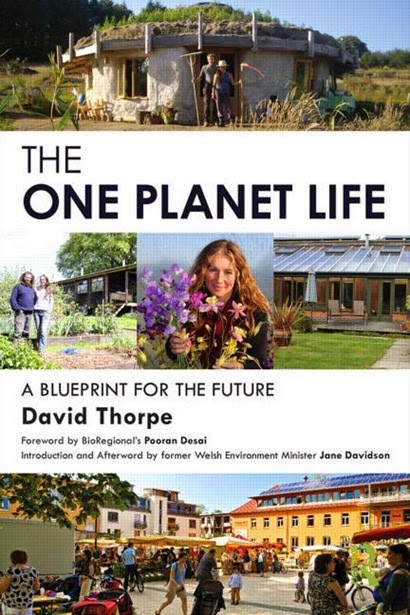
The 'One Planet' Life – Book Review

Review by Michael Smith (Veshengro)

The 'One Planet' Life
A Blueprint for Low Impact Development
by David Thorpe
published by Routledge (part of Taylor and Francis) November 13, 2014.
Paperback, 438pp, 382 full colour illustrations, 15.8 x 2.8 x 23.4 cm
ISBN: 978-0415738552
Price: £26.99

9780415738552The 'One Planet 'Life is being billed as a successor to John Seymour's 'Self Sufficiency', in that it comprehensively and practically tells people how to reduce their impact upon the environment. At the same time, it is an appeal for governments and planners to have a new attitude to development, planning and land management to take into account the full environmental impact of human activities.

The 'One Planet' Life demonstrates a path for everyone towards a way of life in which we don’t act as if we had more than one planet Earth. Much of the book is a manual – with examples – on how to live the 'good life' and reduce your impacts upon the environment to lower your 'ecological footprint'. The average UK citizen is unfortunately using more than three and a half times the amount of resources than the country can sustainably manage.

This book particularly examines the pioneering Welsh policy, One Planet Development but also considers efforts towards 'one planet' living in urban areas.

It contains detailed guides on: sustainable building, supplying your own food, generating renewable energy, reducing carbon emissions from travel, land management, water supply and waste treatment, plus 20 exemplary examples. It contains an introduction by former Welsh Environment Minister Jane Davidson, and a foreword from the co-founder of BioRegional and One Planet Living, Pooran Desai.

Author David Thorpe said: "The 'One Planet' Life" is perhaps the non-fiction book I was meant to write, the combination of everything I have learned, plus the collected wisdom of the scores of people I interviewed who are living the one planet life now. The book provides people with the tools to empower themselves and make their lives and the country as a whole more resilient. "It's easy to give into a sense of fatalism when faced with climate change and other ecological challenges, but this book decisively shows how to take matters into your own hands."

The One Planet Council, of which David is a patron along with Jane Davidson, is behind this title. Jane proposed and was responsible for the One Planet Development policy when she was Minister.

This book is being billed, as already mentioned earlier, a modern day successor to John Seymour's “The Complete Book of Self-Sufficiency” which, by now, has seen a fair number of updates and revisions since John Seymour wrote the first one at the beginning of the last quarter of the last century. However, I would think it is more and different. While “The Complete Book of Self-Sufficiency”, and ideally we should have more than one edition, and also “The Survival Handbook” by Michael Allaby, which John Seymour co-authored in the early 1970s, deals with skills more than this book does; “The 'One Planet' Life” tackles another subject in this bracket and that is a new way of creating a new kind of development and also communities.

Ideally thus both, or all three of them, should be in the armory and on the bookshelves of those of us who work on the creation of a new society and those new settlements.

Most of us in the so-called developed world use more than the resources of one Planet, of one Earth, as if there were other Earths just hiding behind the sun to pop up for us to use up when this one is finished. The wait could be a long one, though, as there is not another going Earth to pop up for us to rape as well. And neither is the notion by Prof. Stephen Hawkins going to hold water, namely that we will simply have to leave the Earth and head for some other Planet. I am afraid to say that with statements like that from someone apparently so educated one can but wonder which planet he is living on.

The book gives, among others advice, step-by-step guidance to the process of applying for OPD status. Alas, for the time being, this applies in Wales only and not for the whole of the UK. It can be useful, though, also in other locales, no doubt.

David Thorpe has twin careers in writing and environmentalism. He has a novel out on the same theme this month too: Stormteller. See the website below for more details. He is a Special Consultant on Sustainable Cities Collective, the primary website for urban leaders globally; a patron of the One Planet Council; and the author of several books on sustainability, solar technology, energy management and more. He is a novelist, non-fiction author, journalist, scriptwriter and the winner of a HarperCollins contest to find a major new children’s writer with his novel for young adults, Hybrids, which the Times called ‘A stunningly clever novel’. He lives in Carmarthenshire with his wife, Helen Adam. Find out more on www.davidthorpe.info.

One can but say that it is a shame that the rest of the United Kingdom does not, anytime soon, unless we have a government change for the better, follow the Welsh example for One Planet Living and One Planet Developments.

The government in Westminster rather wants to create garden cities, much like the eco town idea of the previous labor administration, that will benefit neither the people not the Planet but only the developers who are the ones who will be giving the tender to create those towns and cities.

We neither need eco towns nor garden cities in the UK. What we need are one planet living communities and individual developments, and that not just in the countryside. They also must be created at the fringes of the towns and cities and in the very towns and cities themselves.

This book, I am sure, can help also all of those of us who are working on creating such changes in the minds of planners and government, and it sure should be in the armory of all of us.

A very well written book that covers every conceivable aspect and which also leads the reader – or the prospective applicant for OLD status for a property – through the application process and more, much more.

Rating: 5 out of 5

© 2015