by Michael Smith
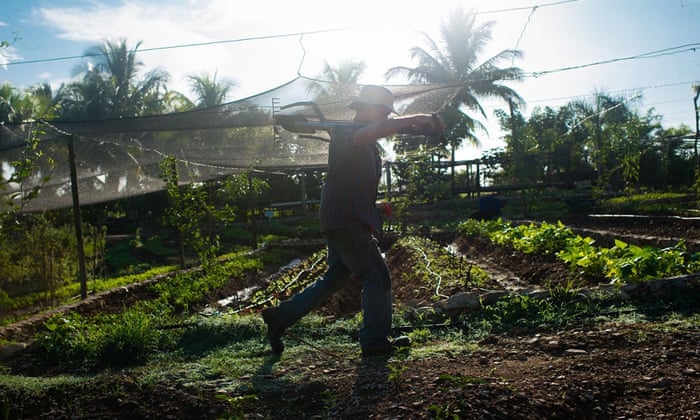
After the collapse of the Soviet Union in 1991, Cuba planted thousands of urban cooperative gardens to offset reduced rations of imported food.
Now, in the wake of three hurricanes that wiped out 30 percent of Cuba's farm crops, the communist country is again turning to its urban gardens to keep its people properly fed.
The capacity to respond in the face of such events can be immediate because those are cooperatives and they can get down to planting and producing what is required..
Around 15 percent of the world's food is grown in urban areas, according to the US Department of Agriculture, a figure experts expect to increase as food prices rise, urban populations grow and environmental concerns mount.
Since they sell directly to their communities, city farms don't depend on transportation and are relatively immune to the volatility of fuel prices, advantages that are only now gaining traction as "grow local - eat local" movements in rich countries.
It would certainly appear that we, in the so-called rich countries can learn a great deal from places such as Cuba as regards to the growing food in urban areas.
ROOFTOPS AND PARKING LOTS
In Cuba, urban gardens have bloomed in vacant lots, alongside parking lots, in the suburbs and even on city rooftops.
They sprang from a military plan for Cuba to be self-sufficient in case of war. They were broadened to the general public in response to a food crisis that followed the collapse of the Soviet Union, Cuba's biggest benefactor at the time.
They have proven extremely popular, occupying presently around 35,000 hectares of land across the the island. Even before the hurricanes, they produced half of the leaf vegetables eaten in Cuba, which imports about 60 percent of its food.
Catherine Murphy, a US sociologist who has studied Cuba's urban gardens said that they may not have the capacity – currently, we might add – to produce enough food to feed the entire island, but for social and also agricultural reasons they are the most adequate response to a crisis.
GREEN PRODUCTIVITY
In most cases the members of the individual cooperatives get a salary and share the garden's profits, so the more they grow, the more they earn. Some of those producers can make an average of about 950 pesos, or $42.75, per month. This is more than double the national average in income.
Urban agriculture is going to play a key role in guaranteeing the feeding of the people much more quickly than the traditional farms, and this is definitely true in the case of Cuba. It certainly could also be the case in other places.
When the Soviet Union fell apart, Cuba's supply of oil slowed to a trickle, hurting big state agricultural operations. Chemical fertilizers were replaced with mountains of manure, and beneficial insects were used instead of pesticides.
Unlike in developed countries, where organic products are more expensive, in Cuba they are affordable. The urban farming cooperatives in Cuba have taken organic agriculture to a social level. This could and should be an incentive to do the same also in other countries such as the USA and Britain.
However, one can but assume that we will get the usual responses as far a Britain is concerned, namely that while it may work in other countries it will never be able to work in this one.
This is despite the fact that they have been toying – and toying it but was – with the idea of having vegetables grown in areas of public parks. The problem in that case, however, is that, with the society as it is here any such food that might be growing there would be vandalized by young people who are too stupid to understand the value of things and of society and also just simply be stolen by unscrupulous people.
We must attempt this, anyway, however, to grow food locally and the best way would be as in Cuba through cooperatives that can take over such places as were done on that island for the growing of food.
It can be done in Britain as well as elsewhere, whatever our politicians might tell us, and we, the people, can do it as long as they, the politicians, let us. Even in your own garden, on your own patio, and even your own balcony, food can be grown on a local level. Examples can be found all over the place and there is little limit as regards too container gardening for the growing of vegetables.
© M Smith (Veshengro), December 2008
<>