Showing posts with label waste management. Show all posts

The Rs and the U

by Michael Smith (Veshengro)
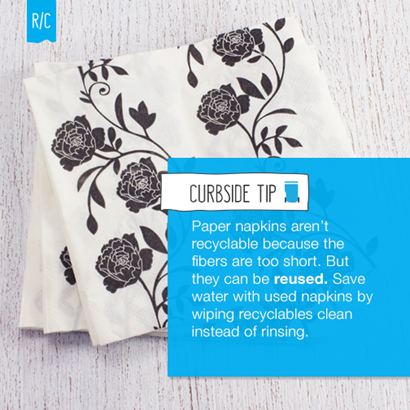
Paper napkins are not recyclableWe have always told, and still are being told, that there are three Rs when it comes to “going green” and that those are “reduce, reuse, recycle” but, in fact, there are more than just those three, or at least there should be. And then there is also the U for upcycle. Recycle should come at the very bottom of the list, and that is why I have put it here.

Reduce: Just use and buy less. Also, obviously, reduce your waste, especially the stuff you send into the waste stream. When it comes to food and food waste use everything and leftovers are used the next day. That's the way our parents and their parents did things. It works, would you believe it. Oh, and guess what, reusable cutlery, plates, cups and such are meant to be washed after use and used again.

Return: Producers should take back what they sell. This is not going to happen very soon, of that we can be certain, even as far as packaging, and over-packaging goes.

Reuse: Almost boring, but we throw too much stuff out too soon. Reuse also must include not just continued use of what we have but reusing and repurposing items of waste such as glass jars and much more. There often is another life for many of so-called waste products.

Repurpose: That is taking reuse to another level in that the product is used for another, often “higher” purpose.

Repair: Fix and mend things rather than replacing them.

Rework: Taking an item of waste and making something new, which could include changing the shape of the original waste product but does not have to be and is akin to upcycling.

Refurbish: This is a little like repair but may go a lot further than just simple repair, that is to say fix and mend.

Refill: In Ontario Canada, 88% of beer bottles are returned to the beer store, washed and refilled; just south of the border in the USA, the number drops to under 5%. In many countries of Europe beer bottles are also returned, washed, sterilized and refilled; alas not in the UK. Apparently, according to government, it was never done in Britain and thus could never work here despite the fact that until the end of the 1970s this was done, last with lemonade bottles and until not so long ago – and in some cases still – with milk bottles.

Rot: Compost what is left over, turning it into valuable nutrients.

Refuse: Simply refuse to accept this crap from the manufacturers any more.

Reducing and reusing also saves money, as do many of the other Rs, aside from being good for the Planet they are good for your wallet and bank balance too. If that isn't an incentive I don't know what ever would be.

And now for the U, even though this one should come well before this stage and that is:

Upcycling: This is the process where (at least) some of the shape and properties of the original waste product are retained and where another useful product is produced from it. Though at times it might also be a decorative item or a piece of art.

Upcycling ideally, however, should be about turning an item of waste into a useful item and product rather than a work of “art”. Although there are times when making artworks out of such waste is the only answer to throwing it and that is still better than doing that.

Recycle: Yes, I have put recycling at the very bottom of the list, and not just of the Rs because of the way recycling, at least commercial recycling, generally, works. The problem with recycling is that it, actually, destroys the “waste” product and more often than not this product is not recycled but downcycled.

Glass is a prime example here where in the majority of instances, aside from being broken into fragments anyway in the first case, it is ground down to make road aggregate, a glass sand, rather than new glass. In other words they are turning it almost into the material that glass is made from in the first place, namely sand. But, as all the colors are being mixed together it is not possible to make new glass products from them, or so they say. Why not make multicolored glass tumblers and such?

Many other “waste” products in commercial recycling also are downcycled rather than properly recycled into what they originally were, hence recycling should always be the very last resort to turn to when everything else has failed. But, for some unexplainable reason, there is no infrastructure there for a proper reuse and upcycling economy, so to speak, and everyone concentrates in commercial recycling on what actually is downcycling.

That is why upcycling has to become a main part of the equation also and especially on a commercial level, from small independent craftspeople to SMEs as recycling does recycle very little and mostly downcycles the materials. This may be good, to some extent, for the large operators and their shareholders but not for the Planet.

Some of us may have already seen the little gadget and “trick” about turning PET bottles into string that makes for an extremely strong rope. There is potential in small and larger scale recycling or upcycling of such bottles (yes, in this instance the original shape is not retained) and using the material thus garnered to make ropes, but also woven products such as mats, and others. And that is just via one simple method.

Just some food for thought, maybe.

© 2017

Nation wakes up to coffee cup recycling on-the-go-go

Veolia’s coffee cup recycling bins brew up a solution

by Michael Smith (Veshengro)

NoPapercupUnderpinned by insight into coffee cup disposal habits and with trials supported by partners such as Costa and Starbucks, Veolia, the UK’s leading resource management company, is rolling out a national coffee cup recycling solution.

With 84% of takeaway hot drink consumers still using disposable cups, Veolia’s coffee cup solution aims to collect takeaway cups as soon as the consumer has finished their drink to reduce cup contamination and increase recycling rates.

The solution is now available to existing customers nationwide and to potential new customers, as part of a packaged service, and offers multiple service options. These include a specialist designed in-house recycling bin, a bulk collection option and a post back service – which is available to all business types nationally.

By capturing cups before they enter the general waste stream Veolia’s solution aims to get a higher quality of material that can be reprocessed into a new product. And the public is onboard.

The latest YouGov research shows a staggering 88% of the public would use a purpose-built bin to ensure their disposable paper cups is recycled. Almost half (47%) would even be willing to hold onto their cup for longer if they knew they would pass a purpose-built bin, and nearly a quarter (24%) would go out of their way to use one. As a result, Veolia is calling for more disposal locations, such as train stations, university campuses and offices, to step-up and help solve the coffee cup conundrum with them.

For regular takeaway hot drink consumers, those that buy at least four drinks a week or more, the most popular location for cup disposal is at work. In fact, over half (52%) cite the office as a disposal location, with ‘on-the-go’ locations such as train stations, service stations and on trains, the second most popular (40%) and then in coffee shops third (31%).

Estelle Brachlianoff, Senior Executive Vice-President at Veolia UK & Ireland, comments: “Over the last six months a lot of activities have been taking place with our customers, such as Costa and Starbucks to overcome our biggest challenge – contamination in the cups. As a result, we’ve worked on a solution that will separate the cup from the general waste stream as soon as the customer has enjoyed their drink – and we’re thrilled to see so much public support for cup recycling.

“Coffee cup recycling is now happening across the country but I’d like to take this opportunity to further encourage a mass collaboration between designers, manufacturers, vendors and consumers as we all have a part to play in making all of our packaging more environmentally friendly and ensuring our resources are kept in the loop for longer.”

Once the consumer has ‘Tipped-it, flipped-it and stacked-it’ – a process to ensure any remaining liquid is drained and the lid, sleeve and cup are separated – Veolia undertakes a further separation process to guarantee all rogue items have been removed. This is key because it will help to ensure a higher quality of material that can be reprocessed into a new product.

After the cups have been debagged, separated, checked for quality and contamination, and baled up they go on to further treatment at paper pulping facilities, which recover the fibers and separate the polymer plastic lining. Working with a number of outlets, the fiber could potentially be used to make a multitude of products such as egg boxes or cup holders given back out in stores or alternatively used in the manufacturing of cellulose-based insulation for homes.

OK, so much for what Violia UK says and now let's looks at the way the world really works, at least according to what I am being told by other experts in the waste management industry.

Violia UK is claiming to have a facility that can separate cardboard from the polymer liner of those cups. If that is the case than this is the only such plant and no one else in the waste industry heard of it being possible.

I know that I am a skeptic and rather sarcastic with regards to this but when 99.9% experts in the industry tell me that those “paper” cups with their polymer linings cannot be recycled and that separation of the two components is not possible I find the claims of one or two companies questionable in the extreme.

As I have said it is either the case that Violia UK has a facility that is capable of doing the things that the vast majority, bar one or two, claim cannot be done or somewhere along the line someone is rather economical with the truth.

It would be better by far if the beverage industry would get away from those cups and people would carry their own. There are enough alternatives available.

© 2017

The reuse economy or reuse sector

by Michael Smith (Veshengro)

reuse_fabrics-940x400New York City Department of Sanitation Commissioner Kathryn Garcia thinks, as does the department, that the reuse sector, both the nonprofit and the for-profit sector, are key to moving forward with regards to a New York City's “zero-waste” drive.

Compared to the heavy duty world of urban waste collection in New York, the reuse sector can seem quite esoteric. Now, the city is looking to make it a mainstream operation.

Because reusable items are generated more sporadically than the steady streams of refuse, recyclables and organics, the systems to handle them can be less organized. Due to a lack of awareness or access, it’s often easier for many residents to just put their old couches and dusty guitars out on the curb. In many places, one has to add, such systems are not – at least not on an official level – even existent.

So, let's look at what this “new” or “newish” sector of the economy, this reuse thing, actually is. Well, to have said new or even newish is rather incorrect for it is neither of it; it is quite old, only it was not called reuse or even an economy back then.

It was what the rag and bone man and others did, namely pick up things that could either be sold for scrap, refurbished, reworked or whatever, and secondhand shops, once upon a time, were very common. Now they have gone upmarket and are called charity shops. Often the same difference. And those charity shops are, obviously, the nonprofit part of the sector, although, considering that the items are donated to them, and even bought to them, they do make quite a bit of profit from the sale of them.

To bring about a more or less zero waste situation the reuse economy must also include and incorporate the repair, rework and upcycling economy, like those artisans and and other workers who will make goods, ideally usable goods and not just art, for sale, as a business, out of items of waste.

It it made to appear as if the reuse and remake economy is something new, recently invented by the green movement, but it has existed for ages. And even upcycling is not a new thing at all. It too has existed for almost ever and a day. Only it was not called upcycling. It was just what one did, and especially what those that did not have the financial resources to buy did. But it also was an economy in that people repaired, restored and upcycled for sale.

Fact is though that over the last number of decades it fell out of fashion and that was as much due to the fact that people just wanted to appear affluent pretending that they could buy new all the time as with the fact that products became, almost all, non-repairable.

The latter especially led to the demise of the repair economy and repair businesses, large and small, fell by the wayside and died a death. Yes, we still have the so-called shoe repairers, for instance, who often also operate the dry-cleaners and key cutting, but you try to get those franchisees to sew back leather upper to a leather midsole. They can't do it “because they haven't got the machine for it”, as I was told when wanting it done. They are not cobblers, the are just machine operators and if there is not a machine with which to do it they cannot do it. Anything that would involve sewing by hand, where a machine cannot be used, they cannot do. Basically all they can do it put a new heel or sole onto a shoe or boot and that is about it. And the latter obviously only if the shoe or boot has a sole that can be removed and a new one put on and with many shoes and boots today that no longer can be done today.

Before every manufacturer – or almost every one – jumped on the bandwagon of built-in obsolescence, following the likes of Osram in the mid-twentieth century and other US firms after World War II, the repair economy was everywhere because everything could be fixed, at least almost everything.

In countries such as the GDR – often referred to as (communist) East Germany – there were entire small enterprises as well as state combines dedicated to repair. The combines were like a department store where you could bring anything to be fixed, even bed sheets and such, though many things people just fixed themselves.

When the built-in obsolescence “hit the shelves”, so to speak, it was the death knell for the repair businesses, large and small, under capitalism, as almost nothing could be fixed anymore or was and still is too expensive to fix with repairs costing many times that of a new one. And we are surprised that our landfills are overflowing and that we have a waste problem.

That is not to say that people are not a problem here either as many seem to treat everything as disposable even if it is not. It begins with cutlery and other reusable things at picnics in parks where those items are, once soiled having been used for eating with, are tossed out just like disposable items. It carries on with clothes where a button has come off, even though they still have the button in their possession, and so on and so forth.

The reuse sector could really have its work cut out nowadays with people's waste alone to clean, rework and all that, and then bring it back into circulation. And if we add to that upcycling then we would really be motoring and a good thing it would be too.

© 2017

The 81-year-old woman inspiring a nation to recycle

Zeinab Mokalled

An 81-year-old who set up an all-woman rubbish collection team in her village in Lebanon now has a stream of visitors asking how she did it. For nine months in 2015 and 2016 rubbish piled up on the streets of the capital, Beirut, and even now a lack of landfill sites means some of the city's waste is being thrown in the sea. Zeinab Mokalled has shown that when government fails, do-it-yourself local initiatives can work.

"There used to be dirt everywhere and the kids were filthy," Zeinab Mokalled tells me.

She is remembering the 1980s and 90s, when Israel occupied part of the south of the country for 15 years, and waste collection came to a halt in her village, Arabsalim.

As the years went by, it piled up, and Mokalled went to the regional governor to ask for help.

"Why do you care? We are not Paris," he told her.

"I knew that day that I had to take it upon myself," she says.

Mokalled called on the women of the village to help, not the men - partly because she wanted to empower them, and partly because she thought they would do a better job.

Read more here.

Talking Trash With The Cyclists Behind This Compost Startup

An eco-preneur hits pay dirt with a bike-powered pick-up service in the heart of Austin, Texas.

compost pedallers

Last year the world generated more than 1.3 billion tons of food waste. Tons. That’s more than 20 pounds of food per person per month that floods into landfills and emits harmful methane gasses. Some cities have gone to bat on the problem by creating civic compost programs. For example, Seattle recently passed a law mandating that all food scraps be kept out of residential garbage and offers weekly pickup of food waste bins. And in Austin, Texas, there’s a similar pilot program, but expansion to the entire urban area could take up to 10 years.

Until then, small business and private networks are popping up to fill in the gaps, including Austin’s Compost Pedallers, a startup that offers bike-powered, carbon-neutral food waste pickup. Since its founding in 2012 by Dustin Fedako, Compost Pedallers has diverted 500,000 pounds out of the waste stream a la community composting. Their 650 subscribers within a five-mile radius of downtown Austin pay $16 a month for pick-up services. Anyone who signs up simply finishes, say, his or her morning coffee and tosses the grounds into a green 5-gallon bucket that the Pedaller crew cleans and delivers once a week. Once banana peels, egg shells, and other nonanimal waste accumulates, the bucket goes out on the porch for pickup. Then one of the company’s nine cyclists arrives in style on a cargo bike and dumps the residential food scraps into large bins strapped to the front of their ride or in a bike trailer that follows behind. At the end of the daily route, the haul goes to the company’s garden partners—called compHOSTS—like Springdale Farms. These hosts add the scraps to their personal compost piles and—with guidance from Compost Pedallers’ how-to handbook—transform the waste into usable material for their growing operation. So far the operation has kept an estimated 70 tons of methane out of Earth’s atmosphere.

Read more here.

What happens to your shredded office waste?

by Michael Smith (Veshengro)

Have you ever wondered what really does happen to those bags of shredded waste that gets taken out of your office on a daily basis? Many who do not know, and that may include even you, more than likely, believe that that is all going to be recycled. But nothing could be further from the truth.

ideal-3104-office-shredder-waste-binNo longer do those bags of “confidential” waste that have gone through the shredder, nowadays contain only shredded paper. Nay, they also contain shredded credit cards, ID cards, CDs, DVDs, etc., and that all in the same bag.

This means that the contents of such bags, in fact, no longer be recycled in any way, shape or form and it all ends up in some incinerator or – wait for it – a “secure” landfill. However secure it may be it is still a landfill, a hole in the ground.

When it was just shredded papers that were in those bags recycling was no problem, despite the security thing, and new paper products were made from the pulp created with that and other paper.

Today this is not possible, though to some degree it would be but it would be somewhat costly, probably, to separate the plastic waste from the true paper waste and therefore all of it goes to be either burned or dumped in the ground.

If we really want to be “green” in business then we have to rethink the way we deal with this kind of waste and that would mean to shred paper separately to plastics. That way both can be recycled rather than buried in holes in the ground together or burned.

© 2014

Sweden has run out of rubbish

by Michael Smith (Veshengro)

Due to Sweden’s innovative waste-to-energy program and highly efficient recycling habits, this Scandinavian nation faces an interesting dilemma. They have run out of trash.

resourcerecovery_smlThe country’s waste management and recycling programs are second to none as only four percent of the nation’s waste ends up in landfills.

By contrast, according to the U.S. Environmental Protection Agency, over half of the waste produced by American households ends up in landfills and things are not better in Britain either. To add to that the fact that many things that are collected in kerbside recycling also end up in the same place as there are no means to recycle them, there is a glut in the market for recyclables or they are “contaminated” and thus cannot be (easily) recycled.

Because Sweden manages waste so effectively and then use what remains to partly power their country, they are now living an environmentalist’s dream; a shortage of garbage. Can you believe that?

However, the environmentalist in Britain demand that our waste be recycled and not burned and even that what, invariably, remains and cannot be recycled must be recycled say Friends of the Earth and other groups. Incineration must not be done, they say, and that despite the fact that Sweden shows the way how to do it.

In order to continue fueling the waste-to-energy factories that provide electricity to a quarter of a million homes and 20% of the entire country’s district heating, Sweden is now resorting to importing trash from the landfills of other European countries.

In fact, those countries are paying Sweden to do so. Yes, you read that correctly, countries are paying to get rid of a source of fuel they themselves produced so that Sweden can continue to have the energy output they need instead of using the waste for the same purposes at home. This is madness, if you ask me.

One does not have to be an economist to know that this is one highly enviable energy model and that, besides the economic benefit, the Swedish system of sustainability clearly has vast environmental benefits.

Apart from the traditional recycling programs that are being used, Sweden's waste-to-energy system ensures minimal environmental impact from the country’s waste and thus the country's extremely efficient circle of consumption, waste management, and energy output provides the current global population and coming generations inspiration and guidance towards a more sustainable future.

The United States and Britain could learn a great deal from Sweden and how they do things but, alas, it is in Britain the so-called environmentalists that actually block any attempts of doing this, e.g. production of energy from waste by burning it.

Rather Britain is playing with burning biomass in some power stations in the form of pellets which, in the main, have to be imported from as far afield as the USA and are, more often than not, made from virgin wood rather than waste wood. Or those power plants are fueled by biomass in the form of specially grown “crops” such as willow, eucalyptus, or miscanthus. Plants which use up land areas better used for the growing of food.

We must change and we must change now and follow models that work in other countries and implement them in order, in this case, to (one) have energy security and (two) reduce the waste going to landfill.

© 2013

Where do your recyclables (really) go?

by Michael Smith (Veshengro)

Have you ever asked yourself as to where your recyclables that you put out for collection or that you take to the recycling bank actually end up. The answers would surprise you in may, if not indeed all, cases.

recyclablesGLASS

“Oh, they make it back into bottles and such” is what most people believe and say and maybe even you. But that is, in most cases, plain wrong.

A major percentage of all glass collected is crushed and made – wait for it – building sand. Yes, sand, the very thing that glass is made of in the first place; silicate. Only a tiny percentage of bottles and jars from recycling banks and kerbside recycling goes back to become new bottles and jars or any other glass products for that matter.

PLASTIC/PLASTIC CONTAINERS/-BOTTLES

The recycling of plastic is also very much an issue. The problem is that much of your recyclables in the form of plastic bottles and other plastic containers are while they are collected “at home”, and this is also the case with many other recyclables, they are not recycled “at home” but are shipped to places such as China and India, etc. where the recycling “industry” is not subject to the same stringent regulations as would be the case “at home”.

Many of the recyclables that you, and others, so diligently put out for kerbside recycling never actually make it to any recycling plants, whether “at home” or “abroad”. If there is no market for them – that is to say if there is an 'oversupply' – they simply get landfilled the way it used to be and the same goes for anything that may be “contaminated”.

This is why waste reduction and especially reduction of packaging, and reuse and upcycling in DIY fashion is so very important.

The majority of people, conditioned nowadays by the powers-that-be to recycle, obediently toss their cans, plastic, glass, paper, etc. into the appropriate receptacles believing they do a good thing and the Planet a good turn. Reusing like our grandparents did rarely ever enters their minds.

Are we being lied to by our governments as to what happens to most of the recyclables collected? One could say “yes” to this question to a very large degree.

It makes for an educated consumer to change the behavior of industry to reduce packaging and not just in weight as some have done with glass bottles the glass of which has become a great deal thinner. This is only done to benefit the corporations and their bottom line as it reduces weight and they can put more onto a truck. And this is the same reason why some companies have replaced tin cans for, say, chopped tomatoes with Tetrapak like cardboard packs lines with foil. The latter, unlike the tin cans used before, cannot be reused and also not be recycled in most places.

As long as the consumer, however, is left in the belief that the packaging is recyclable and recycled such change is not about to happen soon.

We must understand how things actually work and function in recycling and waste management field to understand as to how the proverbial cookie crumbles.

Paper recycling and that of cardboard is another issue also that is far from as cut and dry as it is more often than not being presented.

A great amount of paper and card collected goes straight to landfill and that more often than not not only because of market saturation but also and especially because of what is referred to as contamination.

Contamination, as far as paper and card is concerned are the wrong kind of printed matter, such as glossies, for instance, or ink jet printed pages. This ink of the latter which is, more often than not, not waterproof but actually water soluble, and certain colors of this can make the entire batch unusable and in cardboard items such as Pizza boxes and other card with grease or “paper” cups which are lined with either a plastic or a wax liner. Here often people are fault rather than the municipalities, etc., and that through ignorance.

But, again, when the market is saturated with recyclable paper waste the rest gets landfilled and often even at other times.

All of this makes a mockery of kerbside recycling (and other methods) that we are presented with. The only way to go is that of waste reduction and as most of this waste is packaging it is reduction of this, of packaging. Furthermore we have to think REUSE rather than recycling and reuse and upcycle as much as we possibly can. Our ancestors did and we must do so (again) as well.

© 2013

The real R's of waste management

by Michael Smith (Veshengro)

We keep hearing the mantra “reduce, reuse, recycle” but they way most people seem to perceive it, due to government brainwashing, is as “recycle, recycle, recycle”.

All talk is about that we must recycle more, and more, and about recyclability of products and so on. Reducing waste to start with and then reuse (and repurposing) never gets a looking in and a mention. But, the governments, central and local, cannot make any money from us reusing things now, can they. Only recyclables that they collect from the curbside and businesses can be sold to processors.

We do not so much need recyclability in products but we need repairability of products and people who can fix those products if and when there is something wrong with them.

The problem is, however, that even if a product if repairable it is more often than not more expensive to repair it or getting it repaired, with the parts being prohibitively expensive not even to talk about labor costs.

Recyclability for one is becoming a great get out as the very fact that so many products can, now, be recycled is, paradoxically, feeding consumption.

Buying recyclable and recycled has become the “in thing” and is giving people a false sense of making a sustainable choice.

While products now often are considered to be recyclable, that is to say they can be broken up into their components and then the bits recycled, they still have a factored-in obsolescence of three years or less and that factored in obsolescence, in itself, is causing our problems and recyclability is changing not one iota here.

Recyclability is, in fact, now fueling consumption as people think that it does not mater if they toss their laptop, smartphone, or what-have-you, out after less than a year because they want to upgrade. “What's the problem”, they say. “It can be recycled”.

We must start with Rethink: That is to say we must rethink our consumption and what we really need rather than what we are told that we need.

Do you really need a new cellphone, a new iPhone, for instance, after you have just got a new one a few months ago simply because there is a new one out. No. It is not need but want.

And we often mistake wants for needs because the way advertising and marketing suggest to us that we need those things to make us happy, or make us feel part of a group, or whatever. But many of those things are not need, they are but wants that we need not fulfill.

The second R to look at is Respect: Respect for what we have and for the resources that went into the products that we already have. This respect was once known as “looking after out things” and especially our younger generation needs to learn this again.

As children when we were given, say, a knife or a bicycle or whatever, we were also told to look after it and taught how to look after it. Which reminds me that I really have to give my bicycles – yes, more than one, but all rebuilt ones – a good looking over and service and repair them where necessary.

The next to consider is Refuse: Refusing to buy into the consumerism that we are told, including by our governments, we should do to “grow the economy”.

Reduce is a very obvious one and it means for us to do not just one form of reducing but more than one. The most obvious is to reduce the waste that we produce; the other to reduce our consumption of things we do not really need.

Now we come to the most important of the R's, namely to Reuse: Reusing of everything, almost, was the way of our parents and grandparents and their parents. Tin cans, glass jars, etc., all were reused for other purposes, which is already the other R of Repurpose.

Other ways of reuse were that clothes that the children had grown out of were passed on to younger siblings, cousins, etc., or simply to children of the neighbors.

Repair is the next one when it comes to products that we own when they develop a problem or to clothes and shoes when they come apart or get torn.

Most people, however, today cannot even sew on a button let alone repair a tear in a garment, or patch a hole in a pair of pants or such, and patching is definitely something that most have not got the slightest idea of.

When it comes to the repair of footwear the problem is also that most so-called shoe repairers in fact cannot do much more than glue a new sole or heel on a shoe or boot. Reattaching the upper to the bottom is something they have almost no idea of at all.

And the other issue is that most of our products today, as already said, can either not be repaired or, if and when they can, repair often costs several times more than a new product, thus giving the consumer, that is you and me, no other choice but to buy new and thus carry on the onslaught on the environment and resources.

Only after all has failed and as a last resort there comes Recycle: Recycling is presented to us as almost the be all and end all of waste management and how we should treat our rubbish but it should never be the fist choice. Alas, for many, even in the green movement, it is.

Instead of reusing a tin can as a pencil bin (and yes, I have arrived at that peeve of mine again) they toss the clean can into the recycling bin and go out to buy a recycled steel pencil bin. Duh? And the same goes for glass jars that are tossed into the recycling and then they go out and buy recycled glass storage jars where the ones tossed, like the tin can, would have done the same duty, for free.

Recycling is the last resort and that simply because it is costly, to our municipalities and to the environment.

The curbside pickup costs money and also costs the environment by way of emissions, that is to say pollution from the diesel trucks. The recyclables then go to the plant to be broken up and then made into products again, though, don't be deceived, your glass jar or bottle tossed is not going to become another bottle or jar. In fact a whole industry has sprung up creating new products using the materials created by heavy use of energy, such as “bricks” from the ground up glass, or road aggregate.

The steel from tin cans does become steel again and the same is true about aluminum from soda and beer cans but that is not the point. All of it costs a great deal of money which, if those items where not waste in the first time, and glass bottles and jars, for instance, cleaned, can be used time and again until they finally break. Only then should the glass be recycled.

Look at every item of waste that you do, after reducing, produce as to whether it may have a new use in one way or the other. With the right mindset those uses can and will be found.

Be frugal and live frugal. Use various kinds of small glass jars as drinking vessels for various drinks, larger ones as vases, and others as storage jars for dried foods, coffee, tea, etc. It saves you money and prevents things going for recycling or into the landfill.

Look at some of the old books as to how the people in the last century of your grandparents' and their parents' generation reused items of “waste”, and here especially those that had very little.

Make this into a philosophy and a way of life and both your wallet and the Planet will benefit.

© 2013

Reuse: The stepchild of waste management (in our homes)

by Michael Smith (Veshengro)

For some peculiar reason, despite the fact that the 3Rs of waste management are “reduce, reuse, recycle” most people and even governments only seem to understand them as being “recycle, recycle, recycle” and reuse is, literally, being ignored like a poor stepchild or orphan.

It would appear that many people do not understand the difference between reuse and recycle either and will refer to, say, my glass jars that I reuse, or repurpose, if you will, as drinking glasses as to the jars having been recycled into such glasses. This is, obviously, incorrect. They are reused or, if one wants, repurposed; not recycled.

When we reuse something, albeit for a purpose slightly different to the product's original intended one, we do not change it or its structure, and thus we use no energy.

Recycling, on the other hand, uses lots of energy. Energy to collect the “recyclables”, many of which should be reused; energy to sort and get them to the recycling plant; energy to break the materials up; and then still yet more energy to make new products. In other words, recycling is a very energy intensive process.

Reuse, as we have already seen, on the other hand, requires no energy use (or very, very little) but your own and your imagination.

In addition to reuse by us as individuals a more commercial reuse should be brought back in that glass bottles and jars should be taken back by the stores for reuse for their original purpose. This used to be done with all lemonade, soda and beer bottles some decades past and is, indeed, still being done or again in some countries. Glass jars were also taken back during World War Two in Britain and in all cases there is and was a deposit on the things. It is, thus, not rocket science.

Next to reducing our, especially packaging, waste REUSE must be our priority in managing our waste; at home, at school, and at work.

Recycling is very far down on the list for, when you have to resort to and choose the last option, namely recycling, you have already lost the game.

Reuse must be, if reduce has not worked, and industry is still over packaging things, the way to go and our primary choice. We must relearn, and the great majority of people today indeed seem to need to, the thinking of our parents and grandparents and their parents and grandparents, of considering packaging waste in the form of glass jars, tin cans, and nowadays a variety of other things, as a resource. A resource for reuse and upcycling.

So, instead of throwing out a glass jar we reuse them as much and as long as possible, until such a day when we have a system in place where stores take them back. And the same, though only as far as reusing, goes for tin cans, bicuit tins, single-side printed papers, cardboard boxes, packaging card, plastic containers, etc.

They all must be candidates for reuse and upcycling and the limit as to what they can be reused for and upcycled into is only set by our imagination.

So, let's get reuse out of the orphanage and give it a loving home.

© 2012

Turning trash into treasure

Diverting waste is the ultimate act of sustainability

by Michael Smith (Veshengro)

There are abundant resources for any home sustainability project you wish to undertake. All you have to do is learn to look in the right places first! And, these resources are completely free.

There is nothing more sustainable than trying to get the most use out of the embodied energy of any material. That means: if you have got an old cupboard you don’t have a place for anymore, don’t smash it and use it as firewood! Countless gallons of water and petroleum went into turning that wood into a cupboard, so brainstorm other ways to use it in its high-energy state, or give to someone who can use it. In fact I am normally the one who ends up with such an item from others, as I am generally happy to accept such donations, though I have to say that my home is currently a little overflowing with such items.

In “Cradle to Cradle”, the authors talk about how recycling materials often results in “downcycling”– where the subsequent use of the material results in low-grade, un-recyclable products. Since this is the current state of design, recycling is nowhere near “sustainable.” On the other hand, reusing materials and not thinking of them as “waste” leads to a more ecologically-responsible lifestyle.

Don't let me loose on any skip, as dumpsters are called over here, as long as there is place at home, in the garage or the shed. Alas there are times where stuff has to remain there for one or the other reason. The biggest one is that I am not a driver and do not own a motorcar. Thus transportation is a problem at times and other times it is the case, as it is at present, that there is simply no space either in the house, the grange or the shed. The grange is full of bicycles, abandoned and some damaged, to be rebuilt, and the shed is just, well, full. But using found and available materials makes everything in my home all the more specific, original, and creative!

Here are some tips for where you can find just about anything you need.

“Garbage picking” in affluent neighborhoods. This is by far the most successful means of acquiring excellent materials. Simply driving or biking around the streets on trash night (easily determined on the Internet), there are tons – at times literally – of interesting and useful things to be picked up.

The neighborhoods don’t have to be affluent either, but I think you’ll find that the rate of good materials is higher on a house-to-house basis in such neighborhoods. Shame on them for being so wasteful… but good for you and your projects.

Freecycle or the “Free” section on Craigslist. Dozens of furniture items, building materials, and miscellaneous household stuff are being given away right now in your neighborhood on these online forums! For FREE! When was the last time you could get loads of lumber for free? Also, check out the barter and other sections for good deals.

Dumpsters or skips, as they are called in Britain, or Containers in Germany: Ever driven around to the back of a grocery store or a strip mall? There is lots of great stuff there but, and here it comes; in many places going through those is, theoretically and practically, regarded as trespass and theft. So, you have been warned. Check your local ordinances and laws as to this.

Tag sales. Sometimes people just don’t know what goodies they are tossing out.

Free box. Some community projects, especially cooperatives, may offer a free box. Common items include clothing, slightly damaged tools, and miscellaneous small items.

Wholesalers. Occasionally you will find large, unusual items from food distributors, retailers, supply stores, etc. This includes 55-gallon drums. And don’t forget…

The Junkyard! Want to build a wind turbine for home use? It’s a pretty simple procedure… and it requires a car alternator. Get one for a couple bucks at a junk yard!

Well, I think you are getting the idea.

I am lucky, in a way, that I often find useful items thrown away by people in my day job. I love litter bins... and on top of that there is what people “fly tip”.

While, officially, I hate fly tippers, and that is true, there are times when the stuff is rather useful, such as a bow saw – perfectly usable still though may need a new blade – dumped by some tree surgeons that fly tipped a load of branches in the park.

I could start a very long list here of stuff people throw into bins, or not, as the case may be, and also lose and never bother to cone back for but that would be way too long and, I should think, boring. Suffice to say I won't have to buy a woolly hat for years.

© 2011

Landfills nearly at capacity

by Michael Smith (Veshengro)

According to the ONS (Office of National Statistics) we have less than 7 years landfill capacity left in the UK. The fact is that some areas have no capacity left, SE England only 3 years or so capacity left.

This information was distributed by Tweeter @earthexchange (Alex Albon) from Cheshire, UK, and I would not doubt this one bit.

In fact, in my personal opinion, I am surprised that, as a nation, we still, basically, have 7 years left. Holes in the ground are hard to come by and we must make a serious change in our habits and behavior. Exporting our waste, as we do already to some extend cannot be allowed to be the option.

In the Unites States some areas, such as New York State and New York City, and some states further south even, have run out of ground space and are shipping – yes, you read right – their waste all the way into Canada, to places in Ontario and Quebec.

This is madness in the extreme and only a serious change in people's attitude, and that of industry, will make inroads here.

A serious reduction in waste is what is needed and that starts at the manufacturer and retail store. Personally I cannot see what, for instance, the replacement brushed for a Braun electric tooth brush come in their own individual packages which are then in a huge blister package that is very hard to recycle to boot. And this is but one example of the total packaging madness.

It is, predominately, packaging what fills up the landfill sites in this country and elsewhere and it is packaging that we must reduce. Eliminating is not possible, that I know, but reducing must be and is.

And this is also the place were reuse of bottles and glass jars comes in and it is reuse not just by consumers who upcycle the stuff into something else but a reuse by the manufacturer taking the bottles and jars back to be refilled. It has been done with bottles always until the disposable came about in the 1970s though it has not, as yet, been done with glass produce jars, but it could and can.

There are but a number of opening sizes and lid types for all glass jars on the market worldwide and therefore it is not rocket science to take them back and refill and reuse them. It makes sense in more than one way too for it saves costs for the manufacturer of the produce as well.

Time we began starving the landfill in a rather serious way.

© 2011

Re-manufacturing has role in the war on waste

by Michael Smith (Veshengro)

Squeezed in somewhere between reuse and recycling, re-manufacturing sits most uncomfortably in the standard waste hierarchy.

The process, however, which essentially boils down to reusing the parts of a product which weather well and replacing those that wear out faster, can trace its roots back centuries to when repairing - rather than replacing - was the norm. And it was the norm until not all that long ago. So where did we go wrong?

Reworking too, falls, to some degree into this category, making things, such, as an example, usable knives from old knives – a trade that has been practiced by some Romani clans for generations, for instance. Other rework is possible with other things when those may not, in fact, be the same article and use but still.

Though the drivers behind the process were originally purely economic - it's cheaper to re-manufacture than build from scratch - the idea has a major environmental role to play in both cutting carbon emissions and reducing waste.

The UK re-manufacturing industry, according to its advocates, employs more than 50,000 people and contributes in the region of five billion Pound Sterling to the national economy, covering everything from printer cartridges to rugged industrial machinery.

The re-manufacturing sector has, nevertheless and unfortunately, been nigh on invisible, despite being on a par with the entire UK recycling industry.

One of the main hurdles today, however, is persuading both consumers and industry that re-manufactured products really are as good as new while clearing up confusion over what exactly the term means.

When it comes to repair, as mentioned above, though, the problem is that today we do live in a throw-away society where it is cheaper, I am afraid to say, to by new than to repair. It makes no sense when an ink jet printer costs less than £30 to buy and when it went wrong – and I am speaking from experience – after six month because of the high volume of print that was put through it (so Epson informed me) it would have cost 4x as much to repair it than what if cost to buy in the first place. Reply from company representative was “well, then you better buy a new one then and dump the old one.” This should not be thus, however, if we are serious about the environment and all that.

Ben Walsh, technical consultant at the government-sponsored Centre for Re-manufacturing and Reuse, acknowledged the problem in that he said that this is one of the big obstacles that they have as there is an issue that second hand is perceived by the consumers as second best.

The website of the Centre for Re-manufacturing and Reuse, www.remanufacturing.org.uk, explains what re-manufacturing is, who is doing it and with what products. It also provides a wealth of advice for businesses wanting to save money while at the same time helping the environment.

© M Smith (Veshengro), August 2008
<>

London Borough of Brent prepares for mandatory recycling

by Michael Smith (Veshengro)

Residents in the London Borough of Brent are gearing up and preparing themselves for the introduction of compulsory recycling next month.

From the 4th of August, those residents of the Borough who live in houses or houses converted into flats will have to recycle or will face a fine of up to £1,000 (US$2,000).

Brent Council is introducing those new regulations in a bid to increase its recycling rate and avoid rising landfill costs. The former is, obviously, in order to meet targets imposed from central government, the latter to save money.

Its landfill bill is set to be around £7m this year, but council chiefs predict it could increase to as much as £10m by 2011 if it continues to collect the same amount of waste.

While we all agree, I am sure, that recycling is the way to go, aside from the first step and that is reduction of waste for starters and also reuse, running about slapping fines on those that do not recycle (enough) is certainly not the answer. It would appear to me that this yet another way of taxing people and getting more money for the coffers of the councils.

A huge publicity campaign has been underway to alert local people to the change and hundreds of households have ordered recycling boxes from the council.

Council leader Cllr Paul Lorber said: "I want to say thank you to everyone who is already recycling. If you aren't, you should get involved to avoid a fine.

"We all have to recycle more or the cost will be passed onto local people. And recycling will help us preserve the planet for future generations.

"Two-thirds of what people throw away can be recycled, and it's easy to do using the green box scheme, so compulsory recycling should help us make a substantial improvement.

"The early signs are good - more and more people are getting involved. Let's work together to make Brent one of the best recycling boroughs in Britain."

This is despite the fact that Brent council is part Liberal-Democrats and part Tories and that the Tory party only the other day called for financial incentives for recycling rather than fines and was accusing central government of that. Here it is it's own party members in this councils that seem to follow a completely different line. Obviously, sound and text bites for the media are something different to reality, whether Tory, Labor or Lib-Dem. What's new? It would appear that the Tory leadership are either not in tune with its councillors and others or that the Shadow Cabinet members are but out to get publicity while the truth remains different.

If you aren't recycling already, you should get involved to avoid a fine, say the leader of the Council to his residents. In other word, a threat. Get a recycling box and recycle or get fined.

What the result of this will be is like elsewhere where such schemes have been introduced and that is the increase in fly tipping, especially in alleyways and in parks, open spaces and derelict land. Brilliant idea – NOT!

© M Smith (Veshengro), July 2008

The fourth “R” of waste management

by Michael Smith (Veshengro)

Most people, if not indeed all, by now will be familiar with the commonly quoted three “Rs” of waste management, that is to say “reduce, reuse and recycle”.

However, I think that somewhere there must be added a fourth “R”, namely the “R” of “Rethink”.

We must urgently rethink the waste, amount and type that we produce and we also must rethink our approach to and the way that we use, reuse and recycle it.

Reducing the waste we produce is probably the most important step in waste reduction and -management and this applies, basically, to all waste.

The biggest proportion of all of out waste that we generate, from households and elsewhere, is packaging that has no other use and either has to be recycled – if possible and often it is not – or needs to be deposited in landfill or burned in incineration.

The field of packaging is where Rethink must be applied to start with, and this will have to be on at least two levels.

Level one is to actually rethink packaging (and the need for it) all together and to consider how much packaging is actually needed.

I cannot, for the life of me, see the reason for electric toothbrush replacement heads for a Braun electric toothbrush that are already each individually “wrapped” in their own little blister to then having to be encapsulated in yet another big solid blister pack. I also know that this example given here for Braun toothbrushes is but one example of such bad practice and over packaging.

Then there are the supermarkets with their pre-packed vegetables on those dreaded Styrofoam trays and similar packs and wraps.

No one seems to have died, not to my knowledge at least, from ever purchasing goods loose from grocers, as used to be the case with grocers only a few decades ago. You brought your own packaging, that is to say, your own bags, your own jars and your own small milk churn and such along, where your purchases were decanted into or you bought loose dry goods and those were put loose, like sugar, pulses, rice, etc., into strong Kraft paper bags and those bags were often used again at least once after taking the dry produce home in them and that was more often than not as lunch bags for kids going to school and such.

The jars that you took to the store to be filled and the other containers you washed after you emptied the contents or finished the contents and then you took them back for refilling.

Nowadays to buy loose goods, such as rice, beans, peas and such, and even ordinary vegetables in a store is nigh on to completely impossible and do not even try to buy loose sugar, loose salt, loose flour; no chance in that department whatsoever.

If I go and buy a freshly made sandwich – not that that happens often – at a sandwich bar why, pray, do they insist on sticking it into one of those triangular plastic boxes? Why not put it into a good ol' kraft paper bag with a napkin, as it used to be? Rethink time, methinks.

Where, for hygienic reasons or reasons of protection from knocks, tamper, etc. packaging is unavoidable we must apply the Rethink process here to designing, and I have said this before more than once, I am sure, packaging in such a way that it, immediately, has a second and even third life after the first – already designed in.

Packaging could be designed in such a way that it has instructions printed on it (on the indiside) that would show people what second use is intended for the box or such.

Such kind of re-purposing has been designed into packages before, such as the box of a media center that becomes, with a few moves, a shelf unit upon which the center sits, with room beneath for all the paraphernalia, such as CDs, Videos, etc.

Cardboard, though the above mentioned was not just simple cardboard, can, in fact, be very strong indeed, as long as it does not get exposed to rain and such like.

The next biggest item of waste is paper and especially here from factories, offices and educational establishments. The offices of the governments probably churn out the greatest amount of waste paper, but other organizations and companies are not far behind.

Much of the waste generated here should not need to have all that much thinking applied during the Rethink process, as the solutions are often very simple. Paper often is used – that is to say, printed or written upon – on one side only and is then tossed straightaway into the waste that goes to landfill or, if lucky, the paper recycling plant. Why? If the back is clean then use it for scrap paper, turn it through in-house printing, and with computers there is no excuse in not doing it, into notepads, telephone message pads, and other such things. No excuse not to do. Just Rethink required.

As far as food waste is concerned, with the fact that not only it being expensive but there being many, even in our developed world, that go hungry, there should not be any and we should and must Rethink our use of food and how we purchase and also and especially as to reusing leftover food the next day. For many this may mean actually to learn to cook rather than to rely on ping meals.

In order to reuse food leftovers one must have a little – more than a little at times – ideas of how to create meals from scratch. It can be done, believe me. All those of a slightly older generation will be able to agree with me there, I am sure, that their parents did exactly that; use leftovers from the Sunday roast, for instance, with which to create the dinner for the Monday after. Now, with refrigeration and even freezers this is even easier. The problem today only is that a great majority of people are unable to cook meals from scratch. They cannot even use tinned foods to make things with, let alone working with “raw” foods.

When I was growing up, being of a Romany family, we often did not know where the next meal would come from and it often depended on what could be garnered, hunted or found it other ways. We also knew what was edible and good to eat from the hedgerows and other wild and semi-wild places.

The latter may also stay some people in good stead should food get more expensive than it is already.

Already because of the fact that food prices are rising we should make every bit of food go as far as possible.

While we want to no waste food, I do, like all of us, that there will always be some waste, and not just peelings and tops and tails cut off from vegetables. There will always be something that goes off without us wishing this to happen. Any such waste, peelings and gone off food, should then, however, not be thrown into landfill but should be recycled by composting.

Reuse and Recycling

When we now finally come to reuse and recycling the Rethink process also must be applied here.

Reuse
Too many people don't seem to know what to do with the glass jars, plastic boxes and other packaging materials that come their way.

Having seen the lack of ingenuity in people and the only thing that they can think of is to put it into the recycle bin of the appropriate grade, e.g. glass to glass and plastics to plastics, I think that some could not only do with a period of thinking the Rethink but with some ideas and such being sent their way. This may happen at some state in this here magazine and/or as a PDF publication.

Reuse is not only possible without or with some little adaptations here and there with the glass jar and the plastic container but even including some packaging materials, such as cardboard boxes of various types. The use of the old shoebox for the storing of photos and such is an old one, I know. However, there are many other ways of making use of various size boxes that come one's way, in the home and in the office.

Recycling
On recycling there also needs a Rethink process to be employed so as to get some community involvement in small scale recycling – practical recycling – projects where this or that type of waste, or a number of different kinds, are being recycled by hand and such into new items for sale. Example could be the likes of Trashe Bolsas in the Philippines that make tote bags and others from old advertising tarps.

With the right approach and the right Rethink I am sure that there will be many projects that can be created that could bring money to poor people and to those that would like an independent life, away from factory floor or cube farm.

Such recycling could and should be done by small crafts people and crafts co-operatives, the latter that specifically specialize in recycling.

While there is a place for the large-scale commercial recycling there is a much greater place for community livelihood projects based on recycling things and materials into items for sale on markets and elsewhere. Direct practical recycling should be promoted and given priority over the other kind, as the former uses much less resources than the latter and as, generally, done locally also has a much smaller environmental footprint as far as mileage is concerned.

Now, let's start this Rethink process and add this as a fourth “R” to the already existing “Three Rs” of waste management.

© M Smith (Veshengro), July 2008