by Michael Smith (Veshengro)
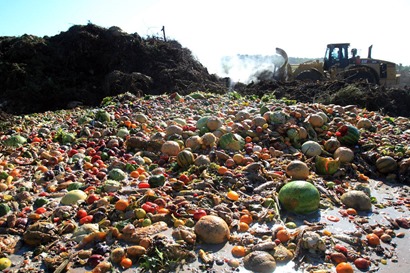
Instead, the real reason why people are starving is because capitalism says that it is better to throw away suboptimal vegetables, which means those that not conforming to the approved norm, instead of selling them (cheaper).
Cucumbers that are too small or too big, or have a bigger than permitted bend, apples that do not fit into the size and whatever criteria, and the same goes for potatoes, carrots and other fruit and vegetables that are not grown straight, and so on; they all are not allowed to be sold.
It is because of this kind of manic capitalist system there is hunger at home and abroad. It has nothing to do with an inability to produce enough food or the lack of suitable land and the amount of suitable land for growing produce. When we are told that we are being lied to. Already at present the amount of perfectly good edible food, though misformed, according to the standards, that is being thrown before it ever makes it to the shelves of the stores, or even the wholesalers, could feed the entire global population several times over.
Years back in Britain we had the so-called Agricultural Intervention Board which stepped in each and every time there was a glut, whether it was apples, potatoes, or whatever else, and ordered a proportion of the produce to be destroyed by being dumped in holes in the ground and having bleach poured over everything.
Today it is the wholesalers and supermarkets who make the decisions after having hammered into the heads of the consumers that vegetables should look a certain way and since then claim that they cannot sell the what we would lovingly call “ugly” fruit and vegetables, as no one would buy it as they are not esthetically right.
In addition to that, in Europe, there seem to be European Union regulations which specify ho much bend a cucumber, for instance, is allowed to have and any that fall outside that rule are to be destroyed. The same seems to go for the size and shape of apples, bell pepper, and so much more; potatoes even.
Anyone, however, who has ever grown fruit and vegetables in a garden, allotment, smallholding or farm will know that such engineering criteria almost cannot be applied to stuff that grown in the ground or on a tree and in the stages between. While we may be quite happy to eat the non-conform fruit and vegetables from our own garden – and those of us who would do that, I am sure, would also buy and eat such produce if it would come onto the market, especially when a little cheaper – such produce may not, legally, apparently, be sold on market stalls or in stores.
In times of glut have you ever notices that – generally – the prices do not fall in the store, at least not significantly. The reason for that is that only a certain amount of the produce is allowed to make it to the market so as to keep the prices artificially high. That is what was, in the older day, the task of the Agricultural Intervention Board in Britain and it would appear that the practice if still alive and well, only operated by different agencies; nowadays by the capitalist entities themselves.
It is not a lack of produce, of food, that is the cause of hunger in the world, especially not in the countries of the so-called West, but the capitalist system. And there is enough food being produced capable of also eliminating hunger in the Third World, especially if we would not force countries such as Kenya, and others, to grow food for the market in the West; food that the people there often would not, themselves, eat, as it is not part of their diet, such as green beans. Obviously the roses grown in Kenya for the market in Europe and elsewhere are not edible in the first place and take up valuable agricultural land and water.
© 2017


 Here's how you do hunger activism and community-building in an accessible, scalable, social, and fun manner, three loaves of bread at a time. Plus, a tasty bread recipe.
 The Archbishop of Canterbury has said he was left more shocked by the plight of Britain's hunger-stricken poor than suffering in African refugee camps.
 "It is easy to forget that once upon a time all agriculture was organic, grassfed and regenerative. Seed saving, composting, fertilizing with manure, polycultures, no-till and raising livestock entirely on grass—all of which we associate today with sustainable food production—was the norm in the ‘old days’ of merely a century ago, not the exception as it is now. Somehow, back then we managed to feed ourselves and do so in a manner that followed nature’s model of regeneration.