Showing posts with label container gardening. Show all posts

Urban gardening: The real green revolution

by Michael Smith (Veshengro)

urban gardening1Urban gardening, the gardening in the towns and suburbs, is highly political. Anyone who belittles this movement blocks his own view of this societal change.

If one would want to measure the success of a movement on the number of those that claim that it cannot possible be any good then the Urban Gardening Movement has during the few years that it has been in existence come a long way already.

Unfortunately there are some writers in newspapers and other media who belittle this to the extent that the state that those who long for the countryside and for gardening and farming should move to the countryside because towns and cities have been sealed, poisoned, and so on. They find it laughable that people are planting Marigolds in front of their doors or tomatoes on their balconies.

But many of those writers have actually no idea, it would seem, what this urban gardening and urban farming is all about. It is not about just growing food for oneself but to actually grow food for the people in the city, and in some cases those urban gardens are created in such a way that everyone can have the food for free (or almost for free) and the movement is growing regardless.

Urban gardening does not mean annexing of ground for private use but free access for all to grow food. It is a fact that the almost 500 urban community garden in Germany, for example, are some of the few places in the gentrified towns where people from different social strata meet in the public realm and interact by creating such gardens and working them.

Those urban community gardens are an innovative contribution to the restructuring of the living together in towns and cities where there is an increasing delineation between the different classes (and I do use the word class/classes here deliberately) which produces a great many risks for our living together in those spaces.

While growing produce for use by all, in community gardens “managed” and worked by all, by people from different strata and classes in the city, is one part of it such gardens also and especially aim to overcome the borders that have been created between people of different groups in society, in our increasingly gentrified towns and especially cities.

Through gardening together in reclaimed public spaces collective forms are created that can be seen as part of an ever strengthening commons movement even and especially in our towns and cities. Those forms could be the basis for new political framework to change society and all for the better.

Though not everyone may be realizing the potential that the urban gardening movement has to change the political structure and through it society as a whole. The powers-that-be, however, are well aware of its potential and thus use the media to belittle those that participate in this, whether in the form of community urban gardens or simply by trying to be somewhat more autark by turning their front and back yards and their balconies, etc., into spaces in which to grow at least some of their food.

People who are independent – to some extent – from the markets and people who join in community of whatever kind are perceived as a threat by the powers-that-be and thus every attempt possible is being made to discredit them in they eyes of the majority not as yet involved.

© 2017

Bucket crops: Mississippi man takes container gardening to another level

Some people are happy with a patio tomato on the porch.

Willie Anderson, 82, took container gardening to another level; he planted tomatoes, cucumbers, corn, okra, squash, peppers and eggplants in five-gallon plastic buckets in his yard in Red Banks, Mississippi. He now has plants in more than 1,000 buckets.

It’s easier to grow an entire garden if you’re planting everything in buckets, Anderson said. “There’s no hoe on the place,” he said. “We don’t need one.”

“You don’t have to have any equipment,” said his son, Ron Anderson. “You don’t have to have any utensils to farm with as far as hoes and shovels. You don’t have to have a tiller. All you do is plant, water and harvest.”

The garden is totally organic. “I use grass clippings, soybean stalks, cotton hulls — that’s the waste that comes out when they gin the cotton,” Willie said.

Read more here.

Across Africa, a New Kind of Container Garden Is Changing Women’s Lives

Growing food in sacks uses fewer resources and less labor and provides high yields too.

Residents of the Kibera slum in Kenya tend to vegetables planted in sack gardens. (Photo: Tony Karumba/Getty Images)

Some people have the talent to take a simple idea and adapt it into a solution with far-reaching benefits. Take Veronica Kanyango of Zimbabwe, a grassroots organizer who works in home-based health care and hospice for people with HIV/AIDS. She’s managed to take a couple of bags full or dirt and turn them into an agrarian movement.

“You show her a sack garden, and she’s turned it into a network of women who are producing lettuce and tomatoes for the Marriott hotel,” said Regina Pritchett of the Huairou Commission, a nonprofit that works on housing and community issues for women across Africa.

Using bags of the sort you stuffed yourself in for a race on field day—which are filled with manure, soil, and gravel—sack gardening or farming has been successfully adopted in areas of Africa where agriculture faces distinctly different challenges. It’s proved an effective way to grow food in regions with drought as well as areas prone to flooding, in rural communities and in urban slums. At the Grassroots Academy coordinated by the Huairou Commission in the spring of 2014, Pritchett said, the concept exploded.

“Of all the practices in the room, that’s the one people were most excited about. There’s not a high cost to get started, you’re not waiting on someone to give you seed funding. You could grab a sack and do that tomorrow,” she said.

Read more here.

How To Grow Fruits, Vegetables And Herbs In A Container Garden

Not everyone has access to a lovely yard full of rich soil and abundant sunlight. For those of us in cities, container gardens—growing plants in individual pots—is often the only option. But there are special considerations for container gardens. We spoke to Meredith Sheperd, founder of urban agriculture firm Love & Carrots, about how to get the most out of a container.

Most urbanites, and many suburbanites, are restricted to containers when planting a garden. Containers have a lot of advantages: they’re portable, cheap, and can be placed in awkward places, from yards to fire escapes to roofs. But they have special needs, too, and many home gardeners make some key mistakes that can prevent their fruits, vegetables and herbs from delivering home-grown deliciousness. So we’re going to walk you through the basics of setting up an expert-approved container garden.

It’s All About Sun
“When I’m helping someone set up a container garden, the first thing I look at is sunlight. That is the number one limiting factor as far as what’s possible,” says Sheperd. You want south-facing light, because you want the majority of your light to come in the morning. You might think that the more sun you can get, the better, but that’s not always true: harsh, broiling afternoon light can burn your plants and evaporate water too quickly for your soil to really absorb it. And in containers, that problem is amplified. “There’s less soil volume, so things do dry out more quickly,” says Sheperd.

Does The Container Matter?
There are hefty price differences among pots. You might think that a beautiful ceramic or terra cotta or galvanized steel container must have some superior growing ability compared with cheapo plastic containers. You’d be wrong. “It’s not really going to make a difference,” says Sheperd. All of those materials will work equally well (though Sheperd says terra cotta can tend to break down after a few years). If you want an expensive glazed ceramic pot because it looks great, that’s fine! But Sheperd actually recommends a cheap all-purpose bucket of the sort you can get at Home Depot for under $3 apiece.

The most important thing in container gardening, and the thing that almost everyone gets wrong, is not the material of the container but the size. “I’d say that size is the first factor,” says Sheperd. “You want to go bigger. Bigger means more soil volume, which means more root mass, which means it can hold more nutrients and water.” Small ornamental pots are cute when they hold seedlings, but they’re going to significantly retard your ability to grow plants. “I’ll often show up at people’s houses and they’ll have, like, a solo-cup-sized pot with a pumpkin plant in it,” says Sheperd. “And they’re like ‘I don’t know why I didn’t get any pumpkins!'”

Read more here.

No Garden? Here Are 66 Things You Can Grow At Home In Containers

http://themindunleashed.org/wp-content/uploads/2014/08/containersss.jpgGrowing your own food is exciting, not only because you get to see things grow from nothing into ready-to-eat fruits and veggies, but you also don’t have to worry about the pesticides they might contain, and you definitely cut down on the miles they—and you—have to travel.

As it turns out, with pretty minimal effort, anyone can be a gardener. My boyfriend and I are essentially first-timers this season and so far have the beginnings of strawberries peeking out, tomatoes are on their way, the basil’s about ready for a big batch of pesto, and once the last frost hits, the peppers, kale, spinach, chard, and mesclun will be on their way, too. All on a tiiiny little terrace (with the help of a little DIY carpentry).

If you’re up to the challenge—and it really isn’t much of one—growing your own food can be so rewarding. And so much cheaper! Just be sure to choose the right planter or container, learn how to maintain it properly, and go find yourself some seeds! (Or starter plants.)
Like this idea? Be sure to check out these 6 Crazy Concepts for Micro Gardens That Actually Work to get inspiration for designing your own garden in a small space.

Here’s a starter list of all the crazy things even urban gardeners, without space for a garden, can grow at home.

Read more: http://themindunleashed.org/2014/08/garden-66-things-can-grow-home-containers.html

4 Simple Steps to Grow a Hundred Pounds of Potatoes in a Barrel

Container gardening isn't only for savvy urban gardeners and folks with limited space to grow, it can also be for folks who want to maximize their yields in a controlled environment. Not only does growing potatoes in a barrel reduce the amount of weeding and exposure to pests and fungi, you don't even have to risk shovel-damage to the tender potatoes by digging them out of the ground when they're done, just tip the container over!

After extensive research to plan my own potatoes-in-a-barrel, I've boiled all of the recommendations down to 4 simple steps to a winning potato harvest.

1. Select and prepare a container

You'll need to pick out a container such as a 50-gallon trash barrel or one of those half whiskey barrel planters. Alternatively, you can buy used food-grade barrels or commercially-available potato planters. Just about any 2 to 3-foot tall container will work, but be sure to select a container that either already has holes in it, or is okay to cut holes in. Next you'll want to clean your container with a mild bleach solution to get out any of the nasties that have been lingering in there. If you don't want to use bleach, you can make a bleach alternative to use instead.

Good drainage is critical for the cultivation of healthy potatoes so you'll want to cut or drill a series of large drainage holes in the bottom and bottom sides of your container. Alternatively, you can cut out the bottom altogether and place it on a well-drained surface like your garden bed.

Read more: http://greenupgrader.com/11708/4-simple-steps-to-grow-a-hundred-pounds-of-potatoes-in-a-barrel/

Growing carrots in containers – yes, it can be done!

by Michael Smith (Veshengro)

Most people believe that carrots, potatoes and other root crops (as well as cabbages) cannot be grown in containers and need large beds of one kind or another. That, however, it not true.
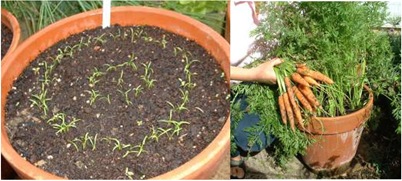
carrots_in_containersIt is easy to grow carrots (and other vegetables) in containers, be those large “flower” pots or other tubs. In fact, as far as container types are concerned the sky – or better your imagination – is the limit. Do NOT, however, plant any vegetables whatsoever in tires unless they did have inner tubes. The steel radial belted tires are not suitable as they leach cadmium into the soil which is taken up by the plants and is harmful to health. In fact, my advice is to leave tires well alone and use only, if you want to, for the growing of flowers, cut or other, but not for food. That means also no nasturtiums in tires as you may want to use the leaves and flowers as they are edible.

In order to grow carrots – and other veg – in containers all you have to do is get the container you want, and this can even be an old bathtub, fill with compost and this can be compost you have bought in or made yourself (or use the lasagna gardening method (and no, you won't be harvesting lasagna, however nice this would be), and then sow the carrots, or other veg. Or you can use plugs you have grown yourself from seed or bought. Do not, however, do this with carrots or their relations as they do not like to be moved.

If you use a round tub you can sow, I tend to do, in a circular fashion and don't fall for the instructions that you have to thin them out. You don't have to.

As I have said, the containers that you use are basically irrelevant. Just ensure there is enough depths of soil.

I have very successfully grown carrots in shopping carts converted to planters and, in fact, this year has me using a cart for this again where last year there had been pole beans growing in them.

Container vegetable growing with carrots has a lot going for it as the environment is so easy to manage, and this goes for about every kind of vegetable imaginable. It is the easiest way I know for how to grow carrots and any other vegetables. I also grow successfully potatoes in containers of various kinds and sizes and,, another word of wisdom from myself: You do not have to use seed potatoes either. Just use any that have sprouted, even supermarket bought ones.

Carrots in containers are target for the dreaded carrot (root) fly in the same way as those that are grown in beds. However, when the planters are about waist height off the ground the problem seems to be reduced to averted, as I found with the ones grown previously in a shopping cart.

If any roots of the carrots begin to show above soil level earth them up to cover the them in order to lessen the chances of a carrot fly attack. The fly is apparently attracted by the carrot smell and also you do not want the tops to green off.

Talking about greens. The greens of the carrots are also edible and make good soup so do not discard the leaves but use them instead. Waste not want not was the old adage of my grandparents and has seen them well through the lean years.

Sowing your carrot seed

Sown over the months from mid-February to July you can be eating carrots from early June to October. Storing this vegetable correctly can increase that period even longer. Below is a list of the average sowing and harvesting dates that will act as a rough guide on how to grow carrots at the correct times in the British Isles. They will vary in other areas, such as the USA, mainland Europe, and especially Down Under.

  • Sow mid February and protect with a cloche. Grow an early variety which you can harvest in early June.

  • Sow March and protect with a cloche. Grow an early variety which you can harvest in June/July.

  • Sow April - no protection necessary. If you grow an early variety expect to harvest July/August. A main crop variety will be ready August.

  • Sow May. Grow a main crop variety and harvest in August.

  • Sow June. Grow a main crop variety and harvest in September.

  • Sow July. Grow a main crop variety and harvest in October.

Remember that for container the spacing does not apply and, as said already, do not worry, necessarily, about thinning them. All too often you end up pulling those that you do not want to pull out with those you aim for.

Caring for your carrot plants

As you are growing them in a container using a hoe, with the exception of a small wire hoe, such as the Agralan Threadhoe, is not possible and thus you will have to remove any weeds by hand.

Water enough to keep the ground damp as splitting of the root can occur if the watering is too irregular. Also water with a liquid feed on a regular basis. They respond well to this.

Carrot pest control

The carrot fly is the carrots' worst enemy. It is a small black fly which lays its eggs in the soil at the base of the plant and it is the small maggot that hatches from those egg that causes the damage. The tell-tale signs of carrot fly infestation are reddish leaves which droop in sunny weather.

As the maggot eats out the carrot root the foliage turns yellow and the root is liable to rot. Needless to say seedlings are shown no mercy and are soon killed. The fly tends to be most common in May.

There is no known treatment against the carrot fly, even if one of the other chemical claims so and thus preventive measures are the only safeguard that you can undertake. It is essential to learning how to grow carrots and indeed any vegetable that you get to know your enemy.

  • Cover seedlings with a plant fleece in spring.

  • Destroy thinnigs immediately - bury, burn or trash can.

  • If carrot fly infestation is bad in your area then harvest early varieties no later than August and do not sow main crop varieties until June.

  • Infestation seems worst on dry soils so keep the ground damp at all times. This also prevents root splitting.

One thing to remember in learning how to grow carrots is that the carrot root fly's 'flight path' is low and in a straight line. It is for that reason that I said about placing the containers above ground at about waist height. Also makes it easier for your back in dealing with the plants.

If you grow at ground level then try erecting a low 'fence' around your carrot growing rows – about 30 cm (12") high. It could be made from fleece, fine netting or similar.

Harvesting your carrots

You can start harvesting the earlier varieties sown from about June onwards. Careful, even if grown in tubs, loosen the soil around the plants – you won't be able to use a garden fork, not even a border one, but a hand one will work – if necessary.

If you intend to store some of your crop of carrots for over winter then October is the best month for doing this. Lift the main crop varieties, clean off any soil – use only undamaged carrot roots – and cut the foliage back to about 12 mm (1/2") above the crown of the root.

Using a stout box place the roots on layers of sand – ensuring that the carrots do not touch each other and then store this box with the carrots in the sand in a dry place and inspect regularly to remove any that may have started to rot. This way they should keep until March.

Canning your carrots in a variety of ways is another great option and thus learning the skills of canning is also a good idea.

© 2013

Container Gardening

by Michael Smith (Veshengro)

Many people, including gardeners, believe that container gardening with planters and hanging baskets is only for flowers and other decorative plants. This is, however, not so.

Container gardening can equally be employed for growing vegetables and fruit and is especially suited for those with little or no yard space for such endeavors.

Colorful, low maintenance, and a quick gardening fix, that is container gardening, but also a great deal more. It is a great way of making use of all available space to grow the things that you want to grow.

The definition of container gardening is practically limitless and anyone from kids to the elderly to apartment and condominium dwellers and people with a limited amount of time can garden using containers.

From a simple pot of marigolds placed next to the front door to a balcony overflowing with a container garden masterpiece flowering vines, yellow, red, and green vegetables, and fruit trees, the only real constraint is your imagination.

Just about any container can be used as long as there are holes for drainage, and practically anything can be grown including annuals, perennials, herbs and vegetables. It is also possible to grow shrubs such as low bush blueberries and fruit trees as long as the container is large enough. In fact many plant- and seed breeders now produce plants and seeds designed especially for containers.

There are a couple of rules to successful container gardening however. It’s important to choose the right container for the job. It should be the right size, shape, and proportion for the plant that will be growing in it.

Use potting soil such as from your own compost, nice and crumbly, ideally, or, if you have to buy it in, instead for soil dug from the garden. Though I have done the latter and that has worked also, especially with trees and shrubs.

Plants should be grouped according to their growing conditions, therefore don’t mix shade and sun loving plants together or plants that prefer drier soil with those that thrive with more soil moisture.

Finally, plants growing in containers tend to need frequent watering and containers in full sun may require watering once or even twice a day so keep an eye on the moisture levels of the soil.

In addition use mulch. Well, use mulch anyway. It reduced the evaporation rate and the breaking down of the material creates a great soil below.

Almost anything can be grown in containers, as long as they are large enough and a container, as said, can be almost anything also. I have used everything up to and including old bathtubs and also woven polypropylene builder's bags, known, I believe, as tonne bags in the USA.

Beware with trees in containers, and I speak here from experience. If placed on bare ground their roots can and will break through the confines of the tub and will get into the ground and anchor themselves there.

While they tend to look good do not use terracotta planters. They will often not withstand cold winters and fall apart, as has happened with my strawberry planter and my herb planter, as well as other larger and smaller ones. Terracotta and other “stone” materials are also heavy as planters, especially when it comes to large ones and even more so once they have soil in them.

Always move your container to the site and then fill with soil, not the other way round. Saves your back for sure, unless you happen to have a sack-barrow you can use to shift it with.

© 2013

No Yard? No Problem?

by Michael Smith (Veshengro)

container-gardenMany people believe that in order to grow their own vegetables they need a large garden but container growing is a great way to have great tasting fresh vegetables even if you don't have the yard space for a full garden.

Container gardening is the answer for those that are short of space as regards to gardening, whether flowers, or as far as we are concerned, vegetables for the table.

Growing in containers, with loose and deep soil, also allows the plants to be closer together and thus the density of them does away with an over-amount of weeds and also makes for a larger harvest.

The type of containers for this kind of growing is legion and you can go out and buy decorative ones at a cost or, alternatively, repurpose any other kind of container, including old bathtubs, sinks and the like. It just depends as to whether you want a certain look or just simply a food garden for as little outlay as possible.

Aside from putting your planters on the ground you can also use containers in the vertical, by hanging them up, putting them on old stepladders, etc.

certain trailing tomatoes, for instance, do well in hanging planters and hanging baskets and some plants can, actually, also be grown hanging upside down.

Pot and other containers hung on a fence or a wall can be used to grow herbs and spices and the do do very well in such situations. Also much easier to harvest if they are at the right height.

I have filled my yard, even though I could have been digging or using raised beds, with containers of all kinds that have been repurposed into planters, including so-called builder bags or tonne bags, plant buckets and tubs from tree planting, etc. Even old shopping carts have been drafted into use, lined with barrier fabric and such, as planters.

The latter are ideal for use with growing carrots as they are above the height of the carrot fly's vector and thus are more or less out of its reach to it.

That does not mean, unfortunately, that a container garden will be immune to pests. It is not, and neither to weeds. However, you have a little better access to each and every plant to check and manually destroy pests or remove weeds.

Using containers in your yard you can still have a garden and grow at least some food for your table even if you do not have the space for a proper garden.

So, go and dig some dirt and grow some tasty veg. You no longer have any excuse.

© 2013

The CobraHead® Weeder and Cultivator & CobraHead® Long Handle Tool – Product Review

Review by Michael Smith (Veshengro)

The CobraHead® Weeder and Cultivator is a tool that was developed by Noel Valdes, the owner of Cobrahead LLC, as a result of his gardening hobby. The blade is called a cultivating tine.

The US garden tool industry cranked out hundreds of thousands of long handled tools with three and five of these blades on tightly curved tines locked into cast iron heads and with various forms of attaching screws., and the same is true for the garden tool industry in Britain and elsewhere. Those cultivators could be found all over.

Production ceased sometime in the late 1950s in the USA with the collapse of gardening as a necessity by most Americans. The old tools are still out there, and many are still in use by hard-core gardeners.

Noel modified the blade to work as a short handled weeder and cultivator. The tool is primarily a weeder, but it is an excellent cultivator and also an extremely useful planting device. Using it is mostly intuitive, but think of it as a "steel fingernail®" and its logic should become apparent.

It scrapes, scratches, and digs. It can extract huge tap roots, pull out grasses, and shave off small weeds. It works in the tightest areas, but it can cover an amazing amount of ground for such a small tool. It can clean out the cracks in pavers and flagstones. It lays down an excellent furrow for seeds and it makes a nice hole for transplants or bulbs. Its uses are, as they say, limited only by your imagination.

The CobraHead® Long Handle is actually a variant of another tool that used to be made in the US. It was called a single tined cultivating hoe. It used the same blade shape, but with a more pronounced curve, similar in shape to a shepherd's crook.

Noel realized an advantage of making the sharp all-around, flat blade absolutely perpendicular to the handle and this tool can be used as a scalping or scuffling hoe and by holding the tool like a broom, one can sweep off small weeds before they get established. With it, you have both excellent reach and the ability to work in the tightest areas. The tool is also a superb cultivator, and what it lacks in width, it more than makes up for in the efficiency of having the thin blade cut through soil with very little resistance.

As a company Cobrahead LLC decided to “walk the green walk” from the outset as regards tool production and for the company's business model.

The tools are made locally, right there in Wisconsin and all the rawmaterial inputs for both the tools are US sourced. The small tool features steel with a recycle content of at least 60% . Its handle is a unique "bio-plastic" – an injection molded blend of 80% recycled polypropylene and 20% agriculturally grown flax fiber. The flax makes the plastic lighter and stronger.

The long tool features replaceable parts, so should the blade be broken, the tool does not need to be discarded, but can be repaired. The handle is North Carolina ash, considered the best for wood handles of this type.

The CobraHead® Long Handle has an MSRP in the States of $59.95. It is available for that price (including shipping) from the company's website at www.cobrahead.com, and stores and catalogs listed on the site.

Customers outside the USA and Canada can order directly from the website but there will be a delivery charge added then to the cost of the tool(s).

I have have received samples of both the small tool and the big tool for review and I must say that the tools definitely live up to what has been said about them and the workmanship is superb.

They work both very well in small spaces while, as said, they can also cover large areas easily.

The CobraHead® tools are ideally suited for work in market gardening and raised bed operations and the intensive close growing operations that are favored now by many that grow produce for personal use and also for sale.

Having a tool that can weed, hoe and till the soil all in one, so to speak, is a great way to go and the depth of the tillage is very good as well. The CobraHead® tools are the kind of tools you always were looking for but did not know that they existed or you did not believe that they could work that well.

Personally I would not want to be parted from those tools ever again as far as my own gardening work is concerned. I am definitely finding the CobraHead® tools to be indispensable aids in my vegetable gardening endeavors.

© 2009
<>

Harvest Lunch From Your Patio

Yes, it is possible.

by Michael Smith

As we have discussed in previous articles it is possible to grow vegetables for the table, from salad veggies to potatoes and other crops in a small space and even in containers on a patio or a balcony even.

With the prices of food, for one, increasing by the day, so at least at this present time it would seem, and food miles, that is the amount of miles and energy it takes from pitchfork to dinner fork, being more and more important for those of us that want to have a smaller environmental footprint (as I have said before, I do not use the term “carbon footprint”), growing our own food is something we can do to less the impact; to some degree at least.

That is one of the reasons that I grow my own vegetables and want to increase the amount that I grow per year now and also the space in which I grow them.

While I am no vegetarian and also know that the human body is not actually meant to just live of vegetables I do want to have a more vegetable-based diet, and that not only because of the fact that meat prices have, recently, gone through the roof. However, wood pigeons and squirrels are quite abundant in my location and many of them will find themselves into the freezer from now on, and this not only because of the price rises. They have had a field day in my garden, in the crops this year, and so, hence they have eaten my vegetables I am going to eat them.

And before any of the love the furry critter brigade now come screaming at me I would like to say one that gray squirrels are under the status of vermin in Britain and that there is an official cull order out on them and two I ask all the vegetarians, as I did with regards to those at the Carshalton Green Fair, namely think what would happen to the animals that you think you would protect if every person in the world would change to become a vegetarian tomorrow. With the exception of chickens for eggs and cows for milk and sheep for wool all others would be killed and destroyed for no farmer, and no one else either for that matter, will spend money feeding those animals for no reason. In addition to that, if we really would have to all live of vegetables deer and others animals that “attack” food crops also would soon no longer be amongst us, for if we would not eradicate them to protect our food then we humans would soon all face starvation. It is all fine and good to think of how cute all those animals are and I too like them all as well but, and here comes the big but, they owe their general existence and life, however short it may be, only to the fact that humans like to eat them. But I digressed.

When you turn your patio into a backyard veggie garden you can bring your food miles down to almost zero, at least as regards to those veggies that you can grow there. It goes some way towards reducing your impact on the environment.

By just eating 20% less meat a week, it is reckoned that one could save as as much gas as driving a hybrid car. Obviously, if you grow your own vegetables at home or at an allotment then, by cutting down those food miles you are reducing that impact even further, as the transportation costs for the vegetables that you eat but did not buy in a store are zero in that case.

The Royal Horticultural Society in the United Kingdom has shown that even in a 3x3m square raised bed set up a family can grow – in a rather intensive way, which is to say to plant new stuff as soon as the other stuff comes to an end – fresh vegetables for the table all year round. It will still take me a while before I am even anywhere near that. But, as it can be done, I shall endeavor to do so and I hope that others will do the same.

I have this year, for a trial, grown potatoes in cardboard boxes , and without doing much to them, got quite a good crop for no real input at all, as the potatoes used as seed were just simply supermarket potatoes that had grown some sprouts. So, another proof that it can be done with little material input. It would have been a lot better had the boxes been deeper and had I continued to add soil and such. However, the trial worked and more of this next year.

© M Smith (Veshengro), September 2008
<>

Grow your own small vegetable garden

Even the smallest space can produce plenty of vegetables, even a patio can

by Michael Smith (Veshengro)

I am no market gardener, that's for sure, and I have varied success with my own small garden in that fashion but that is due to the location and the fact that I get overrun by slugs and snails and also the squirrels and pigeons think that my garden is a feeding station for them. Well, it is not but try telling them that.

Also, I must add that I am not the most consistent home gardener, as I am often too busy with writing material for the many magazines that I own and edit.

However, while I doubt that most families could become entirely self-sufficient (then again, is complete self-sufficiency even possible?) in the suburbs on their patio and/or small part of garden that they are often only willing to sacrifice for food growing, the food thus grown can go someways towards reducing food miles and costs.

Obviously, the bigger the area the more food you can grow. But, having said that, lots can be done in a small space. This was shown at the “Grand Designs Live” exhibition with the small garden that was shown there and also in other places. It is possible.

If you do not want to build raised beds with timber, bricks or whatever, then there are nowadays a couple of companies that produce “clickable” plastic siding that make then up a raised beds. But be warned! They are not cheap but they will last nigh on forever, unlike timber.

However, there are many other options for building a small garden – I mean other than digging up the ground. On a patio you would not and could not do that anyway. So, here comes “container gardening”.

There are containers and there are containers for gardening, obviously, From the old style terracotta put and tub to the plastic ones and everything else. You do not even have to go and buy such containers, as they can often be found thrown away. Old washing-up bowls can be used, the pots that contained trees from nurseries, the barrels that contained cooking oils – cut in half makes two – and many more. In addition to that there are the large bags in which building sands and the likes comes nowadays. Fold over the sides and – voila – one square raised bed of rather some depth.

The tubs presently mentioned all – bar the containers that once will have had trees in them – will require holes for drainage drilled into the bottom. I handle that quite simply and quickly here; a few shots of target practice with a .22 air rifle and, well, drainage holes. Who said they had to be x-amount of millimeter in size and perfectly round?

That is container gardening on the cheap, basically. It beats – in cost at least – any store bought tubs for plastic tub/container gardening.

In addition to that there are other containers that can be employed as well. Know of an old bathtub, whether iron (well, they are worth money...) or fiberglass? They too make great planters for vegetables.

There have been articles around about the advantages of growing your own vegetables and in them it is pointed out that not only do people waste less food by being able to go pick fresh vegetables when they need them, but the cost of having a small garden compared to buying fresh produce from the grocery store can save us all a lot on food.

So, what's stopping you?

© M Smith (Veshengro), July 2008