Showing posts with label Grow your own Vegetables. Show all posts

Grow your own – An act of defiance

by Michael Smith (Veshengro)

Growing your own, as well as making your own, are acts of true (non-violent) resistance and will really upset the applecart – even if you don't grow apples in your garden.

grow your ownWhen you grow at least some of your own things and make many of the things that you want and need yourself you take away many of the measures of control from the government and the powers-that-be.

This is true even more so when you do things for yourself also on other levels and, maybe, even can get others to do the same, as individuals, families and groups.

This, however, tends to scare the proverbial excrement out of the powers-that-be and they will go to all manner of lengths to suppress such acts of defiance of the system, as they see it, is not even as terrorism.

Yes, as acts of terrorism for they even likened thriftiness not so long ago as “acts of domestic terrorism” as those that do not spend, spend, and spend even some more, in order for us to spend our way out of the recession, as just that... domestic terrorists, as they are not supporting the economy.

People who can, and are prepared to, provide for themselves, their families, and their communities, are but an anathema to the powers-that-be. They do not fit into the plan (of total control). Where would the world and the economy come to if everyone would be able to provide for themselves, their families and, maybe, even for their communities? The system would (as it should) collapse.

One of the greatest acts of defiance this is as in doing so we basically tell the government and the powers-that-be to “shove it”.

The most dangerous sentence one can ever hear is” “I am from the government and I am here to help you”. It does not mean what most people seem to think that it does but government interference as soon as the “help” is accepted.

Grow your own, make your own, and do things for yourself, including foraging and be as self-reliant as possible, as individuals, groups and communities. It reduces your reliance on the system and thus gets you away from the control mechanism of the powers-that-be.

Government is doing all that it can, though, to some degree disguised, to stop you from being self-reliant, especially in the food department. It is not in their interest, whatever they may claim, and in some places it is being made quite obvious with the banning of people gardening as regards to the growing of vegetables, of food, rainwater harvesting, and doing things for themselves up to and including homeschooling.

In Britain, and many other European countries, we can still count ourselves lucky, compared to the USA and Canada, in that respect, as far as the gardening is concerned (and also homeschooling in Britain), as we are actively being encouraged to grow our own food, harvest rainwater, and such. Albeit with restrictions as to what seeds we can use and therefore what food we can grow by the European Union. Thriftiness, on the other hand, and total self-reliance is an anathema to the governments here as well, it would seem.

When we grow our own stuff, make our own things, etc. we throw a seriously large spanner into the works of government control. Self-reliance is a powerful statement especially if we do as much as possible ourselves. Growing your own is but a part of it, though a significant part.

© 2013

Growing carrots in containers – yes, it can be done!

by Michael Smith (Veshengro)

Most people believe that carrots, potatoes and other root crops (as well as cabbages) cannot be grown in containers and need large beds of one kind or another. That, however, it not true.
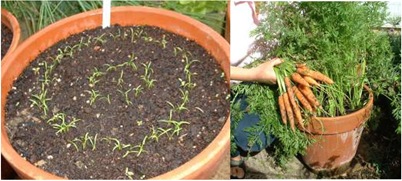
carrots_in_containersIt is easy to grow carrots (and other vegetables) in containers, be those large “flower” pots or other tubs. In fact, as far as container types are concerned the sky – or better your imagination – is the limit. Do NOT, however, plant any vegetables whatsoever in tires unless they did have inner tubes. The steel radial belted tires are not suitable as they leach cadmium into the soil which is taken up by the plants and is harmful to health. In fact, my advice is to leave tires well alone and use only, if you want to, for the growing of flowers, cut or other, but not for food. That means also no nasturtiums in tires as you may want to use the leaves and flowers as they are edible.

In order to grow carrots – and other veg – in containers all you have to do is get the container you want, and this can even be an old bathtub, fill with compost and this can be compost you have bought in or made yourself (or use the lasagna gardening method (and no, you won't be harvesting lasagna, however nice this would be), and then sow the carrots, or other veg. Or you can use plugs you have grown yourself from seed or bought. Do not, however, do this with carrots or their relations as they do not like to be moved.

If you use a round tub you can sow, I tend to do, in a circular fashion and don't fall for the instructions that you have to thin them out. You don't have to.

As I have said, the containers that you use are basically irrelevant. Just ensure there is enough depths of soil.

I have very successfully grown carrots in shopping carts converted to planters and, in fact, this year has me using a cart for this again where last year there had been pole beans growing in them.

Container vegetable growing with carrots has a lot going for it as the environment is so easy to manage, and this goes for about every kind of vegetable imaginable. It is the easiest way I know for how to grow carrots and any other vegetables. I also grow successfully potatoes in containers of various kinds and sizes and,, another word of wisdom from myself: You do not have to use seed potatoes either. Just use any that have sprouted, even supermarket bought ones.

Carrots in containers are target for the dreaded carrot (root) fly in the same way as those that are grown in beds. However, when the planters are about waist height off the ground the problem seems to be reduced to averted, as I found with the ones grown previously in a shopping cart.

If any roots of the carrots begin to show above soil level earth them up to cover the them in order to lessen the chances of a carrot fly attack. The fly is apparently attracted by the carrot smell and also you do not want the tops to green off.

Talking about greens. The greens of the carrots are also edible and make good soup so do not discard the leaves but use them instead. Waste not want not was the old adage of my grandparents and has seen them well through the lean years.

Sowing your carrot seed

Sown over the months from mid-February to July you can be eating carrots from early June to October. Storing this vegetable correctly can increase that period even longer. Below is a list of the average sowing and harvesting dates that will act as a rough guide on how to grow carrots at the correct times in the British Isles. They will vary in other areas, such as the USA, mainland Europe, and especially Down Under.

  • Sow mid February and protect with a cloche. Grow an early variety which you can harvest in early June.

  • Sow March and protect with a cloche. Grow an early variety which you can harvest in June/July.

  • Sow April - no protection necessary. If you grow an early variety expect to harvest July/August. A main crop variety will be ready August.

  • Sow May. Grow a main crop variety and harvest in August.

  • Sow June. Grow a main crop variety and harvest in September.

  • Sow July. Grow a main crop variety and harvest in October.

Remember that for container the spacing does not apply and, as said already, do not worry, necessarily, about thinning them. All too often you end up pulling those that you do not want to pull out with those you aim for.

Caring for your carrot plants

As you are growing them in a container using a hoe, with the exception of a small wire hoe, such as the Agralan Threadhoe, is not possible and thus you will have to remove any weeds by hand.

Water enough to keep the ground damp as splitting of the root can occur if the watering is too irregular. Also water with a liquid feed on a regular basis. They respond well to this.

Carrot pest control

The carrot fly is the carrots' worst enemy. It is a small black fly which lays its eggs in the soil at the base of the plant and it is the small maggot that hatches from those egg that causes the damage. The tell-tale signs of carrot fly infestation are reddish leaves which droop in sunny weather.

As the maggot eats out the carrot root the foliage turns yellow and the root is liable to rot. Needless to say seedlings are shown no mercy and are soon killed. The fly tends to be most common in May.

There is no known treatment against the carrot fly, even if one of the other chemical claims so and thus preventive measures are the only safeguard that you can undertake. It is essential to learning how to grow carrots and indeed any vegetable that you get to know your enemy.

  • Cover seedlings with a plant fleece in spring.

  • Destroy thinnigs immediately - bury, burn or trash can.

  • If carrot fly infestation is bad in your area then harvest early varieties no later than August and do not sow main crop varieties until June.

  • Infestation seems worst on dry soils so keep the ground damp at all times. This also prevents root splitting.

One thing to remember in learning how to grow carrots is that the carrot root fly's 'flight path' is low and in a straight line. It is for that reason that I said about placing the containers above ground at about waist height. Also makes it easier for your back in dealing with the plants.

If you grow at ground level then try erecting a low 'fence' around your carrot growing rows – about 30 cm (12") high. It could be made from fleece, fine netting or similar.

Harvesting your carrots

You can start harvesting the earlier varieties sown from about June onwards. Careful, even if grown in tubs, loosen the soil around the plants – you won't be able to use a garden fork, not even a border one, but a hand one will work – if necessary.

If you intend to store some of your crop of carrots for over winter then October is the best month for doing this. Lift the main crop varieties, clean off any soil – use only undamaged carrot roots – and cut the foliage back to about 12 mm (1/2") above the crown of the root.

Using a stout box place the roots on layers of sand – ensuring that the carrots do not touch each other and then store this box with the carrots in the sand in a dry place and inspect regularly to remove any that may have started to rot. This way they should keep until March.

Canning your carrots in a variety of ways is another great option and thus learning the skills of canning is also a good idea.

© 2013

Growing your own food is like printing your own money

by Michael Smith (Veshengro)

Growing your own food is like printing your own money, but, unlike the latter the former is, for the moment still, legal. There are, however, some places in the USA and Canada that wish to forbid the growing of food in your garden, even your backyard and not just the front lawn.

It was, so it is understood, Henry Kissinger, who said that “if you want to control nations you have to control fuel; if you wish too control people you have to control food” and it is that, it would appear, that the powers-that-be are hard working at.

When you grow your own groceries, your own vegetables, though you may also raise chickens (for eggs and meat) and, say rabbits for meat, in your garden, you first of all know where your food comes from and what was put on it, and secondly you save money, even if you only grow those foods that you eat most.

So, go and dig the dirt and print, or better, in fact, grow your own money.

© 2013

No Yard? No Problem?

by Michael Smith (Veshengro)

container-gardenMany people believe that in order to grow their own vegetables they need a large garden but container growing is a great way to have great tasting fresh vegetables even if you don't have the yard space for a full garden.

Container gardening is the answer for those that are short of space as regards to gardening, whether flowers, or as far as we are concerned, vegetables for the table.

Growing in containers, with loose and deep soil, also allows the plants to be closer together and thus the density of them does away with an over-amount of weeds and also makes for a larger harvest.

The type of containers for this kind of growing is legion and you can go out and buy decorative ones at a cost or, alternatively, repurpose any other kind of container, including old bathtubs, sinks and the like. It just depends as to whether you want a certain look or just simply a food garden for as little outlay as possible.

Aside from putting your planters on the ground you can also use containers in the vertical, by hanging them up, putting them on old stepladders, etc.

certain trailing tomatoes, for instance, do well in hanging planters and hanging baskets and some plants can, actually, also be grown hanging upside down.

Pot and other containers hung on a fence or a wall can be used to grow herbs and spices and the do do very well in such situations. Also much easier to harvest if they are at the right height.

I have filled my yard, even though I could have been digging or using raised beds, with containers of all kinds that have been repurposed into planters, including so-called builder bags or tonne bags, plant buckets and tubs from tree planting, etc. Even old shopping carts have been drafted into use, lined with barrier fabric and such, as planters.

The latter are ideal for use with growing carrots as they are above the height of the carrot fly's vector and thus are more or less out of its reach to it.

That does not mean, unfortunately, that a container garden will be immune to pests. It is not, and neither to weeds. However, you have a little better access to each and every plant to check and manually destroy pests or remove weeds.

Using containers in your yard you can still have a garden and grow at least some food for your table even if you do not have the space for a proper garden.

So, go and dig some dirt and grow some tasty veg. You no longer have any excuse.

© 2013

Mixing flowers and vegetables

by Michael Smith (Veshengro)

The majority of people, even gardeners, always think of flower gardens and vegetable gardens as two separate entities, but there is absolutely no reason to think that this is the way it has to be.

flowers&vegOn the contrary. Think about the kitchen garden of colonial days in the United States and the cottage gardens of England. It was a mix of vegetables, fruits, flowers, and herbs.

While some see this as companion planting it is not, necessarily thus, as the plants may not be chosen for the companion value. Companion planting, on the other hand, is something that would make such a mixed flower and vegetable garden even better.

Such a vegetable-flower garden can be seen as an artistic palette, strictly for appearances and enjoyment. And with proper mix there is no reason, other than idiotic ordinances in many parts of the United States (and Canada) to have such a garden also in the front yard. Apparently, however, the powers-that-be in some town halls and such demand that the front yard is but lawn and maybe, just maybe, some pretty flowers.

Your vegetable-flower garden can be orderly or not so orderly. It depends on your personal style and choice. As a front yard food and flower production area it might be best to have it rather orderly as to not to upset some town hall folks.

You do however need to take into account the growing style of the vegetables and flowers. Pumpkins, cucumbers, and squash need lots of horizontal room to grow so you want to avoid planting flowers too close. Unless, that it, you train those plants to climb trellises, which most will quite readily do.

Think about plant forms and foliage too. Peppers are upright and shrub-like. Corn is tall, vertical, and leafy but would look terrific mixed with sunflowers. Or, concentrate on color combinations such as white, purple, and pink for earlier flowering vegetables and flowers, or yellow, red, and orange for late summer crops and blooms. The gold color of marigolds and the dark green of spinach for example or red flowers of nasturiums next to those bright red chile peppers.

You could also add some colorful brassicas into the equation. Despite the fact that some people see them just as, as they are also referred to by seed merchants, ornamental cabbages, they can be eaten and thus make for a great color combination, even still giving color in the depth of winter.

When it comes to planting corn why not follow the Native American approach and plant the Three Sister, that is to say corn, bean and squash together. The corn then acts as a trellis for the beans and even the squash to climb up and they seem to love to live together in perfect harmony.

© 2013

Now is the time to think about vegetable seeds

by Michael Smith (Veshengro)

sns024Now is the time to think about which seeds to sow and plant in your vegetable garden for the year.

The choices are great but there are some varieties of vegetables that are best for all year round cropping and also don't forget the humble edible weeds. They grow better than anything else and are sure worth “cultivating” too.

This notion may seem silly to many a gardener but why battle with your weeds when you can eat them. (More later).

When it comes to the, if I may say so, ordinary vegetables to sew and plant, as said, there is a great variety out there but, alas, at times the choice is limited.

Let's look at beans: While there are many different kinds of beans that can be grown, including in the British Isles, all we seem to see if different “varieties” of runner (Lima), broad (Fava), and French beans, with a few other kinds. The rest of the great armory of beans that exist cannot be found with the great majority of seed companies in Britain.

Asking a representative of one of them one day I got the answer that there was no one interested. Really?

Also amazing is the fact that most people, including avid gardeners, have no idea that they can actually use the beans inside the runner beans after they have become stringy and can no longer be used in the way that they have become accustomed to. Those beans are the same as the dried Lima beans that are found in stores.

Other vegetables, as far as seeds and plants are concerned, also can be rather limited in Britain, and I mean here the kind that are commonly used elsewhere, including mainland Europe.

The same is true for, so at least I have found, potato varieties, but, then again, I do not, generally, buy seed potatoes and there is absolutely no need to do so. I know everyone – or almost everyone – keeps telling us that we must buy seed potatoes in order to grow healthy spuds. Really? I beg to differ here.

I have had nothing but problems with seed potatoes, especially with so-called blight resistant ones. Got a load of them from the Garden Press Event 2012 and they were the ones that, actually, the first ones that had the blight that year. The ones that I grew from cheapest Sainsbury's potatoes that had grown eyes were much more resistant. Sorry, but no more seed potatoes for me.

So, let's now look at what I mentioned before, namely the use of weeds for food. Many common garden, pardon the pun, weeds are edible and, in fact, are very good for us, and they are indeed legion.

Dandelion is one weed that, I am sure, everyone knows and regards as rather pesky. But not so. It is very edible indeed and great in salads or as spinach. I live the look on the faces of folks that ask me – being a professional gardener and forester – as to wht they are to do with the dandelion in their garden when I tell them to eat the stuff.

Another very useful weed is stinging nettle, Again it has many uses and should be used rather than wasted. Sorrel is another one which is, basically, a cut and come again spinach and I use it as it and don't just gather it in the wild, where it is mostly found, but have actually planted some of it in my garden.

Another very common weed in the garden that will take over if not checked but which is nutritious and good to eat is chickweed. And another one is Fat Hen, aka Lambs Quarter. The latter is, yet again, a most versatile one the leaves of which can be used as spinach, but also the stalk and the flower spikes can be eaten, the former steamed like asparagus and the latter like broccoli.

So think seeds and weeds for food in your garden and see how it can work out.

© 2013

Growing your own has many advantages

by Michael Smith (Veshengro)

Growing your own food is becoming once again more and more popular though, while in some areas an allotment cannot be had for love or money in other boroughs they go begging.

No-Till Gardening When you grow your own you can choose to grow for your own tastes rather than the supermarket conformity and in time you will also chose what to grow because it grows OK in your garden rather than trying to grow everything only to fight a losing battle.

I have just come to that conclusion with regards to my food growing in my at home allotment as some things just will not do well here. There are the slugs and snail to contend with and then the location of this garden – with the property being surrounded by trees – lacks the right light condition for some foods.

Potatoes do well, as do Jerusalem Artichoke (aka Sun Chokes). Beans of all types seem to do fire as do carrots, as long as they are grown “at height” to be safe from the root fly. Some abandoned shopping carts do invaluable service there.

Cucumbers, courgettes (zucchini), marrows, etc., also do well. Tomatoes on the other hand do not and brassicas time and again fall prey to the pigeons and the snails and slugs of all types and sizes.

So, I will be, for the next year, chose carefully what I will bother with and what not, as wasting my time I do not wish to do, as I did with the brassicas this year, once again.

While I know that nets would be fine to keep some things at bay, such as the pigeons and the cabbage white butterfly, etc., the snails and slugs seem to be a great menace that even nematodes and slug pellets have problems dealing with.

One the positive note, as said, growing your own is beneficial in many ways and taste, as far as I am concerned is a great reason, aside from the fact that you can save some money.

One skill I advise anyone to learn who thinks of starting or who has started to do his or her own food growing and that is preserving the harvest in which way ever. Pickling, canning, and all the other ways of old – plus freezing – are the skills to have to not waste the harvest.

So, get to it and touch the soil.

© 2012

Grow Your Own Vegetables – Book Review

Review by Michael Smith (Veshengro)

Grow your own Vegetables
by Joy Larkcom
2011 abridged edition of the 2002 Frances Lincoln Edition
Frances Lincoln in association with Marshalls Seeds
Paperback 360 pages
ISBN: 978-0-7112-3264-8
Price: £ 9.99

GrowYourOwnVegBook This book, with illustrations by Elizabeth Douglas, is very much a vegetable grower's manual along the lines of books on this subjects that you would have found during the “Dig for Victory” campaign in the Second World War and just after.

It is an easy book full of valuable information on growing, harvesting and storing vegetables of all kinds.

I would say that “Grow your own Vegetables” by Joy Larkcom is a goldmine of information for the beginners who wants to have a go at growing some of his or her own food, as much as for the experienced vegetable gardener.

Just thumbing through its pages I already picked up a fair number of points and tips, some of which, I must say, I did not even know. A gardener, it is true, never finished learning.

This is a book that I can most highly recommend and at £ 9.95 it is not going to break the bank and is a good investment in your future food security, or at least in the preparation for it.

© 2011