Showing posts with label autumn. Show all posts

4 Fall Gardening Tips That Will Save You Money All Year Long

illustration of man on top of trowel in garden

Attending to your yard now will save time, money, and maintenance all year long.

Though spring gets all the garden-center glory, fall is a far better time to invest in your landscape. Doing the work now can save you a bundle in upfront costs—and it will continue to pay dividends all year. Not only do autumn plantings require less water and fertilizer, they also will have that much more time to get established before the withering heat of summer, which in warm climates can easily kill new plants. “But even where summers are milder, fall planting is lower cost and lower risk,” says Barbara Pierson, nursery manager at garden catalogue company White Flower Farm. Here’s what to do:

Pick Up Plants For Less

Many nurseries put their stock on sale in the fall to avoid storing it over the winter. You can save 40% to 50% off the price of plants, grass seed, even tools. “Don’t worry if plants have a few brown leaves,” Pierson says. “Remove them from their pots and make sure the roots are vibrant and not mushy.”

Better yet, skip the nursery and get your plants for free. Fall is the best time to “divide” spring-flowering perennials, such as day-lilies and peonies. You can literally cut a piece, roots and all, off your favorite specimens from the yards of friends and neighbors (with permission, of course) and pick a spot for them in your yard. This process is beneficial to the original plant, and something colorful that would otherwise set you back $10 to $20 or more costs absolutely nothing. (See burpee.com for instructions.)

Just make sure to get everything in the ground at least six weeks before your average first ground-freeze date; ask at a local nursery.

Read more here.

When Is The Best Time To Plant Trees?

Give them the best chance of survival.

planting fruit trees in the fall

Many trees grow well when planted in fall, says arborist Tom Tyler of Bartlett Tree Experts. Although people often associate planting with spring, fall offers some advantages, he explains. "Warm soil encourages root growth prior to the onset of winter, while air temperatures tend to be cooler and more stable, reducing the amount of stress on newly planted trees. Fall rains make it easier to dig and provide ample moisture." Container-grown and balled-and-burlapped trees are best for fall planting; bare-root plants should be planted while they’re dormant.

Read more here.

Low angle of Autumn sun spells danger for eye health

by Michael Smith (Veshengro)
When the sun crossed the celestial equator on the Autumn Equinox, which happened in the Northern Hemisphere (Britain) on September 23, 2014 at 02:29 GMT, the highest point on its trajectory reduced to just 40-degrees. This means that when the sun is high in the sky, such as at the height of Summer, our brow bone acts like a built in sun shade and prevents damaging UV light entering the eye.

When the sun is low in the sky, such as during the Autumn months, and still more so in winter, but also in Spring, the total amount of UV radiation your eyes are exposed to increases dramatically.

Cumulative UV exposure has been found to promote the onset of cataracts and has been implicated in the development of a range of other eye conditions including photokeratitis, pterygium and macular degeneration – the UK’s leading cause of blindness.

One simple way you can tell if your eyes are in danger of UV damage is to look at your shadow. If your shadow is taller than you, you should protect your eyes using a hat, sunglasses or UV protective lenses.

Simple strategies for staying safe in the sun

  1. Protect your eyes whenever the UV Index rises to three or more – even on a cloudy day. (Over 90% of UV can transmit through the clouds). For comfort you may also wish to wear eye protection on bright days when the UV Index is below three.

  2. Wear sunglasses with a CE; UV 400 or BS standard BSEN1836 : 2005 mark – this ensures they provide adequate UV protection.

  3. Make sure that your children never wear toy sunglasses. These offer little to no UV protection and can actually cause more damage because the tinted lenses dilate the pupil allowing more UV light to enter the eye.

  4. If you wear spectacles, check your lenses provide UV protection.

  5. Make sure your eyes and area around your eyes is fully covered. Large lenses and wrap-around styles provide the greatest protection.

  6. Wear a hat, cap or visor for added protection

  7. Sit or play in the shade

  8. Stay out of the sun between 12pm and 3pm when the sun’s rays are strongest. Up to 50% of the total daily UV is emitted between these times!

  9. Never look directly at the sun, this can permanently scar the retina.

  10. Remember the shadow rule…
    … If your shadow is taller than you are your eyes are at greatest risk from UV exposure, as your brow bone no longer offers natural protection.

© 2014

How to forage for fresh food this autumn

by Michael Smith (Veshengro)

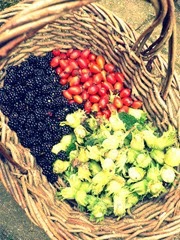
autumn_foragingAutumn, or Fall as our American cousins call it mostly, is the season for fruits, nuts and fungi on the foraging list.

However, when it comes to fungi, that is to say, mushrooms and the foraging of them for food make sure that you really know what you are looking at and what you intend to pick. If not sure leave well alone. Even with a book or app for you smartphone still does not guarantee that you will be able to safely identify if you have not been taught well.
As one of the latest foodie trends, foraging has become a popular way to find delicious plants, berries and nuts growing wild.
Foraging not only gives access to fresh and seasonal healthy foods, it's also a great way to get outdoors to where our food really comes from – as opposed to the supermarket aisles and plastic packaging where it eventually ends up.

Berries, mushrooms and nuts are amongst the best foods to forage at this time of year, but make sure that you know, with everything, that what you pick is safe to eat. Blackberries and hazelnuts are quite obvious; other things may not be so obvious, such as mushrooms, as already mentioned.

Remember to get permission before foraging on private land and don’t over-forage: birds and animals rely on wild foods on their survival, so leave some for them too.

Please remember that Parks and Open Spaces also are private property and you theoretically need the owner's permission. There is no such thing as “public land” in the UK. The owner in this instance would be the local authority or similar.

Having said this in a large countryside park or open space the rangers or wardens will, more likely, no be concerned if you do a little foraging but remember the code as mentioned above. Only take for yourself and only as much as you need. Do not start commercial foraging as that will be regarded as theft and treated and prosecuted as such.

Ministry of Defense land is another kettle of fish and you do well to inquire first as to whether you may actually enter it and then as to whether foraging is permitted in any way.

When picking any wild food it has to be considered that it may have come into contact with animal feces and urine, such as fox, rats and others and thus everything needs to be thoroughly washed, aside from nuts and berries that are well above the level of reach of those animals.

In many old publicly-owned woods and along roadsides you may also find fruit trees, the ones along the roads often are so-called common trees, which were intended for use by the commoners, and amongst those there will be many old varieties of apples and pears and, even though, due too the age of trees, the fruit often is smaller than those of younger trees they often are much tastier.

When I was a child scrumping the common trees which in those days still were – pardon the pun – common along the roads of the countryside and it was everything old variety apples over pears to plums, including my favorite, the Damson. More than once I overate from those fruits and I suffered for it but, nevertheless, I would repeat that about every year.

The countryside is full of free foods for the taking and foraging was a common occupation for all that lived in the countryside or near it. And not just in autumn, though autumn appears to have been the time when more people would go out and gather wild foods than at any other time of the year.

Those that know what is edible out there for the taking – but we must remember to take not all of it – will always have to eat and it was for that reason that the country people lived better – aside from the fact that most had their gardens too – than did the people in the towns and cities during the Second World War in Britain, for instance.

© 2013