Showing posts with label DIY with trash. Show all posts

DIY watering can

by Michael Smith (Veshengro)

Transform a milk jug into a watering can
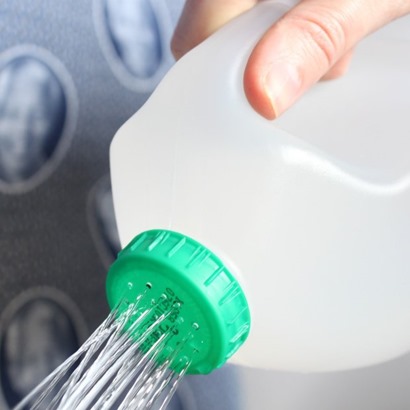
Milk jug watering canThis project will have you saving your milk container to create a kid- friendly watering can. But, obviously, it can also used by an adult.

Children love to water plants. Generally this is good news, and watering is a helpful chore the children can take on in the garden. Sometimes, though, overenthusiastic watering can be bad news – plants can become waterlogged and seedlings can rot away. Sometimes seedlings can be damaged in a deluge. For children the standard watering can with seven or more liters can be a little on the heavy side. This DIY watering can with a rose head could be the ideal solution.

Made from a plastic milk bottle or similar container, it is free and a great way to upcycle your junk into something practical. It is easy to make and holds just the right amount of water, so it is not too heavy for young children, as I said above.

Materials

2-3 liter (maybe 4 liter even if can be had) plastic milk or juice bottle with lid

Small drill bit (3-4mm), gimlet or bradawl

Instructions

1. Start by washing out your milk bottle.

2. Use drill with drill bit (you could use a gimlet instead, or even a bradawl) to make small holes in the bottle's lid. Make sure the holes are big enough to allow the water to come out freely.

3. Remove the bottle top to fill your new watering can with water, pop the lid back on, and you are ready to go. The handle on the bottle makes it comfortable to hold, and if necessary, a gentle squeeze can help the water come out.

© 2018

Make you own hanging basket liners

Make you own hanging basket linerYou can make an efficient, hanging basket liner, white or whatever color, that costs next to nothing.

This kind of hanging basket liner will keep your plants in place and moist and it, generally, comes for free, and will last for years, unlike the coir, moss, or even fake moss ones.

You can choose to make drainage holes or not, depending how well your plants may like having their “feet” in water. Considering, however, that generally, hanging baskets, when with bracket attached to wall of house, are in the so-called rain shadow, and thus do not get watered naturally by the rain having no drainage holes in the liner saves you watering on a daily basis.

There are many options for recycling plastic bags for use as handing basket liners. Compost bags of various sizes, as well as others, are suitable and the colors may vary from white, to blue or black. It all depends. On the other hand, other bags you can use might be transparent, which even allows you to see the growth of the roots and thus can see whether plants may get root bound. Spider plants (Chlorophytum comosum) is a candidate that gets root bound in pots or handing baskets quite quickly, which then meas either re-potting or splitting.

As the bags you may be using will not be designed to fit a hanging basket as a liner you will have to do some cutting and some folding and tucking, but it will be worth it alone for the fact that (1) you don't have to buy a liner every year and (2) you keep some plastic out of the waste stream (for some years at least). The important thing is that it works and well worth it. A win-win on so many levels.

© 2018

Toxic Waste Desk Caddy

From this …

Toxic-Waste

to this...

ToxiWasteContainerPencilBin_sml

is an easy road but one very rarely traveled.

Toxic Waste – in this case – is a very sour candy of some sorts (never actually tried it myself, only tend to find the aftermath of people having used them in a park, including containers left behind) and they come, separately wrapped, in a plastic can such as the one in the picture.

Those containers are, so it is being said, 'collectables' but how many of them do end up, despite of that, in the trash bin? The great majority of them, I wager. Most people would not, probably, consider them any more collectable than, say, a Snapple bottle or the cap of one. And that despite the fact that the Snapple bottle caps do have all those Trivia facts in them.

But why? It is such a shame to waste them as they make great containers and bins for the desk, and thus, also, great little conversation pieces.

When I tend to find them the lids normally are missing (and at times they have been broken as well) and without the lid they are pencil bins and open bins for the desk; with lid, however, such a can could hold also other things.

It is a shame that people do not seem to have the imagination to see the potential in this little container, or in other things that they so thoughtlessly toss into the trash.

I doubt that there is an instruction needed as to how to convert a Toxic Waste can into a pencil bin or such like as it is as simple as “take one empty container, fill with pens and place on desk.”

© 2011

Let's Talk Rubbish

A new book on reusing and upcycling trash

Epsom, Surrey, UK, August 2010: In “Let's Talk Rubbish”, published in August 2010 by Tatchipen Media, the Romani Publishing & Media Company, the author, Michael Smith (Veshengro), is not talking rubbish but about rubbish, about trash, or whatever else you may call it, and about how we can reduce it in our homes and at our places of work.

This 82-page book in A4 format is full of food for thought and ideas and projects of reusing and reworking and upcycling all manner of waste materials into something useful, and that in most cases almost instantly.

In a number of separate chapters from tin cans over glass jars to miscellaneous items the author is trying to communicate to the reader ideas of how he can make an impact by making things he may want or need from waste materials rather than going out and buying them.

The prime example would be the pencil bin. Many people rush out to buy a metal pencil bin – oh, it is made from recycled steel and ONLY costs $8 – while at the same time they have just thrown a perfectly good one into the trash or, if we are lucky, the recycling bin in the for of a clean tin can. That is a better recycled one than one made from recycled metal costing loads of money.

Other items upcycled are glass jars into lamps, electric and oil, drinking vessels, and rehydration vessels.

Then there are ideas as to what to do with all the one-side only printed pages in the office, all the card stock from cereal packs, and much, much more.

But, as the authors says, “Let's Talk Rubbish” is very much a “work-in-progress” in that it, more than likely, would never be finished, as more and more ideas come along all the time.

The book “Let's Talk Rubbish” is currently available only as an E-book and only available for purchase via “Let's Talk Rubbish” website http://letustalkrubbish.blogspot.com/ using PayPal. E-book will be dispatched via email immediately upon receipt of funds and notification from PayPal.

The author of “Let's Talk Rubbish” is Romani-Gypsy of origin and has written extensively on such diverse issues as green living, general and green politics, homesteading, recycling, Romani affairs and politics. He lives in Epsom, Surrey, England.

© 2010