Meet the ‘fix-perts’, an army of experts determined to get Britain on the mend

The Repair Café names the seven easiest things you can fix yourself (and that includes laptops), saving you a small fortune and benefiting the environment
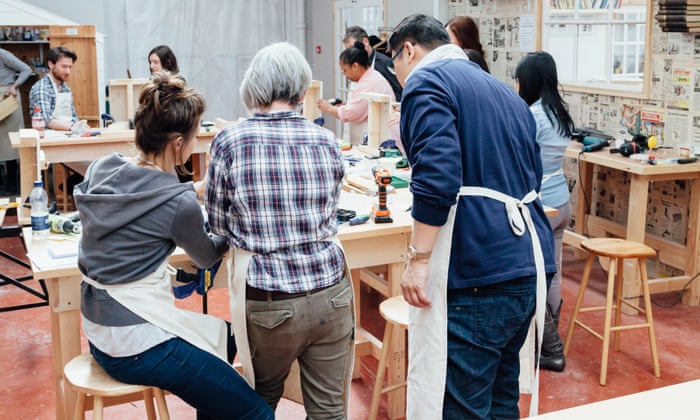
Every year British households chuck out £800-worth of electrical goods, nearly half of which goes straight into landfill. Yet many of those items – as well as wonky bits of furniture – suffer a premature death that could be avoided with a simple repair. Trouble is, most householders have no confidence in their ability to fix things, and have been (profitably) trained to dispose of goods and buy new. But householders in many parts of the UK can now find a Repair Café where, over tea and biscuits, volunteer “fix-perts” give them the knowledge to help themselves in future.

Martine Postma launched the concept in Amsterdam in late 2009, and there are now 1,256 Repair Cafés around the world. They are all staffed by volunteers and designed to be free meeting spaces where visitors can bring their broken items, or just pop in and browse the selection of DIY books. They join the increasing number of events and workshops across the UK that can help you tackle the repair jobs yourself.

Over on BBC2’s The Repair Shop, it too aims to be an “antidote to the throwaway culture” – albeit with an emphasis that is firmly on sentimental rather than monetary value, inspiring viewers to repair and restore much-loved but damaged heirlooms instead of throwing them in the skip. Items featured have ranged from a favourite childhood toy and a 70s talking Dalek that had lost its ability to, well, talk, to a late grandad’s cherished Victorian garden gnome so badly battered and bruised he had been hidden away in a cupboard.

Victoria Jackson set up a branch of Repair Café in Brighton five years ago. As she says: “Most things can be fixed with a bit of imagination and lateral thinking. Electrical items can be tricky and are most in demand as people have a fear of opening them. One of the issues with repairing, as an individual, is that it often takes place behind closed doors in the privacy of our homes. By creating these social – and they are very social – events, it becomes a shared activity.”

A survey this week by insurer Aviva revealed how little confidence people have with even basic electricals. It found that 21% are not confident changing a light bulb, while 43% are nervous about wiring a plug.

Read more here.

The City of Austin will pay you to keep a chicken coop in your backyard

Do you dream of having your own chickens?

Dream no more. The City of Austin is offering free chicken keeping classes and is willing to pay you for it.

629599767_1492101169097_9218491_ver1.0

he city announced Thursday that as a part of Austin Resource Recovery's Home Composting Rebate Program, Austinites can attend one of five "chicken keeping classes," buy a chicken coop, submit a rebate application online and receive a $75 check from the city.

Read more here.

Not everything that is plastic is 'disposables'

by Michael Smith (Veshengro)

Not all plastic things are meant to be “disposables” though it would appear that many people see more or less cheap items of plastic, which is not even plastic packaging (waste), as “disposable”, however. Yes, I am on my pet peeve again, unnecessary waste, and I am having a moan. Though educational I hope it to be as well.

I am coming across people's stupidity almost on a daily basis now again with picnics taking part more regularly in the park.

Salad bowl thrown away after picnic1_webThe picture above shows a perfect salad bowl – no not one in which salad was bought in a store but one that would have been bought as a bowl – just simply tossed into the litter bin – treated as a “disposable” item – simply because they could not be bothered to take it home to wash and reuse. The same, on the same day, also goes for a plastic baby feeding spoon that did not even make it into the bin but which was just thrown beside the bin. Needless to say neither item is on the way to landfill; they both came home with me to be – you guessed it – reused. (Apologies for the fuzziness of the picture of the baby spoon but the light was not right).

Thrown away baby spoon1_web1The bowl will be used exactly as its intention, as a salad bowl and the spoon, as I don't have a baby to feed around here, will be serving very well, due to shape, as a spoon with which to extract olives from a jar. Waste not, want not, as I keep saying.

The weird thing with this behavior is that it is not rich folks who do this but ordinary working class families who, one should think, cannot afford to be that wasteful. The saying: “The rich are rich because they live like poor, and the poor are poor because they live like rich.” seems very much to fit here.

What is most disconcerting with this all is that the message as to waste reduction, somehow, is not reaching those groups of people, who would benefit from it the most financially.

In addition to that I have to ask as whether laziness could also be a factor; too lazy to take it home with them and then too lazy to wash it up. Sometimes I am entirely at a loss as to what part of the message people actually do not understand. Is the word “reuse” really such a complicated one?

© 2017

A court just gave Sajid Javid the right to completely ignore democracy

A court just gave Sajid Javid the right to completely ignore democracy

A court has granted the Conservative government the right to essentially ignore local authority decisions. And the will of whole communities. Because a judge has ruled that Communities Secretary Sajid Javid acted within the law on a controversial fracking decision. A campaign group say the case may set a precedent.

You fracking what?

On 15 March the Preston New Road Action Group (PNRAG) took Javid and the government to a Manchester court. The group was challenging the decision by the Communities Secretary to allow oil and gas exploration company Cuadrilla to extract unconventional oil and gas – or ‘frack’ – at the Preston New Road site. This is near the village of Little Plumpton in Lancashire. PNRAG claimed Javid and the government had breached planning law. But Mr Justice Dove disagreed, saying no PNRAG arguments “have been made out in substance”.

Frack you, Javid

Moreover with this case, the government overrode the decisions of Westby Parish Council, Fylde Borough Council and Lancashire County Council. All three refused to grant Cuadrilla a licence to frack.

PNRAG told The Canary at the time of Javid’s decision:

It is wholly undemocratic. The ramifications of overturning local planning decisions are huge… Ordinary people are appalled… Dismantling the democratic process to facilitate a dirty fossil fuel industry… is another example of… governmental hypocrisy. It is clear to all that this government neither listens nor can it be trusted to do the right thing for local communities. Profit clearly comes before people.

Frack the police

Javid’s decision has caused controversy in the Lancashire community. Cuadrilla officially began work on 5 January. And ever since, protesters have been at the site. But their demonstrations against the work have not been without incident. As The Canary previously reported, protesters and local councillors have accused police at the site of “gratuitous violence”. The police deny those accusations.

Read more here.

NYC will get its first zero-waste store this spring, thanks to Lauren Singer

Lauren Singer & Daniel Silverstein

Singer, the mastermind behind 'Trash is for Tossers', wants to make waste-free living as easy and accessible as possible.

In 2014, Lauren Singer invited TreeHugger to take an exclusive tour of her zero-waste apartment. The result was a beautiful slideshow revealing her spacious cupboards and drawers, plastic-free utensils, and uncluttered fridge filled with Mason jars. Over the past several years, Singer has gone on to achieve zero-waste fame with her blog, Trash is for Tossers, her inspiring TED talk, and a YouTube channel full of practical tips. She has also launched a natural laundry detergent company called The Simply Co.

Now Singer is on to another interesting project. Together with Daniel Silverstein, a fashion designer who utilizes discarded fabric to make clothes, she is opening a pop-up zero-waste store in Williamsburg, Brooklyn, from May till July. Called Package Free, its goal is to provide New Yorkers with the tools they need for trash-free living -- or, as the tagline says, to be able to "think outside the box," quite literally. If the pop-up proves successful, it could turn into a permanent store in the future.

Read more here.

Recycling a la Hyacinth Bucket

by Michael Smith (Veshengro)

Some of people's weird recycling habits revealed such as putting the recyclables through the dishwasher

recycling_iStock_000019128774XSmall-2Apparently thousands of people all over the UK put their recycling through the dishwasher before leaving out for the refuse collectors which has echoes of "Keeping Up Appearances" where posh Hyacinth Bucket (pronounced "Bouquet", you know) puts her milk bottles through the wash, many Brits admit to doing the same with jars, tins bottles and recyclable plastic.

However, this seems to be just the tip of the iceberg as to all kind of weird habits when it comes to putting out their recycling and rubbish bins.

From sorting by size and color down to shredding every piece of paper to come through the house are some of the habits on top of putting glass, plastic and tin packaging waste through the dishwasher – or the washing up in the bowl – in order to clean them and get the labels off.

A waste collector who recounted that they collect from one house where all the empty bottles are sorted in color order – clear, brown, green – every fortnight – made a very interesting comment and those words should be noted: “It makes no difference to us, because they all end up in the back of the same lorry”, he said. Here we have the truth about glass recycling. And the powers-that-be are still trying to tell us that they make new bottles and jars from those recyclables.

Putting the recyclables through the dishwasher – unless they are washed with other stuff – is a tremendous waste of energy. Washing or rinsing by hand is the way to go, just watch out for those sharp edges.

It is also worth noting that shredding your sensitive documents prior to putting them out for recycling is a sensible idea, especially if you put your waste paper out the night before.

Bin night is jackpot time for the old-school identity thieves as bank and credit card statements, forms featuring dates of birth are exactly what they're looking for.

When it comes to weird “recycling” habits I personally will probably be in the top ten of the list and Hyacinth Bucket has nothing on me but then I “recycle” in a strange way compared to most. Not actually having a collection where I live there are no recycling bins to put things in for kerbside collection and not having a car it is also not an option to take it to recycling centers. Thus I have a number of ways of my own.

Glass jars, for example, are washed and labels removed and then kept for reuse. Hardly any glass jar gets thrown as I have so many things that they come in handy for.

Glass bottles do not, necessarily, have a reuse potential but being a woodworker broken they make for great scrapers, as in glass shave.

Paper & card does all go through the shredder. On one account for security reasons and on another to make it small enough for, while I had hens, the paper was used as bedding for them and then went into the compost; now it just goes into the compost.

At other times card stock is recycled into business cards, index cards, note cards, etc. Why buy things that I can make out of what would be waste.

Plastic containers also are always being looked at with a reuse potential before even the thought of throwing them comes along, and that includes the plastic milk jugs in which most milk today is being sold in the UK and the US, and probably in most countries.

From those milk jugs I cut templates for spoon carving, leather-working, etc., and also make many other things, including sandwich boxes, scoops, cloches for gardening, and much more. Told you, I am strange.

© 2017

How to Design Our Neighborhoods for Happiness

When we share our yards, sidewalks, and other common spaces, we find a greater sense of belonging and connection to those around us.

Conover Commons

Biology is destiny, declared Sigmund Freud.

But if Freud were around today, he might say “design is destiny”—especially after taking a stroll through most modern cities.

The way we design our communities plays a huge role in how we experience our lives. Neighborhoods built without sidewalks, for instance, mean that people walk less and therefore enjoy fewer spontaneous encounters, which is what instills a spirit of community to a place. A neighborly sense of the commons is missing.

You don’t have to be a therapist to realize that this creates lasting psychological effects. It thwarts the connections between people that encourage us to congregate, cooperate, and work for the common good. We retreat into ever more privatized existences.

Of course, this is no startling revelation. Over the past 40 years, the shrinking sense of community across America has been widely discussed, and many proposals outlined about how to bring us back together.

One of the notable solutions being put into practice to combat this problem is New Urbanism, an architectural movement to build new communities (and revitalize existing ones) by maximizing opportunities for social exchange: public plazas, front porches, corner stores, coffee shops, neighborhood schools, narrow streets, and, yes, sidewalks.

But while New Urbanism is making strides at the level of the neighborhood, we still spend most of our time at home, which today means seeing no one other than our nuclear family. How could we widen that circle just a bit? Cooperative living and cohousing communities are gaining popularity, especially among young people. Yet, millions more people are looking for more informal arrangements with neighbors, where they share more than a property line.

That’s an idea Seattle-area architect Ross Chapin has explored for many years, and now showcases in an inspiring book: Pocket Neighborhoods: Creating a Small-Scale Community in a Large-Scale World.

Read more here.

UK grid hits 26% solar. (In early April.)

solar power

"With falling minimum demands on the transmission system, we anticipate there may be times this summer when there is more generation on the system than is needed."

That's how the UK's grid operator, National Grid, describes the anticipated situation this coming summer as the country's solar capacity—which has grown at an astounding rate over the last decade—fundamentally reshapes supply and demand curves.

Growth has been so rapid, reports Business Green, that solar momentarily hit a record high of 26% of electricity supply this past Sunday afternoon. Not bad for early April. (Wind also hit a record 20.59% earlier in the same day.)

With these successes, however, come growing pains. As the National Grid statement quoted from above makes clear, there are likely going to be times when the grid is strained by more supply than demand. That's why National Grid is planning on curtailing some power production during sunny days. The company is also increasing its investments in demand-side adjustments through its so-called Demand TurnUp program, whereby businesses are actually rewarded for shifting energy-intensive operations to times of peak supply.

Read more here.

Invest in future foresters

by Michael Smith (Veshengro)

ForestryThe British Royal Forestry Society has launched an appeal and a program for investment in future foresters to encourage young people into forestry, and help them gain skills.

Today 55% of foresters in this country are over 40 and only 11% are under 25. in other words, soon there won't be any around anymore. The old ones will be retiring or not able to continue working while there is no new life coming into the “industry”. Personally I hate to use the word “industry” for forestry and woodland management and working in forests and woodlands but we lack another term for it.

• Forestry and related courses are struggling for applicants

• Shortage of skills at all levels

• lack of awareness of forestry as a career option

• Students qualifying with very little practical experience

Huge growth is planned for the timber sector – this will require more skilled workers. But where to find those workers if they are not being trained? The problem is that even if a youngster at school expresses an interest for a career in forestry, horticulture, etc., in general, and this is especially so if he or she is a bright kid, that the school, because of league tables, will do its utmost to persuade the young person into a different career. This has to change.

The RFS FUTURE FORESTERS program intends strengthen the forestry “industry”, by:

• Promoting forestry as a career option to teenagers and secondary schools

• Giving up to date information, through the Online Forestry and Arboriculture Careers Guide

• Helping students find work experience

• Granting bursaries and awards to help students gain knowledge and recognition

The same is true not just in large-scale forestry, that is to say that foresters are getting older and there are very few young people entering the “industry” (how I hate that word with regards to forestry and farming), but also and especially in the management of smaller woodlands and woodland operations and we have a serious lack of woodsmen/underwoodsmen working the woods, the mixed broad-leaf ones, and especially in the old way of coppicing.

In the latter case, unfortunately, there is not program available from any source, and especially nor bursaries, that would help train more of those woodsmen that are so desperately needed to put our mixed broad-leaf woods back into use and production.

In that department we need some kind of apprentice scheme or schemes where it would be possible for younger – and also not so young people – to learn the skills, in practice and theory, from the old woodsmen. But, alas, those are nowadays far and few between; the old and experienced woodsmen that is.

The biggest obstacle though, in attracting young people to forestry and woodland management is not the young people themselves and that they do not want to go for a “career” in this sector but, like with horticulture, that secondary schools all too often try to dissuade, and that quite vehemently, young people from going to agricultural college to do horticultural or woodland management courses. All the schools are interested in is the league tables and pupils not going for university courses seem to badly affect those.

It is the same with the vocational schools that had their funding and status withdrawn simply because they were teaching practical subjects and especially outdoors trades. There a change will need to be effected before we will see anything happening.

© 2017

Farms could slash pesticide use without losses, research reveals

Study shows almost all farms could significantly cut chemical use while producing as much food, in a major challenge to the billion-dollar pesticide industry

Virtually all farms could significantly cut their pesticide use while still producing as much food, according to a major new study. The research also shows chemical treatments could be cut without affecting farm profits on over three-quarters of farms.

The scientists said that many farmers wanted to reduce pesticide use, partly due to concerns for their own health. But farmers do not have good access to information on alternatives, the researchers said, because much of their advice comes from representatives of companies that sell both seeds and pesticides.

The work presents a serious challenge to the billion-dollar pesticide industry, which has long argued its products are vital to food production, especially with the world population set to grow to nine billion people by 2050.

However, this was dismissed as a “myth” in March by UN food and pollution experts, who said pesticides cause “catastrophic impacts on the environment and human health” and accused pesticide manufacturers of a “systematic denial of harms”. In a further blow, the Guardian revealed in March that Europe is poised to ban the world’s most widely used insecticides from all fields.

Read more here.