The ever-darkening shadow of Monsanto-fueled superweeds

Long before a dispute over illegal herbicide drift left an Arkansas farmer dead of a gunshot wound in November, a growing sense of unease had spread across the Great Plains about the cornstalk-sized superweeds infesting more than 100 million acres.

The fatal dispute was among hundreds of complaints across 10 states that arose in the wake of Monsanto’s decision to release new soy and cotton seeds genetically engineered to resist the herbicide dicamba even though an updated formulation of dicamba had yet to be approved for use on the crops.

In their effort to beat back the profit-choking weed epidemic, some farmers planting the new genetically engineered seeds decided to roll the dice and illegally spray those crops with an outdated formulation of dicamba notorious for drifting onto neighboring crops.

In Missouri alone, spray drift from illegal dicamba use on soybean fields has damaged more than 40,000 acres of other crops, including peaches, tomatoes, alfalfa, cantaloupes, watermelons, rice, peas, peanuts and alfalfa.

Last month, Missouri’s largest peach producer filed a lawsuit claiming Monsanto should be held responsible for the loss of 30,000 peach trees resulting in financial losses exceeding $1 million. The producer alleges the damages were caused by illegal spraying that was a predictable consequence of Monsanto’s decision to release its dicamba-resistant seeds prior to availability of a compatible form of dicamba.

Read more here.

The issue about food waste is going mainstream

by Michael Smith (Veshengro)
meals from left over vegetable wasteThe issue about food waste is going mainstream but will the people listen and understand the message?

The i-News in the UK had a good article on the reuse – and not in the compost – of vegetable peelings for meals. As the article suggests, entitled “Meals from “Peels”. But it also includes the use of cabbage stalks, as in those from broccoli, cauliflower, etc.

I must say that I have never understood why people cut out the heart of a cabbage and toss it, or toss the stalks of broccoli, cauliflower and such. If all else fails, and you really have no ideas as to what to use them for, make vegetable stock.

Radish tops, tops of beets and other vegetables, including those of carrots, can be used but most people are not aware of this, are not adventurous enough or, possibly, even too lazy to think of how to use them. Much easier to cut the things off and throw them in the compost caddy and either put it on their own compost heap of leave it for the municipal food-waste kerbside collection.

Fact is that in many cases most nutrients are actually in the skin, the peelings. As far as potatoes go I rarely every peel them unless it is when making mash, or chips. In the case of mash only if I make a special kind; otherwise the skins also stay on.

Why anyone would actually peel carrots always beats me as well. A good and thorough scrub and into the pot they go. I find that they taste much better that way.

It is good to see that this issue has now been highlighted in the media such as the i-News but what we could do with, I think, is a small book that could educate people as to what can be reused from vegetables which, more often than not, is seen as waste by most, be this peelings or tops from beets, or stalks.

Such a book should be available, ideally, for free at supermarkets and other stores as well as for download from the Web. There are enough organizations, many of them NGOs, others government, that could do this or that could commission this.

Unfortunately today people do not have the wisdom of the grandparents who lived through the Great Depression and the World Wars and many people today, alas, cannot even cook from scratch, at least not without detailed instructions.

The article(s) in the media, with a couple of recipes, are a good start but we must do more to educate people that there is a lot of more that they can do with what they might consider as “waste”, such as peelings, tops, stalks, etc. Many will need ideas and recipes above that what the article (or couple of articles) have provide.

© 2017

How To Make A Layered “Lasagna” Garden—No Digging Required!

Try this simple above-ground technique for growing your backyard vegetables.

layer garden

Sure, digging in the dirt is half the fun of gardening, but occasionally, you want something a tad less labor intensive—or maybe your yard just doesn't allow for you to dig down into the earth. Whatever the case, you can build a pretty awesome vegetable patch with this no-dig method, which is often used by organic farms in rural Australia. It's essentially an above-ground garden made from layers of organic matter that break down into a nutrient-rich living soil. (Here's everything you need to know about organic fertilizer.)

The no-dig piles are fairly stable on their own, but some gardeners prefer to build boxes to contain them. The materials below are enough to fill a 4-by-8 food raised bed, which—lucky for you—is exactly the size of this simple DIY raised bed.

WHAT YOU'LL NEED
  • 2 to 3 pounds bloodmeal and bonemeal
  • Old newspapers
  • 1 bale of herbicide-free alfalfa hay
  • 1 bale of herbicide-free straw (use bedding straw, not feed straw, which has viable seeds)
  • 10 cubic feet of compost (preferably homemade)

Read more here.

How to Plant a Garden Using Jeffersonian Principles

Use Jefferson’s Monticello gardens as inspiration for planting a garden of your own.

Monticello

Do just a little digging into the history of American gardening, and you’ll soon discover Thomas Jefferson’s deep love of horticulture. A favorite quote among those of us with dirt under our nails: “No occupation is so delightful to me as the culture of the earth, no culture comparable to that of the garden … But though an old man, I am but a young gardener.” What does this say about Jefferson’s philosophy on gardening? I’d bet most gardeners feel the same way – there’s always more to learn.

If you spend any time at all reading about Mr. Jefferson’s gardening habits, or even visiting Monticello, you’ll want to follow in his footsteps. While I wouldn’t recommend attempting to level a mountaintop to create a 1,000-foot garden, you can garden in his spirit. While the results might not be Monticello, plenty of Jefferson’s ideas translate well to your backyard.

Heart of a nation

What does it mean to garden in Jefferson’s spirit? He believed that, “Those who labor in the earth are the chosen people of God, if ever he had a chosen people, whose breasts he has made his peculiar deposit for substantial and genuine virtue.” It’s hard to deny Jefferson’s passion for green and growing things. The answer to the question is as simple as adopting his practices and principles in your own “rich spot of earth,” as he so elegantly romanticized in his letter to Charles Willson Peale, longing for “a rich spot of earth, well watered, and near a good market … .” Your Jeffersonian garden can be as basic or as grand as you choose to make it. You’ll probably discover you’ve been practicing a few of his ideas already.

Thomas Jefferson believed in an agricultural future for America. One might even say its soul could be found in agriculture – a nation of “yeoman farmers” and self-taught scholars working the land. He even went so far as to argue that America’s representatives to the people should be “… farmers whose interests are entirely agricultural. Such men are the true representatives of the great American interest, and are alone to be relied on for expressing the proper American sentiments.”

Read more here.

GMO Arctic Apple hitting the shelves

First GMO apple slices to go on sale in Midwest

by Michael Smith (Veshengro)

16251604_1530748503632274_4358807684826816145_oThe first genetically modified apples to be sold in the U.S. will debut in select Midwestern stores next month.

A small amount of Arctic brand sliced and packaged Golden Delicious, produced by Okanagan Specialty Fruits of Summerland, B.C., will be in 10 stores this February and March, said Neal Carter, the company's founder and president. He would not identify the retailers, saying that that would be up to them.

He further went on to say that they are very optimistic with respect to this product because people love it at trade shows, and that it is a great product and the eating quality is excellent.

Okanagan Specialty Fruits reduced the enzyme polyphenol oxidase to prevent browning when apples are sliced, bitten or bruised. The apples match the industry norm of not browning for three weeks after slicing but without using flavor-altering, chemical additives that the rest of the fresh-sliced apple industry uses.

Golden Delicious, Granny Smith and Fuji varieties have been approved by the USDA and Canada. An Arctic Gala could be approved in 2018. Only Goldens and Granny Smiths have been planted long enough to produce fruit in commercial quantities by next fall.

A QR computer scan code on the packaging enables consumers to get information, including that the apple slices are genetically modified, but nothing directly on the packing identifies it. Okanagan Specialty Fruits will adhere to the new genetically engineered foods labeling act but it's not clear what that requires, said the company's founder.

He went on to say that as they were selling it under the Arctic brand and that they have had a lot of press and attention, he would thus assume most people will know what it is.

It has been claimed, however, that the packages may not even feature the Arctic logo at all, so it is a case of buyer beware.

While supportive of the science, the Washington apple industry opposed approval of GMO apples because it believes negative public perception could damage apple sales. While expressing concerns about market disruption before USDA approval, the U.S. Apple Association is now neutral and stresses that all apples are safe, healthy and nutritious.

Regardless of the statement by the industry we have to remember that the long term health impacts of eating these apples are unknown in same way as with any GMO products.

Below is a link to a factsheet on GMO apples by Friends of the Earth

http://libcloud.s3.amazonaws.com/93/42/f/3269/GMO_apple_fact_sheet_rev2.pdf

© 2017

Russia issues temporary ban on beef from New Zealand

Russia issues temporary ban on beef from New Zealand

The Russian agriculture safety watchdog has imposed a temporary ban on imports of beef and beef products from New Zealand, effective February 6.

“The measure comes after the feed additive Ractopamine, a stimulant fertilizer for promoting muscle growth, has been discovered in some samples,” the watchdog spokesperson said.

The watchdog also said that it might ban fish imports from New Zealand due to traces of mercury in some supplies.

New Zealand is not one of the Western countries facing a Russian food ban. Moscow introduced the measure in 2014 in response to sanctions imposed by the US, EU and their allies over Russia’s alleged role in the Ukraine crisis.

The ban Russia plans to impose on the beef would be disruptive because of the uncertainty, but it's the reality of being in the food business, Special Agricultural Trade Envoy Mike Petersen told Radio New Zealand.

The ban would not affect the country's trade relationship with Moscow, Petersen said, adding that further testing would show beef from New Zealand was clean.

Read more here.

The 'Right to Repair' Movement Is Being Led by Farmers

Farmers are pushing back against legislation that prevents them from fixing their own equipment. If successful, it will be a huge victory for consumers.

A major national group has adopted a policy to fight for the right to repair electronics, but it might not be the one you'd expect: farmers.

The right to repair movement is an effort to loosen laws to allow consumers to be able to fix technology without sending it back to the original manufacturer. Right now, replacement parts and diagnostic tools are carefully guarded by the manufacturer, and right to repair supporters believe they should be available to the public. The effort has largely been driven by the consumer tech sector—like people who want to be able to fix their iPhone instead of buying a new one—but the lack of access to repair materials has greatly impacted farmers, too.

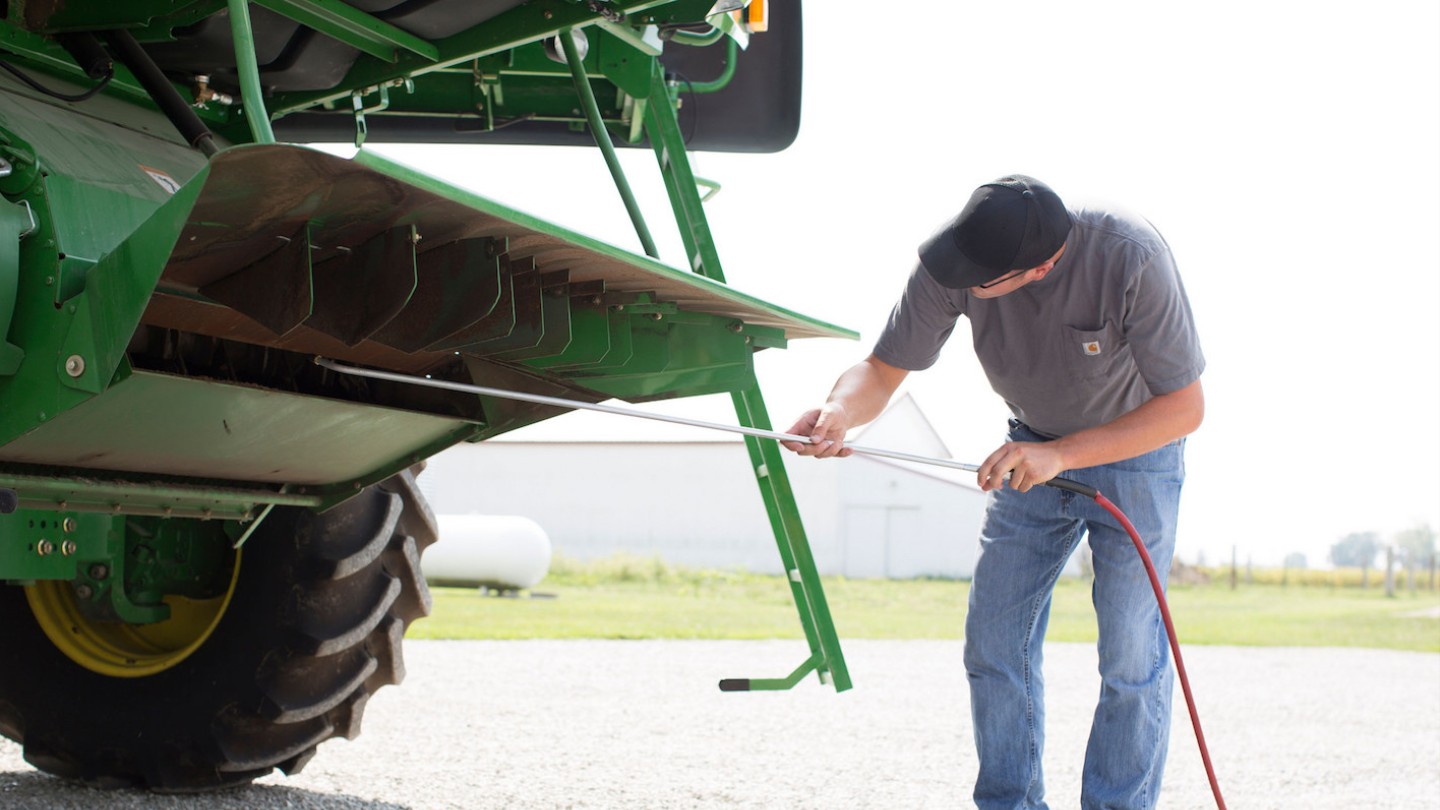
Modern farm equipment is high tech and includes onboard computers, but the majority of farming equipment manufacturers refuse to allow access to the software, claiming it's proprietary information. That means farmers are stuck waiting for a John Deere technician to swap a tiny sensor when it misfires and shuts down the entire tractor.

They'd rather just fix it themselves or, at the very least, take it to someone locally who can do the job. But right now, that's not possible.

"John Deere is behaving exactly as Apple is behaving, in a wholly different market: they're selling equipment and then they're not allowing anybody to fix it except them," said Gay Gordon-Byrne, the executive director of Repair.org, a lobbying group that pushes for right the repair legislation.

Read more here.

Do you have to have a special Sloyd Knife for woodcarving?

by Michael Smith (Veshengro)

MyCarvingKnife1.1The short answer to this question really is a firm No. No, you don't. And this could already be the end of this “discussion” but that. Probably, would be unfair. Many an other knife, reworked or not, can fulfill the carver's needs at a fraction of the cost.

All too often, whether by courses taught on green woodworking or in other places, it is made to appear that a special sloyd knife is a must, is required, in the way that the crooked knife or spoon knife is for carving spoons. The latter is – unless you wish to use a spoon gauge – necessary for to carve the bowls of a spoon, for former, the so-called sloyd knife, is not.

I have been carving from greenwood (in the term greenwood which means anything from wet wood to eighteen months seasoned) – whittling it was referred to then – since early childhood from making clothes pegs to other items, though spoon carving has only come into it for me in the last couple of years, and I have never used any other straight knife than what came along.

Those knives were Opinel #6 pocketknives, for instance, as well as others, and fixed bladed knives that have been reworked from old, often damaged, kitchen knives, and it all worked and still works very well indeed, and a great deal cheaper.

Fair enough, someone might say that a sloyd knife, such as the Frost Mora is not all that expensive but that is not really so much the issue here, even though every little saving that can be made, obviously, helps.

In actual fact, for green woodworking knives, with the exception of spoon knives (or a couple), if making spoons is what you want to do, a carving and woodworking kit can be put together quite cheaply. Flea markets, and what are are called car boot sales in Britain, and yard sales, can bring forth many tools for little money.

Aside from my Opinel pocketknife, the pruning saw, spoon knife and hatchet, all other knives are repurposed for the job of woodcarving, including an old chef's turning knife and simple little Kitchen Devil vegetable knives.

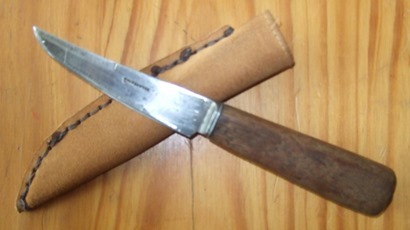
The photo above shows my main “sloyd” knife, which came for a few coins from a flea market and it came this way bar needing a little cleaning up of the blade and really giving the blade a proper sharpening, and making the sheath for it. I have no idea who made it and where it was made though it appears to be carbon steel and has only a “Warranted” stamp on the blade. Whether it was rehandled by the previous owner or whether this was its original handle, with the nut at the “pommel” I also do not know. However, aside from the Opinel #6 this is my main knife from green woodworking. So, there you have it; no need for a fancy and often expensive knife.

© 2017

Full Disclosure Statement: I have used Opinel pocketknives since childhood and am not receiving any payment whatsoever from La Coutellerie Opinel for recommending their knives. Having said that the Opinel knives I use today were payment in kind for advertising done for them on a different magazine some years back.

A Beginner's Guide To Starting A Garden

Never gardened before? This will get you started!

garden

Growing food—even just a little of it—is rewarding and a great way to be both creative and put the absolutely freshest and most delicious stuff on the table. But what should you grow, and how much should you plant? To help you decide, consider three things:

1. Plant What You Like
This may sound obvious, but many budding gardeners are tempted to believe they can revolutionize their family’s eating habits by planting new and interesting vegetables, only to discover the abundance of, say, turnips and kohlrabi end up back in the compost pile. Your family will appreciate the garden more if you grow things they enjoy eating.

2. Do A Little Math
Start by logging what veggies and herbs you buy and eat every week. This will give you an estimate how much of them you would actually eat fresh out of your garden if they were available. A well-managed 10-by-10-foot plot, for example, can actually produce most of the fresh veggies a family of four will eat during the growing season. Online calculators like Kitchen Garden Planner and Zukeeni are great for helping you figure out what and how much to grow, too.

3. Start Small
Nothing is a bigger kill-joy than a garden you don’t have the time or energy to take care of. A good goal is to have fun and produce some tasty eats, not to declare food self-sufficiency. You will harvest and eat far more from a small, well-tended garden you look forward to visiting than from a larger one you dread going near.

Read more here.

How To Grow Asparagus

Fresh-picked is far superior to store-bought.

asparagus plant

Beloved for its delicious young shoots, asparagus is one of the first crops of spring harvest. The perennial vegetable is rich in B vitamins, vitamin C, calcium, and iron. And it just so happens that fresh-picked spears are far more tender and tasty than store-bought.

Asparagus thrives in any area having winter ground freezes or dry seasons. In fact, the mild, wet regions of Florida and the Gulf Coast are about the only places where it’s difficult to grow.

Planting
Select and prepare your asparagus bed with care—this crop will occupy the same spot for 20 years or more. It can tolerate some shade, but full sun produces more vigorous plants and helps minimize disease. Asparagus does best in lighter soils that warm up quickly in spring and drain well; standing water will quickly rot the roots. Prepare a planting bed about 4 feet wide by removing all perennial weeds and roots and digging in plenty of aged manure or compost.

Asparagus plants are monoecious—meaning each individual plant is either male or female. Some varieties of asparagus, such as Jersey Knight and Jersey Giant, produce all male or primarily male plants, so they’re more productive—male plants yield more harvestable shoots because they don’t have to invest energy in producing seeds. Choose an all-male variety if high yield is your primary goal. If you like to experiment, you may also want to grow an heirloom variety or a purple-stalked variety like Purple Passion. With an all-male variety, twenty-five plants are usually adequate for a household of four; plant double that amount for standard varieties. (Ardent asparagus lovers recommend tripling these quantities.)

Read more here.