Free Webinar on Climate Change Solutions

Gaia Education are holding a free webinar on climate change solutions.

Catalyzing-CO-Consciousness-Flyer.standard 460x345Gaia Education are an international NGO who are helping people to understand how we can design much lower impact communities, in the city and in rural situations. They offer a tried and tested Ecovillage Design Education course in many countries in Europe, South America and Africa.

Their next project is to launch a series of free webinars with the first one exploring Climate Change Solutions.

Conducted by Daniel Greenberg, founder of Earth Deeds and co-founder of Gaia Education, the webinar will look at how to mitigate our carbon footprint, raise funds for community projects, move way beyond carbon offsetting and catalyze carbon consciousness.

Read more: http://www.permaculture.co.uk/news/2406145214/free-webinar-climate-change-solutions

This Texas man is fighting the drought one tank of rainwater at a time

tank-townHow do you get to be the mayor of Tank Town? Practice, practice, practice! Or else, wait. I’m confused.

Richard Heinichen became the mayor of Tank Town by building one rainwater storage tank in central Texas in 1994. Back then you could still get groundwater from a well, but apparently it smelled gross. He started out as a rainwater evangelist for the supplemental, sulfur-free benefits, but ended up as deus ex machina during Texas’ crippling droughts.

Heinichen helped neighbors build their own rainwater tanks at first, then decided to turn the whole thing into a business. He built 16 tanks on his own property and sold some 1,300 others. He consults with hundreds of people a year about installing their own rainwater tanks. (Perplexingly, he’s also started bottling and selling his rainwater, Cloud Juice, but we hope he is at least using recycled bottles.)

Read more: http://grist.org/list/this-texas-man-is-fighting-the-drought-one-tank-of-rainwater-at-a-time/

Cargo ships carry a lot of climate baggage

mc3a6rsk_mc-kinney_mc3b8llerBuying local has become a bit of a mantra. We understand that it takes a heck of a lot of climate-killing carbon to get that hula hoop from China to Chicago, but it’s easy to let the details slip. Here’s some perspective: Maersk Triple E’s, the world’s largest container ships, measure 1,312 feet from stem to stern and contain 55,000 tons of steel alone. To put that into more relatable terms, that’s 196 LeBron James long and more than a million Rottweilers in weight.

These giant vessels are giant polluters. The largest vessels burn around 16 tons of low-grade, high-sulphur diesel fuel per hour as they ceaselessly plow the world’s oceans at over 25 knots. One studyestimates just one of these gigantic ships spews out as much cancer-causing pollutants as 50 million cars every year, and there are an estimated 90,000 cargo ships around the world. Unfortunately, pending legislation aimed at cleaning up these ships focuses exclusively on sulfur emissions and misses the boat on CO2, one of the driving causes of climate change.

Read more: http://grist.org/list/cargo-ships-carry-a-lot-of-climate-baggage/

The right to drive, the right to fly

by Michael Smith (Veshengro)
no-fly1Many people seriously believe it to be their (human) right to drive a car or to fly and while they insist upon this “right” they, invariably, deny the very right to life to those now or soon affected by climate change though they may never have driven a car or flown in an airplane.

Neither driving nor flying are a (human) right and no one should believe that they are and that they are entitled to drive or fly. Considering that in the not so distant future cheap oil, or even oil per se, may be history and alternatives either are worse for the Planet by way of pollution or simply not available I certainly would not bank on this “right” to drive or fly.

It is more than high time that everyone woke up to this fact and rather than stamping their feet like little children in a tantrum demanding their (human) right to drive and fly thought about and found some real alternatives. They do exist. That is alternatives to driving and flying, that is.

First and foremost there are your feet and then there is the humble bicycle.

In most developed countries, bar maybe one or two that are geared almost exclusively towards the car, we have good public transport in the form of buses, trams, and trains, both underground and overground.

Unfortunately even in the UK many local bus services, especially in rural and semi-rural areas, have been axed in favor of the car. This has to be reversed and we also need to have many of the train routes back that Beeching destroyed. The latter, however, will only happen if and when the railroads in Britain are taken back into public ownership.

In most countries of Europe the railroads are still state-owned and -operated and thus are cheaper than those in the UK and, amazingly, cleaner and more reliable.

As far as bicycle infrastructure is concerned Britain is lagging far behind most countries of the European mainland such as the Netherlands, Germany, Denmark and Switzerland, all of which, more or less, have a countrywide bicycle route network and as far as the Netherlands and Denmark are concerned, cycling – the non-sports variety – is a passion and the way it functions in those two countries is all but amazing.

Driving and flying are not (human) rights; they are privileges and this is something that we must get into our heads. And no, no, don't stamp your feet, it makes no difference. It is and remains the truth and a fact.

Even if you can afford it to own and drive a car and to fly to this and that destination for vacation or shopping or business it still is but a privilege and not a right. Period!

Flying is the greatest contributor to pollution and emissions and driving a car is not far down the list. Flying is the worst simply because the pollution stays in the upper atmosphere where it has effects on climate and weather in ways that ground generated pollution does not.

You only have to look at the contrails of the airplanes at certain altitudes and under certain conditions and the way that they spread out over the sky – contrail cirrus clouds they are referred to by meteorologists – and cause a hazy cloud cover. Those are the soot particles and others that are covered by ice, basically, and where they are they basically remain, only afterwards invisible to the eye.

So, every time that you fly you are part of the problem and not part of the solution and your flying and driving – which you claim as a right, a human right, almost – restricts the right to life of others. Think about it.

© 2014

An Inexpensive, Earth-Sheltered, Passive Solar House

The Kalmers’ earth-sheltered, passive solar house is made out of many free and inexpensive materials, and cost less than $10 per square foot.

Kalmer-Household jpgReading MOTHER EARTH NEWS for years gave me ideas on energy-efficient home building. I used a few of these ideas on a 100-year-old run-down home I bought and remodeled. This enabled me to acquire tools and skills, learn about solar, and build equity.

I sold the home in 1982 for a profit after spending five years fixing it up, and bought rural land to build my dream home — an earth-sheltered, passive solar house I built using several techniques MOTHER EARTH NEWS had taught me about. The land had an old trailer on it that we lived in during the house-building process, and then we sold it when we moved into the house. We used locally available, free or inexpensive materials whenever possible. My wife and I gathered local stones to slipform walls, borrowed an old concrete mixer, built forms, and used the forms to build our east, west and north walls. We then externally insulated them before backfilling. I cut logs from my newly acquired 31 acres to make a post and beam frame, infilled with cedar cordwood. I traded some of my time with friends in exchange for them helping us when we needed it, such as when pouring concrete. Because of the sale of our remodeled home, we had enough money to support ourselves while we built, which took about 18 months. We did all the carpentry, cabinet making, electrical and plumbing, only hiring out the excavation for our recessed earth-sheltered home. We added an attached greenhouse, and later solar hot water and solar electricity, all without any sort of loan.

Read more: http://www.motherearthnews.com/green-homes/passive-solar-house-zm0z14jjzsor.aspx#ixzz35fwMJLJm

SCOTUS Further Weakens EPA Power to Regulate Greenhouse Gases

Ruling issued Monday cuts back already 'soft' regulatory measures under the Clean Air Act

Pollution in Joliet, Illinois (Photo: Eric Schmuttenmaer / Flickr Creative Commons)

The U.S. Supreme Court on Monday placed further limits on the Environmental Protection Agency's already-modest power to regulate power plant and factory emissions of greenhouse gases.

SCOTUS ruled in a 2007 case that greenhouse gases emitted by new motor vehicles constitute pollution that is subject to regulation under the Clean Air Act. Under this act, any polluter that emits more than 250 tons of a recognized pollutant must acquire a permit before expanding or modernizing.

The EPA interpreted the 2007 ruling to mean that greenhouse gases emitted by stationary facilities—including power plants and factories—are also subject to regulation under the Clean Air Act. The agency raised the threshold for regulation of stationary facilities to 100,000 tons of carbon dioxide a year—a move it said was designed to avoid excessive permitting processes, given how prevalent CO2 pollution is.

The SCOTUS ruling on Monday determined that, contrary to the EPA's interpretation, the 2007 ruling on automobiles does not automatically trigger regulations for stationary greenhouse gas emitters. Furthermore, the court ruled that the EPA did not have the authority to rewrite this threshold without congressional approval.

Read more: http://www.commondreams.org/headline/2014/06/23-1

Norway's Military Does "Meatless Mondays" for the Climate

Signs of change are appearing in the United States military as well.

Girls eat at Norwegian Military Girl's Camp, 2013. Photo by Metziker / Flickr.

The “Meatless Mondays” campaign was originally thought up to support the war effort during World War I, but now a modern army is using it to fight an even bigger battle—the one against climate change.

Last fall, the Norwegian army announced their plan to join the campaign by preparing their soldiers (both at home and overseas) a meat-free breakfast, lunch, and dinner once a week.

It's not just Norway where the military is concerned about climate change.

"It's not about saving money," said navy commander and nutritionist Pal Stenberg, who runs the catering department. "It's about being more concerned for our climate, more ecologically responsible, and also healthier."

According to the United Nations, the livestock industry contributes almost 15 percent to the total greenhouse gas emissions caused by humans. And a study released by the Proceedings of the National Academy of Sciences found that the global livestock business takes up 30 percent of the earth's ice-free land and 30 percent of fresh water.

Read more: http://www.yesmagazine.org/planet/norway-s-military-does-meatless-mondays-for-the-climate

A key factor in any product’s sustainability is its durability

by Michael Smith (Veshengro)

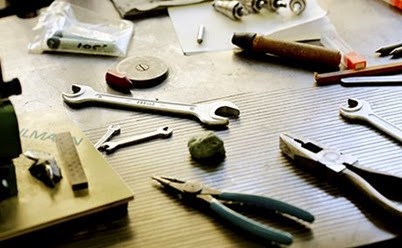
Tools_repairA key factor in any product’s sustainability is its durability. Maybe we should even be saying that it is THE key factor. If something lasts a long time and is made with quality, there is no need for you ever to replace it, recycle it or upcycle it.

Sounds great, doesn't it?

However, that is the very reason why industry, nowadays, has decided to built obsolescence into each and every product that they make so that we will have to buy the came products again, and again, and again, after a year or so, as it is designed to break after that time and so made that it cannot, in most cases, be repaired or repair is made so prohibitively expensive that we have no other choice to buy new.

In fact this decision was taken by capitalists in the US around 1950 as they had made such nice profits during the war they were looking for a way to keep those profits going after the war. During the war things were getting broken and destroyed all the time by enemy action and replacements had to be made and sold and they realized that, with the war over, their profits would be going down if they kept making things that last and so the decision was made to build in an obsolescence reducing the lifespan of products to but a few years and also making them non-repairable.

Once upon a time, and no, this is no fairy tale, things were made in such a way and the only time most people ever bought that product new was if there really was no way to fix it again or if they really wanted a newer, maybe better, one.

Industry had to innovate in those days and bring out real new things if they wanted to keep selling things or find new markets for the things they already made and that meant a lot of R&D and marketing. With built-in obsolescence there is no need for either and you can just go on selling the same thing over and over again in your “normal” market. And that is the aim, and to make as much profit, from such sales, as possible.

As consumers, however, we have the power, and don't believe that you don't, by means of our spending power, such as it may be, to demand stuff again that is made well, by using quality materials, and designed and made to last, and that can be repaired should something go wrong with them. The same goes for stuff that is “Made in England” or “Made in Britain”, “Made in USA” or “Made in Germany”, if you wish to buy products from the home country and not stuff that is made in the Far East or such. This also applies to ethically produced goods. Use your spending power and use it wisely.

What the capitalists designed with the built-in obsolescence is for them to extract ever more money from us, the customer, the consumer, without having to do much for it by way of research and development (R&D), as we have to buy the same product time and again. Or they go so far as to make products obsolete, bring new ones to the market that we then have to buy, where neither charger nor anything else previously used fit, as we see time and again with computer printers for instance and also and especially computers. The software that works fine on a previous installation no longer works on the new one or the updated software no longer works on the operating system that we have at present, forcing us to get a new operating system installed, which often needs a new computer, in fact.

And, even if a product can, theoretically, be repaired repair is either several times more expensive than a new product or, in the case I experience with a pair of boots which, although well made with the upper actually sewn to a leather mid-sole so-called shoe and boot menders could not repair a small section of seam that had come undone as they did not have “a machine to do it”. All that would have been required were two bent needles, thread and five minutes work. The repair skills have also gone out of the window and repair shops can only repair something if they have a machine that can do the repair. Help!

In days gone by there was a cobbler in almost any village and several on the high street of every town and the same goes for alteration and repair tailors. There were shops that could mend a wireless set (radio receiver to those not familiar with the British English) and televisions when they came about and not so long ago there were even shops still that could and would repair computers. Most of them have now gone also because PCs have become cheaper to buy new than to get them fixed.

An entire sector of the economy, the repair economy, has been destroyed or rendered unprofitable by the fact that products can no longer be repaired or are made too expensive to repair as specialist tools and parts are required. But we, as consumers, can change this by changing our buying habits. You and I have the power. Let's use it and hit them where it hurts them, their profits.

© 2014

Try a Wood Pallet Project

A couple in Vermont has created potting sheds, a greenhouse and more from repurposed wood pallets.

Wood-Pallet-Garden-Shed jpgWooden pallets can be reassembled into a number of different structures, such as this charming potting shed. ~ Photo by Kitty Werner

My husband has been collecting discarded wood pallets and shipping crates for years. Businesses that receive pallets and shipping crates include hardware and appliance stores, building supply outlets, and manufacturing businesses. The pallets are usually stacked next to dumpsters and are free for the taking. Discarded wood pallets and shipping crates are everywhere; you just have to know where to look!

Read more: http://www.motherearthnews.com/diy/wood-pallet-project-zm0z14amzkin.aspx#ixzz35aJnSsdl

RESISTANCE IS FERTILE

How we can fight back against herbicide-resistant superweeds

A field dominated by palmer amaranth, or pigweedDelaware Agriculture
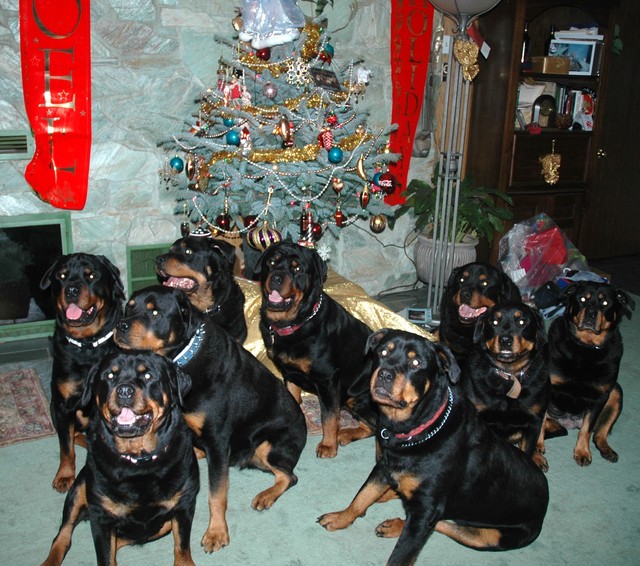
A field dominated by palmer amaranth, or pigweed, one of the plants that has gained glyphosate resistance.

There’s a clear scientific consensus that heavy use of glyphosate — the active ingredient in Roundup and other brands of herbicide — has sped up the evolution of glyphosate-resistant weeds. And it’s reasonable to assume that crops genetically engineered to work hand in glove with glyphosate (like Roundup-resistant soy) are part of the problem, contributing to the popularity of the weed killer.

Now crops genetically engineered to work with other herbicides — such as dicamba and 2,4-D — look like they will soon come on line. The seed companies’ answer to the Roundup-resistance problem is: Let’s just fall back on older herbicides. An editorial published by the journal Nature recently criticized this plan. If we do the same thing with dicamba and 2,4-D that we did with glyphosate, the editorial argued, history is likely to repeat itself.

Read more: http://grist.org/food/weed-wisdom-what-to-do-when-nature-outfoxes-herbicides/