How bicycles transformed our world

...and could do so again, maybe

by Michael Smith (Veshengro)


The Corona virus pandemic has sparked a two-wheeled transport boom in many parts of the globe. But this isn't the first time bicycles have been the hottest machines on the market.

If history doesn't quite repeat itself, it certainly rhymes. With demand for bicycles soaring, and nations preparing to spend billions to redesign their cities with a new focus on cycling and walking, it's worth remembering how the advent of the bicycle in the late 19th century transformed societies the world over.

It was then a hugely disruptive technology, easily the equivalent of the smartphone today. For a few heady years in the 1890s, the bicycle was the ultimate “must-have” swift, affordable, stylish transportation that could whisk you anywhere you cared to go, anytime you liked, for free. And it enabled the poorer in society to cover ranges – if the could afford a bicycle – that previously was only accessible to those with a horse and who could ride.

Almost anyone could learn to ride, and almost everyone did. The sultan of Zanzibar took up cycling. So did the Czar of Russia. The Emir of Kabul bought bicycles for his entire harem.

But it was the middle and working classes around the globe that truly made the bicycle their own. For the first time in history, the masses were mobile, able to come and go as they pleased. No more need for expensive horses and carriages. The “people's nag,” as the bicycle became known as, was not only lightweight, affordable, and easy to maintain, it was also the fastest thing on the roads.

The person generally credited with inventing the modern bicycle was an Englishman named John Kemp Starley. His uncle, James Starley, had developed the penny-farthing in the 1870s. Suspecting that there might be greater demand for bicycles if they weren't so scary and dangerous to ride, in 1885 the 30-year-old inventor began experimenting in his Coventry workshop with a chain-driven bicycle featuring two much smaller wheels. After testing several prototypes, he came up with the Rover safety bicycle, a 45-pound machine that more or less resembles what today we think of as a bicycle.

When first displayed at a bicycle show in 1886, Starley's invention was regarded as a curiosity. But two years later, when it was paired with the newly invented pneumatic tire – which not only cushioned the ride but also made the new safety bicycle about 30 percent faster – the result was magic.

Bicycle makers around the world scrambled to offer their own versions, and hundreds of new companies sprang up to meet demand. At the Stanley Bicycle Show in London in 1895, some 200 bicycle makers exhibited 3,000 models.

The insatiable demand for bicycles spawned other industries – ball bearings, wire for spokes, steel tubing, precision toolmaking – that would shape the manufacturing world long after the bicycle was relegated to the toy department, at least in the United States, though it should have never headed that way.

With a bicycle anything seemed possible, and ordinary people set off on extraordinary journeys. In the summer of 1890, for instance, a young lieutenant in the Russian army pedaled from St. Petersburg to London, averaging 70 miles a day. In September 1894, 24-year-old Annie Londonderry set out from Chicago with a change of clothes and a pearl-handled revolver to become the first woman to cycle around the world. Just under a year later she arrived back in Chicago and collected a $10,000 prize.

In Australia, itinerant shearers routinely rode hundreds of miles across the waterless outback looking for work. They set out on these trips as though they were rides in the park, recalled newspaper correspondent C.E.W. Bean in his book On The Wool Track.

In the American West, during the summer of 1897, the U.S. Army's 25th Regiment – an African-American unit known as the Buffalo Soldiers – made an extraordinary 1,900- mile trek from Fort Missoula, Montana, to St. Louis, Missouri, to demonstrate the usefulness of bicycles to the military. Carrying full kit and carbines and riding over rough, muddy tracks, the Buffalo Soldiers averaged nearly 50 miles a day – twice as fast as a cavalry unit, and at a third the cost.

If we are really serious about carbon reduction and all that then the humble bicycle needs to be brought back into use on a big scale. Forget the e-Bikes, though, and especially the electric cars.

When we look to rural India the bicycle is still the main means of transportation as long as it is not all too heavy haulage, though at times you wonder what they are thinking when you see what they load on their bicycles, and what some tow behind. The same goes for many parts of Africa.

But, in order for the bicycle have a real revival, which it must have, we need the proper infrastructure to go with it, not just some tinkering at the edges or a slight change in the highway code, as was done recently in Britain. That does not go anywhere far enough. In fact, it does not really help at all.

If the governments are truly honest about encouraging people to change their behavior as to travel and try to encourage walking and especially the use of the bicycle for short to medium distances at least then the proper infrastructure has to be created and put in place and those must include proper cycle paths. Cycle paths, not lanes that form part of the normal road, like those in many countries on the European mainland and which are, while along the roads, not part of them but, basically, part of the sidewalks.

© 2022

The benefits of growing up

No, not that kind of growing up but gardening vertically

by Michael Smith (Veshengro)

If you have ever considered growing your garden vertically then do it. If haven't then why not give it a try. Not only can it absolutely stunning visually, but it also provides many benefits as well.

You are able to grow more in less space and thus maximize limited space and especially if you live in town, gardening vertically can provide you a nice and useful privacy screen even though mostly only during the growing season.

It increases accessibility as it is so much easier to harvest your yield, as long as you do not put it up that high – or let the plants grow that tall – that the produce is way too far up. Have done that with beans and know.

It keeps your crop up and off the ground, so it provides great pest prevention and prevents ground rot and it also provides proper air flow to keep diseases, fungi, and powder mildew down which results in healthier plants and can – I did say can – provide a higher crop yield.

Theoretically it also gives the plants more sun exposure. I do theoretically because it all depends also in growing this way from which direction most of your property gets the sun.

Gardening in this way also makes for cleaner and more visually appealing crops because they are not in the dirt, and are able to grow to their true shape with no flat sides or discoloration from sitting in the soil.

And growing vertical is not just trellises and such, as far as I am concerned, but hanging baskets too can be successfully employed in this and I have started growing strawberries in hanging baskets with the result that they are not attacked by slugs – they can't get to them – and not even by birds.

Swiss Chard, for instance, with its more often than not multi-colored foliage looks quite stunning in hanging baskets and if they are hung by, or near, the door you only have to step out to harvest. Same goes for herbs and spices.

Window boxes, and not only used at the windows but fixed to fences, etc., also provide a good growing space. And here you can also improvise, reuse and upcycle for the window box does not have to be a window box nor does it have to be a box at all, or not have been one originally. Thinking out of the box here helps to save money. Also, as far as trellises and other “risers” go, upcycling is very much the way to go.

Any plant that climbs, theoretically, such as cucumbers and other squashes, bean and peas, and those that can be trained to grow that way, should be led up – no, not the garden path – trellises and other such structures.

In Spanish villages one can often observe entire walls of houses with plant pots fixed to them full of all kinds of flowering plants, predominately though geraniums. The same can, however, also be done with edible plants and flowers. And why not mix your pots with crops with pots with flowering plants. Again though, as far as the crops are concerned, do not put them up too high.

I do two things in my approach to gardening. Where I can I use containers, tubs and others, on the ground or, as I am now going over to, seated on old pallets to keep them somewhat off the ground, and I grow upwards, so to speak, in hanging baskets, trellises and wall-“containers” – and that here means anything from pots in holders to window boxes screwed to the wall and the like.

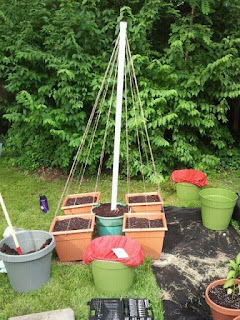
If you, like me, grow beans in a large container, and do not – though I do – have access to bean poles then go the old Victorian kitchen garden way and use one pole in the middle with strings attached that are used for the bean runners to grow up on. (See picture) The Edwardians and Victorians actually, the rich houses, had for their kitchen gardens when growing beans, a special cast iron pole with attachments for the strings but something like that can easily be created by means of upcycling (as in the photo) or by using a wooden pole and attaching the strings. A number of screw in eye hooks could be used to which to attach the strings to the pole.

There are many ways to gardening vertically and this can even be employed if you use the garden itself with raised beds and the like. It gives you additional space and, again, keeps many of the crops off the ground keeping them cleaner and healthier.

For much more information that I could possibly give you in an article check out Mark Ridsdill Smith (no relation) and his Vertical Veg operation at Vertical Veg and in the group that goes with it, Vertical Veg Community on Facebook.

© 2022

America stocks logs

Red-hot firewood price fueled by energy crisis

by Michael Smith (Veshengro)


Americans are turning to firewood in their droves after oil and gas prices rocketed in recent months, with around 1.7MN homes expected to rely on it as their source of heating.

Stove vendors are reporting huge jumps in sales, while firewood itself is selling at up to 33% more than last year.

Around 8% of American households are expected to rely on this “rudimentary” fuel as a main or secondary heating source through winter.

I know that when it comes to the environment and emissions there are many who will now state how bad this situation is but the truth is that the only emissions, as far as CO2 is concerned, is the carbon that the tree sequestered throughout its life. No more. So, theoretically, burning wood is carbon neutral. Alas, depending on how dry the wood is, there are nano-particles in the smoke to be considered, I know.

On the other hand when we see this increase in firewood sales, in the US and probably elsewhere, we have to ask where the wood is coming from and how sustainably it has been grown, harvested and whether it comes from a sustainable operation in that the woods are maintained in a rotation.

We saw in Britain some years back that the firewood being sold came from almost untraceable operations abroad in the main, and from as far afield as Belarus. Very little was actually homegrown and harvested. Sustainable this definitely was not but imports were cheaper, as far as the sellers were concerned, than homegrown. No wonder our woods and our woodland workers and owners cannot make any money in that field.

Importing firewood logs from abroad is not sustainable, neither in the short nor the long run, but then again, as far as the UK is concerned, it makes the laws for homegrown wood fuel more and more difficult, all in attempt to make it impossible for people to heat their homes from sources outside the control of the big corporations and the state. In fact, the UK is not far off banning all wood-burning stoves altogether. They keep talking about net zero but wood fuel is – basically – net zero.

© 2022

We need to stop buying unnecessary stuff

by Michael Smith (Veshengro)


Our ridiculous addiction to acquiring more possessions is stuffing up the planet, so it’s time to call in the experts

Some time ago a person who was an early adopter of environmental concerns wanted a new kitchen. He asked an expert he knew from his work in woodland conservation what wood his new kitchen should be built with. He was startled to get a sharp response: “If you really care, then don't come to me asking which wood to use; ask yourself if you really need a new kitchen.”

A point well made but one that very few people take to heart and act upon and it does not just go for a kitchen. It equally well goes for the cellphone, the car, or whatever. We may want something because everyone else does want this new one but we, at least if we are truly concerned about our environmental impact, as to whether we really need it, or whether it is just a want and not a need.

People often have difficulties to differentiate between wants and needs, and this goes for all ages. While children may express a want as a need they more often actually know that they just want this new toy or whatever else simply because it is new (to them) or because Johnny down the street has one, in that they say “I want” and often add “because...” Many adults do not seem to see that the need they perceive is actually just the same a want and that they do not really need the thing they want.

While we all have to buy things for (daily) consumption, from food, to toiletries and other things, and those are real needs, more often than not, many of the things we tend to buy we do not really need but we want them.

Does one really need a new smartphone – I hasten to add I don't own one – while the old one is not even that old and works perfectly well and does all the things we use it for well? No, but many want a new one just because of the advertising promises about the new bells and whistles on the new one.

This goes for a great many things in that we always need to ask ourselves the question as to whether we really need a new one, whatever it may be, or whether it is a want and whether, if we would be honest with ourselves and everyone else, we could not actually be using the thing that we have and are using.

If it ain't broke, don't fix it, is an old adage, though one from, as we would say here, across the pond, but it is,m nevertheless, a good one. Which also means if it does not need to be fixed then we could continue to use it. And, well, if it is broke we should then ask ourselves could we fix it or could it be fixed, rather than tossed and a new one bought.

There are also other occasions, and I certainly, wherever possible, try to do that, when it is a case I can buy that but I can also make that, from scrap wood or whatever other material around, including by means of upcycling “waste”. It may take some skills and a great deal more effort to make it yourself but aside from the satisfaction of being able to say “I made that” you may have prevented a great deal of carbon emissions and also stopped something going to landfill. If I can make something I am not going to buy it and there have been many, many occasions when I have employed that adage of mine. It may not be exactly as the thing in the catalog, so to speak, but it fulfills the very same purpose.

© 2022

Rom Polska Stirring Wood, the ideal tool for the minimalist kitchen

by Michael Smith (Veshengro)

The Rom Polska Stirring Wood, you could call it a stirring spatula if you would so wish but it is not really a spatula, but what I am using is the literal translation of the word, is the ideal tool for the minimalist kitchen when one might not want so many tools.

It replaces a great number of others as it is equally at home stirring the porridge as to doing the stir fry, and many other stirring jobs in between and, hand carved from local (local to area of the maker) woods and priced between £10 and £15 on cash sales in person, or £15 to £20 for online sales as postage is included in the latter, it does not break the bank either.

Properly treated, which means not, and here especially not, putting it into the dishwasher it will last for many, many years to come. In fact, as this product, like the majority of products I produce, is left untreated and thus the natural antibacterial action of the wood can work washing will rarely if ever be required. All that is needed, really, is to wipe the working end down after use and allow to air dry with the working end up.

Available from Wood, Leather & Recycled via the Facebook Page.

© 2021

Make your holiday gifts handmade or secondhand this year

by Michael Smith (Veshengro)


And not just this year and not just for the gift-giving holidays but also for other gift-giving occasions.

When it comes to the handmade then it is a very nice touch when the gift is handmade by the giver but not everyone has the time nor the tools and the skills to make the gift they might like to gift to someone themselves. That is were makers come into the equation.

OK, you say, he would say that. He is a spoon carver after all and tries to sell his wares. Yes, that is true as well but whenever someone can I would say hand make your own gifts for people. Handmade is such a personal touch that nothing else can convey.

But where making the gifts yourself is not an option then consider buying handmade from a maker, ideally a local one or one as local as possible.

When it come to the other suggestion, namely that of secondhand, many people will balk at this option as they see it as cheapskate but maybe we should rename secondhand in this case to “preloved”, though that may not always be the case if the item(s) come from a secondhand store such as a so-called charity shop. But we would not balk at giving someone an antique. Is that not a secondhand item as well?

When I was a child secondhand gift often featured in the gifts that we received and they were no less valued by us than would have been newly bought ones. Often those gifts were exactly what we had hoped for – the giver being aware, no doubt, what we longed for – and had chose wisely, often actually giving us something of their own “collections”, as in my case when, as a sex-year-old I had ogled a small old pocket knife my uncle had in his collection. This was my New Year gift from him and I still have it to this very day.

Clothes were, generally, anyway secondhand in the form of hand-me-downs, or from other people, and they also were gifted on various occasions and events instead of new bought stuff. It is also, financially, much more practical for children to receive hand-me-downs, even in the form of holiday gifts, as they tend to grow out of them at a rapid rate.

Obviously, giving handmade and secondhand gifts rate also high on the environmental level as handmade and secondhand have, especially if the handmade has been made by the giver or purchased from a local maker, a much lower environmental footprint (I do no use the term carbon footprint as it does not cover all bases) because the transport and production costs and impacts are much lower than newly made from virgin materials and shipped from halfway across the globe.

I can't remember how many times, as a small boy, I got my favorite wooden tractor gifted back to me after it had been repaired. It was my favorite toy and it was at least as good getting it back repaired, better probably, than getting a new one or a new toy. I played so much with it that its wheels came off on occasions and needed, basically, glueing back on but I could not do that myself at that young age; later I was able to do it and then, later still, got handed down to little cousin of mine. So, getting a favorite toy, or other favorite item, repaired for the recipient rather than a new gift might also be something worth considering.

© 2021

Why I have now, more or less, turned against e-bikes

by Michael Smith (Veshengro)


A couple of years ago I got a G-tech e-bike for review and, as I explained in my previous article I have been very happy with it, until now, where I find it almost an impossibility to get hold of a new battery (the original no longer is holding its charge properly and is about to expire). Then there is the fact that, if one would be able to get a new battery it amounts to about a third of the price of a new bike, a price for which one can get a fairly good ordinary Dutch bike, for instance.

But the costs of a new battery (and the problem I am experiencing getting a new one) is but one reason, and the difficulties often experienced in maintenance, even simple tasks, such as repairing a puncture in the wheel that has the motor, another.

In the meantime I have been able to get a replacement battery for the MKI version of the Gtech bike but I am now on my second replacement battery from Gtech; the first one went back because it just was worse in holding charge than the original, six-years-old one that was not longer working properly as to charge and even the second one, after initially performing well as to range no longer is doing so and the range is diminishing by every new charge, it would appear.

The other, probably main reason, however, is the battery – no, not the financial costs of obtaining a new one – for the environmental and human impact the mining of the necessary metals and minerals require for the making of those batteries has. Cobalt, an important component, is being mined in the Congo, often by children, many of them kept as slaves, and lithium mining in South America equally so aside from the fact that the waste of those mining operations, with lithium very much in the forefront, poisons the environment and people. Furthermore at the end of its life the battery falls under hazardous waste and has to be treated almost like nuclear waste.

The same goes, as far as the battery is concerned, though there would be other issues as well, for (other) electric vehicles, be they scooters and bikes of the motorbike kind, cars, vans, and more. While there maybe no pollution, often referred to as (CO2) emissions those vehicles, and especially those batteries, are not environmentally friendly. Rather the opposite. Aside from that there is also the electrical energy required for charging all those batteries. Instead of the vehicle having and exhaust the chimneys of the electricity generating plants become the exhaust for all of them.

While it is, as far as e-bikes are concerned, generally reckoned that the battery will last, properly maintained and such, around three years holding full charge, I have heard of batteries failing after only a year or a little more. Not very good when one considers that those batteries seem to be all around the 300 GBP mark and more. As I said earlier, for that amount of money one can purchase a good quality Dutch bicycle, or a Danish one, if you like; a bicycle that will last almost for ever as long as it is reasonably looked after and is easy to maintain.

Yes, going up inclines with such an “ordinary” bicycle, especially with no gears or but the traditional three, requires a great deal more muscle power (the easier option is pushing it up said inclines; hence the term push bike in English colloquialism) than an e-bike (virtually no muscle power needed in that case) but you get more exercise that way and you have no range restriction and do not need to recharge a battery afterwards bar your own batteries, maybe.

The environmental costs of the manufacture of an ordinary bicycle are also while not zero a great deal lower than an e-bike when taking into account the battery and the proper disposal of the hazardous waste which the battery becomes after the end of its life, but the use of an ordinary bicycle is, if you do not consider the food the rider needs, has a very low to almost zero environmental cost and impact and no emissions.

An e-bike, in the other hands, does have emissions even though not not via an exhaust on the bike it is through the charging of the battery which causes emissions at the power generating plant rather, and while all that is still much lower that the impact of an electric car or van it still is there.

Back to basics is more often than not the better approach and that one more than one level.

© 2021

The municipal recycling sham

...or maybe we should call it the municipal recycling shame

by Michael Smith (Veshengro)


Many of us, households and businesses alike, nicely separate our recyclables for collection, to the extent even of removing labels and washing tin cans and glass jars, but do those recyclables really go for recycling?

My observations are leading me to believe that in a great many cases it is all but a sham because general waste trucks often collect also the recyclables from clearly marked bins and add it to their contents, destined for the landfill, and also the recycling trucks have been seen, rather regularly, dumping their content at landfill sites.

While we, as consumers, whether that be households or businesses, are trying to do our part the municipalities and their contractors, where contractors are being used, just put the stuff with the general waste that ends up in landfill.

This is not how it is supposed to work and neither, but that is not really the story here, should our recyclables go into containers to be shipped to places such as Mexico, many of which have no recycling infrastructure, and, as in the cases recorded in Mexico, being carted from the Atlantic coast to the Pacific coast where the contents then was literally tipped into the sea. Is it any wonder we have the large plastic garbage patches in the oceans?

The problem the industrialized nations are currently faced with concerning waste for recycling is that many developing nations such as China, Vietnam, India and others have shut their ports to imports of our waste for reprocessing. And, as most of those nations, the industrialized developed ones, are not prepared to do the dirty work in their own countries the stuff either gets shipped to other countries where it is just dumped, often into the sea.

When it comes to plastic recyclables, be it bottles or others, we are, whether this is the UK or any other country, wasting a valuable resource by sending the stuff to somewhere to be reprocessed, or destroyed (dumped) rather than having our own national facilities where such materials are reprocessed back into polymers for the plastics industry.

When it comes to glass, even when collected by recycling trucks and, actually, sent to recycling it is not recycling but downcycling because no one can tell me that from the mixed glass – because nowadays all the stuff that we may have separated by color is tossed into one vat – new bottles or jars or whatever are being made. The truth is that this glass gets ground down to make road aggregate. In other words it is being made into almost nothing more than sand.

While, as indicated above, aside from the fact that we should, actually, get rid of plastic bottles and other plastic packaging as much as possible, plastic waste should be recycled at home and unbroken glass bottles and even jars should be returned to whence the came to be sterilized and then reused. Only glass which has been broken should ever go to recycling and, then again, the recycling should be done properly and at home. With “at home” is meant in the home country and not in our individual homes, obviously.

When it comes to drinks bottles, glass ones, be it lemonade, beer, wine, or whatever else, they should come, to give a financial incentive for the bottles to go back into the reuse stream, with a small deposit that is refundable upon return, the way things once were. It is not rocket science, even though the governments, in the UK especially, try to pretend. It does not need to have pilot projects and studies as to whether it would work. We had this system, and many other countries did too, and it worked and works. There is no need to reinvent the wheel.

Alas in the UK and the USA everything is geared towards profit for some, even in this field, and hence they want the recyclable for nothing and then try to sell the stuff to reprocessors. If, however, there is not enough money to be made from the sale of the “raw material” then they rather have it go into landfill than for recycling. This way the demand from the reprocessors increases as then will the price. We can safely file that under greenwash than actual concern for reducing and recycling waste.

© 2021

The repair economy

by Michael Smith (Veshengro)

I know this may sound a little strange and I am not talking about repairing the economy, for we need to change it not repair it, because it is not broken; it was designed that way.

The repair economy is something that we once, actually, had in the form of little workshops that were geared to repairing this and that, from shoes and clothes to radios, TVs, bicycles, and much more.

In the German Democratic Republic, that some people called and still insist in calling East Germany, or communist East Germany even, literally a whole sector of the economy was geared to repair. Not because things broke down easily for lack of quality – rather the opposite, things were designed to last – but because things were repairable and repair was a great deal cheaper than buying new. It was thus also, though repair shops and such were no officially counted as part of the economy, in other countries, including Britain, the USA, and elsewhere.

Nowadays, however, most of those repair shops – at least in the UK – are no longer with the exception of the high street shoe repair places who can just about glue a heel or a sole on but that is about all. Ask them to resew an upper to a leather midsole and they are utterly confused and lost (“I don't have a machine for that,” I was told).

But you will very rarely, if indeed, find the little shop where there will be a guy sitting there with a soldering iron fixing electrical goods, because most of those goods today either cannot be repaired, as they have been designed not to be repairable, or it is more expensive to have them repaired than to buy the same product new again. When a spare part for a computer printer, for instance, costs itself more than a new printer then we really have to question on what principle the economy is working. That is how we register economic growth. Oh, but I am digressing.

We must get back, though, to products that are made to last, that can be repaired and to the repair economy, the small and not so small businesses that specialize in repair. In addition to that we need the small makers back as well, but that is a different story.

But the way this is being promoted by some at the present, much like the so-called circular economy, is not going to deliver the real needs of this kind of economy because all too often the need for products that are made to truly last in the way they were once made is still not properly part of the equation. We must rethink our approach on many level and travel back to the future, so to speak.

We are still, in most talk about any kind of economy, fixated way too much on growth. Growth, the way our economy promoted it, an infinite one, is simply not possible on a finite Planet. Even the majority of proponent of a so-called “green economy” still keep incessantly talking about growth, about growing the economy.

By now we have exhausted and almost exhausted our non-renewable resources, and not just coal, oil and gas, but also metals, though the latter we can reclaim by proper recycling processes, and we are now hell for leather doing the same for rare earth and rare earth metals, be it cobalt, lithium and others for the batteries and other components for cellphones, e-vehicles, etc. and the extraction of at least cobalt and lithium causes environmental and human disasters.

We need to make a serious u-turn and we must make it now and return to the ways of old combined with the knowledge and technology that we have today to produce again in a sustainable way making things that last and that can be repaired, either by simple DIY-tinkering by user or, well, tinkerer, or in small workshops dedicated to undertake such repairs. The latter then creating a repair service economy or sector of the economy. Like with less waste production though using glass bottles and jars, for instance, and having refundable deposits on such containers or though collection of recyclables, only they were not called that then, by the rag-and-bone man, we have been there before and we must go there again.

© 2021

Corona Max Forged Branch & Stem Pruner – Product Review

Review by Michael Smith (Veshengro)

I know that this review comes rather late but better late than never, as they say.

The Corona Max Forged ClassicCUT Pruner is crafted from forged steel for the professional or demanding gardener. Its strength and durability means everyday use isn't a problem. If you need to get the job done day in and day out, you can depend on this pruner.

Professional-grade tool with resharpenable, replaceable high-carbon steel blades

High-precision pivot bolt and locking nut keep blade and hook aligned

Fully-forged steel construction through to tips, for maximum strength and lasting sharpness

Non-slip grips for greater control and comfort

Lifetime warranty

Cuts up to 1.25cm

For smaller hands

Product code: BP3130BB

Packaging is great as only cardboard, though with a plastic window, and thus, more or less, fully recyclable. In fact remove plastic and throw rest onto compost heap.

Blades are extremely sharp, and I do mean the extremely. Alas, the edge of the review sample did have a serious burr on the outside of the cutting blade which means that the final polishing was not done well. This burr, had I not discovered it and removed it, could have caused damage to the cutting edge.

This is a pruner designed for somewhat smaller hands and it does feel a little strange, at first, to someone with larger hands. However, it really cuts extremely well and the catch, very different to many on the market today, is extremely positive and you know it is locked when it is.

Those pruners are extremely well constructed and the blade comes very sharp, right from the box. Alas, the sample from the Garden Press Event 2020, supplied by Burgon & Ball, as already mentioned, had a serious burr on the cutting edge that could have caused damage to the blade. Nothing, however, that a little steeling did not solve. I sincerely hope that that, however, was just an exception and it is not also the case with other blades. Someone not spotting it might have damaged the blade. In other words could we improve quality control at factory end please. Extremely sharp the blade was, nevertheless, despite the burr (now rectified).

The criticism as to the quality control regarding the burr aside this is an extremely well made pair of pruners and I really like it and it has, by now, become my favorite pair of secateurs to take into the garden.

© 2021