by Michael Smith (Veshengro)
Anyone who has children wants the best for them, that is obvious. But financial restraints do not always allow for doing all the things that one may want for them and giving them everything. Then again giving them everything is neither good for the children not is it good for the Planet and sustainable.
It is often said that the rich are rich because they live like poor and the poor are poor because they live like rich and that definitely often is the case as to poorer families with children who want to buy and do everything for their children so that they are not seen as poor. Totally defeats the object.
Wanting to to consider the Planet and to live as far as possible green and sustainable often meets with financial limits. But that should not, actually, be the case. On the contrary: A consumer behavior aimed to resource-conserving should actually benefit the household finances as it should help you save money rather than spend more. But, having said that, greenwash advertising tell us that we have to buy this and that.
Then there are the restrictions as to income and budget anyway and if one is on a restricted budget then what is one to do in this case. On the other hand those suggestions that I shall be making here can also be applied to any financial situation especially if one wants to be kinder to the Planet.
So let's consider a couple of ideas...
Clothes: Children grow very quickly, as those who do have them will know, that they very fast outgrow their clothes and that often well before those clothes are worn out. Unless, that is, you buy the very cheapest, but that is not really a sustainable option. So, what is one to do?
The answer here would be – OK, I know that that is not always what the kids would want – secondhand from charity shops and such like, or hand-me-downs from older siblings or even other families.
If they go to school where school uniforms are worn then, generally, they will have to be purchased new unless the school has a system of “recycling” those from older children to the younger ones. If school without uniform then anything goes.
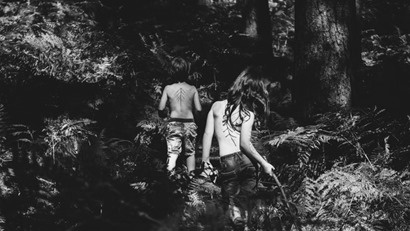
Clothes for play should always be secondhand or even handmade by the parent. If they are at home, indoors or in the yard where it is possible, and now comes a controversial bit, let them be in their one-button suit they were born with. This saves washing clothes and this saves money on water, detergent, energy and is also is better for the clothes as too much washing also wears them out. It is easier and cheaper to wash the kids than their clothes. It is also better for the children and the Planet.
If you homeschool your children – and while that is not an option in many countries but where it is I would suggest to take it if possible – then no school clothes are needed at all (another saving) and if you (and the children) so desire the natural attire of wearing nothing is also an option.
Bedclothes such as nightshirts or pajamas: Here you should ask yourself as to whether they are really necessary at all. Sleeping in the nude is better for them as far as their health is concerned, and the same goes also for you, as their parents. And if it is a little too cold, say, then an old T-shirt will do with below the waist remaining bare. Never should children (or adults) sleep in underpants.
Shoes: Children's shoes are another one of those things that they grow out of at an alarming rate. So, the ideal thing is to have just a couple of pairs of shoes and boots for them and at other times let them go barefoot whenever and wherever possible. Better for their feet anyway.
Ditch the underpants: For the male of the species this, apparently, is especially important for health, and best start with the boys as soon as they are safely out of diapers and “accident free”. Apparently the restriction in those garments causes problems later as well, but it could also be the reason that many males later in life have health problems down there in the front.
Nudity for the children – and even the entire family – at home reduces the impact in the clothing department on the Planet and the wallet. Far fewer clothes are then needed and there are none that get dirty during play, craft activities, helping in the garden, and such. Paint, glue or dirt on the skin only need a bit of soap and water and not a whole wash cycle in a washing machine. It is a lifestyle that not only benefits your children and you but greatly reduces your family's impact on the Planet.
“Holiday camp” for and with children instead of long-distance travel
You want to give your children something special when they are on holiday from school (if you don't homeschool)? Sure travels are great – but not really always for the children many who rather would stay at home – but holiday “camps” and other activities organized by the local council or other organizations which will give the little ones many great experiences. At the same time the environmental footprint is reduced as there are no long distances to travel.
If such “holiday camps” are not available locally, though in many places they are, then create your own adventure with and for the kids in the local countryside. There is much that you can do yourself for and with the kids: a night hike, a scavenger hunt or the campfire by the river or lake (make sure you can legally make a fire there) with bread on the stick or such – such highlight cost next to nothing, don't use up much energy and are much more interesting and exciting for the children and much greener than any travel to foreign destinations. Children also do not necessarily take too well to such trips.
Let children make their own ways
This is very controversial nowadays as in some places this can be constituted as child neglect by the powers-that-be but really should not be.
A quick drive to music lessons, to ballet classes into the next big town: especially when hobbies are concerned much money and gasoline can be saved because also the local municipal centers of have many possibilities and much to offer.
Many regional and local spots or music courses are offers which the child can often get to on his own steam without the need of the Mom or Dad Taxi. Walking and cycling should also be the main way to and from school.
Oh, but dare you suggest that in some countries nowadays, or even do it, that is to say to let the kids go alone to school, walking or cycling, or to the part or the woods, then you risk a visit from child protective services and a charge of child neglect, child endangerment or such. The world has gone mad, I know.
Toys
Regardless of age children really do not need many toys and definitely not expensive ones. All too often the new toy is being played with for five minutes – well, it may be a little longer but – and then put away often never to be played with again. So what's the point?
Pester power, obviously, can be very strong with all the ads on the television aimed at the kids during kids' viewing times and especially during the programs aimed directly at children. The only way to avoid this is to either limit the television viewing of your kids or, my recommendation, getting rid off the television altogether.
Many toys can also, safely, be bought secondhand, at, what we call in Britain, charity Shops, and such like, including stuffed cuddly toys. The best toys, often, however, are those that the kids learn to make for themselves, and the games.
Also and especially when we are talking here about sustainable and money-conscious living with children we want the children to learn and take up that habit of sustainable and money-conscious living themselves and how we raise them in that spirit will go a long way towards how they will become in that department.
© 2017

 Imagine living in an inner city and buying your vegetables and fruit just moments after they've been harvested. Imagine waking up to the rustic sound of a cock crowing. Imagine your household waste and sewage serving to grow even more food in a highly sustainable way. This is the promising picture painted by the EU-funded Supurbfood project.