by Michael Smith (Veshengro)
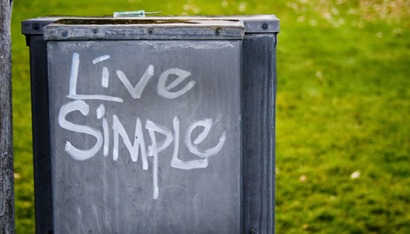
When you decide to go that route on your own accord, to live a simpler, more or less, poverty lifestyle, it is a different kettle of fish to having it forced upon you by circumstances, some beyond your control.
We have looked at Voluntary Poverty before so now let us consider the Poverty Mindset with which we have, more or less, been programmed through various societal pressures and via the power elite.
The reality of this here and now of our existence in this world is that money, in one form or another, is an inherent part of the global interactive construct.
While many of us, if not indeed most, would love to live in a different kind of economic collective where money would not, necessarily, be the means of exchange fact is that currently most of us live in one where we have to use money for most of our transactions regardless of our beliefs and ideology surrounding this “energy”.
This “Poverty Mindset” is a mind control program that has cleverly created and disseminated by the wealthy elite who want us to believe in and operate from. The poverty mindset formula is simple: if we don’t have access to financial abundance, then we don’t have access to the resources we require to become more effective in this world. It is a program of suppression and oppression. Interestingly, it is also a program that requires resentment to fuel it.
In addition to that the mind control has gone so far that we see everyone who does not have the financial abundance as a failure and someone who is alone to blame for his misfortune.
Those elites and “our” politicians keep referring to money as “resources”? But money is not a resource. It is, at the very best, a piece of printed paper (or minted metal), at worst it is a bunch of numbers on a screen. The only thing that gives it any value whatsoever is our shared belief in its value. This means that money is actually a faith-based religion and the politicians and bankers its clerics. But are you and I ready to become non-believers?
Money only has the value that we give it. After all it is only a piece of metal, or worse still a piece of paper, with a number, a “value”, printed upon it. If we would so decide we could use anything as “money”, such as the bits of paper for the Monopoly board game, shells, copper discs of different sizes (in the latter case at least the metal does have a value in that it is something that is needed for the making of things), or bits of wood or simply figures written in a book.
What is “Poverty Mindset”?
It is the mindset that we are being programmed with, through societal pressure, into believing that only if we have a certain amount of money, a fancy car, a big house, and so on, that we are valuable to and in society. That those that have a lot of money and possessions are our betters and thus we should look up to them and, maybe, even obey them.
There is nothing wrong with having a lot of money and there is also nothing wrong with having not so much. However, people should not be pushed into poverty through high prices and low incomes, despite the fact that they work all the given hours, while others who work little or not at all “make” lots of money. That we should not accept. The worker is worthy of his hire, and in all honesty the people that many look down upon because they do the so-called menial and manual jobs are probably worthy of it more than the bankers and the chief executives of industry. Without the worker all the wheels would stand still.
But we are conditioned to believe in this exploitative capitalist system that those “at the top” are worthy of greater pay and remuneration than those “at the bottom” and that those who are in more or less poverty have only themselves to blame for not doing well at school so that they too could be in those “higher” positions. But what would happen if we all would be academics? Who would then maintain the parks, the forests? Who would collect the trash, keep our streets clean, care for the elderly and the sick?
Everyone's hours of work should have the same value and be rewarded in the same way, for the hour of the academic, of the chief executive, of the prime minister, is worth no more than the hour of the road sweeper, the dustman, the gardener, the forester, the nurse or the carer. An hour is an hour is an hour.
It is the system that pushes people into poverty and it is also the system that keeps them there and the majority blames the poor for their condition and looks upon them as something of no value. Mind you, those of the middle class and the upper class also look down upon those of the working class as if they have little or no value. And in the poor the same mindset takes hold, of believing that they are not worthy, but also resentment of those that have more.
And all, including those that are poor not by their own choice, look down upon those that chose Voluntary Poverty; who chose a simple life and lifestyle, trying to do with little money only and few(er) possessions. Doing without a car, a television, foreign holidays, and so on. Few, even those that are poor, believe that people could be (so stupid, as many see it) to voluntarily life a life of poverty (aside from, maybe, some monks).
There should be no poverty, aside from the voluntary kind, in society, if our society is as it is meant to be, with equality. Everyone should be equally remunerated for the hours that they work regardless of what the work is that they do. But for that we would have to change the system, including and especially the “monetary system”.
When everyone's work is regarded the same and everyone is being remunerated in the same way for the hours worked in hours and not coin and when there is work for all then, and only then, the poverty mindset will no longer exist either.
© 2018