Showing posts with label real books. Show all posts

Rekindling our connection to print and paper

by Michael Smith (Veshengro)
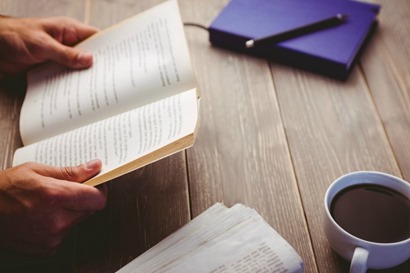
Rekindling our connection to print and paperI have always been a paper guy – preferring to sit down with a good book in hand, not a digital device. And on the writing side, at least as far as notes and drafts of articles, etc., are concerned a pen & paper guy. Digital just does not do it for me and, in fact, is not good for note taking and such at all, and that also according to scientists.

The paperless office isn't here yet and personally I doubt that it ever will be, considering how long it has already been talked about. I still prefer printed material, particularly for longer documents and books as, apparently, do many other people, and not just those of my age and I admit that I am getting a little long in the tooth.

Among some young people the typewriter – yes, the typewriter, would you believe it – even the mechanical – is making somewhat of a comeback and the Russian security services have, because of cyber hacks and other such issues, gone back to typewriters for sensitive material, though in their case to the electric ones.

Did you know that we comprehend and recall more effectively when we read or write with paper vs digital communications? Students surveyed have said they perform better when reading on paper rather than a screen. We also have more emotional connection with hardcopy print because of the physical material, even if you are a “tablet reader”, which I am not. Although, due to the fact that I am amassing some old books in PDF form I am considering getting one solely to be able to more conveniently read such rather than trying a 200 or 300 page book on the PC screen. I find that far too tiring.

When it comes to reading – and I tend to do a fair number of book reviews – I prefer paper copy over electronic and, in fact, refuse to review digital copy, especially if this is of a printed book. In the latter case mostly for the reason that you cannot judge the quality of the book from a pre-print PDF, in my opinion. The feel of the book, in my view, is as important, at least when it comes to physical hardcopies, as the text.

When it comes to writing, especially notes and article drafts there, to me, is no alternative to pen and paper. At times this may be just literally on the back of an envelope, other times in my own little note-taking system while at other times it is in proper notebooks. Also, when we use pen and paper, whether notebooks or other forms, such as I do with a stack of specially folded sheets in a wallet, for our thoughts, articles drafts, or whatever, the data is secure in that no power failure or other technical glitch can destroy it. It is safe from anything but fire and the shredder. A main battle tank could run over my notebook and I will still be able to retrieve the “data” from it. There are also no batteries to fail or any such kind of problems. One of the many reasons that I stick to pen and paper for many things.

While being no Luddite, as you can see, with this article being on the Web and typewritten on a PC I have never lost my connection with pen and paper though, thus I hardly, myself, have to rekindle it. Alas, my handwriting is not the beautiful cursive kind but capital letters. I have tried cursive but it is too slow for me and I can print write much faster, thus following my train of thought.

And, as far as reading is concerned, I have, so far, never, owned an e-book reader though am currently considering investing in one to read larger PDF files. In general, however, it is only the printed book that will ever do it for me. There is something about the printed book, handling it and turning the pages and all that. There is something special about it in the same way as there is something special about writing by hand, even if it is just in capitals, as in my case.

© 2018

Who’s Really Reading Books These Days? Surprise—It’s Not Who You Think

A new Pew Research Center survey found that when it comes to cracking open books, young adults under age 30 are totally crushing it.

Get ready to say good-bye to the stereotype of the texting and selfie-posting millennial holed up in Mom and Dad’s basement binge-watching The Vampire Diaries. According to a new report from the Pew Research Center, Americans younger than 30 are more likely than any other age group to have read a book in the last year.

For its Younger Americans and Public Libraries report, Pew conducted cell phone and landline surveys of more than 6,200 people over the age of 16. They found that 43 percent of millennials under 30 read on a daily basis, slightly more than the 40 percent of folks age 30 and over who read every day. What’s more impressive is that 88 percent of the under-30 crowd had read a book in the past year, compared with 79 percent of those 30 and older.

Indeed, the report’s authors found that young adults read a median of 10 books every year. Although the demise of the printed book is often predicted, it turns out that only 37 percent of young adults report that they read an e-book in the past year—they’re still down with old-school paperback and hardback texts.

It might be tempting to chalk up the high reading rates of young adults to their status as students. However, Pew broke out the data and found that 25- to 29-year-olds read on a daily basis at the same rate as college-age 18- to 24-year-olds. Interestingly enough, the 25- to 29-year-olds were more likely to read on a weekly basis (27 percent) than the 18- to 24-year-olds (22 percent).

Read more: http://www.takepart.com/article/2014/09/16/unexpected-truth-about-who-really-reading-books-america

Reading from books is better for you than reading online

Just half an hour of reading, either with a book or a tablet, can have a multitude of positive effects on your mental health, and 'slow reading clubs' are popping up around the world to do just that. Just don't check Twitter halfway through...

book-clubThe Slow Reading Club of Wellington in New Zealand is a small group of people who all go to a cafe at the same time, shut their phones off, and read for an hour. It doesn’t sound that revolutionary, but the ‘slow reading’ movement has been gaining momentum around the world, and research has suggested that it could be having many significant effects on the participants’ brains.

Members of the group would happily tell you that the benefits they’re getting from their commitment to 'slow reading' include improvements in concentration and the ability to think through difficult concepts and emphasise with other people's feelings and beliefs, and a slew of recent studies seem to back these claims up.

According to Jeanne Whalen at the Wall Street Journal, a study published last year in the journal Neurology and conducted by researchers from the Rush Alzheimer's Disease Center and Departments of Neurological Sciences at the Rush University Medical Center in the US, showed that in 300 elderly people, those that engaged regularly in activities that challenged them mentally, such as reading, had slower rates of memory loss as they aged. And last year, a separate study published in Science revealed that reading literary fiction could actively improve your ability to understand and empathise with other people’s mental states and beliefs.

"Yet reading habits have declined in recent years,” says Whalen. "In a survey this year, about 76 percent  of Americans 18 and older said they read at least one book in the past year, down from 79 percent in 2011, according to the Pew Research Center."

Because many of us now read more on our phones than we are from books and even tablets, we’ve unwittingly changed the way we take in words. In 2006, an eye-tracking report by scientists at the US-based research group, Nielsen Norman, showed that people read web pages in an “F” pattern, scanning the top line all the way, then halfway across the next few lines, and then only down the left side of the page, all the way down to the bottom of the article. This kind of reading helps us scan quickly for important words to spark our interest, but does nothing for our ability to actually gain a deeper understanding of what we’re reading.

Read more: http://sciencealert.com.au/news/20141809-26196.html

E-Books vs. Real Books

By Michael Smith (Veshengro)

E-books vs. real books: on the sustainability scale which wins? E-book readers are, in my opinion, not sustainable.

E-book readers, whether the Amazon Kindle, or whichever else, are NOT sustainable and that regardless of what industry and most green media even would want us to believe. The e-book, as a PDF document, downloaded to your computer is a different story and we will get to those at a later stage.

E-book readers are, predominately, made of non-renewable and thus non-sustainable resources and in addition to that they need a power source in the form of a rechargeable lithium-ion battery. This battery too is made from rare and non-renewable materials. As already said, the e-book in the “portable document format” (PDF) downloaded and read on a computer or printed out, and bound maybe even, the latter the option that I often chose, is a different story altogether.

While it is true that a e-book reader can hold hundreds and even thousands of books I have to as at what cost, and especially cost to the environment, to the Planet.

The lifespan or life expectancy of such a device is how long? Not very and its obsolescence is pre-programmed. At best an e-book user in constant use will last maximum three to, if lucky, five years, and no more.

At that high cost to the environment and the purchaser I see the Kindle and its rivals as but a passing fad. Printable e-books in PDF may be the future of publishing and book buying. The e-book reader, on the other hand, is not the future of the book. It will past just some other fads of time gone by.

The environmental credentials of the e-book readers are definitely not what they are being made out to be by industry and much if not indeed most of the green media.

An e-book reader is made from often toxic materials that are not kind to the environment most of the time and that just for starters.

I really hate to have to put the damper on the e-book reader hype but I don't think it is going to cut it. The claims are mostly nothing but greenwash and it is such as shame that so many green media outlets also have fallen for it.

The e-book, in a generally readable format, whether “Word”, or “PDF”, ot “RTF”, that can be opened and read on any computer, whether Windows, Mac or Linux, and printed from it, is a good alternative to the printed book; the e-book reader, of whatever make, is not. It just does not cut it as regards to “green credentials” and is but a gadget; a gadget that most of us can well do without.

The e-book, in general, in the normal ordinary computer-readable formats mentioned above, is to publishing, to some degree, much like what MP3 downloads are for music, from flyers, pamphlets, papers, and magazines to small and large volume books. However, not necessarily so much for their green credentials as reading matter but for their green credentials as fas as publishing and “shipping” goes.

A great many people will still, in order to be able to conveniently read the document or book print out a copy and, maybe, even bind it in some way rather than read it on the computer or such.

On the other hand, the printed book will not disappear because once the fad of the e-book reader is history people will want the printed book again more than ever.

We have discussed in a previous article also the fact that, as far as Amazon is concerned and some other suppliers, you never own the book that you have downloaded, despite the fact that you have payed for it. They just regards you as having bought a license, limited even, to store and read the book on your e-book reader.

This was shown by Amazon's action a year or so ago when they wiped the content of most Kindle readers remotely because the considered that the people no longer were requiring the books.

Sorry, but if I buy something and pay for it it is mine to do with as I please, within the copyright restrictions, as far as books and music are concerned. Not for the seller to decide that I no longer need it and thus clear it from my virtual library.

The printed book is not dead though publishing and distribution may, to some degree, change.

© 2011